Alleluia, alleluia. Teach me your paths, my God, guide me in your truth.
Today, in God’s Lavish Mercy, we pray with our Alleluia Verse and Psalm 107, grateful chants to God’s Mercy from the lost who have been found.
There are all kinds of “lost”.
There are small “losts” like when I misinterpret my GPS and keep hearing “Recalculating route…”.
Then there are huge “losts” like when a beloved dies and our life’s anchor breaks.
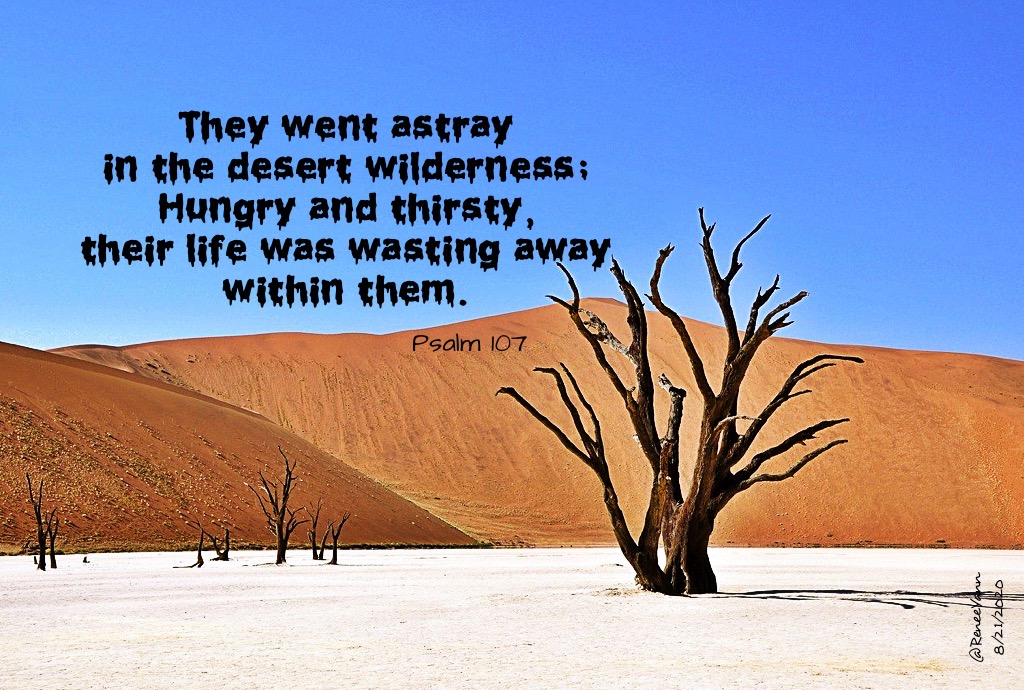
This morning’s psalm and reading are speaking of a particular kind of “lost”, one that comes from wandering away from Love, for whatever reason that happens to us.
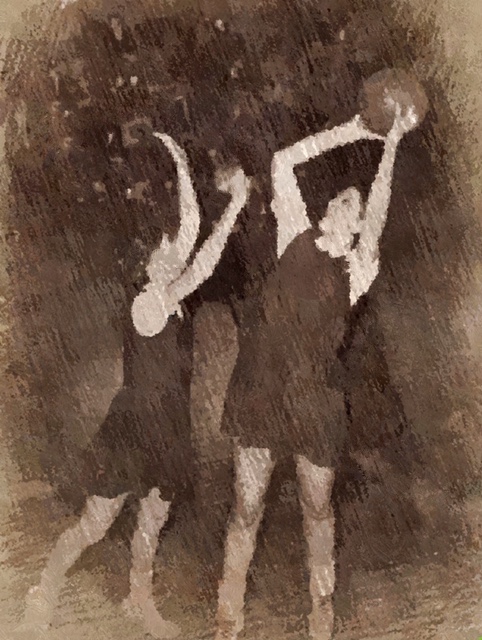
As I pray these readings, the face of a good high school friend comes to mind. Judy was a super basketball player. Everything about her was vigor, coordination, and that all-American beauty that needed no makeup to impress anybody.
After graduation, I went into the silence of the pre-Vatican II convent and Judy disappeared into her future. When our five-year class reunion rolled around, I looked forward to reconnecting with her.
When I saw her, my heart broke. She was a shadow of herself, emaciated, listless, and lightless. She silently shouted a refrain like today’s verse from Ezekiel:
Our bones are dried up, our hope is lost, and we are cut off.
We were both twenty-three years old. I was just beginning to grow into my hopes. Judy was already divorced, alone, and the mother of a father-starved child.
That kind of “lost” feels almost irredeemable.
But Psalm 107 assures us that, in faith, no loss, no alienation is irredeemable.
They cried to the LORD in their distress; from their straits God rescued them. And led them by a direct way to the healing of community.
Judy and I stayed in touch for a few years. Despite her troubles, she kept faith. That was the key.
Alleluia, alleluia. Teach me your paths, my God, guide me in your truth.
She did the hard work to find herself again with the help of family, friends, counselors, and a supportive faith community. Eventually, she remarried and was happy the last time I saw her before she moved to the west coast.
This morning, I see such apparent parallels between Israel’s and Judy’s story. That helps me look back over my own life for the same, perhaps not so dramatic, parallels and to be grateful for the many times God found me.
Let them give thanks for God’s Mercy and wondrous deeds to us, Because God has satisfied the longing soul and filled the hungry heart with good things.
Desolate and lone All night long on the lake Where fog trails and mist creeps, The whistle of a boat Calls and cries unendingly, Like some lost child In tears and trouble Hunting the harbor’s breast And the harbor’s eyes.
Alleluia, alleluia. If today you hear his voice, harden not your hearts.
Today, in God’s Lavish Mercy, we see how the soul becomes “dressed” or prepared for the kingdom.
In our passage from Ezekiel, God does a major makeover for Israel, as a matter of fact, God actually recreates Israel:
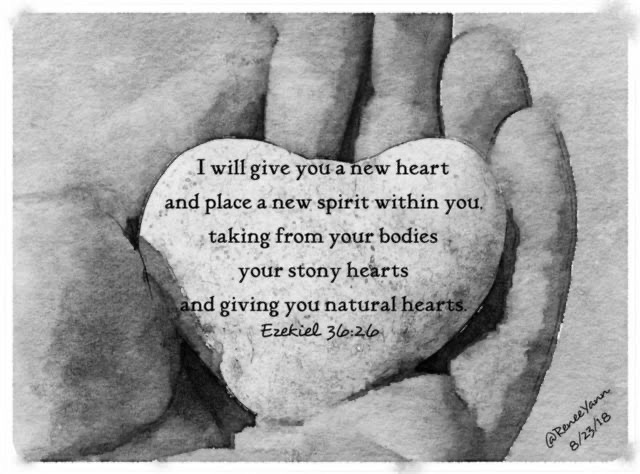
I will sprinkle clean water upon you to cleanse you from all your impurities, and from all your idols I will cleanse you. I will give you a new heart and place a new spirit within you, taking from your bodies your stony hearts and giving you natural hearts. I will put my spirit within you and make you live by my statutes, careful to observe my decrees.
Ezekiel’s God is fed up with Israel’s sinfulness and decides to “make them live by my statutes”. According to Ezekiel, this rejuvenation is done for God’s sake, not Israel’s.
Thus says the LORD: I will prove the holiness of my great name, profaned among the nations, in whose midst you have profaned it. Thus the nations shall know that I am the LORD, says the Lord GOD, when in their sight I prove my holiness through you.
The king in our Gospel gets pretty fed up too with people rejecting his invitation to the wedding. When his recalcitrant invitees killed his servants, the king blew a gasket. He even took a snap on the poor schlep who showed up in business-casual attire!
No Wedding Garment
How are we to interpret these dramatic (and kinda mean) images of God and of God’s invitation to the Kingdom?
As when praying with all scripture passages, we must receive them in light of the circumstances and culture in which they were written. Our prayer, rooted in our own relationship with God, will allow us to peel away the cultural layers to discover the unchanging message which pertains to us.
What I found in today’s passages are these thoughts:
God loves us so much and would do anything to hold us in faithful relationship
If our spiritual life had died, or is on life support, God will do a heart transplant if we repent and open ourselves to grace.
We are all invited to eternal life with God, but we can get so distracted by our entanglements that we miss or ignore the invitation.
Turn down the noise in your life so that you can hear God’s ringtone on your heart.
It matters how we respond to this amazing invitation. We need to put on our best “clothes” – our best selves – so that we can fully welcome God’s life.
Poetry and Music: Here’s a simple but delightful representation of today’s Gospel. Enjoy it, friends.
Alleluia, alleluia. Jesus Christ became poor although he was rich So that by his poverty you might become rich.
Today, in God’s Lavish Mercy, our readings confront us with a few spiritual cautions.
In our first reading, Ezekiel lets the Prince of Tyre know that he has really messed up his spiritual life:
Thus says the Lord GOD:
Because you are haughty of heart, you say, “A god am I! I occupy a godly throne in the heart of the sea!”— And yet you are a man, and not a god, however you may think yourself like a god.
This Tyrian prince Ithobalus reigned over a wealthy and politically powerful nation – a nation which had become arrogant and domineering in its relationship to other peoples. The word Ezekiel uses describes the condition perfectly: haughty. The prince was so haughty that he considered himself equal to — and in no need of — God.
We, of course, can learn a lesson from vainglorious Ithobalus. No material possession or personal strength makes us equal to God or renders us independent of God’s governance and care. According to Ezekiel, old Itho was about to find that out the hard way!
In our Gospel, Jesus talks about how we can get caught up in ourselves similarly to Ithobaal.
Jesus said to his disciples: “Amen, I say to you, it will be hard for one who is rich to enter the Kingdom of heaven. Again I say to you, it is easier for a camel to pass through the eye of a needle than for one who is rich to enter the Kingdom of God.”
When we read this passage, I think most of us picture material riches. And certainly the saying holds true in that case. But it also holds true for other types of “riches” – strengths or possessions that we use in arrogance and indifference toward others’ needs.
Prose: Pope Francis preached about such things in a homily on this passage from the prophet Amos:
Woe to the complacent in Zion, to those who feel secure … lying upon beds of ivory! . They eat, they drink, they sing, they play and they care nothing about other people’s troubles. (Am 6:1,4)
How does something like this happen? How do some people, perhaps ourselves included, end up becoming self-absorbed and finding security in material things which ultimately rob us of our face, our human face? This is what happens when we become complacent, when we no longer remember God. “Woe to the complacent in Zion”, says the prophet. If we don’t think about God, everything ends up flat, everything ends up being about “me” and my own comfort. Life, the world, other people, all of these become unreal, they no longer matter, everything boils down to one thing: having. When we no longer remember God, we too become unreal, we too become empty; like the rich man in the Gospel, we no longer have a face! Those who run after nothing become nothing – as another great prophet Jeremiah, observed (cf. Jer 2:5). We are made in God’s image and likeness, not the image and likeness of material objects, of idols!
Pope Francis – September 29, 2013
Music: Jesu, Joy of Our Desiring – J.S. Bach, interpreted by Daniel Kobialka
Alleluia, alleluia. Mary is taken up to heaven; a chorus of angels exults.
Today, in God’s Lavish Mercy, we honor Mary on the Feast which celebrates her assumption, “that the Immaculate Mother of God, the ever Virgin Mary, having completed the course of her earthly life, was assumed body and soul into heavenly glory.”
The Catholic Church’s teaching on the Assumption of Mary was promulgated in 1950 by Pope Pius XII in an Apostolic Constitution entitled “MUNIFICENTISSIMUS DEUS (the Most Bountiful God). Having experienced the horrors of a world war, and aware of the ensuing evils of the Cold War, Pope Pius XII looked to Mary for healing for himself and the whole world:
We, who have placed our pontificate under the special patronage of the most holy Virgin, to whom we have had recourse so often in times of grave trouble, we who have consecrated the entire human race to her Immaculate Heart in public ceremonies, and who have time and time again experienced her powerful protection, are confident that this solemn proclamation and definition of the Assumption will contribute in no small way to the advantage of human society, since it redounds to the glory of the Most Blessed Trinity, to which the Blessed Mother of God is bound by such singular bonds. It is to be hoped that all the faithful will be stirred up to a stronger piety toward their heavenly Mother, and that the souls of all those who glory in the Christian name may be moved by the desire of sharing in the unity of Jesus Christ’s Mystical Body and of increasing their love for her who shows her motherly heart to all the members of this august body. And so we may hope that those who meditate upon the glorious example Mary offers us may be more and more convinced of the value of a human life entirely devoted to carrying out the heavenly Father’s will and to bringing good to others. Thus, while the illusory teachings of materialism and the corruption of morals that follows from these teachings threaten to extinguish the light of virtue and to ruin the lives of men by exciting discord among them, in this magnificent way all may see clearly to what a lofty goal our bodies and souls are destined. Finally it is our hope that belief in Mary’s bodily Assumption into heaven will make our belief in our own resurrection stronger and render it more effective.
MUNIFICENTISSIMUS DEUS (42)
Maybe, like me, the fact of the Assumption doesn’t matter a whole lot to you. I love Mary whether she was “assumed” or not. But in its time, the declaration of this dogma was important in order to turn the world’s focus toward Mary, a figure of goodness, courage, love, mercy and justice – virtues desperately necessary for healing in the aftermath of war.
Our own world could surely benefit from a prayerful, loving contemplation of Mary.
Mary was a woman so open to God that she enfleshed God’s Spirit in the person of Jesus. She was a vessel of love – for God and for all Creation. By living her ordinary life with extraordinary love and holy courage, she became blessed.
Mary, the Blessed Mother of all of us, can teach us to love, reverence, strengthen and support one another when we pray with her as we meet her in the Gospel.
Elizabeth said:
“Blessed are you who believed that what was spoken to you by the Lord would be fulfilled.”
And Mary said: “My soul proclaims the greatness of the Lord; my spirit rejoices in God my Savior for God has looked on my simplicity with favor . From this day all generations will call me blessed: the Almighty has done great things for me and holy is God’s Name. In every generation, God has mercy on those with holy reverence and awe.
Poetry: The Blessed Virgin compared to the air we breathe… by Gerard Manley Hopkins, SJ
( I know this is a really long poem, and Hopkins can seem a little convoluted. But the images in this poem are spectacular … even if you just read a bit at a time. It’s so worth it.)
Wild air, world-mothering air, Nestling me everywhere, That each eyelash or hair Girdles; goes home betwixt The fleeciest, frailest-flixed Snowflake; that’s fairly mixed With, riddles, and is rife In every least thing’s life; This needful, never spent, And nursing element; My more than meat and drink, My meal at every wink; This air, which, by life’s law, My lung must draw and draw Now but to breathe its praise, Minds me in many ways Of her who not only Gave God’s infinity Dwindled to infancy Welcome in womb and breast, Birth, milk, and all the rest But mothers each new grace That does now reach our race— Mary Immaculate, Merely a woman, yet Whose presence, power is Great as no goddess’s Was deemèd, dreamèd; who This one work has to do— Let all God’s glory through, God’s glory which would go Through her and from her flow Off, and no way but so.
I say that we are wound With mercy round and round As if with air: the same Is Mary, more by name. She, wild web, wondrous robe, Mantles the guilty globe, Since God has let dispense Her prayers his providence: Nay, more than almoner, The sweet alms’ self is her And men are meant to share Her life as life does air. If I have understood, She holds high motherhood Towards all our ghostly good And plays in grace her part About man’s beating heart, Laying, like air’s fine flood, The deathdance in his blood; Yet no part but what will Be Christ our Saviour still. Of her flesh he took flesh: He does take fresh and fresh, Though much the mystery how, Not flesh but spirit now And makes, O marvellous! New Nazareths in us, Where she shall yet conceive Him, morning, noon, and eve; New Bethlems, and he born There, evening, noon, and morn Bethlem or Nazareth, Men here may draw like breath More Christ and baffle death; Who, born so, comes to be New self and nobler me In each one and each one More makes, when all is done, Both God’s and Mary’s Son. Again, look overhead How air is azurèd; O how! nay do but stand Where you can lift your hand Skywards: rich, rich it laps Round the four fingergaps. Yet such a sapphire-shot, Charged, steepèd sky will not Stain light. Yea, mark you this: It does no prejudice. The glass-blue days are those When every colour glows, Each shape and shadow shows. Blue be it: this blue heaven The seven or seven times seven Hued sunbeam will transmit Perfect, not alter it. Or if there does some soft, On things aloof, aloft, Bloom breathe, that one breath more Earth is the fairer for. Whereas did air not make This bath of blue and slake His fire, the sun would shake, A blear and blinding ball With blackness bound, and all The thick stars round him roll Flashing like flecks of coal, Quartz-fret, or sparks of salt, In grimy vasty vault. So God was god of old: A mother came to mould Those limbs like ours which are What must make our daystar Much dearer to mankind; Whose glory bare would blind Or less would win man’s mind. Through her we may see him Made sweeter, not made dim, And her hand leaves his light Sifted to suit our sight. Be thou then, thou dear Mother, my atmosphere; To wend and meet no sin; Above me, round me lie Fronting my froward eye With sweet and scarless sky; Stir in my ears, speak there Of God’s love, O live air, Of patience, penance, prayer: World-mothering air, air wild, Wound with thee, in thee isled, Fold home, fast fold thy child.
Music: Magnificat – Mina
Magnificat anima mea Magnificat Dominum et exsultavit spiritus meus In Deo salutari meo Magnificat, Magnificat Quia respexit humilitatem ancillae suae Ecce enim ex hoc beatam me dicent omnes generationes Magnificat anima mea Magnificat Dominum et exsultavit spiritus meus In Deo salutari meo Magnificat, Magnificat Quia fecit mihi magna qui potens est Et sanctum nomen ejus Magnificat, Magnificat Dominum et exsultavit spiritus meus In Deo Magnificat, Magnificat
Lyrics translation
My soul magnifies the The lord and my spirit rejoices In God my saviour Magnificat, Magnificat For he has looked on his servant in her lowliness Behold this blessed shall call me blessed all generations The Magnificat my soul Magnifies the The lord and my spirit rejoices In God my saviour Magnificat, Magnificat Because I made a big who is able And holy is his name Magnificat, Magnificat The lord and my spirit rejoices In God Magnificat, Magnificat
Today, in God’s Lavish Mercy, the core of our readings is about innocence and authenticity. But you have to dig a little to get to that. Maybe, like me, you finished our first reading asking, “So what’s with the green grapes!?”
A common expression in ancient Israel suggested that people’s bad luck was a punishment for their parent’s sins. It was a handy way of avoiding responsibility for one’s own foolish actions, often the actual source of one’s misfortune.
Ezekiel uses the expression to teach a lesson about the nature of God’s love and forgiveness. God loves us completely – without prejudice, without vengeance. There is no record of faults to “set our teeth on edge”. There are no “green grapes” on God’s table. God only wants our wholeness.
Therefore I will judge you, house of Israel, each one according to their own ways, says the Lord GOD. Turn and be converted from all your crimes, that they may be no cause of guilt for you. Cast away from you all the crimes you have committed, and make for yourselves a new heart and a new spirit.
God will not let us hide behind excuses like a bogus “Green Grapes Theory”. As in any loving relationship, we must be honest with God, own our faults, seek forgiveness, and love ardently.
Jesus uses the example of a little child to show us how to do this. Each one of us is born with a core of innocence and authenticity. These are the attributes of God’s life in us. Throughout our lives there are times when we hide these blessings under our sinfulness. Some people bury them so deep that they lose touch with their own sacred integrity.
Jesus calls us back out of our excuses and our excesses, just as the Lord called Ezekiel’s community. We are invited to an eternal covenant rooted in the gift of divine innocence and authenticity given to us at our creation.
Jesus said: Let the children come to me, and do not prevent them; for the Kingdom of heaven belongs to such as these.
Poetry: The Pursuit – Henry Vaughn
LORD ! what a busy, restless thing
Hast Thou made man !
Each day and hour he is on wing,
Rests not a span ;
Then having lost the sun and light,
By clouds surpris’d,
He keeps a commerce in the night
With air disguis’d.
Hadst Thou given to this active dust
A state untir’d,
The lost son had not left the husk,
Nor home desir’d.
That was Thy secret, and it is
Thy mercy too ;
For when all fails to bring to bliss,
Then this must do.
Ah, Lord ! and what a purchase will that be,
To take us sick, that sound would not take Thee !
Alleluia, alleluia. Blessed are the poor in spirit; the Kingdom of heaven is theirs!
Today, in God’s Lavish Mercy, we’ll pray with the readings for St. Clare of Assisi. Clare, like Francis, was a luminous prophet of the Christian era.
Clare of Assisi (born Chiara Offreduccio, 16 July 1194 – 11 August 1253) was an Italian saint and one of the first followers of Francis of Assisi. She founded the Order of Poor Ladies, a monastic religious order for women in the Franciscan tradition, and wrote their Rule of Life, the first set of monastic guidelines known to have been written by a woman.
Wikipedia
By the life Clare lived, she gave testimony to a sacred reality which continues to enrich the life of the Church.
As I learned about Clare, I discovered a woman who was original and innovative in her own right. She was profoundly mystical and charismatic, unyielding and radical in her commitment to poverty; a model of servant leadership; determined despite years of ailing health; courageous in the face of danger. In short, she was a saint…with or without Francis.
Bret Thoman, O.F.S., – an American Catholic lay writer, secular third order Franciscan. His latest book is St. Clare of Assisi: Light from the Cloister.
Today before I wrote this reflection, our own Mercy Sister Clare was buried. As our sisters are carried to the cemetery, the death knell slowly tolls out over the whole surrounding neighborhood. Some may hear it as a solemn reminder as did the poet John Donne:
No man is an island,
Entire of itself.
Each is a piece of the continent,
A part of the main.
If a clod be washed away by the sea,
Europe is the less.
As well as if a promontory were.
As well as if a manor of thine own
Or of thine friend's were.
Each man's death diminishes me,
For I am involved in mankind.
Therefore, send not to know
For whom the bell tolls,
It tolls for thee.
Instead, I choose to hear the hallowed sound as a salute to one who understood and chose what is most important in life:
Happy the soul to whom it is given to attain this life with Christ,
to cleave with all one’s heart to him
whose beauty all the heavenly hosts behold forever,
whose love inflames our love,
the contemplation of whom is our refreshment,
whose graciousness is our delight,
whose gentleness fills us to overflowing,
whose remembrance makes us glow with happiness,
whose fragrance revives the dead,
the glorious vision of whom will be the happiness
of all the citizens of the heavenly Jerusalem.
For he is the brightness of eternal glory,
the splendor of eternal light,
the mirror without spot.
Clare of Assisi
Our Gospel today reinforces the lesson that a life given fully to Christ and the Gospel, as was both these precious Clare’s, is returned to the giver a hundredfold:
Peter said to Jesus, “We have given up everything and followed you. What will there be for us?” Jesus said to them, “Amen, I say to you that you who have followed me, in the new age, when the Son of Man is seated on his throne of glory, will yourselves sit on twelve thrones, judging the twelve tribes of Israel. And everyone who has given up houses or brothers or sisters or father or mother or children or lands for the sake of my name will receive a hundred times more, and will inherit eternal life.”
Music: Let the Love That Dwells in Your Hearts
Let the love that dwells in your hearts shine forth in your deeds. (St. Clare)
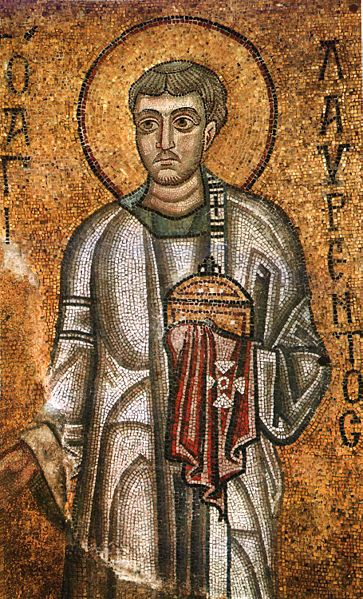
Saint Lawrence. Mosaic from the Saint Sophia Cathedral in Kiev.
Today, in God’s Lavish Mercy, we celebrate the feast of St. Lawrence who is noted for his love for those who were poor. Legend has it that Lawrence was demanded, before his martyrdom, to turn over the Church’s riches to the emperor Valerian. Instead, he distributed all the resources among the poor. Lawrence then gathered all these people, presenting them before Valerian with these words:
Behold in these poor persons the treasures which I promised to show you – these are the true treasures of the Church.
Lawrence was likely inspired by readings like today’s. In Corinthians, Paul encourages us to be cheerful givers. He says this delights God, the Giver of Divine Abundance, whom we are imitating.
In our reading from John, Jesus says that only in dying to ourselves do we live – the ultimate generosity. He says that only by doing this can we truly follow him.
While these readings are clear and simple, they are so profound that we can hardly take in their message. What they ask of us is daunting! The encouragement Jesus gives us to respond to his challenge is this:
The Father will honor whoever serves me.
St. Lawrence believed and lived this promise. What about us?
Poetry: St. Laurence – Joyce Kilmer
Within the broken Vatican
The murdered Pope is lying dead.
The soldiers of Valerian
Their evil hands are wet and red.
Unarmed, unmoved, St. Laurence waits,
His cassock is his only mail.
The troops of Hell have burst the gates,
But Christ is Lord, He shall prevail.
They have encompassed him with steel,
They spit upon his gentle face,
He smiles and bleeds, nor will reveal
The Church's hidden treasure-place.
Ah, faithful steward, worthy knight,
Well hast thou done. Behold thy fee!
Since thou hast fought the goodly fight
A martyr's death is fixed for thee.
St. Laurence, pray for us to bear
The faith which glorifies thy name.
St. Laurence, pray for us to share
The wounds of Love's consuming flame.
Music: Before the Bread – Elizabeth Alexander
We all want our lives to be full and complete – to be “bread”. But there are many steps before the grain of wheat becomes bread, as captured in this elegant acapella canon.
Alleluia, alleluia. God has called you through the Gospel to possess the glory of our Lord Jesus Christ.
by Michelangelo on the ceiling of the Sistine Chapel in the Vatican between 1508 to 1512
Today, in God’s Lavish Mercy, we begin nearly two weeks of first readings from the prophet Ezekiel, and this first one is a real WOW!
As I looked, a stormwind came from the North, a huge cloud with flashing fire enveloped in brightness, from the midst of which (the midst of the fire) something gleamed like electrum. Within it were figures resembling four living creatures that looked like this: their form was human.
Ezekiel 1:4-6
Walter Brueggemann calls Ezekiel “the prophet who had fantasies and hallucinations”. Nevertheless, Ezekiel is considered a prophet because like all prophets, Ezekiel “noticed what no one else noticed” — Ezekiel “saw death coming” to Israel.
Ezekiel did not blame the king, the government, the military or the war planners for this terrible death to come. He blamed the religious community, the clergy, the prophets: “My hands will be against the prophets who see delusive visions and give lying messages” (13:9). Ezekiel blamed the religious community because that community is responsible for truth-telling.
Truth-Telling and Peacemaking: A Reflection on Ezekiel by Walter Brueggemann
I think it might be safe to say that most religious communities – and the people who comprise them – do not want to hear such things about themselves. Abraham Heschel, one of the greatest theologians and philosophers of the 20th century said this:
The prophets had disdain for those to whom God was comfort and security; to them God was a challenge, an incessant demand. He is compassion, but not a compromise; justice, but not inclemency. Tranquility is unknown to the soul of a prophet. The miseries of the world give him no rest. While others are callous, and even callous to their callousness and unaware of their insensitivity, the prophets remain examples of supreme impatience with evil, distracted by neither might nor applause, by neither success nor beauty. Their intense sensitivity to right and wrong is due to their intense sensitivity to God’s concern for right and wrong. They feel fiercely because they hear deeply.
In today’s Gospel, Jesus informs his disciples that he too will endure a prophet’s suffering:
As Jesus and his disciples were gathering in Galilee, Jesus said to them, “The Son of Man is to be handed over to men, and they will kill him, and he will be raised on the third day.” And they were overwhelmed with grief.
Matthew 17:22-23
As we reflect on what these readings mean for us in our lives, our Alleluia Verse offers a key phrase:
Alleluia, alleluia. God has called you through the Gospel To possess the glory of our Lord Jesus Christ.
…through the Gospel
Unless we know and cherish the Gospel, we Christians cannot hear our call.
Poetry: The Call of a Christian – John Greenleaf Whittier
Not always as the whirlwind's rush
On Horeb's mount of fear,
Not always as the burning bush
To Midian's shepherd seer,
Nor as the awful voice which came
To Israel's prophet bards,
Nor as the tongues of cloven flame,
Nor gift of fearful words,--
Not always thus, with outward sign
Of fire or voice from Heaven,
The message of a truth divine,
The call of Godis given!
Awaking in the human heart
Love for the true and right,--
Zeal for the Christian's better part,
Strength for the Christian's fight.
Nor unto manhood's heart alone
The holy influence steals
Warm with a rapture not its own,
The heart of woman feels!
As she who by Samaria's wall
The Saviour's errand sought,--
As those who with the fervent Paul
And meek Aquila wrought:
Or those meek ones whose martyrdom
Rome's gathered grandeur saw
Or those who in their Alpine home
Braved the Crusader's war,
When the green Vaudois, trembling, heard,
Through all its vales of death,
The martyr's song of triumph poured
From woman's failing breath.
And gently, by a thousand things
Which o'er our spirits pass,
Like breezes o'er the harp's fine strings,
Or vapors o'er a glass,
Leaving their token strange and new
Of music or of shade,
The summons to the right and true
And merciful is made.
Oh, then, if gleams of truth and light
Flash o'er thy waiting mind,
Unfolding to thy mental sight
The wants of human-kind;
If, brooding over human grief,
The earnest wish is known
To soothe and gladden with relief
An anguish not thine own;
Though heralded with naught of fear,
Or outward sign or show;
Though only to the inward ear
It whispers soft and low;
Though dropping, as the manna fell,
Unseen, yet from above,
Noiseless as dew-fall, heed it well,---
Thy Father's call of love!
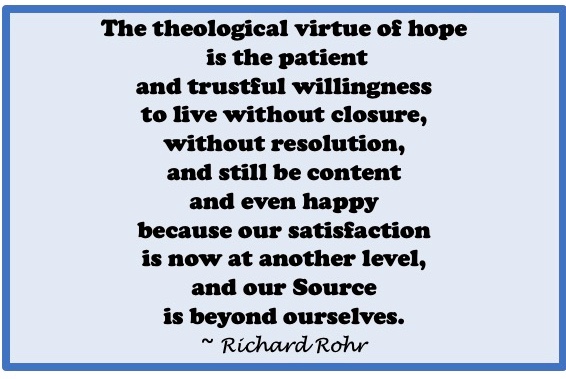
Today, in God’s Lavish Mercy, we are taught about the nature of faith and hope.
Alleluia, alleluia. Stay awake and be ready! For you do not know on what day your Lord will come.
Our readings today are long, complex, and rich. Trying to pray with them this morning brought an image to mind.
Like many Dads, mine both loved and hated putting the lights on the Christmas tree. No matter how carefully he had stored them the previous year, those endless wires and tiny bulbs managed to morph into a ball of frustration when he opened the box.
But Dad persevered because he knew what the end result would be. After a few hours, when he finally leaned over to plug in his work, the whole family all held our breath both in anticipation and trepidation. That was because, most of time, nothing happened… no lights. Zilch.
Dad would then exclaim a litany over the fragile mess – one that I was prohibited from repeating. This chant signaled that we all immediately join in testing every single bulb to find the culprit which had caused the blackout. Ah! Family Christmas rituals!
Well, I think today’s readings are like those labyrinthine lights. Each passage contains a string of bulbs that must be twisted and turned over in our prayer to help us discover their illumination.
The central current for me is this: faith is a relationship, long and unbreakable. Even if a bulb goes out every now and again, keep searching for the energy and light, just as our foremothers and fathers did.
Our faith and hope are rooted in that sacred heritage:
In the ancient faith of Moses:
The night of the passover was known beforehand to our ancestors, that, with sure knowledge of the oaths in which they put their faith, they might have courage.
In the trusting songs of David
Our soul waits for the LORD, who is our help and our shield. May your kindness, O LORD, be upon us who have put our hope in you.
In the grounding insights of Paul
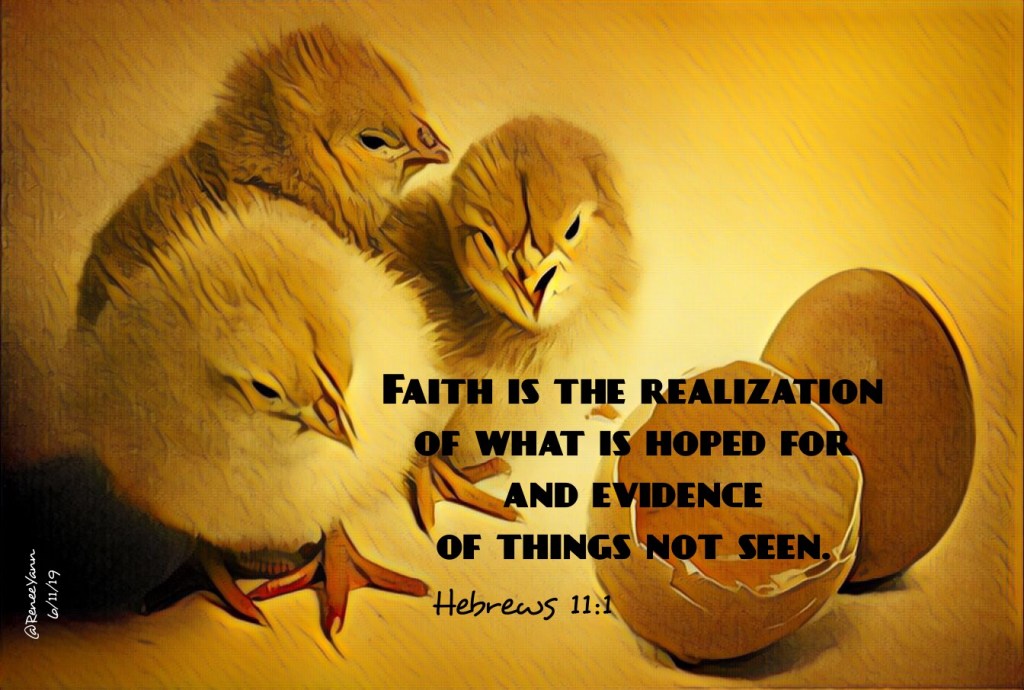
Faith is the realization of what is hoped for and evidence of things not seen.
And in the promise of Jesus to those who remain faithful
Jesus said to his disciples: “Do not be afraid any longer, little flock, for your Father is pleased to give you the kingdom.”
Our readings assure us that, for those who hope and believe, there is no doubt what the end result will be. Our faith will be blessed by the glorious light of God.
Today, in God’ Lavish Mercy, we celebrate the Feast of the Transfiguration of the Lord.
Alleluia, alleluia. This is my beloved Son, with whom I am well pleased; listen to him.
Peter, James, and John – those whom the Lord would most heavily depend on at the time of the Crucifixion – these three were given a sacred privilege. They witnessed Christ transformed by his Divinity, shining before the Creator whose voice came down from heaven.
Icon of Transfiguration by Alexander Ainetdinov
Peter’s account in today’s second reading might seem almost too much to believe. Yet, Peter’s very human telling of the event is most convincing. He doesn’t wax eloquent about how privileged the three were. He simply describes the event and says, “We were terrified.” — as indeed we all might be if we came face to face with God’s glory.
Perhaps they received this gift in order to bolster them through the Passion and Death of Christ, or to open their hearts to believe in the Resurrection. These men were the key leaders who would pick up the message of Jesus when it appeared to fall to the earth at the foot of Cross. They needed a deeply confirmed faith.
So do we. We face a lot of faith-sapping realities in our world. And God does give us “Transfiguration Moments” too – times when the thin veil of hard reality is lifted and we glimpse the face of God. These moments may come at the birth of a child, the devotion of a beloved, the majesty of nature, the simplicity of silence, the deliverance from harm, the momentary awareness that our breath belongs to God.
We must savor and store these Lights, like the three disciples did, to strengthen ourselves for the shadows. As Peter says in his epistle:
… we possess the prophetic message that is altogether reliable. You will do well to be attentive to it, as to a lamp shining in a dark place, until day dawns and the morning star rises in your hearts.
Poetry: Transfiguration – Malcolm Guite
For that one moment, ‘in and out of time’,
On that one mountain where all moments meet,
The daily veil that covers the sublime
In darkling glass fell dazzled at his feet.
There were no angels full of eyes and wings
Just living glory full of truth and grace.
The Love that dances at the heart of things
Shone out upon us from a human face
And to that light the light in us leaped up,
We felt it quicken somewhere deep within,
A sudden blaze of long-extinguished hope
Trembled and tingled through the tender skin.
Nor can this blackened sky, this darkened scar
Eclipse that glimpse of how things really are.
Music: Transfiguration by Carey Landry
We behold the splendor of God shining on the face of Jesus. We behold the splendor of God shining on the face of the Son. And oh, how his beauty transforms us, the wonder of presence abiding. Transparent hearts give reflection of Tabor’s light within, of Tabor’s light within. Jesus, Lord of Glory, Jesus, Beloved Son, oh, how good to be with you; how good to share your light; how good to share your light.













 Lavish Mercy