Today, in God’s Lavish Mercy, we pray with Psalm 95, once again a call to a holy tenderheartedness – that mix of love, discernment, and generosity that magnetizes us into dynamic relationship with God.
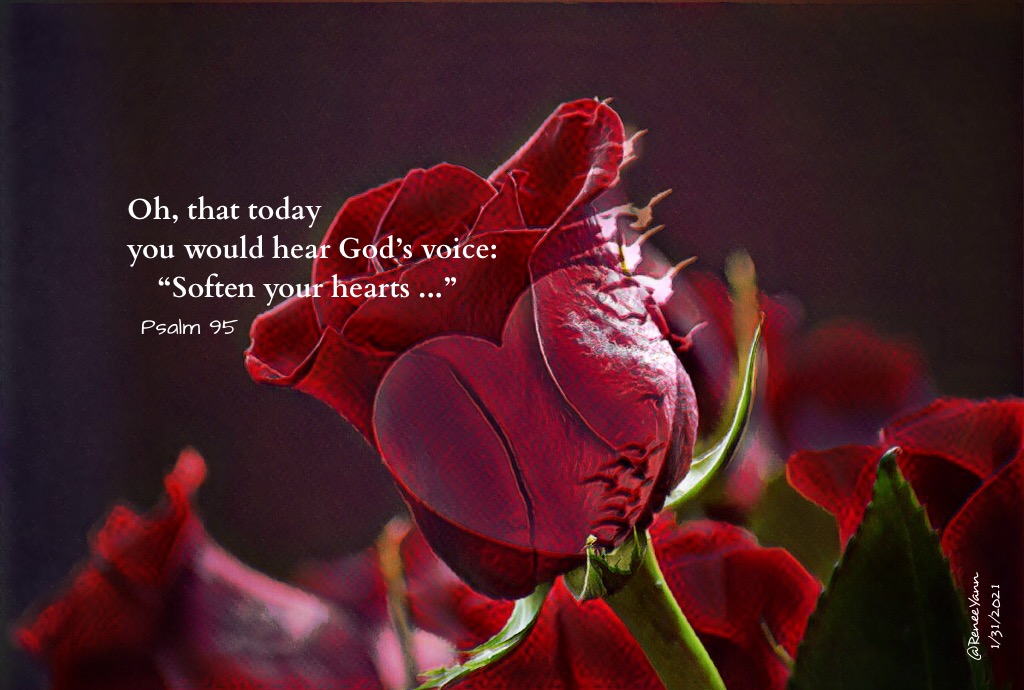
Oh, that today you would hear his voice: “Harden not your hearts as at Meribah, as in the day of Massah in the desert, Where your fathers tempted me; they tested me though they had seen my works.
Psalm 95: 7-9
Our other Sunday readings, which Psalm 95 anchors, clarify the reason we seek this tenderheartedness. It is so that we might not only hear, but really listen and respond to the Truth of God in our lives.
Those who will not listen to my words which a prophet speaks in my name, I myself will make them answer for it.
Deuteronomy 18:18
In our first reading from Deuteronomy, the people were confused. They were passing into a new land with lots of rivaling religions and spiritualities. Moses was nearing the end of his life and leadership over them. They wanted to know who to listen to and how to behave in order to stay in God’s favor.
God promises that God’s voice will come through a prophet like Moses:
I will raise up for them a prophet like you from among their kin, and will put my words into his mouth; he shall tell them all that I command him.
Deuteronomy 18:19
In our Gospel, we see Jesus – the fulfillment of the Deuteronomic Promise. The people witnessing his power are amazed. They struggle with whether they can believe in him when he seems just one of them, a Nazarene, Joseph’s son.
But some could believe – readily. Some, like the disciples, discerned quickly the Truth Jesus was. They heard, listened, believed and obeyed the Word.
Our psalm suggests that such readiness, such tenderheartedness comes from the consistent practice of relationship with God through praise, witness, thanksgiving, prayer, worship, humility, and obedience.
To me, it boils down to this:
let your life unfold in God’s Presence
be silent under God’s loving gaze
thank God for all you have been given
realize you are nothing without God
listen to your life as God speaks it to you
act on what you hear
Come, let us sing joyfully to the LORD;
    let us acclaim the rock of our salvation.
Let us come into God’s presence with thanksgiving;
    let us joyfully sing psalms to the Lord.
R. If today you hear God’s voice, harden not your hearts.
Come, let us bow down in worship;
    let us kneel before the LORD who made us.
For the Lord is our God,
    and we are the people God shepherds, the flock God guides.
Poetry: Rumi
I keep telling my heart,
“Go easy now.
I am submerged in golden treasure.”
It replies,
“Why should I be afraid of love?”
Today, in God’s Lavish Mercy, we have two beautiful readings to enrich our prayer.
In our first reading, Paul blesses and encourages his young disciple Timothy. Reminding Timothy of his faith heritage, received from his mother and grandmother, Paul inspires Timothy to live a spiritually courageous life:
I remind you to stir into flame the gift of God that you have through the imposition of my hands. For God did not give us a spirit of cowardice but rather of power and love and self-control. So do not be ashamed of your testimony to our Lord, nor of me, a prisoner for his sake; but bear your share of hardship for the Gospel with the strength that comes from God.
2 Timothy 1: 6-8
Praying with this passage, we can look both back and forward – to those who have encouraged our faith, and to those who depend on us for edification.
In our Gospel, Jesus paints a picture for his disciples of what the Kingdom of Heaven is like. This is a realm in which we already live – the eternal universe of the Creator’s love and grace. But our time-bound eyes can’t see that world clearly. It is more real than our physical world, but perceptible only to the awakened spirit.
Jesus tries to explain this “kingdom” to his followers. He says that like the growth of a seed, this world is a sacred mystery whose energy is generated by God, not by us:
This is how it is with the Kingdom of God; it is as if someone were to scatter seed on the land and would sleep and rise night and day and the seed would sprout and grow, they know not how. Of its own accord the land yields fruit, first the blade, then the ear, then the full grain in the ear. And when the grain is ripe, they wield the sickle at once, for the harvest has come.
Mark 4: 26-29
Paul and Jesus encouraged their followers to live in joyous alignment with this Divine Order – the “Kingdom of God”, as scripture calls it. In our prayer today, let’s listen to their counsel, for it is meant for us as well.
Poetry: Let This Darkness Be a Bell Tower – Rainer Maria Rilke, Sonnets to Orpheus II, 29
“Quiet friend who has come so far,
feel how your breathing makes more space around you.
Let this darkness be a bell tower
and you the bell. As you ring,
what batters you becomes your strength.
Move back and forth into the change.
What is it like, such intensity of pain?
If the drink is bitter, turn yourself to wine.
In this uncontainable night,
be the mystery at the crossroads of your senses,
the meaning discovered there.
And if the world has ceased to hear you,
say to the silent earth: I flow.
To the rushing water, speak: I am.”
Music: Lamb of God – from the Mass of St. Timothy – Matt Maher
Today, in God’s Lavish Mercy, our readings place us at watershed moments in the lives of David and Jesus.
All the tribes of Israel came to David in Hebron and said: “Here we are, your bone and your flesh. In days past, when Saul was our king, it was you who led the children of Israel out and brought them back. And the LORD said to you, ‘You shall shepherd my people Israel and shall be commander of Israel.’” When all the elders of Israel came to David in Hebron, King David made an agreement with them there before the LORD, and they anointed him king of Israel.
2 Samuel 5:1-4
In 2 Samuel 5, David fully assumes the kingship through the approbation of the community. The scene marks the culmination of his rise to power and “the beginning of the rest of his life”.
Through our readings in Samuel until now, we have ascended with David to the pinnacle of his life. We are about to begin weeks of moving down “the other side of the mountain”.
Scholars generally see the David narrative in two primary units, the Rise of David (I Sam. 16:1—II Sam. 5:10) and the Succession Narrative (II Sam. 9:1—20:26; I Kings 1:1—2:46). Chapters 5:11—8:18, fall between two larger units. Whereas the first presents David in his ascendancy, the second presents David in his demise and expresses pathos and ambiguity. Our chapters thus come after the raw vitality of the rise of David and before the terrible pathos of the succession narrative. They show the painful process whereby this beloved chieftain is transformed into a hardened monarch, who now has more power than popular affection.
Walter Brueggemann: First and Second Samuel
In our Gospel, Jesus also comes to a sort of “continental divide”. But rather than community approbation, Jesus encounters the condemnation of the scribes who have come from Jerusalem to assess him.
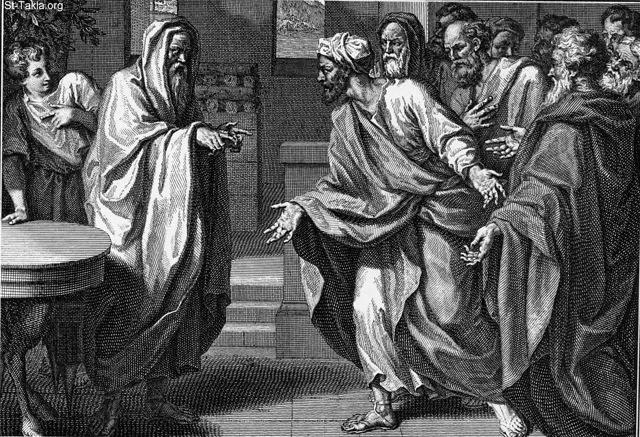
The scribes who had come from Jerusalem said of Jesus, “He is possessed by Beelzebul,” and “By the prince of demons he drives out demons.”
Mark 3: 22
From this moment in his life, Jesus too launches into his “kingship”, one that looks very different from David’s. The ensuing chapters of Samuel will reveal how David struggles and succumbs to the temptations of power and domination. The Gospels, on the other hand, describe Jesus’s “kingdom” as one of humility, mercy, and love for those who are poor and suffering.
Only through faith can we understand the inverse power of God present in the Life, Death and Resurrection of Jesus, and in our own lives. Jesus, the “new David”, is anointed in the Spirit to reveal and incorporate us into the kingdom of God.
Prose: from Immanuel Jakobovits who was the Chief Rabbi of the United Hebrew Congregations of the Commonwealth from 1967 to 1991.
To those without faith there are no answers. To those with faith, there are no questions.
Music: King David, music by Herbert Howells, sung by Sarah Connolly from a poem by Walter de la Mare
King David – Walter de la Mare
King David was a sorrowful man:
    No cause for his sorrow had he;
    And he called for the music of a hundred harps,
    To ease his melancholy.

    They played till they all fell silent:
    Played-and play sweet did they;
    But the sorrow that haunted the heart of King David
    They could not charm away.

    He rose; and in his garden
    Walked by the moon alone,
    A nightingale hidden in a cypress-tree
    Jargoned on and on.

    King David lifted his sad eyes
    Into the dark-boughed tree-
    ''Tell me, thou little bird that singest,
    Who taught my grief to thee?'

    But the bird in no wise heeded
    And the king in the cool of the moon
    Hearkened to the nightingale's sorrowfulness,
    Till all his own was gone.
Today, in God’s Lavish Mercy, our readings center on the themes of grief, honor, and mercy.
In the passage from 2 Samuel, Saul has been killed in battle. The news is brought to David by a scheming Amalekite who (later verses reveal) hopes to profit from his enterprise. He has stripped Saul’s dead body of its kingly insignia, obsequiously depositing it at David’s feet. The messenger expects David’s vengeful rejoicing and a hefty reward.
Instead David, with reverence and honor appropriate to a future king, launches a deep public mourning for Saul and Jonathan. It is a bereavement necessary to both cleanse and heal the community’s heart from all the strife leading up to it.
David seized his garments and rent them, and all the men who were with him did likewise. They mourned and wept and fasted until evening for Saul and his son Jonathan, and for the soldiers of the LORD of the clans of Israel, because they had fallen by the sword.
2 Samuel 1:11-12
David’s lament is profound; it is ”splancha”, sprung from his innards, like the anguish Jesus felt for the suffering persons he encountered, as described in our Gospel.
A callous or indifferent heart cannot comprehend such pathos. Seeing it in Jesus, even his relatives thought him insane!
Jesus came with his disciples into the house. Again the crowd gathered, making it impossible for them even to eat. When his relatives heard of this they set out to seize him, for they said, “He is out of his mind.”
Mark 3: 20-21
Our God is a God of boundless love and impractical mercy. David models a bit of that godliness. Jesus is its complete Incarnation.
Poetry: Talking to Grief – Denise Levertov
Ah, Grief, I should not treat you
like a homeless dog
who comes to the back door
for a crust, for a meatless bone.
I should trust you.
I should coax you
into the house and give you
your own corner,
a worn mat to lie on,
your own water dish.
You think I don't know you've been living
under my porch.
You long for your real place to be readied
before winter comes. You need
your name,
your collar and tag. You need
the right to warn off intruders,
to consider
my house your own
and me your person
and yourself
my own dog.
Music: Lascia Ch’io Pianga (Let Me Weep)- Georg Frideric Handel – a single piece of beautiful music today in two version, an aria and an instrumental interpretation.
Today, in God’s Lavish Mercy, our readings are about the growing popularity and power of David and Jesus. Accompanying that growth is the fearful jealousy of their peers, requiring both Jesus and David to take precautions.
David Calming Saul’s Fury with the Harp by Silvestro Lega
In our first reading, Saul is plagued by a lethal insecurity. As David’s star rises among the people, a plot to kill him festers in Saul’s heart. Right in the middle of this developing drama, Jonathan attempts to conciliate the relationship between his father and his friend.
Saul was very angry and resentful of the song, for he thought: “They give David ten thousands, but only thousands to me. All that remains for him is the kingship.” And from that day on, Saul was jealous of David.
Saul discussed his intention of killing David with his son Jonathan and with all his servants. But Saul’s son Jonathan, who was very fond of David, told him: “My father Saul is trying to kill you.
1 Samuel 18:8; 19:1
Over the course of our lives, haven’t we found ourselves in one, or maybe all, of these roles? Jealous, insecure, envious, like Saul? Unexpectedly successful, perhaps to another’s disadvantage, like David? Trying to make peace between two beloveds who can’t see past themselves, like Jonathan?
Praying with this passage leads us to ask ourselves, “How is God with me when I find myself in such situations?” What would have been God’s hope for Saul at this point in his life? For David? For Jonathan?
When I think of Saul, I wonder what could have happened if he had been big-hearted, if he had been brave enough to offer David mentorship and encouragement. It can be very hard to step back from a role where we have been in control and prominence. Generously advancing a successor is the sign of a graceful heart. Sadly, Saul did not meet the challenge.
When I think of David, I wonder how he might have better included Saul in his success. None of us achieves success alone. Sometimes the people and circumstances that have supported us are invisible — even to us. Especially in the vigor of youth, we may be tempted to think that we are solely responsible for our achievements. Developing an aware and grateful heart can help us realize life’s profound interdependence.
When I think of Jonathan, I just want to be like him. He was such a good person who loved without self-interest. Jonathan is a figure of Christ who sought reconciliation and loved generously to the point of death. Praying with Jonathan is an invitation to holiness.
In our Gospel, we meet Jesus as he seeks the same peace, reconciliation, and love. Still, even as Jesus heals and does good among the people, he is aware of the sinful weakness in some people’s hearts. He therefore calls for care in making his name known:
He had cured many and, as a result, those who had diseases were pressing upon him to touch him. And whenever unclean spirits saw him they would fall down before him and shout, “You are the Son of God.” He warned them sternly not to make him known.
Mark 3: 10-12
So many ways to pray with today’s Scripture! Given your place with God today, what are these passages suggesting for you?
Poetry: Not Like a Cypress by Yehuda Amichai, (1924 – 2000) was an Israeli poet and author, one of the first to write in colloquial Hebrew in modern times. Much of his work tries “to make sense of the world that created the Holocaust”.
Amichai was invited in 1994 by Prime Minister Yitzhak Rabin to read his poems at the ceremony in Oslo when Rabin, Yasser Arafat, and Shimon Peres were awarded the Nobel Peace Prize for their efforts to establish peace in the Middle East. Perhaps we might send a prayer to these honored men for a blessing of sanity and peace over today’s Middle East leaders.
I chose this poem because it mentions Saul, “the single man” whom the “multitudes” made great. But not like Saul does one find meaning and peace. The poet suggests that “becoming like the rain” and giving one’s life is the way to meaning, so reflective of Jesus’s advice, “Unless the grain of wheat …”
Not like a cypress,
not at once, not all of me,
but like the grass, in thousands of cautious green exits,
to be hiding like many children
while one of them seeks.

And not like the single man,
like Saul, whom the multitude found
and made king.
But like the rain in many places
from many clouds, to be absorbed, to be drunk
by many mouths, to be breathed in
like the air all year long
and scattered like blossoming in springtime.

Not the sharp ring that wakes up
the doctor on call,
but with tapping, on many small windows
at side entrances, with many heartbeats.
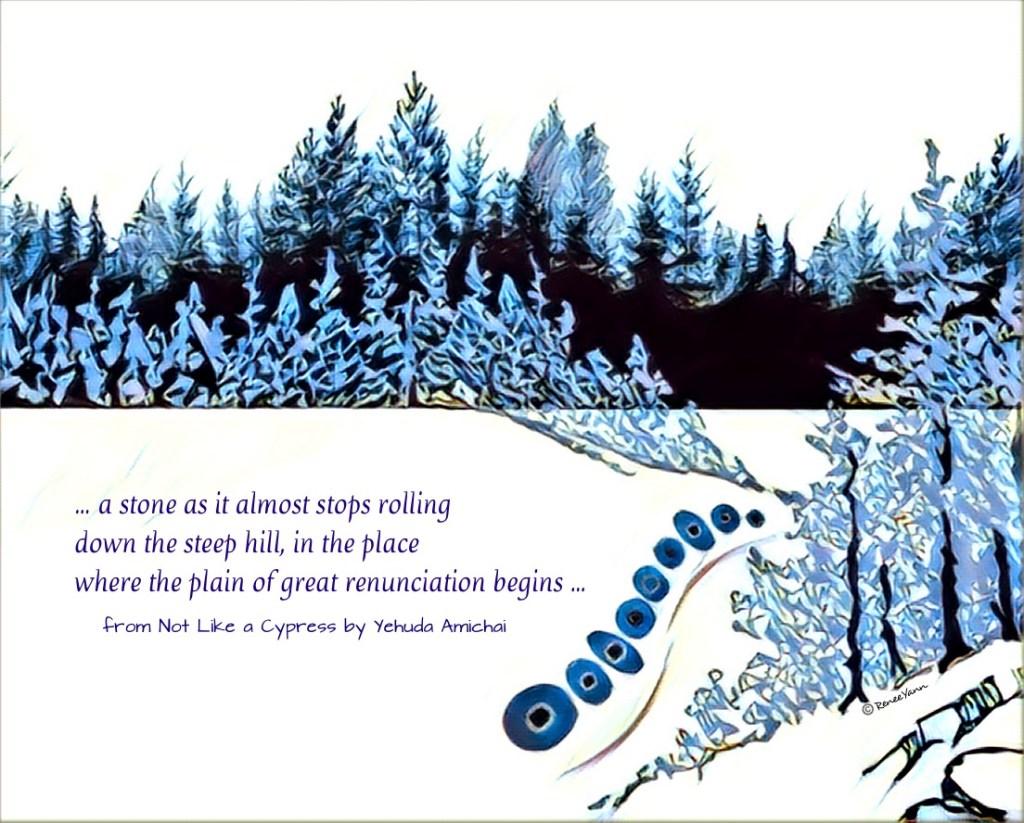
And afterward the quiet exit, like smoke without shofar-blasts, a statesman resigning, children tired from play, a stone as it almost stops rolling down the steep hill, in the place where the plain of great renunciation begins, from which, like prayers that are answered, dust rises in many myriads of grains.
Music: Paintbox – Ofra Haza and Kobi Oshrat
Ofra Haza accompanied by pianist and composer Kobi Oshrat at the Nobel Peace Prize Award Ceremony on December 10, 1994 at the Oslo City Hall in Oslo, Norway, honoring Nobel Laureates Israeli Prime Minister Yitzhak Rabin (1922-1995), Israeli Foreign Minister Shimon Peres (1923-2016) and Palestine Liberation Organization Chairman Yasser Arafat (1929-2004) for their efforts to create peace in the Middle East. She performed here at the request of Israeli Prime Minister Yitzhak Rabin. (Lyrics below)
I had a paintbox Each color glowing with delight I had a paintbox with colors Warm and cool and bright
I had a paintbox Each color glowing with delight I had a paintbox with colors Warm and cool and bright
I had no red I had no red for wounds and blood I had no black for an orphaned child
I had no white I had no white for the face of the dead I had no yellow for burning sands
I had a paintbox Each color glowing with delight I had a paintbox with colors Warm and cool and bright
I had orange I had orange for joy and life I had green Green for buds and blooms
I had blue I had blue for a clear, bright skies I had pink Pink for dreams and rest
I had a paintbox Each color glowing with delight I had a paintbox with colors Warm and cool and bright
I had a paintbox Each color glowing with delight I sat down I sat down and painted peace Peace, peace
Today, in God’s Lavish Mercy, Samuel anoints Saul King of Israel.
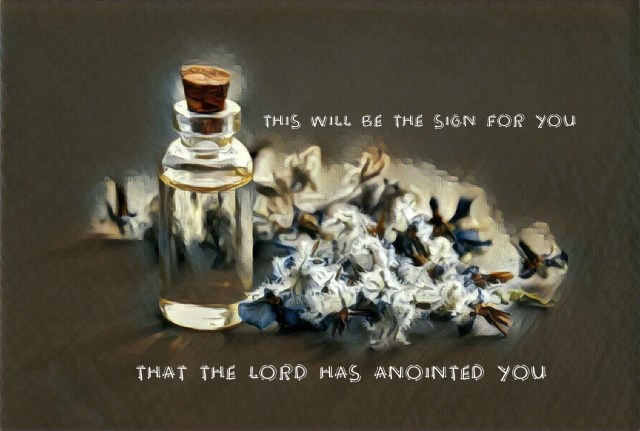
Then, from a flask he had with him, Samuel poured oil on Saul’s head; he also kissed him, saying: “The LORD anoints you commander over his heritage. You are to govern the LORD’s people Israel, and to save them from the grasp of their enemies.
1 Samuel 10:1
Throughout Scripture, the act of anointing signifies being blessed, commissioned by grace. The sacred oil heals and strengthens the anointed to do the work of God.
We share in the grace of anointing through the sacraments – Baptism, Confirmation and Anointing of the Sick. We may not think about the power these rituals give us to live our lives in the pattern of Christ. But it is an amazing power which creates saints out of ordinary human beings like you and me!
Caritas, The Seven Acts of Mercy, pen and ink drawing by Pieter Bruegel the Elder, 1559. Counter-clockwise from lower right: feed the hungry, give drink to the thirsty, ransom the captive, bury the dead, shelter the stranger, comfort the sick, and clothe the naked
As many of you know, 2023 was a year of unexpected and intense health challenges for me. On three critical occasions, compassionate priests carried the Sacrament of the Sick to me. Both Fr. Lynn and Fr. Gleason gently asked me, “Would you like to be anointed?”. The question reminded me of Jesus when he asks the paralytic, “Do you want to be cured?”.
Clearly, healing isn’t a one-sided enterprise from God. We must be willing to open our hearts to the movement of the Spirit in our lives. The Sacrament of Anointing is a sacred gift to help us to that openness. For me, anointing from these ministers opened my heart to understand that, by grace, suffering had the potential to make me someone new. Sacramental grace invited me to find that newness in the pattern of Jesus Christ.
In a less formal way, we can anoint one another by our acts of generosity, honesty, justice and love. Think of the woman who anointed Jesus with nard from her alabaster jar. How that act strengthened him for the suffering he had to face!
There are so many chaffed and sore places in our world longing for the oil of mercy!
We can also “anoint” our own life by gratefully remembering God’s abiding presence with us: the blessings we have received, the challenges we have gracefully met, the love we have both given and received – all that strengthened us to do the work of God over our lifetime.
Poetry: Her Hands, Her Hair by Steve Garnass-Holmes
Mary took a pound of costly perfume made of pure nard, anointed Jesus’ feet, and wiped them with her hair. —John 12.3
God does not promise to save you from suffering,
or to remove you from this life and its jagged edges.
God shares your space in it, offers blessing in it,
anointing your nights as well as days.
The cross is no scheme to get you off a hook somewhere;
it’s the Beloved, with you in your pain.
Let the Beloved pour herself out on your troubles,
let her pour out a jar of tears for you,
wipe your aching feet with her hair.
Let the whole house of you be filled
with the fragrance of God’s blessing.
Others don’t feel your pain but she does,
they will flee but she will be with you.
Lay before her your sorrows and your rage.
Feel her hands upon you, her hair, her heart.
You are in the holy of holies.
The world’s derision fades away outside the gate.
She looks at you with love
that will stay with you forever
1 Samuel 8:19 – Israel demands a king.- J. Winter – from “The Bible and its Story” book, authored by Charles Horne, 1909
Today, in God’s Lavish Mercy, our first reading startles us with how foolish the Israelites are about their leaders.
All the elders of Israel came in a body to Samuel at Ramah and said to him, “Now that you are old, and your sons do not follow your example, appoint a king over us, as other nations have, to judge us.”
Samuel was displeased when they asked for a king to judge them. He prayed to the LORD, however, who said in answer: “Grant the people’s every request. It is not you they reject, they are rejecting me as their king.”
1 Samuel 8: 4-7
Israel is desperate for a “strong man” who will mimic the tyrants leading their enemies. They say a king will “rule us and to lead us in warfare and fight our battles.” They begin to envision a nation of their own design, not God’s.
They believe that having an absolute leader will make them politically strong. They are indifferent to Samuel’s warnings that such a choice will usurp their freedom, and lead to their devastation and enslavement.
This leaf is distinguished by a large initial P depicting Samuel, the last and one of the greatest of Israel’s judges. It introduces the text Preparte corda vestra domino et servite (“Prepare your hearts for the Lord and serve”).
God tells Samuel that, in rejecting the choice for responsible, spiritually-grounded, and mutually sustained leadership, the people are rejecting God and God’s plan for them.
The people, however, refused to listen to Samuel’s warning and said, “Not so! There must be a king over us. We too must be like other nations, with a king to rule us and to lead us in warfare and fight our battles.”
1 Samuel 8:9-20
In a nutshell, Israel’s problem is this: they have forgotten who and whose they are. For the sake of expected political dominance, they are willing to sacrifice their identity as a people formed and led by God.
Centuries later, in today’s Gospel, Jesus comes among these dispirited people. Their choice hasn’t worked. They are still a politically dominated nation. Their religious practice has lost its vigor, denigrating into lifeless rules and practices. A corrupt religious class manipulates every aspect of their lives by a self-serving manipulation of the Law.
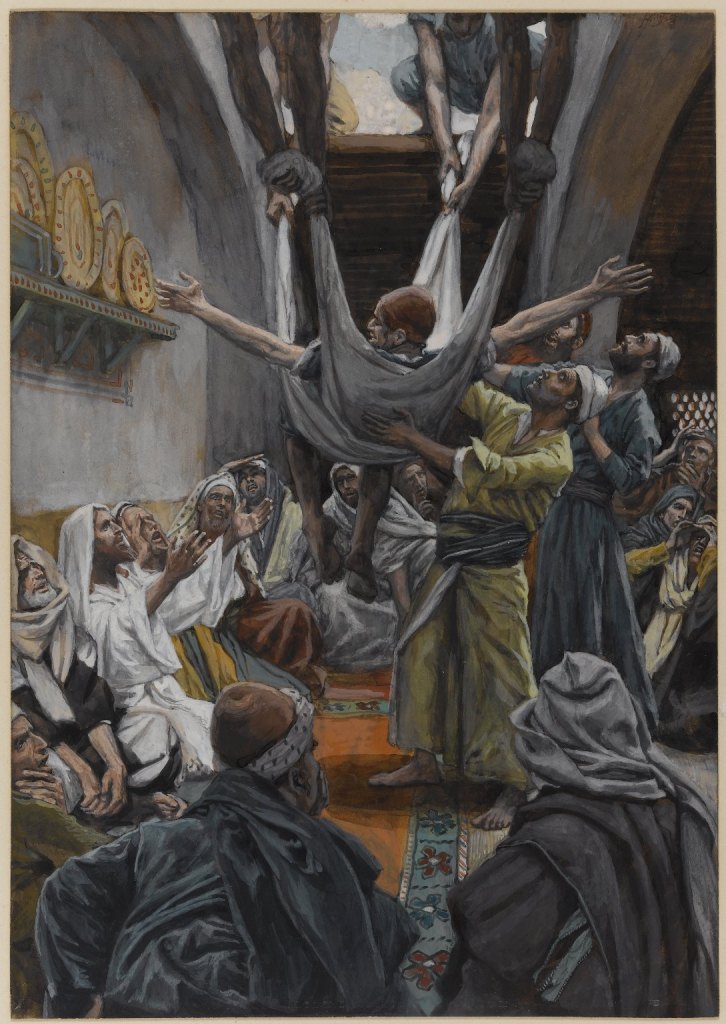
Jesus Cures the Palsied Man – James Tissot
Jesus, ignoring their religiously manufactured limitations, cures a paralyzed man. The scribes are scandalized. But Jesus confronts their equivocation:
Jesus said, “Why are you thinking such things in your hearts? Which is easier, to say to the paralytic, ‘Your sins are forgiven,’ or to say, ‘Rise, pick up your mat and walk’? But that you may know that the Son of Man has authority to forgive sins on earth” –he said to the paralytic, “I say to you, rise, pick up your mat, and go home.” He rose, picked up his mat at once, and went away in the sight of everyone. They were all astounded and glorified God …
Mark 2: 8-12
What would the world be like if we remained open to God’s grace, mercy, and infinite possibility? Can we even imagine such freedom and trust? Can we even imagine the marriage of our faith and politics to the point that we all live for the common good?
Thought for today: from “The City of God” by St. Augustine. This book was written in response to allegations that Christianity brought about the decline of Rome. It is considered one of Augustine’s most important works, standing alongside The Confessions, The Enchiridion, On Christian Doctrine, and On the Trinity.
“Indeed, the only cause of their [Rome] perishing was that they chose for their protectors gods condemned to perish.”
Today, in God’s Lavish Mercy, Jesus shows us how to live a merciful life – through loving, generous, joyfully responsive service.
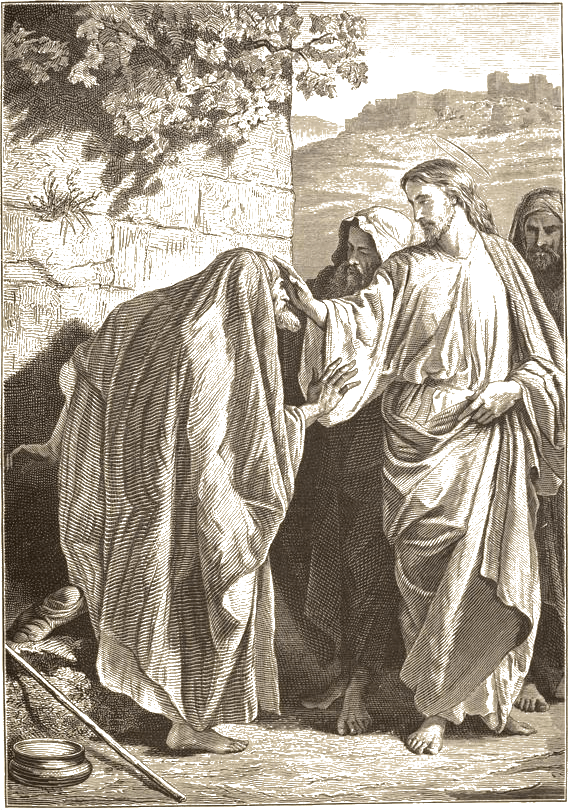
A leper came to him and kneeling down begged him and said, “If you wish, you can make me clean.” Moved with pity, he stretched out his hand, touched the leper, and said to him, “I do will it. Be made clean.”
Mark 1: 40-41
A pitiable leper interrupts Jesus on his journey to ask for help. People like this man were scorned, feared, and isolated. Their leprosy impoverished them, making them annoying beggars. Their cries usually met with indifference at best and banishment at worst.
But when this leper poses his proposal to Jesus – “If you want to, you can heal me.” — Jesus gives the spontaneous answer of a true, merciful heart: “Of course I want to!”
Jesus heals the Leper – Alexandre Bida
There is no annoyance, no suggestion that other concerns are more important. There is just the confirmation that – Yes- this is my life’s purpose: to heal, love, and show mercy toward whatever suffering is in my power to touch. There is simply the clear message that “You, too, poor broken leper, are Beloved of God.”
What an example and call Jesus gives us today! We are commissioned to continue this merciful touch of Christ along the path of our own lives. When circumstances offer us the opportunity to be Mercy for another, may we too respond with enthusiasm, “Of course I want to!” May we have the eyes to see through any “leprosy” to find the Beloved of God.
Poetry: from Naming the Leper – Christopher Lee Manes
Between 1919 and 1941, five relatives of Christopher Lee Manes were diagnosed with an illness then referred to as “leprosy” and now known as Hansen’s disease. After their diagnosis, the five Landry siblings were separated from their loved ones and sent to the National Leprosarium in Carville, Louisiana, where they remained in quarantine until their deaths. Drawing on historical documents and imaginative reconstructions, Naming the Leper tells through poetry this family’s haunting story of exile and human suffering.
Manes won the Summerlee Book Prize for his work. Here is an excerpt that conveys the aimless desolation felt by “the leper” — likely felt by Jesus’s leper too.
” the trouble with this place…”
Dear Claire,
The trouble with this place
is getting out of bed to live
through the corpse of another day;
letting the world roll as God wants it,
while we sit on the front porch
and wave flies
from our face.

Isn’t it a wonder
more of us do not go crazy,
forced to live brooding over these
unfortunate conditions;
thrown into a contact so intimate and prolonged
we let go our reflections in the river,
and our loved ones—but most importantly,
the very children we’ve begotten—
forget us.
Today, in God’s Lavish Mercy, we read about God’s call of Samuel, Hannah’s son.
New things are about to happen in Israel. The People have lived under the questionable leadership of a series of Judges. But now, threats from inside and outside loom. So God chooses to move in a new way among the community.
Samuel is going to be God’s bridge to that new way. In today’s reading and subsequent verses, he hears God’s call, listens, receives a vision, and prophesies to Eli.
In our reading from Mark, Jesus is the Divine Bridge to a new reality. Early now in his ministry, his call is blossoming in his heart, as he realizes that he must go all over Israel preaching and healing.
When Simon told Jesus the local villagers were looking for him, Jesus told them,
“Let us go on to the nearby villages that I may preach there also. For this purpose have I come.” So he went into their synagogues, preaching and driving out demons throughout the whole of Galilee.”
Mark 1:38-39
Jesus continues his healing and enlightening mission through all who call themselves Christian. He calls each of us in different ways to be a “Bridge” with him to the Reign of God.
How are we hearing and listening to our particular call every day? Maybe, like Samuel, by the time God calls us three times, we may understand!😉
Music: Two songs today and no poem.
Since I mentioned “bridge”, I can’t help including one of my favorite songs, Bridge Over Troubled Water by Simon and Garfunkel. It’s not really a religious song, but their popular song actually was inspired by a great Gospel song, Oh Mary, Don’t You Weep and its one freely interpreted verse very near the end: “I’ll be your bridge over deep water/If you trust in my name.’
Bridge Over Troubled Waters
Oh, Mary Don’t You Weep (Lyrics below. They are VERY liberally interpreted by these wonderful Gospel singers.)
Lord, I’m singing . . . (solo) Oh, Mary, don’t you weep. (group) Tell Martha not to mourn. (solo) Tell Martha not to mourn. (group) Listen, Mary, (solo) Oh, Mary, don’t you weep. (group) Tell Martha not to mourn. (solo) Tell Martha not to mourn. (group) Pharaoh’s army, (solo) Oh, Mary, don’t you weep. (group) They got drownded in the sea, (solo) Drowned in the Red Sea. (group) Jesus said, Mary, (solo) Oh, Mary, don’t you weep. (group) Tell Martha not to mourn. (solo) Tell Martha not to mourn. (group) Can’t you hear me singing, Mary? (solo) Oh, Mary don’t you weep. (group) I want you to know, Martha don’t have to mourn. (solo) Tell Martha not to mourn. (group) Oh, listen, Mary, (solo) Oh, Mary don’t you weep. (group) Tell Martha not to mourn. (solo) Tell Martha not to mourn. (group) Pharaoh’s army, (solo) Oh, Mary, don’t you weep, (group) They got drownded in the sea, (solo) Drowned in the Red Sea. (group) Jesus said, Mary, (solo) Oh, Mary don’t you weep, (group) Tell Martha not to mourn, (solo) Tell Martha not to mourn, (group) Lord, and if I could tonight, (solo) If I could, (group) I want to tell you I surely would right now. (solo) Surely would, (group) I would stand on the rock. (solo) Stand on the rock, (group) Right on the rock where Moses stood. (solo) Moses stood, (group) Pharaoh’s army, (solo) Oh, Mary don’t you weep (group) They got drownded in the sea, (solo) Drowned in the Red Sea. (group) Jesus say, Mary, (solo) Oh, Mary don’t you weep. group) He said Mary . . . (solo) Oh, Mary don’t you weep .(group) Oh, Mary . . . (solo) Oh, Mary, don’t you weep. group) Tell Martha not to mourn. (solo) Tell Martha not to mourn. group)
Today, in God’s Lavish Mercy, and on this glorious feast, we pray with Psalm 72.
The kings of Tarshish and the Isles shall offer gifts; the kings of Arabia and Seba shall bring tribute. All kings shall pay him homage, all nations shall serve him.
For he shall rescue the poor when he cries out, and the afflicted when he has no one to help him. He shall have pity for the lowly and the poor; the lives of the poor he shall save.
Psalm 72: 10-13
It is a gorgeous psalm that fills our senses with lights, and scents, and the tactile experience of an ancient and sacred world:
we inhale the flower of justice
wrap ourselves in its profound peace
gaze on a distant, moonless universe
stretch our prayer from sea to sea,
and our praise to the ends of the earth
We see the ancient nations gather in homage, carrying the gems, spices and bounty of their homelands.
We, too, kneel in astounded wonder that this vulnerable child, hidden in the far reaches of both geography and imagination, carries to us the Promise of the Ages.
We, too, trust the star, rising in our own hearts.
Psalm 72 echoes our beautiful first reading from Isaiah, another masterpiece that, in itself, is enough simply to read and savor:
Rise up in splendor, Jerusalem! Your light has come, the glory of the Lord shines upon you. See, darkness covers the earth, and thick clouds cover the peoples; but upon you the LORD shines, and over you appears his glory.
Isaiah 60: 1-2
In Isaiah, these magnificent verses follow two chapters of gloom and darkness. They break forth in true epiphany to say, “Your Light has come!” – now your life must begin to shine as well.
Epiphany is not simply about kings and camels. It is not simply about a crèche and a star.
It is about Divine Revelation hovering over our dailyness. It is about us, opening our eyes in faith and responsiveness to our ever-present God.
The feast of Epiphany reminds us:
Look at your life today. The star did not pass you by. Open your eyes and find it. Once you have seen it, live in its Light.
Poetry: The Journey of the Magi – T.S. Eliot
Eliot wrote the poem after his conversion to Anglicanism ( He had been a Unitarian.) The poem conveys his struggle to grow in the light of his new faith. The “journey” is life-long and demanding in a world that often contradicts that faith.
“A cold coming we had of it,
Just the worst time of the year
For a journey, and such a long journey:
The ways deep and the weather sharp,
The very dead of winter.”
And the camels galled, sore-footed, refractory,
Lying down in the melting snow.
There were times we regretted
The summer palaces on slopes, the terraces,
And the silken girls bringing sherbet.
Then the camel men cursing and grumbling
And running away, and wanting their liquor and women,
And the night-fires going out, and the lack of shelters,
And the cities hostile and the towns unfriendly
And the villages dirty and charging high prices:
A hard time we had of it.
At the end we preferred to travel all night,
Sleeping in snatches,
With the voices singing in our ears, saying
That this was all folly.
Then at dawn we came down to a temperate valley,
Wet, below the snow line, smelling of vegetation;
With a running stream and a water-mill beating the darkness,
And three trees on the low sky,
And an old white horse galloped away in the meadow.
Then we came to a tavern with vine-leaves over the lintel,
Six hands at an open door dicing for pieces of silver,
And feet kicking the empty wine-skins.
But there was no information, and so we continued
And arrived at evening, not a moment too soon
Finding the place; it was (you may say) satisfactory.
All this was a long time ago, I remember,
And I would do it again, but set down
This set down
This: were we led all that way for
Birth or Death? There was a Birth, certainly,
We had evidence and no doubt. I had seen birth and death,
But had thought they were different; this Birth was
Hard and bitter agony for us, like Death, our death.
We returned to our places, these Kingdoms,
But no longer at ease here, in the old dispensation,
With an alien people clutching their gods.
I should be glad of another death.
Music: The People that Walk in Darkness – Bob Dufford, SJ
The people that walk in darkness
 have seen, have seen a great light.
 And on those who dwell in endless gloom,
 a light has shone.

Refrain:
For a Child is born this day:
Rejoice, rejoice.
Daughter of Zion, awake.
The glory of God is born.

And they shall name Him counselor,
shall call Him mighty God.
And He shall rule from age to age:
Prince of Peace.

Refrain

Darkness covers the earth;
thick clouds govern its pe0ple.
But the Lord will bring them light;
the Lord will bring them light.

Refrain

The people that walk in darkness
have seen, have seen a great light.
And on those who dwell in endless gloom,
a light has shone.


Refrain













 Lavish Mercy