Practice Resurrection

Twenty-eighth Sunday in Ordinary Time
October 15, 2023

Today’s Readings:

https://bible.usccb.org/bible/readings/101523.cfm


Today, in God’s Lavish Mercy, we pray with radically liberating readings including Psalm 23, a familiar, comforting and beloved prayer.

The LORD is my shepherd; I shall not want.
In verdant pastures he gives me repose;
beside restful waters he leads me;
he refreshes my soul.

Psalm 23: 1-3

The psalm comes between readings that assure us of a waiting and sumptuous banquet to which we gain entrance by both mercy and grace.  


Isaiah describes the feast in the future tense:

On that day it will be said:
“Behold our God, to whom we looked to save us!
This is the LORD for whom we looked;
let us rejoice and be glad that he has saved us!”

Isaiah 25:9

But Paul reminds us of the truth we often forget. The banquet is NOW!

My God will fully supply whatever you need,
in accord with his glorious riches in Christ Jesus.

Philippians 4:20

In our Gospel, Jesus invites his guests to that feast with both an immediacy and a demand. The celebration of abundance is open to all. But we must at least make the effort to don a wedding garment – that reverent, grateful attitude which gives glory to the Source of our abundance. 


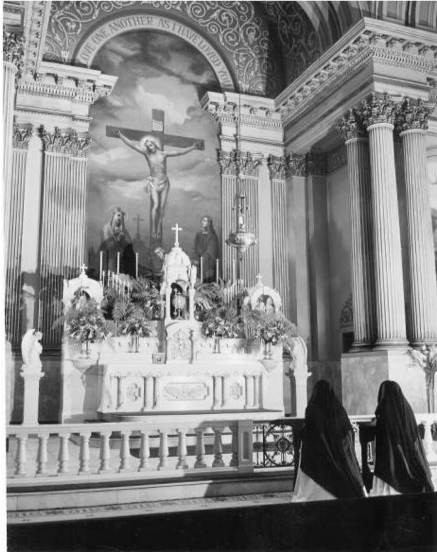
The edge of the white choir mantle is visible below the veils.

In ancient times – when I first came to religious life 🙂 – we would add a special garment to our habit to celebrate a great feast. The white choir mantle was a symbol of our awareness of a particularly sacred moment.


Miraculously, it is that reverent awareness that opens our eyes to the plentitude in our midst. It releases us to the freedom of a hope already realized, but hidden from those whose hearts refuse to be dressed in grace.

You spread the table before me
in the sight of my foes;
you anoint my head with oil;
my cup overflows.

Psalm 23:5

Our readings invite us to live as not only invited but saved people, completely convinced of God’s eternal welcome and protection.

Only goodness and kindness follow me
all the days of my life;
and I shall dwell in the house of the LORD forever.

Psalm 23:6

What would the world be like if we lived out this conviction – that we already possess God’s gracious abundance? 

How might the reproaches of fear, competition,
domination, selfishness, and hoarding
be removed from our midst?

How might the rush of generosity, forgiveness, and mercy 
flow out of our confident hearts
to wash the earth in God’s restful waters?


Poem: Manifesto: The Mad Farmer Liberation Front by Wendell Berry

Love the quick profit, the annual raise,
vacation with pay. Want more
of everything ready-made. Be afraid
to know your neighbors and to die.
And you will have a window in your head.
Not even your future will be a mystery
any more. Your mind will be punched in a card
and shut away in a little drawer.
When they want you to buy something
they will call you. When they want you
to die for profit they will let you know.
So, friends, every day do something
that won’t compute. Love the Lord.
Love the world. Work for nothing.
Take all that you have and be poor.
Love someone who does not deserve it.
Denounce the government and embrace
the flag. Hope to live in that free
republic for which it stands.
Give your approval to all you cannot
understand. Praise ignorance, for what man
has not encountered he has not destroyed.
Ask the questions that have no answers.
Invest in the millennium. Plant sequoias.
Say that your main crop is the forest
that you did not plant,
that you will not live to harvest.
Say that the leaves are harvested
when they have rotted into the mold.
Call that profit. Prophesy such returns.
Put your faith in the two inches of humus
that will build under the trees
every thousand years.
Listen to carrion – put your ear
close, and hear the faint chattering
of the songs that are to come.
Expect the end of the world. Laugh.
Laughter is immeasurable. Be joyful
though you have considered all the facts.
So long as women do not go cheap
for power, please women more than men.
Ask yourself: Will this satisfy
a woman satisfied to bear a child?
Will this disturb the sleep
of a woman near to giving birth?
Go with your love to the fields.
Lie down in the shade. Rest your head
in her lap. Swear allegiance
to what is nighest your thoughts.
As soon as the generals and the politicos
can predict the motions of your mind,
lose it. Leave it as a sign
to mark the false trail, the way
you didn’t go. Be like the fox
who makes more tracks than necessary,
some in the wrong direction.
Practice resurrection.

Music: Abundant Life – written by Ruth Duck, sung by Marty Haugen

We cannot own the sunlit sky, 
the moon, the wild-flowers growing, 
For we are part of all that is 
within life’s river flowing.

With open hands receive and share 
the gifts of God’s creation, 
That all may have abundant life 
in every earthly nation.

When bodies shiver in the night 
and weary wait for morning,
When children have no bread but tears, 
and war horns sound their warning. 

God calls humanity to awake, 
to join in common labor,
That all may have abundant life, 
oneness with their neighbor.

God calls humanity to join as partners
in creating a future free 
from want or fear.
Life’s goodness celebrating, 

that new world beckons from afar,
Invites our shared endeavor 
that all might have abundant life 
and peace endure forever.

Prayer

Wednesday of the Twenty-seventh Week in Ordinary Time
October 11, 2023

Today’s Readings:

https://bible.usccb.org/bible/readings/101123.cfm


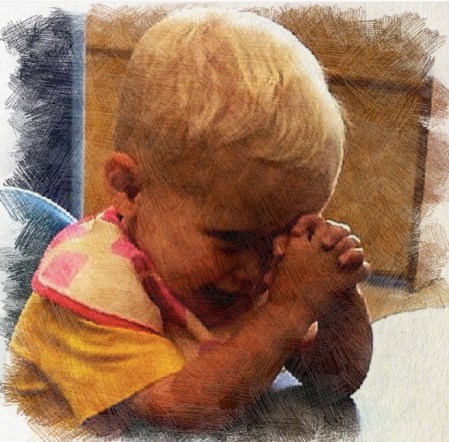
Ollie praying

Today, in God’s Lavish Mercy, Jesus teaches his disciples how to pray. His prayer is simple and direct, like talking to your best friend over a morning cup of coffee.

What about us? How do we pray?

Most of our first learned prayers are a lot like Jesus’s simple Our Father. We praise God, giving thanks, and asking for what we need.

Then we grow up and get sophisticated. We may begin to “say” or read prayers rather than use our own words. While such a practice can deepen our understanding of prayer, it places a layer between us and our conversation with God.

Sometimes others lead our prayer in the community of faith. This too can enrich us as we are inspired by a shared faith. But, sorry to say, at other times such prayer, indifferently led, can leave us empty and even frustrated. The whole process can be a little like trying to have a private conversation in an elevator full of noisy people.


Just as Jesus often went off in solitude to pray, this kind of prayer is our most intimate time with God – a time when God allows us to know God and ourselves in a deeper way. This sacred time alone with God may be spent in words, song, or the silence that speaks beyond words.

It is a time to be with the Beloved as we would be with our dearest, most faithful companion. We rest in the field of our experiences, letting them flow over God’s heart in tenderness. We listen with the ear of absolute trust to the secrets God tells us in the quiet.


When we become deeply accustomed to this type of intimate prayer, it transforms our self-understanding. Our every thought, word, and action is in the Presence of God. It is God Who hears our joys, sorrows, fears, and inspirations rising up in our hearts even before we hear them ourselves. It is God Who holds us at the center of our lives in communion with all Creation. It is God Who breathes grace into our human moments in acts of mercy, joy, charity, and justice.

Father, hallowed be your name,
your Kingdom come.
Give us each day our daily bread
and forgive us our sins
for we ourselves forgive everyone in debt to us,
and do not subject us to the final test.

Luke 11:2-4

Poetry: Praying – Mary Oliver

It doesn’t have to be
the blue iris, it could be
weeds in a vacant lot, or a few
small stones; just
pay attention, then patch

a few words together and don’t try
to make them elaborate, this isn’t
a contest but the doorway

into thanks, and a silence in which
another voice may speak.

Our Father – Leontyne Price

Sibling Dilemma

Tuesday of the Twenty-seventh Week in Ordinary Time
October 10, 2023

Today’s Readings:

https://bible.usccb.org/bible/readings/101023.cfm

Today, in God’s Lavish Mercy, we pray with Martha and Mary. These sisters are the personification of the Benedictine motto: Ora et labora: Pray and work – the two essentials that we all struggle to balance in our lives.

They, with their brother Lazarus, are dear friends of Jesus. The scriptures show us that Jesus felt comfortable at their home, and that they loved to have him stay with them.

As all of us do with our closest friends, Jesus understood the lights and shadows of their personalities – and they of his. He knew that Martha was the organizer, the one who planned and worried about the incidentals. Mary was deeply spiritual, but maybe had her head in the clouds a bit when it came to getting things done. 

Perhaps these personality differences caused some tensions between the sisters, as they might between us and our family members or close friends. Sometimes these little, unnoticed frictions can suddenly become chasms between us and those we love. 

How and why does it happen?

Jesus gives us the answer in this Gospel passage. He hears Martha’s simmering frustration. He calms her, as one might a child – “Martha, Martha…”. We can hear his gentle tone. Jesus tells her that worry and anxiety are signs that we are not spiritually free. He tells her that Mary has focused on the important thing.

This may sound repetitious, but just think about it a while:

It is so important to know what is important. 

It is so freeing to agree on what matters with those closest to us. Talking with each other in openness, respect, and unconditional love is the only path to that freedom.

Maybe Martha and Mary slipped off that path a bit in this situation. But with Jesus’ help, they righted their relationship. 

That’s the best way for us to do it too. Let Jesus show us what is most important through sharing our faith, and even our prayer, with those closest to us. Let him show us where our self-interests, need for control, fears and anxieties are blocking us from love and freedom.

It is the same way that we, like Mary, can strengthen our relationship with God. It is not sufficient for our prayer to consist of incidentals — pretty words and empty practices. 

We must sit open-hearted at the feet of Jesus and let him love us, let him change us. Even in the midst of our responsibilities and duties, we must balance “the better part”.


Poetry: Bethany Decisions – Irene Zimmerman, OSF 

As Jesus taught the gathered brothers
and Martha boiled and baked their dinner,
Mary eavesdropped in the anteroom
between the great hall and the kitchen.
Her dying mother’s warning words
clanged clearly in her memory—
“Obey your sister. She has learned
the ways and duties of a woman.”

She’d learned her sister’s lessons well
and knew a woman’s place was not
to sit and listen and be taught.
But when she heard the voice of Jesus
call to her above the din
of Martha’s boiling pots and pans,
she made her choice decisively—
took off her apron and traditions,
and walked in.


Music: a charming little song by Peg Angell which leaves me with same practical question I always have when reading this passage: who actually did get the dinner ready?

Neighbor

Monday of the Twenty-seventh Week in Ordinary Time
October 9, 2023

Today’s Readings:

https://bible.usccb.org/bible/readings/100923.cfm


Today, in God’s Lavish Mercy, get ready for a three-day cruise with Jonah and a radical journey down the Jericho road with the Good Samaritan.

The message of Jonah is clear: all people, even hated Ninevites, are children of God’s Mercy. Resisting that understanding can be catastrophic to our spiritual life.


Patricia Tull, Rhodes Professor Emerita of Old Testament at Louisville Seminary, summarizes the Book of Jonah like this:

A postexilic book, Jonah’s story is atypical for prophetic works. Not only is it a narrative about the prophet rather than his speeches, but it also rebuffs Jonah for his refusal to preach to foreign enemies. Jonah’s story portrays foreigners as more than ready to repent and turn to God. The book uses humor, hyperbole, and irony to make its parabolic point.

Our Gospel gives us one of the most beloved yet challenging parables of Jesus – who is our “neighbor”. The infinite dimensions within this parable continue to unfold for us as we deepen in our mercy spirituality.

God does not see anyone as a “foreigner”. Every human being lives with the breath of God. We are “neighbors” because we share that breath, that “neighborhood” of God’s boundless Love.


But, oh my God, how we have forgotten or rejected that common bond of reverence for one another! Just yesterday, one of our sisters brought up the subject of a recent hit-and-run accident in Philadelphia. It now seems to be the common practice to leave the scene of such an occurrence, abandoning the victim to his fatal circumstance. She wondered, incredulously, how anyone could be that callous.


Our Gospel parable describes that callousness. Notice that both the priest and the Levite pass the victim by “on the opposite side“. The phrase implies that if I can build a wall to make you invisible to me, I can more easily ignore your claim on my merciful neighborliness.

The Samaritan lived without those walls. He did not see a Jew, or a foreigner, or an expendable “other”. He saw a human being, like himself – a neighbor who was struggling to live.

The Good Samaritan (1880) by Aimé Morot


Jesus’ parable of the Good Samaritan is a clear example of the call of the Gospel to neighborliness. In the story, such a call is an inconvenient truth because it summons outside the comfortable community to find the neighbor among the not-well-regarded “others.” 

Walter Brueggemann, Health Progress, January – February 2010

We don’t want to be like resistant Jonah, nor like the prejudicially blinded priest and Levite of our parable. But it is hard. The world conspires to separate us into the haves and the have-nots, the deserving and the undeserving, the winners and the losers, the sinners and the saints. Mercy not only resists but dismantles such walls. Do we have the courage to examine our own prejudices and to step across from “the opposite side” for the sake of our neighbor?


Poem: Neighbor – Iain Crichton Smith

Build me a bridge over the stream
to my neighbour’s house
where he is standing in dungarees
in the fresh morning.
O ring of snowdrops
spread wherever you want
and you also blackbird
sing across the fences.
My neighbor, if the rain falls on you,
let it fall on me also
from the same black cloud
that does not recognize gates.

Music: JJ Heller – Neighbor

Sometimes it's easier to jump to conclusions
Than walk across the street
It's like I'd rather fill the blanks with illusions
Than take the time to see
You are tryna close the back door of your car
You are balancing the groceries and a baby in your arms
You are more than just a sign in your front yard
You are my neighbor
I can get so lost in the mission
Of defending what I think
I've been surfing on a sea of opinions
But just behind the screen
You are grateful that the work day's finally done
You are stuck in miles of traffic, looking at your phone
You are tryin' to feel a little less alone
You are my neighbor
When the chasm between us feels so wide
That it's hard to imagine the other side
But we don't have to see things eye to eye
For me to love you like you are my neighbor
My neighbor
Oh, to fear the unfamiliar
Is the easy way to go
But I believe we are connected more than we might ever know
There's a light that shines on both the rich and poor
Looks beyond where we came from and who we voted for
'Til I can't see a stranger anymore
I see my neighbor
May my heart be an open door to my neighbor
You are my neighbor

The Lord’s Vineyard

Twenty-seventh Sunday in Ordinary Time
October 8, 2023

Today’s Readings:

https://bible.usccb.org/bible/readings/100823.cfm


Today, in God’s Lavish Mercy, we pray with Psalm 80, rather a desperate plea in the midst of devastation.

… the vineyard which  you planted …
Why have you broken down its walls,
so that every passer-by plucks its fruit,
The boar from the forest lays it waste,
and the beasts of the field feed upon it?

Psalm 80: 13-14

Angelus – Jean Francois Millet

Among my readers there are probably not too many farmers, but there may be a few serious gardeners. You would know what it feels like to lose a valued and tendered crop. And all of us have probably seen a movie or two where early settlers lose the crop which sustained their existence, or a news story of the same tragedy in real life. No words.


So Isaiah tells us that Israel, and by extension the People of God, is that precious vineyard, lovingly planted in hope by the Creator. The prophet paints the image of a deeply disappointed God:

The vineyard of the LORD of hosts is the house of Israel,
and the people of Judah are his cherished plant;
he looked for judgment, but see, bloodshed!
for justice, but hark, the outcry!

Isaiah 5:7

But Psalm 80 calls out to that “disappointed” God and asks for forgiveness and restoration. The psalmist is inspired by the same kind of relentless hope Paul encourages in our second reading:

Have no anxiety at all, but in everything,
by prayer and petition, with thanksgiving,
make your requests known to God.
Then the peace of God that surpasses all understanding
will guard your hearts and minds in Christ Jesus.

Philippians 4:6-7

Our Gospel demonstrates for us that the cycle continues throughout history: hope – sin – devastation- repentance – forgiveness – renewed hope. It continues in individuals, families, societies, churches.

But that cycle has been forever absorbed into the Passion, Death and Resurrection of Christ who once and for all redeemed us from its clutches. In the grace of Jesus Christ, we can never remain devastated or bereft of life. This is the glory of our Baptism into Christ, if we will but claim it!

Paul guides us, himself like a tender gardener, in this passage that is so worth our quiet reflection. It will be our “poem” for today! 

Finally, brothers and sisters,
whatever is true, whatever is honorable,
whatever is just, whatever is pure,
whatever is lovely, whatever is gracious,
if there is any excellence
and if there is anything worthy of praise,
think about these things.
Keep on doing what you have learned and received
and heard and seen in me.
Then the God of peace will be with you.


Music: Shen Khar Venakhi ( You are a Vineyard )
A hymn of praise to God’s perfect vineyard, the Virgin Mary who brought forth Christ

You are a vineyard newly blossomed.
Young, beautiful, growing in Eden,
A fragrant poplar sapling in Paradise.
May God adorn you. 
No one is more worthy of praise.
You yourself are the sun, shining brilliantly.


Thou Art a Vineyard (Georgian: შენ ხარ ვენახი, transliterated: Shen Khar Venakhi) is a medieval Georgian hymn. The text is attributed to King Demetrius I of Georgia (1093–1156). The composer of the music is unknown. Supposedly Demetrius wrote it during his confinement as a monk in the monastery. The hymn is dedicated to Georgia and the patronage of the Virgin Mary: it is also a prayer of praise to Mary in the Georgian Orthodox Church

As the lyrics did not mention any saints or gods, this was the only church-song that was permitted to be performed in the anti-religious Soviet Union. There are East Georgian (Kartli-Kakhetian) and West Georgian (Gurian) versions of this chant with very different musical compositions.

Living Gratitude

Memorial of Saint Francis of Assisi
October 4, 2023

Today’s Readings:

https://bible.usccb.org/bible/readings/1004-memorial-francis-assisi.cfm

(I chose to offer a reflection on the readings for the Memorial of St. Francis rather than for Wednesday of the Twenty-sixth Week)


Today, in God’s Lavish Mercy, we pray with St. Francis of Assisi (1181-1226) , one of the most revered figures in Christianity, an Italian mystic and Catholic friar who founded the Franciscans.

The simple holiness of St. Francis has had an immeasurable effect not only on Christianity but even on secular culture. No matter their religious interest, most people would recognize this humble, medieval itinerant preacher and understand the witness of his life.


Our current Holy Father, in a surprise move, chose St. Francis as his patron and model:

When the former Cardinal Jorge Mario Bergoglio went over the 77 votes needed to become pope, he said that his friend Cardinal Hummes “hugged me, kissed me and said, ‘Don’t forget the poor.’”
At the time of his election, Pope Francis told thousands of journalists that he took to heart the words of his friend and chose to be called after St. Francis of Assisi, “the man of poverty, the man of peace, the man who loves and protects creation.”


In our readings today, both the Responsorial Psalm and the Gospel echo a spirituality deeply compatible with the Franciscan spirit.

Francis, who renounced his wealthy lifestyle and inheritance for the riches of Christ, surely found inspiration when he prayed Psalm 16:

You are my inheritance, O Lord.
Keep me, O God, for in you I take refuge.
I say to the LORD, “My Lord are you.”
O LORD, my allotted portion and my cup,
you it is who hold fast my lot.

I bless the LORD who counsels me;
even in the night my heart exhorts me.
I set the LORD ever before me;
with him at my right hand I shall not be disturbed.

You will show me the path to life,
fullness of joys in your presence,
the delights at your right hand forever.


Most of us reading this reflection have so much in life. We are blessed beyond description with everything we need and even want. Praying in the spirit of St. Francis can help us discern how to honor and use what we have in a way that pleases God.

Keep a clear eye toward life’s end. Do not forget your purpose and destiny as God’s creature. What you are in God’s sight is what you are and nothing more. Remember that when you leave this earth, you can take nothing that you have received…but only what you have given; a full heart enriched by honest service, love, sacrifice, and courage.

Francis of Assisi

Poetry: ST. FRANCIS OF ASSISI – A SERMON TO THE BIRDS
Francis made his deep spirituality and radical teaching easily accessible with unpretentious parables like this one. He imitated Jesus himself who taught us how to live by telling simple stories in which we could find ourselves. So let’s learn from this one, my little “birds”.

My little sisters the birds,
Ye owe much to God, your Creator,
And ye ought to sing his praise at all times and in all places, 
Because he has given you liberty to fly about into all places; 
And though ye neither spin nor sew,
He has given you a twofold and a threefold clothing
For yourselves and for your offspring.
Two of all your species He sent into the Ark with Noah
That you might not be lost to the world;
Besides which, He feeds you, though ye neither sow nor reap.
He has given you fountains and rivers to quench your thirst, 
Mountains and valleys in which to take refuge,
And trees in which to build your nests;
So that your Creator loves you much,
Having thus favored you with such bounties.
Beware, my little sisters, of the sin of ingratitude, 
And study always to give praise to God.” Amen

Music: St. Francis of Assisi by Mendoza Musicals

Nothing for the Journey

Memorial of Saint Vincent de Paul, Priest
Wednesday of the Twenty-fifth Week in Ordinary Time
September 27, 2023

Today’s Readings:

https://bible.usccb.org/bible/readings/092723.cfm


Today, in God’s Loving Mercy, Ezra carries on his shoulders the whole repentant nation of Israel. He is bent in “shame and humiliation” for them as he begins his prayer for God’s mercy.

The Prophet Ezra Prays – Gustave Doré

At the time of the evening sacrifice, I, Ezra, rose in my wretchedness,
and with cloak and mantle torn I fell on my knees,
stretching out my hands to the LORD, my God.I said:

“My God, I am too ashamed and confounded to raise my face to you,
O my God, for our wicked deeds are heaped up above our heads
and our guilt reaches up to heaven.

Ezra 9: 6-7

It is a highly dramatic prayer, ripping out from Ezra’s soul. He not only wants to get God’s attention. Ezra wants to make an indelible impression on the community he prays for.


God doesn’t shout back an answer to Ezra’s expressive prayer. Instead, we get the sense of God’s still, eternal Presence waiting for Israel’s eyes to clear in recognition, like finally seeing the mountain peak through the mist:

Ez9_8mercy rock

And now, but a short time ago,
mercy came to us from the LORD, our God,

who left us a remnant
and gave us a stake in his holy place;

thus our God has brightened our eyes
and given us relief in our servitude.


Once we do see the faithfulness of God, we are ready to chance the journey Jesus invites us to in today’s Gospel:

Take nothing for the journey ….
set out and go from village to village

proclaiming the good news
and restoring wholeness everywhere.

Luke 9:3-4

Poetry: Take Nothing for the Journey – Joyce Rupp, OSM

Take Nothing for the Journey
Heal and Proclaim …
Were the twelve afraid?
Did they wonder if they could do those things?
Compared to the quality of your ministry,
Did they feel inadequate and unworthy?
What persuaded them to go? Your words?
Your friendship? Their enthusiasm?
Your deep belief that they could do it?
And you said:
“Take nothing for the journey”.
What did you mean?
Trust or more than trust?
Did you perhaps imply that we can’t wait
Until we have all the possible things we need?
That we can’t postpone “doing”
Until we are positive of our talents?
That we can’t hold off our commitment
Until we are absolutely sure
We won’t make a mistake?
I think of all the excuses and reasons
We can give for not serving and giving:
No time, no talent, no knowledge,
No energy, no assured results.
You say, “Take nothing.
Don’t worry about your inadequacies.
I will provide for you.
Go! Just Go! Go with my power.
Risk the road, risk the work.
Go! I will be with you.
What else do you need?”

Music: Great Is Thy Faithfulness – written by Thomas O. Chisholm
Sung here by Austin Stone Worship – Jaleesa McCreary (Note the sweet smile on her beautiful face just before she begins to sing. Grace!)

Breathers of Hope

Monday of the Twenty-fifth Week in Ordinary Time
September 25, 2023

Today’s Readings:

https://bible.usccb.org/bible/readings/092523.cfm


Today, in God’s Lavish Mercy, we begin three weeks of readings from some of the lesser known prophets and reformers in ancient Israel:


  • Ezra: instrumental in restoring the Jewish scriptures and religion to the people after the return from the Babylonian Captivity and is a highly respected figure in Judaism.
  • Nehemiah: his book describes his work in rebuilding Jerusalem during the Second Temple period.
  • Haggai: a Hebrew prophet during the building of the Second Temple in Jerusalem, and one of the twelve minor prophets in the Hebrew Bible. He is known for his prophecy in 520 BCE, commanding the Jews to rebuild the Temple
  • Zechariah: His greatest concern was with the building of the Second Temple
  • Baruch: the prophet Jeremiah’s scribe who is mentioned at Baruch 1:1. The book is a reflection of a late Jewish writer on the circumstances of Jewish exiles from Babylon
  • Malachi: Malachi describes a priesthood that is forgetful of its duties, a Temple that is underfunded because the people have lost interest in it, and a society in which Jewish men divorce their Jewish wives to marry out of the faith. (W. Gunther Plaut)
  • Joel: delivers a message of warning and repentance to the southern kingdom of Judah after the nation was divided.
  • Jonah: prophesied the destruction of Nineveh, but attempts to escape his divine mission.

Now some of my readers who are scripture geeks like me may have been interested in the above list. The rest of you skipped down to this paragraph to see if I had anything at all interesting to say about today’s readings. 😉

How about this? While Israel’s prophets and reformers speak to a certain time in history, their themes speak powerfully to our own times and culture as well:

Walter Brueggemann describes the prophets’ two primary themes:

  • First, they are very sure that political economic arrangements that contradict the purpose of God cannot be sustained.
  • Second, the prophets are voices of hope that affirm that God is a future-creating agent who keeps promises and who, against all odds, creates a new world reality that is distinct from present power arrangements.

Walter Brueggemann: From Judgment to Hope


The prophets remind us that, beyond any purely temporal interpretation of life, God is real and intimately involved in the unfolding of both our personal and global histories. When we pray with the prophets, we are strengthened in courage to engage our world, and to act in hope for the redemption of our culture.


In today’s reading, the reformer Ezra speaks a word of liberating alternative hope to a people who had been decimated by the Babylonian Captivity. Many of them thought they had lost their soul in Babylon. Ezra, by the power of God, breathes it back into them.

Therefore, whoever among you belongs to any part of his people,
let him go up, and may his God be with them!
Let everyone who has survived, in whatever place they may have dwelt,
be assisted by the people of that place
with silver, gold, goods, and cattle,
together with free-will offerings
for the house of God in Jerusalem

Ezra 1:3-4

As we consider our own times, our “breathers of hope” may come to mind: Pope Francis working to rebuild the Church, and Martin Luther King inspiring a vision of equity, respect and inclusion. We may think of voices like St. Oscar Romero, Venerable Catherine McAuley, Simone Weil, St. Edith Stein, Greta Thunberg, Servant of God Dorothy Day, or Pierre Teilhard de Chardin. Each one has spoken selflessly for peace, mercy, justice, and wholeness in a fragmented, sinfully distracted society.


In today’s Gospel, Jesus, Divine Daystar of every prophet’s hope, calls each one of us to the work of hope-filled prophecy, and faith-filled listening:

Jesus said to the crowd:
“No one who lights a lamp conceals it with a vessel
or sets it under a bed;
rather, he places it on a lampstand
so that those who enter may see the light.
For there is nothing hidden that will not become visible,
and nothing secret that will not be known and come to light.
Take care, then, how you hear.
To anyone who has, more will be given,
and from the one who has not,
even what he seems to have will be taken away.”

Matthew 5:1-6

Poetry: Advice to a Prophet – Richard Wilbur

When you come, as you soon must, to the streets of our city,
Mad-eyed from stating the obvious,
Not proclaiming our fall but begging us
In God’s name to have self-pity,
Spare us all word of the weapons, their force and range,
The long numbers that rocket the mind;
Our slow, unreckoning hearts will be left behind,
Unable to fear what is too strange.
Nor shall you scare us with talk of the death of the race.
How should we dream of this place without us?—
The sun mere fire, the leaves untroubled about us,
A stone look on the stone’s face?
Speak of the world’s own change. Though we cannot conceive
Of an undreamt thing, we know to our cost
How the dreamt cloud crumbles, the vines are blackened by frost,
How the view alters. We could believe,
If you told us so, that the white-tailed deer will slip
Into perfect shade, grown perfectly shy,
The lark avoid the reaches of our eye,
The jack-pine lose its knuckled grip
On the cold ledge, and every torrent burn
As Xanthus once, its gliding trout
Stunned in a twinkling. What should we be without
The dolphin’s arc, the dove’s return,
These things in which we have seen ourselves and spoken?
Ask us, prophet, how we shall call
Our natures forth when that live tongue is all
Dispelled, that glass obscured or broken
In which we have said the rose of our love and the clean
Horse of our courage, in which beheld
The singing locust of the soul unshelled,
And all we mean or wish to mean.
Ask us, ask us whether with the worldless rose
Our hearts shall fail us; come demanding
Whether there shall be lofty or long-standing
When the bronze annals of the oak tree close.

Music: Daystar – Brooklyn Tabernacle Choir (Lyrics below)

Lily of the Valley, let your sweet aroma fill my life
Rose of Sharon show me how to grow in beauty in God's sight
Fairest of ten thousand make me a reflection of your light
Daystar shine down on me let your love shine through me in the night

Lead me Lord, I'll follow. Anywhere you open up the door
Let your word speak to me, show me what I've never seen before
Lord I want to be your witness, you can take what's wrong and make it right
Daystar shine down on me, let your love shine through me in the night

Lord I've seen a world that's dying wounded by the master of deceit
Groping in the darkness, haunted by the years of past defeat
But when I see you standing near me shining with compassion in your eyes
I pray Jesus shine down on me let your love shine through me in the night

Lead me Lord, I'll follow anywhere you open up the door
Let your word speak to me, show me what I've never seen before
Lord I want to be your witness, you can take what's wrong and make it right
Daystar shine down on me, let your love shine through me in the night

Mercy … not calculation

Twenty-fifth Sunday in Ordinary Time
September 24, 2023

Today’s Readings:

https://bible.usccb.org/bible/readings/092423.cfm


Today, in God’s Lavish Mercy, we pray with Psalm 145 which, with our Sunday readings, ties together the themes of call and commitment.

In our first reading, Isaiah proclaims a repentant urgency to that call:

Seek the LORD 
while he may be found,
call him 
while he is still near.

Isaiah 55:6

In our second reading, Paul confirms his own ultimate commitment to that call and urges his followers to imitate him:

Christ will be magnified in my body, 
whether by life or by death….

Only, conduct yourselves in a way worthy of the gospel of Christ, so that, whether I come and see you or am absent, I may hear news of you, that you are standing firm in one spirit, with one mind struggling together for the faith of the gospel.

Philippians 1:20;27

But our Gospel reveals that not everyone responds immediately to God’s voice in their lives. Some of us come late to the call of grace. Nevertheless, our generous God seeks us, time and again, and embraces us fully no matter how close to the evening.

The early hires chafe against this system, imagining themselves somehow deprived by the Master’s abundance. Perhaps we heard attitudes like theirs expressed in self-sufficient phrases like:

  • but I’ve worked hard for everything I have
  • you need to earn your way in life
  • it’s not a free ride
  • if you can’t stand the heat, get out of the kitchen

Walter Brueggemann writes that the Psalms refute such an attitude:

The counter-world of the Psalms 
contradicts our closely held world of self-sufficiency 
by mediating to us a world confident in God’s preferential option 
for those who call on him in their ultimate dependence.


Psalm 145 lifts us beyond our selfish imaginations. It expresses the grateful praise of one who, swaddled in God’s lavish blessing, recognizes that Divine Justice looks like Mercy not calculation.

The LORD is gracious and merciful,
slow to anger and of great kindness.
The LORD is good to all
and compassionate toward all his works.

Psalm 145: 8-9

Poem: by Rumi

By the mercy of God,
Paradise has eight doors.
One of those is the door of repentance, child. 
All the others are sometimes open, 
sometimes shut, 
but the door of repentance is never closed. 
Come seize the opportunity: 
the door is open; 
carry your baggage there at once.

Music: Psalm 145 = Francesca LaRosa

Don’t Be a Hypocrite

Memorial of Saint Augustine, Bishop and Doctor of the Church
August 28, 2023

Today’s Readings:

https://bible.usccb.org/bible/readings/082823.cfm


Today, in God’s Lavish Mercy, we make a shift in our first readings. We leave the Hebrew Scriptures for a while to pick up Paul’s letters – from now until almost the end of September.

We begin with the first letter to the Thessalonians. Written about twenty years after the Resurrection, 1 Thessalonians is widely agreed to be the first book of the New Testament to be written, and the earliest extant Christian text.


The lyrical opening greeting in itself is magnificent. With it, Paul confirms these very early Christians as a recognized and deeply appreciated community giving them the encouragement they need to sustain and grow their shared life in Christ.

Paul, Silvanus, and Timothy to the Church of the Thessalonians
in God the Father and the Lord Jesus Christ:
grace to you and peace.

1 Thessalonians: 1

And then, they are given this beautiful, grateful prayer from Paul naming and blessing their call and subsequent efforts for God:

We give thanks to God always for all of you,
remembering you in our prayers,
unceasingly calling to mind your work of faith and labor of love
and endurance in hope of our Lord Jesus Christ,
before our God and Father,
knowing, brothers and sisters loved by God, how you were chosen.

1 Thessalonians: 2-4

photo by Martin Sanchez from Unsplash

Praying with this passage, I am moved to recall the “encouragers of faith” in my own life. At those few times in my life when the floor seemed to fall out and I felt like I was hanging on by a fingernail, there have always been those dear voices who called to me the way Paul calls to the Thessalonians today:

  • I am praying for you
  • You are part of a community who needs you and will sustain you
  • Know that who you are and what you do is appreciated
  • By faith, you have endured difficulty before. You can do it again.
  • You are loved and chosen by God. Be confident in that Power.

This kind of loving support is a key element of Christian community.

In today’s Gospel, Jesus condemns those who completely miss that point. He calls them hypocrites because they bury the heart of community in compliance to their controlling and self-promoting laws.

Jesus said to the crowds and to his disciples:
“Woe to you, scribes and Pharisees, you hypocrites.
You lock the Kingdom of heaven before others.
You do not enter yourselves,
nor do you allow entrance to those trying to enter.

Woe to you, scribes and Pharisees, you hypocrites.
You traverse sea and land to make one convert,
and when that happens you make him a child of Gehenna
twice as much as yourselves.

Matthew 23: 13-15

The fundamental charge laid against (the scribes and Pharisees) is hypocrisy—a gap between appearance and reality, between saying and doing, caused by a misplaced hierarchy of values and excessive emphasis on external matters to neglect of the interior.

Daniel J. Harrington – Sacra Pagina: The Gospel of Matthew

Jesus and Paul make it quite clear how we are to love and support one another in the Christian community. As we give thanks for those who have been such a support in our lives, let’s look into our own hearts for the same kind of behaviors. When we love one another in this way, we carry the otherwise invisible love of God to our sisters and brothers when they most need to see it.


Poetry: If I Can Stop One Heart from Breaking – Emily Dickinson

If I can stop one heart from breaking, I shall not live in vain;
If I can ease one life the aching,
Or cool one pain,
Or help one fainting robin
Unto his nest again, I
shall not live in vain.


Music: You Raise Me Up – written by Rolf Levland and sung by Josh Groban