Today, in God’s Lavish Mercy, Mark’s Gospel allows us to spend a day with Jesus during his early ministry.
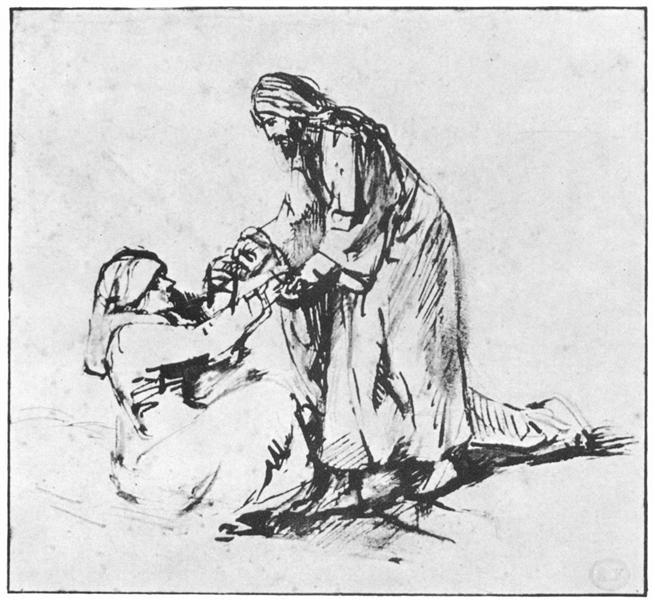
After “church”, so to speak, Jesus and his buddies go to Simon’s house for a meal. Where Simon’s wife was we’re not told, but his mother-in-law seems to have been chief cook and bottle washer. Unfortunately, on that day, she’s not feeling well. However, with but a touch from Jesus, she’s restored and begins waiting on the guys.
The Healing of Peter’s Mother-in-Law by Rembrandt
On leaving the synagogue Jesus entered the house of Simon and Andrew with James and John. Simon’s mother-in-law lay sick with a fever. They immediately told him about her. He approached, grasped her hand, and helped her up. Then the fever left her and she waited on them.
Mark 1:29-31
It seems like Jesus and his friends hung out through the heat of the day. As evening cool descends, neighbors begin arriving with their sicknesses and troubled spirits. Jesus cures many of those gathered. Can you just imagine the scene!
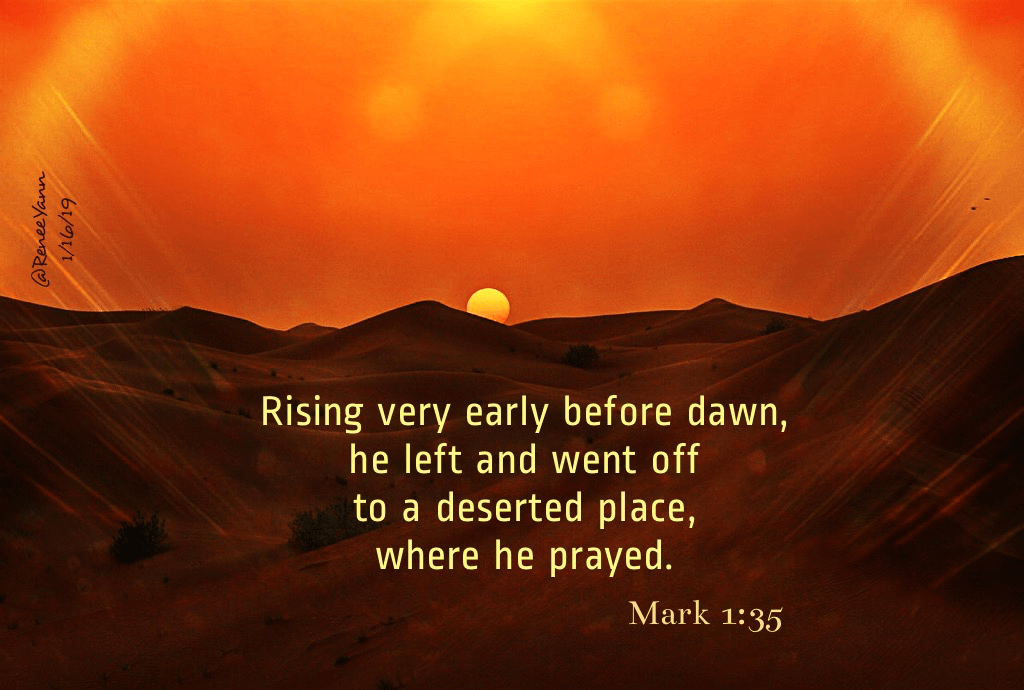
The next morning, even before dawn, Jesus goes off to a quiet place to pray. No doubt he wants to discern, with his Father and the Holy Spirit, the things that are happening in his life. Again can you imagine that conversation!
We know that, when asked, Jesus gave us the human words of the “Our Father” to teach us to pray. But how did Jesus himself pray in the solitude of his heart?
Three Persons of the Blessed Trinity focused in relationship to one another and yielding a Love too immense for description!
In our own humble prayer today, may we lean against the heart of Jesus as he immersed himself in the Presence of the Creator and Spirit. May we pray in Christ’s pregnant silence.
Poetry: Solitude – Thomas Merton
When no one listens
To the quiet trees
When no one notices
The sun in the pool.

Where no one feels
The first drop of rain
Or sees the last star

Or hails the first morning
Of a giant world
Where peace begins
And rages end:

One bird sits still
Watching the work of God:
One turning leaf,
Two falling blossoms,
Ten circles upon the pond.

One cloud upon the hillside,
Two shadows in the valley
And the light strikes home.
Now dawn commands the capture
Of the tallest fortune,
The surrender
Of no less marvelous prize!

Closer and clearer
Than any wordy master,
Thou inward Stranger
Whom I have never seen,

Deeper and cleaner
Than the clamorous ocean,
Seize up my silence
Hold me in Thy Hand!

Now act is waste
And suffering undone
Laws become prodigals
Limits are torn down
For envy has no property
And passion is none.

Look, the vast Light stands still
Our cleanest Light is One!
Music: Intermezzo in B minor – Maureen McCarthy Draper
Today, in God’s Lavish Mercy, Jesus makes a remarkable debut!
Picture the scene. It is a beautiful morning in the Judean Valley where the Jordan Riven runs fresh and sparkling. Most scholars place the Baptism of Jesus sometime in January, which means the weather would have been relatively cool. But perhaps, like our own weather, an unusually warm day may have snuck in.
Rustic, fiery preacher John is baptizing in the Jordan River. Crowds have come to hear what he has to say. Some are convinced and dive into the cool water under his hand.
Others rim the hillside, not so sure John isn’t one of the many who have glorious visions but few facts.
Then, out from the pines on the far side of the river, comes Jesus, flanked by some of the Twelve. While his companions chat away to Jesus, his eyes are focused on John. In an instant, Jesus realizes that this is the moment for his revelation. In that same instant, all Creation realizes the same thing.
As Jesus walks slowly toward John, the birds and little animals speak to him, “My Lord and my God…”. Wind whistling through the trees becomes an Oratorio praising him. All the surrounding colors deepen, breaking forth in unimaginable light.
John is stunned by the cosmic change he senses but cannot describe. Heart trembling, he looks into Jesus’s eyes and catches a glimpse of heaven. “I need to be baptized by you”, John says,”and yet you are coming to me?”
Jesus smiles at his cousin, replying,
“Let it be so now; it is proper for us to do this to fulfill all righteousness.”
Then John consented.
Perhaps those in the crowd, schooled in the ancient scriptures, heard Isaiah’s voice in the charged atmosphere:
Here is my servant whom I uphold, my chosen one with whom I am pleased, upon whom I have put my spirit; he shall bring forth justice to the nations, not crying out, not shouting, not making his voice heard in the street. a bruised reed he shall not break, and a smoldering wick he shall not quench, until he establishes justice on the earth; the coastlands will wait for his teaching.
Matthew tells us:
As soon as Jesus was baptized, he went up out of the water.
Can you see him light-heartedly splashing John as he shakes his dark curls free of the chilly water? Can you see his transfigured face as he hears his Father speak Love over him?
At that moment heaven was opened, and he saw the Spirit of God descending like a dove and alighting on him. And a voice from heaven said, “This is my Son, whom I love; with him I am well pleased.”
What a beautiful moment in time! Don’t we wish we might have been there in the blessed and awe-struck crowd? We can. Let your prayer of imagination take you there. What happens in your heart when the newly baptized Jesus catches your eyes?
Today, in God’s Lavish Mercy, we celebrate the great feast of the Epiphany of Our Lord, a day which commemorates Christ’s manifestation to the Gentiles.
Perhaps on this day, as little children, some of us placed the Three Kings in the crèche, fascinated by their journey and their majesty (and of course by the camels.). These figures represented all nations bringing their gifts to the newborn Savior. In their humble generosity, the journeyers eyes were opened and they recognized Divinity in the most unlikely of places.
An epiphany is a special kind of vision. It is an insight to see something amazingly deeper in what we thought we had already perceived.
We might walk by a tree, a house, a person day after day taking them completely for granted. We see them – but don’t really see them. Then, one day, a certain turn of sun on leaves might let us see that tree differently. An open window with its curtains billowing might transform that house into a home. A caring exchange might change that person into a friend.
And we say things like, “Gosh, why had I never noticed that before…”
The Three Kings were given the grace of Epiphany to see God where others saw only a poor newborn. They were given the wisdom to see Herod’s treachery where he pretended to offer only homage.
This feast reminds us that a sacred dimension exists beneath the surface of all appearances. Every reality contains the capacity for holiness, for goodness, for wisdom, for love. The more we are attuned to Grace, the more we recognize the presence (or the absence, as with Herod) of this capacity. The more we begin to live in deeper relationship with the seemingly ordinary in our lives.
Because actually, nothing is ordinary! Everything that comes to us is fraught with grace and divine possibility. We just need to live intentionally – to ask for and respond to the gift of Epiphany as it is given in our particular circumstances.
Poetry: I think the sentiments of today’s feast thread through a beautiful poem by William Wordsworth, Ode: Intimations of Immortality from Recollections of Early Childhood – particularly in these lines:
Our birth is but a sleep and a forgetting:
The Soul that rises with us, our life’s Star,
Hath had elsewhere its setting,
And cometh from afar:
Not in entire forgetfulness,
And not in utter nakedness,
But trailing clouds of glory do we come
From God, who is our home:
Heaven lies about us in our infancy!
Poetry lovers might like to read the entire poem here:
Today, in God’s Lavish Mercy, we have the belovedly familiar story of the Miracle at Cana.
There was a wedding at Cana in Galilee, and the mother of Jesus was there. Jesus and his disciples were also invited to the wedding. When the wine ran short, the mother of Jesus said to him, “They have no wine.”
John 2: 1-3
Like all good stories, this one is engaging on so many levels:
We see Mary and Jesus enjoying a social event in the same way we would.
We see Mary extending her solicitude and influence for the sake of the hosting family.
We see Jesus needing a swift nudge from his mother to do the right thing!
We see the Apostolic tipsters slowly waking up to the fact that Jesus is not just the guy next door!
We can pray with this Gospel passage by entering it from any one of these, or other, perspectives. We can easily sit right down at one of the wedding tables and watch the slow, human revelation of God in the world. But I think our first reading makes a strong case for us to pray the Cana story as a perfect example of how we should make our prayers of petition.
If you’re like me, you ask God for a lot of things every single day. Some of them are big deal things like “Please move hearts to stop the war on Ukraine.” And some of them are little deals like, “Please don’t let it rain on my picnic!”
In our first reading, John tells us how to pray our needs to God – with the utter confidence that, within God’s Will, we are heard.
Beloved: We have this confidence in God, that if we ask anything according to God’s will, we are heard. And if we know that God hears us in regard to whatever we ask, we know that what we have asked for is ours.
1 John 5: 14-15
This is the way Mary offers her petition in our Gospel story. She knows that Jesus will hear her and do the right thing. She doesn’t niggle him to death to get it done. She knows that by her “prayer”, she is now present to God’s infinite awareness of our needs.
His mother said to the servers, “Do whatever he tells you.”
John 2:5
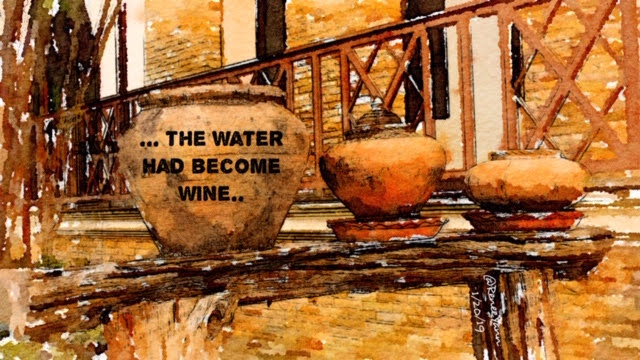
In this case, that “right thing” was to turn huge vats of water into delicious wine. A very satisfying outcome! But what about when our prayer doesn’t result in a deluge of wine? What about when it seems like God paid no attention to our request? Can we still have the unyielding confidence which John encourages and Mary exemplifies?
Our faith calls us to believe that God is present with us in all things. Our prayer opens us to seek that Presence and to respond in faith to our circumstances knowing that even when the vessels seem empty, God abides. Ours is a life in God not limited to one petition, or one prayer. It is an incremental immersion into an Eternal Truth which transcends any particular circumstance. God is always with us and that alone is the source of our confident prayer.
We also know that the Son of God has come and has given us discernment to know the one who is true. And we are in the one who is true, in God’s Son Jesus Christ. He is the true God and eternal life.
1 John 5:20
Poetry: Cana Wine – Irene Zimmerman, OSF
“The weather’s so hot
and no more wine’s to be bought
in all of Cana!
It’s just what I feared—
just why I begged my husband
to keep the wedding small.”

“Does he know?” Mary asked.

“Not yet. Oh, the shame!
Look at my son and his beautiful bride!
They’ll never be able
to raise their heads again,
not in this small town.”
“Then don’t tell him yet.”
Mary greeted the guests
as she made her way
through crowded reception rooms.
“I must talk to you, Son,”
she said unobtrusively.

Moments later he moved
toward the back serving rooms.
They hadn’t seen each other
since the morning he’d left her—
before the baptism
and the desert time.

There was so much to tell her,
so much to ask.
But this was not the time!
They could talk tomorrow
on the way to Capernaum.
She spoke urgently, her words
both request and command to him:
“They have no wine.”
But he hadn’t been called yet!
He hadn’t felt it yet.
Would she send him so soon
to the hounds and jackals?
For wine?

Was wine so important then?

“Woman, what concern is that
to you and me?
My hour has not yet come.”

Her unflinching eyes reflected to him
his twelve-year-old self
telling her with no contrition:
“Why were you searching for me?
Did you not know I must be
in my Father’s house?”

She left him standing there—
vine from her stock,
ready for fruit bearing—
and went to the servants.
“Do whatever he tells you,” she said.

From across the room
she watched them fill water jars,
watched the chief steward
drink from the dripping cup,
saw his eyes open in wide surprise.

She watched her grown son
toast the young couple,
watched the groom’s parents
and the guests raise their cups.

She saw it all clearly:
saw the Best Wine
pouring out for them all.
Today, in God’s Lavish Mercy, we celebrate the Feast of St. Elizabeth Anne Seton, the first American born saint.
Elizabeth Seton was born on August 28, 1774, of a wealthy and distinguished Episcopalian family. She was baptized in the Episcopal faith and was a faithful adherent of the Episcopal Church until her conversion to Catholicism.
She established her first Catholic school in Baltimore in 1808; in 1809, she established a religious community in Emmitsburg, Maryland. After seeing the expansion of her small community of teaching sisters to New York and as far as St. Loius, she died on January 4, 1821, and was declared a saint by Pope Paul VI on September 14, 1975. She is the first native born American to be canonized a saint.
(from CatholicCulture.org)
In our Gospel, we find the first disciples encountering Jesus. They are curious about him because the Baptist has just described him as “the Lamb of God”.
The two disciples heard what he said and followed Jesus. Jesus turned and saw them following him and said to them, “What are you looking for?” They said to him, “Rabbi” (which translated means Teacher), “where are you staying?” He said to them, “Come, and you will see.” So they went and saw where he was staying, and they stayed with him that day. It was about four in the afternoon. Andrew, the brother of Simon Peter, was one of the two who heard John and followed Jesus.
John 1: 37-40
We can picture Andrew and his unnamed buddy trailing behind Jesus, watching him, listening to him. Finally they hazard a question, “Rabbi, where do you live?”
It’s kind of a loaded question. What it might really mean are things like these:
Where did you come from all of sudden?
How could you possibly be the Messiah if you’re walking around looking just like us?
Do you go back to heaven at night or are you really one of us?
Can we just hang out and find out more about you?
Their faith is tentative, hopeful and maybe just a little bit suspicious. Does your faith ever feel like that?
When we pray, are we convinced that God hears us? When we suffer, do we believe God abides with us? When we choose, act or respond, do we trust that God cares about our actions? Do we believe, in these and all circumstances, that the power of God is present in our lives?
To have that kind of faith, we have to “learn” Christ, to become as close and comfortable with him as with an intimate friend. In our Gospel, Jesus tells us how to do that: “Come and see.”
In other words:
Spend time with me. Talk with me about ordinary things. Watch sunsets and sunrises with me. Tell me your secrets. Let me tell you mine. Laugh with me. Be silent with me. Trust that you are never separate from me.
If we do these things, even slowly and steadily as the first disciples, we will eventually say with Andrew, “l have found the Messiah” – and he is living right within my life!
Poetry: the calling of the disciples – Lucille Clifton
some Jesus
has come on me

i throw down my nets
into the water he walks

i loose the fish
he feeds to cities

and everyone calls me
an old name

as i follow out
laughing like God’s fool
behind this Jesus
Today, in God’s Lavish Mercy, we pray with John’s soul-stirring words:
Beloved, we are God’s children …
When I pray these words I think of my mother. As a little child, I already bore a clear physical likeness to her. But as I grew into a young woman, and later an older woman, people remarked that we looked like twins. There were even occasions when we were confused with each other.
This visible resemblance gave me great pride. My mother was strong, courageous, funny, wise, and fiercely loving. I loved to hear the phrase, “Oh my, you are the image of your mother!” I wanted to be like her – made of the same stuff as she was.
In our reading today, John tells us that we are made of the very stuff of God – the essence of the Sacred. He suggests that when people look at us they should see God’s features written all over us.
See what love the Creator has bestowed on us that we may be called the children of God. Yet so we are.
1 John 2:30
John says that we should see this Divine familial likeness in one another – that we are each imprinted with our Creator’s image.
The reason the world does not know us is that it did not know him. Beloved, we are God’s children now; what we shall be has not yet been revealed.
1 John 2:31
If we believe John’s words, what tenderness we would bear toward ourselves and others! How could we ever belittle, hate or kill one another? How could we ever do these things to ourselves?
In our Gospel, the great prophet John the Baptist sees the imminent transformation of the world coming toward him in the person of Jesus Christ. May we see this too as, by our sincere prayer and study of the scriptures, the Light of Christmas waxes in our hearts throughout 2023. In that Loving Light, we recognize one another clearly as beloved children of God.
John the Baptist saw Jesus coming toward him and said, “Behold, the Lamb of God, who takes away the sin of the world. ….. John testified further, saying, “I saw the Spirit come down like a dove from the sky and remain upon him. I did not know him, but the one who sent me to baptize with water told me, ‘On whomever you see the Spirit come down and remain, he is the one who will baptize with the Holy Spirit.’ Now I have seen and testified that he is the Son of God.”
John 1:29-34
Poetry:I Am the Light – Malcolm Guite
I see your world in light that shines behind me,
Lit by a sun whose rays I cannot see,
The smallest gleam of light still seems to find me
Or find the child who’s hiding deep inside me.
I see your light reflected in the water,
Or kindled suddenly in someone’s eyes,
It shimmers through the living leaves of summer,
Or spills from silver veins in leaden skies,
It gathers in the candles at our vespers
It concentrates in tiny drops of dew
At times it sings for joy, at times it whispers,
But all the time it calls me back to you.
I follow you upstream through this dark night
My savior, source, and spring, my life and light.
Music: How Can Anyone Ever Tell You – Shaina Knoll
Often, when I think of Christ on the Cross, I can hear God the Mother singing this song to Jesus, reaching from heaven to console Him in His pain.
This morning, we might ask God to sing this song over our wounded world which has so obscured God’s likeness – perhaps to sing it over us if we are in particular pain.
In our heart’s deep forgiveness, we might sing this song over anyone who has hurt us – the meanness coming from their failure to recognize their own beauty – the fact that they and we are the very image of our loving God.
Solemnity of the Blessed Virgin Mary, the Mother of God
Theotokos, a mosaic mural from the Gelati Monastery, Georgia, (1125-1130 AD)
Today, in God’s Lavish Mercy, we celebrate Mary, Mother of Jesus.
We might begin prayer today by asking a question posed by distinguished theologian, Elizabeth Johnson, CSJ:
What would be a theologically sound, spiritually empowering and ethically challenging theology of Mary, mother of Jesus the Christ, for the 21st century? This question has no simple answer, for the first-century Jewish woman Miriam of Nazareth, also held in faith to be Theotokos, the God-bearer, is arguably the most celebrated woman in the Christian tradition. One could almost drown surveying the ways different eras have honored her in painting, sculpture, icons, architecture, music and poetry; venerated her with titles, liturgies, prayers and feasts; and taught about her in spiritual writings, theology and official doctrine.
In my own prayer today, though, I am not reaching for a deeper theological understanding of Mary. I simply want to talk with her as a faithful woman, my Mother, my older Sister, my Friend. I want to seek her guidance and her inspiration. I want to thank her for her continual willingness to bear Christ into the world, and into my life.
How significant it is that the Church begins the year inviting us all to Mary’s Light! Our first reading blesses us in a way that Mary might bless us, especially as we begin this New Year of grace:
The LORD bless you and keep you! The LORD let his face shine upon you, and be gracious to you! The LORD look upon you kindly and give you peace!
Numbers 6: 24-26
Mary was all about giving us the LORD, not giving us herself. We see Mary best when we see her holding Christ toward us – the “God-bearer” or “Theotokos”.
Theotokos Vladimirskaya icon, Vologda, Vladimirskaya Church, mid-end 16 century
“Theotokos”, a title used especially in Eastern Christianity, originated in the 3rd century Syriac tradition. It affirms Mary as the Mother of Jesus, Who was both human and divine in nature.
Our reading from Galatians assures us that we too, by our Baptism, are the daughters and sons of God – thus becoming Mary’s own. She is our Mother too by the power of this sacrament.
When the fullness of time had come, God sent his Son, born of a woman, born under the law, to ransom those under the law, so that we might receive adoption as sons
Galatians 4:4
Our Gospel reveals the spirituality of Mary who, after all the heavenly wonders faded, “pondered” all the mysterious workings of God deep in her heart. This Mary is my revered sister, guiding me as I meet the unfolding of God in my own life.
And Mary kept all these things, reflecting on them in her heart. Then the shepherds returned, glorifying and praising God for all they had heard and seen, just as it had been told to them.
Luke 2: 19-20
Today, let us pray with Mary, our Mother, our Sister, Bearer of God. Let us learn to be “ponderers” and “bearers” of God in her pattern. Let us pray for the whole Church, the whole world – all of whom dear Mary tenderly loves.
Music: Two selections today.
A Peaceful Hymn to the Theotokos – Nuns of the Carmazani Monastery in Romania
Today, in God’s Lavish Mercy, as I begin to create today’s reflection, Pope Francis has asked the world to pray for Pope Emeritus Benedict XVI who is mortally ill. Perhaps by the time you red this, God will already have taken Benedict home. If so, may he rest in peace.
Today’s readings fit so well for this moment for Benedict and for the Church. Our first reading offers us John’s perfect honesty and simplicity:
Whoever says, “I know him,” but does not keep his commandments is a liar, and the truth is not in him. But whoever keeps his word, the love of God is truly perfected in him. This is the way we may know that we are in union with him: whoever claims to abide in him ought to walk just as he walked.
1 John 2:5-6
Yes, it’s that simple and that hard!
It is so fitting that as we pray Pope Benedict home to heaven, we meet Simeon in our Gospel. He speaks with the holy confidence of a long and well-lived life. His lifelong dream was that he might not die before seeing the Messiah. That dream now fulfilled, Simeon intones one of the most beautiful prayers in Scripture:
Lord, now let your servant go in peace; your word has been fulfilled: my own eyes have seen the salvation which you prepared in the sight of every people, a light to reveal you to the nations and the glory of your people Israel.
Luke 2: 29-32
If we live by the Light, we too will see the Messiah within our own life’s experiences. We too will come to our final days confident and blessed by that enduring recognition.
For as John also assures us:
Whoever says they are in the light, yet hates their brother or sister is still in the darkness. But whoever loves their brother and sister remains in the light …
1 John 2:9-10
Let’s pray today for those all who are dying, that they may know this kind of peace, especially for Pope Emeritus Benedict XVI.
Let us pray for ourselves, that when our time comes, we too may experience this confidence.
Poetry: Nunc Dimittis – Joseph Brodsky (from Joseph Brodsky, A Part of Speech by George L. Kline (NY: Noonday, 1996) The poem is long but exceptionally beautiful. I hope you can take the time to enjoy it.
‘Nunc Dimittis’
When Mary first came to present the Christ Childto God in His temple, she found—of those fewwho fasted and prayed there, departing not from it—devout Simeon and the prophetess Anna.The holy man took the Babe up in his arms.The three of them, lost in the grayness of dawn,now stood like a small shifting frame that surroundedthe Child in the palpable dark of the temple.The temple enclosed them in forests of stone.Its lofty vaults stooped as though trying to cloakthe prophetess Anna, and Simeon, and Mary—to hide them from men and to hide them from Heaven.And only a chance ray of light struck the hairof that sleeping Infant, who stirred but as yetwas conscious of nothing and blew drowsy bubbles;old Simeon's arms held him like a stout cradle.It had been revealed to this upright old manthat he would not die until his eyes had seenthe Son of the Lord. And it thus came to pass. Andhe said: ‘Now, O Lord, lettest thou thy poor servant,according to thy holy word, leave in peace,for mine eyes have witnessed thine offspring: he isthy continuation and also the source ofthy Light for idolatrous tribes, and the gloryof Israel as well.' The old Simeon paused.The silence, regaining the temple's clear spaceoozed from all its corners and almost engulfed them,and only his echoing words grazed the rafters,to spin for a moment, with faint rustling sounds,high over their heads in the tall temple's vaults,akin to a bird that can soar, yet that cannotreturn to the earth, even if it should want to.A strangeness engulfed them. The silence now seemedas strange as the words of old Simeon's speech.And Mary, confused and bewildered, said nothing—so strange had his words been. He added, while turningdirectly to Mary: ‘Behold, in this Child,now close to thy breast, is concealed the great fallof many, the great elevation of others,a subject of strife and a source of dissension,and that very steel which will torture his fleshshall pierce through thine own soul as well. And that woundwill show to thee, Mary, as in a new visionwhat lies hidden, deep in the hearts of all people.’He ended and moved toward the temple's great door.Old Anna, bent down with the weight of her years,and Mary, now stooping gazed after him, silent.He moved and grew smaller, in size and in meaning,to these two frail women who stood in the gloom.As though driven on by the force of their looks,he strode through the cold empty space of the templeand moved toward the whitening blur of the doorway.The stride of his old legs was steady and firm.When Anna's voice sounded behind him, he slowedhis step for a moment. But she was not callingto him; she had started to bless God and praise Him.The door came still closer. The wind stirred his robeand fanned at his forehead; the roar of the street,exploding in life by the door of the temple,beat stubbornly into old Simeon's hearing.He went forth to die. It was not the loud dinof streets that he faced when he flung the door wide,but rather the deaf-and-dumb fields of death's kingdom.He strode through a space that was no longer solid.The rustle of time ebbed away in his ears.And Simeon's soul held the form of the Child—its feathery crown now enveloped in glory—aloft, like a torch, pressing back the black shadows,to light up the path that leads into death's realm,where never before until this present hourhad any man managed to lighten his pathway.The old man's torch glowed and the pathway grew wider.
Music: Nyne Otpushchayeshi ~Sergei Rachmaninoff (translated Nunc Dimittis, Now Let Your Servant Go). This was sung at Rachmaninoff’s funeral, at his prior request.
Thursday of the Fourth Week of Advent December 22, 2022
Today, in God’s Lavish Mercy, our O Antiphon beseeches God, Who is King of All Nations, Who unites Gentile and Jew, to deliver us.
But from what?
The answer lies in the closing phrase of the antiphon: “we whom you formed from the dust of the earth”.
Deliver us from the artificial barriers we have created to separate from and dominate over one another – by nationality, ethnicity, color, gender, social or economic class. We each began as dust and will end that way. May we be humble, mutual and compassionate in the time between.
Consider the holy humility of Hannah in our first reading today, and of Mary in our Gospel. They are power figures in Salvation History. But their power comes from their utter dependence on and honor to God, their only true King.
I prayed for this child, and the LORD granted my request. Now I, in turn, give him to the LORD; as long as he lives, he shall be dedicated to the LORD.”
1 Samuel 1: 27-28
My soul proclaims the greatness of the Lord; my spirit rejoices in God my savior. for he has looked upon his lowly servant. From this day all generations will call me blessed: the Almighty has done great things for me, and holy is his Name.
Luke 1: 46-49
There was no fragmentation in the commitment of their entire lives to God. They understood all Creation to belong to the Divine.
King of Kings, deliver us from any such fragmentation. Make us all whole in You.
O King of all nations and keystone of the Church: come and save us, whom you formed from the dust! R. Alleluia, alleluia.
Poetry: A King Dressed as a Servant – Rumi
You may interpret Rumi, of course, as you wish. He is deeply mystical and his thoughts don’t always correspond to a logical path. But that’s the real beauty of his poetry. We can put ourselves in his poem and shape it to fit our experience of God. In this poem, Rumi says that we must wait, and be ready, for God’s Love to come to us. And when it does, it will be far beyond anything we expected.
A sweet voice calls out,"The caravan from Egypt is here!"A hundred camels with what amazing treasure!Midnight, a candle and someone quietlywaking me, "Your friend has come."I spring out of my body, put a ladderto the roof, and climb up to see ifit's true.Suddenly, there is a world within this world!An ocean inside the water jar!A king sitting with me wearingthe uniform of a servant!A garden in the chest of the gardener!I see how love has "thoughts,"and that these thoughts are circulatingin conversation with majesty.Let me keep opening this momentlike a dead body reviving.My teacher saw the Placeless Oneand from That, made a place.
Music: O Rex Gentium – Gregorian Chant ( this is a Latin rendering of the italicized prayer above.)
Today, in God’s Lavish Mercy, as the anticipation of Christmas builds to a crescendo, we have the tender and sublime images of the Song of Songs.
Hark! my lover–here he comes springing across the mountains, leaping across the hills. My lover is like a gazelle or a young stag. Here he stands behind our wall, gazing through the windows, peering through the lattices.
Song of Songs 2:8-9
This book of the Bible is unique in that “it shows no interest in Law or Covenant or the God of Israel, nor does it teach or explore wisdom like Proverbs or Ecclesiastes. Jewish tradition reads it as an allegory of the relationship between God and Israel; Christianity, as an allegory of Christ and his bride, the Church.” (Wikipedia)
Like all enduring poetry, the Song of Songs invites us to match its images with our own understanding of God. Of course, God is more than any image we can humanly create, but our relationship with God has the characteristics of a human relationship because WE are human.
As we read this passage, we might pray with thoughts like these:
God loves me – and all Creation – passionately.
God wants and waits for me to notice the loving Divine Presence in my life
God’s love is energetic and attentive. God is at the center and edge of all my existence.
Added to all that, God wants us to live in the world as people who already see the Spring of Eternal Life. Living with that kind of faith and hope allows us not only to find God, but to reflect God’s Presence to all around us.
For see, the winter is past, the rains are over and gone. The flowers appear on the earth, the time of pruning the vines has come, and the song of the dove is heard in our land. The fig tree puts forth its figs, and the vines, in bloom, give forth fragrance. Arise, my beloved, my beautiful one, and come!
Songs of Songs 8: 11-13
On this day of Winter Solstice, when – depending on our hemisphere – we are ultimately close or far from our Sunstar, this particular passage is so comforting. In our everyday life we will still experience a rollercoaster of seasons – sadness and joy and everything in between. But beyond all the seasons, the Verdant Eastertide has already redeemed our lives. With deep faith and hope, we can always live with the Spring’s abundance.
The Visitation by Raphael
In our Gospel, we are given a beautiful picture of Mary and Elizabeth, with in-vitro Jesus and John – dancing in the graces of this holy Springtime. Join them as we sing of O Antiphon for today:
R. Alleluia, alleluia. O Emmanuel, our King and Giver of Law: come to save us, Lord our God! R. Alleluia, alleluia.
Poetry: May is Mary’s Month – Gerard Manley Hopkins
May is Mary’s month, and I
Muse at that and wonder why:
    Her feasts follow reason,
    Dated due to season—

Candlemas, Lady Day;
But the Lady Month, May,
    Why fasten that upon her,
    With a feasting in her honour?

Is it only its being brighter
Than the most are must delight her?
    Is it opportunest
    And flowers finds soonest?

Ask of her, the mighty mother:
Her reply puts this other
    Question: What is Spring?—
    Growth in every thing—

Flesh and fleece, fur and feather,
Grass and greenworld all together;
    Star-eyed strawberry-breasted
    Throstle above her nested

Cluster of bugle* blue eggs thin
Forms and warms the life within;
    And bird and blossom swell
    In sod or sheath or shell.

All things rising, all things sizing
Mary sees, sympathising
    With that world of good,
    Nature’s motherhood.

Their magnifying of each its kind
With delight calls to mind
    How she did in her stored
    Magnify the Lord.

Well but there was more than this:
Spring’s universal bliss
    Much, had much to say
    To offering Mary May.

When drop-of-blood-and-foam-dapple
Bloom lights the orchard-apple
    And thicket and thorp† are merry
    With silver-surfèd cherry

And azuring-over greybell makes
Wood banks and brakes‡ wash wet like lakes
    And magic cuckoocall
    Caps, clears, and clinches all—

This ecstasy all through mothering earth
Tells Mary her mirth till Christ’s birth
    To remember and exultation
    In God who was her salvation.










 Lavish Mercy