Today, in Mercy, we continue to relish John’s eloquent first letter in which he heartily instructs us in the life of Christian love.
John has written this letter out of concern about false teachings that are cropping up in the early Church. Misguided “teachers” are placing distorted interpretations on the pure, original message of the Gospel.
Human beings have never stopped doing that, have we? Down through the centuries, how many heresies and misinterpretations have woven their way into the Gospel’s central, inviolable thread?
Has it happened to our faith? Have we lost the crisp, clear power of our original belief?
John tells us to hold fast to the core teaching of the Gospel. This is the faith that many of us learned as children from devout parents and teachers. It is a faith that continues to evolve through scriptural prayer and meditation, through openness to theological wisdom, through the holy dialogue of the beloved community.
It is a living faith, stretched and tested by our daily choices for true Christian love for all people, especially the poor, sick and marginalized.
Ultimately, it is a faith rooted in the Cross and transformed by the Resurrection.
Over these next few weeks, let us listen carefully to John as he guides us to the depth of that faith.
Music: some gentle meditation music for your prayer with John:
Today, in Mercy, our readings offer a harmonious exultation of Mary, beloved mother of Jesus.
The prophet Micah foretells the time “when she who is to give birth has borne.”
Even the ancient voices spoke of Mary, long before time knew her name. Their hope depended on her cosmic“Yes”, long before she spoke her first childish word.
Hebrews speaks of the Body of Christ, that physical place where the grandeur of God took flesh, that tabernacle woven of Mary’s own body and blood, that temple made possible by her “Fiat”.
The Gospel gives us two loving women, Elizabeth and Mary, rejoicing in God’s power manifested in their lives. They need no proclamations, executive orders, bills, or injunctions. Just a soft greeting, a leap within, a confirmed trust carried in each other’s eyes.
This poem by Mark Strand captures their moment for me. These two women had waited with all Creation for the redeeming Messiah. Now it was about to happen within their lives:
The Coming of Light Even this late it happens: the coming of love, the coming of light. You wake and the candles are lit as if by themselves, stars gather, dreams pour into your pillows, sending up warm bouquets of air. Even this late the bones of the body shine and tomorrow’s dust flares into breath.
Music: Agni Parthene (Greek: Ἁγνὴ Παρθένε), rendered “O Virgin Pure”, is a Greek Marian Hymn composed by St. Nectarios in the late 19th century. The dulcet melody is sung here in both Greek and English. Lyrics are below.
O Virgin Pure
by St. Nectarios
Refrain: O Rejoice, Bride Unwedded.
O Virgin pure, immaculate/ O Lady Theotokos
O Virgin Mother, Queen of all/ and fleece which is all dewy
More radiant than the rays of sun/ and higher than the heavens
Delight of virgin choruses/ superior to Angels.
Much brighten than the firmament/ and pure than the sun’s light
More holy than the multitude/ of all the heav’nly armies.
O Rejoice, Bride Unwedded.
O Ever Virgin Mary/ of all the world, the Lady
O bride all pure, immaculate/ O Lady Panagia
O Mary bride and queen of all/ our cause of jubilation
Majestic maiden, Queen of all/ O our most holy Mother
More hon’rable than Cherubim/ beyond compare more glorious
than immaterial Seraphim/ and greater than angelic thrones.
O Rejoice, Bride Unwedded.
Rejoice, O son of Cherubim/ Rejoice, O hymn of angels
Rejoice, O ode of Seraphim/ the joy of the archangels
Rejoice, O peace and happiness/ the harbor of salvation
O sacred chamber of the Word/ flower of incorruption
Rejoice, delightful paradise/ of blessed life eternal
Rejoice, O wood and tree of life/ the fount of immortality
O Rejoice, Bride Unwedded.
I supplicate you, Lady/ now do I call upon you
And I beseech you, Queen of all/ I beg of you your favor
Majestic maiden, spotless one/ O Lady Panagia
I call upon you fervently/ O sacred, hallowed temple
Assist me and deliver me/ protect me from the enemy
And make me an inheritor/ of blessed life eternal.
Today, in Mercy, we come to the end of our readings from Revelation.They have been challenging, to say the least.
The passage from Luke’s Gospel today is just as confronting.These are not easy times.
Our prayer over these past few days has led us to deeper understanding of this hard truth: life as we know it will be transformed and we will be judged at the transformation.
But hopefully our reflections have also assured us that the Master and Judge of Life is the same merciful God who forgave and healed the sinful and suffering.
By our faithfulness to this merciful God, we will be redeemed. Revelation puts it this way:
The servants of God
will look upon his face,
and his name
will be on their foreheads.
When a person is filled with goodness (or evil), we often say it is “written all over her face”.So it is with those who love and long for God and for God’s peaceable kingdom.
God will recognize us at the judgment because our hope and desire for God are written all over our face. And God’s love for us will be written all over that Divine Countenance.
Today, in Mercy, we celebrate the feast of St. Frances Xavier Cabrini, who from a very young age, was filled with the missionary spirit.
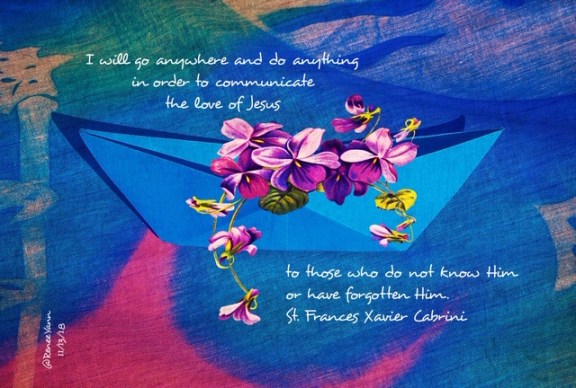
When she went to visit to her uncle, Don Luigi Oldini of Livagra,
a priest who lived beside a swift canal, she made little boats of paper,
dropped violets in them, called the flowers missionaries,
and launched them to sail off to India and China.
~ Lives of the Saints – John J. Cauley ~
Frail as a young woman, she was at first rejected for religious life. But eventually, through the often labyrinthine ways of God’s grace, Frances founded the Missionary Sisters of the Sacred Heart of Jesus.
Still desiring to be a missionary to China, Frances petitioned the Pope for approval. He, instead, requested that she and her sisters go to the USA to minister to the massive influx of Italian immigrants there.
She did this with an extraordinary and holy distinction. In 1945, Frances became the first citizen of the USA to be canonized a Saint.
To learn more about her life and legacy, see the website of her community:
Today, in Mercy, we learn lessons from widows – those whose place in biblical times was uncertain and frightening. Without a husband, a woman experienced diminished standing in the legal, financial and political life of the community.
She was often dependent on charity, and was deemed fortunate to capture a bit of good will from those in better circumstances.
There are several examples of widows being blessed by miracles, because they were among those most in need of them.
In today’s first reading and in the Gospel, we meet two widows displaying amazing charity and character strength.The widow of Zarephath steadfastly prepares for death because she has nothing left to live on. When Elijah asks to share in her last few cornmeal cakes, she does not hesitate to feed him.
In our Gospel, it is significant that, just across the road from the well-stocked treasury, a nearly penniless widow gives her last coins to the poor.
In Elijah’s account, we learn the outcome of the widow’s generosity.She reaps an abundant reward in perpetual flour and oil to sustain her.
We never learn what happens to Jesus’s widow. We are left to imagine that, in some way, her selflessness is rewarded.
It is so hard to give it all to God, especially if we feel we have little left for ourselves.It is hard to give our love when we feel empty-hearted.It is hard to give care when we feel unappreciated.It is hard to assist others when we ourselves are exhausted. It is hard to do good if no one, not even God, seems to notice.
But God does notice.Like Jesus on that long-ago afternoon, God is watching as we empty our coffers in service and care for the poor, sick, troubled and lost.
What we have to give may be small — a single corn cake or two little coins. It is the act of givingit that is large — and will make our hearts large by the choice.
One this date in 1841, Catherine McAuley, the first Sister of Mercy, died. She had given everything she had — a fortune actually.. and a life — for God’s poor and needy.Let’s call on her to inspire us to greater charity and mercy. God knows we need to do something for this aching world!
Today, in Mercy, both Jesus and Paul continue to instruct us on the Christian life. Paul, writing from a distance to his beloved Philippians, encourages them to hold fast to the teachings he gave them when he was with them. We can sense, in Paul’s tone, an awareness of his impending death. There is a “last advice” urgency in his words.
The same is true of Jesus’s teaching in the Gospel. He is driving home the point that, with God, it must be all or nothing. We can’t be half-hearted, “sometimes” disciples.
His words fall hard on our sensibilities.
If anyone comes to me without hating his father and mother, wife and children, brothers and sisters,
and even his own life,
he cannot be my disciple.
Really? Hate? In a Gospel which is always Love, from a man who is himself Love, what can this really mean?
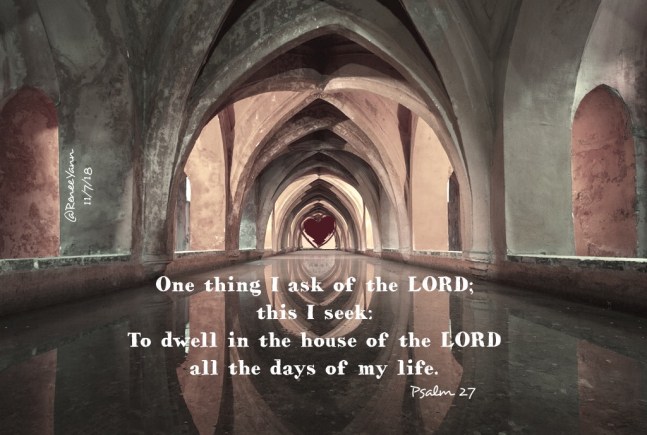
For me, the passage says that we can let nothing hold us that would turn us from God – even if that might be as dear as beloved family. It means that our one core desire must be that of the Psalmist:
One thing I ask of the LORD;
this I seek:
To dwell in the house of the LORD
all the days of my life,
That I may gaze on the loveliness of the LORD
and contemplate his temple.
What we love, cherish and choose should reveal God’s heart to us, not obscure it. If that’s not the case, we have some tough choices to make, just like Jesus’s listeners in today’s Gospel.
Today, in Mercy,we continue our readings from Paul’s inspiring letter to the Philippians. Paul sincerely loves this community and wants them to be perfected in Christ.
This is what Jesus wants for us too.Today’s Gospel is just one example of Jesus showing his followers the way to holiness. He uses the opportunity of a dinner to remind those gathered that they are very fortunate. Their lives are like a banquet compared with the lives of those who are poor and burdened.
He suggests that his followers do what God would do:
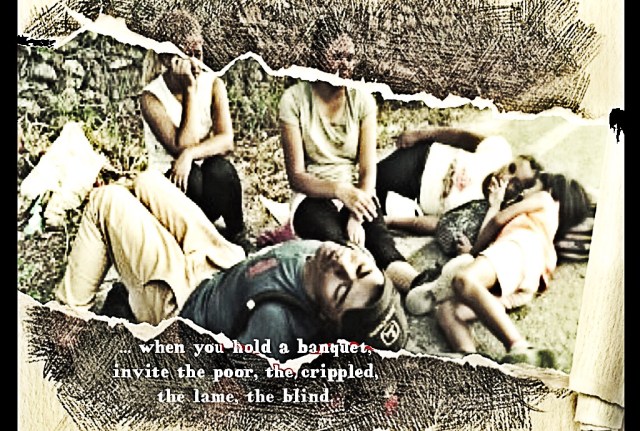
When you hold a banquet,
invite the poor, the crippled, the lame, the blind; blessed indeed will you be because of their inability to repay you….
Just such an opportunity to be blessed awaits us, in the USA, at our southern border. A wave of God’s beloved poor and besieged washes toward us. Will we meet them with true mercy and justice born out of Christian charity? Or will we confront them with a brutal show of power born of fear and alienation?
Of course, there are legitimate concerns with such a large migration. But these concerns must be met with wisdom and prudence, not prejudice and vilification. This is not a horde of animals attacking us. These are human beings desperately seeking a better life.
Jesus thought that his table companions, gifted as they were by God, had the moral capacity to respond to his challenge. Can he expect the same of us?
Let’s hope so, because our Gospel closes with a very compelling reason:
“For you will be repaid
(one way or the other, I might add)
at the resurrection of the righteous.”
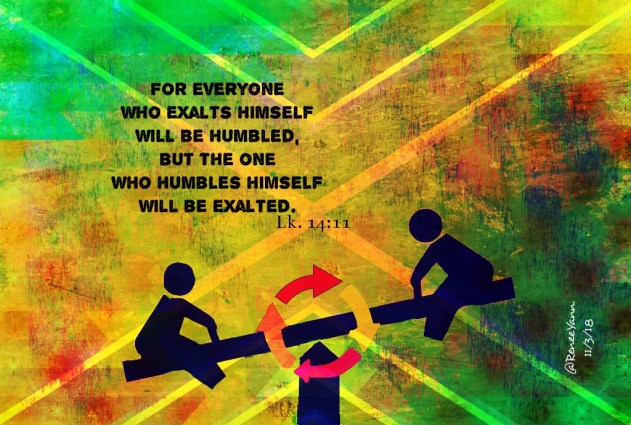
Today, in Mercy, Jesus gives us one of the many “seesaw“ choices of the Gospel:
with Me or against Me
sheep or goats
God or money
being first or last
being humble or exalted
These phrases are both hard and kind. They’re hard because they leave us no middle ground. It’s either-or, not both-and. I don’t know about you but I like both-and. I like to have my cake and eat it too. But it doesn’t work, does it?
The phrases are kind because, if we trust them, they make our choices clear.
Today’s Gospel tells us the secret to true spiritual greatness – humility. In worldly terms, that’s a contradiction. Just observe the pompous, dishonest posturing of some of our politicians to see how the world rejects humility as a path to greatness!
But Jesus turns the world upside-down. In Christ’s world, the seesaws go backward. They dip to power by service; to love by sacrifice; to wealth by compassion. They are rides in contradiction to the world.
Our spiritual life is the constant challenge of balancing these seesaws toward God and God’s beloved poor, wounded, and marginalized. That’s how Jesus rode them. That’s how He’s asking us to do it.
Today, in Mercy, having blessed and reassured the Ephesian community of the power of their Baptism, Paul instructs them in how to live a Christian life. He says that their Baptism demands a life worthy of their call.
Do you feel called? In your daily life, do you recognize the demand to witness to a graced life in the face of a sometimes ungracious world?
Paul says that’s what it’s all about:
the humble, gentle, patient exercise of Christian love
the building of inclusive community through acts of peace
the embrace of one God Who claims all humanity as one people
Therefore, anything that suggests hate, aggression, pride or exclusion is not worthy of our Baptismal call.
I watched – or tried not to watch – a few political ads last night. I heard the vitriolic rhetoric before I could tap the mute button. I saw the news clip about the terrorizing of a particular party’s leaders. My heart keeps saying, “What has happened to us?”
And then I read Paul’s admonitions on Christian responsibility.
Even if our culture’s rampant hostility makes us sad and angry, we must respond to it with Christian courage and peace-building action. We must not become like those who stun us with their indifference to life, humanity, morality and truth. We must never make an appeal to religion as an excuse for loveless behavior.
In our Gospel, Jesus challenges his listeners in a similar way:
Why do you not know how to interpret the present time? Why do you not judge for yourselves what is right?
Our times will challenge our Christian character. Will we pass the test?
Today, in Mercy, we celebrate the Feast of St. Luke, evangelist, writer of the Gospel and the Acts of the Apostles, and devoted missionary companion of Paul.
Luke’s Gospel is unique in several ways.
Six miracles appear only in Luke:
the miraculous catch of fish
the raising of the widow’s only son
healing a possessed, crippled woman
healing a man with dropsy
cleansing of ten lepers
healing the man’s ear in Gethsemane
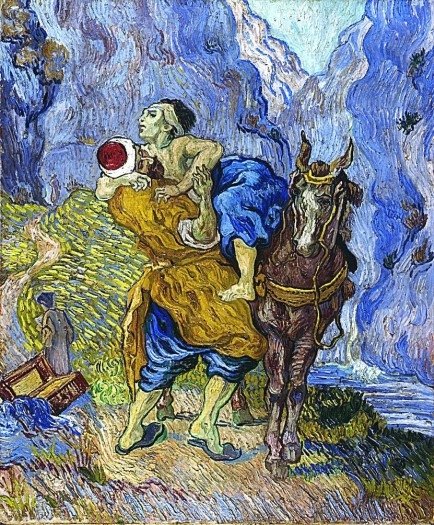
Eighteen parables are unique to Luke, including the beloved stories of the Good Samaritan and the Prodigal Son.
Van Gogh’s Good Samaritan
While both Matthew and Luke contain the story of Christ’s birth, only Luke includes those beautiful passages which now comprise the joyful mysteries of the rosary: Annunciation, Visitation, Nativity, Presentation, and Finding in the Temple.
Only Luke gives us the Magnificat and the cherished words of the Hail Mary.
Think of all that we would not be able to visualize without Luke’s blessed writings. No Gabriel. No Elizabeth, Zachary, Anna or Simeon. No tender Samaritan or merciful loving Prodigal Father to show us God’s face.
Rembrandt’s Prodigal Son
Maybe some of your favorite passages are among these Lucan treasures. You might want to choose one to accompany you throughout your day.
The music today is a country song, not really about St. Luke’s Gospel, but certainly reflecting its love and respect for those who are poor.



 Lavish Mercy