Grateful

Wednesday of the Thirty-second Week in Ordinary Time
November 15, 2023

Today’s Readings:

https://bible.usccb.org/bible/readings/111523.cfm


Today, in God’s Lavish Mercy, we pray with Psalm 82 considered, by at least one Biblical scholar, to be:

“.. the single most important text in the entire Christian Bible.”

John Dominic Crossan

Council of the Gods by Raphael

Psalm 82 best summarizes for me the character of (the early Biblical) God. 
It imagines a scene in which God sits among the gods and goddesses in divine council. 
Those pagan gods and goddesses are dethroned not just because they are pagan, 
nor because they are other, nor because they are competition. 
They are dethroned for injustice, for divine malpractice, for transcendental malfeasance. 
They are rejected because they do not demand and effect justice among the peoples of the earth. 
And that justice is spelled out as protecting the poor from the rich, 
protecting the systemically weak from the systemically powerful. 

Crossan: The Birth of Christianity

Rise up, O God, bring judgment to the earth.
Defend the lowly and the fatherless;
    render justice to the afflicted and the destitute.
Rescue the lowly and the poor;
    from the hand of the wicked deliver them.
Psalm 82: 3-4


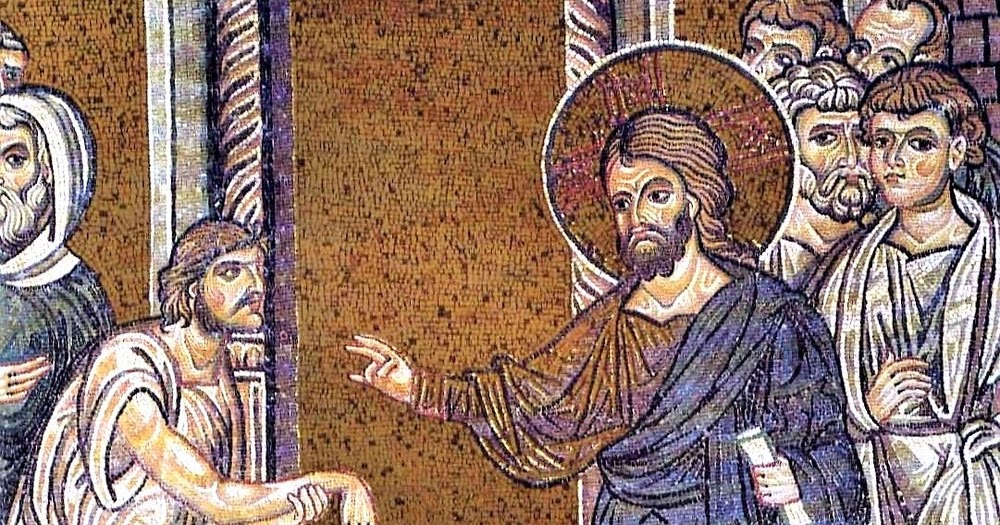
Ten Lepers by James Christianson

To learn more about this enthralling painting, see:


In today’s Gospel, we encounter this just and supreme God in the person of Jesus when we witness the cure of the ten lepers.  

You know, it would be startling enough to run into one leper on your daily walk, right?  But TEN! That must have been an astounding situation. For Jesus’s followers, it must have been an overwhelming sight to meet those people – sad and disfigured by disease – and to watch them be restored to wholeness.

Can you imagine that the recipients of such a miracle wouldn’t have clung in gratitude to Jesus for the rest of their days??? But, wow, only one even bothered to say “Thank you”.

What might have kept the other nine away, locked in their blind ingratitude?


Perhaps it’s not such a mystery if we allow ourselves to examine our own often ungrateful hearts. We don’t necessarily mean to be boorish in the face of God’s kindness and the generosity of others, but we sometimes suffer from … (of course, I’m only speaking for myself here 🙂 )

  1. Distraction: our lives are filled with frenetic activity which causes our blessings to flit by us into dizzying forgetfulness
  2. Entitlement: we think we deserve or have earned those blessings
  3. Self-absorption: we are so wrapped up in ourselves that we don’t even notice that our whole life is a gift
  4. Laziness: we might say thanks if we get around to it. But we never get around to it.
  5. Unresolved anger: we’re mad that we even needed help
  6. Non-intentionality: we fail to live with intention and reflection, thus missing the opportunities for gratitude 
  7. Pride: we are too proud to acknowledge that we need anything
  8. Fear: we are afraid something will be required of us in return for the gift
  9. Spiritual blindness: we just don’t see the nurturing power of God and others in our life

It’s likely that our nine ungrateful lepers had these human frailties. But don’t be thinking about them, or your acquaintances who share their failings.  

Let’s think about ourselves and how we want to be more grateful. Let’s think about our omnipotent God who is always Justice and Mercy.

The story is a powerful wake-up call to do better than the poor lepers did by living this prayer:

May I live humbly and gratefully today.


Poetry: The Ten Lepers – by Rosanna Eleanor (Mullins) Leprohon who was both a poet and novelist. Born in Montreal in 1829, Rosanna Mullins was educated at the convent of the Congregation of Notre Dame.

’Neath the olives of Samaria, in far-famed Galilee,
Where dark green vines are mirrored in a placid silver sea,
’Mid scenes of tranquil beauty, glowing sun-sets, rosy dawn,
The Master and disciples to the city journeyed on.
And, as they neared a valley where a sheltered hamlet lay,
A strange, portentous wailing made them pause upon their way—
Voices fraught with anguish, telling of aching heart and brow,
Which kept moaning: “Jesus, Master, have mercy on us now!”
Softly raised the gentle Saviour His eyes like midnight star,
And His mournful gaze soon rested on ten lepers, who, afar,
Stood motionless and suppliant, in sackcloth rudely clothed,
Poor Pariahs! by their nearest, their dearest, shunned and loathed.
Not unto Him prayed vainly those sore afflicted ten,
No! He yearned too fondly over the erring sons of men,
Even sharing in their sorrows, though He joined not in their feasts,—
So He kindly told the Lepers: “Show yourselves unto the priests.”
When, miracle of mercy! as they turned them to obey,
And towards the Holy Temple quickly took their hopeful way,
Lo! the hideous scales fell off them, health’s fountains were unsealed,
Their skin grew soft as infant’s—their leprosy was healed.
O man! so oft an ingrate, to thy thankless nature true,
Thyself see in those Lepers, who did as thou dost do;
Nine went their way rejoicing, healed in body—glad in soul—
Nor once thought of returning thanks to Him who made them whole.
One only, a Samaritan, a stranger to God’s word,
Felt his joyous, panting bosom, with gratitude deep stirred,
And without delay he hastened, in the dust, at Jesus’ feet,
To cast himself in worship, in thanksgiving, warm and meet.
Slowly questioned him the Saviour, with majesty divine:—
“Ten were cleansed from their leprosy—where are the other nine?
Is there none but this one stranger—unlearned in Gods ways,
His name and mighty power, to give word of thanks or praise?”
The sunbeams’ quivering glories softly touched that God-like head,
The olives blooming round Him sweet shade and fragrance shed,
While o’er His sacred features a tender sadness stole:
“Rise, go thy way,” He murmured, “thy faith hath made thee whole!”

Music:  Hymn of Grateful Praise – Folliott S. Pierpoint

But They Kept Silent

Friday of the Thirtieth Week in Ordinary Time
November 3, 2023

Today’s Readings:

https://bible.usccb.org/bible/readings/110323.cfm


Today, in God’s Lavish Mercy, as we read our scriptures for the day, we sense that both Jesus and Paul suffer heartbreak for those who resist the Gospel.

Brothers and sisters:
I speak the truth in Christ, I do not lie;
my conscience joins with the Holy Spirit in bearing me witness
that I have great sorrow and constant anguish in my heart.
For I could wish that I myself were accursed and cut off from Christ
for the sake of my own people,
my kindred according to the flesh.

Romans 9:1-3

Paul expresses his deep regret that his own people, the Israelites, resist the Messiah who is God’s final gift to them in a long line of unique blessings:

They are children of Israel;
theirs the adoption, the glory, the covenants,
the giving of the law, the worship, and the promises;
theirs the patriarchs, and from them,
according to the flesh, is the Christ,
who is over all, God blessed forever. Amen.

Romans 9:4-5

In our Gospel, Jesus encounters a man with a withered hand. From the get-go, Jesus plans to heal the suffering man, but he decides to use the occasion to teach the Pharisees a lesson.

Jesus invites the scholars and Pharisees to move beyond the written Law and into the true practice of its spirit:

Jesus spoke to the scholars of the law and Pharisees in reply, asking,
“Is it lawful to cure on the sabbath or not?”
But they kept silent; so he took the man and,
after he had healed him, dismissed him.
Then he said to them
“Who among you, if your son or ox falls into a cistern,
would not immediately pull him out on the sabbath day?”
But they were unable to answer his question.

Luke 14: 5-6

What Jesus asked was apparently too much for them. They were so encrusted in the worldly benefits the Law had brought them that they couldn’t challenge themselves to hear Jesus’s message. So they were silent – they gave no response to the divine invitation to life-giving change.

And to be fair to the Pharisees, Jesus’s invitation was a huge challenge. Their lives had become entirely dependent on a system that had lost its true meaning. The Law no longer led them to God but to themselves. They had lost the way through the woods, as you will see in Kipling’s poem below.


There are many levels on which we can pray with this passage. We are surely aware of the same kind of resistant silences in ourselves and in our world.

We may be caught in a sort of personal woods where we can’t make our way through to a life-giving choice or, like the Pharisees, to an inclusive, merciful understanding.

Or we may see this kind of entrapment happening in a beloved’s life.

Or we may see the atrophic effects of dead, unreviewed laws in our country, world, and Church. Failing to adapt laws that have lost their true spirit allows us to normalize outrageous behaviors based on manufactured”legality”. The image of a 16-year-old carrying an AK-47 down a neighborhood street, “legally” shooting unarmed protesters, comes to my mind!

All of these situations arise when we are entwined in a system that no longer gives life. The spirit and energy of the Gospel is the key to our un-entwining. Let’s pray for it in ourselves and in our very knotted world.


Poetry: The Way Through the Woods – Rudyard Kipling

They shut the road through the woods
Seventy years ago.
Weather and rain have undone it again,
And now you would never know
There was once a road through the woods
Before they planted the trees.
It is underneath the coppice and heath,
And the thin anemones.
Only the keeper sees
That, where the ring-dove broods,
And the badgers roll at ease,
There was once a road through the woods.

Yet, if you enter the woods
Of a summer evening late,
When the night-air cools on the trout-ringed pools
Where the otter whistles his mate,
(They fear not men in the woods,
Because they see so few.)
You will hear the beat of a horse’s feet,
And the swish of a skirt in the dew,
Steadily cantering through
The misty solitudes,
As though they perfectly knew
The old lost road through the woods.
But there is no road through the woods.

Music: Dave Eggar – Fallen Leaves

Raised Up!

Monday of the Thirtieth Week in Ordinary Time
October 30, 2023

Today’s Readings:

https://bible.usccb.org/bible/readings/103023.cfm


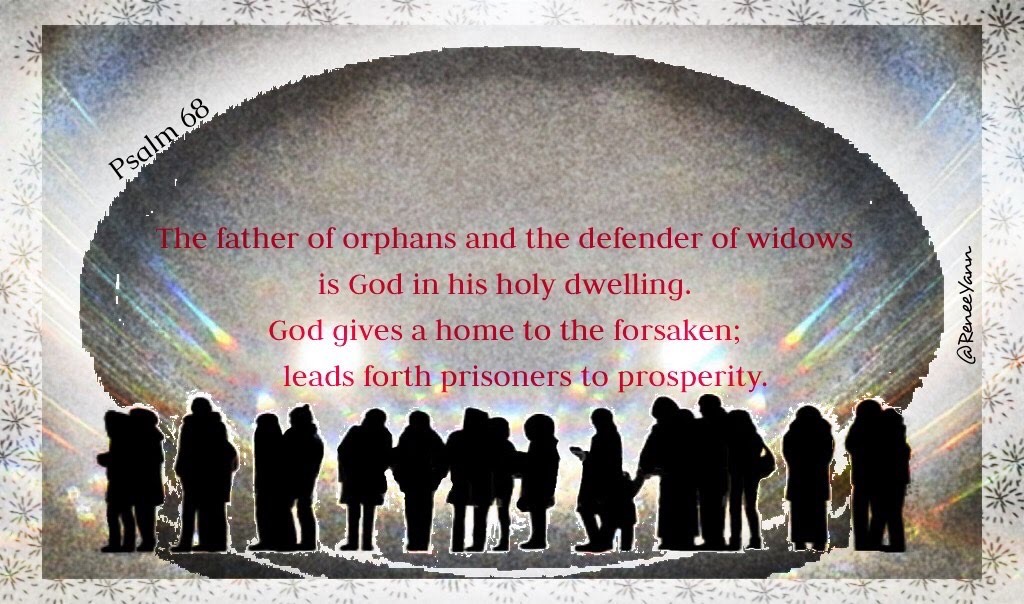
Today, in God’s Lavish Mercy, we pray with Psalm 68 which pictures a triumphant God, rising like the sun over the darkness of evil.

Arise, O God, and let your enemies be scattered;
let those who hate you flee.
Let them vanish like smoke when the wind drives it away; 
as the wax melts at the fire,
so let the wicked perish at your presence.

Psalm 68:1-3

This psalm comforts us with a tender picture of God:

Protector of orphans, defender of widows,
the One who dwells in holiness,
who gives the solitary a home
and brings forth prisoners into freedom;
but the rebels shall live in dry places.

Psalm 68: 5-6

It is the same tenderness Paul presents in our first reading:

For those who are led by the Spirit of God are children of God.
For you did not receive a spirit of slavery to fall back into fear,
but you received a spirit of adoption,
through which we cry, “Abba, Father!”
The Spirit bears witness with our spirit
that we are children of God,
and if children, then heirs,
heirs of God and joint heirs with Christ…
if only we suffer with him
so that we may also be glorified with him.

Romans 8:8-9

And there we have the key line: 
we are to live a life aligned with 
the Passion, Death, and Resurrection of Christ.


And what will that kind of life look like? It will look like our merciful Jesus of today’s Gospel – who stepped out to see, comfort, and heal the suffering around him.

Jesus recognized the crippled woman as “an heir of God, and joint heir with him” to the fullness of life in God. We are called to recognize ourselves and all of our sisters and brothers in the same way.


Poetry: WOMAN UN-BENT (LUKE 13:10–17) – by Irene Zimmerman, OSF

That Sabbath day as always 
she went to the synagogue 
and took the place assigned her 
right behind the grill where, 
the elders had concurred, 
she would block no one’s view, 
she could lean her heavy head, 
and (though this was not said) 
she’d give a good example to 
the ones who stood behind her. 
 
That day, intent as always 
on the Word (for eighteen years 
she’d listened thus), she heard 
Authority when Jesus spoke. 
 
Though long stripped 
of forwardness, she came forward, nonetheless, 
when Jesus summoned her. 
“Woman, you are free of your infirmity,” he said. 

The leader of the synagogue 
worked himself into a sweat 
as he tried to bend the Sabbath 
and the woman back in place. 

But she stood up straight and let 
God’s glory touch her face.

Video: Jesus Heals the Bent-over Woman

If you’d still like a little music, this one seems to fit: Spirit Touch by Joseph Akins

Wake Up! Act Up!

Friday of the Twenty-seventh Week in Ordinary Time
October 13, 2023

Today’s Readings:

https://bible.usccb.org/bible/readings/101323.cfm


Today, in God’s Lavish Mercy, – and tomorrow – we finish up our short journey with the minor prophets with two passages from Joel.

Joel the Prophet by Michelangelo
from the Sistine Chapel ceiling

Joel and his neighbors were living through a plague of locusts. The book begins with a stark warning to wake up and see the meaning of what is happening:

Listen to this, you elders!
Pay attention, all who dwell in the land!
Has anything like this ever happened in your lifetime,
or in the lifetime of your ancestors?…
What the cutter left
the swarming locust has devoured;
What the swarming locust left,
the hopper has devoured;
What the hopper left,
the consuming locust has devoured.
Wake up, you drunkards, and weep;
wail, all you wine drinkers,
Over the new wine,
taken away from your mouths.

Joel 1:1-5

Although Joel’s agricultural disaster is part of ancient history, like other seemingly remote scriptural passages, it bears a startlingly apropos message for us today.

Joel gave voice to a ravaged earth that could not speak for itself. In his writings, earth and its people are intimately connected – each affected by and bearing the consequences of the other’s suffering. The devastation of the wheat fields and vineyards has robbed the worshippers of their most important possession – the staples to offer in praise of God:

Gird yourselves and weep, O priests!
wail, O ministers of the altar!
Come, spend the night in sackcloth,
O ministers of my God!
The house of your God is deprived
of offering and libation.
Proclaim a fast,
call an assembly;
Gather the elders,
all who dwell in the land,
Into the house of the LORD, your God,
and cry to the LORD!

Joel 1:13-14

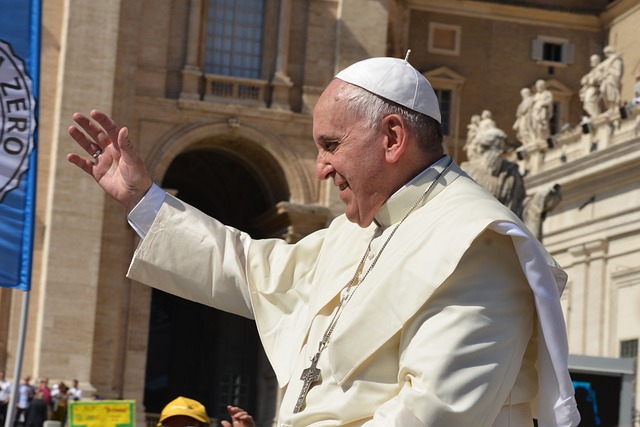
As Joel pleaded with his people to recognize their implication in the earth’s annihilation, so Pope Francis pleads with us in Laudate Deum:

Eight years have passed since I published the Encyclical Letter Laudato Si’, when I wanted to share with all of you, my brothers and sisters of our suffering planet, my heartfelt concerns about the care of our common home. Yet, with the passage of time, I have realized that our responses have not been adequate, while the world in which we live is collapsing and may be nearing the breaking point. In addition to this possibility, it is indubitable that the impact of climate change will increasingly prejudice the lives and families of many persons. We will feel its effects in the areas of healthcare, sources of employment, access to resources, housing, forced migrations, etc. (2)
This is a global social issue and one intimately related to the dignity of human life.(3)

Pope Francis recognizes, as did the prophet Joel, that there are “deniers” – climate change deniers and deniers of the sins of complicity.

Joel warns that such sinful denial will bear consquences not only on his current generation but on their children:

Yes, it is near, a day of darkness and of gloom,
a day of clouds and somberness!
Like dawn spreading over the mountains,
a people numerous and mighty!
Their like has not been from of old,
nor will it be after them,
even to the years of distant generations.

Joel 2: 1-2

Pope Francis voices a similar warning:

Climate change is one of the principal challenges facing society and the global community. The effects of climate change are borne by the most vulnerable people, whether at home or around the world. In a few words, the Bishops assembled for the Synod for Amazonia said the same thing: “Attacks on nature have consequences for people’s lives”. And to express bluntly that this is no longer a secondary or ideological question, but a drama that harms us all, the African bishops stated that climate change makes manifest “a tragic and striking example of structural sin”. (3)


Many of us don’t want to read about climate change much less pray about it. A lot of us don’t have a clue how we can help reverse the cataclysmic tide. We may even be a “denier” ourselves! But if we are, we are in a very small minority:

Robust studies of climate change perceptions in Australia, the UK and America show that only very small numbers of people actually deny that climate change is happening. The figures range from between 5 to 8% of the population. However this small minority can be influential in casting doubt on the science, spreading misinformation and impeding progress on climate policies.

from the Australian Psychological Society

The other 92% to 95% of us must pray and act with the global community to respond effectively to the summons of Pope Francis:

I ask everyone to accompany this pilgrimage of reconciliation with the world that is our home and to help make it more beautiful, because that commitment has to do with our personal dignity and highest values. At the same time, I cannot deny that it is necessary to be honest and recognize that the most effective solutions will not come from individual efforts alone, but above all from major political decisions on the national and international level. (69)
Nonetheless, every little bit helps, and avoiding an increase of a tenth of a degree in the global temperature would already suffice to alleviate some suffering for many people. Yet what is important is something less quantitative: the need to realize that there are no lasting changes without cultural changes, without a maturing of lifestyles and convictions within societies, and there are no cultural changes without personal changes. (70)

Video: from the Vatican website introducing Laudate Deum

Turn to Tenderness, Turn to God

Thursday of the Twenty-fifth Week in Ordinary Time
September 28, 2023

Today’s Readings:

https://bible.usccb.org/bible/readings/092823.cfm


Today, in God’s Lavish Mercy – and tomorrow – we will hear from Haggai, one of the twelve minor prophets of the Hebrew Scriptures. These dozen writers are referred to as “minor” because of the length of their writings, not their value.

So Haggai, even though many of us have never heard of him, has something important to say for Judeo-Christian tradition and for each of us who read him. Let’s see what that might be.

Hag1_9JPG

Haggai is prophesying during the Persian period of Jewish history, around the middle of the 6th century, BC. The Jewish people had been back home from the Babylonian captivity for almost 20 years. When they first returned they were passionate about rebuilding the Temple. But as the decades passed, and opposition from their non-Jewish neighbors increased, their commitment waned.


The building of worship places has always been an activity with fans on both sides of the aisle. Some argue that God needs a spot where the Divine Presence can be recognized and revered. Others believe that the effort and resources expended in such building could better be used in human services for God’s poor and needy people. Haggai’s community had people in both camps. (Sound familiar?)

Haggai offers a turning point for their arguments. He tells the people they are a mess. The absence of a central symbol for their faith has weakened and scattered them to their own selfish pursuits. He tells them to look at themselves:

Consider your ways!
You have sown much, but have brought in little;
you have eaten, but have not been satisfied;
You have drunk, but have not been exhilarated;
have clothed yourselves, but not been warmed;
And whoever earned wages
earned them for a bag with holes in it.


The Temple, while it is important, isn’t the most important part of Haggai’s prophecy. He tells the people they have lost their souls. The lack of a central, shared faith has caused them to forget who they are. They will remember only when they remember God’s centrality in their lives.

Haggai appeals to the people to restore a public life which gives honor to God. For their time and circumstance, such a return is symbolized by the rebuilding of the Temple which had been destroyed at the time of their enslavement by Babylon.


We humans often forget what’s important. We chip away at, and ultimately destroy, what makes us who we are by little acts of faithlessness, deceit, covetousness, and envy. These small treacheries grow into big ones redeemable only by an impeachment of the soul and the renewal of a common moral purpose. Haggai offered that conversion to Israel. Pope Francis is offering it to us today.


Video: TED Talk by Pope Francis given at the Annual TED Conference in 2017 and pleading for a “Revolution of Tenderness”. (Yes, it’s long, but it is profound. When he delivered this talk, the Pope was given a standing ovation by some of the most prestigious business people of our time.)

https://www.npr.org/sections/thetwo-way/2017/04/26/525699847/in-surprise-ted-talk-pope-francis-asks-the-powerful-for-revolution-of-tenderness


Music: Come Back to Me – by Gregory Norbet, sung by John Michael Talbot

Universal Call

Friday of the Thirteenth Week in Ordinary Time
July 7, 2023

Today’s Readings:

https://bible.usccb.org/bible/readings/070723.cfm


Today, in God’s Lavish Mercy, each of our readings presents a story of vocation and how it is fulfilled in a lifespan.

Our reading from Genesis describes four people at different stages of their life’s vocation: Abraham and Sarah in its fulfillment, Isaac and Rebekah in its initial hope.


For my prayer, I focused on Abraham who is closing out his story in peace, prosperity, and active hope for a future he will not see:

Abraham had now reached a ripe old age,
and the LORD had blessed him in every way.
Abraham said to the senior servant of his household,
who had charge of all his possessions:
“Put your hand under my thigh,
and I will make you swear by the LORD,
the God of heaven and the God of earth, …
… that you will go to my own land and to my kindred
to get a wife for my son Isaac.”

Genesis 24:1-4

Both Abraham and Sarah lived long and fruitful lives, matured in faith, and died in peace. Through the extensive history of their lives, they listened to and trusted God (on and off!), acted for God’s glory, and guided their household in God’s way.

They listened, responded and connected their lives irrevocably to God’s vision.
It is at once a simple and a challenging formula for spiritual fulfillment.


In our Gospel, Matthew is called to the same formula which is the underpinning of any vocation:

As Jesus passed by,
he saw a man named Matthew sitting at the customs post.
He said to him, “”Follow me.””
And he got up and followed him.
While he was at table in his house,
many tax collectors and sinners came
and sat with Jesus and his disciples.
The Pharisees saw this and said to his disciples,
“”Why does your teacher eat with tax collectors and sinners?””
He heard this and said,
“Those who are well do not need a physician, but the sick do.
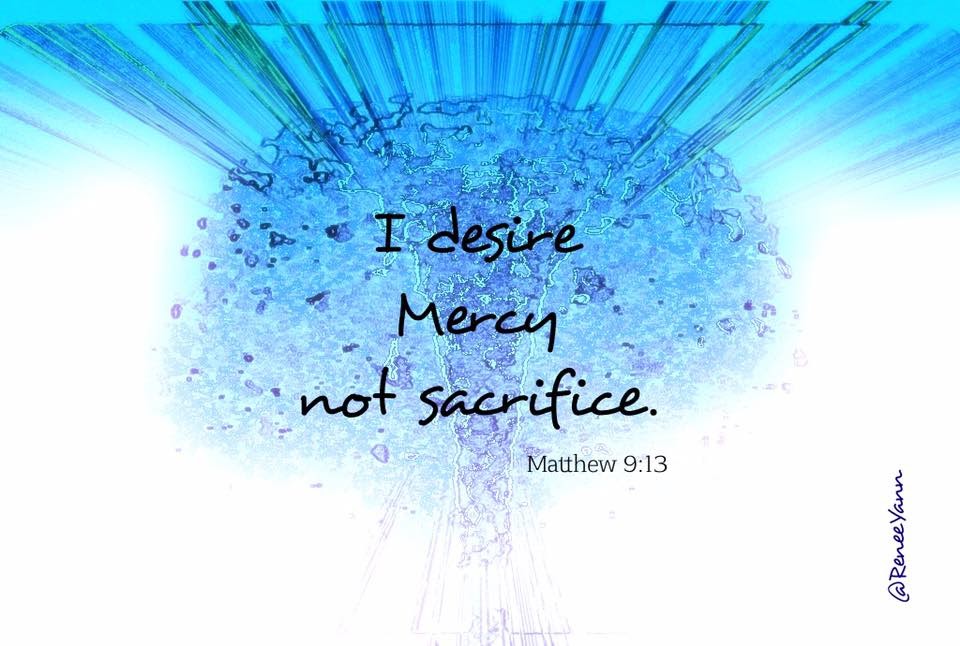
Go and learn the meaning of the words,
I desire mercy, not sacrifice.”

Matthew 9:9-12

Matthew listens to Jesus’ call, responds,
and connects his life irrevocably to Jesus’ vision.


The continuing call for each of us is clear. Each of our lives offers us a particular expression of “vocation”. It may be as religious, priest, parent, spouse, family member, teacher, caregiver, public servant, or any other role that places us in loving and responsible relationship with our neighbor.

In that role, can we/do we:

  • listen for God in every circumstance
  • respond in faith, hope, and love
  • witness a Christ-rooted life by our actions for Gospel justice and mercy

Poetry: Vocation by William E. Stafford

This dream the world is having about itself 
includes a trace on the plains of the Oregon trail, 
a groove in the grass my father showed us all 
one day while meadowlarks were trying to tell
something better about to happen. 

I dreamed the trace to the mountains, over the hills, 
and there a girl who belonged wherever she was; 
but then my mother called us back to the car: 
she was afraid; she always blamed the place,
the time, anything my father planned. 

Now both of my parents, the long line through the plain, 
the meadowlarks, the sky, the world's whole dream 
remain, and I hear him say while I stand between the two,
helpless, both of them part of me:
"Your job is to find what the world is trying to be."

Music: The Call – Celtic Women sing a song written by Anthony Downes


Is Anything Impossible for God?

Saturday of the Twelfth Week in Ordinary Time
July 1, 2023

Today’s Readings:

https://bible.usccb.org/bible/readings/070123.cfm


Today, in God’s Lavish Mercy, our readings build on yesterday’s themes of promise and patience, faith and resistance.

The Trinity or The Hospitality of Abraham –
Icon by Sister Petra Clare


Genesis tells the rich and instructive story of the visiting angels who come as spokespeople for God’s Promise. Abraham, in a flurry of Middle Eastern hospitality convinces the three visitors to linger at his home. Exuding a deferential hospitality certain to gain them a blessing, Abraham and Sarah lay out a lovely dinner. The blessing comes in an unexpected reiteration of that nagging, and still unfulfilled, promise:

They asked him, “Where is your wife Sarah?” 
He replied, “There in the tent.” 
One of them said, “I will surely return to you about this time next year,
and Sarah will then have a son.”

Genesis 18:9-10

This time, post-menapausal Sarah has had it with the inconclusive, and seemingly outlandish, promise!

Sarah was listening at the entrance of the tent, just behind him.
Now Abraham and Sarah were old, advanced in years,
and Sarah had stopped having her womanly periods.
So Sarah laughed to herself and said,
“Now that I am so withered and my husband is so old,
am I still to have sexual pleasure?”

Genesis 18:10-12

God doesn’t think it’s funny. To Abraham and Sarah, God poses the elemental faith question that will be posed to every potential believer:

But the LORD said to Abraham: “Why did Sarah laugh and say,
‘Shall I really bear a child, old as I am?’
Is anything too marvelous for the LORD to do?

Genesis 18:13

Our Gospel centurion has already answered that question for himself. When Jesus agrees to come heal the beloved suffering servant, the centurion expresses his humble and unconditional faith in God’s promise:

The centurion said in reply,
“Lord, I am not worthy to have you enter under my roof;
only say the word and my servant will be healed.”

Matthew 8:8

This prayer, repeated at every Eucharistic celebration, allows us to measure our own faith and to ask for our own healing.


Poetry: Thou Art Just Indeed, Lord, If I Contend – Gerard Manley Hopkins

Hopkins questions God about his suffering, stating that he’s a good priest and if God treats him this poorly, how must God treat enemies! Like Abraham, Hopkins needs fruitfulness – “send my roots rain?”


Justus quidem tu es, Domine, si disputem tecum; verumtamen
justa loquar ad te: Quare via impiorum prosperatur? &c.


Thou art indeed just, Lord, if I contend
With thee; but, sir, so what I plead is just.
Why do sinners’ ways prosper? and why must
Disappointment all I endeavour end?
Wert thou my enemy, O thou my friend,
How wouldst thou worse, I wonder, than thou dost
Defeat, thwart me? Oh, the sots and thralls of lust
Do in spare hours more thrive than I that spend,
Sir, life upon thy cause. See, banks and brakes
Now, leavèd how thick! lacèd they are again
With fretty chervil, look, and fresh wind shakes
Them; birds build – but not I build; no, but strain,
Time’s eunuch, and not breed one work that wakes.
Mine, O thou lord of life, send my roots rain.


Music: Abraham and Sarah – Bryan Sirchio

I just love this song. I hope you do too! Lyrics below.


Ha Ha Ha – Ho Ho Ho
I wonder what’s so funny?

Abraham and Sarah were very old and grey.
An angel of Lord showed up and said to them one day,
“I know you’re very old and that you’ve never had a kid,
but God says, “Better find a baby crib!”

And they said:
Ha Ha Ha – Ho Ho Ho
You can’t have a baby when you get this old.
Abraham and Sarah had to laugh.
Oh, bend at the knees

Ha Ha Ha – Ho Ho Ho
So now Abraham and Sarah know
that nothing is too hard for God.

Abraham and Sarah were very old and grey.
An angel of Lord showed up and said to them one day,
“I know you’re very old and that you’ve never had a kid,
but God says, “Better find a baby crib!”

And they said:
Ha Ha Ha – Ho Ho Ho
You can’t have a baby when you get this old.
Abraham and Sarah had to laugh.
Oh, bend at the knees

Ha Ha Ha – Ho Ho Ho
So now Abraham and Sarah know
that nothing is too hard for God.

And sure enough they had a baby
and they named the baby Isaac
which means “Laughter”!

Undimmable Light

Friday of the Second Week of Advent
December 9, 2022

Today’s Readings:

https://bible.usccb.org/bible/readings/120922.cfm

(Today, I am re-publishing an earlier blog. I used it for my own prayer this morning and I thought it really deserved another read. I hope you agree.)

Today, in God’s Lavish Mercy, we pray with Psalm 1 and its confident responsorial verse.

Last night we watched a public television Christmas special, “Rick Steves’s European Christmas“. From its many beautiful scenes, one in particular remained with me: a little group of friends tobogganing down a snow covered hill at night. Their only lights came from the small lanterns they held and the full moon’s generous luster against the white snow.

My first reaction to the scene was to wonder, “What if their light goes out?”. Then I realized that there was a light beyond them which would guide their way.


There are times in our lives when the light, if it doesn’t go out, at least flickers. I wrote about that awareness in this story a few years ago: 

She had arranged to visit with an old college friend. They had been separated too long by the distancing choices that life often demands. She wanted to reconnect to that rare experience of shared transparency found just once or twice in a lifetime – the gift of a real friend.

They sat on a porch overlooking a gentle pond. The day was bright, the coffee hot, the chairs comfortable. But the magic was gone.  Only half her friend had arrived for the cherished conversation. The other half – joy, adventure and the excess of youthful hope – had been lost. Somewhere in the intervening years, the light had gone out. Her friend had suffered a wound she did not share. This one afternoon would be too short a time to give that wound a name.

During our Advent journey, God is waiting in the seeming darkness to guide us. God already knows the wounds we carry. God sees where our heart’s light has dimmed. Holding our half-heartedness next to the Divine Heart, God yearns to rekindle us.


Today’s psalm reminds us that there is a always Light waiting beyond us to guide our way.

Blessed the one follows not
the counsel of darkness
nor walks in it ways,
nor remains in the company of the insolent,
But delights in the law of the LORD
and meditates on its Light day and night.

Psalm 1:1-2

Poetry: from Mary Oliver

When I am among the trees,
especially the willows and the honey locust,
equally the beech, the oaks and the pines,
they give off such hints of gladness.

I would almost say that they save me, and daily.
I am so distant from the hope of myself,
in which I have goodness, and discernment,
and never hurry through the world
but walk slowly, and bow often.

Around me the trees stir in their leaves
and call out, “Stay awhile.”
The light flows from their branches.
And they call again, “It’s simple,” they say,
“and you too have come
into the world to do this, to go easy, to be filled
with light, and to shine.”

Music: Christ, Be Our Light – Bernadette Farrell

That Comforting Voice …

Tuesday of the Second Week of Advent
December 6, 2022

Today’s Readings:

https://bible.usccb.org/bible/readings/120622.cfm

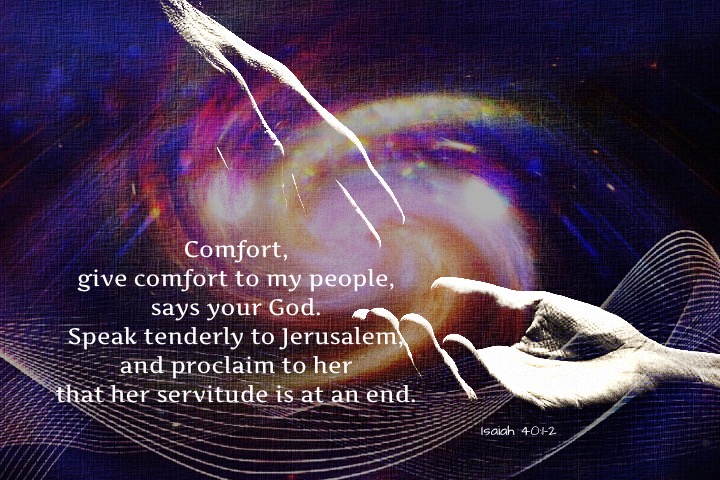
Today, in God’s Lavish Mercy, we once again hear that powerful passage from Isaiah, “Comfort Ye, My People”.

In these words from ancient Isaiah, also suggest echos of the Baptist’s voice, yet to be born, but fashioned from the same hope:

A voice cries out:
In the desert prepare the way of the LORD!
Make straight in the wasteland a highway for our God!
Every valley shall be filled in,
every mountain and hill shall be made low;
The rugged land shall be made a plain,
the rough country, a broad valley.
Then the glory of the LORD shall be revealed,
and all people shall see it together;
for the mouth of the LORD has spoken.

Isaiah 40:1-2

Our Gospel gives us the gentle parable of the Good Shepherd who finds and comforts the lost sheep. This Divine Shepherd rejoices in the chance to seek out the hurt sheep and to comfort them, just as God rejoices in comforting and healing us.

And finding the sheep, amen, I say to you, the shepherd rejoices more over it
than over the ninety-nine that did not stray.
In just the same way, it is not the will of your heavenly Father
that one of these little ones be lost.”


As we listen to today’s magnificent music, let us slowly name in our prayer those who most need God’s comfort – the “little ones” – not so much in stature – but in hope, freedom, justice, and the blessings of this world. 

We may pray for ourselves, for someone we love, for those we know by name, or for those dear to God though nameless to us – all who suffer throughout the world.


Poetry: Shepherd – William Blake

How sweet is the Shepherd's sweet lot,
From the morn to the evening he strays:
He shall follow his sheep all the day
And his tongue shall be filled with praise.

For he hears the lambs innocent call,
And he hears the ewes tender reply,
He is watchful while they are in peace,
For they know when their Shepherd is nigh

Music: Comfort Ye from Handel’s Messiah, sung by Jerry Hadley

Alleluia: True Ministry

Wednesday of the Twenty-second Week in Ordinary Time
August 31, 2022

Today, in God’s Lavish Mercy, both Paul and Luke talk about ministry – our loving and merciful service to one another through prayer, word, and action.

LK4_18 good news

Paul says this ministry must be humble and mutual. This is because all the good that any of us does comes from God, not from us.

What is Apollos, after all, and what is Paul?
Ministers through whom you became believers,
just as the Lord assigned each one.
I planted, Apollos watered, but God caused the growth.
Therefore, neither the one who plants nor the one who waters is anything,
but only God, who causes the growth.


Jesus shows us that our ministry must be immediate and practical, responding to the present needs of our sisters and brothers. You wouldn’t think Jesus had time to pay attention to Peter’s mother-in-law, but he did. Her need drew his ministry out of him.

After Jesus left the synagogue, he entered the house of Simon.
Simon’s mother-in-law was afflicted with a severe fever,
and they interceded with him about her.
He stood over her, rebuked the fever, and it left her.
She got up immediately and waited on them.

At sunset, all who had people sick with various diseases
brought them to him.
He laid his hands on each of them and cured them.


You will meet your own “Peter’s mother-in-law” today – someone whose apparent need touches your goodness. They may need a smile, an encouragement, an invitation or a gentle correction from you. They may come to you from a distance, in a request for service or funding. They may come in news story crying out for your prayers or civic action.

People can be poor in many ways.  Even the apparently free can be held captive by hidden burdens. Sometimes these burdens hide under a false bravado, impudence, indifference, or pride that make it difficult to pity their bearers. 

We will meet these people in our families, workplaces, schools and neighborhoods. 

Our response should reflect the humble and spontaneous Mercy and Love of Jesus who was always honest, respectful and kind. This is the ministry of every Christian because…

Music: Christ Has No Body Now But Yours ~ David Ogden

Poetry: The Woman – I wrote this poem about 30 years ago but I thought of it this morning when I reflected on Peter’s mother-in-law and her need for Jesus’s touch.

One bitter day in February
I sat inside a sunlit room,
offered you warm prayer and promises,
and she passed outside my window
dressed uncarefully against the wind,
steadied on a cane, though she was young.
She seemed searching for
a comfort, unavailable and undefined.

The wound of that impossibility
fell over her the way it falls
on every tender thing that cries
but is not gathered to a caring breast.
Suddenly she was a single
anguished seed of You,
fallen into all created things.

Re-entering prayer,
I wear the thought of her  
like old earth wears fresh rain.
I’ve misconstrued You,
Holy One, to whom I offer my heart
as if I were a yearning field,
Holy One, already ripe within
her barest, leanest yearning.