Today, in God’s Lavish Mercy, we have a choice in readings between the 24th Monday or the Holy Name of Mary. I’m going with Mary, especially since the passage from Corinthians is about people overeating and drinking (and stealing parking spots?) at their church meetings. Can you imagine! Well, yes, maybe we’ll save that for another day. 😉
When the fullness of time had come,
God sent his Son, born of a woman..
Galatians 4:4
It’s such a brief and simple phrase from Galatians, isn’t it? But it carries the whole possibility of our redemption, and the infinite hope of our eternal life.
We owe it all, of course to God’s Mercy, but in a very real way, we owe it to this “woman” who is not even named in Galatians!
Today, let’s simply say her holy name in prayer, asking to be strengthened in faith, courage, hope, fidelity, and love – the hallmarks of her life.
Praying her name slowly – Mary……… Mary…… Mary …. let each breath deepen our love for her. Let each quiet thought ask for the grace to learn from her.
Alleluia, alleluia. If today you hear his voice, harden not your hearts.
Today, in God’s Lavish Mercy, we see how the soul becomes “dressed” or prepared for the kingdom.
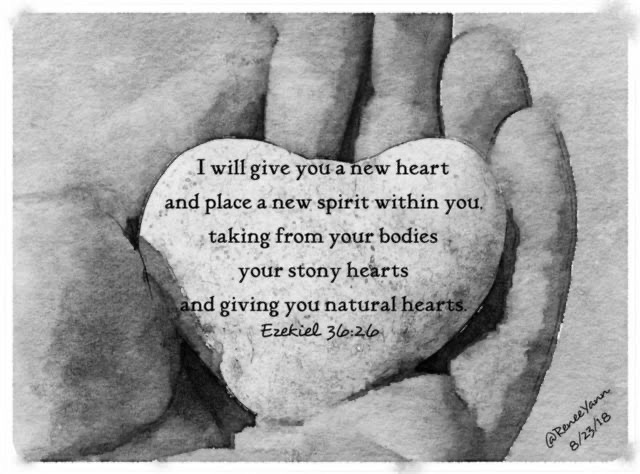
In our passage from Ezekiel, God does a major makeover for Israel, as a matter of fact, God actually recreates Israel:
I will sprinkle clean water upon you to cleanse you from all your impurities, and from all your idols I will cleanse you. I will give you a new heart and place a new spirit within you, taking from your bodies your stony hearts and giving you natural hearts. I will put my spirit within you and make you live by my statutes, careful to observe my decrees.
Ezekiel’s God is fed up with Israel’s sinfulness and decides to “make them live by my statutes”. According to Ezekiel, this rejuvenation is done for God’s sake, not Israel’s.
Thus says the LORD: I will prove the holiness of my great name, profaned among the nations, in whose midst you have profaned it. Thus the nations shall know that I am the LORD, says the Lord GOD, when in their sight I prove my holiness through you.
The king in our Gospel gets pretty fed up too with people rejecting his invitation to the wedding. When his recalcitrant invitees killed his servants, the king blew a gasket. He even took a snap on the poor schlep who showed up in business-casual attire!
No Wedding Garment
How are we to interpret these dramatic (and kinda mean) images of God and of God’s invitation to the Kingdom?
As when praying with all scripture passages, we must receive them in light of the circumstances and culture in which they were written. Our prayer, rooted in our own relationship with God, will allow us to peel away the cultural layers to discover the unchanging message which pertains to us.
What I found in today’s passages are these thoughts:
God loves us so much and would do anything to hold us in faithful relationship
If our spiritual life had died, or is on life support, God will do a heart transplant if we repent and open ourselves to grace.
We are all invited to eternal life with God, but we can get so distracted by our entanglements that we miss or ignore the invitation.
Turn down the noise in your life so that you can hear God’s ringtone on your heart.
It matters how we respond to this amazing invitation. We need to put on our best “clothes” – our best selves – so that we can fully welcome God’s life.
Poetry and Music: Here’s a simple but delightful representation of today’s Gospel. Enjoy it, friends.
Alleluia, alleluia. If today you hear God’s voice, soften your hearts.
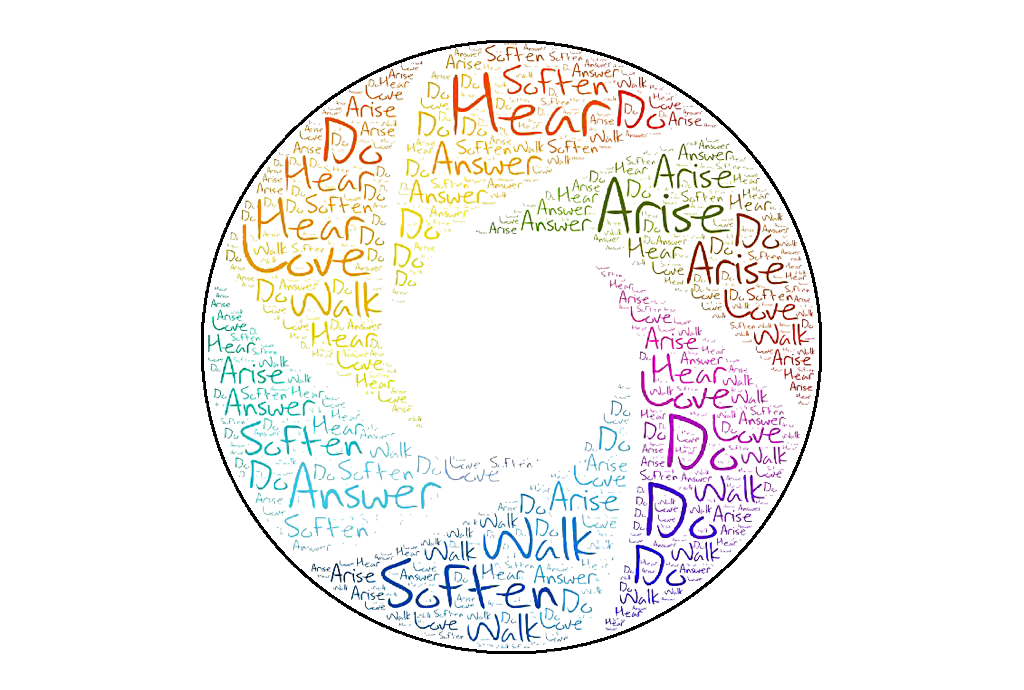
Today, in God’s Lavish Mercy, the readings heighten the familiar imperative of our Alleluia Verse with several more injunctions:
Hear
Soften
Arise
Answer
Do
Love
Walk
God is not shy in telling us what to do in order to grow in holiness – in mutual relationship with God.
We have to DO something, to be responsive in order to unite with God. We can’t be just passive lumps of inactive devotion.
Don’t Be a Spiritual Couch Potato
Each instruction has its own vitality which is meant, in turn, to vitalize our spirits and to make us agents of the Holy One in the world.
Our first reading carries this message clearly to the people of Micah’s time. It’s not about contrived sacrifice. It’s about love and compassion.
With what shall I come before the LORD, and bow before God most high? Shall I come before him with burnt offerings, with calves a year old? Will the LORD be pleased with thousands of rams, with myriad streams of oil? Shall I give my first-born for my crime, the fruit of my body for the sin of my soul? You have been told, O Creature, what is good, and what the LORD requires of you: Only to do the right and to love goodness, and to walk humbly with your God.
Micah 6: 6-8
The scribes and Pharisees of Jesus’s time demand a sign before they will listen. Jesus says the only sign they will get is to remember that the Ninevites listened when Jonah delivered God’s message.
At the judgment, the men of Nineveh will arise with this generation and condemn it, because they repented at the preaching of Jonah; and there is something greater than Jonah here.
Matthew 12:42
We don’t have a Micah or a Jonah coaching us to holiness. What we have is the Word present to us in the Gospel and in the community of faith. That Word reveals itself in the circumstances of our lives to which we must respond by:
Hearing God’s invitation Softening our hearts from judgments Arising from our self-absorption Answering the call to holiness Doing good Loving compassionately Walking humbly with our God
Poetry: from Rumi
Discard yourself
and thereby regain yourself.
Spread the trap of humility
and ensnare Love.
Today, in God’s Lavish Mercy, we move from Amos’s angry God to the gentle Jesus of our Gospel who gently lifts a broken man out of both his paralysis and sin.
These readings offer quite a leap as we try to image our invisible God! And, once again, our Alleluia Verse is the bridge that helps us do so.
The verse assures us that, in all circumstances, God in restoring us to a share in Divine Life.
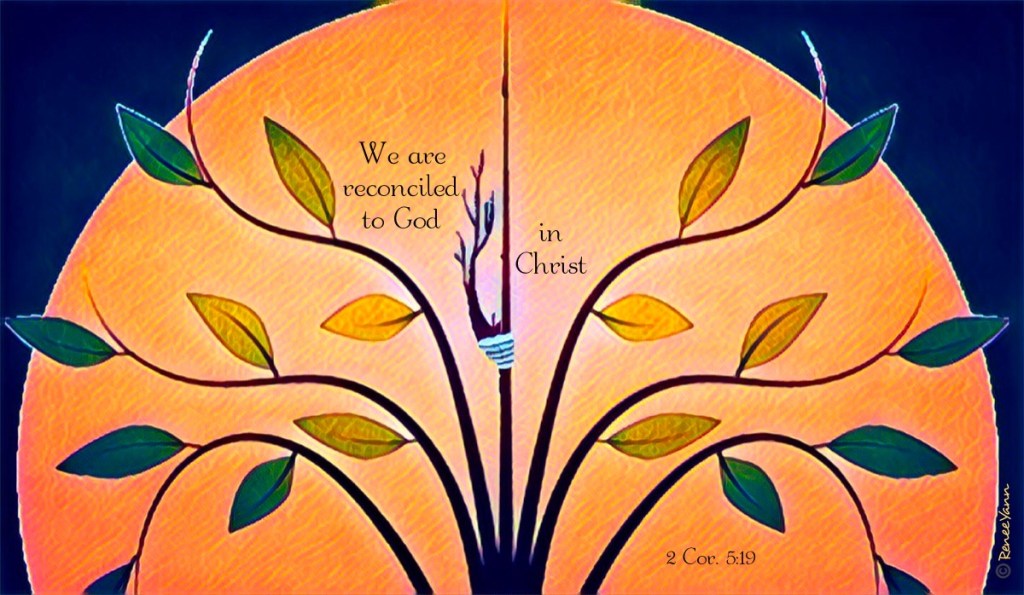
Alleluia, alleluia. God was reconciling the world to himself in Christ and entrusting to us the message of reconciliation.
2 Corinthians 5:19
The image that comes to my mind is that of an expert gardener grafting a broken shoot on to a vibrant tree.
That “grafting” occurs within the context of our life stories. In Amos’s time, it was a story fraught with political struggles crippling the community’s moral life. The crowd gathered around Jesus are challenged by the crippling effects of their lack of faith. His cure of the paralytic demonstrates how God wishes to restore their spiritual freedom.
God continues to reconcile the world in Christ even in our own time. How am I a recipient and how am I an agent of that merciful, conciliatory grace?
Praying with the elements of Responsorial Psalm 19 today suggests a guide for us. When our lives are reconciled with God, we should experience these gifts:
truth
justice
wholeness
refreshment
trustworthiness
wisdom
simplicity
right balance
joy
clarity
enlightenment
purity
steadfastness
and spiritual sweetness
Poetry: from Rumi
Find the sweetness
in your own heart,
then you may find the sweetness
in every heart.
Music: Sweet Will of God – by Lelia Naylor Morris (1862 – 1929) an American Methodist hymn writer. In the 1890s, she began to write hymns and gospel songs; it has been said that she wrote more than 1,000 songs and tunes, and that she did so while doing her housework. In 1913, her eyesight began to fail; her son thereupon constructed for her a blackboard 28 feet (8.5 m) long with oversized staff lines, so that she could continue to compose.
In 1900, she published Sweet Will of God, about the true “sweetness” of a deep spiritual life.
Two versions today. The first is the entire hymn sung by Amy Grant. The second is just the interlude so beautifully sung by Junior W. Smith that I had to share it. (Lyrics below)
Amy Grant
Junior W. Smith
My stubborn will at last hath yielded; I would be Thine, and Thine alone; And this the prayer my lips are bringing, “Lord, let in me Thy will be done.”
Sweet will of God, still fold me closer; Till I am wholly lost in Thee; Sweet will of God, still fold me closer, Till I am wholly lost in Thee.
Thy precious will, O conquering Saviour, Doth now embrace and compass me; All discords hushed, my peace a river, My soul, a prisoned bird, set free.
Shut in with Thee, O Lord, forever, My wayward feet no more to roam; What power from Thee my soul can sever? The centre of God’s will my home.
Today, in God’s Lavish Mercy, we listen to Jesus’s instruction and promise about how to live at one with God.
Alleluia, alleluia. If you love me and will keep my word, and my Father will love you and we will come to you.
What wonderful assurance! We don’t have to labor to find God, or worry about searching for God.
God will come to us – will blossom in our hearts like a sacred flower, – if we love Jesus and keep his Word.
In the opening sentence of her book “Too Deep for Words”, Thelma Hall, r.c. says this:
There is an inner dynamic in the evolution of all true love that leads to a communication too deep for words. There the lover becomes inarticulate, falls silent, and the beloved receives the silence as eloquence.
Our verse today carries that same, exquisite mystery, the silent and complete unity that comes from mutual love.
Our Gospel elaborates on the invitation.
But when you pray, go to your inner room, close the door, and pray to your Father in secret. And your Father who sees in secret will repay you.
Matthew 6:6
Let us savor these promises in our prayer today.
Poetry: in the silence – Rumi
In the silence
between your heartbeat
bides a summons
from Love.
Do you hear it?
Name it if you must,
or leave it forever nameless,
but why pretend it is not there?
Today, in God’s Lavish Mercy, our readings offer us the deeply comforting image of God as a mother, vigilant and caring for us even in our unawareness.
In our reading from Isaiah, the Israelites recently have been freed from their long sojourn in Babylon and have returned to Jerusalem. It is a time of great joy, but also of reorientation and reflection. God, Who may have seemed to abandon them to captivity, is assuring them that is not so:
Thus says the LORD: In a time of favor I answer you, on the day of salvation I help you; and I have kept you and given you as a covenant to the people, To restore the land and allot the desolate heritages, Saying to the prisoners: Come out!
Isaiah 49: 8-9
We too may have times when we think God isn’t paying attention to us, or to the world that seems to be falling apart around us. We may be tempted to think that Divine attention is turned to us only when we demand it by intense prayer of supplication.
In Isaiah 49, God – through a outlay of abundant promises, – tells us otherwise:
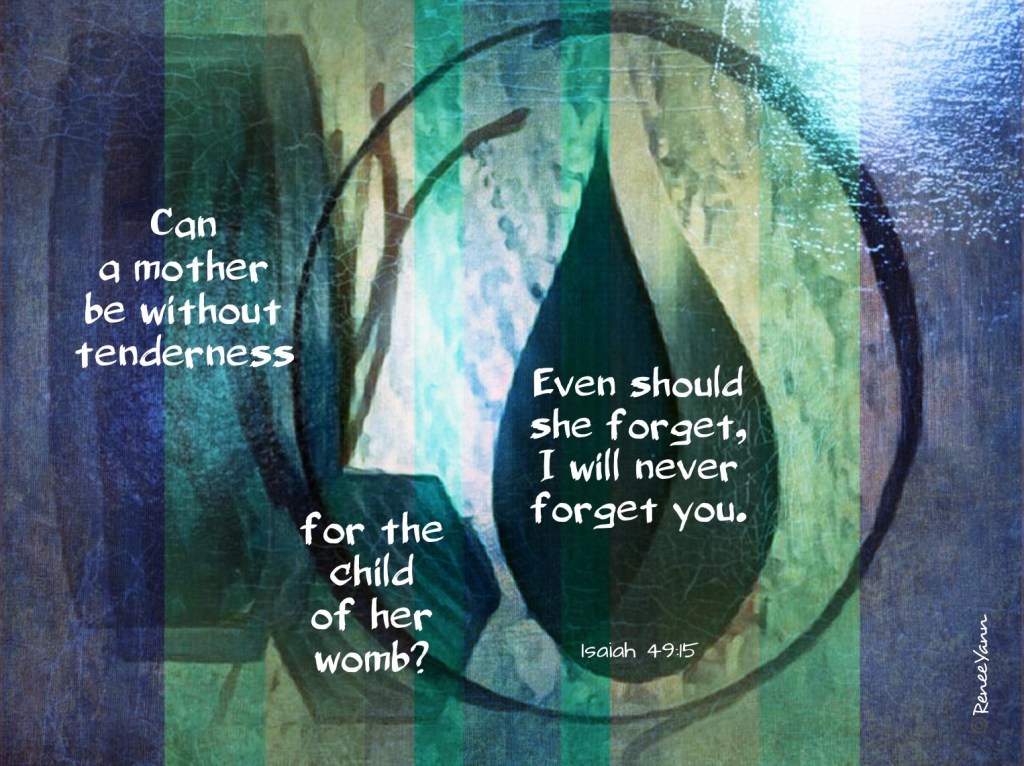
But Zion said, “The LORD has forsaken me; my Lord has forgotten me.” Can a mother forget her infant, be without tenderness for the child of her womb? Even should she forget, I will never forget you.
Isaiah 49:14-15
In our Gospel, Jesus tells us the same things in a little bit of a different way.
My Father is at work until now, so I am at work.
John 5: 17
When he says this, Jesus is in the midst of the recalcitrant, vengeful Pharisees who have placed their faith only in their own arrogance – who have come to depend only on their own wealth and power rather than on the mercy and love of God.
Jesus offers his own outlay of Divine promises, showing how he and God the Creator are One in their constant desire for each of us to share fully in the Divine Life, even to the point of taking flesh to redeem us:
For just as the Father has life in himself, so also he gave to the Son the possession of life in himself. And he gave him power to exercise judgment, because he is the Son of Man. Do not be amazed at this, because the hour is coming in which all who are in the tombs will hear his voice and will come out, those who have done good deeds to the resurrection of life …
John 5: 26-29
We might ask in our prayer today to be deepened in our awareness of God’s constant, loving Presence in our lives. There is no moment or circumstance that doesn’t offer us an invitation to greater grace and holiness. But, unlike the Pharisees, we must open our hearts to trust God’s Presence in all things and to find that path to God’s heart.
In these final weeks of Lent, and in this particular passage from John, we see Jesus doing exactly what we must do. As Calvary began to loom unrelentingly on the horizon, Jesus could not have found it easy to accept the path unfolding before him. But he trusted. He knew the Father was with him. He believed that he walked toward Resurrection even though all he could see was a dark lonely hill.
May our Lenten prayer let us learn from Jesus.
Poetry: Forgetting by Joy Ladin
Zion says, “The LORD has forsaken me, my Lord has forgotten me.” Can a woman forget her baby, or disown the child of her womb? Though she might forget, I never could forget you.
—Isaiah 49:14–15

You never remember anything, do you?
How I formed you in your mother’s womb;
nursed you; bathed you; taught you to talk;

led you to springs of water?
I sang your name before you were born.
I’m singing your name now.

You’re clueless as an infant.
When I tell you to shout for joy,
you hear a bicycle, or a cat.

Sometimes, memories of me come back
like children you forgot you had:
a garden; a bride; an image of  your mother,

your best friend, your brother, or a cop, or snow, or afternoon.
The heavens shout; mountain becomes road;
gardenias burst into song.

Whose are these? you wonder.
Then you forget, and feel forgotten,
like an infant who falls asleep

at a mother’s breast
and wakes up hungry again.
Your mother might forget you, child,

but I never forget.
I’ve engraved your name
on the palms of my hands.

I show you trees, I lay you down in the grass,
I shower you with examples of my love—
sex and birds, librarians and life skills, emotions, sunlight, compassion.

Nothing connects.
Every dawn, every generation,
I have to teach you again:

this is water; this is darkness;
this is a body
fitting your description;

that’s a crush;
these are bodily functions;
this is an allergic reaction.

This is your anger.
This is mine.
This is me

reminding you to eat.
Turn off the stove.
Take your medication.

This is the realization
that I am yours and you are mine. This is you
forgetting.
Today, in God’s Lavish Mercy, James continues to “tell it like it is”.
Come now, you who say, “Today or tomorrow we shall go into such and such a town, spend a year there doing business, and make a profit”– you have no idea what your life will be like tomorrow.
James 4: 13
James offers that hard truth to his listeners, Jewish Christians dispersed outside of Israel. It’s an insight many of us might not like hearing, because we thrive on making plans for future growth and improvement.
When a current situation is looking a little dim, we like to think that “there is always tomorrow”. James says, “Maybe not! Make sure you humbly do all that you can TODAY.”
James reminds me of my Nana.
My great-grandmother was born in Ireland in 1869. She was no-nonsense Irish, probably because of the no-nonsense times during which she grew up. She was highly religious and stringently moral, and she worked to insure that the family benefitted from all the lessons she had learned in her challenging life.
Her accent was as thick as porridge, but after a while I, a perspicacious little toddler, began imitating it. I listened intently to her oft-repeated phrases and folded them into my own conversations. One such phrase made an indelible impression on me to the point that I can hear it even now in her soft, rolling brogue.
When one of the family retired for the night, it was common to say, ” Good night. God bless you.” Sometimes we added, ” I’ll see you in the morning” and if we did, Nana invariably responded:
if God spares us!
I think that is exactly what James is saying in his no-nonsense epistles.
We depend on God’s goodness and mercy for everything. We need to remember and acknowledge that truth, and to live in hopeful gratitude.
… you should say, “If the Lord wills it, we shall live to do this or that.” But instead you are boasting in your arrogance. All such boasting is evil. So for one who knows the right thing to do and does not do it, it is a sin.
I think that most of us aren’t really arrogant. We just forget. We get confused. We let our lives slip off their center on God. And then we might start to think that we are the center of everything! Big mistake!
Our Responsorial Psalm for today reinforces these truths. I love the way Pastor Christine Robinson has interpreted Psalm 49:
Here is my wisdom—Listen to my song! I am surrounded by those who put their trust in possessions and money I am not taken in.
What is precious in life can’t be had in the marketplace What is important about us is not what we acquire, but what we do to add love, goodness, and beauty to the world.
It’s the size of our hearts, not the size of our houses, It’s our understanding, not our fame. What we own is taken from the earth and from others. It returns to them when we die.
But love, wisdom, and beauty, they strengthen the fabric of creation. They accrue to God, enlarge our very souls. These are our true legacy and our ongoing life.
Today, in God’s Lavish Mercy, we celebrate one of the many feasts honoring Mary, Mother of Jesus.
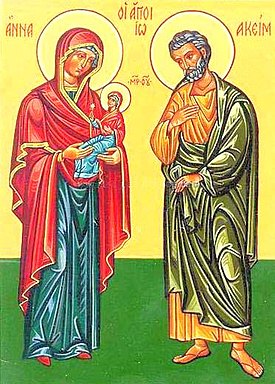
Anna and Joachim
Today’s feast can be confusing to people. It is sometimes mixed up with the Virgin Birth – the moment when Jesus was born. What we celebrate today, however, is the moment Mary was conceived by her parents, Anna and Joachim.
Over the centuries, devotional practice has tended to make Mary more than human – to separate her from the rest us because of her great holiness. However, many theologians today encourage us to find in Mary the same human struggles and triumphs we all meet in life. In this way, we can learn from her and be supported on our own path to holiness.
Today, as we pray with our many images, devotions and understandings of Mary, may we open our hearts to be inspired by her singular witness to God’s desire to be among us.
Poetry: On a separate entry today, I have copied a few passages from the beautiful classic, ” A Woman Wrapped in Silence”. I absolutely love this book and it has been my treasured companion through at least fifty Advents (and Lents). I highly recommend it to you. Read it in small doses that you can break open in your prayer.
Music: The Magnificat – Mary’s radical prayer for justice and mercy, sung here in Latin by the Daughters of Mary (English below)
My soul magnifies the Lord, and my spirit rejoices in God my Savior. For he has regarded the lowliness of his handmaiden. For behold, from henceforth all generations shall call me blessed. And his mercy is on them that fear him throughout all generations. He has shown strength with his arm. He has scattered the proud in the imagination of their hearts. He has put down the mighty from their seat s and has exalted the humble and meek. He has filled the hungry with good things. And the rich he has sent empty away. Remembering his mercy, he has helped his servant Israel as he promised to our forefathers Abraham, and his posterity forever.
Today, in God’s Lavish Mercy, we pray with Psalm 128. It describes the blessed scene that might ensue from the kind of hopeful and just community described in yesterday’s reflection. Because of its final verse, I like to think of it as a “Grandparents’ Blessing”.
Happy are they all who fear the Lord, and who follow in the ways of God! You shall eat the fruit of your labor; happiness and prosperity shall be yours. Your beloved shall be like a fruitful vine within your house, your children like olive shoots round about your table. The one who fears the Lord shall thus indeed be blessed. The Lord bless you from Zion, and may you see the prosperity of Jerusalem all the days of your life.
May you live to see your children’s children; may peace be upon your household.
In our Gospel, Jesus tells us that we achieve such blessedness by actions, not simply by words.
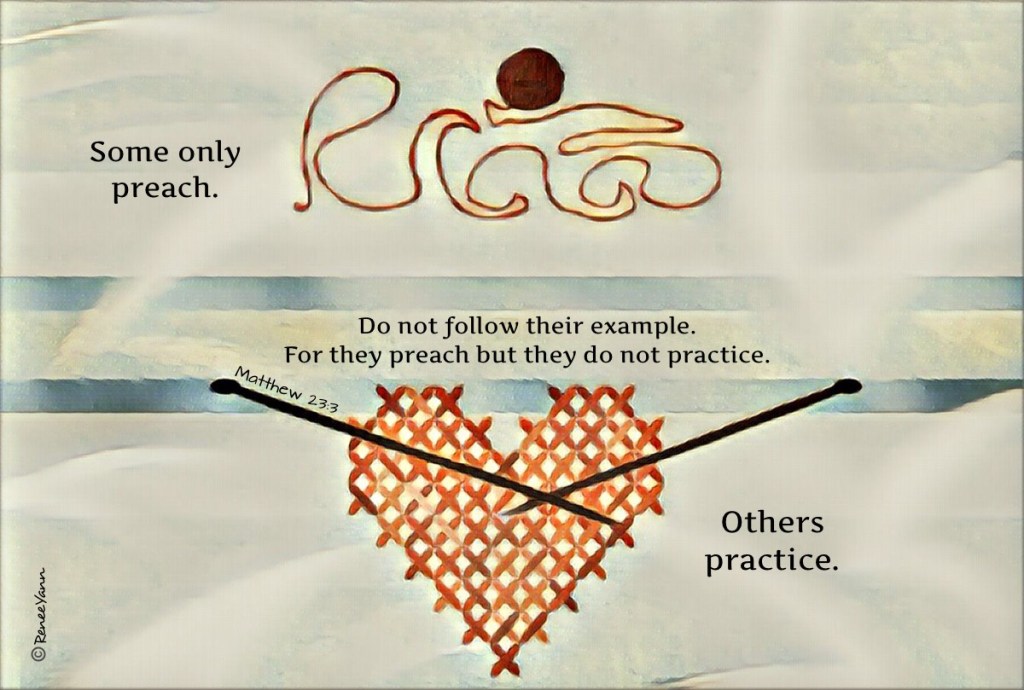
Jesus spoke to the crowds and to his disciples, saying, “The scribes and the Pharisees have taken their seat on the chair of Moses. Therefore, do and observe all things whatsoever they tell you, but do not follow their example. For they preach but they do not practice.
Matthew 23: 1-3
I took that admonition to heart today. I do a lot of “preaching” on these pages. Following the example of Jesus, I need to see if those words come to life in my actions.
Are you with me?
Poetry: The Words We Speak – Hafiz
The words
We speak
Become the house we live in.
Who will want to sleep in your bed
If the roof leaks
Right above
It?
Look what happens when the tongue
Cannot say to kindness,
“I will be your slave.”
The moon
Covers her face with both hands
And can’t bear
To look.
Music: Without Words – Bethel Music
Just a pretty cool instrumental to reflect with today.
Today, in God’s Lavish Mercy, we pray with Psalm 40, and wow, do we need it after an astounding heartless first reading!
The Return of Jephthah by Giovanni Antonio Pellegrini The Yorck Project ( Public Domain)
The story of Jephthah and his daughter is one of the most disturbing in the Bible! It contains so many flaws in faith and reason that it becomes almost unusable for prayer. Then again, maybe that’s the very reason we should pray with it.
Jephthah:
was so full of his own lust for victory that he made a promise to God which God would never want.
was so focused on himself that he ignored the maxim against human sacrifice
had such a distorted concept of God that he made an excuse to kill on God’s supposed behalf
The lesson for me? Don’t be like Jephthah.
We can use God, distort God, and manufacture what we believe to be God’s Will. Countless people have done so down through the centuries and are still doing it. Just shake a history book, and a thousand Jephthahs fall out wrapped in other inglorious names.
We constantly see religion manipulated into a tool for political and personal aggression. The world is full of people who purport to know God’s Will for the rest of us.
Psalm 40 blessedly contradicts this kind of idolatry. We must never attempt to create God in our own image, to satisfy our own agendas.
Psalm 40 lists those practices that will help us to sincere relationship with God and God’s power in our lives:
steadfast trust
unvarnished honesty
humble praise
prayerful obedience
responsiveness to grace
Happy are they who trust in the Lord! they do not resort to evil spirits or turn to false gods. Great things are they that you have done, O Lord my God! how great your wonders and your plans for us! There is none who can be compared with you. Oh, that I could make them known and tell them, but they are more than I can count. In sacrifice and offering you take no pleasure (you have given me ears to hear you); burnt-offering and sin-offering you have not required.
Psalm 40:4-8
These virtues are powereded by a deeply prayerful and reflective life which roots God’s Goodness in our souls.
And so I said, “Behold, I come. In the roll of the book it is written concerning me: ‘I love to do your will, O my God; your law is deep within my heart.’”
Psalm 40:
Poetry: I Know What You Want – a Psalm 40 prayer by Rev. Christine Robinson
I have trusted You, Holy One
  and waited for You.
When I was mired in misery
  you touched me with your spirit.
You pulled me out
  and set me on solid ground.
You put a song in my heart and work in my hands.
  I praise you.
I know what you want from me,
  and where the meaning of my life lies—
Not in rituals, offerings, sacrifices, or creeds,
  just my heart; open to others, and open to You.
I try to live that way.
  I fail often but you nudge and beckon and I follow.
I pray that my words, my song, my life
  show forth your light and light others’ way.
May all who seek you find you.
Touch us with your spirit, that we may be glad.
Music: Take, Lord, Receive – John Foley, SJ
This prayer is the Suscipe of St. Ignatius Loyola found in the final part of his book, “The Spiritual Exercises”.













 Lavish Mercy