Wednesday of the Twenty-second Week in Ordinary Time

Wednesday, September 1, 2021

Today, in God’s Lavish Mercy, we pray with Psalm 52, whose chosen verses today form an exquisite prayer – one that can be held like a diamond to the Light:

I, like a green olive tree
    in the house of God,
Trust in the mercy of God
    forever and ever.
I will thank you always for what you have done,
    and proclaim the goodness of your name
    before your faithful ones.

Psalm 52: 10-11

It is ironic that these tenderly beautiful verses close one of the most virulent curses of the Psalms! It’s better to let them stand alone for today’s prayer. Like that, they perfectly complement Paul’s gorgeous blessing poured over the Colossians in our first reading:

Grace to you and peace from God our Father.
We always give thanks to God, the Father of our Lord Jesus Christ,
when we pray for you,
for we have heard of your faith in Christ Jesus
and the love that you have for all the holy ones
because of the hope reserved for you in heaven.

Colossians 1:2-5

As this first day of September breaks over us, it is a good day to give thanks within these scriptural blessings:

  • for courage given and hope sustained
  • for storms weathered and favors received
  • for the resilience of new promises 
  • and the polished incandescence of the long-kept vow
  • for fields turned over toward a season of rest
  • for sweaters shaken out and ready to warm
  • for the smell of a sharpened pencil, the endless possibilities of a fresh notebook, 
  • and a new box of crayons ( to follow in a later post. I mistakenly send a fragment earlier today. I hope it wasn’t a distraction to you.)

Poetry: First Day of School – by Howard Nemerov (February 29, 1920 – July 5, 1991), an American poet. He was twice Poet Laureate Consultant in Poetry to the Library of Congress, from 1963 to 1964 and again from 1988 to 1990. For The Collected Poems of Howard Nemerov (1977), he won the National Book Award for Poetry,Pulitzer Prize for Poetry,and Bollingen Prize.

I

My child and I hold hands on the way to school,

And when I leave him at the first-grade door

He cries a little but is brave; he does

Let go. My selfish tears remind me how

I cried before that door a life ago.

I may have had a hard time letting go.

Each fall the children must endure together

What every child also endures alone:

Learning the alphabet, the integers,

Three dozen bits and pieces of a stuff

So arbitrary, so peremptory,

That worlds invisible and visible

Bow down before it, as in Joseph’s dream

The sheaves bowed down and then the stars bowed down

Before the dreaming of a little boy.

That dream got him such hatred of his brothers

As cost the greater part of life to mend,

And yet great kindness came of it in the end.

II

A school is where they grind the grain of thought,

And grind the children who must mind the thought.

It may be those two grindings are but one,

As from the alphabet come Shakespeare’s Plays,

As from the integers comes Euler’s Law,

As from the whole, inseperably, the lives,

The shrunken lives that have not been set free

By law or by poetic phantasy.

But may they be. My child has disappeared

Behind the schoolroom door. And should I live

To see his coming forth, a life away,

I know my hope, but do not know its form

Nor hope to know it. May the fathers he finds

Among his teachers have a care of him

More than his father could. How that will look

I do not know, I do not need to know.

Even our tears belong to ritual.

But may great kindness come of it in the end.


Music: September Morn – instrumental version of Neil Diamond’s song. The words don’t exactly work for our prayer, but the melody does 🙂

Saturday of the Fifteenth Week in Ordinary Time

July 17, 2021

Today, in God’s Lavish Mercy, we pray with Psalm 136 in which the psalmist remembers in detail Israel’s long experience of God’s enduring fidelity.

The cadence of the psalm creates an underlying drumbeat to our prayer, a chant of gratitude and confidence. Reading it, I was reminded of two things.

The first is a scene from the movie “Glory” where the troops pray the night before battle. They pray in the classic style of the Black spiritual call-and-response song.

You may have seen it:

The prayer of these men, like the prayer of ancient Israel, is not just a walk down memory lane. No. Each proclamation is an act of of faith – and of gratitude for the past, courage for the present, and hope for the future.


Secondly, I was reminded of the simple and methodical cadence of a childhood ditty – S/he loves me S/he loves me not. Didn’t many of us try that magic practice at least once, maybe at our first young crush?

Well, God does love us – daisy or not. The proof is not in the petals, but in the story of our lives.

Today might be a good day
to “chant” gratefully
through our own catalogue with God
– remembering, thanking,
believing,and hoping.


Poetry: I thank you, God – e.e.cummings

i thank You God for most this amazing
day:for the leaping greenly spirits of trees
and a blue true dream of sky;and for everything
which is natural which is infinite which is yes
(i who have died am alive again today,
and this is the sun’s birthday;this is the birth
day of life and of love and wings:and of the gay
great happening illimitably earth)
how should tasting touching hearing seeing
breathing any—lifted from the no
of all nothing—human merely being
doubt unimaginable You?
(now the ears of my ears awake and
now the eyes of my eyes are opened)

Music: Swing Low, Sweet Chariot – Etta James sings a classical example of the call-and-response spiritual

Swing low, sweet chariot

Coming for to carry me home,

Swing low, sweet chariot,

Coming for to carry me home.

I looked over Jordan, and what did I see

Coming for to carry me home?

A band of angels coming after me,

Coming for to carry me home.

Sometimes I’m up, and sometimes I’m down,

(Coming for to carry me home)

But still my soul feels heavenly bound.

(Coming for to carry me home)

The brightest day that I can say,

(Coming for to carry me home)

When Jesus washed my sins away.

(Coming for to carry me home)

If I get there before you do,

(Coming for to carry me home)

I’ll cut a hole and pull you through.

(Coming for to carry me home)

If you get there before I do,

(Coming for to carry me home)

Tell all my friends I’m coming too.

(Coming for to carry me home)

Swing low, sweet chariot

Coming for to carry me home,

Swing low, sweet chariot,

Coming for to carry me home.

Thursday of the Fourteenth Week in Ordinary Time

Thursday, July 8, 2021

Today, in God’s Lavish Mercy, we pray with Psalm 105, one of the psalms which Walter Brueggemann characterizes as “lively remembering”.

These are psalms which gratefully inventory God’s generosity and faithfulness to Israel. The long list evokes holy surprise, gratitude, trust, and commitment in the believer’s heart.


Today’s verses pertain particularly to the wonderful story of Joseph cited in our first reading. But the entire psalm remembers a Divine Generosity covering generations.

Recall the wondrous deeds God has done,
wonders and words of judgment,

You descendants of Abraham God’s servant,
offspring of Jacob the chosen one!

Psalm 105: 5-6

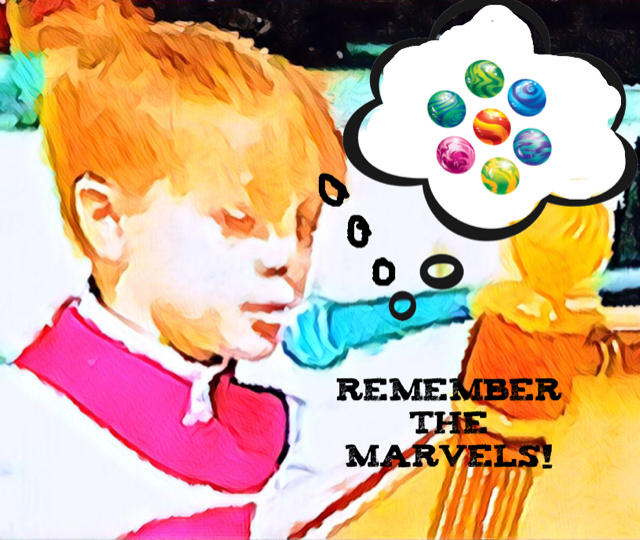
Reading Psalm 105 always makes me remember a little blond kid from my long ago teaching days. 

We regularly gathered our school community for a “Children’s Mass”, either on Sunday or some special occasion. Bobby, a very good reader for a third grader, had volunteered to deliver the Responsorial Psalm. 

And he delivered, loud and clear:

Remember the “marbles”
the Lord has done.

Four times, the school body of 500+ children obediently responded in kind, apparently visualizing the same “marbles” as Bobby did.


Did God care? No, I think God enjoyed it as much as we teachers did. 

And as I remember the moment this morning, I can’t help considering how innocently garbled my own prayer must seem to God. Because honestly, how can we even imagine God, let alone find the words to speak the mysteries of our soul!

Glory in his holy name;
let hearts that seek the LORD rejoice!

Seek out the LORD’s might;
constantly seek God’s face.

Psalm 105: 3-4

So, praying our psalm today, we might want to hold up silently before God, who created the vastness of universe, all the tiny “marbles” in our hearts – those brilliant but impenetrable mysteries of love, hope, suffering, and joy which roll around in the deep universe of our lives.

Like the psalmist, we can unroll an inventory of God’s faithfulness to us which allows us to imagine a future full of hope – for ourselves and the generations to follow us.


Poetry: Ode to Marbles BY MAX MENDELSOHN

I love the sound of marbles   
scattered on the worn wooden floor,   
like children running away 
in a game of hide-and-seek.   
I love the sight of white marbles,   
blue marbles,   
green marbles, black,   
new marbles, old marbles,   
iridescent marbles,   
with glass-ribboned swirls,   
dancing round and round.   
I love the feel of marbles,   
cool, smooth,   
rolling freely in my palm,   
like smooth-sided stars   
that light up the worn world.

Music: Tchaikovsky’s Waltz of the Flowers
– synchronized with MARBLES!
By DoodleChaos

Allow this video to open up your amazement. Invite into that amazement your gratitude for God’s astounding goodness to you. Perhaps like prayerfully walking a labyrinth, you can roll with the marbles through your faith journey.

Wednesday of the Fourteenth Week in Ordinary Time

Wednesday, July 7, 2021

Today, in God’s Lavish Mercy, we pray with Psalm 33 in which the psalmist is clearly awestruck by both the power and the mercy of God. It is a prayer of radical awareness that God is Creator and we are creature.

According to Walter Brueggemann,
Psalm 33 describes Yahweh
as the settled sovereign, securely in control,
who need only speak
to have the command fulfilled.

The psalm has two divisions. In part one, the community is called to praise God because God deserves it.

Rejoice, you righteous, in the LORD;
praise from the upright is fitting.

Give thanks to the LORD on the harp;
on the ten-stringed lyre offer praise.

Sing to God a new song;
skillfully play with joyful chant.

For the LORD’s word is upright;
and works are trustworthy.

Psalm 33: 1-4

In part two, that praise is articulated by recounting God’s caring intervention in the community’s experience.

From heaven the LORD looks down
and observes the children of Adam,

From that dwelling place surveying
all who dwell on earth.

The One who fashioned together their hearts
and who knows all their works.

Psalm 33: 13-15

Psalm 33 can be summarized in this way:

Because Yahweh rules with righteousness, justice, and unfailing love,
we must worship Yahweh with songs and praise
and by rejecting all false sources of salvation.

Lynn Jost, Professor of Biblical and Religious Studies – Tabor College, Kansas

Praying Psalm 33 reminds me that one can never demand mercy. We cannot require the other to hold us in continual compassion. We can only hope and be grateful.

Mercy is the gift of a heart moved beyond itself by love and tenderness. Such outpouring is the very nature of God in whose image we are created.

Thus for God, and for us, to be unmerciful is to be unnatural. In Psalm 33, we pray not only to receive mercy, but to become mercy.


Psalm 33 closes with a plea for our hearts to be deepened in their affinity to God, to mirror God by our patience, joy, hope, and mercy.

Our soul waits for the LORD,
Who is our help and shield.

For in God our hearts rejoice;
in God’s holy name we trust.

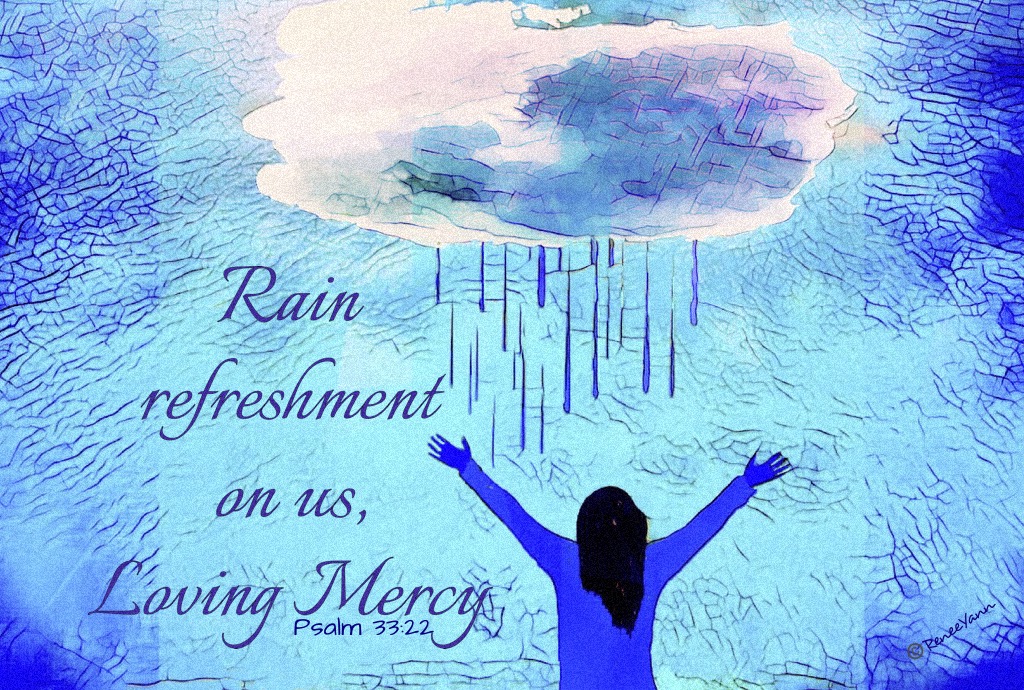
May your mercy, LORD, be upon us;
as we put our hope in you.

Psalm 33: 20-22

Poetry: To Live in the Mercy of God BY DENISE LEVERTOV

To lie back under the tallest
oldest trees. How far the stems
rise, rise
               before ribs of shelter
                                           open!
To live in the mercy of God. The complete
sentence too adequate, has no give.
Awe, not comfort. Stone, elbows of
stony wood beneath lenient
moss bed.
And awe suddenly
passing beyond itself. Becomes
a form of comfort.
                      Becomes the steady
air you glide on, arms
stretched like the wings of flying foxes.
To hear the multiple silence
of trees, the rainy
forest depths of their listening.
To float, upheld,
                as salt water
                would hold you,
                                        once you dared.
                  .
To live in the mercy of God.
To feel vibrate the enraptured
waterfall flinging itself
unabating down and down
                              to clenched fists of rock.
Swiftness of plunge,
hour after year after century,
                                                   O or Ah
uninterrupted, voice
many-stranded.
                              To breathe
spray. The smoke of it.
                              Arcs
of steelwhite foam, glissades
of fugitive jade barely perceptible. Such passion—
rage or joy?
                              Thus, not mild, not temperate,
God’s love for the world. Vast
flood of mercy
                      flung on resistance.

Music: As you listen to David Arkenstone’s instrumental, you may want to remember Shakespeare’s famous description of mercy. See below the music.

Fourteenth Sunday in Ordinary Time

Sunday, July 4, 2021

Today, in God’s Lavish Mercy, we pray with Psalm 123. 

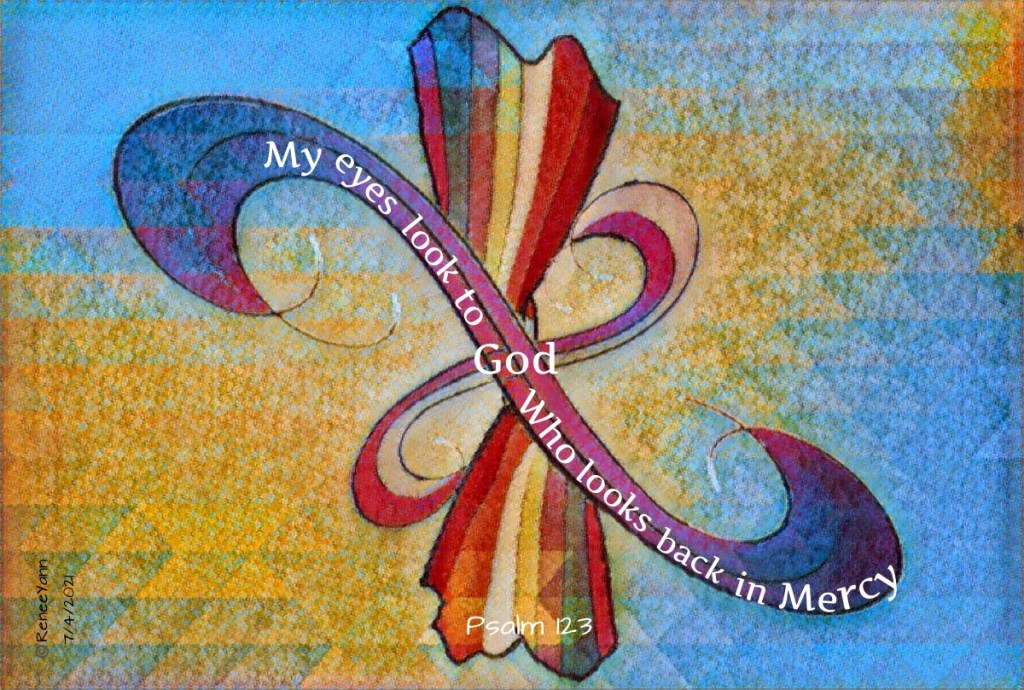
… eyes fixed on the Lord, pleading for mercy.

Psalm 123:2

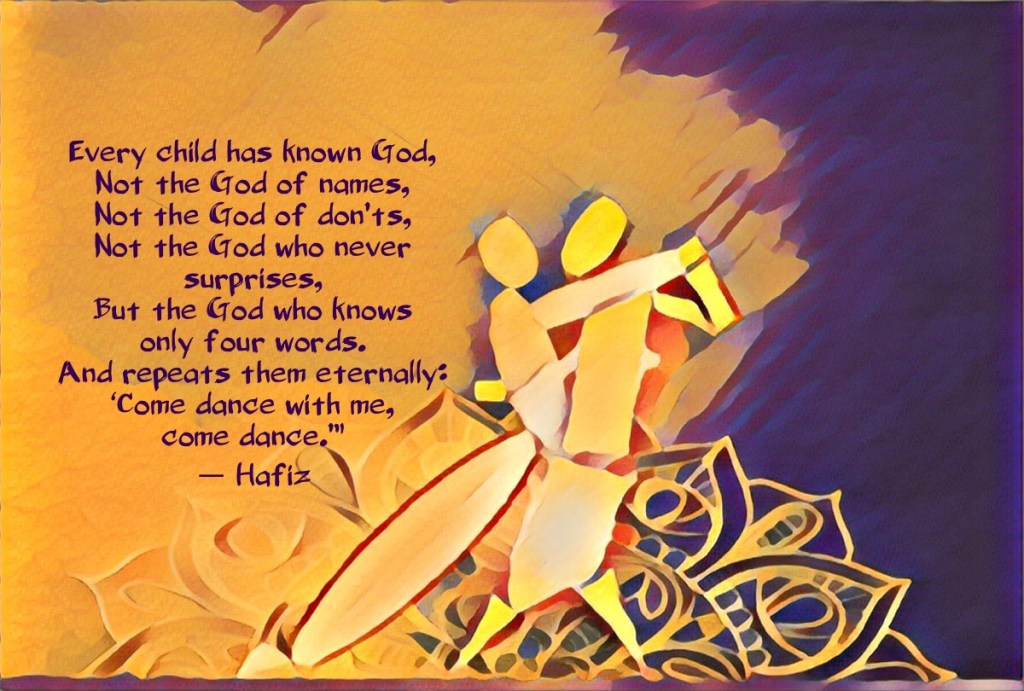
This starkly passionate response, repeated throughout the psalm, struck an image in my imagination – an ardent tango with the Beloved, eyes fixed in hope.


Often in my prayer I just dance or sing with God – sometimes with sound and movement, sometimes in still silence. The dances are varied depending  on the prayer and the day’s circumstances.  

Today’s readings, filled with Israel’s resistance, Paul’s thorn, and Nazarene recalcitrance drew an energetic tango in my mind.

It is a dance between Mercy and Resistance. In my prayer, I searched for where that dance resides in me.


Music: Tango to Evora – Loreena McKennitt

Wednesday of the Thirteenth Week in Ordinary Time

June 30, 2021

Today, in God’s Lavish Mercy, we pray with Psalm 34. We do so in the light of our first reading which tells us the heart-wrenching story of Hagar. 

As Hagar sat opposite Ishmael, he began to cry.
God heard the boy’s cry,
and God’s messenger called to Hagar from heaven:
“What is the matter, Hagar?
Don’t be afraid; God has heard the boy’s cry in this plight of his.
Arise, lift up the boy and hold him by the hand;
for I will make of him a great nation.”
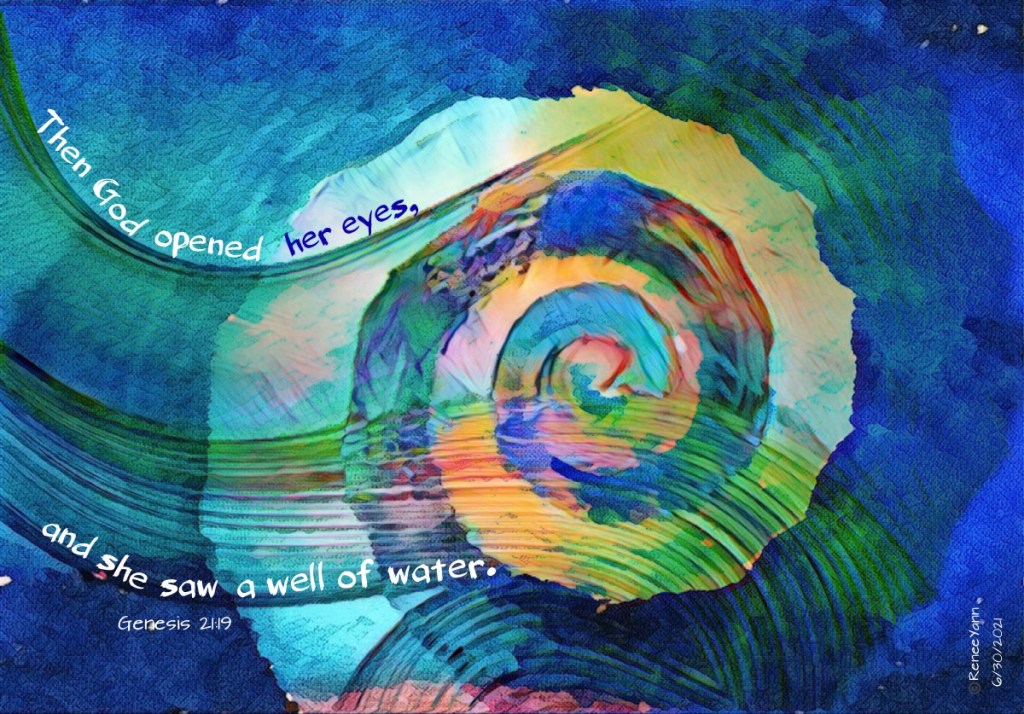
Then God opened her eyes, and she saw a well of water.
She went and filled the skin with water, and then let the boy drink.

Genesis 21: 15-19

Surely Hagar, and her baby Ishmael, are “poor ones” whose cries the Lord hears.

When the poor ones called out, the LORD heard,
and from all distress saved them.
The angel of the LORD encamps
around those who fear God, and delivers them.

Psalm 34: 7-8

Hagar is the embodiment of a faith that has surrendered everything to God. She is pressed to it by the circumstances of her life. But even in that press, she has a choice: God or godlessness. 

God sees her heart choice and opens her eyes to its power:

Then God opened her eyes,
and she saw a well of water.
She went and filled the skin with water,
and then let the boy drink.

The revelation I take from today’s readings?

Even in our deepest thirsts, there is a “well of water” awaiting us when we live in faith and reverence for God:

Fear the LORD, you holy ones,
for nought is lacking to those who fear God.
The great grow poor and hungry;
but those who seek God want for no good thing.

Psalm 34: 10-11

Poetry: Hagar in the Wilderness by Tyehimba Jess

My God is the living God,
God of the impertinent exile.
An outcast who carved me
into an outcast carved
by sheer and stony will
to wander the desert
in search of deliverance
the way a mother hunts
for her wayward child.
God of each eye fixed to heaven,
God of the fallen water jug,
of all the hope a vessel holds
before spilling to barren sand.
God of flesh hewn from earth
and hammered beneath a will
immaculate with the power
to bear life from the lifeless
like a well in a wasteland.
I'm made in the image of a God
that knows flight but stays me
rock still to tell a story ancient as
slavery, old as the first time
hands clasped together for mercy
and parted to find only their own
salty blessing of sweat.
I have been touched by my God
in my creation, I've known her caress
of anointing callus across my face. 
I know the lyric of her pulse
across these lips...  and yes,
I've kissed the fingertips
of my dark and mortal God.
She has shown me the truth
behind each chiseled blow
that's carved me into this life,
the weight any woman might bear 
to stretch her mouth toward her
one true God, her own
beaten, marble song.
sculptor: Edmonia Lewis (1845-1907), an African/Native American expatriate who was phenomenally successful in Rome.

Music: El Roi (Hagar’s Song)

Twelfth Sunday in Ordinary Time

Sunday, June 20, 2021

Today, in God’s Lavish Mercy, we pray with Psalm 107, a poem filled with images that hold secrets for our spiritual journey:

They who sailed the sea in ships,
    trading on the deep waters,
These saw the works of the LORD
    and God’s wonders in the abyss.

Psalm 107:23-24

Those who have the opportunity to see the ocean in its many moods will quickly understand the analogy. 

Life is an ocean, but we are not sailing it alone.

That’s what the Lord suggests to Job in our first reading, and what Jesus points out to the nervous disciples in our Gospel.

Psalm 107 tells us that when life distresses us we should do just what the disciples did:

They cried to the LORD in their distress;
    from their straits he rescued them,
God hushed the storm to a gentle breeze
    and the billows of the sea were stilled

Psalm 107: 28-29

It also suggests us that we can hope for this result:

They rejoiced that they were calmed,
    and  brought to their desired haven.
Let them give thanks fo the Lord’s kindness
    and  wondrous deeds to us all.

Psalm 107:30-31

The message of today’s readings for me is trust and hope
— in both calm and storm. Let’s pray for it.


Poetry: blessing of the boats – Lucille Clifton

                                    (at St. Mary’s)

may the tide
that is entering even now
the lip of our understanding
carry you out
beyond the face of fear
may you kiss
the wind then turn from it
certain that it will
love your back     may you
open your eyes to water
water waving forever
and may you in your innocence
sail through this to that.


Music: Secret Ocean – Peter Kater

Friday of the Eleventh Week in Ordinary Time

June 18, 2021

Today, in God’s Lavish Mercy, we pray with Psalm 34 which carries forward the thread of sage advice running through all of our readings


I’m going to state the obvious here: distress is not a pretty thing. 


We all have stress in our lives and, guess what, it can be a good thing. Stress is a reaction in us when a situation calls for our response. If such reactions never occurred, we would be living in isolation from our environment or community. We would not grow as persons.

This positive stress can be called “eustress”. Distress, on the other hand, occurs when we cannot respond effectively to our experiences or situation. We become overwhelmed, fearful, or anxious.


Paul, in our first reading, has a lot of opportunity to grow from stress! Maybe too much. It sounds like Paul’s experiences had certainly bordered on “distress”.

So did our psalmist’s experiences. In later verses of the psalm, we get a hint of that. The writer is broken-hearted, crushed in spirit, and under physical threat — just like Paul:

The LORD is close to the brokenhearted,
saves those whose spirit is crushed.
Many are the troubles of the righteous,
but the LORD delivers us from them all.
God watches over all our bones;
not one of them shall be broken.
Evil will slay the wicked;
those who hate the righteous are condemned.
But the  LORD redeems the faithful servant
and none are condemned who take refuge in God.

Psalm 34:19-23

Jesus has a word for us about dealing with distress:

Do not store up for yourselves treasures on earth,
where moth and decay destroy,
and thieves break in and steal.
But store up treasures in heaven,
where neither moth nor decay destroys,
nor thieves break in and steal.


So it all depends on what we treasure, on what we allow to become most important in our lives. If wealth, reputation, power, and self-aggrandizement are our treasures, we’re going to live in distress all our lives trying to protect these trophies.

If charity, hope, faith, and merciful justice are our treasures, it doesn’t mean we will never have stress or pain. But we will understand the prayer of Psalm 34:

Glorify the LORD with me,
    let us together extol God’s name.
I sought the LORD who answered me
    and delivered me from all my fears. 
From all their distress God rescues the just.
Look to God that you may be radiant with joy,
    and your faces may not blush with shame.
When the poor one called out, the LORD heard,
    and was delivered from all distress.

Psalm 34:4-7

Poetry: Do not be troubled, God, though they say “mine” – Rainer Maria Rilke

Do not be troubled, God, though they say “mine”
of all things that permit it patiently.
they are like wind that lightly strokes the boughs
and says: MY tree.
They hardly see
how all things glow that their hands seize upon,
so that they cannot touch
even the utmost fringe and not be singed.
They will say “mine” as one will sometimes call
the prince his friend in speech with villagers,
this prince being very great — and far away.
They call strange walls “mine,” knowing not at all
who is the master of the house indeed.
They still say “mine,” and claim possession, though
each thing, as they approach, withdraws and closes;
a silly charlatan perhaps thus poses
as owner of the lightning and the sun.
And so they say: my life, my wife, my child,
my dog, well knowing all that they have styled
their own: life, wife, child, dog, remain
shapes foreign and unknown,
that blindly groping they must stumble on.
This truth, be sure, only the great discern,
who long for eyes. The others WILL not learn
that in the beggary of their wandering
they cannot claim a bond with any thing,
but, driven from possessions they have prized,
not by their own belongings recognized,
they can OWN wives no more than they own flowers,
whose life is alien and apart from ours.
God, do not lose your equilibrium.
Even he who loves you and discerns your face
in darkness, when he trembles like a light
you breathe upon, — he cannot own you quite.
And if at night one holds you closely pressed,
locked in his prayers so you cannot stray,
…..you are the guest
…..who comes, but not to stay.
God, who can hold you? To yourself alone
belonging, by no owner’s hand disturbed,
you are like unripened wine that unperturbed
grows ever sweeter and is all alone.


Music: Me and Bobby McGee written and sung by Kris Kristofferson

I don’t know if you will appreciate this song, but I thought I’d give it a try. 
I have always identified today’s Gospel with a verse in the song:
Freedom’s just another word for nothin’ left to lose.
Nothin’, it ain’t nothin’ honey, if it ain’t free
I have never fully spiritually plumbed that verse, but I love to explore it every time I hear this song.

Wednesday of the Tenth Week in Ordinary Time

June 9, 2021

Today, in God’s Lavish Mercy, we pray with Psalm 25 which is our Alleluia Verse.

Psalm 25, in total, is a psalm of lament. But today’s single phrase is a golden thread in an otherwise somber weave. It is a simple act of faith and dependence on God. It is the yielding of one’s life into God’s unfolding promise.


Praying with this psalm today, I am nostalgic. On June 9th, 58 years ago, I graduated from high school.

I guess for some, high school graduation isn’t a remarkable or memorable event. But for me, and the two other young women in this photo, it was a time of earth-shaking choices and profound commitments. It was a moment in our personal stories that would shape our lives forever – we had decided to become Sisters of Mercy.


Every life has one – or likely a few – such moments. They are the hinges on which our life story revolves. Praying gratefully with them helps us to recognize God’s enduring Presence in our lives and to rejuvenate our faith. 

When you get as old as I am, the accumulation of gratitude is overwhelming and the trust in God’s continued abiding is assuring.

Robert Frost seems to have been having such a prayer when he wrote his beloved poem. Maybe it will help your prayer today or at some other date of holy reminiscence in your life.


Poetry: The Road Not Taken – Robert Frost

Two roads diverged in a yellow wood,
And sorry I could not travel both
And be one traveler, long I stood
And looked down one as far as I could
To where it bent in the undergrowth;

Then took the other, as just as fair,
And having perhaps the better claim,
Because it was grassy and wanted wear;
Though as for that the passing there
Had worn them really about the same,

And both that morning equally lay
In leaves no step had trodden black.
Oh, I kept the first for another day!
Yet knowing how way leads on to way,
I doubted if I should ever come back.

I shall be telling this with a sigh
Somewhere ages and ages hence:
Two roads diverged in a wood, and I—
I took the one less traveled by,
And that has made all the difference.

Music: The Magnificat Medley – John Michael Talbot

I chose this song today for two reasons.

  1. It is the verse in our Responsorial Psalm:

Holy is the Lord our God.

Psalm 99:7

2. The Magnificat was such a moment in Mary’s life.

Tuesday of the Tenth Week in Ordinary Time

June 8, 2021

Today, in God’s Lavish Mercy, we pray with Psalm 119, a repeated favorite on the blog – you might like to re-visit any of the 13 entries:


Today, let’s pray with 119 in the light of Paul’s words to the Corinthians:

For the Son of God, Jesus Christ, … 
was not “yes” and “no,” but always “YES”.
God’s promises … find their “Yes” in him.

2 Corinthians 1:19-20

Here’s what those slightly cryptic but profoundly meaningful phrases mean to me.

No doubt, sometime in your life you have heard someone powerful say “No” to you. Or perhaps life itself has said it with some insurmountable limitations.

It is in those moments that we truly understand what “Yes” means because it has eluded us!

That meaning takes various forms depending on our circumstances. “Yes” can mean freedom, love, mercy, forgiveness, renewal, possibility, hope, fulfillment.

And “Yes” is always a beginning … a mystery that longs to be unfurled, unpeeled – like this beautiful red onion ( that I bought yesterday for a salad that turned into a reflection!)


Psalm 119 “unpeels” the layers of our relationship with God. Here’s how I hear it in my prayer:

O Lovely God,
You are wonderful.
You are my Light.
You amaze me
by the “Yes” of your Love.
You fire my spirit
to love You in return.

Lavish Mercy, turn to me
because I love You.
Steady me in my shadows.
Draw my “yes” 
into the Light 
of your beautiful Face.

based on Psalm 119:129-135

Poem: love is a place – e.e.cummings 

love is a place
& through this place of
love move
(with brightness of peace)
all places

yes is a world
& in this world of
yes live
(skillfully curled)
all worlds

Music: The Beauty We Love