Today, in God’s Lavish Mercy, we pray with Psalm 123.
… eyes fixed on the Lord, pleading for mercy.
Psalm 123:2
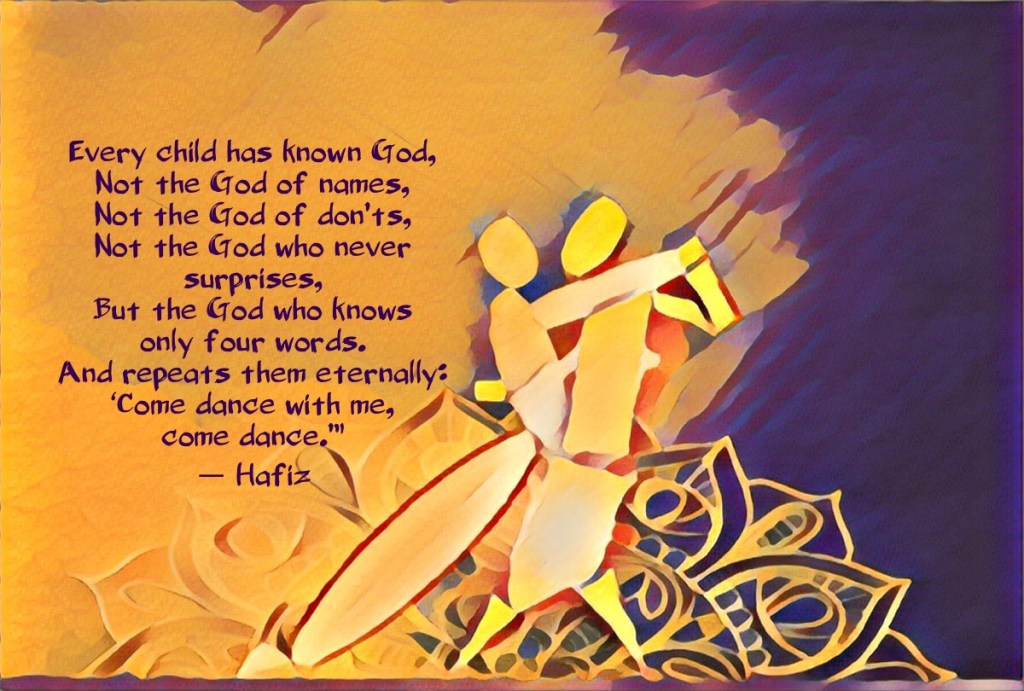
This starkly passionate response, repeated throughout the psalm, struck an image in my imagination – an ardent tango with the Beloved, eyes fixed in hope.
Often in my prayer I just dance or sing with God – sometimes with sound and movement, sometimes in still silence. The dances are varied depending on the prayer and the day’s circumstances.
Today’s readings, filled with Israel’s resistance, Paul’s thorn, and Nazarene recalcitrance drew an energetic tango in my mind.
It is a dance between Mercy and Resistance. In my prayer, I searched for where that dance resides in me.
Today, in God’s Lavish Mercy, we pray with Psalm 34. We do so in the light of our first reading which tells us the heart-wrenching story of Hagar.
As Hagar sat opposite Ishmael, he began to cry. God heard the boy’s cry, and God’s messenger called to Hagar from heaven: “What is the matter, Hagar? Don’t be afraid; God has heard the boy’s cry in this plight of his. Arise, lift up the boy and hold him by the hand; for I will make of him a great nation.” Then God opened her eyes, and she saw a well of water. She went and filled the skin with water, and then let the boy drink.
Genesis 21: 15-19
Surely Hagar, and her baby Ishmael, are “poor ones” whose cries the Lord hears.
When the poor ones called out, the LORD heard, and from all distress saved them. The angel of the LORD encamps around those who fear God, and delivers them.
Psalm 34: 7-8
Hagar is the embodiment of a faith that has surrendered everything to God. She is pressed to it by the circumstances of her life. But even in that press, she has a choice: God or godlessness.
God sees her heart choice and opens her eyes to its power:
Then God opened her eyes, and she saw a well of water. She went and filled the skin with water, and then let the boy drink.
The revelation I take from today’s readings?
Even in our deepest thirsts, there is a “well of water” awaiting us when we live in faith and reverence for God:
Fear the LORD, you holy ones, for nought is lacking to those who fear God. The great grow poor and hungry; but those who seek God want for no good thing.
Psalm 34: 10-11
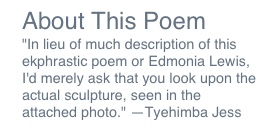
Poetry: Hagar in the Wilderness by Tyehimba Jess
My God is the living God,
God of the impertinent exile.
An outcast who carved me
into an outcast carved
by sheer and stony will
to wander the desert
in search of deliverance
the way a mother hunts
for her wayward child.
God of each eye fixed to heaven,
God of the fallen water jug,
of all the hope a vessel holds
before spilling to barren sand.
God of flesh hewn from earth
and hammered beneath a will
immaculate with the power
to bear life from the lifeless
like a well in a wasteland.
I'm made in the image of a God
that knows flight but stays me
rock still to tell a story ancient as
slavery, old as the first time
hands clasped together for mercy
and parted to find only their own
salty blessing of sweat.
I have been touched by my God
in my creation, I've known her caress
of anointing callus across my face.
I know the lyric of her pulse
across these lips...  and yes,
I've kissed the fingertips
of my dark and mortal God.
She has shown me the truth
behind each chiseled blow
that's carved me into this life,
the weight any woman might bear
to stretch her mouth toward her
one true God, her own
beaten, marble song.
sculptor: Edmonia Lewis (1845-1907), an African/Native American expatriate who was phenomenally successful in Rome.
Today, in God’s Lavish Mercy, we pray with Psalm 107, a poem filled with images that hold secrets for our spiritual journey:
They who sailed the sea in ships, trading on the deep waters, These saw the works of the LORD and God’s wonders in the abyss.
Psalm 107:23-24
Those who have the opportunity to see the ocean in its many moods will quickly understand the analogy.
Life is an ocean, but we are not sailing it alone.
That’s what the Lord suggests to Job in our first reading, and what Jesus points out to the nervous disciples in our Gospel.
Psalm 107 tells us that when life distresses us we should do just what the disciples did:
They cried to the LORD in their distress; from their straits he rescued them, God hushed the storm to a gentle breeze and the billows of the sea were stilled
Psalm 107: 28-29
It also suggests us that we can hope for this result:
They rejoiced that they were calmed, and brought to their desired haven. Let them give thanks fo the Lord’s kindness and wondrous deeds to us all.
Psalm 107:30-31
The message of today’s readings for me is trust and hope — in both calm and storm. Let’s pray for it.
Poetry: blessing of the boats – Lucille Clifton
(at St. Mary’s)
may the tide that is entering even now the lip of our understanding carry you out beyond the face of fear may you kiss the wind then turn from it certain that it will love your back may you open your eyes to water water waving forever and may you in your innocence sail through this to that.
Today, in God’s Lavish Mercy, we pray with Psalm 34 which carries forward the thread of sage advice running through all of our readings
I’m going to state the obvious here: distress is not a pretty thing.
We all have stress in our lives and, guess what, it can be a good thing. Stress is a reaction in us when a situation calls for our response. If such reactions never occurred, we would be living in isolation from our environment or community. We would not grow as persons.
This positive stress can be called “eustress”. Distress, on the other hand, occurs when we cannot respond effectively to our experiences or situation. We become overwhelmed, fearful, or anxious.
Paul, in our first reading, has a lot of opportunity to grow from stress! Maybe too much. It sounds like Paul’s experiences had certainly bordered on “distress”.
So did our psalmist’s experiences. In later verses of the psalm, we get a hint of that. The writer is broken-hearted, crushed in spirit, and under physical threat — just like Paul:
The LORD is close to the brokenhearted, saves those whose spirit is crushed. Many are the troubles of the righteous, but the LORD delivers us from them all. God watches over all our bones; not one of them shall be broken. Evil will slay the wicked; those who hate the righteous are condemned. But the LORD redeems the faithful servant and none are condemned who take refuge in God.
Psalm 34:19-23
Jesus has a word for us about dealing with distress:
Do not store up for yourselves treasures on earth, where moth and decay destroy, and thieves break in and steal. But store up treasures in heaven, where neither moth nor decay destroys, nor thieves break in and steal.
So it all depends on what we treasure, on what we allow to become most important in our lives. If wealth, reputation, power, and self-aggrandizement are our treasures, we’re going to live in distress all our lives trying to protect these trophies.
If charity, hope, faith, and merciful justice are our treasures, it doesn’t mean we will never have stress or pain. But we will understand the prayer of Psalm 34:
Glorify the LORD with me, let us together extol God’s name. I sought the LORD who answered me and delivered me from all my fears. From all their distress God rescues the just. Look to God that you may be radiant with joy, and your faces may not blush with shame. When the poor one called out, the LORD heard, and was delivered from all distress.
Psalm 34:4-7
Poetry: Do not be troubled, God, though they say “mine” – Rainer Maria Rilke
Do not be troubled, God, though they say “mine” of all things that permit it patiently. they are like wind that lightly strokes the boughs and says: MY tree. They hardly see how all things glow that their hands seize upon, so that they cannot touch even the utmost fringe and not be singed. They will say “mine” as one will sometimes call the prince his friend in speech with villagers, this prince being very great — and far away. They call strange walls “mine,” knowing not at all who is the master of the house indeed. They still say “mine,” and claim possession, though each thing, as they approach, withdraws and closes; a silly charlatan perhaps thus poses as owner of the lightning and the sun. And so they say: my life, my wife, my child, my dog, well knowing all that they have styled their own: life, wife, child, dog, remain shapes foreign and unknown, that blindly groping they must stumble on. This truth, be sure, only the great discern, who long for eyes. The others WILL not learn that in the beggary of their wandering they cannot claim a bond with any thing, but, driven from possessions they have prized, not by their own belongings recognized, they can OWN wives no more than they own flowers, whose life is alien and apart from ours. God, do not lose your equilibrium. Even he who loves you and discerns your face in darkness, when he trembles like a light you breathe upon, — he cannot own you quite. And if at night one holds you closely pressed, locked in his prayers so you cannot stray, …..you are the guest …..who comes, but not to stay. God, who can hold you? To yourself alone belonging, by no owner’s hand disturbed, you are like unripened wine that unperturbed grows ever sweeter and is all alone.
Music: Me and Bobby McGee written and sung by Kris Kristofferson
I don’t know if you will appreciate this song, but I thought I’d give it a try. I have always identified today’s Gospel with a verse in the song: Freedom’s just another word for nothin’ left to lose. Nothin’, it ain’t nothin’ honey, if it ain’t free I have never fully spiritually plumbed that verse, but I love to explore it every time I hear this song.
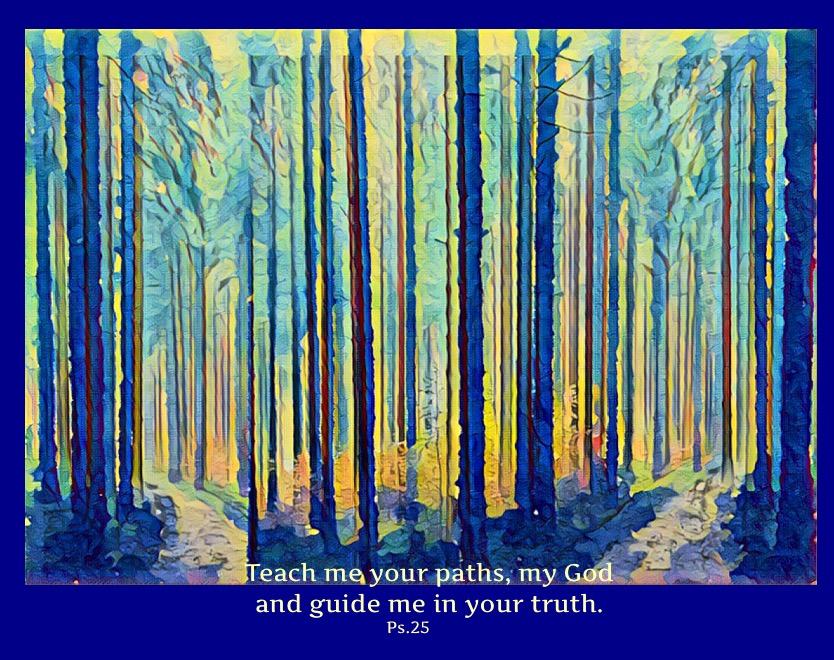
Today, in God’s Lavish Mercy, we pray with Psalm 25 which is our Alleluia Verse.
Psalm 25, in total, is a psalm of lament. But today’s single phrase is a golden thread in an otherwise somber weave. It is a simple act of faith and dependence on God. It is the yielding of one’s life into God’s unfolding promise.
Praying with this psalm today, I am nostalgic. On June 9th, 58 years ago, I graduated from high school.
I guess for some, high school graduation isn’t a remarkable or memorable event. But for me, and the two other young women in this photo, it was a time of earth-shaking choices and profound commitments. It was a moment in our personal stories that would shape our lives forever – we had decided to become Sisters of Mercy.
Every life has one – or likely a few – such moments. They are the hinges on which our life story revolves. Praying gratefully with them helps us to recognize God’s enduring Presence in our lives and to rejuvenate our faith.
When you get as old as I am, the accumulation of gratitude is overwhelming and the trust in God’s continued abiding is assuring.
Robert Frost seems to have been having such a prayer when he wrote his beloved poem. Maybe it will help your prayer today or at some other date of holy reminiscence in your life.
Poetry: The Road Not Taken – Robert Frost
Two roads diverged in a yellow wood,
And sorry I could not travel both
And be one traveler, long I stood
And looked down one as far as I could
To where it bent in the undergrowth;

Then took the other, as just as fair,
And having perhaps the better claim,
Because it was grassy and wanted wear;
Though as for that the passing there
Had worn them really about the same,

And both that morning equally lay
In leaves no step had trodden black.
Oh, I kept the first for another day!
Yet knowing how way leads on to way,
I doubted if I should ever come back.

I shall be telling this with a sigh
Somewhere ages and ages hence:
Two roads diverged in a wood, and I—
I took the one less traveled by,
And that has made all the difference.
Music: The Magnificat Medley – John Michael Talbot
I chose this song today for two reasons.
It is the verse in our Responsorial Psalm:
Holy is the Lord our God.
Psalm 99:7
2. The Magnificat was such a moment in Mary’s life.
Today, let’s pray with 119 in the light of Paul’s words to the Corinthians:
For the Son of God, Jesus Christ, … was not “yes” and “no,” but always “YES”. God’s promises … find their “Yes” in him.
2 Corinthians 1:19-20
Here’s what those slightly cryptic but profoundly meaningful phrases mean to me.
No doubt, sometime in your life you have heard someone powerful say “No” to you. Or perhaps life itself has said it with some insurmountable limitations.
It is in those moments that we truly understand what “Yes” means because it has eluded us!
That meaning takes various forms depending on our circumstances. “Yes” can mean freedom, love, mercy, forgiveness, renewal, possibility, hope, fulfillment.
And “Yes” is always a beginning … a mystery that longs to be unfurled, unpeeled – like this beautiful red onion ( that I bought yesterday for a salad that turned into a reflection!)
Psalm 119 “unpeels” the layers of our relationship with God. Here’s how I hear it in my prayer:
O Lovely God, You are wonderful. You are my Light. You amaze me by the “Yes” of your Love. You fire my spirit to love You in return.
Lavish Mercy, turn to me because I love You. Steady me in my shadows. Draw my “yes” into the Light of your beautiful Face.
based on Psalm 119:129-135
Poem: love is a place – e.e.cummings
love is a place
& through this place of
love move
(with brightness of peace)
all places

yes is a world
& in this world of
yes live
(skillfully curled)
all worlds
Today, in God’s Lavish Mercy, we pray with Psalm 79, one of the “Sad Songs of Zion”. While many of the Psalms are celebratory in nature, offering praise and thanksgiving, about a third of the Psalter is lament.
These mournful songs remind us that life is indeed full of both joys and sorrows. Faith calls us to live through these modulations within the presence of God.
The psalmist of 79 cries out from imprisonment and deathly fear, but is not without hope for a better future:
Let the prisoners’ sighing come before you; with your great power free those doomed to death. Then we, your people and the sheep of your pasture, will give thanks to you forever; through all generations we will declare your praise.
Psalm 79: 11-13
This is the kind of resilient prayer we can learn from the Psalms. At times, we find ourselves “imprisoned” – locked away from what we most want in our lives – love, peace, security, health, freedom. To deny such suffering only buries us deeper in it.
As we see in our Gospel today, Jesus calls us to face our truth and to seek God’s Presence within it. Doing so will allow us, as it did the disciples, to move beyond self-centered expectation to God-centered courageous hope.
Then James and John, the sons of Zebedee, came to Jesus and said to him, ‘Teacher, we want you to do for us whatever we ask of you.” He replied, ‘What do you wish me to do for you?” They answered him, “Grant that in your glory we may sit one at your right and the other at your left.” Jesus said to them, “You do not know what you are asking. Can you drink the chalice that I drink or be baptized with the baptism with which I am baptized?” They said to him, ‘We can.” Jesus said to them, “The chalice that I drink, you will drink, and with the baptism with which I am baptized, you will be baptized; but to sit at my right or at my left is not mine to give but is for those for whom it has been prepared.”
As we look at our world, and perhaps our own lives, we see much suffering. How can God come to us from the midst of such pain? Psalm 79 tells us to keep inviting God and to be vigilant and attentive for God’s appearance. Just as in our Gospel, it will not look as we had expected it to look.
Remember us Show us Help us Deliver us Free us Then we will give thanks and praise your Name
The Basic Prayer of Psalm 79
Poetry: A Blessing by Elizabeth Eiland Figueroa
May the God of Surprises delight you,
inviting you to accept gifts not yet imagined.
May the God of Transformation call you,
opening you to continual renewal.
May the God of Justice confront you,
daring you to see the world through God’s eyes.
May the God of Abundance affirm you,
nudging you towards deeper trust.
May the God of Embrace hold you,
encircling you in the hearth of God’s home.
May the God of Hopefulness bless you,
encouraging you with the fruits of faith.
May the God of Welcoming invite you,
drawing you nearer to the fullness of God’s expression in you.
May God Who is Present be with you,
awakening you to God in all things, all people, and all moments.
May God be with you.
Amen.
Music: The Joys and Sorrows of Life – Johannes Bornlöff
Today, in God’s Lavish Mercy, we pray with Psalm 68, some different verses for this second day:
Show forth, O God, your power, the power, O God, with which you took our part; For your temple in Jerusalem let the kings bring you gifts. You kingdoms of the earth, sing to God, chant praise to the Lord who rides on the heights of the ancient heavens. Behold, God’s voice resounds, the voice of power: “Confess the power of God!”
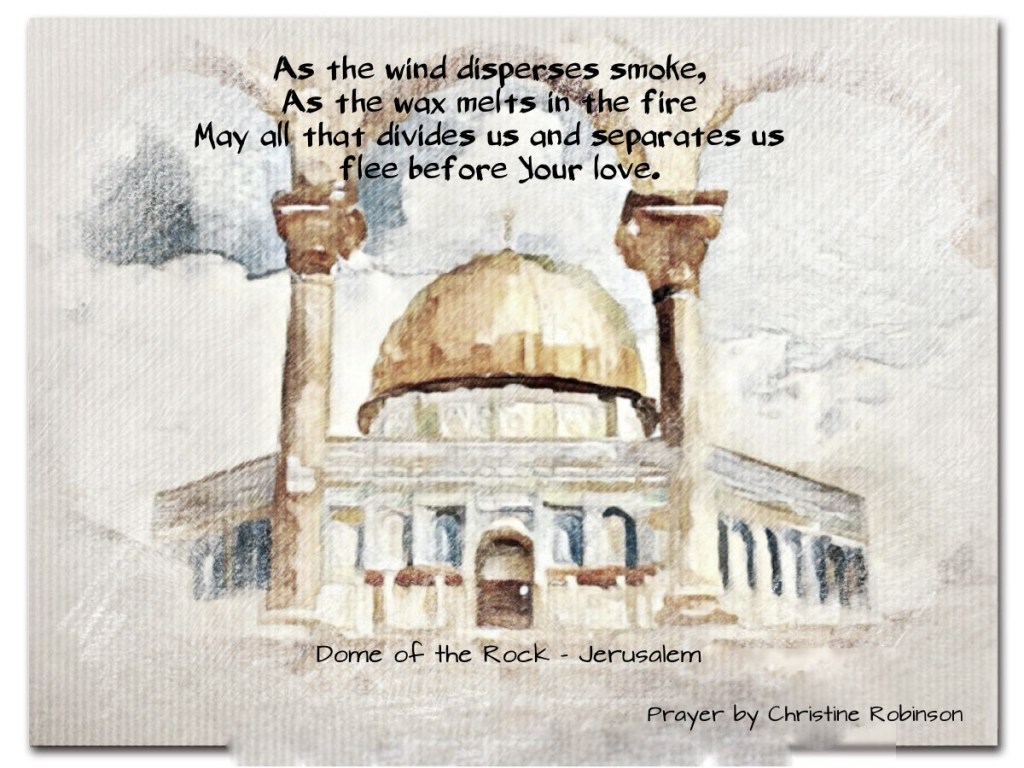
Psalm 68 is a prayer that gives full voice to Israel’s gratitude for being God’s chosen people. And in that way, it is a challenging psalm to pray with today as modern Israel and Palestine descend into all out war which disproportionately affects the poor, elderly, women and children.
The contradiction of our psalm, placed against this war scenario, is deeply unsettling. Does God really want the nation of Israel to dominate a geography to the annihilation of other peoples?
What I remind myself of this morning is this: biblical Israel is not the same as the political state of Israel. After WWII, the political state was initiated as part of a partition plan in which both Palestine and Israel would be independent states. The plan didn’t work out, creating multiple ensuing conflicts. The current one is just the latest edition.
Biblical Israel, on the other hand, is not a physical territory but instead a relationship – the foundational heritage of all Abrahamic faiths. For Christians it is a heritage that led to our faith in Jesus Christ, the fulfillment of God’s promise to Abraham. Although once rooted in a geography, that faith is now rooted in a universal love which reverences life for all people, particularly the poor, the orphaned, and the disenfranchised.
As I pray Psalm 68 today, I pray it with a woman named Arlette in my mind and heart. My friend Eileen McGovern introduced me to her friend, who wishes not to be named, with the following story. As we pray today, let this woman and all who suffer in war be with us.
I write for a friend who is voiceless. She lives in Bethlehem, Palestine.
I met her during a pilgrimage in October 2019, and we became friends. We have kept in touch and have grown to know and to respect one another. She is teaching me Arabic phrases. I am not a good student so we both laugh at my efforts. Or, we used to until the recent outbreak of violence.
She was born in 1948 when Palestine was a French protectorate. French is her first language, one of four. Yet she is voiceless. Who will hear her?
As a young school girl she pledged allegiance to the French flag and sang La Marseillaise when her home was a French protectorate. When Transjordan was created, as a teenager she sang the Jordanian anthem as she struggled to learn Arabic. At age 40 she became a Palestinian with the creation of the Israeli and Palestine states. She still lives in the West Bank. She has not moved, but politics again have upended her life.
She loves children. Before the Covid-19 pandemic she volunteered at a school for deaf children. At Christmas she runs a charity to give poor Christian children a gift card and food so that their families can celebrate the feast with the traditional chicken dinner, a luxury they cannot afford. During the previous intifada she used to gather Palestinian children into her home and give them chocolates and tell them stories so they would not throw stones at Israeli soldiers.
She is a woman of peace who has seen too much war. She is haunted by the memory of looking out her window to see a man standing outside her house disappear in a phosphorescent flash. This morning she told me of watching TV and seeing men desperately digging, some with their bare hands, in the rubble of a Palestinian home where the cries of an infant girl could be heard. The men did not have heavy equipment so I do not know if they were able to save her.
Now she asks: “Who am I? The Israelis do not want us here. They want me to leave the home of my birth, but I am a devout Christian who loves this land, a sacred land, the Holy Land, the land of Jesus’ birth. I do not want to leave, and where would I go? Who wants Palestinians? No one wants us. I want only to live in peace and to see people of all faiths be able to come to Jerusalem without fear. I live in fear, especially for my son who can be taken from me at any time by Israeli police. I pray, but I am afraid to hope again.”
Music: Desert – Rasha Nahas is a Palestinian artist. Below is her song “Desert” which I find both profound and disturbing. It can be interpreted as a personification poem describing the experience of the Palestinian people in the story of a single individual.
Here is a link to learn more about Rasha from America magazine:
Please just take it all away I am nobody I could name My self I float upon Pearls some songs They’ve been buried for years
My self I’m a desert torn I was born on the mountain by the sea The west rapes east My west disease I’m a little beast Hiding up the street In a little room With a little bed On the dusty floor Lies human flesh
Time melts out my eyes As my heart is bleeding quarter tones and I sail on this song
The dead sea used to be alive She had a woman and a child And she couldn’t live at home she said She wandered lost and she wandered west to the place where the bible spoke of gods All their temples and their floods They hung her on a cross She is a language no one dares to talk Sweet bleeding palms and the breeze of death They buried her She’s a roaring breath
Time melts out her eyes As her heart is bleeding Quarter tones and she sails on this song
Sweet bleeding palms And the cheering men They buried me I am a roaring breath
Today, in God’s Lavish Mercy, we pray with Psalm 98, an invitation to believe and rejoice in God’s Presence in our lives.
O Lord, You have made known the victory, You have openly showed your righteousness in the sight of the nations
Psalm 98: 2-3
In our first reading, as many Jews reject the invitation to Christian faith, the Apostles turn to the Gentiles with their evangelization:
The Gentiles were delighted when they heard this and glorified the word of the Lord. All who were destined for eternal life came to believe, and the word of the Lord continued to spread through the whole region.
Acts 13: 48-49
But our Gospel passage reminds us that the exercise of faith demands an openness to God’s presence. Poor Philip seems to be missing the fact that Jesus – God – is right there with him!
Philip’s statement, “Show us the Father and it will be enough for us” translates like this for me: prove everything and then we can believe. I smile at Philip’s simplicity but then realize I am not that different from him. I often ask for proof of God’s Presence in my circumstances completely forgetting the fact that God is already and always there!
When thinking about faith, these two complementary passages both challenge and sustain me. I pray with them often:
Now faith is the substance of things hoped for, the evidence of things not seen.
Hebrews 11:1
But hope that is seen is not hope. Who hopes for what they already have? But if we hope for what we do not yet have, we wait for it patiently.
Romans 8:24-25
This kind of Resurrection faith and hope allow us to receive and rejoice in the Good News the Apostles preach in Acts today, and to proclaim it as encouraged in our Psalm:
Sing a new song to the Lord, who has done marvellous things, whose mighty hand and holy arm have won the victory. O Lord, You remember your mercy and faithfulness toward us, and all the ends of the earth have seen your victory, O God. Shout with joy to the Lord, all you lands; lift up your voice, rejoice and sing.
Psalm 98: 1-4
Poetry: Flickering Mind – Denise Levertov
Lord, not you
it is I who am absent.
At first
belief was a joy I kept in secret,
stealing alone
into sacred places:
a quick glance, and away -- and back,
circling.

I have long since uttered your name
but now
I elude your presence.
I stop
to think about you, and my mind
at once
like a minnow darts away,
darts
into the shadows, into gleams that fret
unceasing over
the river's purling and passing.

Not for one second
will my self hold still, but wanders
anywhere,
everywhere it can turn.  Not you,
it is I am absent.

You are the stream, the fish, the light,
the pulsing shadow.
You the unchanging presence, in whom all
moves and changes.

How can I focus my flickering, perceive
at the fountain's heart
the sapphire I know is there?
Music: Prayer- From Moses in Egypt, an oratorio by Giaocchino Rossini
In the opera, Moses in Egypt, Moses leads the community in a prayer of hope before the crossing of the Red Sea.
I couldn’t find a suitable English translation, but the original Italian is below. As with many gorgeous operatic arias, I am just as happy not to translate. The music itself speaks and often the actual words pale in comparison. Hear what “speaks” particularly to you in this lovely music.
Dal tuo stellato soglio, Signor, ti volgi a noi! Pietà de’ figli tuoi! Del popol tuo pietà! Pietà de’ figli tuoi! Del popol tuo pietà! Se pronti al tuo potere Sono elementi, e sfere, Tu amico scampo addita Al dubbio, errante piè! Pietoso Dio! ne aìta’: Noi non viviam, che in Te! In questo cor dolente deh, scendi, o Dio clemente, e farmaco soave tu sia di pace almen! Il nostro cor che pena deh! tu confronta almen!
Today, in God’s Lavish Mercy, we pray with our revered Psalm 23. This powerful prayer of confidence and hope fits well with today’s readings.
In the passage from Daniel, the innocent Susanna never wavers in her trust:
O eternal God, you know what is hidden and are aware of all things before they come to be: you know that they have testified falsely against me. Here I am about to die, though I have done none of the things with which these wicked men have charged me.” The Lord heard her prayer.
Daniel 13: 42-44
In our Gospel, the woman – though not innocent – stills finds refuge in Jesus’s mercy.
So he was left alone with the woman before him. Then Jesus straightened up and said to her, “Woman, where are they? Has no one condemned you?” She replied, “No one, sir.” Then Jesus said, “Neither do I condemn you. Go, and from now on do not sin any more.”
John 8: 9-11
Like these two women, we may find ourselves in a dark valley at times. Whether we are innocent or guilty in arriving there, God abides with us in mercy.
The key is to acknowledge our situation and to reach out to that Mercy. In that way, even though we encounter difficulty, as said in Psalm 23, we live in Light and not in shadow:
Only goodness and kindness follow me all the days of my life; And I shall dwell in the house of the LORD for years to come.
Psalm 23: 5-6
Poetry: Light by Rabindranath Tagore
Light, my light, the world-filling light, the eye-kissing light, heart-sweetening light!
Ah, the light dances, my darling, at the center of my life; the light strikes, my darling, the chords of my love; the sky opens, the wind runs wild, laughter passes over the earth.
The butterflies spread their sails on the sea of light. Lilies and jasmines surge up on the crest of the waves of light.
The light is shattered into gold on every cloud, my darling, and it scatters gems in profusion.
Mirth spreads from leaf to leaf, my darling, and gladness without measure. The heaven’s river has drowned its banks and the flood of joy is abroad.











 Lavish Mercy