The Last Day

November 27, 2021
Saturday of the Thirty-fourth Week in Ordinary Time

Today, in God’s Lavish Mercy, we come – FINALLY – to the last day in Ordinary Time. And, believe me, the readings are as daunting as their predecessors suggested they would be.

They are so daunting that I will leave you to them if you wish, but I choose to close the Liturgical Year with another story I wrote years ago.

May the story inspire you as we stand on beautiful Advent’s doorstep. Within it, may you find love, hope, tenderness, mercy and gratitude to carry with you into the new Church Year.

The Earring

Young Emma, skewered by indecision, had stared into her mother’s jewelry box. She had always loved those bejeweled earrings, a gift to her mother from her grandmother—an heirloom now, a treasure beyond price. She wanted so to wear them on this special date, but they were “hands off” and she knew it. Still, her mother at work and unaware of her desire, Emma had succumbed to temptation.


The dance had been wonderful, a whirlwind of such delight that Emma had not noticed when her left earring had brushed against her partner’s shoulder, tumbling hopelessly under the dancers’ trampling feet. Only at evening’s end, approaching her front door exhausted and dreamy, had she reached up to unclip the precious gems.


Her mother sat waiting for her in the soft lamplight, having already noticed the earrings missing from her dresser. Awaiting retribution, Emma knelt beside her mother and confessed the further sacrilege of loss. But her mother simply cupped Emma’s tearful face in her hands, whispering, “You are my jewel. Of course I forgive you.”  Though accustomed to her mother’s kindness, this act of compassion astonished Emma, filling her with an indescribable, transformative gratitude.


Like Emma, we may be astonished at the graciousness that has been given to us. We may respond by pouring out our thanks to God in a silent act of prayer.

May we also have the courage to become like our merciful God, anticipating the other’s need for our forgiveness and compassion. May we seek the strength not to harbor injury, but too release it to make room for further grace in our hearts.


Advent 2021

I am so excited about Advent – my favorite time of the Church Year! The readings are magnificent — especially lyrical, prophetic Isaiah!

Advent offers us the wonderful call “to relish expectation” – to believe in, to hope for, and to love what we cannot yet see. It is a time of blind but unshakeable trust which teaches us to live within our deep, invisible spirit.

Looking forward to being with all of you tomorrow as we begin the journey through this season of profound hope.


Poetry: I Hear the Oriole’s Always-Grieving Voice – Anna Akhmatova

I chose this poem because it captures a spirit of hope – yet unrealized, but nevertheless convinced.

I hear the oriole’s always-grieving voice,
And the rich summer’s welcome loss I hear
In the sickle’s serpentine hiss
Cutting the corn’s ear tightly pressed to ear.
And the short skirts of the slim reapers
Fly in the wind like holiday pennants,
The clash of joyful cymbals, and creeping
From under dusty lashes, the long glance.

I don’t expect love’s tender flatteries,
In premonition of some dark event,
But come, come and see this paradise
Where together we were blessed and innocent.


Music: Gracias a la Vida – Mercedes Sosa and Joan Baez ( English lyrics below.) Thanks to my friend Beth who shared this lovely song on Facebook today.

Thanks to life, which has given me so much.
It gave me two beams of light, that when opened,
Can perfectly distinguish black from white
And in the sky above, her starry backdrop,
And from within the multitude The one that I love.

Thanks to life, which has given me so much.
It gave me an ear that, in all of its width
Records— night and day—crickets and canaries,
Hammers and turbines and bricks and storms,
And the tender voice of my beloved.

Thanks to life, which has given me so much.
It gave me sound and the alphabet.
With them the words that I think and declare:
“Mother,” “Friend,” “Brother” and the light shining.
The route of the soul from which comes love.

Thanks to life, which has given me so much.
It gave me the ability to walk with my tired feet.
With them I have traversed cities and puddles
Valleys and deserts, mountains and plains.
And your house, your street and your patio.

Thanks to life, which has given me so much.
It gave me a heart, that causes my frame to shudder,
When I see the fruit of the human mind,
When I see good so far from bad,
When I see within the clarity of your eyes…

Thanks to life, which has given me so much.
It gave me laughter and it gave me longing.
With them I distinguish happiness and pain—
The two materials from which my songs are formed,
And your song, as well, which is the same song.
And everyone’s song, which is my very song.
Thanks to life

Thanks to life
Thanks to life
Thanks to life

Confident Hope

Wednesday, November 4, 2021
Memorial of St. Charles Borromeo

Today, in God’s Lavish Mercy, we pray with Psalm 27:


Our scripture passages are all about confidence in our salvation.

Do you have that confidence?
Do you ever wonder if you’re going to get to heaven?
Maybe even worry about it a little?


If so, today’s readings are for you.

Paul tells the faithful:

For if we live, we live for the Lord,
and if we die, we die for the Lord;
so then, whether we live or die, we are the Lord’s.

And Jesus, using the symbol of a lost sheep, counsels the critical Pharisees:

I tell you, in just the same way
there will be more joy in heaven over one sinner who repents
than over ninety-nine righteous people
who have no need of repentance.

Key to both readings is the call to a repentant, Christian life.


Our beautiful Responsorial Psalm captures the joy of the repentant sinner, the very ones for whom Christ died. It’s a beautiful psalm. We might want to just slowly relish it in our prayer today.

R. I believe that I shall see the good things of the Lord in the land of the living.

The LORD is my light and my salvation;
whom should I fear?
The LORD is my life’s refuge;
of whom should I be afraid?

R. I believe that I shall see the good things of the Lord in the land of the living.

One thing I ask of the LORD;
this I seek:
To dwell in the house of the LORD
all the days of my life,
That I may gaze on the loveliness of the LORD
and contemplate his temple.

R. I believe that I shall see the good things of the Lord in the land of the living.

I believe that I shall see the bounty of the LORD
in the land of the living.
Wait for the LORD with courage;
be stouthearted, and wait for the LORD.

R. I believe that I shall see the good things of the Lord in the land of the living.


We might want to turn toward
the searching Shepherd of today’s Gospel
while praying this Psalm of repentance and faith.


Poetry: The Shepherd Boy Sings in the Valley of Humiliation – John Bunyan (1628–1688), a Christian writer and preacher, most famous for The Pilgrim’s Progress.

He that is down needs fear no fall,
He that is low, no pride;
He that is humble ever shall
Have God to be his guide.

I am content with what I have,
Little be it or much:
And, Lord, contentment still I crave,
Because Thou savest such.

Fullness to such a burden is
That go on pilgrimage:
Here little, and hereafter bliss,
Is best from age to age.


Music:  In the Land of the Living – Eric Becker

That Little Seed

Tuesday of the Thirtieth Week in Ordinary Time
October 26, 2021

Today, in God’s Lavish Mercy, we pray once again with Psalm 126, a song of hope fulfilled:

When the LORD brought back the captives of Zion,
    we were like men dreaming.
Then our mouth was filled with laughter,
    and our tongue with rejoicing.

Then they said among the nations,
    “The LORD has done great things for them.”
The LORD has done great things for us;
    we are glad indeed.

Psalm 126: 1-3

In our readings, we are called to be people of hope – to live in gratitude for hopes fulfilled, and to live in confidence of future blessing.


Paul blesses us with some of his most powerful words:

I consider that the sufferings of this present time are as nothing
compared with the glory to be revealed for us.

Romans 8:18

How often, over the ensuing centuries, have these words uplifted and embravened a struggling heart! Paul reminds us of what he so passionately believed – that we are not here for this world alone; that we, with all Creation, are being transformed for eternal life in God.


Jesus too reminds us that our life in faith is so much bigger than we perceive. We see a tiny mustard seed, but God sees the whole tree of eternal life blossoming in us.  We see a fingertip of yeast, but God sees the whole Bread of Life rising in us.

Paul tells us to be People of Hope who do not yet expect to see the object of their hope but who, nonetheless, believe and love with all their hearts.

May we pray this today for ourselves, and for anyone burdened by suffering or hopelessness at this time in their lives.


Poetry: Hope – Czeslaw Milosz

Hope is with you when you believe
The earth is not a dream but living flesh,
that sight, touch, and hearing do not lie,
That all thing you have ever seen here
Are like a garden looked at from a gate.
You cannot enter. But you're sure it's there.
Could we but look more clearly and wisely
We might discover somewhere in the garden
A strange new flower and an unnamed star.
Some people say that we should not trust our eyes,
That there is nothing, just a seeming,
There are the ones who have no hope.
They think the moment we turn away,
The world, behind our backs, ceases to exist,
As if snatched up by the hand of thieves.

Music:  Living Hope – Phil Wickham

Out of the Depths

Tuesday of the Twenty-seventh Week in Ordinary Time 
October 5, 2021

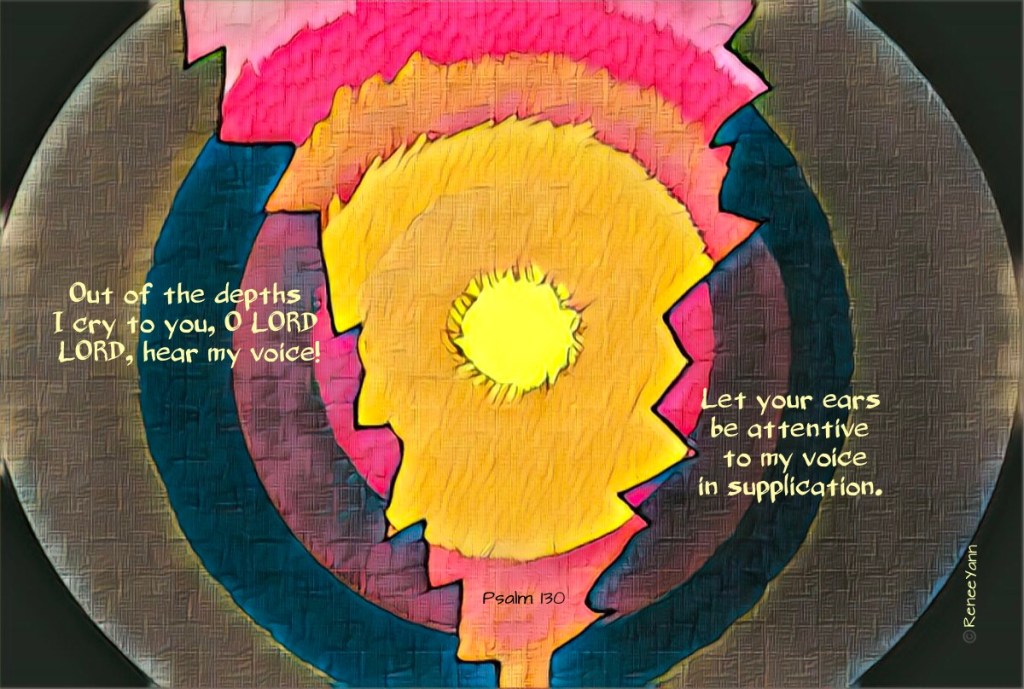
Today, in God’s Lavish Mercy, we pray with Psalm 130, a “Psalm of Ascents” in which the whole community joined in a prayer of intense supplication as they gathered at the Temple.

Although prayed as a community, the psalm is written in an individual voice, helping us to connect our times of personal desperation to the prayer.

Out of the depths I cry to you, O LORD
    LORD, hear my voice!
Let your ears be attentive
    to my voice in supplication.

Psalm 130: 1-2

Jonah, in the chapter before today’s first reading, gives us a graphic image of what “the depths” feel like.  Not only is Jonah swallowed by the sea, but also by a whale which carries him – imprisoned – to the very bottom of the ocean!

Jonah prayed to the LORD, his God, from the belly of the fish:
Out of my distress I called to the LORD,
Who answered me;
From the womb of Sheol I cried for help,
and you heard my voice.

Jonah 2:2-3

Sheol” is a Hebrew term which could be translated as “place of the dead spirits”. It is different from the grave, which harbors the body. In other words, “Sheol” is a place where our spirits can die before we physically die.


We can experience this kind of spiritual death in so many ways. Some come upon us not by our own choice. Certainly in the illness of depression we feel this darkness. Profound bereavement and debilitating sickness can overwhelm us as well. Praying Psalm 130 may help at such times. But they also call for reaching out to friends, counselors, and professional support to help in our healing.


But the psalm more specifically addresses those times when we get caught in a deadly spiral due to our own sinful and selfish choices – by allowing prejudice, hate, willful ignorance or any of the seven deadly sins to overtake us.

Lord, hear my cry!
May your ears be attentive
to my cry for mercy.
If you, LORD, keep account of sins,
Lord, who can stand?
But with you is forgiveness
and so you are revered.

Psalm 130: 2-4

Psalm 130 tells us that God is present to us in both situations- whether our suffering is brought on by our own choices or not. God will walk us through to the Light when we open ourselves to Grace:

Let us wait patiently 
to discern God’s way,
For with God is kindness
    and plenteous redemption;
God will restore us
    from every darkness;
God’s way is mercy.

Psalm 130: 7-8

Let’s pray for that kind of faith in our hearts, and the hearts of those we love, especially for anyone suffering “the depths” right now.


Poetry: De Profundis – Christina Rossetti 

Oh why is heaven built so far, 
Oh why is earth set so remote? 
I cannot reach the nearest star 
That hangs afloat. 
I would not care to reach the moon, 
One round monotonous of change; 
Yet even she repeats her tune 
Beyond my range. 
I never watch the scatter'd fire 
Of stars, or sun's far-trailing train, 
But all my heart is one desire, 
And all in vain: 
For I am bound with fleshly bands, 
Joy, beauty, lie beyond my scope; 
I strain my heart, I stretch my hands, 
And catch at hope. 

Music: Out of the Deep – John Rutter

Psalm 130, ‘Out of the deep have I called unto thee O Lord’ begins darkly with an unaccompanied cello solo in C minor, later giving way to a more positive C major at the words ‘for with the Lord there is mercy, and with him is plenteous redemption’.

Out of the deep have I called unto thee, O Lord; Lord, hear my voice.
O let thine ears consider well the voice of my complaint.
If thou, Lord, wilt be extreme to mark what is done amiss, O Lord, who may abide it?
For there is mercy with thee: therefore shalt thou be feared.
I look for the Lord; my soul doth wait for him; and in his word is my trust.
My soul fleeth unto the Lord before the morning watch; I say, before the morning watch.
O Israel, trust in the Lord; for with the Lord there is mercy, and with him is plenteous redemption.
And he shall redeem Israel from all his sins.

Resilient Hope

Friday of the Twenty-fifth Week in Ordinary Time
September 25, 2021

Today, in God’s Lavish Mercy, we pray with Psalm 43 whose heart reveals the nature of hope and its power to inspire praise.

Wait for God, whom I shall again praise,
my savior and my God.

Psalm 43 is really the completion of Psalm 42, and they form a masterful combination. 

According to biblical scholar Carroll Stuhmueller:

The three stanzas of Psalm 42-43 lead listeners and readers through depression, struggle, and hope. The refrain sung at the end of each stanza contains three parts that summarize the attitude of each:
Why are you cast down, O my soulDepression
and why are you disquieted within me?Struggle
Hope in God Whom I shall again praise,Hope
my Lord and my God.Praise
Stuhmueller: Spirituality of the Psalms

The psalm follows logically after today’s first reading in which the prophet Haggai challenges the people to pick themselves up by the bootstraps and get working on the restoration of the Temple. The prophet proclaims encouragement in God’s name:

For I am with you, says the LORD of hosts.
This is the pact that I made with you
when you came out of Egypt,
And my spirit continues in your midst;
do not fear!

Haggai 2:5

Praying with these readings, we may reflect on our own current or past challenges in the light of faith and hope. God is with us now as God always has been, and will be. 

We are empowered by that promise to live courageous, generous lives. This is what hope looks like when it is alive in us.


Poetry: Hope – Czeslaw Milosz

Hope is with you when you believe
The earth is not a dream but living flesh,
that sight, touch, and hearing do not lie,
That all thing you have ever seen here
Are like a garden looked at from a gate.
You cannot enter. But you're sure it's there.
Could we but look more clearly and wisely
We might discover somewhere in the garden
A strange new flower and an unnamed star.
Some people say that we should not trust our eyes,
That there is nothing, just a seeming,
There are the ones who have no hope.
They think the moment we turn away,
The world, behind our backs, ceases to exist,
As if snatched up by the hand of thieves.

Music: Angel of Hope – Erik Berglund

Thursday of the Twenty-second Week in Ordinary Time

Thursday, September 2, 2021

Today, in God’s Lavish Mercy, we pray with Psalm 98 which we reflected on just this past Saturday on the feast of St. Augustine. Here’s a refresher if you’d care to glance back.

Because they proclaim God’s faithfulness, today’s psalm verses ready us to receive the Gospel’s expansive injunction: 

As we pass through the waters of life, we each meet our own “deeps”. Sometimes we do not recognize them as the sacred places where we are to meet God’s call.

Sometimes we see only their choppy surface, their tangled riptides, their frightening shadows.

Sometimes we miss the bounty held in the mystery of these moments. We fold our nets and try to sail away. 

As he did for the weary disciples, Jesus

  • lovingly contradicts our fear, 
  • releases our hope, 
  • fills the flimsy net of our faith to bursting … 

… if we will just trust his Word, and cast out with him over the waters of our lives.


A little visual “poetry” today:

Music: Cast Your Net – Timothy R. Smith

Wednesday of the Twenty-second Week in Ordinary Time

Wednesday, September 1, 2021

Today, in God’s Lavish Mercy, we pray with Psalm 52, whose chosen verses today form an exquisite prayer – one that can be held like a diamond to the Light:

I, like a green olive tree
    in the house of God,
Trust in the mercy of God
    forever and ever.
I will thank you always for what you have done,
    and proclaim the goodness of your name
    before your faithful ones.

Psalm 52: 10-11

It is ironic that these tenderly beautiful verses close one of the most virulent curses of the Psalms! It’s better to let them stand alone for today’s prayer. Like that, they perfectly complement Paul’s gorgeous blessing poured over the Colossians in our first reading:

Grace to you and peace from God our Father.
We always give thanks to God, the Father of our Lord Jesus Christ,
when we pray for you,
for we have heard of your faith in Christ Jesus
and the love that you have for all the holy ones
because of the hope reserved for you in heaven.

Colossians 1:2-5

As this first day of September breaks over us, it is a good day to give thanks within these scriptural blessings:

  • for courage given and hope sustained
  • for storms weathered and favors received
  • for the resilience of new promises 
  • and the polished incandescence of the long-kept vow
  • for fields turned over toward a season of rest
  • for sweaters shaken out and ready to warm
  • for the smell of a sharpened pencil, the endless possibilities of a fresh notebook, 
  • and a new box of crayons ( to follow in a later post. I mistakenly send a fragment earlier today. I hope it wasn’t a distraction to you.)

Poetry: First Day of School – by Howard Nemerov (February 29, 1920 – July 5, 1991), an American poet. He was twice Poet Laureate Consultant in Poetry to the Library of Congress, from 1963 to 1964 and again from 1988 to 1990. For The Collected Poems of Howard Nemerov (1977), he won the National Book Award for Poetry,Pulitzer Prize for Poetry,and Bollingen Prize.

I

My child and I hold hands on the way to school,

And when I leave him at the first-grade door

He cries a little but is brave; he does

Let go. My selfish tears remind me how

I cried before that door a life ago.

I may have had a hard time letting go.

Each fall the children must endure together

What every child also endures alone:

Learning the alphabet, the integers,

Three dozen bits and pieces of a stuff

So arbitrary, so peremptory,

That worlds invisible and visible

Bow down before it, as in Joseph’s dream

The sheaves bowed down and then the stars bowed down

Before the dreaming of a little boy.

That dream got him such hatred of his brothers

As cost the greater part of life to mend,

And yet great kindness came of it in the end.

II

A school is where they grind the grain of thought,

And grind the children who must mind the thought.

It may be those two grindings are but one,

As from the alphabet come Shakespeare’s Plays,

As from the integers comes Euler’s Law,

As from the whole, inseperably, the lives,

The shrunken lives that have not been set free

By law or by poetic phantasy.

But may they be. My child has disappeared

Behind the schoolroom door. And should I live

To see his coming forth, a life away,

I know my hope, but do not know its form

Nor hope to know it. May the fathers he finds

Among his teachers have a care of him

More than his father could. How that will look

I do not know, I do not need to know.

Even our tears belong to ritual.

But may great kindness come of it in the end.


Music: September Morn – instrumental version of Neil Diamond’s song. The words don’t exactly work for our prayer, but the melody does 🙂

Saturday of the Fifteenth Week in Ordinary Time

July 17, 2021

Today, in God’s Lavish Mercy, we pray with Psalm 136 in which the psalmist remembers in detail Israel’s long experience of God’s enduring fidelity.

The cadence of the psalm creates an underlying drumbeat to our prayer, a chant of gratitude and confidence. Reading it, I was reminded of two things.

The first is a scene from the movie “Glory” where the troops pray the night before battle. They pray in the classic style of the Black spiritual call-and-response song.

You may have seen it:

The prayer of these men, like the prayer of ancient Israel, is not just a walk down memory lane. No. Each proclamation is an act of of faith – and of gratitude for the past, courage for the present, and hope for the future.


Secondly, I was reminded of the simple and methodical cadence of a childhood ditty – S/he loves me S/he loves me not. Didn’t many of us try that magic practice at least once, maybe at our first young crush?

Well, God does love us – daisy or not. The proof is not in the petals, but in the story of our lives.

Today might be a good day
to “chant” gratefully
through our own catalogue with God
– remembering, thanking,
believing,and hoping.


Poetry: I thank you, God – e.e.cummings

i thank You God for most this amazing
day:for the leaping greenly spirits of trees
and a blue true dream of sky;and for everything
which is natural which is infinite which is yes
(i who have died am alive again today,
and this is the sun’s birthday;this is the birth
day of life and of love and wings:and of the gay
great happening illimitably earth)
how should tasting touching hearing seeing
breathing any—lifted from the no
of all nothing—human merely being
doubt unimaginable You?
(now the ears of my ears awake and
now the eyes of my eyes are opened)

Music: Swing Low, Sweet Chariot – Etta James sings a classical example of the call-and-response spiritual

Swing low, sweet chariot

Coming for to carry me home,

Swing low, sweet chariot,

Coming for to carry me home.

I looked over Jordan, and what did I see

Coming for to carry me home?

A band of angels coming after me,

Coming for to carry me home.

Sometimes I’m up, and sometimes I’m down,

(Coming for to carry me home)

But still my soul feels heavenly bound.

(Coming for to carry me home)

The brightest day that I can say,

(Coming for to carry me home)

When Jesus washed my sins away.

(Coming for to carry me home)

If I get there before you do,

(Coming for to carry me home)

I’ll cut a hole and pull you through.

(Coming for to carry me home)

If you get there before I do,

(Coming for to carry me home)

Tell all my friends I’m coming too.

(Coming for to carry me home)

Swing low, sweet chariot

Coming for to carry me home,

Swing low, sweet chariot,

Coming for to carry me home.

Thursday of the Fourteenth Week in Ordinary Time

Thursday, July 8, 2021

Today, in God’s Lavish Mercy, we pray with Psalm 105, one of the psalms which Walter Brueggemann characterizes as “lively remembering”.

These are psalms which gratefully inventory God’s generosity and faithfulness to Israel. The long list evokes holy surprise, gratitude, trust, and commitment in the believer’s heart.


Today’s verses pertain particularly to the wonderful story of Joseph cited in our first reading. But the entire psalm remembers a Divine Generosity covering generations.

Recall the wondrous deeds God has done,
wonders and words of judgment,

You descendants of Abraham God’s servant,
offspring of Jacob the chosen one!

Psalm 105: 5-6

Reading Psalm 105 always makes me remember a little blond kid from my long ago teaching days. 

We regularly gathered our school community for a “Children’s Mass”, either on Sunday or some special occasion. Bobby, a very good reader for a third grader, had volunteered to deliver the Responsorial Psalm. 

And he delivered, loud and clear:

Remember the “marbles”
the Lord has done.

Four times, the school body of 500+ children obediently responded in kind, apparently visualizing the same “marbles” as Bobby did.


Did God care? No, I think God enjoyed it as much as we teachers did. 

And as I remember the moment this morning, I can’t help considering how innocently garbled my own prayer must seem to God. Because honestly, how can we even imagine God, let alone find the words to speak the mysteries of our soul!

Glory in his holy name;
let hearts that seek the LORD rejoice!

Seek out the LORD’s might;
constantly seek God’s face.

Psalm 105: 3-4

So, praying our psalm today, we might want to hold up silently before God, who created the vastness of universe, all the tiny “marbles” in our hearts – those brilliant but impenetrable mysteries of love, hope, suffering, and joy which roll around in the deep universe of our lives.

Like the psalmist, we can unroll an inventory of God’s faithfulness to us which allows us to imagine a future full of hope – for ourselves and the generations to follow us.


Poetry: Ode to Marbles BY MAX MENDELSOHN

I love the sound of marbles   
scattered on the worn wooden floor,   
like children running away 
in a game of hide-and-seek.   
I love the sight of white marbles,   
blue marbles,   
green marbles, black,   
new marbles, old marbles,   
iridescent marbles,   
with glass-ribboned swirls,   
dancing round and round.   
I love the feel of marbles,   
cool, smooth,   
rolling freely in my palm,   
like smooth-sided stars   
that light up the worn world.

Music: Tchaikovsky’s Waltz of the Flowers
– synchronized with MARBLES!
By DoodleChaos

Allow this video to open up your amazement. Invite into that amazement your gratitude for God’s astounding goodness to you. Perhaps like prayerfully walking a labyrinth, you can roll with the marbles through your faith journey.

Wednesday of the Fourteenth Week in Ordinary Time

Wednesday, July 7, 2021

Today, in God’s Lavish Mercy, we pray with Psalm 33 in which the psalmist is clearly awestruck by both the power and the mercy of God. It is a prayer of radical awareness that God is Creator and we are creature.

According to Walter Brueggemann,
Psalm 33 describes Yahweh
as the settled sovereign, securely in control,
who need only speak
to have the command fulfilled.

The psalm has two divisions. In part one, the community is called to praise God because God deserves it.

Rejoice, you righteous, in the LORD;
praise from the upright is fitting.

Give thanks to the LORD on the harp;
on the ten-stringed lyre offer praise.

Sing to God a new song;
skillfully play with joyful chant.

For the LORD’s word is upright;
and works are trustworthy.

Psalm 33: 1-4

In part two, that praise is articulated by recounting God’s caring intervention in the community’s experience.

From heaven the LORD looks down
and observes the children of Adam,

From that dwelling place surveying
all who dwell on earth.

The One who fashioned together their hearts
and who knows all their works.

Psalm 33: 13-15

Psalm 33 can be summarized in this way:

Because Yahweh rules with righteousness, justice, and unfailing love,
we must worship Yahweh with songs and praise
and by rejecting all false sources of salvation.

Lynn Jost, Professor of Biblical and Religious Studies – Tabor College, Kansas

Praying Psalm 33 reminds me that one can never demand mercy. We cannot require the other to hold us in continual compassion. We can only hope and be grateful.

Mercy is the gift of a heart moved beyond itself by love and tenderness. Such outpouring is the very nature of God in whose image we are created.

Thus for God, and for us, to be unmerciful is to be unnatural. In Psalm 33, we pray not only to receive mercy, but to become mercy.


Psalm 33 closes with a plea for our hearts to be deepened in their affinity to God, to mirror God by our patience, joy, hope, and mercy.

Our soul waits for the LORD,
Who is our help and shield.

For in God our hearts rejoice;
in God’s holy name we trust.

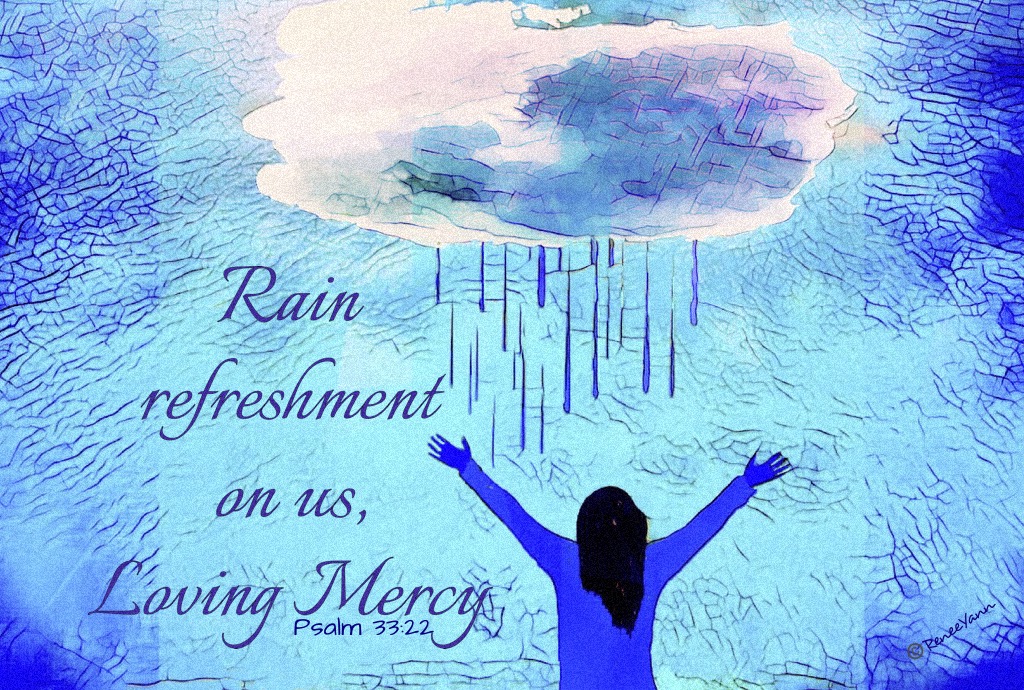
May your mercy, LORD, be upon us;
as we put our hope in you.

Psalm 33: 20-22

Poetry: To Live in the Mercy of God BY DENISE LEVERTOV

To lie back under the tallest
oldest trees. How far the stems
rise, rise
               before ribs of shelter
                                           open!
To live in the mercy of God. The complete
sentence too adequate, has no give.
Awe, not comfort. Stone, elbows of
stony wood beneath lenient
moss bed.
And awe suddenly
passing beyond itself. Becomes
a form of comfort.
                      Becomes the steady
air you glide on, arms
stretched like the wings of flying foxes.
To hear the multiple silence
of trees, the rainy
forest depths of their listening.
To float, upheld,
                as salt water
                would hold you,
                                        once you dared.
                  .
To live in the mercy of God.
To feel vibrate the enraptured
waterfall flinging itself
unabating down and down
                              to clenched fists of rock.
Swiftness of plunge,
hour after year after century,
                                                   O or Ah
uninterrupted, voice
many-stranded.
                              To breathe
spray. The smoke of it.
                              Arcs
of steelwhite foam, glissades
of fugitive jade barely perceptible. Such passion—
rage or joy?
                              Thus, not mild, not temperate,
God’s love for the world. Vast
flood of mercy
                      flung on resistance.

Music: As you listen to David Arkenstone’s instrumental, you may want to remember Shakespeare’s famous description of mercy. See below the music.