

Category: Hope
Mountain
Second Sunday of Lent
February 25, 2024
Today’s Readings:
https://bible.usccb.org/bible/readings/022524.cfm

“Take your son Isaac, your only one, whom you love,
and go to the land of Moriah.
There you shall offer him up as a holocaust
on a mountain that I will point out to you.”
Jesus took Peter, James, and John
and led them up a high mountain apart by themselves.
And he was transfigured before them,
and his clothes became dazzling white,
such as no fuller on earth could bleach them.
Often it is at the height of our joy, or the height of our sorrow that we feel closest to God. Intense experiences can bring us unequaled grace and opportunity for spiritual growth.
Today, in God’s Lavish Mercy:
In our prayer, we may gratefully remember the “mountains” of our lives, those times when joy, hope, pain, or anxiety built almost insurmountably in our hearts. How did God meet us in those moments? How did we meet God? How have our “mountains” transformed our lives?
Poetry: Unveiling the Heart’s Mirror – Rumi
All through eternity
Beauty unveils His exquisite form
in the solitude of nothingness;
He holds a mirror to His Face
and beholds His own beauty.
he is the knower and the known,
the seer and the seen;
No eye but His own
has ever looked upon this Universe.
His every quality finds an expression:
Eternity becomes the verdant field of Time and Space;
Love, the life-giving garden of this world.
Every branch and leaf and fruit
Reveals an aspect of His perfection.
The cypress gives hint of His majesty,
The rose gives tidings of His beauty.
Whenever Beauty looks,
Love is also there;
Whenever beauty shows a rosy cheek
Love lights Her fire from that flame.
When beauty dwells in the dark folds of night
Love comes and finds a heart
entangled in tresses.
Beauty and Love are as body and soul.
Beauty is the mine, Love is the diamond.
They have together
since the beginning of time-
Side by side, step by step.
I swear, since seeing Your face,
the whole world is fraud and fantasy
The garden is bewildered as to what is leaf
or blossom. The distracted birds
can’t distinguish the birdseed from the snare.
A house of love with no limits,
a presence more beautiful than venus or the moon,
a beauty whose image fills the mirror of the heart.
Music: God on the Mountain – Lynda Randle
See!
Christmas Weekday
January 3, 2023
Today’s Readings:
https://bible.usccb.org/bible/readings/010324.cfm
Today, in God’s Lavish Mercy, we again have John the evangelist and John the Baptist as the “bookends” of our prayer. Each one calls his listeners to see the world differently – more deeply, under the surface – with the eyes of God.
See what love God has lavished upon us
1 John 3:1
that we may be called the children of God.
Yet so we are.
The reason the world does not know us is that it did not know him.
The spiritual vision the Evangelist describes comes through our knowledge of Jesus Christ. Through his life, death, and Resurrection, Jesus taught us how God loves and wants us to love. That is why a prayer life rooted in scripture, particularly the Gospel, is so critical to our spiritual integrity.
John the Baptist was steeped in this kind of integrity. Stripped of worldliness by ardent desert prayer, the Baptist was ready to not only hear the Word, but to see it when it came to him across the Jordan.
John testified further, saying,
John 1:32-34
“I saw the Spirit come down like a dove from the sky
and remain upon him.
I did not know him,
but the one who sent me to baptize with water told me,
‘On whomever you see the Spirit come down and remain,
he is the one who will baptize with the Holy Spirit.’
Now I have seen and testified that he is the Son of God.”
Our readings today tell us that we too, through our Baptism into Christ, have been born to a new vision. Every day, this side of heaven, we are challenged to live within that vision – to see the world as God sees it, to live in the world as Jesus would live. The courage to do that comes from our hope which, with faith and love, purifies and fires our heart.
Beloved, we are God’s children now;
1 John 3:2-3
what we shall be has not yet been revealed.
We do know that when it is revealed we shall be like him,
for we shall see him as he is.
Everyone who has this hope based on him makes himself pure,
as he is pure.
Poetry: Into the Eye of God – Macrina Wiederkehr, OSB
For your prayer, your journey into God
May you be given a small storm,
A little hurricane named after you,
persistent enough to get your attention
violent enough to awaken you to new depths
strong enough to shake you to the roots
majestic enough to remind you of your origin:
Made of the earth yet steeped in eternity
Frail human dust yet soaked with infinity.
You begin your storm under the eye of God
A watchful caring eye gazes in your direction
as you wrestle with the life force within.
In the midst of these holy winds
In the midst of this divine wrestling
Your storm journey, like all hurricanes
Leads you in to the eye of God
Into the eye of God where all is calm and quiet
the stillness beyond imagining
Into the eye of God after the storm
Into the silent beautiful darkness
into the eye of God.
Music: Apple of My Eye – Sal Arico
Blessed Christmas!
The Nativity of the Lord (Christmas)
December 25, 2023
Today’s Readings:
https://bible.usccb.org/bible/readings/122523-Day.cfm

Merry Christmas, dear readers! May our sweet Jesus abundantly bless you and those you love.
Below is a video beautifully edited by our Sister Mary Kay Eichman. We both thought you might like to enjoy it, whole or in parts, over this Christmastide.
Today, in God’s Lavish Mercy, let us pray within the amazing Presence of God in our life renewed in us this Christmas.
Today’s readings:
https://bible.usccb.org/bible/readings/122523-Day.cfm
Mary is wrapped in the cold darkness of this winter night.
She is vulnerable as she waits to bring forth her child.
Yet she feels wrapped in tenderness by God
and supported by God’s love.
She longs to welcome this Holy Child in warmth
And to wrap him in the same love and tenderness.
We too want to welcome Jesus with warm tenderness.
In Mercy, we have tried to bring Christ into world
and to warm and comfort people with God’s presence.
Is there a person in your life,
Or a place in your heart today
that needs warmth, comfort and love?
Be in quiet prayer for that person or place for a while
as we absorb the amazing graces
offered us in the Christmas miracle.
Prayer
Today the Christ Child is born
We welcome Him into our hearts
We wrap Him in our adoration.
Today the Christ Child is born
In the refugee who longs for home
In the sick who long care
In the poor who long for sustenance
In the uneducated who long for hope
In these, we welcome Him.
We wrap them in our prayer.
Today the Christ Child in born
In children who long for a future
In families who long for unity
In elders who long for peace
In all people who long for dignity and love
In these, we welcome Him.
We wrap them in our prayer.
Today the Christ Child is born
In our Church that longs for holiness
In our community that longs for grace
In our world that longs for peace
In our hearts that long for God
In these we welcome Him.
We wrap them in our prayer.
Amen.
Music: Silent Night
Praying with the Prophets
Saturday of the Second Week of Advent
December 16, 2023
Today’s Readings:
https://bible.usccb.org/bible/readings/121623.cfm
Today, in God’s Lavish Mercy, we think about John the Baptist. For several days in this middle part of Advent, our Gospel makes reference to John, the Precursor of the Messiah.

Faithful Jews had an expectation that there would be a Messiah, and that a fiery Precursor would announce him. They identified this forerunner with the prophet Elijah, based on writings like today’s from Sirach:
How awesome are you, Elijah, in your wondrous deeds!
Whose glory is equal to yours?
You were taken aloft in a whirlwind of fire,
in a chariot with fiery horses.
You were destined, it is written, in time to come
to put an end to wrath before the day of the LORD…
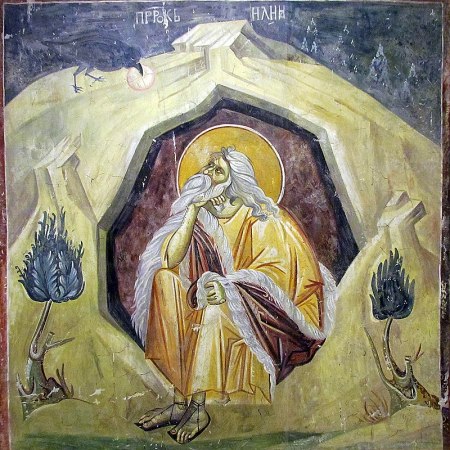
In our Gospel, Jesus indicates that John the Baptist is the new Elijah, preparing the way for Jesus’s ministry.
As they were coming down from the mountain,
Matthew 17: 9-13
the disciples asked Jesus,
“Why do the scribes say that Elijah must come first?”
He said in reply, “Elijah will indeed come and restore all things;
but I tell you that Elijah has already come,
and they did not recognize him but did to him whatever they pleased.
So also will the Son of Man suffer at their hands.”
Then the disciples understood
that he was speaking to them of John the Baptist.
As we pray today with these two greatest prophets, we might examine our own readiness to receive God’s revealing grace in our lives:
- What is it in my life that prepares me to receive God in my heart?
- What inspires me “prepare the way of the Lord” in the many “worlds” that I touch?
- Am I attuned to God’s “announcements”, those quiet inklings that tell me God is trying to make something new in my life?
Jesus says that Elijah “has already come” but has been rejected by the people.
- Are there habits and choices in my life that make it hard for God to get through to me?
- Maybe God is sending an “Elijah”or “Baptist” my way today. Will I recognize that Precursor? Will I be open to the message?
Poetry: The Cup of Eliyahu – Marge Piercy
Eliyahu is a masculine Hebrew given name and surname of biblical origin. It means “My God is Yahweh” and derives from the prophet Elijah who, according to the Bible, lived during the reign of King Ahab (9th century BC).
In life you had a temper.
Your sarcasm was a whetted knife.
Sometimes you shuddered with fear
but you made yourself act no matter
how few stood with you.
Open the door for Eliyahu
that he may come in.
Now you return to us
in rough times, out of smoke
and dust that swirls blinding us.
You come in vision, you come
in lightning on blackness.
Open the door for Eliyahu
that he may come in.
In every generation you return
speaking what few want to hear
words that burn us, that cut
us loose so we rise and go again
over the sharp rocks upward.
Open the door for Eliyahu
that he may come in.
You come as a wild man,
as a homeless sidewalk orator,
you come as a woman taking the bima,
you come in prayer and song,
you come in a fierce rant.
Open the door for Eliyahu
that she may come in.
Prophecy is not a gift, but
sometimes a curse, Jonah
refusing. It is dangerous
to be right, to be righteous.
To stand against the wall of might.
Open the door for Eliyahu
that he may come in.
There are moments for each
of us when you summon, when
you call the whirlwind, when you
shake us like a rattle: then we
too must become you and rise.
Open the door for Eliyahu
that we may come in.
Music: Days of Elijah – Robin Mark
The commentary in the Worship & Song Leader’s Edition contains a good summary of this hymn’s text: “This is a song of victory and of hope, of God’s triumph forever over death and of Christ’s eternal reign. It also calls believers to stand fast, even in the face of troubles, and to witness to the promised coming of Christ.”
Fuller Every Day
Friday of the Second Week of Advent
December 15, 2023
Today’s Readings:
https://bible.usccb.org/bible/readings/121523.cfm
Today, in God’s Lavish Mercy, Isaiah paints a poetic picture of the soul fully taught by God. He describes that sacred obedience, or heart’s listening to God, which leads to fullness of joy, peace, and eternal life.
I, the LORD, your God,
Isaiah 48:17-19
teach you what is for your good,
and lead you on the way you should go.
If you would hearken to my commandments,
your prosperity would be like a river,
and your vindication like the waves of the sea;
Your descendants would be like the sand,
and those born of your stock like its grains,
Their name never cut off
or blotted out from my presence.
When looking for music to complement Isaiah’s passage, I found a hymn written in 1876 by Frances R. Havergal, an English Anglican poet and hymn writer.
Her hymn Like a River Glorious, although written in older style language, spoke to me. It contains several beautiful metaphors, many reflective of today’s passage from Isaiah.
You might want to pray with one or two of these images today as you think about your own relationship with God and the Advent hopes flowing in your heart:




across the sundial of our lives
Throughout the ages, believers have used images to open their hearts to the graces of prayer. Think about the magnificent stained glass windows in the world’s churches — and of the centuries of our ancestors who have prayed beside them.
I hope you enjoy praying with this hymn, and the accompanying pictures, as much as I did.
Music: Like a River Glorious – Frances R. Havergal – 1876; performed here by the Parkview Mennonite Church. Follow the images and verses below.

Like a river glorious is God’s perfect peace,
Over all victorious, in its bright increase;
Perfect, yet it floweth fuller every day,
Perfect, yet it groweth deeper all the way.

Refrain:
Stayed upon Jehovah, hearts are fully blest
Finding, as He promised, perfect peace and rest.

Hidden in the hollow of His blessed hand,
Never foe can follow, never traitor stand;

Not a surge of worry, not a shade of care,
Not a blast of hurry touch the spirit there.

(Refrain then …)
Every joy or trial falleth from above,
Traced upon our dial by the Sun of Love;
We may trust Him fully, all for us to do;
They who trust Him wholly find Him wholly true.
Rain Down the Just One
Memorial of Saint John of the Cross, Priest and Doctor of the Church
Thursday of the Second Week of Advent
December 14, 2023
Today’s Readings:
https://bible.usccb.org/bible/readings/121423.cfm

Today, in God’s Lavish Mercy, Isaiah offers us polar opposites for our prayer: some charmless metaphors and some beautiful lyricism.
In a graphic attempt to alert us to our spiritual weakness, Isaiah suggests that we are worms and maggots whom God still loves. It’s a comparison I get, but I choose not to linger on in my prayer.
Still, I don’t want to miss the point. No matter how unimportant we may feel in human estimation, we are ardently cared for by God who does not want us to be afraid. God wants us to turn from our worrisome self-estimation toward the hope that God’s Love promises:
The afflicted and the needy seek water in vain,
Isaiah 41:17-20
their tongues are parched with thirst.
I, the LORD, will answer them;
I, the God of Israel, will not forsake them.
I will open up rivers on the bare heights,
and fountains in the broad valleys;
I will turn the desert into a marshland,
and the dry ground into springs of water.
I will plant in the desert the cedar,
acacia, myrtle, and olive;
I will set in the wasteland the cypress,
together with the plane tree and the pine,
That all may see and know,
observe and understand,
That the hand of the LORD has done this,
the Holy One of Israel has created it.
In our Gospel, Jesus praises John the Baptist, a preacher who could get a little wormy too at times. But John’s core message bursts with hope as does Isaiah’s. Their messages sound like this in my spirit:
Your soul is a window into eternity!
Stop looking in your unlit mirror!
Repent! Turn your heart toward God!
Believe in the New Dawn
rising in Jesus Christ!
Imagery:

As our Alleluia Verse charges us:
R. Alleluia, alleluia.
Let the clouds rain down the Just One,
and the earth bring forth a Savior.
R. Alleluia, alleluia.
Music: Window of the Soul – Chuck Loeb
Without Cost
Saturday of the First Week of Advent
December 9, 2023
Today’s Readings:
https://bible.usccb.org/bible/readings/120923.cfm

Today, in God’s Lavish Mercy, our readings invite us to consider the state of our world and to imagine its transformation. And more significantly, our Gospel invites us to imagine ourselves as participants in that transformation.

This image is taken from Cassell’s Illustrated Universal History
illustrated by Edmund Ollier (1827)
This amazing book is preserved and can be accessed here:
https://archive.org/details/cassellsillustr02olligoog/page/192/mode/1up
Isaiah prophesied in a time of desperation for Israel. Crushed by the Assyrian Empire, the Jewish people languished in foreign captivity. As all prophets do, Isaiah interprets Israel’s experience in terms of its spiritual meaning – how do one’s present circumstances reveal the evolution of one’s eternal relationship with God.
The entire Book of Isaiah swings back and forth between two poles: the sin of a faithless people counterbalanced by the merciful generosity of a faithful God. Isaiah’s job is to call the people to awareness, repentance, and hope.
Today’s passage is a call to hope. In it, Isaiah describes the glorious peace that will occur when humankind truly repents from sin and turns to God for healing. The prophet assumes God’s voice in an invitation to healing and the restoration of fidelity:
Thus says the Lord GOD,
Isaiah 30:19-21
the Holy One of Israel:
O people of Zion, who dwell in Jerusalem,
no more will you weep;
He will be gracious to you when you cry out,
as soon as he hears he will answer you.
The Lord will give you the bread you need
and the water for which you thirst.
No longer will your Teacher hide himself,
but with your own eyes you shall see your Teacher,
While from behind, a voice shall sound in your ears:
“This is the way; walk in it,”
when you would turn to the right or to the left.
Scripture speaks to us as well as to the audience for whom it was originally written. And surely Isaiah’s world, distanced on a timeline, is amazingly comparable to our own.
Imagine if you can, living in a world that calls good evil and evil good. Imagine a place where the powerful store up money and treasures while the poor and vulnerable go hungry. Imagine a cultural system that applauds immorality and whose icons lead undiscerning masses to open graves of unrestrained greed, lust, and hatred. Obviously, none of us has to work too hard to imagine such a place.
Robarts, Charme (2003) “By Faith We Can See It Afar: Believing Isaiah’s Word,” Leaven: Vol. 11: Iss. 2, Article 4
These are not new problems. The book of Isaiah presents a world strangely familiar to our own. Two powerful images emerge. On one hand, is the picture of sin’s ravaging ways; the aftermath is devastating. But filtering through this awful picture is the more powerful vision of deliverance and salvation. Isaiah invites the reader to see this bright vision through eyes of faith.
In our Gospel, Jesus – like Isaiah and like us – is in the midst of such a wounded world:
Jesus went around to all the towns and villages,
Matthew 9:35-36
teaching in their synagogues,
proclaiming the Gospel of the Kingdom,
and curing every disease and illness.
At the sight of the crowds, his heart was moved with pity for them
because they were troubled and abandoned,
like sheep without a shepherd.
Jesus tells his disciples – and us – that by selfless generosity, rooted in grace, we become God’s healing agents for our times and communities.
Then he summoned his Twelve disciples
Matthew 9:6-8
and gave them authority over unclean spirits to drive them out
and to cure every disease and every illness.
Jesus sent out these Twelve after instructing them thus,
“Go to the lost sheep of the house of Israel.
As you go, make this proclamation: ‘The Kingdom of heaven is at hand.’
Cure the sick, raise the dead,
cleanse lepers, drive out demons.
Without cost you have received; without cost you are to give.”
Prose: from “Kindness” – The First Gift by John O’Donohue
Despite all the darkness, human hope is based on the instinct that at the deepest level of reality some intimate kindness holds sway. This is the heart of blessing. To believe in blessing is to believe that our being here, our very presence in the world, is itself the first gift, the primal blessing...

... To be born is to be chosen. To be created and come to birth is to be blessed. Some primal kindness chose us and brought us through the forest of dreaming until we could emerge into the clearance of individuality, with a path of life opening before us through the world.
Music: Kindness – Steven Curtis Chapman
An Obstinate Faith
Thursday of the First Week of Advent
Memorial of Saint Ambrose, Bishop and Doctor of the Church
December 7, 2023
Today’s Readings:
https://bible.usccb.org/bible/readings/120723.cfm

Today, in God’s Lavish Mercy, Isaiah describes the upside-down nature of God’s Reign:
Trust in the LORD forever!
Isaiah 26:4-6
For the LORD is an eternal Rock,
who humbles those in high places,
and the lofty city he brings down;
He tumbles it to the ground,
levels it with the dust.
It is trampled underfoot by the needy,
by the footsteps of the poor.

God humbles the haughty, dwindles the lofty, tramples the elite with the “footsteps of the poor”. Wow! God turns our messy world on its head to right it!
This eloquent prophecy was intended to bolster the hopes of Isaiah’s careworn exiled community. It imagines the embodiment of the hope for which they have no evidence. Isaiah tells a geographically imprisoned people that they will be the ultimate conquerors. He assures a shackled community that their trust will earn them jubilant liberation. He enjoins them to believe!
It is really hard to have that kind of faith and trust when we have no evidence of delivery from whatever imprisons or assails us. Sometimes we wait a lifetime for a prayer to be answered but it seems that it never is. Are we fools to keep believing under such circumstances? Or are we wise enough to trust that the answers have come in ways we could not yet discern?
Our Gospel summons us to the same type of wildly hopeful trust. Jesus says that we cannot foresee nor control what kind of weather will assail us in life. Therefore, we must have a firm and sure foundation in faith so that we may survive any storm.

Jesus tells us to hear the sacred word with integrity and to measure ourselves according to it, because simply murmuring “Lord, Lord” doesn’t merit a pass to eternal life.
Everyone who listens to these words of mine and acts on them
Matthew 7:24-27
will be like a wise one who built the house on rock.
The rain fell, the floods came,
and the winds blew and buffeted the house.
But it did not collapse; it had been set solidly on rock.
And everyone who listens to these words of mine
but does not act on them
will be like a fool who built the house on sand.
The rain fell, the floods came,
and the winds blew and buffeted the house.
And it collapsed and was completely ruined.
In this Advent time, let’s pray for a simple, wise and strong faith for ourselves and for those we love.
Prose: from On Obstinacy in Belief by C.S. Lewis
… a little bit long from Lewis but so worth it! If you like the excerpt, here’s a link to the entire essay:
https://thesewaneereview.com/articles/on-obstinacy-and-belief
Christians seem to praise an adherence to the original belief which holds out against any evidence whatever. I must now try to show why such praise is in fact a logical conclusion from the original belief itself.

This can be done best by thinking for a moment of situations in which the thing is reversed. In Christianity such faith is demanded of us; but there are situations in which we demand it of others. There are times when we can do all that a fellow creature needs if only he will trust us.

In getting a dog out of a trap, in extracting a thorn from a child’s finger, in teaching a boy to swim or rescuing one who can’t, in getting a frightened beginner over a nasty place on a mountain, the one fatal obstacle may be their distrust.

We are asking them to trust us in the teeth of their senses, their imagination, and their intelligence. We ask them to believe that what is painful will relieve their pain and that what looks dangerous is their only safety. We ask them to accept apparent impossibilities: that moving the paw further back into the trap is the way to get it out; that hurting the finger very much more will stop the finger hurting; that water which is obviously permeable will resist and support the body; that holding onto the only support within reach is not the way to avoid sinking; that to go higher and onto a more exposed ledge is the way not to fall.

To support all these incredibilia we can rely only on the other party’s confidence in us—a confidence certainly not based on demonstration, admittedly shot through with emotion, and perhaps, if we are strangers, resting on nothing but such assurance as the look of our face and the tone of our voice can supply, or even, for the dog, on our smell. Sometimes, because of their unbelief, we can do no mighty works.

But if we succeed, we do so because they have maintained their faith in us against apparently contrary evidence. No one blames us for demanding such faith. No one blames them for giving it. No one says afterward what an unintelligent dog or child or boy that must have been to trust us. If the young mountaineer were a scientist it would not be held against him, when he came up for a fellowship, that he had once departed from Clifford’s rule of evidence by entertaining a belief with strength greater than the evidence logically obliged him to.

Now to accept the Christian propositions is ipso facto to believe that we are to God, always, as that dog or child or bather or mountain climber was to us, only very much more so.
Music: Sheep May Safely Graze – J. S. Bach from from Cantata No. 208, “Was mir behagt” (Hunt Cantata), BWV 208, arr. by Egon Petri, (Oliver Schnyder – Piano)
A Budding Promise
Tuesday of the First Week of Advent
December 5, 2023

Today’s Readings:
https://bible.usccb.org/bible/readings/120523.cfm
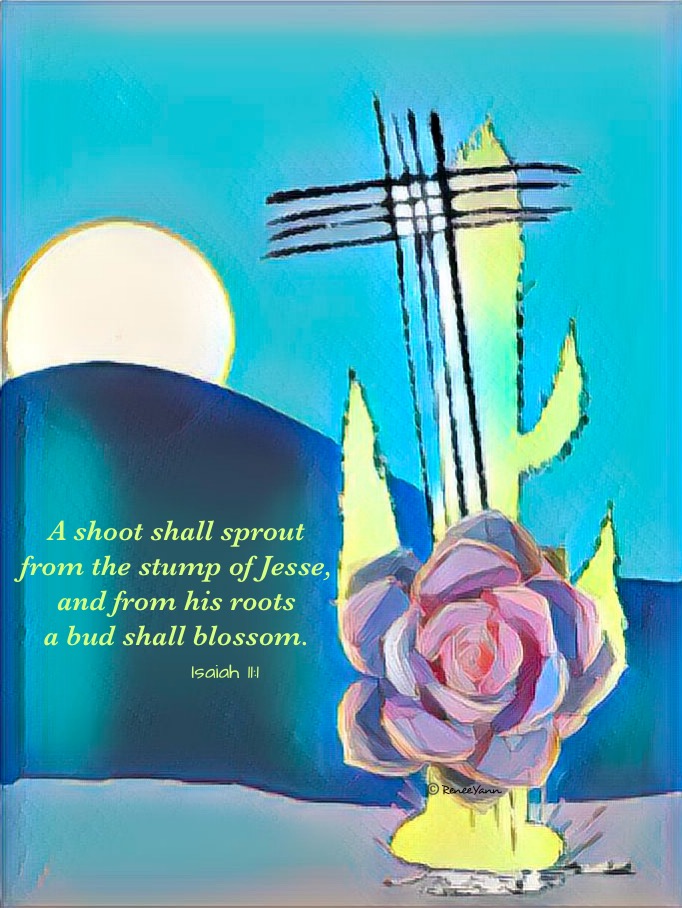
Today, in God’s Lavish Mercy, Isaiah challenges us with his outrageously hopeful poetry.
After describing, in lyrical magnificence, the Messianic Ruler, Isaiah tells us this:
Then the wolf shall be a guest of the lamb,
Isaiah 11:6-10
and the leopard shall lie down with the kid;
The calf and the young lion shall browse together,
with a little child to guide them.
The cow and the bear shall be neighbors,
together their young shall rest;
the lion shall eat hay like the ox.
The baby shall play by the cobra’s den,
and the child lay his hand on the adder’s lair.
There shall be no harm or ruin on all my holy mountain;
for the earth shall be filled with knowledge of the LORD,
as water covers the sea.
We love this lilting Advent balladry, don’t we? Its movement is laced with hidden bells and waft of pine. It makes us remember Handel’s Messiah and resolve to find and play the CD we put away last January.
But as much as we might love the passage, do we believe it? Is the era of messianic peace possible, and will it be realized through the mystery of Divine Love incarnate in Jesus Christ?
Well, here are the facts:
Isaiah lived and prophesied a redeemed kingdom about 700 years before Christ. When Christ was born, the world was in pretty much the same sad shape as it was when Isaiah wrote.
Jesus lived 2000 years ago, speaking and modeling specific instructions for the world’s transformation. But the world is in pretty much the same sad shape today as it was when Jesus lived.
So where is all this “peaceable kingdom” stuff happening? Is it non-existent or just invisible? Is it just the rather lunatic imagining of ancient prophets?
Today’s Gospel offers us an understanding of God’s Reign too deep for the world’s logic. By the gift of faith and the grace of Baptism, we have been given a new set of eyes, charged with the same outrageous yet real hope evident in Isaiah and enfleshed in Christ.
I give you praise, Father, Lord of heaven and earth,
Luke 10:21-24
for although you have hidden these things
from the wise and the learned
you have revealed them to the childlike…
… Turning to the disciples in private he said,
“Blessed are the eyes that see what you see.
For I say to you,
many prophets and kings desired to see what you see,
but did not see it,
and to hear what you hear, but did not hear it.
If we can give ourselves to the vulnerable simplicity Jesus describes, faith can transform us. The “Kingdom” can live in us and because of us!
We too will see the bud beyond the stump. New life will arise from what appears lifeless. The worldly fears and inhospitalities that prey on us will be tamed by a holy confidence. In life’s sinuous circumstances, we will see the Holy Mystery unfolding.
The Kingdom, so indiscernible in our fractious world, will “advent” in us. This is what we long for in our Advent prayer.
Poetry: Advent Credo – Allan Boesak, a South African pastor in the Dutch Reformed Church, politician, anti-apartheid activist, and author of fifteen books. This poem is taken from his book Walking on Thorns (Eerdmans, 1984), and is often but wrongly attributed to Daniel Berrigan.
It is not true that creation and the human family are doomed to destruction and loss—
This is true: For God so loved the world that He gave his only begotten Son, that whoever believes in Him shall not perish but have everlasting life;
It is not true that we must accept inhumanity and discrimination, hunger and poverty, death and destruction—
This is true: I have come that they may have life, and that abundantly.
It is not true that violence and hatred should have the last word, and that war and destruction rule forever—
This is true: Unto us a child is born, unto us a Son is given, and the government shall be upon his shoulder, his name shall be called wonderful councilor, mighty God, the Everlasting, the Prince of peace.
It is not true that we are simply victims of the powers of evil who seek to rule the world—
This is true: To me is given authority in heaven and on earth, and lo I am with you, even until the end of the world.
It is not true that we have to wait for those who are specially gifted, who are the prophets of the Church before we can be peacemakers—
This is true: I will pour out my spirit on all flesh and your sons and daughters shall prophesy, your young men shall see visions and your old men shall have dreams.

It is not true that our hopes for liberation of humankind, of justice, of human dignity of peace are not meant for this earth and for this history—
This is true: The hour comes, and it is now, that the true worshipers shall worship God in spirit and in truth.

So let us enter Advent in hope, even hope against hope. Let us see visions of love and peace and justice. Let us affirm with humility, with joy, with faith, with courage: Jesus Christ—the life of the world.
Music: Lo, How a Rose E’er Blooming – pre-17th century anonymous hymn
From Wikipedia: The hymn was originally written with two verses that describe the fulfillment of the prophecy of Isaiah foretelling the birth of Jesus. It emphasizes the royal genealogy of Jesus and Christian messianic prophecies. The hymn describes a rose sprouting from the stem of the Tree of Jesse, a symbolic device that depicts the descent of Jesus from Jesse of Bethlehem, the father of King David. The image was especially popular in medieval times, and it features in many works of religious art from the period. It has its origin in the Book of Isaiah:
And there shall come forth a rod out of the stem of Jesse, and a Branch shall grow out of his roots.— Isaiah 11:1
 Lavish Mercy