… because love is of God

Tuesday, January 8, 2019

Click here for readings

1 john_ gods love

Today, in Mercy, we are presented with a most powerful reading from John:

Beloved, let us love one another
because love is of God.

But many of us miss the power of this invitation. We read it like a valentine, seeing shining hearts connecting us to those we already favor. God’s love doesn’t look like that.

God’s love is like this:

  • standing at the border looking, in between barbed wire, for a chance to welcome
  • keeping vigil at a stranger’s hospital bedside
  • pouring prayer and courageous guidance over an addicted child
  • vigilantly engaging government for just and humane policy 
  • spending time, interest and care with those who cannot command it of us

God’s love is always near the poor, the sick, those caught in the unraveling edges of a greedy, selfish society.

We see this love in today’s Gospel. It lifts up five loaves, two fish, and spins them into nourishment for thousands. Such is the power of this awesome love.

So let us begin, in the small invitations our life will offer us today, to love like that.

Doing so, we come to more clearly know God Who loves us first and always.

Music: Where Love Is Found – Dan Schutte (Lyrics below)

Where Love is Found – Dan Schutte

Where charity and love are found,
there will the face of God be seen.
The love of Christ will bind our hearts;
as one body we will be.

Love is patient, love is kind,
never boastful, never proud.
Love is hopeful in its waiting,
ever trusting in Gods light.

Love is steadfast to the end,
ever ready to endure.
Love is gracious in its kindness,
ever ready to forgive.

Though I speak with angels tongue,
I am nothing more than sound.
I am but a cymbal clanging
if I sing without God’s love.

There are three things that will last:
there is faith, hope, and love.
But the greatest of all blessings
is the faithfulness of love.
O King of Kings ( O Rex Gentium)

Saturday, December 22, 2018

Click here for readings

Rex Gentium

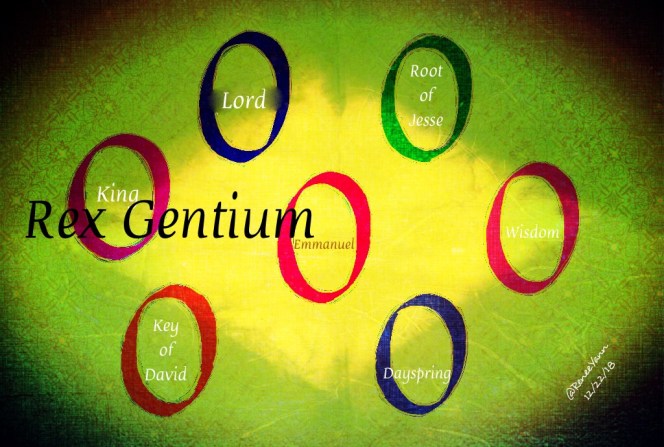
Today, in Mercy, our O Antiphon beseeches God, Who is King of All Nations, Who unites Gentile and Jew, to deliver us. 

But from what? 

The answer lies in the closing phrase of the antiphon: “we whom you formed from the dust of the earth”. 

Deliver us from the artificial barriers we have created to separate from and dominate over one another – by nationality, ethnicity, color, gender, social or economic class. We each began as dust and will end that way.  May we be humble, mutual and compassionate in the time between.

Consider the gracious humility of Hannah in our first reading today, and of Mary in our Gospel.  They are power figures in Salvation History.  But their power comes from their utter dependence on and honor to God, their only true King.

There was no fragmentation in the commitment of their entire lives to God. They understood all Creation to belong to the Divine.

King of Kings, deliver us from any such fragmentation. Make us all whole in You.

O King of all nations and keystone of the Church:
come and save us, whom you formed from the dust!
R. Alleluia, alleluia.

Music: O Rex Gentium – Gregorian Chant ( Latin rendering of the italicized prayer above.)

Stand Up

Thursday, November 29, 2018

Click here for readings

human circle

Today in Mercy, our readings from Revelation and Luke are truly terrible, in the full meaning of that word: extremely distressing, causing terror.  They’re intended to be.

They describe and warn against times of destruction. Revelation describes the fall of Babylon. The Gospel relates the destruction of Jerusalem.

But neither reading is history. They are not offered so that we get the facts, the way a newspaper or encyclopedia reports a story.

These readings are given to us, and to the audiences they were originally written for, so that we might understand clearly this important reality: we live in two worlds, the material and the spiritual.

These worlds are intended by God to be united in one Creation, joined at the wedding feast of the Lamb. But we humans fail. We exalt and distort the power of the material world to the destruction of the spiritual. We split what God intended to be whole.

In other words, we build both global and personal kingdoms and governments that have no heart, have no soul.

If you think these readings describe only past civilizations, then look to the Mexican-US border. Look at the starving people of Yemen. Look at the devastation of the rainforest. Look at our drug-infested, gun-enthralled culture.

Jesus knew that his followers would battle these forces forever. He tells us that, in the midst of these destructive signs, we should

“ … stand erect and raise your heads
because your redemption is at hand.”

Jesus’s followers must stand as a sign of another way. We must raise our heads to say “No” to the heartless moral choices of our time. We cannot allow ourselves to be swept up in a culture of lies, political expediency, material greed, and dehumanization of whole peoples. We must break through the cabled propaganda we are fed to find God’s Word to us.

Our readings today ask us to take a good look at ourselves. How complicit are we in our own destruction by our failure to choose, speak, and act for Gospel justice in our world?

Music: No Outsiders – Rend Collective

The Fiery Wine Press

Tuesday, November 27, 2018

Click here for Readings

Rev 14_19 furyJPG

Today, in Mercy, we are struck with Revelation’s images of the end time!

  • a crowned Christ wielding a sharp sickle
  • angels commanding the final harvest of the earth

and perhaps the most powerful

  • the earth’s vintage thrown into the great winepress of God’s fury!

This author could write! We can almost imagine the scene, filmed with all the pyro-technics of today’s computer age.

But besides the amazing imagery, what does the passage say to our hearts?

In Biblical symbolism, the winepress almost always stands for judgment. The passage reminds us that we all will be judged.  The divine winepress will compress the sinful gaps that plague our human existence.  In the end time, there will be no “other” — no judgmental spaces separating us from one another.  We will all be one, like wine mingled.

We will be judged on how we lived that oneness in this life, on where we have stood in the gap between the:

  • rich and poor
  • well and sick
  • citizen and refugee
  • abled and disabled
  • powerful and vulnerable

Do we live in ignorance or indifference to those who suffer on the other side of the human scale? Have we been impervious to the imbalances of justice and charity in this world?

And how do we respond? The passage suggests that we do some weeding of our spiritual gardens before the harvest of our souls. The intention of this fiery writer is to tell us that we still have a little time.

Music:  The Day Is Surely Drawing Near – written by the prolific 16th century Lutheran hymnist Bartholomaüs Ringwaldt. This piece is a majestic instrumental rendering, but if you would like to see the words, they are below. 

1 The day is surely drawing near
When Jesus, God’s anointed,
In all His power shall appear
As judge whom God appointed.
Then fright shall banish idle mirth,
And flames on flames shall ravage earth
As Scripture long has warned us.

2 The final trumpet then shall sound
And all the earth be shaken,
And all who rest beneath the ground
Shall from their sleep awaken.
But all who live will in that hour,
By God’s almighty, boundless pow’r,
Be changed at His commanding.

3 The books are opened then to all,
A record truly telling
What each has done, both great and small,
When he on earth was dwelling,
And ev’ry heart be clearly seen,
And all be known as they have been
In thoughts and words and actions.

4 Then woe to those who scorned the Lord
And sought but carnal pleasures,
Who here despised His precious Word
And loved their earthly treasures!
With shame and trembling they will stand
And at the judge’s stern command
To Satan be delivered.

5 My Savior paid the debt I owe
And for my sin was smitten;
Within the Book of Life I know
My name has now been written.
I will not doubt, for I am free,
And Satan cannot threaten me;
There is no condemnation!

6 May Christ our intercessor be
And through His blood and merit
Read from His book that we are free
With all who life inherit.
Then we shall see Him face to face,
With all His saints in that blest place
Which He has purchased for us. 

7 O Jesus Christ, do not delay,
But hasten our salvation;
We often tremble on our way
In fear and tribulation.
O hear and grant our fervent plea;
Come, mighty judge, and make us free
From death and ev’ry evil.

Christ the King

Sunday, November 25, 2018

Click here for readings

Today, in Mercy, we celebrate The Solemnity of Christ the King.

Rev1_7JPG

For some, the lofty, politically-tinged title might obscure the rich devotion offered by this feast. The title “king” carries with it suggestions of exaggerated power, wealth and dominance not compatible with our Gospel perception of Jesus.

We may be more comfortable with images of Christ as infant, brother, shepherd, lamb, vine, gate, way, truth, life…

But what all these images point out is that our ability to comprehend the fullness of Christ is severely limited by our humanity. We usually choose a specific image based on our circumstances and spiritual needs.

Pope Pius XI promoted the concept of Christ the King in his 1925 encyclical Quas Primas, in response to growing international secularism and nationalism. His intent was not to compare Christ to the challenged world leaders of the time. It was to raise the perceptions of all people to the lessons of Divine Leadership: mercy, justice, inclusivity, and peace.

Oh, how we could benefit from the same understanding today! 

In this age with its culture of continual war, the human pain it causes, refugee crises, climate devastation, wealth distortion and indifference to the poor, how our hearts long for just, wise and loving leadership!

In his encyclical, Pius XI wrote:

Christ the King reigns “in the human hearts,” both by reason of the keenness of his intellect and the extent of his knowledge, and also because he is very truth, and it is from him that truth must be obediently received by all humanity. He reigns, too, in our wills, for in him the human will was perfectly and entirely obedient to the Holy Will of God, and further by his grace and inspiration he so subjects our free-will as to incite us to the most noble endeavors. He is King of hearts, too, by reason of his “charity which exceedeth all knowledge.”

— Quas primas, §7[4]

Let’s pray for these virtues for all who are charged with any form of power or leadership:

  • keen spiritual intellect
  • deep heart’s knowledge
  • uncompromising truth
  • obedience to grace
  • holy inspiration 
  • noble character
  • and surpassing charity for all Creation

May Christ the King truly live and reign among us. May we behold the “sweet light in His eyes”!

Music: We Shall Behold Him – offered in American Sign Language by Kayla Seymour; sung by Sandi Patty

Bread and Roses

Saturday, November 17, 2018

Readings: Click here for readings

Eliz_bread

Today, in Mercy, we celebrate the Memorial of St. Elizabeth of Hungary.  Elizabeth, a princess in Hungary, was married at the age of fourteen to Louis IV of Thuringia, a German state. Both rulers were kind and saintly. 

Elizabeth used her considerable royal resources to help the poor and hungry. She met them outside the walls of the palace, even building a small hospital there to care for the sick among them. 

But there was some controversy within the castle, questioning her charity as a depletion of the governmental treasures. 

Eliz windowJPG

Once, on a charitable journey, Elizabeth met her husband traveling with a band of such questioners. She carried baskets of bread to the poor, covered with her traveling cloaks. They demanded she reveal her cargo at which the bread is said to have been miraculously transformed into roses.

(St Elizabeth of Hungary with her crown and apron full of flowers. Blois château, France. One of a series of female saints in the Oratory (once the queen’s private chapel). Designed by Michel Dumas in 1858, the windows were painted by Claude Lavergne in 1859.)

As indicated by Pope Benedict XVI, Elizabeth is part of that long line of holy ones, whose relationship with Jesus moved them to justice and mercy for all people.

Praying with Elizabeth today, asking for insight on how to be loving and charitable in today’s world, one might consider this:

  • What would it be like to greet our border refugees with baskets of bread rather than barbed wire?
  • What would it be like if we built rose hedges rather than walls?

The caravan of refugees seeking asylum at our border mirrors many similar marchers throughout history, searching for a measure of equality and a livable life.

The music for today, aptly titled “Bread and Roses”, originated in the early 1900s, as women marched for improved working conditions and the right to vote.

Music: Bread and Roses

The Grace at Our Border

Monday, November 5, 2018

Readings: http://www.usccb.org/bible/readings/110518.cfm

Today, in Mercy,  we continue our readings from Paul’s inspiring letter to the Philippians. Paul sincerely loves this community and wants them to be perfected in Christ. 

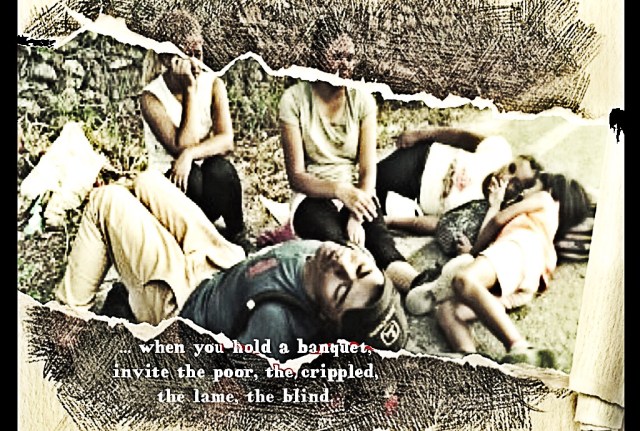
This is what Jesus wants for us too.  Today’s Gospel is just one example of Jesus showing his followers the way to holiness. He uses the opportunity of a dinner to remind those gathered that they are very fortunate. Their lives are like a banquet compared with the lives of those who are poor and burdened.

He suggests that his followers do what God would do:

When you hold a banquet,
invite the poor, the crippled, the lame, the blind;
blessed indeed will you be
because of their inability to repay you….

Just such an opportunity to be blessed awaits us, in the USA, at our southern border. A wave of God’s beloved poor and besieged washes toward us. Will we meet them with true mercy and justice born out of Christian charity? Or will we confront them with a brutal show of power born of fear and alienation?

Lk14_14 banquet

Of course, there are legitimate concerns with such a large migration. But these concerns must be met with wisdom and prudence, not prejudice and vilification. This is not a horde of animals attacking us. These are human beings desperately seeking a better life.

Jesus thought that his table companions, gifted as they were by God, had the moral capacity to respond to his challenge. Can he expect the same of us?

Let’s hope so, because our Gospel closes with a very compelling reason:

“For you will be repaid
(one way or the other, I might add)
at the resurrection of the righteous.”

Music: God of the Poor – Graham Kendrick

Rachel Weeps

Tuesday, October 30, 2018

Readings: http://www.usccb.org/bible/readings/103018.cfm

Today, in Mercy, Jesus poses a question to his followers:

“What is the Kingdom of Heaven like?” It is rhetorical question and he goes on to explain, in beautiful symbols, the joy and fullness of heaven.

But were Jesus walking physically among us today, He might answer his own question by saying:

This is what it is NOT like:

  • the killing of innocents because of their faith, heritage, lifestyle or politics
  • the starvation and incarceration of children from Yemen to Mexico to Syria
  • the fueling of war by an economy of arms sales
  • the destruction of an environment given to us in trust
  • the systematic dehumanization of humanity through violence, lies, greed, and political arrogance
  • the ignorant indifference in “good” people which blindly fosters such dehumanization

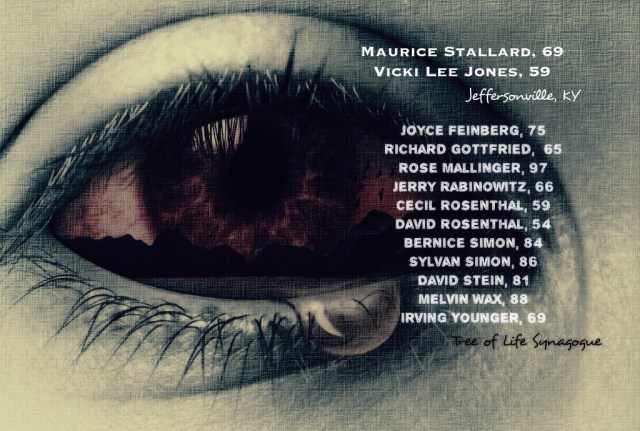
Indeed, Rachel weeps for her beloved martyrs in Pittsburgh, for her dear children in Jeffersonville – as do all of decent and loving heart. And she weeps also for thousands who die daily from the failure of love. She weeps for all of us. In a society this sick with violence and hate, we are all victims.

Let us all choose the only survival — to act in mercy, justice and love. Let us do so to the memory of these martyrs and the many whom they follow.

Music: Shalom Aleichem

https://m.youtube.com/watch?v=gP2S5KPQID4

Dirty Cups

Tuesday, October 16, 2018

Readings: http://www.usccb.org/bible/readings/101618.cfm

Today, in Mercy, our readings challenge religious and moral hypocrisy.

Lk.11_39 dirty cup

Paul, in his continuing letter to the Galatians, counsels them about the practice of circumcision. But his counseling is really about freedom in Christ. 

In Paul’s time, circumcision had religious significance as a sign of inclusion in the Jewish nation. Some Jewish Christians mistakenly taught that a Gentile must first become a Jew, through the law of circumcision, in order to become a Christian.

Paul condemns this error, reminding the Galatians that the grace given to us in Christ is beyond the Law.

For in Christ Jesus,
neither circumcision nor uncircumcision counts for anything,
but only faith working through love.

In the Gospel, Jesus condemns any religious practice that is empty and just for show.  He compares such rituals to cups, whose clean exterior hides a corrupt interior. Jesus says that the remedy to this hidden nastiness is to give alms, to be merciful.

We are all aware of pharisaical behavior within our religious institutions. We have seen disgusting evidence of it in sexual predation among clergy. We see it when exaggerated religious rituals are substituted for sincere, communal worship. We see it when the small, visible mistakes of others are used to hide the gaping faithlessness of the condemner. Sometimes, we are even caught in the judgmental nets these pretenses spin.

When we are confused by such situations, look to the words of Jesus and Paul today:

Look for faith working through love.
Look for a generous heart that sees and comforts the poor.

If our “religious” observance results in any form of exclusion, prejudice, condemnation or unforgiveness, we can be sure it is not of God.

Music: Purify My Heart ~ Brian Doerksen

Teach Us to Pray

Wednesday, October 10, 2018

Readings: http://www.usccb.org/bible/readings/101018.cfm

Today, in Mercy, Paul and Peter have a big fight – two of the Greats take it to the mat over an issue of inclusivity in the early Church.

To put the episode in a nutshell, Peter had succumbed to political pressure from Jewish Christians to isolate non-Jewish Christians from full participation in the Church. The pressure was rooted in nationalism, religious prejudice and unexamined fear. Peter, in an attempt to manage these forces, made a huge misstep.

Paul, seeing that Peter’s actions would set a dangerous and divisive precedent in the emerging Church, confronted him before the whole community. For a moment in time, these two pillars of Christianity stood on separate shores.

Lk11_2 Pray

Ultimately, through prayer, respect and discernment, Peter and Paul continued together to shepherd the embryonic Church toward a new reality – one built on, but beyond, the Judaism in which they both had been raised.

The Church, as a living reality, will always be challenged by issues of growth, identity, inclusion and other concerns. But as soon as we define ourselves as anything other than simply Christians, we run the risk of moving to our own “separate shores”. 

We are not conservative or liberal Christians. We are not American, or European or Asian Christians. We are not gay or straight, Black or White, male or female, rich or poor Christians.

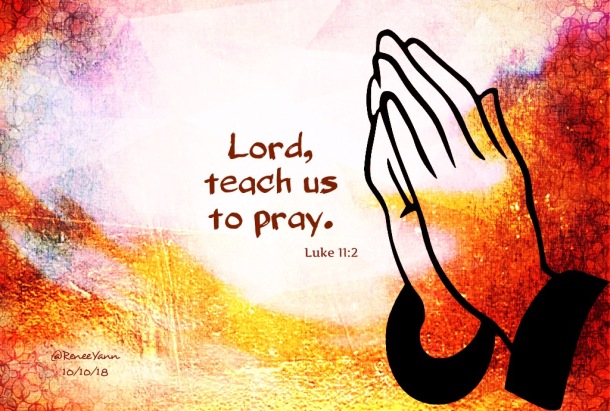
We are all sisters and brothers in the Gospel of Christ, standing on the same shore with Him, praying to our one Father. May this shared prayer help us to become who we are called to be.

Music: Lord, Teach Us to Pray ~ Joe Wise