No Sign Will Be Given Except…..

Monday of the Sixteenth Week in Ordinary Time
July 24, 2023

Today’s Reading:

https://bible.usccb.org/bible/readings/072423.cfm


Today, in God’s Lavish Mercy, Jesus is pestered by scribes and Pharisees who want him to prove himself by a sign.

Jesus answers their jibing in a kind of spiritual code.

Some of the scribes and Pharisees said to Jesus,
“Teacher, we wish to see a sign from you.”
He said to them in reply,
“An evil and unfaithful generation seeks a sign,
but no sign will be given it
except the sign of Jonah the prophet.
Just as Jonah was in the belly of the whale three days and three nights,
so will the Son of Man be in the heart of the earth
three days and three nights.

Matthew 12:38-40

So what exactly is “The Sign of Jonah”? Sounds like the title of a Dan Brown novel, doesn’t it?

Well, it is the title of a wonderful book, but not one by Dan Brown.


When I was in high school, I was obsessed with the writings of Thomas Merton. The fire was ignited by my freshman homeroom teacher who gave me a copy of his “Seeds of Contemplation” — another book that changed my life. Inspired by that first read, I slowly made my way through Seven Storey Mountain, No Man is an Island, Thoughts in Solitude … finally coming, in a veil of limited understanding, to “The Sign of Jonas”.

I didn’t understand the title. What I did begin to understand, as Merton journaled his daily life in the Abbey of Gethsemane, was that we discover God not by any external revelation or intellectual acquisition, but by our choices for love in the pattern of Jesus.

In today’s Gospel, the scribes and Pharisees seek an external demonstration that Jesus is all powerful. But their seeking is an insincere attempt at self-satisfaction, not a choice for Gospel love.


So what does Jonah have to do with the Pharisees’ insincerity? Jonah, given a mission by God, could not initially align himself with God’s call. At God’s irresistable invitation, Jonah spent three days of solitude in a whale’s belly contemplating his circumstances. By the graces gained in his solitude, Jonah emerged as a prophet for God.


As recounted in his book, the whale’s belly for Merton was his life in Gethsemane Abbey where he found the profound meaning and deep awareness of his vocation.

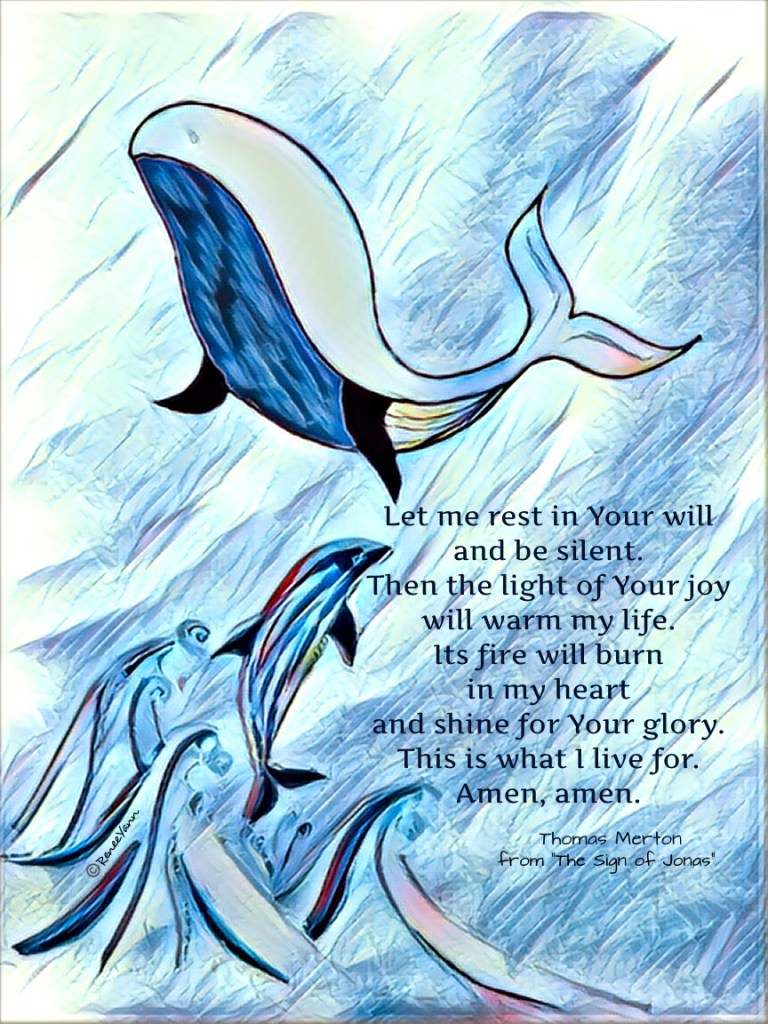
Let me rest in Your will and be silent.
Then the light of Your joy will warm my life.
Its fire will burn in my heart
and shine for Your glory.
This is what I live for. Amen, amen.


It may not sound all that inviting, but every one of us is called to the “whale’s belly”. Our transformation there is accomplished by our congruity with Christ’s sojourn in the tomb. Like Jesus, we must die to self for the sake of others. Like Jonah, we must abandon our fears and conveniences to become signs of God’s love in the world.


The Pharisees didn’t get it. And, God help them, I understand. It’s hard to get it! Life seems so much easier if we run away from this deep call like Jonah did at first. But the call remains: to be God’s Word in the world – to “shine for God’s glory“.


The editorial staff of the National Catholic Reporter wrote this about Merton’s Sign of Jonas:

Thomas Merton wrote in his early journals that the “sign of Jonas” — the mystery of Christ’s death and resurrection — is “burned into the roots of our being.” Sooner or later, everyone faces the universal truth that only through death to self do we find life. Merton embraced this sign and described himself as one like Jonah, because “I find myself traveling toward my destiny in the belly of a paradox.”


We may need to choose a little “whale-belly” time to get our hearts straight with this astounding yet universal call to be “for God” in our paradoxical world.


Poetry: two poems from “You! Jonah!” by Thomas John Carlisle

THE GREAT INTRUDER
It is exasperating
to be called
so persistently
when the last thing
we want to do
is get up and go
but God
elects
to keep on
haunting
like some
holy ghost.

———————–

COMING AROUND
And Jonah stalked
to his shaded seat
and waited for God
to come around
to his way of thinking.
And God is still waiting
for a host of Jonahs
in their comfortable houses
to come around
to His way of loving.

Music: Jonah and the Whale – Louis Armstrong – lyrics below

Jonah was a man who got a word from the Lord
Go and preach the Gospel to the sinful land‿
But he got on a ship and he tried to get away
And he ran into a storm in the middle of the sea

Now the Lord, He made the waves just roll so high
The ship begin to sink and they all begin to cry
So they pulled ole Jonah out of the hole
And they jumped him in the water just to lighten up the load

Now the Lord made a whale, long and wide Lord, Lord waddnat a fish
And he swallowed up Jonah, hair and hide Lord, Lord waddnat a fish,
Mmm, Lord, mmm, Lord

Now Jonah started to pray in the belly of the whale
Lord, Lord waddnat a fish
He repented of his sins like a man in jail
Lord, Lord waddnat a fish
Mmm, Lord, mmm, Lord

Now Jonah must o’ been a bad man, he must o’ been a sinner
Lord, Lord waddnat a fish
Cos when the whale got him down, he didn’t like his dinner
Lord, Lord waddnat a fish
Mmm, Lord, mmm, Lord

Well he swum around the ocean, sick as he could be
Lord, Lord waddnat a fish
And after three days, whoops! he had to set him free
Lord, Lord waddnat a fish, mmm

So the whale spit Jonah out onto dry land
Lord, Lord waddnat a fish
And went on to preaching like a righteous man
Lord, Lord waddnat a fish

Then the people quit their sins when they heard him the town
Lord, Lord waddnat a fish
So when you hear the call, don’t you turn the Gospel down
Lord, Lord waddnat a fish, mmm?

Good Ground for Hope

Sixteenth Sunday in Ordinary Time
July 23, 2023

Today’s Readings:

https://bible.usccb.org/bible/readings/072323.cfm


Today, in God’s Lavish Mercy, our readings revolve around the dynamic of hope – God’s hope planted in our spirits and our hope entrusted to God’s Mercy.

As we pray with these passages, it helps to remind ourselves of the true definition of “hope”. It is a word that many of us use carelessly to the point that we may have lost the power of its meaning – as in when we say things like, “I hope it doesn’t rain”. What we really mean is that we wish it wouldn’t rain.

Hope is not the same as wishing. Wishing is a mental activity that has no power to make its object come true. Hope, on the other hand, is a resident condition of our spirits that frees us to live with enthusiasm and gratitude despite whatever outcome may arise.

Wishing dissapates when conclusions pass. Hope is eternal because it draws its energy from faith in God’s Infinite Mercy and the promise of eternal life.


The Book of Wisdom’s author understood the Source from which hope springs:

Though you are master of might, you judge with clemency,
and with much lenience you govern us;
for power, whenever you will, attends you.
And you taught your people, by your deeds,
that those who are just must be kind;
and you gave your children good ground for hope
that you would permit repentance for their sins.

Wisdom 12:18-19

Paul, in another passage from magnificent Romans 8, acknowledges that we can sustain hopeful hearts only by the power of the Holy Spirit who lifts us up and prays within us when we are too overwhelmed to do so ourselves.

The Spirit comes to the aid of our weakness;
for we do not know how to pray as we ought,
but the Spirit intercedes with inexpressible groanings. 
And the one who searches hearts
knows what is the intention of the Spirit,
because Spirit intercedes for the holy ones
according to God’s will.

Romans 8:26-27

Jesus gives us a great parable for understanding hope. How discouraged might that farmer have been when the enemy tried to ruin his crop! But instead, the farmer realized that his field, like life, can sustain both the wheat and the weeds. If we live hopefully and faithfully, the wheat can be gathered from the harvest, and the weeds ultimately cast aside.


How many times in our own lives have we nearly been overwhelmed by the weeds! There is no life which passes without its hurts, disappointments, confusions, and dashed wishes! Some experience a sparse scattering of these weeds, and some lives are thick with difficulty. How surprising that it is often in the latter circumstance that hope rises up and sustains hearts.


As our Responsorial Psalm reminds us, those who live simply and sincerely are most able to tap deeply into the mysterious power of hope.

Blessed are you, Father, Lord of heaven and earth;
you have revealed to little ones the mysteries of the kingdom.


Poetry: From “Odes” – George Santayana was a Spanish-American philosopher known more for his aphorisms than his poetry. He came up with lines like, ‘Those who cannot remember the past are doomed to repeat it”, and “Fanaticism consists in redoubling your effort when you have forgotten your aim.”

IV

Slowly the black earth gains upon the yellow,
And the caked hill-side is ribbed soft with furrows.
Turn now again, with voice and staff, my ploughman,
Guiding thy oxen.
Lift the great ploughshare, clear the stones and brambles,
Plant it the deeper, with thy foot upon it,
Uprooting all the flowering weeds that bring not
Food to thy children.
Patience is good for man and beast, and labour
Hardens to sorrow and the frost of winter.
Turn then again, in the brave hope of harvest,
Singing to heaven.

Music: Weed and Wheat – Silayio Kirisua is a Maasi woman who represented Kenya in the Voice of Holland singing competition. After winning the competition, she has become an international sensation.

Magdalene, Disciple of Christ

Feast of Saint Mary Magdalene
July 22, 2023

Today’s Readings:

https://bible.usccb.org/bible/readings/072223.cfm


(This is a “repeat post”, but I think it’s worth the repeat. I hope you agree.)

Today, in God’s Lavish Mercy, we pray with St. Mary Magdalene, disciple of Christ.

Massimo_Stanzione,_Mary-Magdalene_in_meditation
Magdalen in Meditation by Massimo Stanzione

Modern scripture scholarship recognizes Mary Magdalene as a disciple and companion of Jesus.  She is present in stories throughout all four Gospels, and most notably, as one who remained with Jesus at the foot of the Cross. Mary is the first witness to the Resurrection who then announces the Good News to the other disciples.

Over the centuries, Mary Magdalene has been confused with the many other Marys in the Gospel, as well as with the unnamed repentant woman who washes Jesus’ feet with her tears. These confusions have inclined us to think of Mary Magdalene as a reformed prostitute. This erroneous concept has supported a diminished understanding of the role of women in the ministry of Jesus and done a huge disservice to Mary’s vital role as beloved disciple.

The Gospel passage for the feast captures the powerful moment when the Resurrected Jesus is first revealed to the world. The scene also portrays the deep love, trust and friendship between Jesus and Mary Magdalene – a relationship which serves as a model for all of us who want to be Christ’s disciples. I imagined the scene like this in an earlier Easter reflection:

 Rabbouni

 The Upper Room on Holy Saturday evening: a place filled with sadness, silence and seeking. Jesus was dead. Jerusalem, scattered to their various houses to keep Shabbat, murmur their shocked questions under their shaky prayers.

 We have all been in rooms like this. They enclose a special kind of agony – one teetering between hope and doubt, between loss and restoration. It may have been a surgical waiting room or the hallway outside the courtroom. Sometimes, such a space is not bricks and mortar.  It is the space between a sealed envelope and the news inside. It is the hesitant pause between a heartfelt request and the critical response. In each of these places, we exist as if in a held breath, hoping against hope for life, freedom, and wholeness.

 It was from such a room that Mary Magdalene stole away in the wee hours. A woman unafraid of loneliness, she walked in tearful prayer along the path to Jesus’ tomb. Scent of jasmine rose up on the early morning mist. Hope rose with it that his vow to return might be true. Then she saw the gaping tomb, the alarm that thieves had stolen him to sabotage his promise. She ran to the emptiness seeking him. She was met by angels clothed in light and glory, but they were not enough to soothe her.

 Turning from them, she bumped against a gardener whom she begged for word of Jesus, just so she might tend to him again. A single word revealed his glory, “Mary”. He spoke her name in love.

 As we seek the assurance of God’s presence in our lives, we too may be unaware that God is already with us. The deep listening of our spirit, dulled with daily burdens, may not hear our name lovingly spoken in the circumstances of our lives. God is standing behind every moment. All we need do is turn to recognize him.

 Turn anger into understanding. Turn vengeance into forgiveness. Turn entitlement into gratitude. Turn indifference into love. All we need do is turn to recognize him.


For a comprehensive and enlightening lecture on the current theological and scriptural thinking on Mary Magdalen, follow this link to an Elizabeth Johnson, CSJ lecture at Fordham.

Click here for lecture


Music: I Know That My Redeemer Liveth

Angels Hidden in the Bushes

Wednesday of the Fifteenth Week in Ordinary Time
July 19, 2023

Today’s readings:

https://bible.usccb.org/bible/readings/071923.cfm


Today, in God’s Lavish Mercy, our readings lead us to consider how God is present in our lives, calling us to deeper spiritual awareness and vitality.


In Exodus 3, Moses has fled Egypt and taken up a new, uneventful life, working for his father-in-law, napping by the sheepfold in Midian.

Meanwhile, Moses was tending the flock
of his father-in-law Jethro, the priest of Midian.


The text makes no notation that Moses is contemplating the gravity of his past experiences, nor seeking spiritual meaning from them. As a matter of fact, the first three chapters of Exodus make little reference to God, except for God’s faithfulness to the resistant midwives who saved Moses’ life.

Left up to Moses, no great theophanic event would be recorded in Exodus. It would simply be a story about a Midian shepherd too scared to go back to his old hometown. It was God Who made the magic happen in Exodus, and oh, what magic it was!


We first have notice that God is about to act in the final verses of Exodus 2:

A long time passed (after Moses fled), during which the king of Egypt died. The Israelites groaned under their bondage and cried out, and from their bondage their cry for help went up to God.
God heard their moaning and God was mindful of the covenant with Abraham, Isaac and Jacob.
God saw the Israelites, and God knew….

Exodus 2: 23-25

Because God knew – and always knows – our sufferings and joys, God cares and is present to us in our lives. We are not always aware of that Divine Accompaniment, as perhaps Moses was unaware in his Midian field.

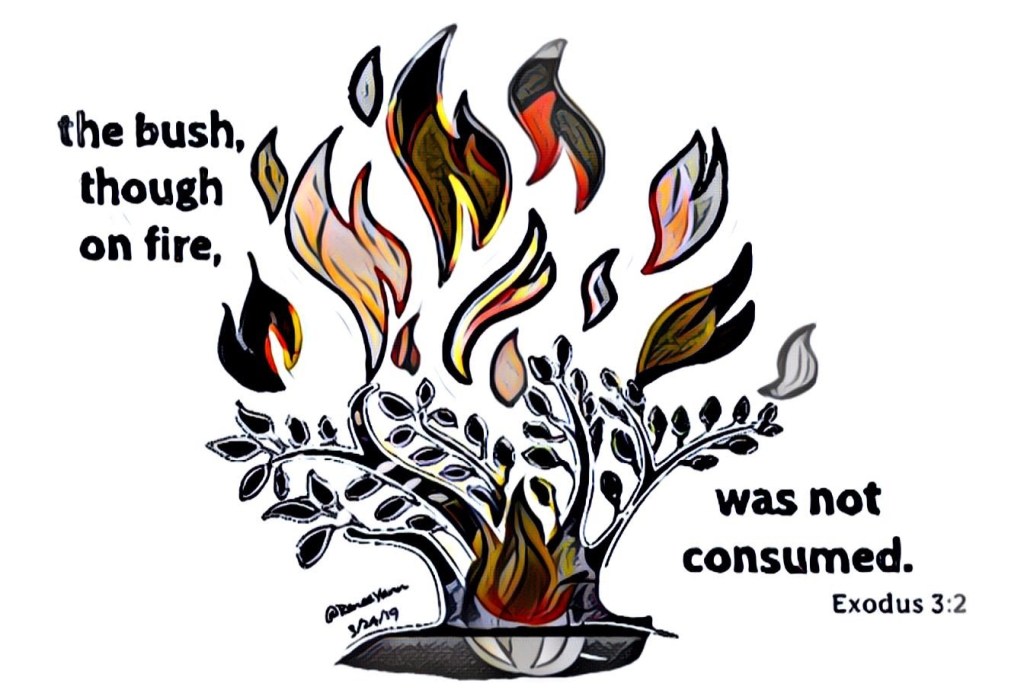
God woke Moses up with a burning bush. Then, by sharing his Name, God invited Moses to the deep spiritual intimacy which empowered him to act for God in the world.

God called out to him from the bush, “Moses! Moses!”
He answered, “Here I am.”
God said, “Come no nearer!
Remove the sandals from your feet,
for the place where you stand is holy ground.
I am the God of your father,” he continued,
“the God of Abraham, the God of Isaac, the God of Jacob.”


I think, for most of us, God is often hidden in our circumstances. I know I haven’t found too many buring bushes along life’s road. So what’s the secret to that deep spiritual awarnessthat allows us to live always in God’s Presence?

Jesus tells us in today’s Gospel that the secret is innocence.

At that time Jesus exclaimed:
“I give praise to you, Father, Lord of heaven and earth,
for although you have hidden these things
from the wise and the learned
you have revealed them to the childlike.


Spiritual innocence is not childish or uniformed. It is not faultless or naïve. The childlike quality Jesus describes is guileless, trusting, open, and wise. It waits in prayer and reflection for God’s time and movement. It believes despite doubt, and hopes despite setback.

Humble Moses – murderer, exile, and loafer on his in-law’s farm – had this kind of innocence. Like a wick awaiting kindling, Moses’s innocent heart caught fire with God. After that there was never an unnoticed “bush” in his life. After all, every one of them might contain angels!


Poetry: excerpt from Aurora Leigh by Elizabeth Barret Browning

But man, the two-fold creature, apprehends
The two-fold manner, in and outwardly,
And nothing in the world comes single to him.
A mere itself,–cup, column, or candlestick,
All patterns of what shall be in the Mount;
The whole temporal show related royally,
And build up to eterne significance
Through the open arms of God. 'There's nothing great
Nor small,' has said a poet of our day,
(Whose voice will ring beyond the curfew of eve
And not be thrown out by the matin's bell)
And truly, I reiterate, . . nothing's small!
No lily-muffled hum of a summer-bee,
But finds some coupling with the spinning stars;
No pebble at your foot, but proves a sphere;
No chaffinch, but implies the cherubim:
And,–glancing on my own thin, veined wrist,–
In such a little tremour of the blood
The whole strong clamour of a vehement soul
Doth utter itself distinct. Earth's crammed with heaven,
And every common bush afire with God:
But only he who sees, takes off his shoes,
The rest sit round it, and pluck blackberries,
And daub their natural faces unaware
More and more, from the first similitude.

Music: Burning Bush – Terrana and Manicardi

Burning bush You are, 
glowing and endless love. 
Living in Your midst, 
to live by You, 
to be alive in You. 

This Fire does not consume 
the essence of every person. 
You show Yourself in creation
in all of the beauty,  
that speaks and cries out Thee.

That You are Love 
in a flower, in the waves of the sea, 
in the dawn, in the song of a swan, 
in a kiss of a child to his mother 
in the farewell of a dying father. 

You are Love 
In a man who climbs the slope, 
In a woman who chooses life, 
In a star bursting with light, 
In the forgiveness that brings pain. 

You are earth, water, air and fire. 
Earth, water, air and fire. 

(Interlude)

Let’s take off our shoes 
in front of so much love. 
We need only to listen to 
the beautiful, the good, the true, 
That lies around us. 

For it’s Love
In a flower, in the waves of the sea,
in the dawn, in the song of a swan, 
in a kiss of a child to his mother
in the farewell of a dying father

It is Love
In a man who climbs the slope, 
In a woman who chooses life, 
In a star bursting with light,
In the forgiveness that costs pain

(Interlude)
repeat above
You are earth, water, air and fire
Earth, water, air and fire

Two Kinds of Silence

Tuesday of the Fifteenth Week in Ordinary Time
July 18, 2023

Today’s Readings:

https://bible.usccb.org/bible/readings/071823.cfm

Today, in God’s Lavish Mercy, silence plays a role in both our readings, but they are silences that differ profoundly from each other.

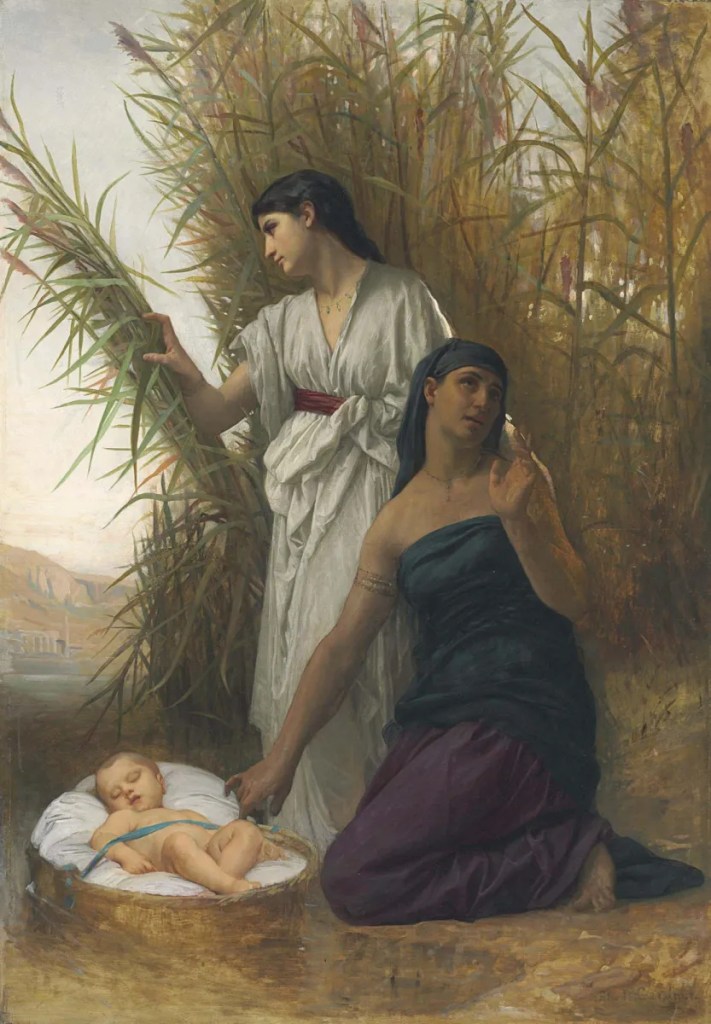
Moses in the Bulrushes – by Elizabeth Jane Gardner


In Exodus, we see the power of silent resistance to turn the tide of history. It is the resistance of righteousness.

Pharaoh, out of fear, has ordered all Hebrew boy babies drowned at birth. But Moses’s mother (Jochebed), aided by his sister (Miriam), silently resists.

A certain man of the house of Levi married a Levite woman,
who conceived and bore a son.
Seeing that he was a goodly child, she hid him for three months.
When she could hide him no longer, she took a papyrus basket,
daubed it with bitumen and pitch,
and putting the child in it,
placed it among the reeds on the river bank.
His sister stationed herself at a distance
to find out what would happen to him.

Her resistance, though silent, was nonetheless active. Look at all the intricate steps she took to assure the success of her plot.


The resistance cited in Matthew is of a different nature entirely. It reflects a hard heart not a determined heart. It is the resistance of indifference.

Christ Preaching at Capernaum – by Maurycy Gottlieb


Capernaum had become Jesus’s own home town. He had moved there as a young adult in order to begin his ministry after his own neighborhood had rejected him. But despite Jesus’s miracles and witness, Capernaum resisted the call of the Gospel:

Jesus began to reproach the towns
where most of his mighty deeds had been done,
since they had not repented.

And as for you, Capernaum:

Will you be exalted to heaven?
You will go down to the netherworld.

For if the mighty deeds done in your midst had been done in Sodom,
it would have remained until this day.
But I tell you, it will be more tolerable
for the land of Sodom on the day of judgment than for you.


We might find ourselves anywhere in these stories. We all experience resistances within, around, and toward us – sometimes for good reasons, sometimes not. We just have to fill in the blank to imagine all the resistances we are capable of:

I tend to resist ______________________________.

What did you come up with? Maybe some of these?

  • change
  • work
  • quiet
  • commitment
  • injustice
  • direction
  • strangers
  • programming
  • affection
  • cronyism, and on and on and on……

Jesus wanted to break through the negative resistance of his dearest communities.

Jocebed and her courageous women companions used positive resistance to break through abusive domination.

In our spiritual lives, we must, by prayer and informed reflection, lower our resistance to God’s transforming Word.

We must, at the same time, assume our role in resisting the injustice and violence of our times. Like Jocebed, we might consider our precious world and its peoples as if they were our own children, threatened by fear-blinded tyranny. In that case, what determined steps would we be willing to take to preserve its sacred life?


Poetry: Rosa Parks by Nikki Giovanni

This is for the Pullman Porters who organized when people said
they couldn’t. And carried the Pittsburgh Courier and the Chicago
Defender to the Black Americans in the South so they would
know they were not alone. This is for the Pullman Porters who
helped Thurgood Marshall go south and come back north to fight
the fight that resulted in Brown v. Board of Education because
even though Kansas is west and even though Topeka is the birth-
place of Gwendolyn Brooks, who wrote the powerful “The
Chicago Defender Sends a Man to Little Rock,” it was the
Pullman Porters who whispered to the traveling men both
the Blues Men and the “Race” Men so that they both would
know what was going on. This is for the Pullman Porters who
smiled as if they were happy and laughed like they were tickled
when some folks were around and who silently rejoiced in 1954
when the Supreme Court announced its 9—0 decision that “sepa-
rate is inherently unequal.” This is for the Pullman Porters who
smiled and welcomed a fourteen-year-old boy onto their train in
1955. They noticed his slight limp that he tried to disguise with a
doo-wop walk; they noticed his stutter and probably understood
why his mother wanted him out of Chicago during the summer
when school was out. Fourteen-year-old Black boys with limps
and stutters are apt to try to prove themselves in dangerous ways
when mothers aren’t around to look after them. So this is for the
Pullman Porters who looked over that fourteen-year-old while
the train rolled the reverse of the Blues Highway from Chicago to
St. Louis to Memphis to Mississippi. This is for the men who kept
him safe; and if Emmett Till had been able to stay on a train all
summer he would have maybe grown a bit of a paunch, certainly
lost his hair, probably have worn bifocals and bounced his grand-
children on his knee telling them about his summer riding the
rails. But he had to get off the train. And ended up in Money,
Mississippi. And was horribly, brutally, inexcusably, and unac-
ceptably murdered. This is for the Pullman Porters who, when the
sheriff was trying to get the body secretly buried, got Emmett’s
body on the northbound train, got his body home to Chicago,
where his mother said: I want the world to see what they did
to my boy. And this is for all the mothers who cried. And this is
for all the people who said Never Again. And this is about Rosa
Parks whose feet were not so tired, it had been, after all, an ordi-
nary day, until the bus driver gave her the opportunity to make
history. This is about Mrs. Rosa Parks from Tuskegee, Alabama,
who was also the field secretary of the NAACP. This is about the
moment Rosa Parks shouldered her cross, put her worldly goods
aside, was willing to sacrifice her life, so that that young man in
Money, Mississippi, who had been so well protected by the
Pullman Porters, would not have died in vain. When Mrs. Parks
said “NO” a passionate movement was begun. No longer would
there be a reliance on the law; there was a higher law. When Mrs.
Parks brought that light of hers to expose the evil of the system,
the sun came and rested on her shoulders bringing the heat and
the light of truth. Others would follow Mrs. Parks. Four young
men in Greensboro, North Carolina, would also say No. Great
voices would be raised singing the praises of God and exhorting
us “to forgive those who trespass against us.” But it was the
Pullman Porters who safely got Emmett to his granduncle and it
was Mrs. Rosa Parks who could not stand that death. And in not
being able to stand it. She sat back down.


Music: Soften My Heart, Lord – Maranatha Singers

Leaving Fear Behind

Monday of the Fifteenth Week in Ordinary Time
July 17, 2023

Today’s Readings:

https://bible.usccb.org/bible/readings/071723.cfm


Today, in God’s Lavish Mercy, as we continue with Matthew, we begin a nearly three-week engagement with the Book of Exodus. Our companion along the way will be Moses (and, on occasion, Charlton Heston).

The Book of Exodus, a literary masterpiece, has profoundly influenced religion and culture for over 3000 years. Finally written down about 300 years before Christ, it is a gathering of the rich oral traditions and salvation history of the Judea-Christian faith. A total of forty chapters, the Book can be divided into two key parts: the liberation from Egyptian enslavement and the formation of a new, life-giving Covenant with God.

The Book’s enduring influence can be ascribed to these two themes. They reflect the universal life cycles in all of nature and in each one of our lives. The totality of human culture as well as our individual biographies are stories of breaking forth from whatever binds us into the call and promise of fuller life.


Today’s chapter is an introduction or bridge from the time of Joseph, (when Israel thrived in Egypt), to just before the emergence of Moses, (when Israel suffered in Egypt).

A new king, who knew nothing of Joseph, came to power in Egypt.
He said to his subjects, “Look how numerous and powerful
the people of the children of Israel are growing, more so than we ourselves!
Come, let us deal shrewdly with them to stop their increase;
otherwise, in time of war they too may join our enemies
to fight against us, and so leave our country.”

Accordingly, taskmasters were set over the children of Israel
to oppress them with forced labor.

Exodus 1:8-11

The theme of suffering also anchors our passage from Matthew:

Jesus said to his Apostles:
“Do not think that I have come to bring peace upon the earth.
I have come to bring not peace but the sword.

Matthew 10:34

The suffering imposed upon both “the children of Israel” and true disciples of Jesus generates from the same source – fear:

  • Pharaoh is afraid of what he will lose should the growing Israelite community turn on him.
  • The fear of losing one’s life in Christ inhibits the heart from true discipleship.

As we pray and study these next few weeks with the Book of Exodus, we may be moved to consider the fears both within and around us that prevent us from growing to fuller life.

Our world is full of the fears that induce violence and retribution. Our own spirits may be restrained with the fear of what we might lose by falling deeper into a Gospel life.


Our journey through Exodus offers us a time to consider and examine the fears we perceive. These fears may not necessarily be big spiritual impediments. They may be as simple as the fear of not being right, first, liked, included, or successful. But those very simple fears, left moldering in our hearts, are the seeds of the isolation, domination, and dissolution we see so rampant in our current culture.

Praying with Exodus, may we ask for courage to name and expose our personal and societal fears to God’s healing grace. We might begin with this thought from Paula D’Arcy:

Who would I be,
and what power would be expressed in my life,
if I were not dominated by fear?

Israel finally answered that question by coming into Covenant with God and Community with one another. The path is much the same for us in our lives.


Poetry: Immortality by Lisel Mueller

In Sleeping Beauty’s castle
the clock strikes one hundred years
and the girl in the tower returns to the world.
So do the servants in the kitchen,
who don’t even rub their eyes.
The cook’s right hand, lifted
an exact century ago,
completes its downward arc
to the kitchen boy’s left ear;
the boy’s tensed vocal cords
finally let go
the trapped, enduring whimper,
and the fly, arrested mid-plunge
above the strawberry pie
fulfills its abiding mission
and dives into the sweet, red glaze.
As a child I had a book
with a picture of that scene.
I was too young to notice
how fear persists, and how
the anger that causes fear persists,
that its trajectory can’t be changed
or broken, only interrupted.
My attention was on the fly:
that this slight body
with its transparent wings
and life-span of one human day
still craved its particular share
of sweetness, a century later.


Music: Fear is a Liar by Zach Williams – in this song, Williams images God as Fire, a Fire upon Whom we can cast our fears for a return of Love.

Unbound by Mercy

Memorial of Saint Benedict, Abbot
Tuesday of the Fourteenth Week in Ordinary Time
July 11, 2023

Today’s Readings:

https://bible.usccb.org/bible/readings/071123.cfm


Today, in God’s Lavish Mercy, Jacob wrestles with an angel and Jesus cures a man muted by demons.

Jesus Cures a Deaf Mute – Tissot Jacob Wrestles with an Angel – Bonnat

Thinking of these two figures this morning, I was reminded of one of my all-time most influential books, “Womanspirit Rising“. In the late 1970s, I first read this now classic anthology of feminist theology. It changed the whole framework of how I saw the world.


A key concept in the collection is a phrase written by theologian Nelle Morton which describes how women, despite the obstructions of patriarchy, can help one another to self-realization by practicing deep listening to one another. Morton calls this ministry:

“hearing one another into speech”

The point is that when our pain and struggles are truly listened to, we can begin to name and explore our own healing.


I think this is exactly what Jesus did for the man muted by demons. Jesus heard this man’s pain before the man could speak it. The Spirit of Jesus was one so attuned to all Creation that he could hear the “Sound beyond sound” within this man’s suffering.

Jesus’ unspoken response to the speechless man is the same that he offers to all of us …. Infinite, Lavish Mercy:

At the sight of the crowds,
his heart was moved to breaking for them
because they were troubled and abandoned,
like sheep without a shepherd.

Matthew 9:32-36

In our Genesis passage, Jacob is fighting his own form of “demons” — one that, in this case, turns out to be an angel, a giver of blessing!

Some man wrestled with him until the break of dawn.
When the man saw that he could not prevail over him,
he struck Jacob’s hip at its socket,
so that the hip socket was wrenched as they wrestled.
The man then said, “Let me go, for it is daybreak.”
But Jacob said, “I will not let you go until you bless me.”
The man asked, “What is your name?”
He answered, “Jacob.”
Then the man said,
“You shall no longer be spoken of as Jacob, but as Israel,
because you have contended with divine and human beings
and have prevailed.”

Genesis 32:25-29

The entire night’s struggle is executed in silence. It is not until dawn that the combatants speak. Like the Gosple mute, Jacob’s true self is liberated by a silent hearing. As a result, he is blessed with a new identity and a new name – “Israel”.


When we were very young nuns, our Mistress of Postulants was filled with unexpected, old-fashioned wisdom. For example, her recommendation to our vocational doubts was to “sleep on them”. She counseled that “everything looks better in the morning.” Simplistic though it may have sounded, she was right!

Some of the turbulent adjustments, which could not be articulated in the dark hours, found expression and resolve in morning light – when we could see one another clearly and listen heartily to each other’s confusions. Such listening helped to either evaporate the troubles or to suggest a clear path through them.


That early experience was a simple time for me of growing in self-understanding. But it offered a more complex truth – that, not only we, but all the suffering world needs to be “heard into speech“. This is the work of Mercy as we see it so tenderly expressed in today’s Gospel.


In such times of deep listening and new naming, the God of miracles is with us. These times in our lives can help us become deep listeners to the world’s pain, re-christeners of the world’s hope, humble architects of God’s tender design for our wholeness:

For Professor Nelle Morton, the hearing to speech is not just a human phenomenon, but one that occurs because of a prior divine hearing and listening. We are able to hear one another into speech (and thus, perhaps, into full humanity) because we are first heard by “a prior great Listening Ear . . . an ear that hears . . . our own”

Dr. Elaine Graham – Professor of Social and Pastoral Theology at the University of Manchester.

Poetry: Listening – from Rumi

What is the deep listening? Sama is
a greeting from the secret ones inside
the heart, a letter. The branches of
your intelligence grow new leaves in
the wind of this listening. The body
reaches a peace. Rooster sound comes,
reminding you of your love for dawn.
The reed flute and the singer's lips:
the knack of how spirit breathes into
us becomes as simple and ordinary as
eating and drinking. The dead rise with
the pleasure of listening. If someone
can't hear a trumpet melody, sprinkle
dirt on his head and declare him dead.
Listen, and feel the beauty of your
separation, the unsayable absence.
There's a moon inside every human being.
Learn to be companions with it. Give
more of your life to this listening. As
brightness is to time, so you are to
the one who talks to the deep ear in
your chest. I should sell my tongue
and buy a thousand ears when that
one steps near and begins to speak.

Music: Whispering Sea – Tony O’Connor


The Promise Survives Deception

Saturday of the Thirteenth Week in Ordinary Time
July 8, 2023

Today’s Readings:

https://bible.usccb.org/bible/readings/070823.cfm

Today, in God’s Lavish Mercy, Genesis presents us with a story that may make us pick sides.

Jacob Deceives Isaac (Rebekah in back). James Jacques Joseph Tissot. c. 1896-1902.

(All I can say is that Esau must have been one hairy dude!)


Old, blind Isaac, sensing death on the horizon, dramatically prepares to hand over the promise to Esau. But his wife Rebekah has other ideas:

Rebekah then took the best clothes of her older son Esau
that she had in the house,
and gave them to her younger son Jacob to wear;
and with the skins of the kids she covered up his hands
and the hairless parts of his neck.
Then she handed her son Jacob the appetizing dish
and the bread she had prepared.

Genesis 27:15-17

It’s a fascinating and powerful narrative. I can see the movie trailer in my mind’s eye:

Watch as “The Promise” is passed to the wrong son
by means of his mother’s deception.


So is that what the story is about? Well, only on the surface.

The real story stars an Actor who is never mentioned in the script:

God, the Promise Keeper

This Bible passage teaches that God does not deviate from the Promise, no matter how the other players manipulate its unfolding. God performs the Promise despite human fiddling.


Friends, aren’t we just a little bit like Rebekah and Jacob? When our life’s dramas swirl around us, don’t we make every effort possible to salvage our own designs? It’s human nature, and it’s all good.

But all the same, God must smile at us and our sometimes frenzied efforts to control our lives. I think God smiled like that at Rebekah, covering her favorite son with smelly sheepskins so as to deceive her hungry husband.

Rebekah thought she had a better plan, but it was God’s plan all the time!

It takes some of us so long to realize that we can’t control much of our life. We can only engage our days, trusting that, as they unfold for us, they carry the promise and will of God for our hallowing.

By grace, we can learn to receive our lives as an infinite river of blessing, with all its natural turns. We can pray to trust that blessing when it is hidden in the curve of life’s shadows.


In our Gospel, the Baptist’s disciples are confused by Jesus’ behavior because it contradicts the old Law which offered them a controllable path to holiness.

Jesus tells them that the Law of Requirements is no longer sufficient. It is an old wineskin.
With the new wine of the Gospel, He is calling them to trust and enfold themselves in the Law of Love.

No one patches an old cloak with a piece of unshrunken cloth,
for its fullness pulls away from the cloak and the tear gets worse.
People do not put new wine into old wineskins.
Otherwise the skins burst, the wine spills out, and the skins are ruined.
Rather, they pour new wine into fresh wineskins, and both are preserved.

Matthew 9:16-17

Poetry: Late Ripeness – Czeslaw Milosz

Not soon, as late as the approach of my ninetieth year,
I felt a door opening in me and I entered
the clarity of early morning.
One after another my former lives were departing,
Like ships, together with their sorrow.
And the countries, cities, gardens, the bays of seas
assigned to my brush came closer,
ready now to be described better than they were before.
I was not separated from people,
grief and pity joined us.
We forget -- I kept saying -- that we are all children of
the King.
For where we come from there is no division
Into Yes and No, into is, was, and it will be.
We were miserable, we used no more than a hundredth part
of the gift we received for our long journey.
Moments from yesterday and from centuries ago --
a sword blow, the painting of eyelashes before a mirror
of polished metal, a lethal musket shot, a caravel
staving its hull against a reef -- they dwell in us,
waiting for a fulfillment.
I knew, always, that I would be a worker in the vineyard,
as are all men and women living at the same time,
whether they are aware of it or not.

Music: Piano and Flute Meditation – by Laura Sullivan


Universal Call

Friday of the Thirteenth Week in Ordinary Time
July 7, 2023

Today’s Readings:

https://bible.usccb.org/bible/readings/070723.cfm


Today, in God’s Lavish Mercy, each of our readings presents a story of vocation and how it is fulfilled in a lifespan.

Our reading from Genesis describes four people at different stages of their life’s vocation: Abraham and Sarah in its fulfillment, Isaac and Rebekah in its initial hope.


For my prayer, I focused on Abraham who is closing out his story in peace, prosperity, and active hope for a future he will not see:

Abraham had now reached a ripe old age,
and the LORD had blessed him in every way.
Abraham said to the senior servant of his household,
who had charge of all his possessions:
“Put your hand under my thigh,
and I will make you swear by the LORD,
the God of heaven and the God of earth, …
… that you will go to my own land and to my kindred
to get a wife for my son Isaac.”

Genesis 24:1-4

Both Abraham and Sarah lived long and fruitful lives, matured in faith, and died in peace. Through the extensive history of their lives, they listened to and trusted God (on and off!), acted for God’s glory, and guided their household in God’s way.

They listened, responded and connected their lives irrevocably to God’s vision.
It is at once a simple and a challenging formula for spiritual fulfillment.


In our Gospel, Matthew is called to the same formula which is the underpinning of any vocation:

As Jesus passed by,
he saw a man named Matthew sitting at the customs post.
He said to him, “”Follow me.””
And he got up and followed him.
While he was at table in his house,
many tax collectors and sinners came
and sat with Jesus and his disciples.
The Pharisees saw this and said to his disciples,
“”Why does your teacher eat with tax collectors and sinners?””
He heard this and said,
“Those who are well do not need a physician, but the sick do.
Go and learn the meaning of the words,
I desire mercy, not sacrifice.”

Matthew 9:9-12

Matthew listens to Jesus’ call, responds,
and connects his life irrevocably to Jesus’ vision.


The continuing call for each of us is clear. Each of our lives offers us a particular expression of “vocation”. It may be as religious, priest, parent, spouse, family member, teacher, caregiver, public servant, or any other role that places us in loving and responsible relationship with our neighbor.

In that role, can we/do we:

  • listen for God in every circumstance
  • respond in faith, hope, and love
  • witness a Christ-rooted life by our actions for Gospel justice and mercy

Poetry: Vocation by William E. Stafford

This dream the world is having about itself 
includes a trace on the plains of the Oregon trail, 
a groove in the grass my father showed us all 
one day while meadowlarks were trying to tell
something better about to happen. 

I dreamed the trace to the mountains, over the hills, 
and there a girl who belonged wherever she was; 
but then my mother called us back to the car: 
she was afraid; she always blamed the place,
the time, anything my father planned. 

Now both of my parents, the long line through the plain, 
the meadowlarks, the sky, the world's whole dream 
remain, and I hear him say while I stand between the two,
helpless, both of them part of me:
"Your job is to find what the world is trying to be."

Music: The Call – Celtic Women sing a song written by Anthony Downes


Who Have Not Seen Yet Believe

Feast of Saint Thomas, Apostle
July 3, 2023

Today’s Readings:

https://bible.usccb.org/bible/readings/070323.cfm

Today, in God’s Lavish Mercy, we pray with Psalm 117. We do so in the spirit of Thomas, who now offers his unquestioning faith to our patient and forgiving Jesus.

Praise the LORD, all you nations;
    glorify him, all you peoples!
For steadfast is his kindness for us,
    and the fidelity of the LORD endures forever

Psalm 117: 1-2

Faith is not a commodity or an achievement.
Faith is relationship and a journey.

It is a gift and an exercise of grace.
Never stretched, it withers like a brittle ligament.

It ebbs and flows with our personal and communal dramas.
It deepens with prayer, silent reaching, and a listening obedience to our lives.
It shallows with our demands, like Thomas’s, only to see and to touch.

It is fed by the Lavish Mercy of God Who never cuts its flow to our souls
if we but take down the seawall around our heart.

On this day when we celebrate the power of tested and proven faith,
may we bring our needs into the circle gathered in that Upper Room.

Standing beside Thomas today in our prayer,
may we place our trust in the glorified wounds of Christ.


A video today for our prayer: Blessed Are They That Have Not Seen


Music: Healing Touch – Deuter

As we reach out in faith with Thomas to touch Christ’s wounds, let us open our hearts to receive the returning touch of God’s Lavish Mercy.