Released from Hate

Monday of the Thirty-first Week in Ordinary Time
October 31, 2022

Today’s Readings:

https://bible.usccb.org/bible/readings/103122.cfm

Today, in God’s Lavish Mercy, what a beautiful prayer Paul spreads over his listeners. It is a prayer that calls all believers to live in love, peace, and reverence for one another:

Brothers and sisters:
If there is any encouragement in Christ,
any solace in love,
any participation in the Spirit,
any compassion and mercy,
complete my joy by being of the same mind, with the same love,
united in heart, thinking one thing.

Philippians 2:1-2

Reading this passage, I was immediately struck by the awareness of how much opposite messaging we receive in today’s world.

In the arenas of entertainment, politics, civic life, and – sad to say – even religion, we often hear a message contradictory to Paul’s. We hear civic and supposedly “religious” leaders tell their followers to attack, shun, fight, and even “hang” the other. Night after night on our TVs, we watch fictional characters act out the hate and crime that has become normalized in our culture. Our video games, music and movies are drowning in blood, hate and anger.

Sometimes, I am just astounded that we entertain ourselves with murder, war, rape and other outrages against human beings!

With the vicious attack on Paul Pelosi this week, as in so many other horrendous incidents of unbridled hate, we see a perpetrator sickened and abetted by the violent rhetoric our society has allowed. And perhaps even worse than the crime itself, we see political leaders not only minimizing the atrocity, but mocking the victim!


If St. Paul were here, what would he say?

  • where is the encouragement in Christ?
  • where is the solace in love?
  • where is the participation in the Spirit?
  • where is the compassion and mercy?

As a matter of fact, if St. Paul were here, I think he would wail in sadness!


In Luke’s Gospel, Jesus tells us what a society should look like when it respects God and God’s Creation. It should be impelled by the deepest respect and tenderness toward the self and the other:

When you hold a lunch or a dinner,
do not invite your friends or your brothers or sisters
or your relatives or your wealthy neighbors,
in case they may invite you back and you have repayment.
Rather, when you hold a banquet,
invite the poor, the crippled, the lame, the blind; 
blessed indeed will you be because of their inability to repay you.
For you will be repaid at the resurrection of the righteous.

Luke 14:12-14

Bottom line is this: a lot of people just don’t buy Paul’s or Jesus’s message. A lot of people would rather live for themselves to the expense of others.

But we’re not just “a lot of people”. We are Christ’s, and we must examine our speech, attitudes, choices and behaviors for anything that contradicts his message of love, mercy, inclusion, and mutual reverence.

The contradictions are subtle. Discovering and uprooting them takes honest and humble prayer. It requires a good look at how we entertain ourselves, how we confront those we disagree with, who we criticize and how we do it.


Several years ago, I was shocked when someone close to me announced, “I hate Obama!” I asked her why and she said, “I just do. I don’t need a reason!”

Where does all the hate in our culture come from? And, oh, how much more does it tell us about the haters than the ones hated! And of course, the essential question, “What can we do about it?”

Jesus made it simple. He told us to look around the “table” of our attitudes, behaviors and choices.

Who is welcome? Who is shunned? Who is embraced as a human being? Who is objectified and dispensed with as unimportant.

As in all solutions, we can begin with ourselves. Ridding ourselves of these contradictions requires that we listen to ourselves to see if, how, and why we ever use the word “hate”. Only then might we cleanse our hearts of its subtle poisons.


Prose: Two thoughts today

The enemy is fear.
We think it is hate,
but it is really fear.

Mahatma Gandhi

Who would I be,
and what power would be expressed in my life,
if I were not dominated by fear?

Paula D’Arcy

Music: At My Table – JJ Heller – a kinda fun video to watch!

Called by Name

Thirty-first Sunday in Ordinary Time
October 30, 2022

Today’s Readings:

https://bible.usccb.org/bible/readings/103022.cfm

Today, in God’s Lavish Mercy, we have three wonderful readings to enrich our prayer.

In our passage from Wisdom, we can picture the pray-er sitting down with God to express admiration, thanks and love.

Before the LORD the whole universe is as a grain from a balance
 or a drop of morning dew come down upon the earth.
 But you have mercy on all, because you can do all things;
 and you overlook people’s sins that they may repent.
 For you love all things that are
 and loathe nothing that you have made;
 for what you hated, you would not have fashioned.

In his letter to the Thessalonians, Paul prays a beautiful blessing over the community – a blessing which, by grace, transcends through time to us:

We always pray for you,
that our God may make you worthy of his calling
and powerfully bring to fulfillment every good purpose
and every effort of faith,
that the name of our Lord Jesus may be glorified in you,
and you in him,
in accord with the grace of our God and Lord Jesus Christ. 

In Luke’s Gospel, Jesus meets a height-challenged scribe who is intensely interested in seeing the rumored Messiah:

Zaccheus ran ahead and climbed a sycamore tree in order to see Jesus,
who was about to pass that way.
When he reached the place, Jesus looked up and said,
“Zacchaeus, come down quickly,
for today I must stay at your house.” 

Notice that Jesus doesn’t just wave or look at Zacchaeus with a wry smile at his perch. Jesus incorporates Zacchaeus into the embrace of salvation.As Wisdom says, Jesus “loves all things that are..” And as Paul says, “powerfully brings to fulfillment every good purpose
and every effort of faith…”


I think there are times in every life when we need to stretch to find God. We may need to climb faith’s tree and dangle over the confusions of life in the hope of grasping grace. Friends, all of us, no matter how tall we might be, have been Zaccheaus! Am I right? When we are, let”s listen for the One Who calls our name!


Poetry: Zacchaeus – George Macdonald (10 December 1824 – 18 September 1905) was a Scottish author, poet and Christian minister. He was a pioneering figure in the field of modern fantasy literature and the mentor of fellow writer Lewis Carroll. 

To whom the heavy burden clings,
It yet may serve him like a staff;
One day the cross will break in wings,
The sinner laugh a holy laugh.

The dwarfed Zacchaeus climbed a tree,
His humble stature set him high;
The Lord the little man did see
Who sought the great man passing by.

Up to the tree he came, and stopped:
“To-day,” he said, “with thee I bide.”
spirit-shaken fruit he dropped,
Ripe for the Master, at his side.

Sure never host with gladder look
A welcome guest home with him bore!
Then rose the Satan of rebuke
And loudly spake beside the door:

“This is no place for holy feet;
Sinners should house and eat alone!
This man sits in the stranger‘s seat
And grinds the faces of his own!”

Outspoke the man, in Truth‘s own might:
“Lord, half my goods I give the poor;
If one I’ve taken more than right
With four I make atonement sure!”

Salvation here is entered in;
This man indeed is Abraham’s son!”
Said he who came the lost to win-
And saved the lost whom he had won.


Music: He Called Me by My Name – Fr. Christopher Cuelho, OFM

Praying with Jesus

Wednesday of the Twenty-seventh Week in Ordinary Time
October 5, 2022

Today’s Readings:

https://bible.usccb.org/bible/readings/100522.cfm

Today, in God’s Lavish Mercy, Paul and Peter have a big fight – two of the Greats take it to the mat over an issue of inclusivity in the early Church.

To put the episode in a nutshell, Peter had succumbed to political pressure from Jewish Christians to isolate non-Jewish Christians from full participation in the Church. The pressure was rooted in nationalism, religious prejudice and unexamined fear. Peter, in an attempt to manage these forces, made a huge misstep.

Paul, seeing that Peter’s actions would set a dangerous and divisive precedent in the emerging Church, confronted him before the whole community. For a moment in time, these two pillars of Christianity stood on separate shores.

Lk11_2 Pray

Ultimately, through prayer, respect and discernment, Peter and Paul continued together to shepherd the embryonic Church toward a new reality – one built on, but beyond, the Judaism in which they both had been raised.

The Church, as a living reality, will always be challenged by issues of growth, identity, inclusion and other concerns. But as soon as we define ourselves as anything other than simply Christians, we run the risk of moving to our own “separate shores”. 

We are not conservative or liberal Christians. We are not American, or European or Asian Christians. We are not gay or straight, Black or White, male or female, rich or poor Christians.

We are all sisters and brothers in the Gospel of Christ, standing on the same shore with Him, praying to our one Father. May this shared prayer help us to become who we are called to be.


Poetry: Our Father – Malcolm Guite

I heard him call you his beloved son
And saw his Spirit lighten like a dove,
I thought his words must be for you alone,
Knowing myself unworthy of his love.
You pray in close communion with your Father,
So close you say the two of you are one,
I feel myself to be receding further,
Fallen away and outcast and alone.
And so I come and ask you how to pray,
Seeking a distant supplicant’s petition,
Only to find you give your words away,
As though I stood with you in your position,
As though your Father were my Father too,
As though I found his ‘welcome home’ in you.

Music: Lord, Teach Us to Pray ~ Joe Wise

Lessons in Love and Light

Monday of the Twenty-fifth Week in Ordinary Time
September 19, 2022

Today’s Readings

https://bible.usccb.org/bible/readings/091922.cfm

Today, in God’s Lavish Mercy, our readings encourage us to live lives of Charity and Light.

Today’s first reading opens two weeks of inspiration from the Wisdom Literature of the Hebrew Scriptures. These books include Job, Proverbs, Ecclesiastes, Song of Solomon, and parts of Psalms.

Wisdom literature differs from other books in the Old Testament in that the authors were sages rather than prophets or priests. Priests and prophets typically dealt with religious and moral concerns whereas sages generally focused on the practical aspects of how to live and the intellectual challenges that arise when contemplating the human experience. 

from: compellingtruth.org

Our passage from Proverbs offers a good dose of that sage advice with these basics of mutual charity:

  • Refuse no one the good on which they have a claim
  • Plot no evil against your neighbor,
  • Quarrel not with someone without cause,
  • Envy not lawless persons
  • Choose not their ways …

If we all followed that list, the world would be in pretty good shape. And, in Luke’s Gospel, Jesus says that once we get that shaped-up, we can take it up a notch — into the Light:

No one who lights a lamp conceals it with a vessel
or sets it under a bed;
rather, you place it on a lampstand
so that those who enter may see the light.

Matthew’s version adds this line:

Let your light shine before others,
that they may see your good deeds 
and glorify God in heaven.

So how do I let Charity kindle God’s Light in me? The list from Proverbs can get me started, but what might my own “Charity Challenges” look like?

Poetry: Charity — The Greatest of All Three – Robert Morris

The soul serene, impenetrably just, 
Is first in CHARITY; we love to muse 
On such a model; knit in strictest bonds 
Of amity with spirits like disposed; 
Aiming at truth for her own sake, this one 
Passes beyond the golden line of Faith, 
Passes beyond the precious line of Hope, 
And sets foot unmoved on CHARITY . 
“A soul so softly radiant and so white, 
The track it leaves seems less of fire than light.”


Music: Lampstand – Ben Bigelow

(Spoiler alert: Those who are still able may want to dance by the end of this video!🤩 I just did a very good finger-snapping routine)

Earthshine & Bling!

Twenty-fifth Sunday in Ordinary Time
September 18, 2022

Today’s Readings:

https://bible.usccb.org/bible/readings/091822.cfm

Today, in God’s Lavish Mercy, our readings make one thing very clear: we cannot serve both God and “mammon”.

The problem is that we have a hard time figuring out what mammon is. Experience tells us that it’s a lot more than just money, because there are people with money who do a good job serving God.

It seems to me that “mammon” is more the illusion that we are only our “possessions” — our money, house, car, looks, degrees, physical abilities — and that we (or anybody else) is nothing without them.

This misperception is so intrinsic to our inability to live the Gospel that it cripples our souls. The love of “mammon” becomes an overwhelming, incurable addiction that feeds on the well-being of our neighbor.

As our first reading tells us, living by this addiction invokes God’s eternal anger. Describing the abuse heaped upon the poor, God warns the abusers:

The LORD has sworn by the pride of Jacob:
Never will I forget a thing they have done!

Amos 8:7

Our Gospel tells us that we can’t have it both ways. We either live within the generosity and inclusivity of God, or we’re outside it:

No servant can serve two masters.
He will either hate one and love the other,

or be devoted to one and despise the other.

Luke 16:13

This is a challenging but fundamental teaching of the Gospel. It is essential that we consider how we live it.

Walter Bruggemann, in his book Money and Possessions says this:

Jesus said it … succinctly. You cannot serve God and mammon. You cannot serve God and do what you please with your money or your sex or your land. And then he says, “Don’t be anxious, because everything you need will be given to you.” But you must decide. Christians have a long history of trying to squeeze Jesus out of public life and reduce him to a private little Savior. But to do this is to ignore what the Bible really says. Jesus talks a great deal about the kingdom of God—and what he means by that is a public life reorganized toward neighborliness. . . .

Let’s have the courage to pray with that thought today. Although challenging, the question is rather simple: how do we use what we have to live a Gospel life, the essence of which Jesus stated like this:

Love God above all things

and your neighbor as yourself.

Mark 12:30-31


Poetry: Cullen in the Afterlife – P. K. Page

(This poet is new to me. She is a Canadian poet whose work is noted for its vibrant images. I liked this poem in which she imagines the experience of finding oneself in the afterlife. She notes the difficulty of embracing Love when hampered by “mammon” which she called “Earthshine”.

And how partake of such a gift when he
was handicapped by Earthshine—wore the stars,
badges and medals of privilege and success?
Desensitizers, brutalizers—all 
the tricks that mammon plays to make one sleep.


Cullen in the Afterlife – P. K. Page

He found it strange at first. A new dimension.  
One he had never guessed. The fourth? The fifth? 
How could he tell, who’d only known the third?
Something to do with eyesight, depth of field.
Perspective quite beyond him. Everything flat
or nearly flat. The vanishing point 
they’d tried to teach at school was out of sight
and out of mind. A blank.

Now, this diaphanous dimension—one
with neither up nor down, nor east nor west,
nor orienting star to give him north.
Even his name had left him. Strayed like a dog. 
Yet he was bathed in some unearthly light,
a delicate no-color that made his flesh
transparent, see-through, a Saran-Wrap self.
His body without substance and his mind
with nothing to think about—although intact—
was totally minus purpose. He must think.

Think of a Rubens, he said to himself. But where
Rubens had been there was a void, a vast
emptiness—no opulence. And then
Cézanne who broke all matter up—
made light of it, in fact. And mad Van Gogh
who, blinded by the light, cut off his ear.
Gone—that shadowy assembly—vanished, done. 
Gone without substance. Like himself. A shell.
Insensate in a flash. (What was that flash—
bereft of all but essence?) Was it death?
He wondered about the word, so filled with breath
yet breathless, breathless, breathless. A full stop.

“Divino Espirito Santo,” he had said
once in Brazil, “Soul of my very soul.”
He’d prayed in Portuguese, an easier tongue—
for newly agnostic Anglos—than his own,
burdened with shibboleths and past beliefs.
“Alma de minha alma”—liquid words
that made a calm within him. Where within?
Was there a word for it? Was it his heart?

Engulfed by love. Held in a healing beam
of love-light. Had he earned such love?
And how partake of such a gift when he
was handicapped by Earthshine—wore the stars,
badges and medals of privilege and success?
Desensitizers, brutalizers—all 
the tricks that mammon plays to make one sleep.
He must wake up. He must expose and strip
successive layers to find his soul again.
Where had the rubble come from? He was like
a junkyard—cluttered, filled with scrap iron, tin.
As dead as any metal not in use.
So he must start once more. He had begun
how many times? Faint glimmerings and dim
memories of pasts behind the past
recently lived—the animal pasts and vague
vegetable pasts—those climbing vines and fruits;
and mineral pasts (a slower pulse) the shine
of gold and silver and the gray of iron.
The “upward anguish.”
                                   What a rush of wings
above him as he thought the phrase and knew 
angels were overhead, and over them
a million suns and moons.

Music: a simple mantra, but powerful if we can live it: Love God, Love Neighbor by Dale Sechrest

Alleluia: The Fig Tree

Feast of Saint Bartholomew, Apostle
August 24, 2022

Today’s Readings:

https://bible.usccb.org/bible/readings/082422.cfm

Jn 1_48 fig

Today, in God’s Lavish Mercy, we celebrate the Feast of the Apostle Bartholomew, also known as Nathaniel. As with many of the Apostles, little is known of Bartholomew’s life outside of a few Gospel stories. John’s Gospel tells the wonderful story of Nathaniel’s call by Christ.

The encounter is a very personal one. Jesus and Nathaniel share a conversation that must have impressed the other listeners because it was remembered and recounted word for word in the Gospel.

One exchange, in particular, carries deep significance for Nathaniel. Jesus says that there is no duplicity, or pretense, in Nathaniel. There is a transparency in him shared even with God. Nathaniel wonders out loud , “How do you know me?” Jesus answers, “Before Philip called you, I saw you under the fig tree.”

Saint Bartholomew – El Greco

What was going on with Nathaniel under that fig tree? A moment of intense prayer, questioning, decision, doubt, hope? Whatever it was, Jesus had shared it, even at a distance. When Nathaniel realizes this, his faith in Jesus and vocation to follow Him are confirmed. Nathaniel professes, “Rabbi, you are the Son of God; you are the King of Israel.”


Where are the fig trees in your life story — those moments when, looking back, you realize that God was with you even though seeming distant?

What have been the turning points in your faith, when you came out from under the shadow of a challenging experience, to the grateful amazement that God had accompanied you through it?

What are those pivotal, intimate moments when it was just you and God – those transparent moments that changed your life?

If you can’t recall any such moments, perhaps you are not giving yourself the time and space to let God reach you.

It might be time to seek out a “fig tree” – a place of spiritual solitude where you may speak honestly and directly to God about the most important things in your life. Open your heart, like Nathaniel, to hear what God already knows about you.

Poetry: The Banyan Tree – Rabindranath Tagore

O you shaggy-headed banyan tree
standing on the bank of the pond,
have you forgotten the little child,
like the birds that have
nested in your branches and left you?

Do you not remember
how he sat at the window
and wondered at
the tangle of your roots
plunged underground?

The women would come
to fill their jars in the pond,
and your huge black shadow
would wriggle on the water
like sleep struggling to wake up.

Sunlight danced on the ripples
like restless tiny shuttles
weaving golden tapestry
Two ducks swam by the weedy margin
above their shadows, and
the child would sit still and think.

He longed to be the wind
and blow through your resting branches,
to be your shadow and
lengthen with the day on the water,
to be a bird and perch
on your topmost twig, and to float like
those ducks among the weeds and shadows.


Forest Lake with Boy Fishing – Alfred Wahlberg

Music: The Memory of Trees – Enya (Some lyrical New Age music to listen to under your fig tree!)

Alleluia: Discerning Word

Tuesday of the Twenty-first Week in Ordinary Time
August 23, 2022

Today’s Readings:

https://bible.usccb.org/bible/readings/082322.cfm

Alleluia, alleluia.
The word of God is living and effective,
able to discern reflections and thoughts of the heart.

Today, in God’s Lavish Mercy, Jesus and Paul both get downright serious about true spiritual discernment — in other words,

“Stop the bull(ony)!

The passage from Thessalonians indicates that “conspiracy theories” are not just a sick modern phenomenon. Apparently some religious charlatans were trying to delude the neophyte Christian community with threats about the end of the world. Paul is adamant in his advice:

Do not to be shaken out of your minds suddenly,
or to be alarmed either by a “spirit,”
or by an oral statement,
or by a letter allegedly from us
to the effect that the day of the Lord is at hand.
Let no one deceive you in any way.

2 Thessolians 2:2

Jesus “woes” the Pharisees once again for a similar type of deluding behavior. For their own advancement, they impose minute religious entanglements which block the true purpose of the law:

Woe to you, scribes and Pharisees, you hypocrites.
You pay tithes of mint and dill and cummin,
and have neglected the weightier things of the law:
judgment and mercy and fidelity.
But these you should have done, without neglecting the others.

Matthew 23:23

Jesus employs a great image to correct such delusions:

You cleanse the outside of cup and dish,
but inside they are full of plunder and self-indulgence.
Blind Pharisee, cleanse first the inside of the cup,
so that the outside also may be clean.

Matthew 23:25

In matters of faith, always look inside the cup for “justice, mercy and fidelity”. If instead you find “plunder and self-indulgences”, you can be sure it is not the word of God.

Alleluia, alleluia.
The word of God is living and effective,
able to discern reflections and thoughts of the heart.


Poetry: A Cup Story – Author Unknown

You are holding a cup of coffee when 
someone comes along and accidentally bumps you 
and shakes your arm, 
making you spill coffee everywhere.
Why did you spill the coffee?
Because someone bumped into you, right?
Wrong answer.
You spilled the coffee because coffee was in the cup.
If tea had been in it, you would have spilled tea.
Whatever is inside the cup is what will come out.
Therefore, when life comes along and shakes you,
whatever is inside of you will come out. 
So each of us has to ask ourselves..... what's in my cup?
When life gets bumpy, what spills over?
Joy, gratefulness, peace, and humility?
Or anger, bitterness, harsh words, and reactions?
We choose what's in our cup!

Music: Inside of the Cup – Ernst Samuel

Alleluia: The Invitation

Thursday of the Twentieth Week in Ordinary Time
August 18, 2022

Today’s Readings:

https://bible.usccb.org/bible/readings/081822.cfm

Alleluia, alleluia.
If today you hear his voice,
harden not your hearts.

Today, in God’s Lavish Mercy, we see how the soul becomes “dressed” or prepared for the kingdom.

In our passage from Ezekiel, God does a major makeover for Israel, as a matter of fact, God actually recreates Israel:

I will sprinkle clean water upon you
to cleanse you from all your impurities,
and from all your idols I will cleanse you.
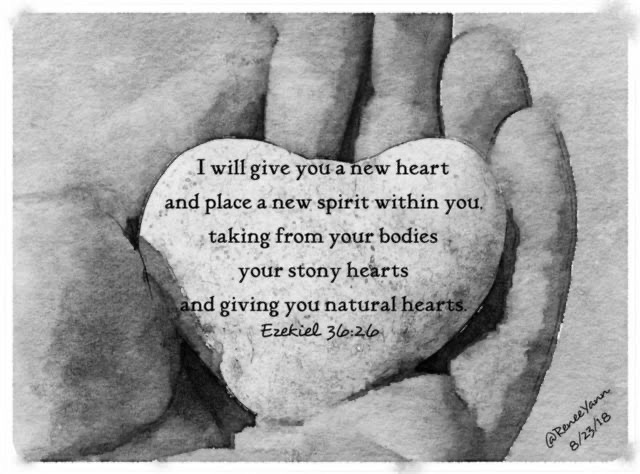
I will give you a new heart and place a new spirit within you,
taking from your bodies your stony hearts
and giving you natural hearts.
I will put my spirit within you and make you live by my statutes,
careful to observe my decrees.

Ezekiel’s God is fed up with Israel’s sinfulness and decides to “make them live by my statutes”. According to Ezekiel, this rejuvenation is done for God’s sake, not Israel’s.

Thus says the LORD:
I will prove the holiness of my great name, 
profaned among the nations, 
in whose midst you have profaned it.
Thus the nations shall know that I am the LORD, says the Lord GOD,
when in their sight I prove my holiness through you.


The king in our Gospel gets pretty fed up too with people rejecting his invitation to the wedding. When his recalcitrant invitees killed his servants, the king blew a gasket. He even took a snap on the poor schlep who showed up in business-casual attire!

No Wedding Garment

How are we to interpret these dramatic
(and kinda mean)
images of God and of God’s
invitation to the Kingdom? 

As when praying with all scripture passages, we must receive them in light of the circumstances and culture in which they were written. Our prayer, rooted in our own relationship with God, will allow us to peel away the cultural layers to discover the unchanging message which pertains to us.

What I found in today’s passages are these thoughts:

  • God loves us so much and would do anything to hold us in faithful relationship 
  • If our spiritual life had died, or is on life support, God will do a heart transplant if we repent and open ourselves to grace.
  • We are all invited to eternal life with God, but we can get so distracted by our entanglements that we miss or ignore the invitation.
  • Turn down the noise in your life so that you can hear God’s ringtone on your heart.
  • It matters how we respond to this amazing invitation. We need to put on our best “clothes” – our best selves – so that we can fully welcome God’s life.

Poetry and Music: Here’s a simple but delightful representation of today’s Gospel. Enjoy it, friends.

Alleluia: Good Shepherd

Wednesday of the Twentieth Week in Ordinary Time
August 17, 2022

Today’s Readings:

https://bible.usccb.org/bible/readings/081722.cfm

Alleluia, alleluia.
The word of God is
living and effective,
able to discern the reflections
and thoughts of the heart.

Today, in God’s Lavish Mercy, Ezekiel gets another tough assignment from God:

The word of the Lord came to me:
Son of man, prophesy against the shepherds of Israel,
in these words prophesy to them to the shepherds:
Thus says the Lord GOD: Woe to the shepherds of Israel
who have been pasturing themselves!
Should not shepherds, rather, pasture sheep?

Ezekiel 34: 1-2

With prophetic insight, Ezekiel understands that Israel’s corrupt leaders will cause its downfall. He takes on the unhappy responsibility of summoning them – and the people – to repentance and conversion of heart.

By comparing Israel’s kings and princes to shepherds, Ezekiel points out how their leadership is a perversion of the ministry to which they have been called. He tells them that God won’t put up with their malfeasance because God has a tenderness for the “sheep” – particularly the struggling ones.

Thus says the Lord GOD:
I swear I am coming against these shepherds.
I will claim my sheep from them
and put a stop to their shepherding my sheep
so that they may no longer pasture themselves.
I will save my sheep, 
that they may no longer be food for their mouths.

For thus says the Lord GOD: 
I myself will look after and tend my sheep.

Ezekiel 34: 10-11

The parallels to our present world are so stark that it’s difficult not to launch into political opining here! But I choose not to because the call within these readings goes much deeper than even current global circumstances.

And it is the call embodied in our Alleluia Verse:

Alleluia, alleluia.
The word of God is living and effective,
able to discern the reflections and thoughts of the heart.

Each one of us is created to live in the sincere light of God’s Word; to discern our relationships within Creation through the ‘living and effective” lens offered to us through our Baptism.

Whether we are leader or follower, these relationships must be built on reverence, honesty, justice, peace and mercy. Only then can we forestall the corporate corruptions that fester in the absence of grace.

The promissory nature of Ezekiel’s oracles articulates what good leadership looks like…in government, in corporations, all through the private sector. That rule consists in:
– Seeking the lost
– Bringing back the strayed
– Binding up the injured
– Strengthening the weak
– Feeding the hungry
In a word, good leadership consists in the restoration of the common good so that all members of the community, strong and weak, rich and poor, may live together in a common shalom of shared resources.

Walter Brueggemann, On Ezekiel 34

In our Gospel, the landowner refuses to be bound by corporate definitions regarding how he treats his laborers. He chooses to be generous, no doubt realizing the laborers’ underlying need for a decent day’s pay. Doing so, the landowner mirrors God whose generosity has granted the landowner life and livelihood.


As we pray today, let’s consider where we serve a leaders, and who depends on our sincere and generous heart for their subsistence. Some of these relationships might be obvious to us – such as the children in our lives, and others whom we support by our presence, care and love.

But others may not be so obvious. There may be others who need us to recognize that they’re waiting to be noticed and invited just like the late laborers of today’s Gospel. Is our world, and our generosity, big enough to include them?


Poetry: Shepherd – Rumi

Be a lamp, 
or a lifeboat, 
or a ladder. 
Help someone’s soul heal. 

Walk out of your house 
like a shepherd.

Music: The Lonely Shepherd – Zamfir

Alleluia: Green Grapes!

Saturday of the Nineteenth Week in Ordinary Time
August 13, 2022

Today’s Readings:

https://bible.usccb.org/bible/readings/081322.cfm

Today, in God’s Lavish Mercy, the core of our readings is about innocence and authenticity. But you have to dig a little to get to that. Maybe, like me, you finished  our first reading asking, “So what’s with the green grapes!?”

A common expression in ancient Israel suggested that people’s bad luck was a punishment for their parent’s sins. It was a handy way of avoiding responsibility for one’s own foolish actions, often the actual source of one’s misfortune.

Ezekiel uses the expression to teach a lesson about the nature of God’s love and forgiveness. God loves us completely – without prejudice, without vengeance. There is no record of faults to “set our teeth on edge”. There are no “green grapes” on God’s table. God only wants our wholeness.

Therefore I will judge you, house of Israel,
each one according to their own ways, says the Lord GOD.
Turn and be converted from all your crimes,
that they may be no cause of guilt for you.
Cast away from you all the crimes you have committed,
and make for yourselves a new heart and a new spirit.


God will not let us hide behind excuses like a bogus “Green Grapes Theory”. As in any loving relationship, we must be honest with God, own our faults, seek forgiveness, and love ardently.

Jesus uses the example of a little child to show us how to do this. Each one of us is born with a core of innocence and authenticity. These are the attributes of God’s life in us. Throughout our lives there are times when we hide these blessings under our sinfulness. Some people bury them so deep that they lose touch with their own sacred integrity.

Jesus calls us back out of our excuses and our excesses, just as the Lord called Ezekiel’s community. We are invited to an eternal covenant rooted in the gift of divine innocence and authenticity given to us at our creation.

Jesus said:
Let the children come to me,
and do not prevent them;
for the Kingdom of heaven
belongs to such as these.

Poetry: The Pursuit – Henry Vaughn

LORD ! what a busy, restless thing
Hast Thou made man !
Each day and hour he is on wing,
Rests not a span ;
Then having lost the sun and light,
By clouds surpris’d,
He keeps a commerce in the night
With air disguis’d.
Hadst Thou given to this active dust
A state untir’d,
The lost son had not left the husk,
Nor home desir’d.
That was Thy secret, and it is
Thy mercy too ;
For when all fails to bring to bliss,
Then this must do.
Ah, Lord ! and what a purchase will that be,
To take us sick, that sound would not take Thee !

Music: Tender Hearted – Jeanne Cotter