At Once, He Believed!

Feast of Saint Andrew, Apostle
November 29, 2022

Today’s Readings

https://bible.usccb.org/bible/readings/113022.cfm

Rom 10_17 Andrew

Today, in God’s Lavish Mercy, we celebrate the Feast of St. Andrew, the brother of Peter, also a fisherman, a beloved Apostle and friend of Jesus.

Our Gospel tells the story of Andrew’s call. The spontaneity of Andrew and Peter’s response to Jesus is stunning and deeply inspiring!

As Jesus was walking by the Sea of Galilee, he saw two brothers,
Simon who is called Peter, and his brother Andrew,
casting a net into the sea; they were fishermen.
He said to them,
“Come after me, and I will make you fishers of men.”
At once they left their nets and followed him.

Matthew 4:18-20

Another favorite passage about Andrew is when he points out to Jesus that, in the famished crowd, there is a young boy with five loaves and two fish.

When Jesus looked up and saw a great crowd coming toward him, he said to Philip,
 “Where shall we buy bread for these people to eat?” 
He asked this only to test him, for he already had in mind what he was going to do.

Philip answered him, “It would take more than half a year’s wages
to buy enough bread for each one to have a bite!”
Another of his disciples, Andrew, Simon Peter’s brother, spoke up, 
 “Here is a boy with five small barley loaves and two small fish,
but how far will they go among so many?”

Jesus said, “Have the people sit down.” 

John 6: 5-10

How simple and complete was Andrew’s faith! Those seven little items must have seemed so minute among 5000. Can you picture Andrew looking into Jesus’s eyes as if to say, “I know it’s not much but you can do anything!” Maybe it was that one devoted look which prompted Jesus to perform this amazing miracle!


We trust that our deep devotion and faith can move God’s heart too. On this feast of St. Andrew, many people begin a prayer which carries them through to Christmas. Praying it, we ask for particular favors from God.

I love this prayer because it was taught to me by my mother, a woman blessed with simple faith like Andrew’s. As I recite it, I ask to be gifted with the same kind of faith.

( Another reason I love it is this: how often in life do you get a chance to say a word like “vouchsafe“! )

St. Andrew Christmas Novena
Hail and blessed be the hour and moment
in which the Son of God was born

of the most pure Virgin Mary,
at midnight, in Bethlehem, in the piercing cold.
In that hour vouchsafe, I beseech Thee, O my God,
to hear my prayer and grant my desires
through the merits of Our Savior Jesus Christ,
and of His blessed Mother. Amen.


Like the hungry five thousand.
our hurting world needs sustenance and healing.
Let’s fold our Advent prayers around its many wounds,
asking God for miracles
with a simple faith like Andrew’s.

Poetry: St. Andrew’s Day – John Keble

In this thought-provoking poem, the poet uses Andrew’s and Peter’s relationship to reflect on the meaning of being true brothers (and of course SISTERS).

When brothers part for manhood's race,
What gift may most endearing prove
To keep fond memory its her place,
And certify a brother's love?
'Tis true, bright hours together told,
And blissful dreams in secret shared,
Serene or solemn, gay or bold,
Shall last in fancy unimpaired.
E'en round the death-bed of the good
Such dear remembrances will hover,
And haunt us with no vexing mood
When all the cares of earth are over.

But yet our craving spirits feel,
We shall live on, though Fancy die,
And seek a surer pledge-a seal
Of love to last eternally.
Who art thou, that wouldst grave thy name
Thus deeply in a brother's heart?
Look on this saint, and learn to frame
Thy love-charm with true Christian art.
First seek thy Saviour out, and dwell
Beneath this shadow of His roof,
Till thou have scanned His features well,
And known Him for the Christ by proof;
Such proof as they are sure to find
Who spend with Him their happy days,
Clean hands, and a self-ruling mind
Ever in tune for love and praise.
Then, potent with the spell of Heaven,
Go, and thine erring brother gain,
Entice him home to be forgiven,
Till he, too, see his Savior plain..
Or, if before thee in the race,
Urge him with thine advancing tread,
Till, like twin stars, with even pace,
Each lucid course be duly aped.
No fading frail memorial give
To soothe his soul when thou art gone,
But wreaths of hope for aye to live,
And thoughts of good together done.
That so, before the judgment-seat,
Though changed and glorified each face,
Not unremembered ye may meet
For endless ages to embrace.

Music:  Hear my prayer, O Lord is an eight-part choral anthem by the English composer Henry Purcell (1659–1695). The anthem is a setting of the first verse of Psalm 102 in the version of the Book of Common Prayer. Purcell composed it c. 1682 at the beginning of his tenure as Organist and Master of the Choristers for Westminster Abbey.

Imagine!

Monday of the First Week of Advent
November 28, 2022

Today’s Readings:

https://bible.usccb.org/bible/readings/112822.cfm

Today, in God’s Lavish Mercy, Isaiah teaches us how to imagine with the power of faith.

We’ve probably all done this, at least in small ways. It’s a mechanism for getting through some of the tougher spots in our lives. For example, when I have an unpleasant dental procedure, I calm myself by imagining the pizza I will pick up on the way home. I even envision a specific time when the procedure will be over and I’ll be in line at the pizzeria.


Isaiah is coaching us in the same coping mechanisms, but on a much grander scale. 

On that day,
The branch of the LORD will be luster and glory,
and the fruit of the earth will be honor and splendor
for the survivors of Israel.
He who remains in Zion
and he who is left in Jerusalem
Will be called holy:
every one marked down for life in Jerusalem.

During his lifetime, Isaiah lived in a war torn land where the poor and the vulnerable were particularly threatened. These daily anxieties challenged their faith and eroded their confidence in God. Their intent to build and participate in a faithful community suffered because they could not see beyond their pain.

Isaiah tells them that a better day is coming. He invites Israel to stretch their faith, to trust in God’s promise, and to believe that God abides with them and will deliver them to glory.

Then will the LORD create,
over the whole site of Mount Zion
and over her place of assembly,
A smoking cloud by day
and a light of flaming fire by night.
For over all, the LORD’s glory will be shelter and protection:
shade from the parching heat of day,
refuge and cover from storm and rain.


Isaiah is asking a lot of these bereft people. It is really hard to live in the Light when there is nothing around you but darkness. But it is possible to do so by the power of faith.


In our Gospel, Jesus meets a man who has that kind of powerful faith. When Jesus offers to come cure the man’s paralyzed servant, the man says there is no need to come. He already trusts that God is with that servant and will bring him to wholeness.

Hearing the man, Jesus was amazed and said to those following him,
“Amen, I say to you, in no one in Israel have I found such faith. 
I say to you, many will come from the east and the west,
and will recline with Abraham, Isaac, and Jacob
at the banquet in the Kingdom of heaven.”

Wow! Wouldn’t it be great to amaze Jesus with our faith!

Indeed, as we pray today, Isaiah and Jesus may be asking us for the same kind of faith. There is a lot of pain and darkness in the larger world we share, and in many of our individual worlds. As we make our Advent journey, God asks us to live in a way that does not ignore the gloom, but still sees through it to trust the Light – a faith that proclaims God is already with us, bringing us to wholeness.


Come and save us, LORD our God;
let your face shine upon us, that we may be saved.
R. Alleluia, alleluia.

Poetry: To Imagination – Emily Brontë

When weary with the long day's care,
And earthly change from pain to pain,
And lost and ready to despair,
Thy kind voice calls me back again:
Oh, my true friend! I am not lone,
While thou canst speak with such a tone! 

So hopeless is the world without;
The world within I doubly prize;
Thy world, where guile, and hate, and doubt,
And cold suspicion never rise;
Where thou, and I, and Liberty,
Have undisputed sovereignty.

What matters it, that, all around,
Danger, and guilt, and darkness lie,
If but within our bosom's bound
We hold a bright, untroubled sky,
Warm with ten thousand mingled rays
Of suns that know no winter days? 

Reason, indeed, may oft complain
For Nature's sad reality,
And tell the suffering heart, how vain
Its cherished dreams must always be;
And Truth may rudely trample down
The flowers of Fancy, newly-blown: 

But, thou art ever there, to bring
The hovering vision back, and breathe
New glories o'er the blighted spring,
And call a lovelier Life from Death,
And whisper, with a voice divine,
Of real worlds, as bright as thine.

I trust not to thy phantom bliss,
Yet, still, in evening's quiet hour,
With never-failing thankfulness,
I welcome thee, Benignant Power;
Sure solacer of human cares,
And sweeter hope, when hope despairs!

Music: Imagine – John Lennon

Wake up, Beloved!

First Sunday of Advent
November 27, 2022

Today’s Readings:

https://bible.usccb.org/bible/readings/112722.cfm

Today, in God’s Lavish Mercy,we embark once again on an age-old journey — the path through Advent to Christmas. It is a spiritual journey about which we must be intentional because there are so many cultural distractions to waylay us from the path.

Beloved Isaiah, beautiful poet and prophet, stands along the sideline rallying us:

In days to come,
the mountain of the LORD’s house
shall be established as the highest mountain
and raised above the hills.
All nations shall stream toward it;
many peoples shall come and say:
“Come, let us climb the LORD’s mountain,
to the house of the God of Jacob,
that he may instruct us in his ways,
and we may walk in his paths.”
O house of Jacob, come,
let us walk in the light of the Lord!


Isaiah is telling us that it is time to get moving – moving deeper into our relationship with God. 

Like the “House of Jacob”, winding through a long journey, we may forget where we are really going in our lives. We are not going to material, social, or political success. We are not traveling life’s roads in order to end up at a cushy retirement.

Our lives are about moving deeper and deeper into the heart of God — that’s all. If we are not doing that by engaging the grace of our everyday lives, then we are missing the whole point!


Paul trusts that we understand this. He says, “You know the time … wake up!”

You know the time;
it is the hour now for you to awake from sleep.
For our salvation is nearer now than when we first believed;
the night is advanced, the day is at hand.
Let us then throw off the works of darkness
and put on the armor of light…


I have a sleepy friend who loves to linger in her blankets in the morning. When we need to be up and “at ‘em”, I can sound a lot like Paul. “Look at the time!”, “We don’t want to be late!”, “Throw off those blankets of night!”

Friends, the Church gives us the gift of Advent so that we will not be late for the ultimate “God-Party” which is our life’s glorious destination. The potential to reach this “destination” is offered us, not only in some future parousia, but in each moment of our existence by our choice for grace.


In our Gospel, Jesus reiterates the profound importance of our wakeful awareness of God’s Presence in our lives.

For you do not know on which day your Lord will come. 
Be sure of this: if the master of the house
had known the hour of night when the thief was coming,
he would have stayed awake
and not let his house be broken into.
So too, you also must be prepared,
for at an hour you do not expect, the Son of Man will come.


So, let the journey begin! Begin today to receive every moment as an invitation to God’s house — God’s heart. Whether the moment comes in darkness or light, joy or sorrow, God is in it – calling.

May this Advent bless each of us
with deeper understanding of
God’s Love incarnate in our lives.


Poetry: Advent Calendar – Rowan Williams

He will come like last leaf’s fall.
One night when the November wind
has flayed the trees to bone, and earth
wakes choking on the mould,
the soft shroud’s folding.
He will come like frost.
One morning when the shrinking earth
opens on mist, to find itself
arrested in the net
of alien, sword-set beauty.
He will come like dark.
One evening when the bursting red
December sun draws up the sheet
and penny-masks its eye to yield
the star-snowed fields of sky.
He will come, will come,
will come like crying in the night,
like blood, like breaking,
as the earth writhes to toss him free.
He will come like child.

Music: wake – TuneCore

Love’s Crown

The Solemnity of Our Lord Jesus Christ, King of the Universe
Sunday, November 20, 2022

Today’s Readings:

https://bible.usccb.org/bible/readings/112022.cfm

Today, in God’s Lavish Mercy, we celebrate the Solemnity of Christ the King. This feast was established in 1925 by Pope Pius XI by his encyclical Quas Primas. The Pope was acutely aware of the secularization of society and culture. He wanted this feast and devotion to bring people a deep awareness that Christ is the center of all Creation.

The images, language and metaphors surrounding the feast are ones that spoke to the people in the early 20th century. They may ring differently to us. Concepts of king”, “empire”, “dominion”, “subjection” tend to engender negative connotations for many of us. But our readings today can direct us to a deeper understanding of the characteristics Pius sought to highlight, ones that may speak more clearly to us in our time.


Our first reading from Samuel presents the anointing of David as King of Israel. Anointed by those who were “his own bone and flesh”, David prefigured the Incarnate Christ who, by the power of the Holy Spirit, took our flesh to redeem us.


Col1_15 image

The magnificent passage from Colossians offers exultant praise to the Creator for 

…delivering us from the power of darkness
and transferring us to the kingdom of the beloved Son,
in whom we have redemption …


And our Gospel gives us our precious Jesus on the Cross, teaching us the paradoxical truth of what his “Kingdom” really means – not oppressive dominion, but rather a sacrificial love that gives everything for the life of the beloved.

van eyck
Van Eyck’s painting of Christ King and his follower Petrus Christus’s Christ Suffering (15th C.)

Many cannot recognize such “kingship”. They cannot see the holy power within Christ’s sacrifice. They are, as Pius XI recognized for his time, blinded by a secularized culture and a dispirited life.

Let us pray today with the “justly condemned”, but spiritually enlightened, man in our Gospel who asked his Crucified King,

“Lord Jesus,
remember me
when you come into Kingdom!”


Poetry: As Kingfishers Catch Fire – Gerard Manley Hopkins

As kingfishers catch fire, dragonflies draw flame; 
As tumbled over rim in roundy wells 
Stones ring; like each tucked string tells, each hung bell's 
Bow swung finds tongue to fling out broad its name; 
Each mortal thing does one thing and the same: 
Deals out that being indoors each one dwells; 
Selves — goes itself; myself it speaks and spells, 
Crying Whát I dó is me: for that I came. 

I say móre: the just man justices; 
Keeps grace: thát keeps all his goings graces; 
Acts in God's eye what in God's eye he is — 
Chríst — for Christ plays in ten thousand places, 
Lovely in limbs, and lovely in eyes not his 
To the Father through the features of men's faces. 

Music: Jesus Remember Me

 Renee Yann, RSM

A Dance of Praise

Memorial of St. Elizabeth of Hungary
November 17, 2022

Today’s Readings:

https://bible.usccb.org/bible/readings/111722.cfm

Today, in God’s Lavish Mercy, we pray with Psalm 149 which calls the community to sing and dance because God has delivered them.

This happy, celebratory summons is set, contrastingly, between two readings that mention weeping.

Then I saw a mighty angel who proclaimed in a loud voice,
“Who is worthy to open the scroll and break its seals?”
But no one in heaven or on earth or under the earth
was able to open the scroll or to examine it.
I shed many tears because no one was found worthy
to open the scroll or to examine it.

Revelation 5: 2-4

As Jesus drew near Jerusalem,
he saw the city and wept over it, saying,
“If this day you only knew what makes for peace–
but now it is hidden from your eyes.

Luke 19: 41-42

The readings leave us with a sense that there is a secret to eternal life –
a secret to which only grace can open our eyes and hearts.


John writes that “the Lion of Judah” has the key:

One of the elders said to me, “Do not weep.
The lion of the tribe of Judah, the root of David, has triumphed,
enabling him to open the scroll with its seven seals.”

Revelation 5: 5-6

Jesus, Uncreated Grace, is the Lion of Judah. He has incarnated the sacred key in his Life, Death, and Resurrection. For those who receive him and share his life, the door is opened, the scroll unrolled.

So what is the path to such union with Jesus? 


Our psalm contains a brief line tucked at its center which foreshadows the entire message of the Gospel. 

Let them praise God’s name in the festive dance,
let them sing praise with timbrel and harp.
For the LORD loves us,
and adorns the lowly with victory.

We will find a dancing, singing joy when we give ourselves to these truths:

  • God loves us irrevocably
  • We can fully receive this great love to the degree that we become like Christ whose image we find among the poor, lowly, and suffering.

Poetry: Dance from Rumi

Come to me, and I shall dance with you
In the temples, on the beaches, through the crowded streets
Be you man or woman, plant or animal, slave or free
I shall show you the brilliant crystal fires, shining within
I shall show you the beauty deep within your soul
I shall show the path beyond Heaven.
Only dance, and your illusions will blow in the wind
Dance, and make joyous the love around you
Dance, and your veils which hide the Light
Shall swirl in a heap at your feet.

Music:  Psalm 149 – Antonín Dvořák

Our Splendid God

Wednesday of the Thirty-third Week in Ordinary Time
November 16, 2022

Today’s Readings:

https://bible.usccb.org/bible/readings/111622.cfm

Today, in God’s Lavish Mercy, we move deeper into the final weeks of Ordinary Time. Our readings continue to offer us images about what it will be like at the end of time.  

In our passage from Revelation, we are given an ornate and exuberant description of how the author envisions God’s “headquarters”, so to speak. With all its gems and thrones and crowns and flaming torches, the passage can be a little overwhelming. But what is the core message? I think it is this:

God is the Splendid Creator. Despite time’s destruction, Creation will be ultimately perfected by our Perfect God. Believing this, we are called to awe-filled worship and gratitude, as spoken in these two verses from the passage:

“Holy, holy, holy is the Lord God almighty,
who was, and who is, and who is to come.”

Revelation 4:8

“Worthy are you, Lord our God,
to receive glory and honor and power,
for you created all things;
because of your will they came to be and were created.”

Revelation 4:11

Today’s Gospel about the talents reminds us that we each have been given particular gifts with which to build up God’s Creation. Like the watchful Master, God expects – and needs – us to use these gifts, and to increase their value by sharing them with our sisters and brothers.

Sometimes we think we have no real gifts to give. But the witness of a simple, faithful, generous life is beyond price.

We may want to spend some prayer time reflecting on the many gifts we have been given – by God and by those who love us, and how we might offer these in worship to our Splendid Generous God.


Poetry: Advice to a ProphetRichard Wilbur (1921 – 2017) was an American poet and literary translator. One of the foremost poets of his generation, Wilbur’s work, composed primarily in traditional forms, was marked by its wit, charm, and gentlemanly elegance. He was appointed the second Poet Laureate Consultant in Poetry to the Library of Congress in 1987 and received the Pulitzer Prize for Poetry twice, in 1957 and 1989.

In Wilbur’s poem, we get a different vision of what the end of times might be like, and how we might respond to the prophet who describes such times.

When you come, as you soon must, to the streets of our city,
Mad-eyed from stating the obvious,
Not proclaiming our fall but begging us
In God's name to have self-pity,

Spare us all word of the weapons, their force and range,
The long numbers that rocket the mind;
Our slow, unreckoning hearts will be left behind,
Unable to fear what is too strange.

Nor shall you scare us with talk of the death of the race.
How should we dream of this place without us?—
The sun mere fire, the leaves untroubled about us,
A stone look on the stone's face?

Speak of the world's own change. Though we cannot conceive
Of an undreamt thing, we know to our cost
How the dreamt cloud crumbles, the vines are blackened by frost,
How the view alters.  We could believe,

If you told us so, that the white-tailed deer will slip
Into perfect shade, grown perfectly shy,
The lark avoid the reaches of our eye,
The jack-pine lose its knuckled grip

On the cold ledge, and every torrent burn
As Xanthus once, its gliding trout
Stunned in a twinkling.  What should we be without
The dolphin's arc, the dove's return, 

These things in which we have seen ourselves and spoken?
Ask us, prophet, how we shall call
Our natures forth when that live tongue is all
Dispelled, that glass obscured or broken

In which we have said the rose of our love and the clean
Horse of our courage, in which beheld
The singing locust of the soul unshelled,
And all we mean or wish to mean.

Ask us, ask us whether with the worldless rose
Our hearts shall fail us; come demanding
Whether there shall be lofty or long standing
When the bronze annals of the oak-tree close.

Music: We Have Gifts to Share – Susan Kay Wyatts – This is a childlike song, but the point is profound. For those with young children and Grands, you might like to share this song with them.

The Divine Adventure

Monday of the Thirty-third Week in Ordinary Time
November 14, 2022

Today’s Readings:

https://bible.usccb.org/bible/readings/111422.cfm

Today, in God’s Lavish Mercy, we earnestly begin the Book of Revelation. These twelve days of passages will close out the liturgical year before Advent.

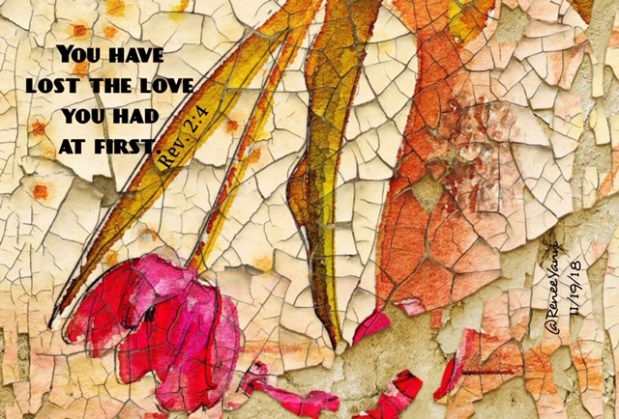
Rev 2_4 first love

The Book of Revelation, also commonly known as the Apocalypse, is one of the most controversial in the Bible. Scholars disagree as to its author, its meaning, its literary genre and even its place in the biblical canon.

Wherever we might fall in this spectrum of interpretations, the book still can inspire us to prayer and reflection.

In today’s passage, the author addresses the first of seven churches to whom he will write – the church at Ephesus. He praises them and says that God is pleased with their work, their endurance and their fidelity. That must have made them feel pretty good, right?

But then, the heart-breaking line:

Yet I hold this against you:
you have lost the love you had at first.

We might easily find ourselves in this passage. We’re trying hard to be faithful Christians. But, depending on where we are in our lives, have we lost that first fervor?

The continual grind of work, ministry, family and community responsibility can dim that first fire. Maybe the fresh flower has been choked in the daily weeds. Just the accumulation of years may obscure it. Just the unnoticed indifference within and around us can smother the love that once propelled us to choose God as our Everything.


Perhaps with the blind person in our Gospel, we might beg God to let us see where our faith has become dim or even blinded:

The people walking in front rebuked the blind man,
telling him to be silent,
but he kept calling out all the more,
“Son of David, have pity on me!”
Then Jesus stopped and ordered that he be brought to him;
and when he came near, Jesus asked him,
“What do you want me to do for you?”
He replied, “Lord, please let me see.”
Jesus told him, “Have sight; your faith has saved you.”

Luke 18:39-42

Today, let’s try to remember that first love which turned our hearts to God and to God’s work in the world. Let’s ask our generous God, Who longs for our love, to renew our passion and energy for the Divine Adventure.


Poetry: Consumed in Grace – Catherine of Siena

This poem is from a wonderful book which I highly recommend to you:

I first saw God when I was a child, six years of age.
The cheeks of the sun were pale before Him,
and the earth acted as a shy
girl, like me. 

Divine light entered my heart from His love
that did never fully wane, 

though indeed, dear, I can understand how a person’s
faith can at times flicker, 

for what is the mind to do
with something that becomes the mind’s ruin:
a God that consumes us
in His grace.

I have seen what you want;
it is there,
a Beloved of infinite
tenderness.

Music: Power of Your Love – Hillsongs

 Renee Yann, RSM  Disciples

Invisible Presence

Memorial of St. Leo the Great
November 10, 2022

https://bible.usccb.org/bible/readings/111022.cfm

Today, in God’s Lavish Mercy, Jesus tells us a secret about the Kingdom of God:

“The coming of the Kingdom of God
cannot be observed,
and no one will announce,
‘Look, here it is,’ or, ‘There it is.’
For behold, the Kingdom of God
is among you.”

And it remains a bit of a secret, even after He tells it, because it is often very hard to discern the “Kingdom among us”. There is nothing more invisible than something hiding in plain sight.

Lk17_21JPG

Through prayer, we discover that it is about our eyes – not about visibility. It is about the power of grace within us to see beyond appearances. We need a soul that can “peel the onion” of experience to find the face of God resident within all things.

  • With that kind of eyes, you don’t just have a business meeting today.
    You have an opportunity to build God’s Kingdom through respect, encouragement and mutuality.
  • You don’t just pass a person begging on the corner.
    You walk near Christ himself accompanying a broken spirit.
  • You don’t just encounter the hurts and challenges of your life.
    You are invited by God into a living faith that finds God’s will in all things.
  • You don’t live in the world with just other creatures.
    You meet and honor the Divine Presence in every living thing.

Indeed, the Kingdom of God is right here among us.

May we see it!
May we treasure it!
May we reveal it!


Photo by Johannes Plenio on Pexels.com

Poetry: In No Strange Land – Francis Thompson

O world invisible, we view thee,
O world intangible, we touch thee,
O world unknowable, we know thee,
Inapprehensible, we clutch thee!

Does the fish soar to find the ocean,
The eagle plunge to find the air—
That we ask of the stars in motion
If they have rumour of thee there?

Not where the wheeling systems darken,
And our benumbed conceiving soars!—
The drift of pinions, would we hearken,
Beats at our own clay-shuttered doors.

The angels keep their ancient places;—
Turn but a stone and start a wing!
’Tis ye, ’tis your estrangèd faces,
That miss the many-splendoured thing.

But (when so sad thou canst not sadder)
Cry;—and upon thy so sore loss
Shall shine the traffic of Jacob’s ladder
Pitched betwixt Heaven and Charing Cross.

Yea, in the night, my Soul, my daughter,
Cry,—clinging to Heaven by the hems;
And lo, Christ walking on the water,
Not of Genesareth, but Thames!


Music:  Let Your Kingdom Come – Tommy Walker

The Light

Tuesday of the Thirty-second Week in Ordinary Time
November 8, 2022

Today’s Readings:

https://bible.usccb.org/bible/readings/110822.cfm

Today, in God’s Lavish Mercy, our readings carry a few strident tones. 

The description of the perfect Christian household in Paul’s world feels a little uncomfortable for us in today’s culture:

Similarly, older women should be reverent in their behavior,
not slanderers, not addicted to drink,
teaching what is good, so that they may train younger women
to love their husbands and children,
to be self-controlled, chaste, good homemakers,
under the control of their husbands,
so that the word of God may not be discredited.

We understand what Paul was driving at – harmonious, loving and faith-filled families that would nurture the growing Church. But times, attitudes, and understandings change, and the words don’t work so well today.


Our Gospel presents a bit of the same discomfort. It’s hard for us to relate to servanthood, slavery, and unequal accessibility to “the table”.

Jesus said to the Apostles:
“Who among you would say to your servant
who has just come in from plowing or tending sheep in the field,
‘Come here immediately and take your place at table’?
Would he not rather say to him,
‘Prepare something for me to eat.
Put on your apron and wait on me while I eat and drink.
You may eat and drink when I am finished’?


Sometimes the “dissonance” of words or cultural concepts in ancient scriptures might cause us too miss the point. Here’s what I found once I cracked through these passages in my prayer.

  • From Titus:

A deep self-respect and
a reverent mutuality in our relationships
allow God’s Presence to be felt in the world.
They are the signs that draw others to grace.

  • From Luke:

We don’t “deserve” anything from God.
All that God gives us is given
in lavish mercy and infinite generosity.
Everything we are and have is GIFT.
Therefore we are bound in gratitude
to live in love and worship,
and to work for the wholeness of all Creation.


Poetry and Music:

Enjoy the poetry of the mystic Rumi, words very much in the tone of John of Cross.

A God-aligned Heart

Thirty-second Sunday in Ordinary Time
November 6, 2022

Today’s Readings

https://bible.usccb.org/bible/readings/110622.cfm

Today, in God’s Lavish Mercy, one theme threaded through our readings is that of “The Law”.

“Law” is a frustratingly elastic word and concept which runs the gamut from tyranny to benevolent guidance depending on who administers it.

2thess3_5 scale

In both our first reading and our Gospel, we find people trying to curtail the freedom of others by invoking the Law. In 2 Maccabees, King Antiochus attempts to incorporate the Jewish people by fracturing their religious practice, that which identifies and unites them as Jews. On the surface, the story seems to be about eating pork, and one might wonder if that resistance is worth dying for.

But the real conflict is between tyrannical domination and spiritual freedom, between “Empire” and “Kingdom” – a struggle we have seen endlessly repeated through history and current events.

When “law” is interpreted to advantage some and suppress others, it is no longer law. The essence of law is always the wise administration of mercy balanced with justice. The understanding of such law grows from covenanted relationship with the Creator who wills the good and wholeness of all Creatures.


In today’s Gospel, some Sadducees (perhaps sincere, but more likely trying to trap Jesus) ask him to solve a hypothetical problem regarding marriage in the afterlife.

Jesus doesn’t bite. He explains to the questioners that eternal life transcends all their human perceptions of time, relationship and law. The earthly laws by which we either bind or free one another in this world evaporate in Heaven. Only Mercy and Justice order eternal life in the Kingdom of God. ultimately, “law” is alignment of heart with God’s.


Paul tells us that we are called to be examples of that eternal kingdom now. He knows how hard it is, and so he blesses us:

May our Lord Jesus Christ himself and God our Father,
who has loved us and given us everlasting encouragement
and good hope through his grace,
encourage your hearts and strengthen them in every good deed
and word.


May God’s law of love align our hearts
so that we
– like the Maccabees, like Jesus –
will have the courage and strength to live it
in a sometimes hostile world.


Poetry: The Higher Pantheism – Alfred, Lord Tennyson

The sun, the moon, the stars, the seas, the hills and the plains,- 
Are not these, O Soul, the Vision of Him who reigns?
 
Is not the Vision He, tho’ He be not that which He seems? 
Dreams are true while they last, and do we not live in dreams? 

Earth, these solid stars, this weight of body and limb, 
Are they not sign and symbol of thy division from Him? 

Dark is the world to thee; thyself art the reason why, 
For is He not all but thou, that hast power to feel “I am I”? 

Glory about thee, without thee; and thou fulfillest thy doom, 
Making Him broken gleams and a stifled splendour and gloom. 

Speak to Him, thou, for He hears, and Spirit with Spirit can meet- 
Closer is He than breathing, and nearer than hands and feet. 

God is law, say the wise; O soul, and let us rejoice, 
For if He thunder by law the thunder is yet His voice. 

Law is God, say some; no God at all, says the fool, 
For all we have power to see is a straight staff bent in a pool; 

And the ear of man cannot hear, and the eye of man cannot see; 
But if we could see and hear, this Vision-were it not He? 


Music: The Law of the Lord is Perfect