Today, in God’s Lavish Mercy, our readings are about prophets and miracles, brought to us by Elisha and Jesus.
The core of the readings is this: some of us want the prophets’ miracles, but we don’t want their challenge to live in God’s freedom. We want their cures, only to return to lifestyles that make us spiritually sick or imprisoned.
Wanting to write about these themes, I decided to check with my favorite Old Testament scholar, Walter Brueggemann to see if he had any wisdom on the story of Naaman.
Naaman brings his retinue and gifts… from The Pictorial History of Palestine and the Holy Land (1844) by John Kitto
Well, Walter certainly did…. something so good and wise that I won’t water it down with my own words. The link is below. It’s a little long, but so worth your reading and meditation. I hope you’ll take the time.
Today, in God’s Lavish Mercy, there is a great sadness in our readings.
The poignant opening line from Genesis immediately strikes us:
Israel loved Joseph best of all his sons, for he was the child of his old age. Genesis 37:3
We picture young Joseph in his beautiful rainbow coat and, under an olive tree’s shade, old Jacob(Israel) proudly, tenderly, watching him play.
As the story ensues to reveal the later betrayal of Joseph’s jealous brothers, we are left astounded. Such treachery, especially among brothers, sickens the heart.
Our Gospel picks up the sad theme because Joseph and his brothers are archetypes of Christ’s story with humankind.
The Wicked Husbandman by John Everett Millais shows the owner’s murdered son
Jesus tells a parable in which he is actually the unnamed main character. He is the Son sent by a loving Father. He is the one rejected, beaten and killed by the treacherous tenants of his Father’s garden.
We know from our familiarity with Scripture that both these stories ultimately come to glorious conclusions. But today’s readings do not take us there. They leave us standing, mouths dropped open, at the dense meanness of the human heart, at the soul’s imperviousness to grace, at the profound sadness Jesus felt at this point in his ministry.
In our prayer today, let’s just be with Jesus, sharing his sadness for the meanness still poisoning our world. We might pray today for Jesus suffering in the Ukrainian people and throughout the many war-infested parts of our world.
May our prayers comfort Jesus with our desire to be open to God’s Grace and Mercy. May they lead us to actions of peace and justice on behalf of our suffering sisters and brother.
Poetry: Despised and Rejected – Christina Rossetti
My sun has set, I dwell In darkness as a dead man out of sight; And none remains, not one, that I should tell To him mine evil plight This bitter night. I will make fast my door That hollow friends may trouble me no more.
“Friend, open to Me.”–Who is this that calls? Nay, I am deaf as are my walls: Cease crying, for I will not hear Thy cry of hope or fear. Others were dear, Others forsook me: what art thou indeed That I should heed Thy lamentable need? Hungry should feed, Or stranger lodge thee here?
“Friend, My Feet bleed. Open thy door to Me and comfort Me.” I will not open, trouble me no more. Go on thy way footsore, I will not rise and open unto thee.
“Then is it nothing to thee? Open, see Who stands to plead with thee. Open, lest I should pass thee by, and thou One day entreat My Face And howl for grace, And I be deaf as thou art now. Open to Me.”
Then I cried out upon him: Cease, Leave me in peace: Fear not that I should crave Aught thou mayst have. Leave me in peace, yea trouble me no more, Lest I arise and chase thee from my door. What, shall I not be let Alone, that thou dost vex me yet?
But all night long that voice spake urgently: “Open to Me.” Still harping in mine ears: “Rise, let Me in.” Pleading with tears: “Open to Me that I may come to thee.” While the dew dropped, while the dark hours were cold: “My Feet bleed, see My Face, See My Hands bleed that bring thee grace, My Heart doth bleed for thee, Open to Me.”
So till the break of day: Then died away That voice, in silence as of sorrow; Then footsteps echoing like a sigh Passed me by, Lingering footsteps slow to pass. On the morrow I saw upon the grass Each footprint marked in blood, and on my door The mark of blood forevermore.
Music: Handel: Messiah – He was despised and rejected – sung by Jakub Józef Orliński
“He was despised and rejected of men; a man of sorrows, and acquainted with grief. (Isaiah 53, v.3) “He gave his back to the smiters, and his cheeks to them that plucked off the hair: he hid not his face from shame and spitting.” (Isaiah 50, v.6)
Today, in God’s Lavish Mercy, we learn a lesson in humble leadership, thanks once again to “Mrs. Zebedee”.
Our Gospel recounts the story of the mother of James and John interceding for her sons with Jesus. Like many overprotective mothers, she intervenes even into their adult lives. She wants to make sure they get the best deal for their investment with Jesus.
Listen, I understand and love her! I would be the same way with my kids if I had any. I often say it’s best I had none because “Overprotective Me” would have had to shadow them to school, dances, playgrounds etc. until they were about 35 years old!
But the point of this Gospel story isn’t Mrs. Zebedee’s overprotectiveness. It has little to do with Mrs. Zebedee at all.
The point is that “Mrs. Zebedee” (like many of us) has missed the whole POINT. The Gospel story is about US and the integrity of our choice to live a life in the pattern of Jesus.
Christ’s disciples have decided to follow a man who says things like this:
The last shall be first and the first, last.
Unless you lay down your life, you cannot follow me.
Whoever takes the lowly position of a child is the greatest in the Kingdom of Heaven.
The seats at Christ’s right and left, which Mrs. Zebedee requests for her sons, will bring them rewards only through humility and sacrificial service.
Here’s the way a 14th century artist imagined the Zebedee family. (Dad looks happy!)
Mary Salome and Zebedee with their Sons James the Greater and John the Evangelist (c.1511) by Hans von Kulmbach, Saint Louis Art Museum
Jesus is gentle with “Mrs. Zebedee”. He understands how hard it is for any of us to comprehend the hidden glory of a deeply Christian life. We are surrounded by a world that screams the opposite to us:
Me first!
Stand your ground!
Good guys finish last!
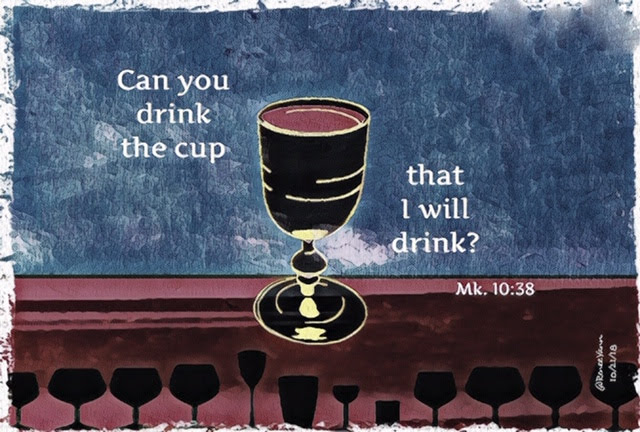
So Jesus turns to James and John (and to us). One can imagine the bemused look on Christ’s face. He knows the hearts of his disciples. He knows they have already given themselves to him. So he asks them for a confession of faith, “Can you drink the cup that I will drink?”
The meeting of Christ with Zebedee’s wife and sons by Paolo Veronese
Their humble, faith-filled answer no doubt stuns their mother. She is left in wonder at the holy men her sons have become. Perhaps it is the beginning of her own deep conversion to Christ.
As we pray with this passage, where do we find ourselves in this scene? How immediate, sincere, and complete is our response to Jesus’ question: “Can you drink the cup….?”
Prose: by Henri J.M. Nouwen, Can You Drink the Cup?
Drinking the cup that Jesus drank is living a life in and with the spirit of Jesus, which is the spirit of unconditional love. The intimacy between Jesus and Abba, his Father, is an intimacy of complete trust, in which there are no power games, no mutually agreed upon promises, no advance guarantees. It is only love —pure, unrestrained, and unlimited love. Completely open, completely free. That intimacy gave Jesus the strength to drink his cup. That same intimacy Jesus wants to give us so that we can drink ours.
Today, in God’s Lavish Mercy, our reading from Daniel gives us one of the Great Prayers of the Old Testament (according to Walter Brueggemann’s like-named book.)
The Book of Daniel and chapter nine in particular, have been the subjects of extensive biblical exegesis. Chapter nine in considered one of the Messianic Prophecies, Old Testament markers pointing to Christ. So there is much we could study about today’s first reading.
But how might we pray with it – for our times and our lives?
Naming the sins of all the People, Daniel’s great prayer is a plea for mercy:
Lord, great and awesome God, you who keep your merciful covenant toward those who love you and observe your commandments! … … yours, O Lord, our God, are compassion and forgiveness!
Three themes, so strikingly germane to Lent, arise from Daniel’s prayer:
Repentance Forgiveness Transformation
Our Responsorial Psalm picks up this plea to Mercy for mercy:
Remember not against us the iniquities of the past; may your compassion quickly come to us, for we are brought very low. R. Lord, do not deal with us according to our sins. Help us, O God our savior, because of the glory of your name; Deliver us and pardon our sins for your name’s sake.
The questions for each of us as we pray today —
Is there someplace in my life longing for such mercy and healing? Where can my spirit grow from repentance, forgiveness, and transformation?
In our Gospel Jesus tells us how to open our hearts to this merciful healing.
Be merciful, just as your Father is merciful. Stop judging and you will not be judged. Stop condemning and you will not be condemned. Forgive and you will be forgiven. Give and gifts will be given to you; a good measure, packed together, shaken down, and overflowing, will be poured into your lap. For the measure with which you measure will in return be measured out to you.
There it is in black and white. Whether or not the advice changes my heart is up to me!
Poetry: To Live in the Mercy of God – Denise Levertov
To lie back under the tallest oldest trees. How far the stems rise, rise before ribs of shelter open!
To live in the mercy of God. The complete sentence too adequate, has no give.
Awe, not comfort. Stone, elbows of stony wood beneath lenient moss bed.
And awe suddenly passing beyond itself. Becomes a form of comfort. Becomes the steady air you glide on, arms stretched like the wings of flying foxes. To hear the multiple silence of trees, the rainy forest depths of their listening.
To float, upheld, as salt water would hold you, once you dared.
.To live in the mercy of God. To feel vibrate the enraptured
waterfall flinging itself unabating down and down to clenched fists of rock. Swiftness of plunge, hour after year after century, O or Ah uninterrupted, voice many-stranded. To breathe spray. The smoke of it. Arcs of steelwhite foam, glissades of fugitive jade barely perceptible. Such passion— rage or joy? Thus, not mild, not temperate, God’s love for the world. Vast flood of mercy flung on resistance.
Music: Kyrie Eleison (Lord, have mercy) Beethoven- Missa Solemnis
Today, in God’s Lavish Mercy, we are invited to be like God:
The LORD said to Moses, “Speak to the whole assembly of the children of Israel and tell them: Be holy, for I, the LORD, your God, am holy.
Leviticus 19:1
Our first reading goes on to tell us how to be a decent person.
Don’t steal, lie, or cheat Pay just wages Respect and help those physically burdened Be impartial and just Defend life Don’t slander, hate, take revenge, or hold a grudge
Basically, the message is about kindness … deep kindness, the type that comes from realizing how infinitely kind God is to us.
Leviticus, after a long list of practical examples, sums it up:
You shall love your neighbor as yourself. I am the LORD.
Leviticus 19:18
Our Gospel tells us what happens when we make the choice to take the Old Testament advice — or not.
We are all familiar with the parable of the sheep and the goats. And we all hope our scorecard gets us into the right herd “When the Son of Man comes in his glory, and all the angels with him …”
In this parable, Jesus puts the advice of Leviticus into practical form for his followers. But he adds one dynamic element that not only invites but impels our wholehearted response:
Amen, I say to you, what you did not do for one of these least ones, you did not do for me.
Matthew 25:40
Leviticus invites us to become holy as God is holy. But Jesus reveals the secret that this Holy God lives in the poor, hungry, homeless, imprisoned and sick. By embracing these most beloved of God, we find the path to holiness.
Poetry: When Did I See You – Renee Yann, RSM
When Did I See You … (Woman Who Is Homeless)
In the bitter rain of February I sat inside a sunlit room, and offered You warm prayer.
Then, she passed outside my window dressed too lightly for the wind, steadied on a cane, though she was young.
She seemed searching for a comfort, unavailable and undefined. The wound of that impossibility
fell over her the way it falls on every tender thing that cries but is not gathered to a caring breast.
Suddenly she was a single anguished seed of You, fallen into all created things.
Gathering my fallen prayer, I wear the thought of her like cracked earth wears fresh rain.
I’ve misconstrued You, Holy One, to whom I spread my heart
as if it were a yearning field… Holy One, already ripe within her barest, leanest yearning.
Today, in God’s Lavish Mercy, our readings confirm that a life patterned on Christ contradicts worldly definitions.
Deuteronomy gives us stark, either-or, advice:
I have set before you life and death, the blessing and the curse. Choose life, then, that you and your descendants may live, by loving the LORD, your God, heeding his voice, and holding fast to him.
Deuteronomy 30: 15-16
It’s definitive advice, but we could probably do these things, right?
Choose life
Love God
Heed God’s voice
Hold fast to God
Sounds OK, doesn’t it?
It’s when Jesus comes along that it begins to sound difficult. Jesus tells us, “Here’s how you choose life:
“Whoever wishes to save his life will lose it, but whoever loses his life for my sake will save it.”
Jesus tells us, “Here’s the God you must love, one who:
“suffers greatly, is rejected, and is killed.”
Jesus tells us, “Here’s what my voice says to you :
“What profit is there for you to gain the whole world yet lose or forfeit yourself?”
Jesus tells us, “Here’s how you hold fast to me:
‘Take up your cross daily and follow me.”
The deep love of the Holy Cross was the sacred gift of Catherine McAuley to her Mercy Family. Let us listen to her counsel.
Some have huge crosses to carry in their lives – war, famine, enslavement, untended illness, homelessness, persecution, poverty. Those who carry such crosses are singularly loved by God who dwells with them.
But if we don’t have big, obvious crosses in our lives – if we are among those the world deems fortunate – how do we follow the crucified Jesus to find our way to eternal life?
How do we really CHOOSE LIFE?
We need to get close to the ones God singularly loves. We need to walk beside them and lift some of their heavy crosses. We need to help their voices be heard, their needs be met, their rights be honored.
Not all of us can do this by direct service. But we can do it by our advocacy, our material contributions, and our articulated support for justice.
We need to make these choices for LIFE all the time. But Lent is a great time to examine the vigor and commitment of our choices, a time to take a closer walk with our suffering Christ and ask him to inspire our courage.
Poetry: Simon the Cyrenian Speaks – Countée Cullen, an American poet, novelist, children’s writer, and playwright, particularly well known during the Harlem Renaissance. I picked his poem today because Simon of Cyrene is someone who chose to carry the cross just as we are asked to do.
He never spoke a word to me, And yet He called my name; He never gave a sign to me, And yet I knew and came.
At first I said, “I will not bear His cross upon my back; He only seeks to place it there Because my skin is black.”
But He was dying for a dream, And He was very meek, And in His eyes there shone a gleam Men journey far to seek.
It was Himself my pity bought; I did for Christ alone What all of Rome could not have wrought With bruise of lash or stone.
Music: Just a Closer Walk with Thee – Patsy Cline and Willie Nelson
Today, in God’s Lavish Mercy, we resolve to turn our hearts more fully to God. The sacred journey of Lent, one we have traveled so often over the years, invites us each time to go deeper into the Well of Mercy.
Joel’s pregnant phrase summons us:
Think of the “even now” moments of your life, those times when, despite darkness and cold, you turned toward light and warmth. Think of a time when, in contradiction to all negativity, your soul proclaimed:
Even now I hope
Even now I believe
Even now I love
Even now I care
Even now I repent
Even now I forgive
Even now I begin again
The rise of an “Even Now” moment in our souls is like the hint of spring pushing its head through the winter snow.
It is the reddish-green thread suggesting life at the tip of the brown, cold-cracked branch.
It is the moment we believe that what we desire and love will turn toward us and embrace us.
Can you imagine God having such moments, longing for our attention, love, presence, catching a glimpse of our turning?
Our reading from Joel describes such a God.
Even now, says the LORD, return to me with your whole heart… These words suggest God’s longing for us, for our devotion and love.
But our holy intentions weaken and we often drift away from our “first fervors”. Our hearts attach to distractions from God. So God says:
Rend your hearts … and return to the LORD, your God. For I am gracious and merciful, slow to anger, rich in kindness … Come back to Me, with all your heart.
Joel 2: 13-14
This is what Lent is all about. Each of us knows where our hearts have wandered. Each of knows what we must turn from — even now — to return to God’s embrace.
If we can hear God’s longing in this haunting reading from Joel perhaps the true turning will begin. A blessed Lent, a holy listening, my friends.
Poetry: God’s Longing – from Rumi
All night, a man called out “God! God!” Until his lips were bleeding. Then the Adversary of mankind said, “Hey! Mr Gullible! … How come you’ve been calling all night And never once heard God say, “Here, I AM”? You call out so earnestly and, in reply, what? I’ll tell you what. Nothing!”
The man suddenly felt empty and abandoned. Depressed, he threw himself on the ground And fell into a deep sleep. In a dream, he met an angel, who asked, “Why are you regretting calling out to God?”
The man said, “ I called and called But God never replied, “Here I AM.”
The Angel explained, “God has said, “Your calling my name is My reply. Your longing for Me is My message to you. All your attempts to reach Me Are in reality My attempts to reach you. Your fear and love are a noose to catch Me. In the silence surrounding every call of “God” Waits a thousand replies of “Here I AM.”
Music: Come Back to Me – Gregory Norbet, sung by John Michael Talbot
Today, in God’s Lavish Mercy, our readings invite to consider God’s naming us – calling us.
We celebrate wonderful Saint Peter – so fully human, so fully holy, so fully in love with God! As we pray the Gospel of Peter’s naming, may we deepen in understanding our own naming by God.
Once, Jesus asked Peter what he believed. Peter answered, simply and magnificently: “YOU ARE THE CHRIST, THE SON OF THE LIVING GOD.” Peter was an ordinary man who responded to Jesus with a clear and extraordinary faith.
One June morning, nearly fifty years ago, I sat in a sun-drenched field in the Golan Heights of Israel at a spot called Caesarea Philippi. Thirty other pilgrims composed the group as we heard today’s Gospel being read. Listening, I watched the rising sun grow brilliant on the majestic rock face in the near distance.
I thought how Peter might have watched his day’s sun playing against the same powerful cliffs as Jesus spoke his name:
Jesus said to him, You are Peter (which means “Rock”), and upon this Rock I will build my Church.
A few years later, I stood at the center of St. Peter’s Basilica in the Vatican. Looking up, I saw these words emblazoned around the awesome rotunda dome:
Tu es Petrus, et super hanc petram aedificabo ecclesiam.
On that sunlit afternoon two-thousand years ago, Peter could never have imagined what God already saw for him. Yet, Peter responded – with his whole life. This is what makes a Saint.
Jesus calls us to be saints too. He lovingly speaks our name into a sacred future we cannot even imagine. But if, like Peter, we trust and believe, God does the rest.
Poetry: Peter by John Poch. The poem captures the transformation of Peter’s humanness into God’s hope for him – the “changing” of his name.
There are three things which are too wonderful for me, Yes, four which I do not understand. The way of an eagle in the air, The way of a serpent on a rock, The way of a ship in the heart of the sea, And the way of a man with a maid –Prov. 30:18, 19
I Contagious as a yawn, denial poured over me like a soft fall fog, a girl on a carnation strewn parade float, waving at everyone and no one, boring and bored. There actually was a robed commotion parading. I turned and turned away and turned. A swirl of wind pulled back my hood, a fire of coal brightened my face, and those around me whispered: You’re one of them, aren’t you? You smell like fish. And wine, someone else joked. That’s brutal. That’s cold, I said, and then they knew me by my speech. They let me stay and we told jokes like fisher- men and houseboys. We gossiped till the cock crowed, his head a small volcano raised to mock stone.
II Who could believe a woman’s word, perfumed in death? I did. I ran and was outrun before I reached the empty tomb. I stepped inside an empty shining shell of a room, sans pearl. I walked back home alone and wept again. At dinner. His face shone like the sun. I went out into the night. I was a sailor and my father’s nets were calling. It was high tide, I brought the others. Nothing, the emptiness of business, the hypnotic waves of failure. But a voice from shore, a familiar fire, and the nets were full. I wouldn’t be outswum, denied this time. The coal-fire before me, the netted fish behind. I’m carried where I will not wish.
Music: Peter’s Song – Face to Face – Michael O’Brien
I recall something in the way you called my name, an ordinary fisherman you called me friend and took me in. How everything had changed because then I knew I’d never be the same.
Love came and rescued me. I gave up my everything to follow. Now I know. All that I was before won’t matter anymore for I am a new man because I have seen my Savior face-to-face.
I recall standing in the courtyard by the fire, words still ringing in my head, three times before the break of dawn you would be denied. And yet I saw no judgment in your eyes.
Love came and died for me. I gave up my everything, gave up my everything to follow. Now I know all that I was before is dead and it lives no more for I am a new man because I have seen my savior face-to-face.
The dark night, the new day – The stone was rolled away – my Savior, You are the Light You are alive! Ascended to heaven. I know that you will come again.
That moment I will arise to worship before your throne, to bow down for you alone are worthy, so worthy and there with saints of old, I’ll sing a brand new song in heaven forever where I will see my Savior face-to-face.
Today, in God’s Lavish Mercy, the deep undercurrent of our readings is about the power and difficulties of faith.
James talks about how our faith can be choked by the weeds of “bitter jealousy and selfish ambition”. These chokers make us “boast and be false to the truth”. They fill us with a “pretend wisdom” that is not from the Holy Spirit.
Praying with this passage, I asked myself why we allow these ugly constraints to grasp our souls when the alternative James describes is so beautiful:
… the wisdom from above is first of all pure, then peaceable, gentle, compliant, full of mercy and good fruits, without inconstancy or insincerity. And the fruit of righteousness is sown in peace for those who cultivate peace.
James 3:17-18
The Gospel helped me with an answer.
Unconditional faith is scary. It requires us to give control over to God. It asks us to let go of fear and to trust God’s Spirit within us. It needs us to empty our hearts of pretense and self-protection in order to make room for God’s transforming Mercy and Love.
This kind of faith will change us. It will make us “foolish” and insecure in worldly terms. It will cause us to live from a Wisdom the world misunderstands and mocks.
It’s hard to live that kind of faith. The dad in today’s Gospel admits it. He wants to have a faith that invites Christ’s power into his life. But he’s afraid. What if God wants something different for him and his son? What happens if he gives control over to God?
This yearning father confesses his ambivalence in a plea for Christ’s assistance: Lord, I do believe. Help my unbelief!
We all find ourselves within that plea sometimes in our lives. It’s a faith of “if”, “maybe”, and “but” – all of which are hardly faith at all. Unconditional faith is “Yes”, no matter what. It is the place where Faith and Love merge.
Our faithful “Yes”, as the e.e.cummings poem might describe it:
love is a place & through this place of love move (with brightness of peace) all places
yes is a world & in this world of yes live (skillfully curled) all worlds
Music:When we live this “Yes Faith”, God’s love, God’s heart lives in us. This song by Michael Hedges, based on another poem by e.e.cummings, can be a prayer for us. We may be unused to calling God “my dear”, “my darling”. But a loving name for God can be helpful to our prayer. And it is an ancient practice of mystics like St. John of the Cross. Use whatever might feel natural for you. Don’t be hesitant about being in love with God❤️
I Carry Your Heart – Michael Hedges (Lyrics below)
I carry your heart with me I carry it in my heart I am never without it Anywhere i go you go, my dear And whatever is done by only me Is your doing, my darling.
I fear no fate For you are my fate, my sweet I want no world For beautiful you are my world, my true And it’s you are whatever a moon has always meant And whatever a sun will always sing is you
Here is the deepest secret nobody knows Here is the root of the root And the bud of the bud And the sky of the sky Of a tree called life; Which grows higher than the soul can hope Or mind can hide And this is the wonder that’s keeping the stars apart I carry your heart I carry it in my heart
Today, in God’s Lavish Mercy, two disciples of Jesus are our teachers. James advises us on what to do. Beloved Peter, as so often is the case, shows us what not to do.
James tells us to show no partiality. He makes clear that he is talking about impartiality toward those who are materially poor. It’s a maxim that Jesus gave us time and again in the Gospel.
James reminds us that Jesus is not just impartial toward those who are poor, he actually has a preferential love for them. So Jesus was partial to the poor, right? Hmm!
Yes, I think that’s right. In order to balance our human inclination to the richest, best, strongest, etc., Jesus teaches us to go all out in the other direction.
It’s like this great cartoon that popped up on Facebook a while ago:
Our Gospel picks up the theme.
Because of his great love for the poor and his passion for mercy, Jesus tells his followers that suffering is coming. Peter doesn’t like hearing that. Can you see Peter take Jesus aside and say, “Listen, Jesus, negative talk is going to hurt your campaign. You’re God! You can just zap suffering out of your life!”
Jesus responds to Peter definitively: “Get thee behind me, Satan!”
James Tissot: Get Thee Behind me, Satan
Wow! That must have stung! But that’s how important it was to Jesus that his followers understood his mission: to preach Mercy to the poor, sick, and broken by sharing and transforming their experience.
Jesus wants us to understand that too.
Prose: from St. Oscar Romero
It is no honor for the Church to be on good terms with the powerful. The honor of the Church consists in this, that the poor feel at home in her, that she fulfils her mission on earth, that she challenges everyone, the rich as well, to repent and work out their salvation, but starting from the world of the poor, for they, they alone are the ones who are blessed.