Lent: The Choice

March 3, 2022
Thursday after Ash Wednesday

Today, in God’s Lavish Mercy, our readings confirm that a life patterned on Christ contradicts worldly definitions.

Deuteronomy gives us stark, either-or, advice:

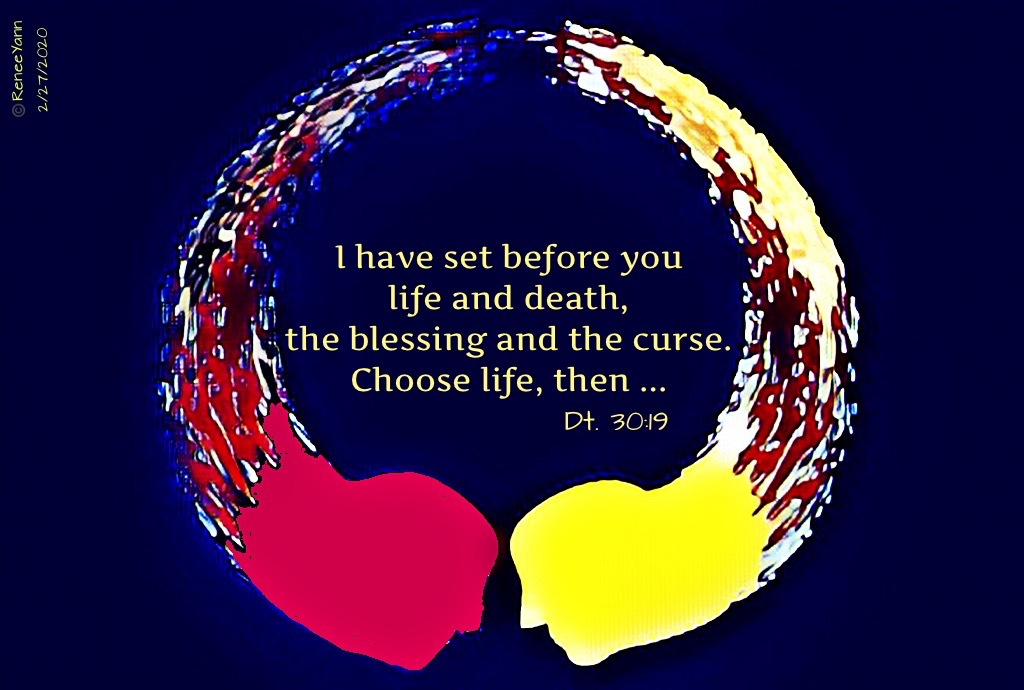
I have set before you life and death,
the blessing and the curse.
Choose life, then,
that you and your descendants may live,
by loving the LORD, your God,
heeding his voice,
and holding fast to him.

Deuteronomy 30: 15-16

It’s definitive advice, but we could probably do these things, right?

  • Choose life
  • Love God
  • Heed God’s voice
  • Hold fast to God

Sounds OK, doesn’t it?


It’s when Jesus comes along that it begins to sound difficult.
Jesus tells us, “Here’s how you choose life:

“Whoever wishes to save his life will lose it,
but whoever loses his life for my sake will save it.”


Jesus tells us, “Here’s the God you must love, one who:

“suffers greatly, is rejected, and is killed.”


Jesus tells us, “Here’s what my voice says to you :

“What profit is there for you to gain the whole world
yet lose or forfeit yourself?”


Jesus tells us, “Here’s how you hold fast to me:

‘Take up your cross daily and follow me.”

The deep love of the Holy Cross was the sacred gift of Catherine McAuley to her Mercy Family.
Let us listen to her counsel.

Some have huge crosses to carry in their lives – war, famine, enslavement, untended illness, homelessness, persecution, poverty. Those who carry such crosses are singularly loved by God who dwells with them.

But if we don’t have big, obvious crosses in our lives – if we are among those the world deems fortunate – how do we follow the crucified Jesus to find our way to eternal life?

How do we really CHOOSE LIFE?

We need to get close to the ones God singularly loves. We need to walk beside them and lift some of their heavy crosses. We need to help their voices be heard, their needs be met, their rights be honored.

Not all of us can do this by direct service. But we can do it by our advocacy, our material contributions, and our articulated support for justice.

We need to make these choices for LIFE all the time. But Lent is a great time to examine the vigor and commitment of our choices, a time to take a closer walk with our suffering Christ and ask him to inspire our courage.


Poetry: Simon the Cyrenian Speaks – Countée Cullen, an American poet, novelist, children’s writer, and playwright, particularly well known during the Harlem Renaissance. I picked his poem today because Simon of Cyrene is someone who chose to carry the cross just as we are asked to do.

He never spoke a word to me,
And yet He called my name;
He never gave a sign to me,
And yet I knew and came.

At first I said, “I will not bear
His cross upon my back;
He only seeks to place it there
Because my skin is black.”

But He was dying for a dream,
And He was very meek,
And in His eyes there shone a gleam
Men journey far to seek.

It was Himself my pity bought;
I did for Christ alone
What all of Rome could not have wrought
With bruise of lash or stone.


Music: Just a Closer Walk with Thee – Patsy Cline and Willie Nelson

Lent: Time of Holy Listening

March 2, 2022
Ash Wednesday

Today, in God’s Lavish Mercy, we resolve to turn our hearts more fully to God. The sacred journey of Lent, one we have traveled so often over the years, invites us each time to go deeper into the Well of Mercy.

Joel’s pregnant phrase summons us:

Think of the “even now” moments of your life, those times when, despite darkness and cold, you turned toward light and warmth. Think of a time when, in contradiction to all negativity, your soul proclaimed:

  • Even now I hope
  • Even now I believe
  • Even now I love
  • Even now I care
  • Even now I repent
  • Even now I forgive
  • Even now I begin again

The rise of an “Even Now” moment in our souls is like the hint of spring pushing its head through the winter snow.

It is the reddish-green thread suggesting life at the tip of the brown, cold-cracked branch.

It is the moment we believe that what we desire and love will turn toward us and embrace us.

Can you imagine God having such moments, longing for our attention, love, presence, catching a glimpse of our turning?

Our reading from Joel describes such a God.

Even now, says the LORD,
return to me with your whole heart…
These words suggest God’s longing for us, for our devotion and love.

But our holy intentions weaken and we often drift away from our “first fervors”. Our hearts attach to distractions from God. So God says:

Rend your hearts …
and return to the LORD, your God.
For I am gracious and merciful,
slow to anger, rich in kindness …
Come back to Me, with all your heart.

Joel 2: 13-14

This is what Lent is all about. Each of us knows where our hearts have wandered. Each of knows what we must turn from — even now — to return to God’s embrace.

If we can hear God’s longing in this haunting reading from Joel perhaps the true turning will begin. A blessed Lent, a holy listening, my friends.


Poetry: God’s Longing – from Rumi

All night, a man called out “God! God!”
Until his lips were bleeding.
Then the Adversary of mankind said, “Hey! Mr Gullible!
… How come you’ve been calling all night
And never once heard God say, “Here, I AM”?
You call out so earnestly and, in reply, what?
I’ll tell you what. Nothing!”

The man suddenly felt empty and abandoned.
Depressed, he threw himself on the ground
And fell into a deep sleep.
In a dream, he met an angel, who asked,
“Why are you regretting calling out to God?”

The man said, “ I called and called
But God never replied, “Here I AM.”

The Angel explained, “God has said,
“Your calling my name is My reply.
Your longing for Me is My message to you.
All your attempts to reach Me
Are in reality My attempts to reach you.
Your fear and love are a noose to catch Me.
In the silence surrounding every call of “God”
Waits a thousand replies of “Here I AM.”


Music: Come Back to Me – Gregory Norbet, sung by John Michael Talbot

Hear God Speak Your Name

February 22, 2022
Feast of the Chair of St. Peter

Today, in God’s Lavish Mercy, our readings invite to consider God’s naming us – calling us.

We celebrate wonderful Saint Peter – so fully human, so fully holy, so fully in love with God! As we pray the Gospel of Peter’s naming, may we deepen in understanding our own naming by God.

Once, Jesus asked Peter what he believed. Peter answered, simply and magnificently:
“YOU ARE THE CHRIST, THE SON OF THE LIVING GOD.”
Peter was an ordinary man who responded to Jesus with a clear and extraordinary faith.


One June morning, nearly fifty years ago, I sat in a sun-drenched field in the Golan Heights of Israel at a spot called Caesarea Philippi. Thirty other pilgrims composed the group as we heard today’s Gospel being read. Listening, I watched the rising sun grow brilliant on the majestic rock face in the near distance.

I thought how Peter might have watched his day’s sun playing against the same powerful cliffs as Jesus spoke his name:

Jesus said to him,
You are Peter (which means “Rock”),
and upon this Rock
I will build my Church.


A few years later, I stood at the center of St. Peter’s Basilica in the Vatican. Looking up, I saw these words emblazoned around the awesome rotunda dome:

Tu es Petrus,
et super hanc petram
aedificabo ecclesiam.

On that sunlit afternoon two-thousand years ago,
Peter could never have imagined
what God already saw for him.
Yet, Peter responded – with his whole life.
This is what makes a Saint.

Jesus calls us to be saints too. He lovingly speaks our name into a sacred future we cannot even imagine. But if, like Peter, we trust and believe, God does the rest.


Poetry: Peter by John Poch.
The poem captures the transformation of Peter’s humanness into God’s hope for him – the “changing” of his name.


There are three things which are too wonderful for me,
Yes, four which I do not understand.
The way of an eagle in the air,
The way of a serpent on a rock,
The way of a ship in the heart of the sea,
And the way of a man with a maid

–Prov. 30:18, 19

I
Contagious as a yawn, denial poured
over me like a soft fall fog, a girl
on a carnation strewn parade float, waving
at everyone and no one, boring and bored.
There actually was a robed commotion parading.
I turned and turned away and turned. A swirl
of wind pulled back my hood, a fire of coal
brightened my face, and those around me whispered:
You’re one of them, aren’t you? You smell like fish.
And wine, someone else joked. That’s brutal. That’s cold,
I said, and then they knew me by my speech.
They let me stay and we told jokes like fisher-
men and houseboys. We gossiped till the cock crowed,
his head a small volcano raised to mock stone.

II
Who could believe a woman’s word, perfumed
in death? I did. I ran and was outrun
before I reached the empty tomb. I stepped
inside an empty shining shell of a room,
sans pearl. I walked back home alone and wept
again. At dinner. His face shone like the sun.
I went out into the night. I was a sailor
and my father’s nets were calling. It was high tide,
I brought the others. Nothing, the emptiness
of business, the hypnotic waves of failure.
But a voice from shore, a familiar fire, and the nets
were full. I wouldn’t be outswum, denied
this time. The coal-fire before me, the netted fish
behind. I’m carried where I will not wish.


Music: Peter’s Song – Face to Face – Michael O’Brien

I recall
something in the way
you called my name,
an ordinary fisherman you called me friend and took me in.
How everything had changed
because then I knew I’d never be the same.

Love came and rescued me.
I gave up my everything to follow.
Now I know.
All that I was before
won’t matter anymore
for I am a new man
because I have seen my Savior
face-to-face.

I recall
standing in the courtyard by the fire,
words still ringing in my head,
three times before the break of dawn
you would be denied.
And yet I saw no judgment in your eyes.

Love came and died for me.
I gave up my everything,
gave up my everything to follow.
Now I know
all that I was before
is dead and it lives no more
for I am a new man
because I have seen
my savior face-to-face.

The dark night, the new day –
The stone was rolled away –
my Savior, You are the Light
You are alive! Ascended to heaven.
I know that you will come again.

That moment I will arise
to worship before your throne,
to bow down for you alone are worthy,
so worthy
and there with saints of old,
I’ll sing a brand new song in heaven
forever
where I will see my Savior face-to-face.

Twists of Faith

February 21, 2022
Monday of the Seventh Week in Ordinary Time

Today, in God’s Lavish Mercy, the deep undercurrent of our readings is about the power and difficulties of faith.

James talks about how our faith can be choked by the weeds of “bitter jealousy and selfish ambition”. These chokers make us “boast and be false to the truth”. They fill us with a “pretend wisdom” that is not from the Holy Spirit.

Praying with this passage, I asked myself why we allow these ugly constraints to grasp our souls when the alternative James describes is so beautiful:

… the wisdom from above is first of all pure,
then peaceable, gentle, compliant,
full of mercy and good fruits,
without inconstancy or insincerity.
And the fruit of righteousness is sown in peace
for those who cultivate peace.

James 3:17-18

The Gospel helped me with an answer.

Unconditional faith is scary. It requires us to give control over to God. It asks us to let go of fear and to trust God’s Spirit within us. It needs us to empty our hearts of pretense and self-protection in order to make room for God’s transforming Mercy and Love.

This kind of faith will change us. It will make us “foolish” and insecure in worldly terms. It will cause us to live from a Wisdom the world misunderstands and mocks.

It’s hard to live that kind of faith. The dad in today’s Gospel admits it. He wants to have a faith that invites Christ’s power into his life. But he’s afraid. What if God wants something different for him and his son? What happens if he gives control over to God?

This yearning father confesses his ambivalence
in a plea for Christ’s assistance:
Lord, I do believe. Help my unbelief!

We all find ourselves within that plea sometimes in our lives. It’s a faith of “if”, “maybe”, and “but” – all of which are hardly faith at all. Unconditional faith is “Yes”, no matter what. It is the place where Faith and Love merge.


Our faithful “Yes”, as the e.e.cummings poem might describe it:

love is a place
& through this place of
love move
(with brightness of peace)
all places

yes is a world
& in this world of
yes live
(skillfully curled)
all worlds


Music: When we live this “Yes Faith”, God’s love, God’s heart lives in us. This song by Michael Hedges, based on another poem by e.e.cummings, can be a prayer for us. We may be unused to calling God “my dear”, “my darling”. But a loving name for God can be helpful to our prayer. And it is an ancient practice of mystics like St. John of the Cross. Use whatever might feel natural for you. Don’t be hesitant about being in love with God❤️

I Carry Your Heart – Michael Hedges (Lyrics below)

I carry your heart with me
I carry it in my heart
I am never without it
Anywhere i go you go, my dear
And whatever is done by only me
Is your doing, my darling.

I fear no fate
For you are my fate, my sweet
I want no world
For beautiful you are my world, my true
And it’s you are whatever a moon has always meant
And whatever a sun will always sing is you

Here is the deepest secret nobody knows
Here is the root of the root
And the bud of the bud
And the sky of the sky
Of a tree called life;
Which grows higher than the soul can hope
Or mind can hide
And this is the wonder that’s keeping the stars apart
I carry your heart
I carry it in my heart

Living the Cross

February 17, 2022
Thursday of the Sixth Week in Ordinary Time

Today, in God’s Lavish Mercy, two disciples of Jesus are our teachers. James advises us on what to do. Beloved Peter, as so often is the case, shows us what not to do.

James tells us to show no partiality. He makes clear that he is talking about impartiality toward those who are materially poor. It’s a maxim that Jesus gave us time and again in the Gospel.

James reminds us that Jesus is not just impartial toward those who are poor, he actually has a preferential love for them. So Jesus was partial to the poor, right? Hmm!

Yes, I think that’s right. In order to balance our human inclination to the richest, best, strongest, etc., Jesus teaches us to go all out in the other direction.

It’s like this great cartoon that popped up on Facebook a while ago:


Our Gospel picks up the theme.

Because of his great love for the poor and his passion for mercy, Jesus tells his followers that suffering is coming. Peter doesn’t like hearing that. Can you see Peter take Jesus aside and say, “Listen, Jesus, negative talk is going to hurt your campaign. You’re God! You can just zap suffering out of your life!”


Jesus responds to Peter definitively: “Get thee behind me, Satan!”

James Tissot: Get Thee Behind me, Satan

Wow! That must have stung! But that’s how important it was to Jesus that his followers understood his mission: to preach Mercy to the poor, sick, and broken by sharing and transforming their experience.

Jesus wants us to understand that too.


Prose: from St. Oscar Romero

It is no honor for the Church 
to be on good terms with the powerful.
The honor of the Church consists in this,
that the poor feel at home in her,
that she fulfils her mission on earth,
that she challenges everyone,
the rich as well,
to repent and work out their salvation,
but starting from the world of the poor,
for they, they alone are the ones who are blessed.

Music: Beauty for Brokenness – Graham Kendrick

Joyful Calculation

February 14, 2022
Monday of the Sixth Week in Ordinary Time

Today, in God’s Lavish Mercy, Lent is just a little over two weeks away. We will spend the intervening time in good company with daily insights from James, Peter and Mark. Today we begin the Epistle of James.

The Epistle of James- Chapter 1: Illustration provided to Wikimedia Commons by Distant Shores Media/Sweet Publishing as part of a cooperation project. Sweet Publishing released these images, which are taken from now-out-of-print Read’n Grow Picture Bible Illustrations (Biblical illustrations by Jim Padgett, courtesy of Sweet Publishing, Ft. Worth, TX, and Gospel Light, Ventura, CA. Copyright 1984.), under new license, CC-BY-SA 3.0

This letter is one of the very earliest of the New Testament. Scholars are mixed about exactly which “James” wrote it, but agree that it was one of several who were very close to Jesus – perhaps one of “the brothers of Jesus” mentioned in several New Testament passages:

  • Matthew 12:46-50
  • Mark 3:31
  • Luke 8:19
  • John 2:12
  • Acts 1:14
  • 1 Corinthians 9:5
  • and specifically “the Lord’s brother James” in Galatians 1:19

James writes in the style of Wisdom Literature, those Old Testament books that give advice, proverbs, and insights for living a holy life. His immediate audience was a community of dispersed Christian Jews whose world was filled with increasing upheaval and persecution.


When I read the following description I thought how germane James’s letter could be for our world today. His themes echo the teachings of Pope Francis for our chaotic time:

The epistle is renowned for exhortions on fighting poverty and caring for the poor in practical ways (1:26–27; 2:1-4; 2:14-19; 5:1-6), standing up for the oppressed (2:1-4; 5:1-6) and not being “like the world” in the way one responds to evil in the world (1:26-27; 2:11; 3:13-18; 4:1-10). Worldly wisdom is rejected and people are exhorted to embrace heavenly wisdom, which includes peacemaking and pursuing righteousness and justice (3:13-18).

Jim Reiher, “Violent Language – a clue to the Historical Occasion of James.”Evangelical Quarterly. Vol. LXXXV No. 3. July 2013

Here is the golden advice James gives us today:

  • Be joyful in trials.
  • Let trials increase your perseverance not discourage you.
  • Doing this is a sign of wisdom.
  • When your wisdom is depleted, ask God for more with an open and trusting heart.
  • Honor all people, high or low in circumstances
  • Don’t be fooled by riches. They fade away.

In our Gospel, Jesus is frustrated with the Pharisees who insincerely demand a magical sign from him. They demonstrate none of the spiritual wisdom and openness to grace that James describes.

When we think about our own faith, where does it fall on the scale of sincerity, on the spectrum joy, justice, and faithful perseverance?


Poetry: On Joy and Sorrow – Kahlil Gibran

Then a woman said, Speak to us of Joy and Sorrow.
And he answered:
Your joy is your sorrow unmasked.
And the selfsame well from which your laughter rises 
was oftentimes filled with your tears.
And how else can it be?
The deeper that sorrow carves into your being, 
the more joy you can contain.
Is not the cup that holds your wine 
the very cup that was burned in the potter’s oven?
And is not the lute that soothes your spirit, 
the very wood that was hollowed with knives?
When you are joyous, look deep into your heart 
and you shall find it is only that which has given you sorrow 
that is giving you joy.
When you are sorrowful look again in your heart, 
and you shall see that in truth you are weeping for 
that which has been your delight.
Some of you say, “Joy is greater than sorrow,” 
and others say, “Nay, sorrow is the greater.”
But I say unto you, they are inseparable.
Together they come, 
and when one sits alone with you at your board, 
remember that the other is asleep upon your bed.
Verily you are suspended like scales 
between your sorrow and your joy.
Only when you are empty 
are you at standstill and balanced.
When the treasure-keeper lifts you 
to weigh his gold and his silver, 
needs must your joy or your sorrow rise or fall.

Music: Count It All Joy

Giving or Grabbing?

February 12, 2022
Saturday of the Fifth Week in Ordinary Time

Today, in God’s Lavish Mercy, our readings stand in stark contrast to each other.

In our first reading, we meet the two adversarial kings of the now split kingdom of Israel – so cooly named King Rehoboam and King Jeroboam. They were grasping, grabbing and trying to hold on to power over each other’s terrain. Using idols, Jeroboam tried to lure the people away from their covenanted practice of going up to Jerusalem to worship.


Our Gospel demonstrates that Jesus is a very different kind of king. His concern is for the wholeness of his people, not for the increase of his own power and standing.

Jesus summoned the disciples and said,
“My heart is moved with pity for the crowd,
because they have been with me now for three days
and have nothing to eat.
If I send them away hungry to their homes,
they will collapse on the way,
and some of them have come a great distance.”

Matthew 8:1-4

This morning I can’t help thinking that many of us have come a long way with Jesus too. But still we find ourselves in spells of hunger — hungers of all kinds. Jesus sees our true needs, has compassion for, and presence with us in the pangs of any human experience.

He ordered the crowd to sit down on the ground.
Then, taking the seven loaves he gave thanks, broke them,
and gave them to his disciples to distribute,
and they distributed them to the crowd.

Matthew 8: 6

Let’s just sit down with Jesus today as we pray, laying out before him our deepest hungers, worries, regrets, doubts and hopes. Let’s wait for the gift of God’s beautiful and miraculous Bread – broken for each one of us.

Poetry: Gratitude – Henry Van Dyke

“Do you give thanks for this? — or that?”
No, God be thanked
I am not grateful
In that cold, calculating way, with blessing ranked
As one, two, three, and four, — that would be hateful.

I only know that every day brings good above”
My poor deserving;
I only feel that, in the road of Life, true Love
Is leading me along and never swerving.

Whatever gifts and mercies in my lot may fall,
I would not measure
As worth a certain price in praise, or great or small;
But take and use them all with simple pleasure.

For when we gladly eat our daily bread, we bless
The Hand that feeds us;
And when we tread the road of Life in cheerfulness,
Our very heart-beats praise the Love that leads us.

Music: Bread of Life – rory Cooney

I myself and the bread of life.
You and I are the bread life,
Taken and blessed,
Broken and shared by Christ that the world might live.

This bread is spirit, gift of the maker’s love,
And we who share it know we can be one:
A living of God in Christ.

I myself and the bread of life.
You and I are the bread life,
Taken and blessed,
Broken and shared by Christ that the world might live.

Here is God’s kingdom given to us as food.
This is our body, this is our blood:
A living sign of God in Christ.

I myself and the bread of life.
You and I are the bread life,
Taken and blessed,
Broken and shared by Christ that the world might live.

Lives broken open, stories shared aloud,
Become a banquet, a shelter for the world:
A living sign of God in Christ.

I myself am the bread of life.
I myself am the bread of life

Down, Dirty, and Divine!

February 11, 2022
Friday of the Fifth Week in Ordinary Time

Today, in Mercy, our Gospel gives us one my favorite portrayals of Jesus. It’s what I think of as “down in the dirt with us” Jesus. Let me give you some background on the image.

Me and Petey 😉 1955, looking a lot cleaner and official than we really were!

When I was a kid in North Philly, my buddy’s dog was hit by a car. We were playing baseball in a cinder lot (that’s where the railroad dumped its ashes in the old days when trains ran on coal). We were about a half block away when we heard the screeching. We turned and watched the guilty car speed off without a moment’s hesitation.

Petey ran screaming toward his dog, the rest of us cinder-dusty kids streaming behind him. I can still see Petey lie down beside that whimpering mutt who had been tossed into a muddy gully along Philip Street. He cradled the bruised head and whispered to the frightened eyes. Then Petey quietly said, “Get my Dad”, as he stroked Lightening’s heaving back.


As I remember that moment today, Petey reflects the image of the Divine Healer who – muddied and bloodied — has taken a place beside all of us as we suffer. He is unafraid of our mud and cinders. He is touched by our mumblings and tears.

In today’s Gospel, there is stunning humanness. The suffering man doesn’t just ask for a miracle. He asks for a hand to be laid on him, for a touch, for a connection he can feel. And Jesus hears his deep human need.

People brought to Jesus a deaf man who had a speech impediment
who begged him to lay his hand on him.

Mark 7:32
Be Opened – Thomas Davidson (1872)

Some miracles are accomplished by a fleshless, electric word shot through the air. But not this one.

With this lonely, isolated man, feel Jesus caress your head, perhaps finger the ears that have heard so much criticism and frustration. Feel Jesus touch your tongue, twisted sometimes in its attempts to speak your meaning into the world. Receive the surprising gift of Divine spittle that intends to insure, “I am part of you now. You will never be alone again.”

Hear Christ’s groan as he prays for you in sounds that plead, “Get my Dad. ABBA, Father.”

He took him off by himself away from the crowd.
He put his finger into the man’s ears
and, spitting, touched his tongue;
then he looked up to heaven and groaned, and said to him,
“Ephphatha!” (that is, “Be opened!”)

Mark 7:32-34

Hear the definite pronouncement of your liberation
from anything that tongue-ties, heart-ties,
soul-ties your life:
“Ephphatha!” (that is, “Be opened!”)

Poetry: I believe in all that has never been spoken – Rainer Maria Rilke
~ from Rilke’s Book of Hours: Love Poems to God, translated by Anita Barrows and Joanna Macy

I believe in all that has never yet been spoken.
I want to free what waits within me
so that what no one has dared to wish for
may for once spring clearwithout my contriving.
If this is arrogant, God, forgive me,
but this is what I need to say.
May what I do flow from me like a river,
no forcing and no holding back,
the way it is with children.
Then in these swelling and ebbing currents,
these deepening tides moving out, returning,
I will sing you as no one ever has,
streaming through widening channels
into the open sea.

Music: Ephphatha – Fill Me – Carrie Allwine

Things Change; God Doesn’t

February 10, 2022
Thursday of the fifth Week in Ordinary Time
Memorial of Saint Scholastica

Today, in God’s Lavish Mercy, our readings leave me wondering about what makes God tick.

In our first reading, God exacts justice for Solomon’s unfaithfulness, but God does it sort of like a prosecutor in a plea bargain.

I will deprive you of the kingdom … but not during your lifetime
It is your son whom I will deprive … but I won’t take away the whole kingdom.

1 Kings 11:11-13

What’s going on with God in this reading? Well, it’s more like “What’s going on with the writer as s/he tries, retrospectively, to interpret God’s role in Israel’s history?”

The passage is much more than a report on exchanges between God and Solomon.

It is a testament to Israel’s unwavering faith that God is intimately involved in their lives. In every circumstance, the believing community returns to the fact that experience leads to God and not away from Him.

So “Solomon … had TURNED his heart to strange gods”
BUT God had not turned from Solomon.
Nor would God EVER turn because
God has CHOSEN Israel.


In our Gospel, the Syrophoenician woman tries to get the favor of Jesus to turn toward her. And actually, Jesus sounds pretty mean and stingy about it.

Again the writer Mark is portraying, retrospectively, a significant time in Christ’s ministry. Jesus has really gone into hiding in a remote place. Apparently, he wants space to figure some things out. The story indicates that one of those things might be whether or not his ministry should embrace the Gentiles.

The persistence of this woman’s faith is a turning point for Jesus Who evolved, as we all do, in his understanding of his sacred role and meaning in the world.

These passages encourage us to constantly turn toward God Who lives our life with us. Day to day, our lives change and challenge us. But throughout, we must stay centered on our God who does not change. This sacred relationship is essential to our spiritual growth. As we become bigger in heart and soul, so does our concept of God and what God’s hope is for us.


Poetry: All this “turning” brought to mind some favorites lines from T.S. Eliot

At the still point of the turning world. Neither flesh nor fleshless;
Neither from nor towards; at the still point, there the dance is,
But neither arrest nor movement. And do not call it fixity,
Where past and future are gathered. Neither movement from nor towards,
Neither ascent nor decline. Except for the point, the still point,
There would be no dance, and there is only the dance.

from Burnt Norton

Music: Perfect Wisdom of Our God – The Gettys

Come Away Awhile

February 5, 2022
Memorial of Saint Agatha, Virgin and Martyr

Today, in God’s Lavish Mercy, in our readings, both Solomon and Jesus seek a quiet place to pray, reflect, recenter, and commune with God.

Solomon went to Gibeon to sacrifice there,
because that was the most renowned high place.
Upon its altar Solomon offered a thousand burnt offerings.
In Gibeon the LORD appeared to Solomon in a dream at night.
God said, “Ask something of me and I will give it to you.”

1 Kings 3:4
Dream of Solomon – Luca Giordano

Solomon’s retreat is characterized by his sincere humility and gratitude. In this, his first documented encounter with God, Solomon hits a homer in relationship. God is pleased with Solomon’s self-abnegating request for only wisdom to benefit others.

O LORD, my God, you have made me, your servant,
king to succeed my father David;
but I am a mere youth, not knowing at all how to act.
I serve you in the midst of the people whom you have chosen,
a people so vast that it cannot be numbered or counted.
Give your servant, therefore, an understanding heart
to judge your people and to distinguish right from wrong.
For who is able to govern this vast people of yours?”

1 Kings 3:7-9

In his prayer, Solomon has been able to get himself out of the way in order to really see and hear God – to fully receive God’s Presence in his life.


In our Gospel, Jesus seeks retreat for himself and his disciples because of the pressures of their ministries and the recent gut-punch news of John the Baptist’s execution.

Turns out, they don’t really get much of a chance for a “holy chill”. As with many of us, the responsibilities are so pressing that they conspire to find us no matter what.

So they went off in the boat by themselves to a deserted place.
People saw them leaving and many came to know about it.
They hastened there on foot from all the towns
and arrived at the place before them.

When Jesus disembarked and saw the vast crowd,
his heart was moved with pity for them,
for they were like sheep without a shepherd;
and he began to teach them many things.

Mark 6: 32-34

We too, like Solomon and Jesus, need times of retreat and dedicated prayer in our lives. But sometimes, our responsibilities and work follow us as we attempt to find that sacred space.

How can we free ourselves for such spiritual renewal? By planning, asking for assistance, disciplining our time and choices. But the key is that we really have to want that precious deserted place for meeting God in a special way.

These “retreats” must be a way of life for us, consistent choices to bring our busy lives before God, humbly open our hearts, and ask to see ourselves in a new and graced way.

Our “going off to rest awhile” in God can be as short as a few minutes morning and evening, or as long as a 30 day retreat. But they must be a consistent and disciplined desire of our hearts.


“Discipline” may seem like a hard word for it, especially if we think of our high school demerits when we hear that word🤪 But remember, without disciple music would be just noise, art would be just scribble, dance would be contortion, and conversation would be babble.

When you consider “discipline”, think instead of the elegant balance of a beautiful dance and let God lead, or of the sweet perfection of glorious music and let God sing to you.


Prose: A treasured thought of the Jesuit Pedro Arrupe suggests itself here:

Nothing is more practical than
finding God, than
falling in Love
in a quite absolute, final way.
What you are in love with,
what seizes your imagination, will affect everything.
It will decide
what will get you out of bed in the morning,
what you do with your evenings,
how you spend your weekends,
what you read, whom you know,
what breaks your heart,
and what amazes you with joy and gratitude.
Fall in Love, stay in love,
and it will decide everything.

Music: These Alone Are Enough – Dan Schutte