Psalm 34: The Reason

Tuesday of the Third Week of Advent

December 15, 2020


Today, in God’s Lavish Mercy, we pray with Psalm 34.

When I read its refrain, my mind was triggered into a kind of “Jeopardy-like” exchange with God:

Answer: This is the reason God sent his Son,
and continues to redeem the world in us.

Question : What is “The Lord hears the cry of the poor”.

Psalm 34 reiterates a fundamental fact so often overshadowed by our highly secularized “Christmas unconsciousness”. The psalm refocuses us by consistently using words like this:

  • Let my soul glory in the LORD;
    the lowly will hear me and be glad.
  • When the poor one called out, the LORD heard,
    and from all his distress he saved him.
  • When the just cry out, the LORD hears them,
    and from all their distress he rescues them.
  • The LORD is close to the brokenhearted;
    and those who are crushed in spirit he saves.

Christmas is God’s response to the unrelenting cry of the poor. If we want to truly honor and celebrate Christmas, we must allow that merciful and healing response to flow through us.

How and where do I hear the cry of the poor?
How do I respond?

Poetry: Blessed Are the Poor in Spirit Alice Walker (born February 9, 1944) is an American novelist, story writer, poet and social activist. In 1982, she wrote the novel The Color Purple for which she won the National Book Award hardcover fiction, and the Pulitzer Prize for Fiction.

Did you ever understand this? 
If my spirit was poor, how could I enter heaven? 
Was I depressed? 
Understanding editing,
I see how a comma, removed or inserted
with careful plan,
can change everything.
I was reminded of this
when a poor young man
in Tunisia
desperate to live
and humiliated for trying
set himself ablaze; 
I felt uncomfortably warm
as if scalded by his shame.
I do not have to sell vegetables from a cart as he did
or live in narrow rooms too small for spacious thought; 
and, at this late date,
I do not worry that someone will
remove every single opportunity
for me to thrive.
Still, I am connected to, inseparable from,
this young man.
Blessed are the poor, in spirit, for theirs is the kingdom of heaven.
Jesus. (Commas restored) .
Jesus was as usual talking about solidarity: about how we join with others
and, in spirit, feel the world, and suffering, the same as them.
This is the kingdom of owning the other as self, the self as other; 
that transforms grief into
peace and delight.
I, and you, might enter the heaven
of right here
through this door.
In this spirit, knowing we are blessed,
we might remain poor 

Music: The Lord Hears the Cry of the Poor – John Foley, SJ

Gaudete Sunday: Rejoice!

Third Sunday of Advent

December 13, 2020

The day takes its name from the Latin word Gaudete (“Rejoice”),
the first word of the Introit prayer for this day’s Mass taken from Philippians 4:
Gaudete in Domino semper: iterum dico, gaudete.
Rejoice in the Lord always; again I say, rejoice. 


Today, in God’s Lavish Mercy, we prayerfully rejoice with Mary’s courageous and hopeful song:

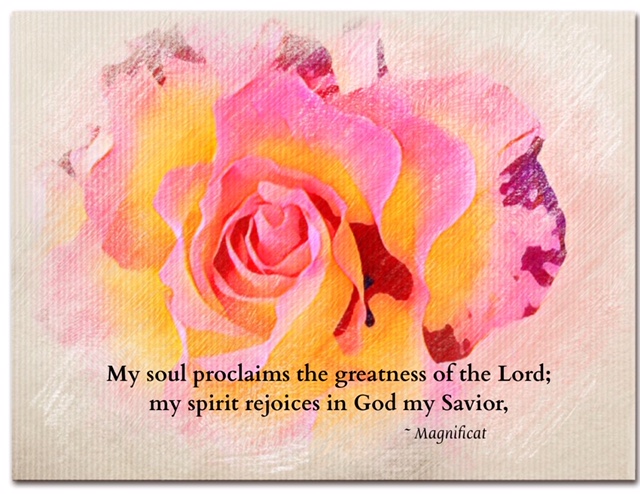
My soul proclaims the greatness of the Lord;
my spirit rejoices in God my Savior,
for he has looked upon his lowly servant.
From this day all generations will call me blessed.

Today is a break day midway through a season which is otherwise of a penitential character, and signifies the nearness of the Lord’s coming. On Gaudete Sunday, the Church is no longer inviting us to adore merely “The Lord who is to come”, but calling upon us to worship and hail with joy “The Lord who is now nigh and close at hand“.


While the whole Church is called this Sunday to rejoice in the approach of the Christ-event,  Mary’s Magnificat calls us to celebrate a specific “nearness” – God’s preferential affinity for those who are poor:

The Lord has filled the hungry with good things,
and sent the rich away empty.
He has come to the help of his servant Israel
remembering the promise of mercy.

The Gaudete message is not about a cheap and frenzied Christmas celebration. It is a profound reminder that Divine Joy seeks its home in a holy emptiness – in a heart space that has been reflectively cleared of spiritual arrogance.

His mercy is from age to age
to those who bow in awe.
He has shown might with his arm,
dispersed the arrogant of mind and heart.

Luke 150-51

How do we become, like Mary,
poor and humble before our God,
open to the Awesome Joy who is Christ?

We can pray according to Paul’s blessing to the Thessalonians in our second reading:

May the God of peace make us perfectly holy
and may we entirely, spirit, soul, and body,
be preserved blameless for the coming of our Lord Jesus Christ.
The One who calls us is faithful,
and will also accomplish it.


Poem: Heart Cave – Geoffrey Brown

I must remember to go down to the heart cave
And sweep it clean, make it warm, with fire on the hearth
And candles in their niches
The pictures on the walls glowing with quiet lights
I must remember to go down to the heart cave
And make the bed with the quilt from home
Strew rushes on the floor
And hang lavender and sage from the corners
I must remember to go down to the heart cave
And be there when you come.

Music: Gaudete – Steeleye Span 

This British folk rock group had a hit in 1973 (No. 14, UK singles chart) with an a cappella recording of the song. Guitarist Bob Johnson heard the song when he attended a folk-carol service with his father-in-law. 
This single is one of only three top 50 British hits to be sung fully in Latin (the others were both recordings of “Pie Jesu” from Andrew Lloyd Webber’s
Requiem)

Psalm 145:The Hint of God

Thursday of the Second Week of Advent

December 10, 2020


Today, in God’s Lavish Mercy, we pray with Psalm 145 in which the psalmist once again assures us that our God is 

The psalm extends the promises of our first reading from Isaiah:

The afflicted and the needy seek water in vain,
their tongues are parched with thirst.
I, the LORD, will answer them;
I, the God of Israel, will not forsake them.

Isaiah 41:17

We need promises like those of Isaiah and our psalmist, especially in times when we feel tested, alone, frightened, desperate, or abandoned. Even a taste of these radical emotions is hard to bear without some glimmer of promise.

Faith tells us that the Promise is already fulfilled in the Gift of Jesus Christ. 


Advent is our annual liturgical practice in waiting … in the recommitment

  • to a faith that cannot yet see,
  • to a hope that waits yet believes,
  • to a trust that praises even in the predawn shadows.

Advent is our promise to lean
on an invisible God. 

Christmas is the astounding Divine response –
Jesus Christ – God made visible.

Poetry: Paul’s great poem from Colossians 1: 15-23

Christ is the image of the invisible God,
the firstborn of all creation.

For in him were created all things in heaven and on earth,
the visible and the invisible,
whether thrones or dominions or principalities or powers;
all things were created through him and for him.i

He is before all things,
and in him all things hold together.

He is the head of the body, the church.
He is the beginning, the firstborn from the dead,
that in all things he himself might be preeminent.

For in him all the fullness was pleased to dwell,
and through him to reconcile all things for him,
making peace by the blood of his cross
whether those on earth or those in heaven.

Music: Immortal, Invisible, God Only Wise (1867) – Walter Chalmers Smith.
The original, beautiful final verses of this hymn have been lost in the English translation. Here they are, and worth their own meditation:

Great Father of glory, pure Father of light,
Thine angels adore Thee, all veiling their sight;
But of all Thy rich graces this grace, Lord, impart
Take the veil from our faces, the vile from our heart.
All laud we would render; O help us to see
’Tis only the splendour of light hideth Thee,
And so let Thy glory, Almighty, impart,
Through Christ in His story, Thy Christ to the heart.

Psalm 118: Inside the Gate

Memorial of Saint Francis Xavier, Priest

December 3, 2020


Today, in God’s Lavish Mercy,
we pray with Psalm 118
which describes the Lord’s strong city
and the gate which protects it.

Our opening passage from Isaiah exults in this Divine Strength, asking to be embraced  within its sacred space:

A strong city have we;
the Lord sets up walls and ramparts to protect us.
Open up the gates
to let in a nation that is just,
one that keeps faith.

Isaiah 26: 1-2

Jesus, in our Gospel, tells us that inclusion in the sanctuary must be merited by those who understand that God’s Will is for justice over all Creation:

Not everyone who says to me, ‘Lord, Lord,’
will enter the Kingdom of heaven,
but only the one who does the will of my Father in heaven.

Matthew 7: 21

Thus we, longing to be among the included, we pray this Advent psalm:

Open to me the gates of justice;
I will enter them and give thanks to the LORD.
This gate is the LORD’s;
the just shall enter it.
I will give thanks to you, for you have answered me
and have been my savior.

Psalm 118: 19-21

As I meditate on these thoughts, our Motherhouse property offers many “icons” to reflect upon the concept of the “gate”. The entire campus is enclosed by various types of fencing or walls. There are four gates through which one may pass into the complex.

early photo of Motherhouse main gate , Montgomery County Historical Society. The open gate is barely visible against the small pine tree on the left of the opening.

I imagine that, when first installed, these great gates offered a more formidable enclosure than they do today. Only the wrought iron hinges remain of the main gate’s  double swing panels. Yet these, driven into imposing stone pillars, still suggest the firm purpose to create a sacred space.

You will notice the open gate just under the right side of the big tree

Inside the property, another wrought iron enclosure surrounds the community cemetery. This fence’s two gates are usually open, demonstrating that their purpose too is not security but rather sacred designation.

These venerable gates, rather than castle-like ramparts, are more like torii, those traditional Japanese gates found at the entrance or within a Shinto shrine where they symbolically mark the transition from the mundane to the sacred.

The famous torii at Itsukushima Shrine, Hiroshima, Japan

During Advent, we slowly pass through such a sacred symbolic gate, once again entering the holy mystery who is Jesus Christ. We pray to be transformed, not simply by the retelling of his story, but by the Living Grace he is for us in our own lives.

With today’s powerful readings, we pray to enter more deeply into that Mystery.


Poetry: Endless Time – Tagore

Time is endless in thy hands, my lord.
There is none to count thy minutes.
Days and nights pass and ages bloom and fade like flowers.

Thou knowest how to wait.
Thy centuries follow each other perfecting a small wild flower.

We have no time to lose,
and having no time we must scramble for a chance.
We are too poor to be late.

And thus it is that time goes by
while I give it to every querulous person who claims it,
and thine altar is empty of all offerings to the last.

At the end of the day I hasten in fear lest thy gate be shut;
but I find that yet there is time.

Music: Huanqiutan Garden – Oliver Shanti 

Psalm 23: Awake to the Feast

Wednesday of the First Week of Advent

December 2, 2020


Today, in God’s Lavish Mercy, we pray with Psalm 23. On this first Wednesday of Advent, our psalm is set between two eloquent readings about the full satisfaction of our soul’s hungers.

Isaiah blesses us with his metaphor for Heaven’s abundance, when our souls will be filled to a divine capacity of grace.

In a world already redeemed, Isaiah’s vision has been fulfilled. We live our lives already seated at the banquet he describes.

But do we realize it? Do we partake every moment in the outpouring of grace given us by our Baptism into Christ?

Unaware, many of us sit at the table starving.

In our Gospel, Jesus sees the deeper hungers of the fatigued crowd. His miracle feeds their bodies but, more importantly, awakens their souls to see him as the fulfillment of God’s promise. Isaiah’s prophecy is accomplished in Jesus:

On that day it will be said:
Behold our God, to whom we looked to save us!
This is the LORD for whom we looked;
let us rejoice and be glad that he has saved us!”
For the hand of the LORD will rest on this mountain.

Isaiah 26:9-10

As we read Psalm 23 today, let’s allow its consoling verses to become our prayer of trust and gratitude for God’s “already presence” in our lives. Like the crowd awakened by Jesus’s miracle, let us open our eyes to the infinite grace spread before us, though wrapped sometimes in the mundane circumstances of our lives.


Poetry: Joy Harjo – Perhaps the World Ends Here

The world begins at a kitchen table. No matter what, we must eat to live.

The gifts of earth are brought and prepared, set on the table. So it has been since creation, and it will go on.

We chase chickens or dogs away from it. Babies teethe at the corners. They scrape their knees under it.

It is here that children are given instructions on what it means to be human. We make men at it, we make women.

At this table we gossip, recall enemies and the ghosts of lovers.

Our dreams drink coffee with us as they put their arms around our children. They laugh with us at our poor falling-down selves and as we put ourselves back together once again at the table.

This table has been a house in the rain, an umbrella in the sun.

Wars have begun and ended at this table. It is a place to hide in the shadow of terror. A place to celebrate the terrible victory.

We have given birth on this table, and have prepared our parents for burial here.

At this table we sing with joy, with sorrow. We pray of suffering and remorse. We give thanks.

Perhaps the world will end at the kitchen table, while we are laughing and crying, eating of the last sweet bite.

Music: Psalm 23 – Stuart Townend

Psalm 19: God’s Two Great Books

Feast of Saint Andrew, Apostle

November 30, 2020


My niece Maureen took this picture at the Biltmore in Asheville, NC

Today, in God’s Lavish Mercy, we pray with Psalm 19 which, according to the famous Baptist preacher Charles Spurgeon, is “the study of God’s two great books—nature and Scripture”.

The verses chosen for today’s Responsorial focus on the Law as we receive it in the words of Scripture.

The law of the LORD is perfect,
refreshing the soul;
The decree of the LORD is trustworthy,
giving wisdom to the simple.

Psalm 19:8

St. Andrew, whose feast we celebrate today, was a simple fisherman made wise by the Living Word of God. He received the Gospel as it was first uttered in the life and preaching of his dear friend Jesus.

DUCCIO DI BUONINSEGNA
The Calling of the Apostles Peter and Andrew, 1308-1311

Andrew decided to retell that precious Word in his own life and preaching.

He joyfully accepted the call to radical discipleship, allowing his inner vision to be enlightened by the Christ’s vision for the world.

The precepts of the LORD are right,
rejoicing the heart;
The command of the LORD is clear,
enlightening the eye.

Psalm 19: 9

Andrew’s whole life and death gave witness to his total investment in God’s Word. That apostolic commitment sweetened not only Andrew’s life, but the life of the whole faith community to whom he transmitted the Living Word… including us.

Your words, Lord, are Spirit and life.
They are more precious than gold,
than a heap of purest gold;
Sweeter also than syrup
or honey from the comb.

Psalm 19: 10;11

Let’s pray this Psalm today
with a simplicity and faith like Andrew’s.


Prayer: from daily-prayers.org

O Glorious St. Andrew,
you were the first to recognize and follow the Son of God.
With your friend, St. John,
you remained with Jesus,
for your entire life,
and now throughout eternity.
Just as you led your brother, St Peter,
to Christ and many others after him,
draw us also to Him.
Teach us how to lead them,
solely out of love for Jesus
and dedication to His service.
Help us to learn the lesson of the Cross
and carry our daily crosses without complaint,
so that they may carry us to God the Almighty Father. Amen.

Music: from Bach – Die Himmel erzählen die Ehre Gottes, BWV 76

 Chor

Die Himmel erzählen die Ehre Gottes, 

und die Feste verkündiget seiner Hände Werk. 

Es ist keine Sprache noch Rede, 

da man nicht ihre Stimme höre.

(Psalm 19:2,4)

Chorus

The heavens declare the glory of God, 

and the firmament shows His handiwork. 

There is no speech or language, 

since one does not hear their voices.

We Shall Behold God

November 22, 2020

Today, in Mercy, we celebrate The Solemnity of Christ the King.

For some, the lofty, politically-tinged title might obscure the rich devotion offered by this feast. The title “king” carries with it suggestions of exaggerated power, wealth and dominance not compatible with our Gospel perception of Jesus.

We may be more comfortable with images of Christ as infant, brother, shepherd, lamb, vine, gate, way, truth, life…

But what all these images point out is that our ability to comprehend the fullness of Christ is severely limited by our humanity. We usually choose a specific image based on our circumstances and spiritual needs.

Pope Pius XI promoted the concept of Christ the King in his 1925 encyclical Quas Primas, in response to growing international secularism and nationalism. His intent was not to compare Christ to the challenged world leaders of the time. It was to raise the perceptions of all people to the lessons of Divine Leadership: mercy, justice, inclusivity, and peace.

Oh, how we could benefit from the same understanding today! 

In this age with its culture of continual war, the human pain it causes, refugee crises, climate devastation, wealth distortion and indifference to the poor, how our hearts long for just, wise and loving leadership!

In his encyclical, Pius XI wrote:

Christ the King reigns “in the human hearts,” both by reason of the keenness of his intellect and the extent of his knowledge, and also because he is very truth, and it is from him that truth must be obediently received by all humanity. He reigns, too, in our wills, for in him the human will was perfectly and entirely obedient to the Holy Will of God, and further by his grace and inspiration he so subjects our free-will as to incite us to the most noble endeavors. He is King of hearts, too, by reason of his “charity which exceedeth all knowledge.”

— Quas primas, §7[4]

Let’s pray for these virtues for all who are charged with any form of power or leadership:

  • keen spiritual intellect
  • deep heart’s knowledge
  • uncompromising truth
  • obedience to grace
  • holy inspiration 
  • noble character
  • and surpassing charity for all Creation

May Christ the King truly live and reign among us. May we behold the “sweet light in His eyes”!

Music: We Shall Behold Him – offered in American Sign Language by Kayla Seymour; sung by Sandi Patty

Psalm 15: Camping with the Beloved

Memorial of Saint Elizabeth of Hungary, Religious

November 17, 2020


Today, in God’s Lavish Mercy, we pray with Psalm 15 which often is called an ‘entrance liturgy’, where a worshipper asks the conditions of entering the worship place and a priest answers.

The psalm’s first line, not included in today’s verses, asks that question of the Lord:

LORD, who may abide in your tent?
Who may dwell on your holy mountain?

Psalm 15:1

Reading this line immediately reminded me of Jesus’s first encounter with his chosen twelve. Upon meeting Jesus, and obviously struck with his unique charisma, the disciples ask, “Lord, where do you live?”. They want to be with him, to learn about him. We do too.


It’s a gift to be invited to someone’s home – to see where and how they live, to share their dailyness. It is a first portal to the intimacy of friendship, a gift beyond price when it proves mutual and true.

In today’s Gospel, in a sort of reverse proposal, Jesus invites himself to dinner at Zaccheus’s home. Throughout all the Gospels, we often see Jesus inviting and accepting invitations which prove to be conversions and calls for his followers.

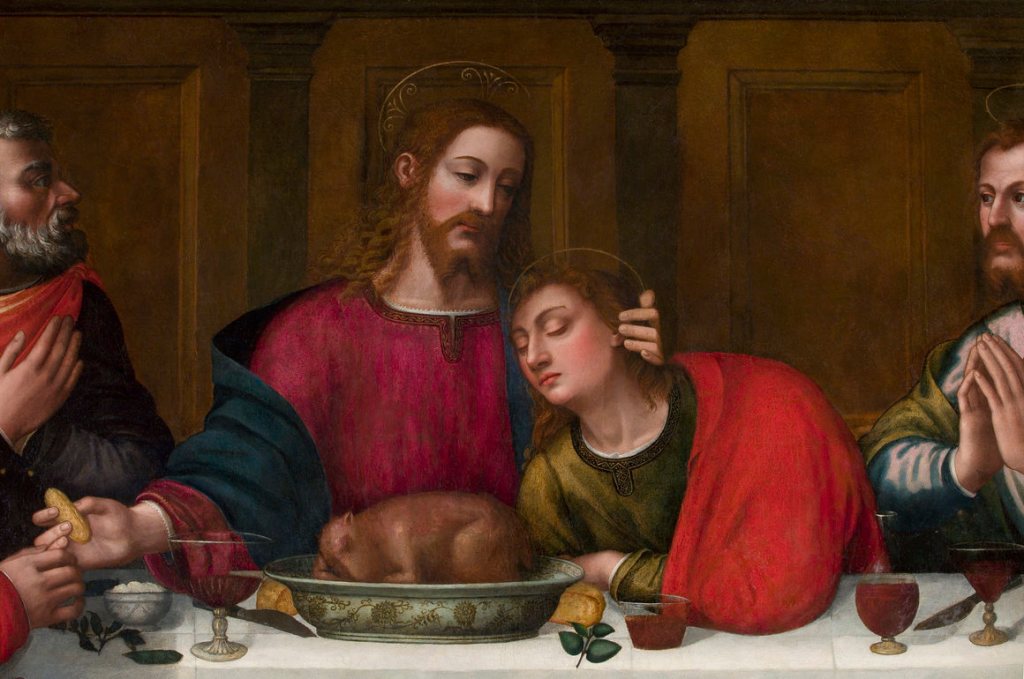
by Plautilla Nelli, an Italian nun who is said to have taught herself to paint in the 16th century. This is a section of her “Last Supper,” painted around 1568, and now newly installed in the old refectory of the Santa Maria Novella Museum. Of course, it shows Jesus with the “beloved” disciple.

In the reading from Revelation, the invitation takes an apocalyptic and corrective tone, but its heart is the same. In essence, God invites us to an intimacy of which we are capable only under certain conditions, i.e. “if you hear my voice“:

Behold, I stand at the door and knock.
If you hear my voice and open the door,
then I will enter and dine with you,
and you with me.
I will give the victor the right 
to sit with me on my throne,
as I myself first won the victory
and sit with my Father on his throne.


Today’s segment from Psalm 15 tells us what some of those conditions look like. It says to be someone who:

  • walks blamelessly and does justice 
  • thinks the truth in your heart
  • slanders not with your tongue.
  • harms not your fellow human beings,
  • takes up no reproach against your neighbor
  • despises not the reprobate
  • honors those who fear the LORD
  • lends not your money at usury
  • accepts no bribe against the innocent

Our challenge from the psalm is to meditate on that list to see what such behavior looks like in modern terms. Beneath the psalmist’s ancient language, we might discover our attitudes and examine our conscience toward issues like:

  • criminal justice
  • capital punishment
  • war
  • poverty
  • immigration policy
  • refugee resettlement
  • propagandist media
  • economic equity
  • felon rehabilitation
  • respect for other religions
  • political oppression
  •  – just to suggest a few.

Psalm 15 tells us, and our other readings affirm, that the one who gets these things right not only gets invited, but gets to remain in God’s house, God’s “tent”.

The one who does these things
shall never be disturbed.

I know that’s Who I want to go eternally camping with! How about you?


Poem: Rainer Maria Rilke, Poems from the Book of Hours

You, neighbor God, if sometimes in the night
I rouse you with loud knocking, I do so
only because I seldom hear you breathe
and know: you are alone.
And should you need a drink, no one is there
to reach it to you, groping in the dark.
Always I hearken. Give but a small sign.
I am quite near.

Between us there is but a narrow wall,
and by sheer chance; for it would take
merely a call from your lips or from mine
to break it down,
and that without a sound.

The wall is builded of your images.

They stand before you hiding you like names.
And when the light within me blazes high
that in my inmost soul I know you by,
the radiance is squandered on their frames.

And then my senses, which too soon grow lame,
exiled from you, must go their homeless ways.

Music: Dwelling Place – John Foley, SJ

Psalm 112: Don’t Worry; Be Happy

Saturday of the Thirty-first Week in Ordinary Time

November 7, 2020


Today, in God’s Lavish Mercy, we pray again with Psalm 112, placed between two interestingly complementary readings.

Psalm 112 is basically a guide to what constitutes a happy life. The psalm tells us this:

Blessed and happy  is the one:

  • who fears the LORD,
  • who greatly delights in God’s commands.
  • who is gracious and lends
  • who conducts affairs with justice
  • who gives to the poor

The psalmist tells us that this kind of humble, grateful generosity is its own reward.

Such a person

  • shall have a posterity which is mighty upon the earth
  • shall never be moved;
  • shall be in everlasting remembrance
  • shall be steadfast; shall not fear.
  • shall be remembered for enduring generosity
  • shall have a “horn” exalted in glory. ( “horn” = strength and power)

If we translate the biblical language here, what is Psalm 112 telling us.

This. True happiness comes from:

  • loving God
  • living within the law of love
  • being just, merciful, and generous
  • taking care of the vulnerable

Such happiness looks like this:

  • others can look up to you, especially the young
  • you stay faithful to goodness and righteousness 
  • your faithfulness nourishes those who come after you
  • you are strong and courageous 
  • your generosity inspires generosity in others
  • you are respected and loved for your goodness, even long after you’re gone

These are the kind of people Paul is depending on in our first reading to keep his ministry afloat. It sounds like he didn’t find too many of them, except finally in his Philippian community! Actually, under his eloquence, I think Paul sounds a little ticked off!😉

Jesus was looking for this kind of people too, but he certainly didn’t find them in the Pharisees of today’s Gospel. And Jesus let’s them have it in a dose of their own medicine. 


What does Jesus, who “knows our hearts”, find when he looks at us? Let’s pray Psalm 112 today asking for the grace to grow in true, generous, faith so we can look back at Jesus with deep peace and HAPPINESS!


Poem: The Work of Happiness by May Sarton

I thought of happiness, how it is woven
Out of the silence in the empty house each day
And how it is not sudden and it is not given
But is creation itself like the growth of a tree.
No one has seen it happen, but inside the bark
Another circle is growing in the expanding ring.
No one has heard the root go deeper in the dark,
But the tree is lifted by this inward work
And its plumes shine, and its leaves are glittering.

So happiness is woven out of the peace of hours
And strikes its roots deep in the house alone:
The old chest in the corner, cool waxed floors,
White curtains softly and continually blown
As the free air moves quietly about the room;
A shelf of books, a table, and the white-washed wall—
These are the dear familiar gods of home,
And here the work of faith can best be done,
The growing tree is green and musical.

For what is happiness but growth in peace,
The timeless sense of time when furniture
Has stood a life’s span in a single place,
And as the air moves, so the old dreams stir
The shining leaves of present happiness?
No one has heard thought or listened to a mind,
But where people have lived in inwardness
The air is charged with blessing and does bless;
Windows look out on mountains and the walls are kind.


Music: Psalm 112 – 4Him

We only get so many times
To ride around this sun
And so many times to see a full moon shine
When day is done if anything's worth doing
Then it's worth doing right

So I looked for wisdom on how to
Best live this brief life I have found
Blessed is he who fears the Lord
Who finds delight in His commands
Blessed is he who fears the Lord

Who finds delight in His commands
I guess that we all gamble on some
Truth to guide our days
And we trust that it will bring us joy and meaning
On the way

I've got friends who feel betrayed by all the things
They once believed
So with everything I've seen I've gotta say
It seems to me

Blessed is he who fears the Lord
Who finds delight in His commands
Blessed is he who fears the Lord
Who finds delight in His commands
Please hear this from a humble heart

But I feel like Exhibit A
In the evidence that God is good to those
Who live by faith, that's why I believe

Blessed is he who fears the Lord
Who finds delight in His commands
Blessed is he who fears the Lord
Who finds delight in His commands
He will not be shaken
He will have no fear
He will then remember

Those Sacred Shoulders

Thursday , November 5,2020

( Good morning, friends, as the world awaits the final result of the U.S. Presidential election. It is an unsettling morning for many of us, and a difficult one for me to create new inspiration! Maybe that’s because I slept so little!
Today, I find myself relying on some of my older reflections to bring myself a measure of equanimity. I was glad to see this one from two years ago. It comforted me as I hope it does you.)


Today, in Mercy, we meet the Shepherd bringing the lost lamb home.  Haven’t we all, at some time in our lives, been carried on those sacred shoulders?

Whether by our own prayers, or the prayers of those who love us, have we not been rescued from sorrow, foolishness, isolation or fear?

This beautiful Gospel assures us of the one thing we most deeply need – we are cherished, irrevocably, by God.

This morning, if we need to ride those shoulders, let us trust ourselves to them in prayer. 

If, by grace, we are already home, let us pray for those feeling most lost or abandoned – those most beset by a hostile world. May our merciful action help lift them to peace and the sweet scent of God so close beside them.


Poetry: from Kahlil Gibran

We live only to discover beauty.
All else is a form of waiting.


Music: I Will Carry You – Sean Clive

I will carry you when you are weak.
I will carry you when you can’t speak.
I will carry you when you can’t pray.
I will carry you each night and day.

I will carry you when times are hard.
I will carry you both near & far.
I’ll be there with you whenever you fall.
I will carry you through it all.

My arms are wider than the sky,
softer than a little child,
stronger than the raging,
calming like a gentle breeze.
Trust in me to hold on tight because 

I will carry you when you can’t stand.
I’ll be there for you to hold your hand.
And I will show you that you’re never alone.
I will carry you and bring you back home.

Not pain, not fear, not death, no nothing at all
can separate you from my love.
My arms and hands will hold you close.
Just reach out and take them in your own.
Trust in me to hold on tight.
I will carry you.