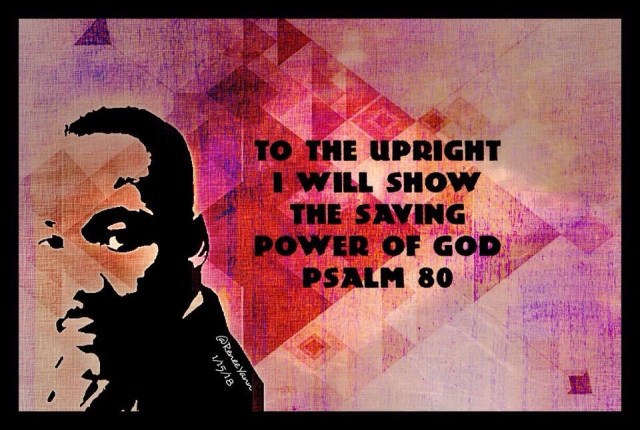
The Sacred Legacy of MLK

Monday of the Second Week in Ordinary Time

January 20, 2020

Click here for readings

MLKJPG

Today, in Mercy, as we memorialize the life and legacy of Dr. Martin Luther King, Jr., our readings speak about leadership and its continuing call to renew the world in the image of its Creator.

In our first reading, Samuel relays God’s displeasure to Saul who, though a conquering hero, has failed in humility and obedience before the Lord. 

In the story, God has given a clear direction to Saul to obliterate Israel’s centuries-old enemy, the Amalekites. Instead Saul, after executing the masses, keeps the enemy king alive as a war trophy. He appropriates the cattle as personal spoil. He also sets up a shrine to commemorate the victory as his own.

God is not happy. When we profess to lead in God’s name we must act as God directs us. In order to understand God’s direction, we must cultivate an honest, just and merciful heart.


Martin Luther King was such a leader. By his faithful obedience to God’s inspiration, Martin, at the ultimate cost, turned the tides of history toward justice and freedom.

But the tides still need turning, because there will always be those who seek “war trophies”, and personal spoil, and domination for themselves. Our times are tortured by such selfish and failed leadership, just as all of history has been from ancient Israel until 1968 and until now.

Today, as we pray with this great prophet and leader, we ask that selfless, merciful and faith-impelled souls continue to hear the call to justice in our day. May Martin’s witness strengthen and inspire us.


Music: Precious Lord, Take My Hand – Mahalia Jackson (Lyrics below)

Per Dr. King’s request, his good friend Mahalia Jackson sang his favorite hymn, “Take My Hand, Precious Lord”, though not as part of the morning funeral service but later that day at a second open-air service at Morehouse College.

Precious Lord, take my hand
Lead me on, let me stand
I am tired, I am weak, I am worn
Through the storm, through the night
Lead me on through the light
Take my hand, precious Lord
And lead me home

When my way grows dreary
Precious Lord, lead me near
When my life is almost gone
At the river I will stand
Guide my feet, hold my hand
Take my hand, precious Lord
And lead me home

Welcome, Christ, Our Light!

Second Sunday in Ordinary Time

January 19, 2020

Click here for readings

Is49_6 Light

Today, in Mercy, our readings invite us to witness the debut of Jesus Christ as he begins his public ministry.  The world has been waiting since the beginning of time and now… here He is!

Now the LORD has spoken
who formed me as his servant from the womb,
that Jacob may be brought back to him
and Israel gathered to him;
and I am made glorious in the sight of the LORD,
and my God is now my strength!

Remember when Pope Francis visited Philadelphia in 2015? The excitement? The preparation? The fanfare? What was that all about?

09222016_Pope_Francis_TC.2e16d0ba.fill-735x490
from phillyvoice.com

I think that, in one form or another, we all wanted to see and be touched by goodness. We wanted to see someone who confirmed that the world could be better than our current experience. We wanted to see the beauty of God in a human being.

The people of Jesus’s time wanted the same things. They longed for a wholeness that was beyond their grasp. They longed for healing that had continually eluded them. They longed to be renewed in faith, hope and love.

That deep longing is universal in every human life. Seeing the Pope on the Parkway won’t fill it. Even seeing Jesus one afternoon in Capernaum won’t do that. Our Alleluia Verse from John’s Gospel tells us the only way to such fulfillment:

The Word of God became flesh and dwelt among us.
To those who accepted him,
he gave power to become children of God.

In our Gospel, we see John the Baptist’s full acceptance of Jesus into his life. After that moment in the Jordan River when the Spirit descended, John’s life changed. It became a life patterned on and completed in the reality of Jesus Christ, not only his expectation.

John changed because he saw and believed. Our Gospel today invites us to the same kind of witness and testimony in our lives:

John testified further, saying,
“I saw the Spirit come down like a dove from heaven
and remain upon him.
I did not know him,
but the one who sent me to baptize with water told me,
‘On whomever you see the Spirit come down and remain,
he is the one who will baptize with the Holy Spirit.’
Now I have seen and testified that he is the Son of God.

May God give us the grace to see and respond to the reality of Christ in our own lives – in the poor, the sick, the persecuted, those longing to know God. Drawing on the beautiful Light of Christ, may we also be a testimony to God’s Merciful Presence in our world.

Music: He Shall Come Again in Glory – Philip Webb (Lyrics below)

This majestic modern hymn proclaims the hope of Christ’s second coming. Crafted for success; the arrangement captures the mystery and majesty of the text and delivers it adroitly to the choir loft with full; satisfying harmonies. Powerful! (from the East Coast Music website)

He who wept above the grave
Who stilled the raging of the wave
Meek to suffering, strong to save,
He shall come again in glory

He who sorrow’s pathway trod
He that every good bestowed
Son of Man, Son of God,
He shall come again in glory.

He who bled with scourgings sore,
He who scarlet meekly wore,
He who every sorrow bore,
He shall come again in glory.

Monarch of the smitten cheek,
Scorn of Jew and scorn of Greek,
Priest and King divinely meek,
He shall come again glory.

He who died to set us free,
He Who comes whom I shall see,
Jesus, only, only He,
He shall ever reign in glory.

Anointed

Saturday of the First Week in Ordinary Time

January 18, 2020

Click here for readings

Today, in Mercy, Samuel anoints Saul King of Israel.

Then, from a flask he had with him, Samuel poured oil on Saul’s head;
he also kissed him, saying:
“The LORD anoints you commander over his heritage.
You are to govern the LORD’s people Israel,
and to save them from the grasp of their enemies.

1Sam10_1

Throughout Scripture, the act of anointing signifies being blessed, commissioned by grace. The sacred oil heals and strengthens the anointed to do the work of God.

We share in the grace of anointing through the sacraments – Baptism, Confirmation and Anointing of the Sick. We may not think about the power these rituals give us to live our lives in the pattern of Christ. But it is an amazing power which creates saints out of ordinary human beings like you and me!


Caritas_Bruegel
Caritas, The Seven Acts of Mercy, pen and ink drawing by Pieter Bruegel the Elder, 1559. Counter-clockwise from lower right: feed the hungry, give drink to the thirsty, ransom the captive, bury the dead, shelter the stranger, comfort the sick, and clothe the naked

In a less formal way, we can anoint one another by our acts of generosity, honesty, justice and love. Think of the woman who anointed Jesus with nard from her alabaster jar. How that act strengthened him for the suffering he had to face!

There are so many chaffed and sore places in our world awaiting the oil of mercy!

works of Mercy

We can also “anoint” our own life by gratefully remembering God’s presence in our lives:  the blessings we have received, the challenges we have gracefully met, the love we have both given and received – all that strengthened us to do the work of God over our lifetime.

Music:  Holy, Anointed One – Vineyard Worship

Be Careful What You Ask For

Memorial of Saint Anthony, abbot

January 17, 2020

Click here for readings

www-St-Takla-org--b3h-50-israel-demands-a-king
1 Samuel 8:19 – Israel demands a king. J. Winter – from “The Bible and its Story” book, authored by Charles Horne, 1909

Today, in Mercy, our first reading startles us with how foolish the Israelites are about their leaders. Oh, wait a minute, why are we so surprised? Don’t we see the same dynamics all around us?

Israel is desperate for a “strong man” who will mimic the tyrants leading their enemies. They say a king will “rule us and to lead us in warfare and fight our battles.” They begin to envision a nation of their own design, not God’s.

They believe that having an absolute leader will make them strong. They are indifferent to Samuel’s warnings that such a choice will usurp their freedom, and lead to their devastation and enslavement.

lossy-page1-441px-Olivetan_Master_-_Leaf_from_an_Antiphonary-_Historiated_Initial_P_with_the_Prophet_Samuel;_Ar_-_1999.131_-_Cleveland_Museum_of_Art.tif
This leaf is distinguished by a large initial P depicting Samuel, the last and one of the greatest of Israel’s judges. It introduces the text Preparte corda vestra domino et servite (“Prepare your hearts for the Lord and serve”). In the lower margin are the arms of the Visconti family, rulers of Milan, featuring an eagle (left) and a coiled serpent (right). At bottom center is the emblem of the Olivetan Order, a reformed branch of the Benedictines founded in 1319 known as the “white monks.” The Olivetan monastery in Milan was founded in 1400 and it appears that this leaf belonged to a set of choral books presented to the monastery by one of the Visconti, perhaps about 1439–47. The so-called Olivetan Master takes his name from a luxuriously illustrated psalter made for the order’s monastery in Milan, where he was undoubtedly a monk

God tells Samuel that, in rejecting the choice for responsible, spiritually-grounded, and mutually sustained leadership, the people are rejecting God and God’s plan for them.

In a nutshell, Israel’s problem is this: they have forgotten who and whose they are. For the sake of expected political dominance, they are willing to sacrifice their identity as a people formed and led by God.


Centuries later, in today’s Gospel, Jesus comes among these dispirited people. Their choice hasn’t worked. They are still a politically dominated nation. Their religious practice has lost its vigor, denigrating into lifeless rules and practices. A corrupt religious class manipulates them.

Jesus, ignoring their religiously manufactured limitations on the Spirit, cures a paralytic. The scribes are scandalized. But Jesus confronts their equivocation:

Jesus said, “Why are you thinking such things in your hearts?
Which is easier, to say to the paralytic,
‘Your sins are forgiven,’
or to say, ‘Rise, pick up your mat and walk’?
But that you may know
that the Son of Man has authority to forgive sins on earth”
–he said to the paralytic,
“I say to you, rise, pick up your mat, and go home.”
He rose, picked up his mat at once,
and went away in the sight of everyone.
They were all astounded
and glorified God …

What would the world be like if we left ourselves so open to grace and mercy that God could work through us for the good of all Creation? Can we even imagine such freedom and trust? Can we even imagine the marriage of our faith and politics to the point that we all live for the common good?

Ps89 name_justice

Music: Come, Holy Spirit – Bright City

Mercy says, “Of course…”

Thursday of the First Week in Ordinary Time

January 16, 2020

Click here for readings

( Our Gospel today nearly repeats a passage in Luke about which I wrote last year. Being a little lazy tonight, and wanting to watch Jeopardy- GOAT, I am offering that earlier reflection to you again. Besides, I liked it.  I hope you do, dear Friends.)

Mk1_41-of-course
This is the Greek word for “Of course!”

Today, in Mercy, Jesus shows us how to live a merciful life – through loving, generous, joyfully responsive service.

A pitiable leper interrupts Jesus on his journey to ask for help. People like this man were scorned, feared, and isolated. Their leprosy impoverished them, making them annoying beggars. Their cries usually met with indifference at best and banishment at worst.

But when this leper poses his proposal to Jesus – “If you want to, you can heal me.” — Jesus gives the spontaneous answer of a true, merciful heart: “Of course I want to!”

There is no annoyance, no suggestion that other concerns are more important. There is just the confirmation that – Yes- this is the purpose of my life: to heal, love, show mercy toward whatever suffering is in my power to touch. There is just the clear message that “You, too, poor broken leper, are Beloved of God.”

What an example and call Jesus gives us today! We are commissioned to continue this merciful touch of Christ along the path of our own lives. When circumstances offer us the opportunity to be Mercy for another, may we too respond with enthusiasm, “Of course I want to!” May we have the eyes to see through any “leprosy” to find the Beloved of God.

Music: Compassion Hymn – Kristyn and Keith Getty

Can You Hear Me Now?

Wednesday of the First Week in Ordinary Time

January 15, 2020

Click here for readings

Today, in Mercy, we read about God’s call of Samuel, Hannah’s son.

New things are about to happen in Israel. The People have lived under the questionable leadership of a series of Judges. But now, threats from inside and outside loom. So God chooses to move in a new way among the community.

1Sam speak Lord

Samuel is going to be God’s bridge to that new way. In today’s reading and subsequent verses, he hears God’s call, listens, receives a vision, and prophesies to Eli.


In our reading from Mark, Jesus is the Divine Bridge to a new reality. Early now in his ministry, his call is blossoming in his heart, as he realizes that he must go all over Israel preaching and healing.

When Simon told Jesus the local villagers were looking for him, Jesus told them,

“Let us go on to the nearby villages
that I may preach there also.
For this purpose have I come.”
So he went into their synagogues,
preaching and driving out demons

throughout the whole of Galilee.”

Jesus continues his healing and enlightening mission through all who call themselves Christian. He calls each of us in different ways to be a “Bridge” with him to the Reign of God.

How are you hearing and listening to your particular call every day? Maybe, like Samuel, by the time God calls us three times, we may understand!😉

Music: Since I mentioned “bridge”, I can’t help including one of my favorite songs, Bridge Over Troubled Water by Simon and Garfunkel. It’s not really a religious song, but their popular song actually was inspired by a great Gospel song,  Oh Mary, Don’t You Weep and its one freely interpreted verse very near the end: “I’ll be your bridge over deep water/If you trust in my name.’ 

Bridge Over Troubled Waters


Oh, Mary Don’t You Weep (Lyrics below, but they are VERY liberally interpreted by these wonderful Gospel singers.)

Lord, I’m singing . . . (solo)
Oh, Mary, don’t you weep. (group)
Tell Martha not to mourn. (solo)
Tell Martha not to mourn. (group)
Listen, Mary, (solo)
Oh, Mary, don’t you weep. (group)
Tell Martha not to mourn. (solo)
Tell Martha not to mourn. (group)
Pharaoh’s army, (solo)
Oh, Mary, don’t you weep. (group)
They got drownded in the sea, (solo)
Drowned in the Red Sea. (group)
Jesus said, Mary, (solo)
Oh, Mary, don’t you weep. (group)
Tell Martha not to mourn. (solo)
Tell Martha not to mourn. (group)
Can’t you hear me singing, Mary? (solo)
Oh, Mary don’t you weep. (group)
I want you to know, Martha don’t have to mourn. (solo)
Tell Martha not to mourn. (group)
Oh, listen, Mary, (solo)
Oh, Mary don’t you weep. (group)
Tell Martha not to mourn. (solo)
Tell Martha not to mourn. (group)
Pharaoh’s army, (solo)
Oh, Mary, don’t you weep, (group)
They got drownded in the sea, (solo)
Drowned in the Red Sea. (group)
Jesus said, Mary, (solo)
Oh, Mary don’t you weep, (group)
Tell Martha not to mourn, (solo)
Tell Martha not to mourn, (group)
Lord, and if I could tonight, (solo)
If I could, (group)
I want to tell you I surely would right now. (solo)
Surely would, (group)
I would stand on the rock. (solo)
Stand on the rock, (group)
Right on the rock where Moses stood. (solo)
Moses stood, (group)
Pharaoh’s army, (solo)
Oh, Mary don’t you weep (group)
They got drownded in the sea, (solo)
Drowned in the Red Sea. (group)
Jesus say, Mary, (solo)
Oh, Mary don’t you weep. group)
He said Mary . . . (solo)
Oh, Mary don’t you weep .(group)
Oh, Mary . . . (solo)
Oh, Mary, don’t you weep. group)
Tell Martha not to mourn. (solo)
Tell Martha not to mourn. group)

Exult in God’s Power

Tuesday of the First Week in Ordinary Time

January 14, 2020

Click here for readings

Today, in Mercy, our readings demonstrate God’s power to change human lives.

hannah
The Travail of Hannah

Our first reading from the Book of Samuel completes the story of Hannah, Samuel’s mother. Hannah, one of the two wives of Elkanah, was childless. In today’s passage, Hannah takes her grief to the Temple and places it before the Lord. God hears her prayer and she conceives her son.

When the story is summarized, as I have just done, it seems like a cookie-cutter miracle story. A skeptic might wonder, had she waited long enough, would Hannah have conceived – Temple or not.

That’s because the summary has drained out all the human angst, emotional roller-coastering, denial, and frustration that finally brought Hannah to God’s arms. It could have taken her so many others places. Unrelieved pain often does. It takes some into unresolved anger, depression, addiction, even suicide.

The miracle of this story is Hannah’s faith and the power of God’s love in her. It just so happens that there was also Samuel.

1Sam2_1 exult


Mark, in these early chapters of his Gospel, presents Jesus as the personification of that Divine Power. Both Christ’s “astonishing “ teaching and his stunning authority over evil convince us of this power.

With Jesus, the believer’s reality is transformed by faith and grace. Divine life blossoms even in formerly barren circumstances. Wholeness emerges even from that which had seemed fragmented.

This is the miracle: there is Divine Life inside that we had not seen until we looked, by faith, with the God’s eyes.

Music: Everyday Miracles – Sarah Grove

Follow Me

Monday of the First Week in Ordinary Time

January 13, 2020

Click here for readings

Today, in Mercy, we re-enter Ordinary Time. (I’ll be posting a second reflection today on the topic of “ordinary time”.)

Today we begin a journey with Mark the Evangelist which carries us all the way to Lent. This journey will allow us to walk right beside Jesus as he preaches, cures, and calls people to full life in God.

Somewhere on Peter’s missionary journeys after Christ’s Ascension, he encountered Mark and took him as travel companion and interpreter. Mark then wrote down Peter’s sermons, thus composing the Gospel according to Mark (According to the historian Eusebius: Eccl. Hist. 15–16). So, in a very real sense, when we pray with Mark, we are also praying with Peter and with Peter’s memories of life with Jesus.

Today’s Gospel is a great example of that first-hand experience — the call of the first disciples.

As he passed by the Sea of Galilee,
he saw Simon and his brother Andrew casting their nets into the sea;
they were fishermen.
esus said to them, “Come after me, and I will make you fishers of men.”
Then they left their nets and followed him.


I like to think of Peter talking to young Mark about this moment in his life.  He states it so simply. One can almost hear Peter say, ”It started so ordinarily.  We were just cleaning our nets, when He came out of nowhere and picked us!”

What Peter doesn’t say, but what might be inferred from the story, is that he and his brother Andrew were READY for the call. It didn’t take them a moment to drop those nets and follow. 

And, oh my, what a journey Peter made from that first moment to where he sat telling Mark the story decades later somewhere in Asia Minor.

Maybe other fishermen along that coastline might have scoffed or been bewildered at an invitation to become “Fishers of Men”. But Jesus knew the right ones to call.  He knew the hearts that would respond to the extraordinary clothed in the ordinary.

Mk1_17 follow

As we follow Mark’s Gospel over these next weeks, let’s look for the call it carries to us in our “ordinary time”.  Let’s be ready when Jesus asks us to tag along with him. We might, like Peter, be surprised at the graces waiting for us when we drop the “nets” entwining us and just follow!

Music: Follow Me – Casting Crowns

In this song, we hear Jesus invite several people to follow him: the disciples, the woman caught in adultery, the Good Thief … even us.

The Glorious Baptism of Jesus

The Feast of the Baptism of the Lord
January 12, 2020

Click here for readings

Today, in Mercy, Jesus makes a remarkable debut! 

Picture the scene. It is a beautiful morning in the Judean Valley where the Jordan Riven runs fresh and sparkling. Most scholars place the Baptism of Jesus sometime in January, which means the weather would have been relatively cool. But perhaps, like our own weather, an unusually warm day may have snuck in.

Rustic, fiery preacher John is baptizing in the Jordan River. Crowds have come to hear what he has to say. Some are convinced and dive into the cool water under his hand.

Others rim the hillside, not so sure John isn’t one of the many who have glorious visions but few facts.

Then, out from the pines on the far side of the river, comes Jesus, flanked by some of the Twelve. While his companions chat away to Jesus, his eyes are focused on John. In an instant, Jesus realizes that this is the moment for his revelation. In that same instant, all Creation realizes the same thing.

As Jesus walks slowly toward John, the birds and little animals speak to him, “My Lord and my God…”.  Wind whistling through the trees becomes an Oratorio praising him. All the surrounding colors deepen, breaking forth in unimaginable light.

John is stunned by the cosmic change he senses but cannot describe. Heart trembling, he looks into Jesus’s eyes and catches a glimpse of heaven. “I need to be baptized by you”, John says,”and yet you are coming to me?

Jesus smiles at his cousin, replying, 

“Let it be so now;
it is proper for us to do this
to fulfill all righteousness.”

Then John consented.

Perhaps those in the crowd, schooled in the ancient scriptures, heard Isaiah’s voice in the charged atmosphere:

Here is my servant whom I uphold,
my chosen one with whom I am pleased,
upon whom I have put my spirit;
he shall bring forth justice to the nations,
not crying out, not shouting,
not making his voice heard in the street.
a bruised reed he shall not break,
and a smoldering wick he shall not quench,
until he establishes justice on the earth;
the coastlands will wait for his teaching.

Matthew tells us:

As soon as Jesus was baptized, he went up out of the water.

the-baptism-of-jesus-jeff-haynie
The Baptism Of Jesus is a painting by Jeff Haynie For purchase, see:https://fineartamerica.com/featured/the-baptism-of-jesus-jeff-haynie.html

Can you see him light-heartedly splashing John as he shakes his dark curls free of the chilly water? Can you see his transfigured face as he hears his Father speak Love over him?

At that moment heaven was opened,
and he saw the Spirit of God descending like a dove and alighting on him.
And a voice from heaven said,

“This is my Son, whom I love; with him I am well pleased.”

What a beautiful moment in time! Don’t we wish we might have been there in the blessed and awe-struck crowd? We can. Let your prayer of imagination take you there.

Music: The Baptism of Jesus

He Must Increase

Saturday after Epiphany

January 11, 2020

Click here for readings

Today, in Mercy, John talks a lot about sin. But I think he’s talking about more than the itemized laundry list of mistakes we sometimes reckon as sin.

Catholic-Sin300

It all seemed so simple when we were in grade school, didn’t it?
Well, dealing with sinfulness in the world
is a lot more than milk bottles!


John is describing the drenching atmosphere of darkness that falls over a soul turned in on its own gratification. Pope Francis’s quote referenced yesterday captures this atmosphere:

“Jesus, at the Last Supper, does not ask the Father to remove the disciples from the world, but to protect them from the spirit of the world, which is the opposite.” The Holy Father emphasized, that it is, “even worse than committing a sin. It is an atmosphere that renders you unconscious, leads you to a point that you do not know how to recognize good from evil”.

John likens this atmosphere to idol worship:

Children, be on your guard against idols.

Most of us are beyond worshipping golden calves, but we may still be allowing ourselves to be distracted from the centrality of God in our lives.

calf

What are some potential idols that could desensitize our souls to the ravages of evil? Greed, lust, and narcissism rise to the top of the list. Caught in the grasp of these idols, human beings become oblivious to astounding evils such as war, slavery, economic oppression, sexual exploitation, corporate dishonesty, technological dehumanization, and all the other rampant abuses befuddled human beings foist on one another. 

When you see the effects of such evils reported on the evening news, do you sometimes ask yourselves, “How could a person do such things to another human being?” 

What we are seeing is evidence of souls who have died to God’s Presence within their hearts. They are indifferent to the effect of their choices on anyone but themselves.

Jesus came to open our eyes and to free us from the bonds of such sin. As the Presence of God grows in us, so does our awareness of all that is dissonant with that Presence.


We pray with John the Baptist today that we may grow in God and diminish in any selfishness that blinds us to the difference between good and evil in our lives.

Pope Francis tweeted today:

In worship, we learn to reject what should not be worshiped: the god of money, the god of consumerism, the god of pleasure, the god of success, the god of self.


Music:  I Must Decrease – Andrew and Saskia Smith ( Words below.)

God has a sovereign plan for our lives.
We won’t find it within ourselves.
But in seeking His will, His cross,
“Lose your life for My sake,” Jesus says.
Allowing ourselves to be poured out in service for Him,
first we decrease, He must increase.

I must decrease, He must increase.

The whole earth is His footstool. Who am I?
Shall the thing formed say to its Maker,
“Why hast thou made me thus?”
I must decrease, He must increase.

God has a sovereign plan for our lives.
We won’t find it within ourselves.
But in seeking His will, His cross,
“Lose your life for My sake,” Jesus says.
Allowing ourselves to be poured out in service for Him,
first we decrease, He must increase.

Lord, I exist to worship You.

The whole earth is Your footstool.
I am thine, Lord. I exist to worship You.
The whole earth is Your footstool.
I am thine, Lord. I exist to worship You.

Lord, I exist to worship You.
Oh yes, Lord, I exist to worship You.