Has doubt ever dogged you, or at least nipped at the edges of your soul?All kinds of doubt, I’m talking about! Doubt yourself. Doubt your loved ones. Doubt the Church, the government, the media. You get the idea.
Some doubt is good. It’s more like “discernment”, and it saves us from misplaced trust. A skill that’s honed through a lifetime, it can eventually be exercised prudentially, without skepticism or aloofness.
But another type of doubt can be crippling. Call it the “not enough” type: I am not good enough, smart enough, good-looking enough, experienced enough, – so on and on – to take on a challenge or make a contribution. Ever felt that kind of doubt?
There is third type of doubt which I call “the flip side of faith”. It’s that fine line where we balance between wanting to believe and wanting to know. This type of doubt whispers things like this in our minds: “You don’t really know if there is a God, so how can you believe?” But isn’t that the whole point of faith? If we really knew, for certain, of God’s existence, we wouldn’t have to believe!
What’s the difference between these flip sides of the coin?
With faith, we give our love and service unreservedly, even though we have not seen. With doubt, we skimp or reserve these until given proof.
So today, we meet “doubting Thomas”. He needed the touch of nail marks and lance wounds before he could believe. And it’s not hard to understand why.
The Resurrection of Jesus was mind-blowing. It changed history for all time to come. It conquered the one unconquerable – DEATH itself. Thomas had not yet seen proof of the Resurrection. The other disciples had. No wonder his coin was spinning between heads and tails!
What about us? Have we seen the Easter Power in our lives? Have we let God win the toss up between our faith and doubt? Today, on this feast of St. Thomas, we might ask his help to let us learn from the wounds of Christ exactly how that Power can assure us.
Music: Blessed Assurance ~ a well-known Christian hymn. The lyrics were written in 1873 by blind hymn writer Fanny Crosby to the music written in 1873 by Phoebe Knapp.
Today, in Mercy, our readings tell the story of the woman with the hemorrhage, and the little girl raised to life. I wrote the following homily about this passage for the Catholic Health association in 2015. I hope you find it worth reading.
For more inspiring prayer and scripture resources from CHA, please see:
Healing of the Daughter of Jairus and the Woman with a Hemorrhage
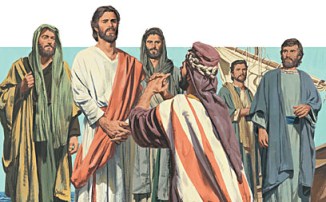
It is a soft, summer morning in Capernaum and Jesus is in the height of his ministry. Large crowds follow him wherever he goes, crowds hungry with hope; crowds fired by his counter-cultural words and miraculous deeds. This morning, Jesus prepares to speak to them, to translate into language they can comprehend the Eternal Life that lives in his heart. His back is to the gentle, sunlit sea. The hubbub softens to a murmur, finally stilled by the lapping waves.
But before Jesus can begin, a distressed man bursts through the gathered crowd. His robes fly about him as he runs to Jesus and falls at his feet. This man is important, so important that we all have known his name for two thousand years. This is Jairus who lives nearby and organizes the worship in the synagogue. Now breathless and swallowing sobs, Jairus pleads with Jesus: Please! My daughter! You can give her life!
Every loving father has been Jairus at least once in his life. We know these fathers. We are these fathers. They are the ones who burst into emergency rooms with a seizing infant in their arms. They are the ones who stare blankly at the pronouncement of a stillborn child. They are the old men in war-ravaged countries who kneel at the sides of their fallen sons and desecrated daughters. They are all the men throughout history rendered helpless by the forces of unbridled power, greed and death.
The merciful heart of Jesus understands this man and his desperate urgency. Without even a word, Jesus gets up and accompanies Jairus to the place of his pleading.
But there is another urgency pushing forward from the crowds: a woman, apparently of low importance for we have never known her name. She is a woman whom the ages have defined by her affliction. She is “The Woman with the Hemorrhage”. Without the status of Jairus, she approaches Jesus as such a woman must. She crawls behind him at his heels, reaching through the milling masses to even scrape the hem of his garment.
This is a troubled woman, a stigmatized woman. Her life has been spent, literally, in embarrassment, isolation, fatigue and, no doubt, abuse. For twelve years – coincidentally the life span of Jairus’ s daughter – her vitality has bled out of her. Her face is gaunt; her eyes sunken. Her soul’s light is all but extinguished. She is a woman who knows a particular kind of scorn.
We know these women. We are these women. They are the ones filled with remorse for an aborted baby. They are the ones who miscarry their longed-for child. They are the women whose beautiful young sons are profiled, stereotyped and hunted on the violent streets. They are the mothers of “The Disappeared”. They are the women who suffer disproportionately from war, poverty, hunger and violence. They are trafficked women, prostituted women, women victimized by the long saga of domination. They are the women whose children have been torn from them at the borders.
It is just such a broken woman who stretches her fingers through the Galilean dust in a last reckless reach for healing. She finds only the hem of his robe. Touching it, she is transformed, like a parched meadow in the spring rain. Her whole being reaches up to receive the holy restoration. She knows herself to be healed. And it is enough; it is everything. She retreats into the resignation of her otherwise lonely life.
But Jesus wants more for us than just the practical miracles we beg for. We ask for one healing; Jesus wants our eternal salvation. We ask for one blessing; Jesus wants our entire lives to be filled with grace. We ask for one prayer to be answered; Jesus wants our life to become a prayer.
Jesus feels the electrical touch of her hope. He feels the secret healing she has extracted from him. He turns to seek her. Can you see their eyes meet? Yes, the bleeding has been stemmed, but he sees the deeper wounds that scar her soul. His look of immense mercy invites her to tell him “the whole truth”. By her touch, she has commandeered a physical healing. But by his gracious turning toward her, her entire being is renewed. In this sacred glance, her history has been healed. Her future has been pulled from darkness into light. Her capacity to love has been rekindled. She now and forever will remember herself as a child of God.
Jairus waits, no doubt impatiently, at the edge of this miracle, anxious for such power to touch his daughter’s life. He fears they have lingered too long with the woman. His servants arrive, confirming his fears. He receives the dreaded report, “Your daughter has died.”
Jesus now pushes Jairus to the gauntlet of pure faith. In the face of this devastating news, Jesus tells him, “Do not be afraid; just have faith.” Is this not an almost impossible command? Like Jairus, we all know what it is to worry for our children:
Fathers of color teach their sons behaviors to protect them from profiling.
Immigrant parents fear their children will be ripped from them in a pre-dawn raid.
Famine-ravaged mothers watch their children disappear into hunger.
In hospitals and doctors’ offices, devastated parents summon the courage to accompany their critically ill child.
And Jesus says, “Don’t be afraid. Have faith.”! What can he possibly mean?
Perhaps it is this simple. In Jairus’s home, Jesus takes the dead girl’s hand. He says, “Talitha, koum – Little girl, arise.” His call to her heart tells her there is no darkness, devastation or death from which God cannot draw us into life. This is the truth Jesus brings to the little girl and to us. But it is a truth that, in our fear and need, we cannot always see.
For the moment, this girl lives. But at some time in history she, like all of us, will die. So the miracle is not the restoration of her life. The miracle is that her eyes, and her parents’ eyes, are opened to the power of God over death. Despite all appearances, God’s life endures eternally.
This is the revelation of this Gospel passage. If we live by faith, we live beyond cure into healing. If we live by faith, even death can bring life. If we live by faith, we are free to release all worry into the abundant mercy of God who grants us healing even beyond our asking or desire.
Man or woman, old or young, at some time in our lives each one of us has been Jairus. Each one of us has been one or the other of these two women. Within their stories of woundedness and deep faith, our stories shelter. Jairus and the afflicted women – unnamed like so many women throughout time – believed there was a way to new life. They reached for it. They begged for it. What is it in us that cries out for such healing? What is it in us that, without the touch of Jesus, teeters on the verge of death?
Simply by believing, these three Gospel figures became new beings. Simply by believing, their orientation changed from darkness to light. By their example, let us lift up those wounded and deadened places in our hearts and world before the loving gaze of Jesus.
To what suffering in our souls is God whispering the encouragement, “Talitha, koum”? What is the “whole truth” Jesus is inviting us to confide? Let us arise and respond to him in the full energy of our faith. Let us gaze with boundless confidence into the eyes of God’s mercy.
Today, in Mercy, we celebrate the great Apostles Peter and Paul. The stories of these men embody all the hills and valleys of a Christian life: call, conversion of heart, ministry, miracles, sacrifice, suffering, failure and glory.
Every human being passes through these hills and valleys. Why do some emerge as saints for the ages and others not?
Today’s readings would suggest this answer: they believed, and submitted their hearts to God’s unimaginable grace and power. Through that faith, they ultimately were led to the heights of holiness and carried the rest of us believers with them.
Paul says,
“The Lord stood by me and gave me strength,
so that through me the proclamation of the Word
might be completed.”
When Jesus asks Peter what he believes, Peter says,
“You are the Christ, the Son of the living God.”
Ordinary men responding with a clear and extraordinary faith.
One June morning, about forty years ago, I sat in a sun-filled field in the Golan Heights of Israel at a spot named Caesarea Philippi. Thirty other pilgrims composed the group as we heard today’s Gospel being read. Listening, I watched the rising sun grow brilliant on the majestic rock face in the near distance. I thought how Peter might have watched his day’s sunplaying against the same powerful cliffs.
Jesus said to him,
You are Peter (which mean “Rock”), and upon this rock I will build my Church.
A few years later, I stood at the center of St. Peter’s Basilica in the Vatican. Looking up, I saw these words emblazoned on the awesome rotunda dome:
Tu es Petrus, et super hanc petram
aedificabo ecclesiam.
On that lazy afternoon, two thousand years ago, Peter could never have imagined what God already saw. Yet, Peter responded – with his whole life. This is what makes a Saint.
Today, in Mercy, Jesus tells us not to judge. Certainly, He does not mean never to exercise good judgement. We are all called to do that.
What we need to avoid is that critical, and hypocritical, manner of dealing with people in which we think ourselves better than they. Some of us are inclined to think the worst of others and their motives, while failing to examine our own motivations.This is the kind of judgement Jesus counsels is to avoid.
Today, we hear so much categorization and stereotyping of people. We hear people condemned for their race, economic level, and lifestyle. We hear people called “criminals” simply because of their nationality. We see people denied normal human services, like cake baking and restaurant services, because of who they love or what their job is. We live in a world where these sinful judgements are used to immobilize, isolate, and control people.
We might pray today for wisdom to be delivered from making, or being the object of such judgements.
We might pray for the generosity to give others the benefit of the doubt, without giving up our wise and honest discernment based on Christian love and mercy.
(Sorry for the late publication. Got caught up in my life today!)
Today, in Mercy, Jesus continues to teach us how to live a truly Gospel life. He does it with two small sermons and closes each with a blockbuster statement.
Have you ever sat in church, suffering through a rambling sermon that never got to the point? Then you can understand the beauty and effectiveness of these statements of Jesus:
Where your treasure is, there also will your heart be.
If the light in you is darkness, how great will the darkness be.
The first statement leaves us to ponder what really matters to us. Where do we spend our time, talent and treasure? If we say we love God and God’s vulnerable ones, do our “investments” prove it?
The second statement challenges us to be profoundly honest, to stop naming as “good” only that which is self-serving. We see blatant examples of this in our political life: policies and tactics tied to greedy, prejudiced outcomes – outcomes fed by the suffering and oppression of vulnerable human beings. These tactics challenge us to look at our own heart and test what we proclaim as “light”.
Today, in Mercy, our readings are a study in contrasts.Our first reading from Sirach describes the fiery majesty of the prophet Elijah. Everything about Elijah was thunder and lightning.He toppled kings and raised the dead, and generally cast a path of fire as he preached. At the end of his life, he passed into heaven in a chariot of flames.
The Gospel presents a Prophet of a gentler stripe – Jesus, who is teaching us how to pray.
Jesus says to pray simply, humbly, to ask for forgiveness, and freedom from temptation. He tells us to forgive others, avoid evil and be content with our daily bread.No fiery chariots; no tumbling governments.This gentle man will die in the agony of the cross.
No wonder those who hoped for a Messiah like Elijah were disappointed in Jesus.No wonder we still struggle to understand the contradiction of the Cross.
However, Walter Brueggemann says this:The crucifixion is
“the ultimate act of prophetic criticism
in which Jesus announces the end of a world of death…
and takes the death into his own person”.
Still, the witness of Calvary would remain nothing but a contradiction without the transformative act of the Resurrection.
Through the combined witness of Good Friday and Easter, Jesus not only confronts the old order, he embraces and transforms it.He takes to himself the same suffering and death that we all must face, but he shows us that it cannot destroy us. He proves that, ultimately, death has no power over those who believe in Him and in the Father Who has sent Him.
Indeed, the Our Father is a most powerful, prophetic prayer. It teaches us how to be in the presence of God even in the midst of our daily life. It shows us how to express our faith in God’s Kingdom even as we live in our earthly one. It helps us to become a little more like gentle, powerful Jesus.
Music: Aramaic Our Father – in the orgs that Jesus likely used.
Today, in Mercy, Jesus continues to instructus in the way of Christian perfection. As we look back over history, and contemplate the present, we realize that these are instructions many Christians have chosen to ignore.
Love your enemies.
Do good to those who hate you.
But WHY, for God’s sake??? Why should we love our ENEMIES???
And that’s exactly the answer: for God’s sake.
Jesus tells us that this is the way God loves, and that if we want to be like God, we must love that way too.
God lets his rain – his grace – pour out to everyone. God does not withhold the hope for good from any creature. It doesn’t mean that God, or we, don’t recognize evil and sin in another. It means that we love despite it.
We may have a few people in our hearts whom we consider so evil or mean-hearted (people who hurt us or the world so egregiously) that we have withdrawn our respect and love from them.
These are the very people Jesus tells us to pray for today. May they be opened to God’s grace. May they be healed by Love. And may we.
Today, in Mercy, we begin several weeks of readings from Matthew’s Gospel. In today’s passage, Jesus starts out by turning the world upside-down!
In the earlier chapters of his Gospel, Matthew has set the tone for the announcement of Jesus’ message – a new reign of grace and glory. The crowds gather in great anticipation. Most are overwhelmed and beleaguered by life under Roman occupation. Many hope for a political Messiah who will deliver them from their current circumstances, returning to them the material control of their lives.
Instead, Jesus announces that:
“The kingdom of God can only be received by empty hands. Jesus warns against
(a) worldly self-sufficiency: you trust yourself and your own resources and don’t need God
(b) religious self-sufficiency: you trust your religious attitude and moral life and don’t need Jesus.”
~ Michael H. Crosby, Spirituality of the Beatitudes: Matthew’s Vision for the Church in an Unjust World
We are so used to hearing the Beatitudes that they may have become tamed for us — lovely consolations to the downtrodden that things will eventually be OK. On the contrary, the Sermon on the Mount proclaims a shocking message to those gathered with Jesus — AND to us. The radical blessedness of life is to be found within our ordinary joys and sorrows, embraced humbly, faithfully and joyfully.It is to be found in right-relationship with all Creation, not in any kind of dominance by one over another – political, economic, or personal.
The poor in spirit, the meek, the bereaved, the justice-seekers, the merciful, the pure of heart, the peacemakers, the persecuted: Jesus says these people are blessed – even FORTUNATE – because there are no barriers between them and the fullness of God. Power, prestige and possessions block us, perhaps even cripple us, from our shared immersion in God’s ever-present love and grace.
It is likely that many who gathered on that Galilean Hill didn’t want to hear Jesus’ astonishing message. Their myopic vision of prosperity was turned upside down. They were challenged to an unexpected, comfort-shattering, radical blessedness. Would they accept the challenge? Will we?
In our readings, we encounter one of the more perplexing Gospel passages. Jesus, in the thick of controversy with the scribes and Pharisees, goes home to seek some respite. But the crowds follow, harassing him with questions and demands for signs. His friends and family are increasingly concerned for him, as the animosity to his challenging message rises. Some even think he is unhinged to jeopardize himself by confronting the evils and blindnesses of his society. His mother and brothers arrive, concerned for him. When Jesus learns this, he delivers what may seem a hard-hearted comment, “Who are my mother and my brothers?” — they are the ones who do the will of God.
With this question, Jesus is not disowning his family and those who love him. He is stating clearly that, rather than deter him from his redemptive work, they need to open their minds to the deeper purpose of his life. To use a contemporary phrase rooted in the socially conscious African-American community – they need to be “woke” people.
How hard it must have been for them! How hard to love a prophet, to fear for their safety in times when truth and justice are assailed!
Walter Brueggemann, in my all-time favorite book Prophetic Imagination, says this:
“In both his teaching and his very presence, Jesus of Nazareth presented the ultimate criticism of the royal consciousness (or self-serving power of the dominant state). He has, in fact, dismantled the dominant culture and nullified its claims. The way of his ultimate criticism is his decisive solidarity with marginal people and the accompanying vulnerability required by that solidarity. The only solidarity worth affirming is solidarity characterized by the same helplessness they know and experience.”
In today’s second reading, Paul is experiencing the same kind of vulnerability as Jesus. Paul says that he is not discouraged for:
“ … although our outer self is wasting away, our inner self is being renewed day by day. For this momentary light affliction is producing for us an eternal weight of glory beyond all comparison, as we look not to what is seen but to what is unseen; for what is seen is transitory, but what is unseen is eternal.”
As Christians, we are called to live prophetic lives in imitation of Jesus. We are called to foster that kind of witness in others, to work together for that “eternal weight of glory”.
The prophet Dorothy Day puts it this way:
“As we come to know the seriousness of the situation, the war, the racism, the poverty in our world, we come to realize that things will not be changed simply by words or demonstrations. Rather, it’s a question of living one’s life in a drastically different way.”
On this powerful Sunday, the message is this: we need to be “woke” people!
Today, in Mercy, we celebrate the Solemnity of the Most Sacred Heart of Jesus.We are blessed with several powerful and profound readings, including the final moments on Calvary.
The second reading offers an example of Paul’s magnificent benedictions and doxologies. As he prays for the Ephesians, so he prays for us. These prayers are exalted, yet simple. They thrill the soul who prays them. They place us, in awe and thanksgiving, fully in the divinely generous, Sweet Heart of Christ.
Let yourself be there, allowing God to love and bless you, as you pray these words:
For this reason I kneel before the Father,
from whom every family in heaven and on earth is named,
that he may grant you in accord with the riches of his glory
to be strengthened with power through his Spirit in the inner self,
and that Christ may dwell in your hearts through faith;
that you, rooted and grounded in love,
may have strength to comprehend with all the holy ones
what is the breadth and length and height and depth,
and to know the love of Christ which surpasses all knowledge,
so that you may be filled with all the fullness of God.
Music: Two offerings today. The first captures Ephesians Prayer. The second harkens back to my childhood — and maybe to yours. (I couldn’t resist the lovely nostalgia!)







 Lavish Mercy