God’s Forever Covenant

Thursday, April 11, 2019

Click here for readings

Today, in Mercy,  our readings focus on the inviolable power of covenant.  

gn17_Covenant

The word “covenant” is derived from the Latin “convenire ”- to gather, to assemble, to fit.

We get the sense of an artist pulling together the pieces of a mosaic to form a masterpiece. Or we may think of a poet choosing the perfect words to convey feelings otherwise unwordable.

In our first reading, God fashions his covenant by weaving together the family lines descending from Abraham:

I will maintain my covenant with you
and your descendants after you
throughout the ages as an everlasting pact,
to be your God and the God of your descendants after you.

Jesus deepens the Abrahamic promise by revealing that he is the Son of God sent to fulfill the ancient promise:

Jesus said to them, “Amen, amen, I say to you,
before Abraham came to be, I AM.”

These promises are passed on to us in many ways. Today’s reading might remind us of the role our families have played in transmitting the faith to us. They, together with our early teachers, opened our hearts to the amazing possibilities of grace.

I pray in thanksgiving today for my parents and all the generations who formed them. I pray for the good Sisters who modeled a captivating holiness to me. I pray for my beloved Mercy family as they continue to show me the face of God.

For whom would you offer a grateful prayer today? You might simply say their names in your prayer, or write their names in your own mosaic of thanksgiving. Or just listen to this music and let them bless your heart today.

Music:  By Faith – Keith & Kristyn Getty
Song of Deliverance

Wednesday, April 10, 2019

Click here for readings

Today, in Mercy, our first reading tells us the captivating story of Shadrach, Meshach, and Abednego. These young men were enslaved Hebrews in Babylon. Their Hebrew names – Hanania, Mishael, and Azaria – had been changed to the Babylonian forms we find in the story.

Dan_Abednego

When coerced by King Nebuchadnezzar to worship a false God, these three faithful men refused. They were thrown into a roaring furnace as capital punishment. But a fourth figure appeared in their midst and saved them from death.

The story assures us that God delivers those who are faithful.

In our Gospel, Jesus reiterates this assurance:

“If you remain in my word, you will truly be my disciples,
and you will know the truth, and the truth will set you free.”

On a personal level, many of us can attest to God’s faithfulness which has delivered us from any number and forms of crises. But the core point of our readings today, so close to Passiontide, is to remind us of that quintessential deliverance given us on Calvary. We now live in an eternal, inextinguishable freedom of grace and love.

It is fitting that we share the jubilant prayer offered by the delivered Shadrach, Meshach, and Abednego:
The Song of the Three Holy Youths – The Greek Orthodox Choir

The “Song of the Three Holy Youths” is part of the hymn called a canon sung during the Matins and other services in Orthodoxy. It can also be found in the Church of England Book of Common Prayer as the canticle called the Benedicite and is one of the traditional canticles that can follow the first scripture lesson in the Order of Morning Prayer. It is also an optional song for Matins in Lutheran liturgies, and either an abbreviated or full version of the Song is featured as the Old Testament Canticle in the Lauds liturgy for Sundays and Feasts in the Divine Office of the Catholic Church.

Also, can’t resist this classic, just for the beat!
Ford Leary Sings – From an old 1939 Vitaphone Jazz short “Larry Clinton & His Orchestra”

I Will Raise Up a Sign

Tuesday, April 9, 2019

Click here for readings

Today, in Mercy, there are some common threads running through our readings.

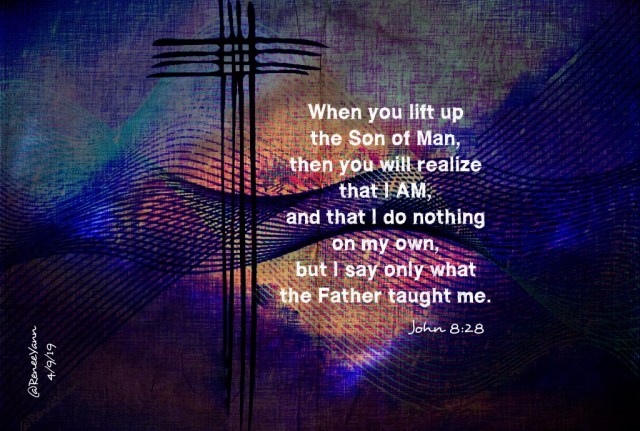
Jn8_28 sign

In the passage from Numbers, we have a restless crowd, confused and hungry, feeling directionless in a vast wilderness. They demand an answer from Moses:

Why have you brought us up from Egypt to die in this desert,
where there is no food or water?
We are disgusted with this wretched food!”

To make things worse, God, annoyed at their complaints, sends a bunch of snakes to hassle them.

In John’s Gospel, a disgruntled gathering of Pharisees pesters Jesus for a resolution to their questions. Even after all Jesus’ signs and preaching, they ask Him, “Who are you?”

In both instances, it is impossible for the questioners to receive the answer they seek because they lack faith.

In both instances, they are told that a sign will be lifted up before them and that then they will understand.

We’re on a life’s journey, at times confused and disgruntled, just like those ancient Hebrews.

We may be locked in faithless expectations of God, just like those debating Pharisees.

In our difficulties and challenges, will we be able to see the sign that God offers us? Not the one we design or demand – but the unexpected one rising up out of the depths of our faith?

Music: By Grace Alone – David Ward

The True Heart

Monday, April 8, 2019

Click here for readings

Today, in Mercy,  our readings offer copious lessons as well as an enthralling drama from the Book of Daniel.

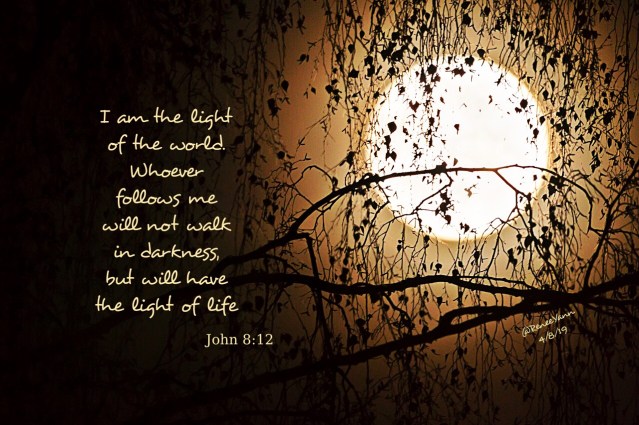
John8_12Light

We have heard the original story many times, and seen it repeated, down through the ages, in innumerable forms: a woman targeted by lecherous men, innocence betrayed by treachery, power exercised in destructive selfishness. When we see goodness vindicated in this story, we feel a certain victory for the ages! Am I right?

While the story’s surface addresses sexual assault and false condemnation, its heart is about power and truth. Susanna and Daniel embody these virtues. The two corrupt judges manifest their distortion.

In our Gospel, Jesus proclaims his identity as the Light of the World. He confronts the Pharisees because they “judge by appearances” rather than by truth. They use their power to oppress rather than to free.

Power and truth suffer terribly in today’s world. They are obscured by the same darknesses we see in the story of Susanna – conspiracy, secrecy, false accusation, dissimulation, malfeasance, and total disregard for human pain. Ultimately, it is always the innocent and poor who suffer most in such an atmosphere.

We pray today for Divine Light for every hidden darkness, for bravery like Daniel’s, for fidelity like Susanna’s, and for truthfulness to make us worthy of the Name of Christ.

Music: A mantra based on John 14 – The Spirit of Truth

Be Made New!

Sunday, April 7, 2019

Click here for readings

Today, in Mercy, Jesus writes new rules for life in the venerable Jerusalem dust.

Jn8_1_11JPG

Jesus enjoys an early morning walk from the Mount of Olives to the Temple. The weather, no doubt, was typically beautiful since others easily gathered and sat around Jesus to hear his teaching.

But the Pharisees, vigilant for an opportunity to condemn Jesus, executed a mean-hearted plot.

Dragging a woman “caught in the act of adultery” before the encircled men, they demanded Jesus’s judgment of the distraught woman.

Imagine the woman’s terror.  Her poverty and loneliness have already forced her into an ignoble commerce. Had she the chance, she surely would have chosen an easier life.

Now, her meager quarters have been broken into, her privacy invaded in the most intimate of circumstances.  Her adulterous accomplice has either turned her in, or absconded in cowardice. She is surrounded by brutal accusers, many of whom are likely her former customers.

But Jesus sees the woman, not her sin. He responds to her heart not her actions.  He also sees these evil, plotting men and responds to their veiled motivations.

Wouldn’t we love to know what Jesus scribbled in the Temple dirt as these blood-thirsty hypocrites hung over him?

Might it have been the names of those who also visited the woman on earlier nights?

Might it have been some of their hidden sins?

Challenged to cast the first stone if they were sinless, the plotters slowly slink away.  Jesus is left to forgive and heal this suffering woman.

Jesus tells her to go and sin no more, to -as the first reading says – “remember not the things of the past”. Jesus has made her into a new person by the power of his mercy.

May that renewing mercy touch us, and our world, where we sorely need it.

May it flow through our renewed hearts to everyone we encounter, no matter the circumstances.

Music:  Remember Not the Things of the Past – Bob Hurd

The Lamb of God

Saturday, April 6, 2019

Click here for readings

Today, in Mercy, our hearts begin to break for Jesus. He is the good, sweet Lamb being led to slaughter. And he knows it. He knows that the hard hearts he had so hoped to soften are recalcitrant. He knows that the souls he has longed to open to Love have turned to hate. He knows that the energy he had wished to turn to generous service has instead turned inward, fearful and self- protective.

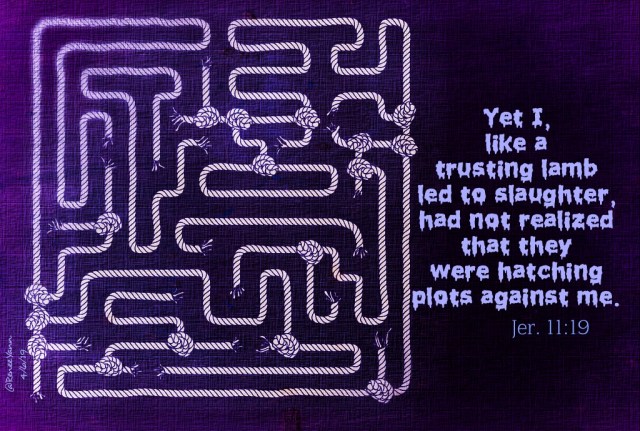
How his heart must have ached in these days before Calvary! Jeremiah gives us an insight in to the pain in today’s first reading. 

Jeremiah’s experience is a foreshadowing of Christ’s. As we pray with the passage, we might allow ourselves simply to share that pain as we look at our own grace-resistant world.

Jer.11_19 plot

Where do we find the opportunity to comfort Jesus today?

On a global basis, we see the persecution of innocence and vulnerability in our own world. We see corrupted laws used as an excuse to extinguish the human spirit. We see people coerced into the maze of power and political domination. We see the poor slaughtered on the altar of indifferent greed.

In our closer daily experience, we see people lost, isolated, infirm, bereaved, lonely and broken, even in small places. We may be tempted to leave their suffering for another caring touch. But we can do much to comfort by our listening, presence and honesty.

When we see these things, we see the Passion of Christ in our time. Let us listen to His suffering. Let us not pretend we care if we don’t act to comfort Him.

Music: Handel’s Messiah: Behold the Lamb of God


When the Hour Comes…

Friday, April 5, 2019

Click here for readings

Today, in Mercy, John let’s us know how difficult things were for Jesus. Even very early in John’s Gospel, doubt, criticism, jealousy, and hatred swirl around Jesus. He realizes that people are trying to kill Him. All this because he does good and preaches love! How can that be?

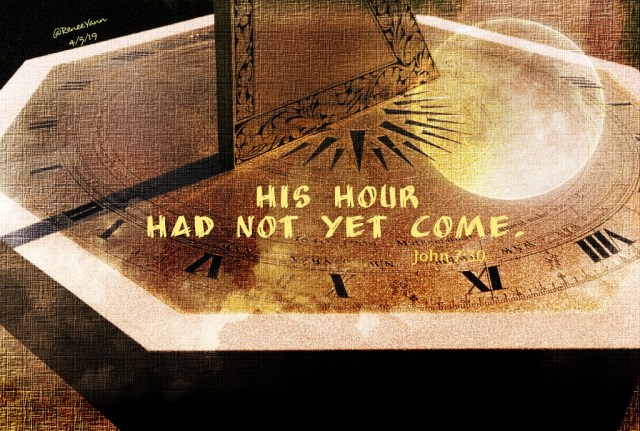
Jn7_30 hourJPG

Jesus upset the apple cart, and many people didn’t like that. They preferred control over love, familiarity over faith. There were others who wanted a more violent shake-up, a political overthrow rather than a spiritual transformation. Basically, people wanted to remake Jesus’s message in their own design. And we’ve been doing the same thing ever since.

Eventually these opposing forces meet in the contradiction of the Cross – that place where Love seems to lose, and Life seems to die. But when Jesus’s hour comes – that timeless moment when Eternal Love and Life break open in the Resurrection – our faith in Christ will be confirmed.

We pray today for all those experiencing great trauma or testing in their lives. May their faith sustain, restore and surprise them.

We pray for ourselves that, like Jesus, when our “hour comes” we are ready because we have already deepened and steadied our hearts in prayer and fidelity.

Music: I Need Thee Every Hour – Annie Hawks (May 28, 1836 – January 3, 1918), an American poet and Gospel hymnist who wrote a number of hymns with her pastor, Robert Lowry.

In 1872, the hymn by which Hawks is most widely known, “I Need Thee Every Hour”, was written. It is said to have been translated into more foreign languages than any other modern hymn at the time of her death. Hawks stated:— “For myself, the hymn was prophetic rather than expressive of my own experiences, for it was wafted out to the world on the wings of love and joy, instead of under the stress of personal sorrow.”

Be Light!

Thursday, April 4, 2019

Click here for readings

Jn5_35 light

Today, in Mercy, the Gospel gives us Jesus claiming his throne. He is setting his disciples straight before he is no longer with them. He drives home each of the pillars of his Messiahship, like so many stakes in the ground:

  • I have testimony greater than John’s.
  • The works that the Father gave me to accomplish,these works that I perform testify on my behalf that the Father has sent me.
  • The Father has testified on my behalf.
  • I came in the name of my Father.

Jesus is saying these things to his persecutors, but he says them for the benefit of his surrounding disciples. He wants them to remember these things to sustain them in the dark times to come.

In this passage, Jesus also pays a glorious compliment to John the Baptist:

He was a burning and shining lamp.

Now Jesus wants his followers, fired by their faith, to burn with an even greater light. He wants us to do the same, to burn with a flame steadied by Christ’s assurances, by the stunning testimony of his Passion, Death and Resurrection.

Music:  But Who May Abide the Day of His Coming – Handel

But who may abide the day of His coming, and who shall stand when He appeareth? For He is like a refiner’s fire.

God Remembers Us

Wednesday, April 3, 2019

Click here for readings

Today, in Mercy, we have, from Isaiah, one of most beloved and comforting passages in Scripture:

But Zion said, “The LORD has forsaken me;
my Lord has forgotten me.”
Can a mother forget her infant,
be without tenderness for the child of her womb?
Even should she forget,
I will never forget you.

Isaiah49_15 Mother

Not to forget is to remember. And to “re-member” is to put back together all the pieces that have fallen apart.

Because God “remembers” us at every moment in our lives, we are held together in that Divine Memory through all the exigencies of time. We are held together in the wholeness of our Creation, in the fullness of grace that God imagines for us. Even when we cannot feel or believe it, God continues to dream us into Eternal Life.

Whenever we feel in our hearts a lament like Zion’s

“The Lord has forsaken me…” 

let us place ourselves in the heart of our Mother God Who cradles us with infinite, unconditional affection and tenderness, Who is alway re-membering us.

Music: God Our Mother – The Litugists

This song, though short, is a good one to repeat as a mantra as we pray. Lyrics below

God our Father
Giver of daily bread
Blessing our hands and covering our heads

God our Mother
Leading us into peace
Drawing and comforting all those in need

Hallowed, hallowed be thy name
Hallowed, hallowed be thy name in all the earth

Jesus, brother, guiding our very step
Deliver us and grant places of rest
Jesus, savior, grabbing us from the grave
Cheating the fall and bringing the light of day

Law or Love?

Tuesday, April 2, 2019

Click here for readings

Today, in Mercy, our readings bring to mind the role of religion in our spiritual life.

take up mat 2

The dictionary defines religion as a particular system of faith and worship. The origin of the word “religion” is from the Latin “religare”: to bind.

In the magnificent passage from Ezekiel, we are given a metaphorical description of grace flowing from the Temple, the locus of faith for Israel. Ezekiel is led by a radiant vision to this source of abundant life symbolized by water. Slowly and incrementally, this abundance deepens for Ezekiel, until he is swimming in its grace. 

Ezekiel’s vision demonstrates what happens in us when religion, ritual and law enhance grace. The beauty, power and architectural symmetry of the Temple symbolize the great benefits of religious practice.

Our Gospel, on the other hand, shows us a Pharisaical religion built on empty practice and bereft of heart. When Jesus cures on the Sabbath, he moves beyond these skeletal boundaries to mercy, which is the reason for all religious practices.

take up mat
Jesus Cures on the Sabbath

Jesus shows us that when religion – and its ensuing ritual and law – bind grace, it needs to be set aside. His whole life was predicated on a faith which generated mercy, not sacrifice. The alleviation of suffering and need always supersede observance – even on the Sabbath.

When we see any so-called faith or religion which places law over mercy, we see an empty temple where the river of grace has run dry. Our culture is filled with fake holiness that measures, condemns and ostracizes others. We see religion distorted into political bullying. We see it redefined as an excuse for excessive wealth. We even see it used as legitimization for nationalism, violence, racism, and war.

Today’s readings tell us to be on guard. The forces which twist religion are very subtle and pervasive in our culture. They dress themselves in impressive words and practices, just like the Pharisees did, but their costumes hide an ugly hate and fear.

To the fearful and weak, these forces preach power – but it is a power over not for others.

Jesus has shown us what faithful practice looks like: mercy and love. It is vulnerable, courageous, inclusive, and humble. It sees the suffering of others and responds. It waters the Temple of our hearts to make them verdant with hope, joy and generosity.

Music: Come to the Water – John Foley, SJ and Matt Maher