Lent: Faith’s Legacy

March 23, 2022
Wednesday of the Third Week of Lent

Today, in God’s Lavish Mercy, our readings lead us to thank God for our heritage of faith. They remind us how precious that heritage is.


Moses, after reiterating the history of God’s goodness to Israel, enjoins the People:

Take care and be earnestly on your guard
not to forget the things which your own eyes have seen,
nor let them slip from your memory as long as you live,
but teach them to your children and to your children’s children.

Deuteronomy 4:6

Jesus, too, acknowledges the importance of his religious heritage:

Do not think that I have come to abolish the law or the prophets.
I have come not to abolish but to fulfill.
Amen, I say to you, until heaven and earth pass away,
not the smallest letter or the smallest part of a letter
will pass from the law,
until all things have taken place.

Matthew 5:17

Readings such as these move us to remember, consider and appreciate our own faith story – that personal unfolding of grace-filled circumstances which have led us to our present relationship with God.

For many of us, faith planted itself in us through the seeds of our family. We simply “inherited” the faith from our parents, grandparents and extended family. That community of blessings was extended through our parish and through our Christian education.

Take time to remember:

  • Who taught you your childhood prayers?
  • Who told you Bible stores?
  • Who prepared you for the sacraments?
  • Who served as a example to you of what a good Christian is like?

The answers will not be some big religious events. They will be simple memories that, at the time, you might not have even recognized as important to your faith life. I remember, for example, that every day in Lent my father walked with me to 6:30 AM Mass. Because many of the laborers had to be in work by 7:00 AM, the priest distributed communion for them before the Mass began. Just after the Gospel, Dad and all the other workmen would quietly exit to get to work on time. No fanfare. No preachy words. Just deep faith and devotion.

I can’t exactly put that lesson into words. All I know is that it deeply affected my faith and my profound appreciation for the Eucharist — and for my Dad.


And as you grew up and grew older:

  • Who has sincerely engaged with you on your questions of faith and morality?
  • Who has encouraged you to live a life of Christian service and social justice?
  • Who has modeled everyday holiness for you?
  • Who challenges and invites you to deeper spirituality and Christian witness?

The names and faces who have come into your prayer as you considered these questions — these people are the “fathers” and “mothers’ of your faith.

And of course, these questions may lead us
to ask ourselves how we have done these things
for the generations now depending on us
for the transmission of faith?


Poetry: On Religion – Kahlil Gibran (1883-1931)

And an old priest said, Speak to us of Religion.
And he said:
Have I spoken this day of aught else?
Is not religion all deeds and all reflection,
And that which is neither deed nor reflection, but a wonder and a surprise ever springing in the soul, even while the hand hew the stone or tend the loom?
Who can separate his faith from his actions, or his belief from his occupations?
Who can spread his hours before him, saying, “This for God and this for myself’ This for my soul, and this other for my body?”
All your hours are wings that beat through space from self to self.
He who wears his morality but as his best garment were better naked.
The wind and the sun will tear no holes in his skin.
And he who defines his conduct by ethics imprisons his song-bird in a cage.
The freest song comes not through bars and wires.
And he to whom worshipping is a window, to open but also to shut, has not yet visited the house of his soul whose windows are from dawn to dawn.

Your daily life is your temple and your religion.
Whenever you enter into it take with you your all.
Take the plough and the forge and the mallet and the lute,
The things you have fashioned in necessity or for delight.
For in revery you cannot rise above your achievements nor fall lower than your failures.
And take with you all men:
For in adoration you cannot fly higher than their hopes nor humble yourself lower than their despair.

And if you would know God be not therefore a solver of riddles.
Rather look about you and you shall see Him playing with your children.
And look into space; you shall see Him walking in the cloud, outstretching His arms in the lightning and descending in rain.
You shall see Him smiling in flowers, then rising and waving His hands in trees.


Music: e Will Serve the Lord

Lent: The Miracle of Transformation

March 21, 2022
Monday of the Third Week of Lent

Today, in God’s Lavish Mercy, our readings are about prophets and miracles, brought to us by Elisha and Jesus.

The core of the readings is this: some of us want the prophets’ miracles, but we don’t want their challenge to live in God’s freedom. We want their cures, only to return to lifestyles that make us spiritually sick or imprisoned.

Wanting to write about these themes, I decided to check with my favorite Old Testament scholar, Walter Brueggemann to see if he had any wisdom on the story of Naaman.

Naaman
Naaman brings his retinue and gifts… from The Pictorial History of Palestine and the Holy Land (1844) by John Kitto

Well, Walter certainly did…. something so good and wise that I won’t water it down with my own words. The link is below. It’s a little long, but so worth your reading and meditation. I hope you’ll take the time.

Click here for Walter Brueggemann’s article


Music: some instrumental music to listen to while you’re reading

Lent: Finding the Firelight

March 20, 2022
Third Sunday of Lent

Today, in God’s Lavish Mercy, we have powerful readings – they get really serious about repentance!

Ex3_2 bush

In our first reading, Moses has been on a kind of decades-long sabbatical on his father-in-law’s homestead. After the young glory days of Egypt, and the ensuing drama that exiled him, Moses had settled into being a humble shepherd in Midian. He probably wasn’t expecting a fiery, direct telegram from God.

But God never gives up on the eternal plan for us. So God, divinely expert at getting our attention, conflagrates a bush right in front of Moses.  Supposedly, it was not that unusual for this type of bush to spontaneously combust in the desert heat. What was unusual was for it not to be consumed by the fire.

God then delivers a message of overwhelming fidelity to Moses:

Thus shall you say to the Israelites:
The LORD, the God of your fathers,
the God of Abraham, the God of Isaac, the God of Jacob,
has sent me to you.
This is my name forever;
thus am I to be remembered through all generations.

Because of God’s mercy and fidelity, the Israelites – and Moses – are getting another chance to live in covenant with God.


In our Gospel, Jesus tells his followers not to ignore such chances. He reminds his listeners that life is fragile and transitory. If we haven’t acted on God’s invitation to grace, we might lose the opportunity. Again, using the symbol of a tree…

Jesus told them this parable:
“There once was a person who had a fig tree planted in his orchard,
and when he came in search of fruit on it but found none,
he said to the gardener,
‘For three years now I have come in search of fruit on this fig tree
but have found none.
So cut it down.


If we look back over our lives, we might realize that there have been burning bushes all over the place – times and events where life offered us a choice between grace or sin, smallness of heart, and selfishness. When we chose grace, the bush kept burning and was not consumed. It lit our way to deeper covenant with God.

These final weeks of Lent offer us countless encouragements to look for God’s Fire in our hearts and to go deeper toward the Light. Let’s not ignore them.


Poetry: Burning Bush by Karle Wilson Baker, American poet, (1878 – 1960)

This poem refers to the plant “burning bush”, but carries sentiments touching on faith, hope and peace similar to our readings.

My heart, complaining like a bird,
Kept drooping on her weary nest:
” Oh, take me out under the sky,
Find me a little rest! “

I took her out under the sky,
I climbed a straggling, sandy street,
Where little weathered houses sag,
And town and country meet,

And in the corner of a yard
Unkempt, forlorn, and winter-browned,
A single sprig of Burning Bush
Thrust up from the bare ground.

It bore no leaf as yet — one flower,
Three pointed buds of pure rose-flame:
Up whirred my heart, circled in air,
Back to my bosom came.

And that was all I showed to her —
I could not find another thing —
But, ” Take me home again, ” she cried,
” And I will sing and sing! “


Music: Fire of God – Craig Musseau

Lent: A Man of Sorrows

March 18, 2022
Friday of the Second Week of Lent

Today, in God’s Lavish Mercy, there is a great sadness in our readings.

The poignant opening line from Genesis immediately strikes us:

Israel loved Joseph best of all his sons,
for he was the child of his old age.
Genesis 37:3

Joseph

We picture young Joseph in his beautiful rainbow coat and, under an olive tree’s shade, old Jacob(Israel) proudly, tenderly, watching him play.

As the story ensues to reveal the later betrayal of Joseph’s jealous brothers, we are left astounded. Such treachery, especially among brothers, sickens the heart.


Our Gospel picks up the sad theme because Joseph and his brothers are archetypes of Christ’s story with humankind.

800px-The_Wicked_Husbandman_(The_Parables_of_Our_Lord_and_Saviour_Jesus_Christ)_MET_DP835802
The Wicked Husbandman by John Everett Millais shows the owner’s murdered son

Jesus tells a parable in which he is actually the unnamed main character. He is the Son sent by a loving Father. He is the one rejected, beaten and killed by the treacherous tenants of his Father’s garden.


We know from our familiarity with Scripture that both these stories ultimately come to glorious conclusions. But today’s readings do not take us there. They leave us standing, mouths dropped open, at the dense meanness of the human heart, at the soul’s imperviousness to grace, at the profound sadness Jesus felt at this point in his ministry.


In our prayer today, let’s just be with Jesus, sharing his sadness for the meanness still poisoning our world. We might pray today for Jesus suffering in the Ukrainian people and throughout the many war-infested parts of our world.

May our prayers comfort Jesus with our desire to be open to God’s Grace and Mercy. May they lead us to actions of peace and justice on behalf of our suffering sisters and brother.


Poetry: Despised and Rejected – Christina Rossetti

My sun has set, I dwell
In darkness as a dead man out of sight;
And none remains, not one, that I should tell
To him mine evil plight
This bitter night.
I will make fast my door
That hollow friends may trouble me no more.

“Friend, open to Me.”–Who is this that calls?
Nay, I am deaf as are my walls:
Cease crying, for I will not hear
Thy cry of hope or fear.
Others were dear,
Others forsook me: what art thou indeed
That I should heed
Thy lamentable need?
Hungry should feed,
Or stranger lodge thee here?

“Friend, My Feet bleed.
Open thy door to Me and comfort Me.”
I will not open, trouble me no more.
Go on thy way footsore,
I will not rise and open unto thee.

“Then is it nothing to thee? Open, see
Who stands to plead with thee.
Open, lest I should pass thee by, and thou
One day entreat My Face
And howl for grace,
And I be deaf as thou art now.
Open to Me.”

Then I cried out upon him: Cease,
Leave me in peace:
Fear not that I should crave
Aught thou mayst have.
Leave me in peace, yea trouble me no more,
Lest I arise and chase thee from my door.
What, shall I not be let
Alone, that thou dost vex me yet?

But all night long that voice spake urgently:
“Open to Me.”
Still harping in mine ears:
“Rise, let Me in.”
Pleading with tears:
“Open to Me that I may come to thee.”
While the dew dropped, while the dark hours were cold:
“My Feet bleed, see My Face,
See My Hands bleed that bring thee grace,
My Heart doth bleed for thee,
Open to Me.”

So till the break of day:
Then died away
That voice, in silence as of sorrow;
Then footsteps echoing like a sigh
Passed me by,
Lingering footsteps slow to pass.
On the morrow
I saw upon the grass
Each footprint marked in blood, and on my door
The mark of blood forevermore.

Music:  Handel: Messiah – He was despised and rejected – sung by Jakub Józef Orliński

“He was despised and rejected of men; a man of sorrows, and acquainted with grief.
(Isaiah 53, v.3)
“He gave his back to the smiters, and his cheeks to them that plucked off the hair: he hid not his face from shame and spitting.” (Isaiah 50, v.6)

Lent: A Heart Become Christ’s

March 17, 2022
Thursday of the Second Week of Lent
St. Patrick’s Day

Sláinte means “health” in Irish and Scottish Gaelic

Today, in God’s Lavish Mercy, Jeremiah challenges us with this powerful question:

More tortuous than all else is the human heart,
beyond remedy; who can understand it?

Jeremiah 7:9

Fortunately, Jeremiah also provides an answer to the question:

I, the LORD, alone probe the mind
and test the heart,
To reward everyone according to their ways,
according to the merit of their deeds.

Jeremiah 17:10

If we invite God into our hearts, we will be guided to this blessing:

Blessed is the one who trusts in the LORD,
            whose hope is the LORD.
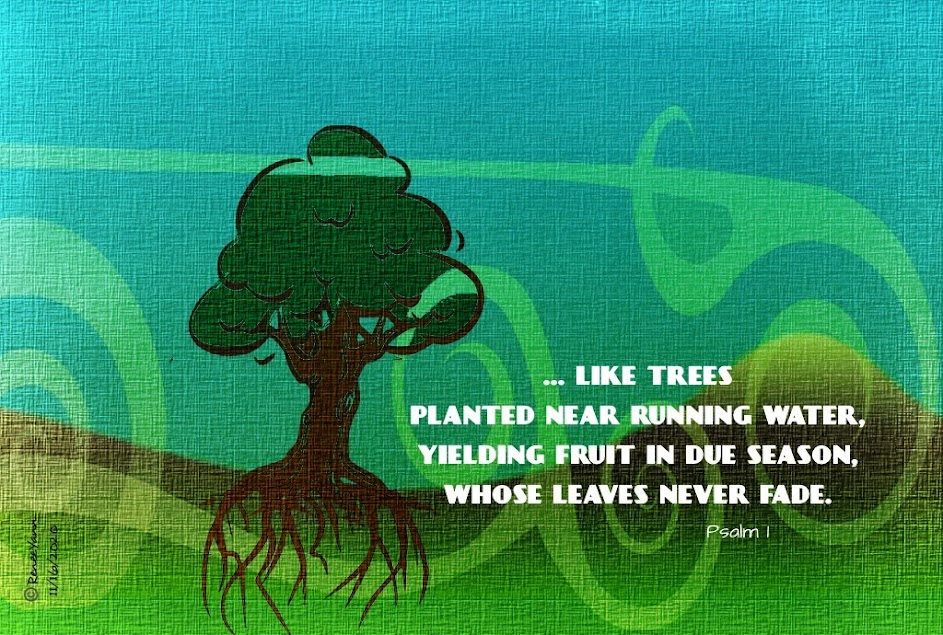
That person is like a tree planted beside the waters
            that stretches out its roots to the stream:
It fears not the heat when it comes,
            its leaves stay green;
In the year of drought it shows no distress,
            but still bears fruit.

Jeremiah 17: 7-8

Poetry: Our dear St. Patrick, on this glorious feast, gives us the perfect prayer to strengthen and direct our hearts:

I arise today
Through the strength of heaven;
Light of the sun,
Splendor of fire,
Speed of lightning,
Swiftness of the wind,
Depth of the sea,
Stability of the earth,
Firmness of the rock.
I arise today
Through God’s strength to pilot me;
God’s might to uphold me,
God’s wisdom to guide me,
God’s eye to look before me,
God’s ear to hear me,
God’s word to speak for me,
God’s hand to guard me,
God’s way to lie before me,
God’s shield to protect me,
God’s hosts to save me
Afar and anear,
Alone or in a mulitude.
Christ shield me today
Against wounding
Christ with me, Christ before me, Christ behind me,
Christ in me, Christ beneath me, Christ above me,
Christ on my right, Christ on my left,
Christ when I lie down, Christ when I sit down,
Christ in the heart of everyone who thinks of me,
Christ in the mouth of everyone who speaks of me,
Christ in the eye that sees me,
Christ in the ear that hears me.
I arise today
Through the mighty strength
Of the Lord of creation

Music: The Breastplate of St. Patrick – Sara Hart

And an added prayer for the ancestral homeland and the ancestors who have blessed us with its spirit …

There were people of all ages
Gathered ’round the gable wall
Poor and humble men and women,
Little children that you called
We are gathered here before you
And our hearts are just the same
Filled with joy at such a vision
As we praise your name

Golden Rose, Queen of Ireland
All my cares and troubles cease
As I kneel with love before you
Lady of Knock, our Queen of Peace

Though your message was unspoken
Still the truth in silence lies
As we gaze upon your vision,
And the truth I try to find
Here I stand with John the teacher,
And with Joseph at your side
And I see the Lamb of God
On the Altar glorified

Golden Rose, Queen of Ireland
All my cares and troubles cease
As we kneel with love before you
Lady of Knock, our Queen of Peace

And the Lamb will conquer
And the woman clothed in the sun
Will shine Her light on everyone
Yes,
The Lamb will conquer
And the woman clothed in the sun
Will shine Her light on everyone

Golden Rose, Queen of Ireland
All my cares and troubles cease
As I kneel with love before you
Lady of Knock, my Queen of Peace
Lady of Knock, my queen of peace

Lent: To Drink from the Cup

March 16, 2022
Wednesday of the Second Week of Lent

Today, in God’s Lavish Mercy, we learn a lesson in humble leadership, thanks once again to “Mrs. Zebedee”.

Mk 10_38 cup

Our Gospel recounts the story of the mother of James and John interceding for her sons with Jesus. Like many overprotective mothers, she intervenes even into their adult lives. She wants to make sure they get the best deal for their investment with Jesus.


Listen, I understand and love her! I would be the same way with my kids if I had any. I often say it’s best I had none because “Overprotective Me” would have had to shadow them to school, dances, playgrounds etc. until they were about 35 years old!

But the point of this Gospel story isn’t Mrs. Zebedee’s overprotectiveness.  It has little to do with Mrs. Zebedee at all.


The point is that “Mrs. Zebedee” (like many of us) has missed the whole POINT. The Gospel story is about US and the integrity of our choice to live a life in the pattern of Jesus.

Christ’s disciples have decided to follow a man who says things like this:

  • The last shall be first and the first, last.
  • Unless you lay down your life, you cannot follow me.
  • Whoever takes the lowly position of a child is the greatest in the Kingdom of Heaven.

The seats at Christ’s right and left, which Mrs. Zebedee requests for her sons, will bring them rewards only through humility and sacrificial service.


Here’s the way a 14th century artist imagined the Zebedee family. (Dad looks happy!)

sons of zebedee
Mary Salome and Zebedee with their Sons James the Greater and John the Evangelist
(c.1511) by Hans von Kulmbach, Saint Louis Art Museum

Jesus is gentle with “Mrs. Zebedee”. He understands how hard it is for any of us to comprehend the hidden glory of a deeply Christian life. We are surrounded by a world that screams the opposite to us:

  • Me first!
  • Stand your ground!
  • Good guys finish last!

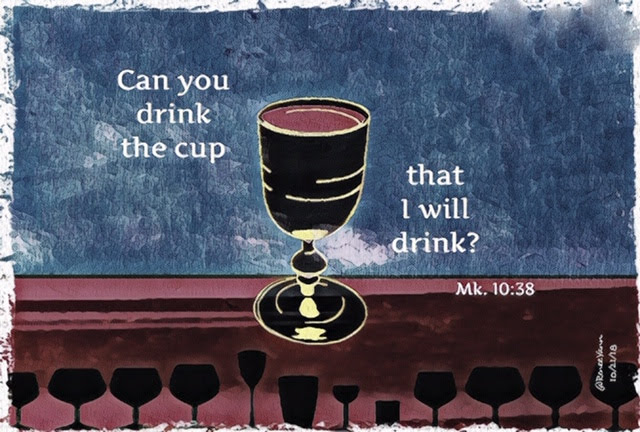
So Jesus turns to James and John (and to us). One can imagine the bemused look on Christ’s face. He knows the hearts of his disciples. He knows they have already given themselves to him. So he asks them for a confession of faith, “Can you drink the cup that I will drink?”

veronese-le-christ-rencontrant-la-femme-et-les-fils-de-zebedee_-_grenoble
The meeting of Christ with Zebedee’s wife and sons by Paolo Veronese

Their humble, faith-filled answer no doubt stuns their mother. She is left in wonder at the holy men her sons have become. Perhaps it is the beginning of her own deep conversion to Christ.

As we pray with this passage,
where do we find ourselves in this scene?
How immediate, sincere, and complete
is our response to Jesus’ question:
“Can you drink the cup….?”

Prose: by Henri J.M. Nouwen, Can You Drink the Cup?

Drinking the cup that Jesus drank
is living a life in and with the spirit of Jesus,
which is the spirit of unconditional love.
The intimacy between Jesus and Abba, his Father,
is an intimacy of complete trust,
in which there are no power games,
no mutually agreed upon promises,
no advance guarantees.
It is only love
—pure, unrestrained, and unlimited love.
Completely open, completely free.
That intimacy gave Jesus the strength to drink his cup.
That same intimacy Jesus wants to give us
so that we can drink ours.


Music: The More I Seek You – Kari Jobe

Lent: Becoming Mercy

March 14, 2022
Monday of the Second week of Lent

bruggemann

Today, in God’s Lavish Mercy, our reading from Daniel gives us one of the Great Prayers of the Old Testament (according to Walter Brueggemann’s like-named book.)

The Book of Daniel and chapter nine in particular, have been the subjects of extensive biblical exegesis. Chapter nine in considered one of the Messianic Prophecies, Old Testament markers pointing to Christ. So there is much we could study about today’s first reading.

But how might we pray with it – for our times and our lives?


Naming the sins of all the People, Daniel’s great prayer is a plea for mercy:

Lord, great and awesome God,
you who keep your merciful covenant 
toward those who love you
and observe your commandments! …
… yours, O Lord, our God, 
are compassion and forgiveness!


Three themes, so strikingly germane to Lent, arise from Daniel’s prayer:

Repentance
Forgiveness
Transformation


Our Responsorial Psalm picks up this plea to Mercy for mercy:

Remember not against us the iniquities of the past;
may your compassion quickly come to us,
for we are brought very low.
R.    Lord, do not deal with us according to our sins.
Help us, O God our savior,

because of the glory of your name;
Deliver us and pardon our sins
for your name’s sake.


The questions for each of us as we pray today —

Is there someplace in my life longing for such mercy and healing? 
Where can my spirit grow from repentance, forgiveness, and transformation?

be Mercy

In our Gospel Jesus tells us how to open our hearts to this merciful healing.

Be merciful, just as your Father is merciful.
Stop judging and you will not be judged.
Stop condemning and you will not be condemned.
Forgive and you will be forgiven.
Give and gifts will be given to you;
a good measure, packed together, shaken down, and overflowing,
will be poured into your lap.
For the measure with which you measure
will in return be measured out to you.

There it is in black and white. Whether or not the advice changes my heart is up to me!


Poetry: To Live in the Mercy of God – Denise Levertov

To lie back under the tallest
oldest trees. How far the stems
rise, rise
               before ribs of shelter
                                           open!

To live in the mercy of God. The complete
sentence too adequate, has no give.

Awe, not comfort. Stone, elbows of
stony wood beneath lenient
moss bed.

And awe suddenly
passing beyond itself. Becomes
a form of comfort.
                      Becomes the steady
air you glide on, arms
stretched like the wings of flying foxes.
To hear the multiple silence
of trees, the rainy
forest depths of their listening.

To float, upheld,
                as salt water
                would hold you,
                                        once you dared.

                  .To live in the mercy of God.
To feel vibrate the enraptured

waterfall flinging itself
unabating down and down
                              to clenched fists of rock.
Swiftness of plunge,
hour after year after century,
                                                   O or Ah
uninterrupted, voice
many-stranded.
                              To breathe
spray. The smoke of it.
                              Arcs
of steelwhite foam, glissades
of fugitive jade barely perceptible. Such passion—
rage or joy?
                              Thus, not mild, not temperate,
God’s love for the world. Vast
flood of mercy
                      flung on resistance.


Music: Kyrie Eleison (Lord, have mercy) Beethoven- Missa Solemnis

Lent: The Way Home

March 13, 2022
Second Sunday of Lent

Today, in God’s Lavish Mercy, our readings are about types of citizenship, that condition of knowing we are fully and irrevocably home.


In Genesis, Abraham is given a land for himself and his descendants as a sign of God’s abiding Presence.

“I am the LORD who brought you from Ur of the Chaldeans
to give you this land as a possession.”

Genesis 15:5

In Philippians, Paul tells us that, truly, “our citizenship is in heaven”.

But our citizenship is in heaven,
and from it we also await a savior, the Lord Jesus Christ.

Philippians 3:20

In Luke, the transfigured Jesus shows us what that heavenly reality will be like. It is a kind of glorious belonging that Peter wants to hold on to … to capture in a tent.

Jesus took Peter, John, and James
and went up the mountain to pray.
While he was praying his face changed in appearance
and his clothing became dazzling white.

Luke 9:28

But the Creator makes it clear this dwelling and citizenship exists only in the heart of Christ where we are called to listen and live our lives.

While Peter was still speaking,
a cloud came and cast a shadow over them,
and they became frightened when they entered the cloud.
Then from the cloud came a voice that said,
“This is my chosen Son; listen to him.”

Luke 9:34-35

These readings confirm that, in God, we are a people not bound by borders, ethnicities, religious cult, or any other human categorization.

Every human being belongs to God and is called to live in the fullness of that Creation. This is our shared Divine citizenship demanding a reverent mutuality for one another’s lives.


Think about that in contrast to the incomprehensible outrage of Putin’s unprovoked war against the Ukrainian people. Think about it relative to the many armed conflicts in Africa, Asia and Latin and South America.

Think of our Oneness in God compared to talk of border walls, ethnic and religious bans, white supremacy, anti-semitism, islamophobia and all the other manufactured ways we try to isolate people from this Divine citizenship which makes us brothers and sisters in God.

On this Sunday when our readings remind us of where and to whom each of our hearts belongs, let us pray for our world – for those suffering from war and isolation, and for the unfortunate lost souls executing that suffering. In differing ways, each of them, and we, need continuing redemption.


Poetry: The Man He Killed – Thomas Hardy

Had he and I but met
By some old ancient inn,
We should have sat us down to wet
Right many a nipperkin!

But ranged as infantry,
And staring face to face,
I shot at him as he at me,
And killed him in his place.

I shot him dead because –
Because he was my for,
Just so: my foe of course he was;
That’s clear enough; although

He thought he’d ‘list, perhaps,
Off-hand like – just as I –
Was out of work — had sold his traps —
No other reason why.

Yes; quaint and curious war is!
You shoot a fellow down
You’d treat if met where any bar is,
Or help to half-a-crown.


Music: The Sins of War – Timothy Shortell

Careful … Compassionate

March 12, 2022
Saturday of the First Week of Lent

Moses spoke to the people, saying:
“This day the LORD, your God,
commands you to observe
these statutes and decrees.
Be careful, then,
to observe them
with all your heart
and with all your soul.


Today, in God’s Lavish Mercy, Moses tells us this:

Be careful, then …

Dt. 26:17

Be careful of what? Does Moses mean be careful like, ”Don’t fall down the steps!”. Or does he mean be careful like, “Hold tenderly to love in your life.”?

In this passage from Deuteronomy, Moses goes on to say one of my favorite biblical phrases:

… today the LORD is making this agreement with you:
you are to be a people peculiarly his own, as he promised you…

Dt. 26:18

Since the 17th century, the word “peculiar” has taken on the meaning of “odd” or “unusual”.  But the original sense comes from the Latin peculiarismeaning “of private property”

Moses is reminding us that we belong to God and God to us in a covenant similar to, but far exceeding, the mutuality of a marriage.

So we should “be careful”, full of care, in appreciation for this infinite love.


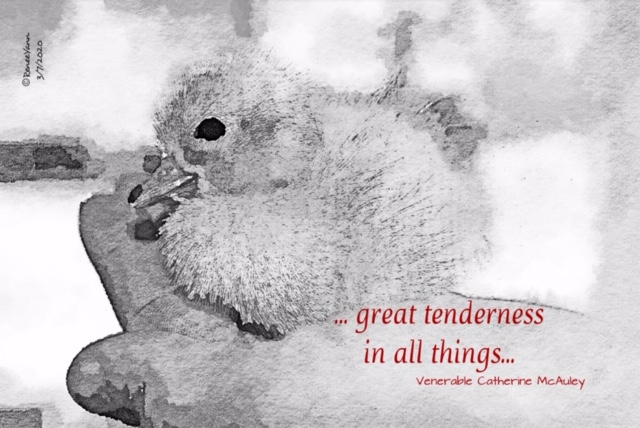
chick
When Catherine McAuley instructed her sisters in the practice of caring for the sick, she told them always to use great tenderness…

In our Gospel, Jesus tells us how to take this exquisite care of our precious relationship with God:

But I say to you, love your enemies,
and pray for those who persecute you,
that you may be children of your heavenly Father,
for God makes the sun rise on the bad and the good,
and causes rain to fall on the just and the unjust.
… Be compassionate as your Heavenly Father is compassionate.

Matthew 5: 44-48

So, let’s be careful of love today
when we find this precious God
in our sisters and brothers
and in all God’s Creation.
“great tenderness in all things…”


Poetry: Tenderness – Rumi

When inward tenderness 
finds the secret hurt,
pain itself will crack the rock and
Ah! let the soul emerge.

Music:  Compassion Hymn – The Gettys

Lent: A Love Beyond Measure

March 11, 2022
Friday of the First Week of Lent

Today, in God’s Lavish Mercy, our readings could confuse us with their threads of legalistic logic. We see several examples of “if-then” admonitions that can make us picture God as an accountant measuring every choice we make.

If the wicked man turns, … then he shall surely live
If the virtuous man turns, … then none of his good deeds shall be remembered.
If you, O Lord, mark iniquities … then who can stand.
If you go to the altar unreconciled … then leave and be reconciled


Sometimes, we can get obsessive about the “if-then” aspects of religion. And IF we do, THEN we probably miss the whole point. Because folded in today’s “if-then” seesaws is the truth of these passages: that the Lord does NOT sit miserly in Heaven to mark our iniquities.

God measures the righteousness of love.

Thus says the LORD, “Let not a wise man boast of his wisdom, and let not the mighty man boast of his might, let not a rich man boast of his riches; but let him who boasts boast of this, that he understands and knows Me, that I am the LORD who exercises lovingkindness, justice and righteousness on earth; for I delight in these things,” declares the LORD.

Jeremiah 9: 23-24

Today’s Responsorial Psalm offers us a beautiful prayer for today as we pray in the embrace of God’s Lavish Mercy:

I trust in the LORD;
my soul trusts in his word.
My soul waits for the LORD
more than sentinels wait for the dawn.
Let Israel wait for the LORD.
For with the LORD is kindness
and with him is plenteous redemption;
And he will redeem Israel
from all their iniquities.

Psalm 130: 5-7

Let’s wait for the Lord today
to see how God’s Grace
invites us to
the righteousness of Love.


Poetry: Measurement by Ella Hines Stratton

Great tasks are but seldom given out,
Great deeds are but for the few,
Yet the little acts, not talked about,
May need a faith as true.

Some things are better for being small,
For a breath who wants a cyclone?
And the flower which would die in a water-fall
Grows bright with a drop alone.

The small is not always a little thing—
The stroke of a pen may move
A crown from off the brow of a king,
A government from its groove.

At times our measurement cannot be right,
For, when tried by the Master’s test,
So little a gift as a widow’s mite
Out-balances all the rest.

And whether a thing be great or small
As none of us may plan,
It is safe to do, what we do at all,
The very best that we can.


Music: Everlasting Love – Mark Hendrickson & Family (Lyrics below)