Today, in Mercy, as Holy Week deepens, so does confusion, fear, and even betrayal among Christ’s disciples.
In today’s Gospel, we see Judas turn from his own truth to a disastrous treachery.
We see John and Peter full of questions, confused by the turn of events. Jesus foretells the impending denial by Peter, his chosen successor.
The great trials of Christ’s Passion and Death emerge from the shadows of rumor and deception. Jesus makes it clear that the end is near.
As we read the passage, we can feel the fear mounting in everyone but Jesus. In him, we see see Isaiah’s description strengthening- the Lord’s Glorious Servant rising as the Light of Nations.
Fear destroys while trust and hope liberate.
Praying with this Gospel this morning, I remember the face of a woman I had seen on the evening news. At a contentious political rally, she was loudly shouting her preference to live under a dictator rather than live in a country “full of filthy immigrants”. She thought her raging made her strong. But I saw a person filled with ignorance and fear.
I can’t forget her face. It so saddened me to see the child of a beautiful God so distorted by weakness, prejudice and fear. She could no longer see the face of God in another human being. I think hers would have been the face I saw on Judas, had I met him as he left the Last Supper.
Fear is a disfiguring disease. It seeps into our heart and mind to blind and deafen us to God’s power in our life. It cripples our graced potential. It eventually kills the “glorious servant” we too have been called to become.
Paula D’Arcy says this:
Who would I be, and what power
would be expressed in my life, if I were not dominated by fear?
It’s a powerful question.
How does fear keep me:
from loving?
from hoping?
from believing?
from giving?
from receiving?
Today’s Responsorial Psalm, filled with beautiful phrases, offers us a heartfelt prayer as we place our fears in God’s hands:
R. I will sing of your salvation. In you, O LORD, I take refuge; let me never be put to shame. In your justice rescue me, and deliver me; incline your ear to me, and save me. R. I will sing of your salvation. Be my rock of refuge, a stronghold to give me safety, for you are my rock and my fortress. O my God, rescue me from the hand of the wicked. R. I will sing of your salvation. For you are my hope, O LORD; my trust, O God, from my youth. On you I depend from birth; from my mother’s womb you are my strength. R. I will sing of your salvation. My mouth shall declare your justice, day by day your salvation. O God, you have taught me from my youth, and till the present I proclaim your wondrous deeds. R. I will sing of your salvation.
Today, in Mercy, we have, from Isaiah, one of most beloved and comforting passages in Scripture:
But Zion said, “The LORD has forsaken me; my Lord has forgotten me.” Can a mother forget her infant, be without tenderness for the child of her womb? Even should she forget, I will never forget you.
Not to forget is to remember. And to “re-member” is to put back together all the pieces that have fallen apart.
Because God “remembers” us at every moment in our lives, we are held together in that Divine Memory through all the exigencies of time. We are held together in the wholeness of our Creation, in the fullness of grace that God imagines for us. Even when we cannot feel or believe it, God continues to dream us into Eternal Life.
Whenever we feel in our hearts a lament like Zion’s
“The Lord has forsaken me…”
let us place ourselves in the heart of our Mother God Who cradles us with infinite, unconditional affection and tenderness, Who is alway re-membering us.
Music: God Our Mother – The Litugists
This song, though short, is a good one to repeat as a mantra as we pray. Lyrics below
God our Father
Giver of daily bread
Blessing our hands and covering our heads
God our Mother
Leading us into peace
Drawing and comforting all those in need
Hallowed, hallowed be thy name
Hallowed, hallowed be thy name
Hallowed, hallowed be thy name in all the earth
Jesus, brother, guiding our very step
Deliver us and grant places of rest
Jesus, savior, grabbing us from the grave
Cheating the fall and bringing the light of day
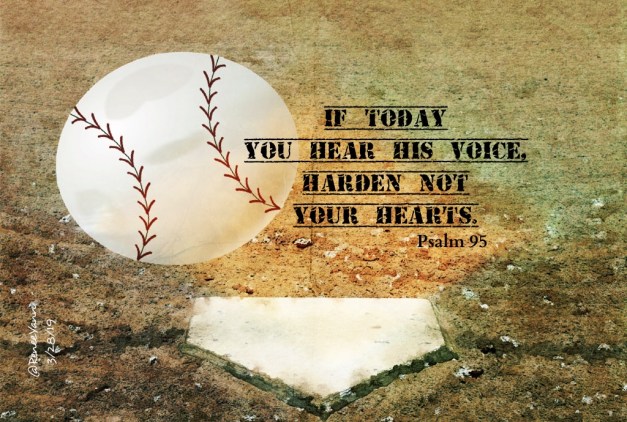
Looking at my graphic for today, you may wonder how I’m going to connect that command to baseball’s Opening Day. Watch! 😊⚾️
There’s no better feeling than an “opening day” feeling. No matter how bad you were last year, you have a clean slate for the new season. You’ve had a chance to assess your weaknesses and rehab them. You’ve been able to add some strengths you needed but had neglected. You’ve got another carte blanche chance to be everything you were born to be! Now you’re standing in the batter’s box just listening for that thrilling phrase, “Play ball!”
Guess what! You’ve been doing all the same things throughout Lent. You’ve taken a look at your life and straightened a few things out. You’ve dusted off the plate, so to speak, and you’re ready to start fresh as Easter approaches.
Today’s readings are telling us to tune in, listen, for God’s coaching in our lives. The game of life plays out for us in ways we could never imagine. But God imagines- and will guide us through to home plate if we just “hear God’s voice and harden not our hearts”.
Today, in Mercy, our readings describe God’s lavish mercy and the expectation for our reciprocity.
The passage from the Book of Daniel, written in lilting prose, quotes the prayer of Azariah. It gives us several phrases to savor in our own prayer, depending on the particular disposition of our heart on any given day:
To whom you promised …. like the stars of heaven, or the sand on the shore of the sea. What has God promised you to give you hope in your life? Can you call on those promises today in your prayer?
For we are reduced, O Lord, beyond any other nation… Are you feeling sad, disconnected, humiliated or depressed? Can you give these feelings to God and open your heart to healing?
We have in our day no prince, prophet, or leader, no burnt offering, sacrifice, oblation, or incense, no place to offer first fruits, to find favor with you. Do you ever feel abandoned by the institutions we all once depended on, whether Church, government, law etc.? Can we pray for the courage to depend only on God in all things?
Now we follow you with our whole heart… Have our life circumstances brought us to the point of placing ourselves totally in God’s care? Can we pray with that peaceful and holy abandonment?
Deliver us by your wonders, and bring glory to your name, O Lord.Can our prayer be one of giving glory to God for all the blessings in our lives?
God has been so good to us! Our Gospel enjoins us to be reciprocally good to others.
Music: Give Me Your Eyes – An interesting song by rock singer Brian Heath. As his plane is landing one night, he receives a grace to pray for new eyes — eyes that see and love all humanity as God does.
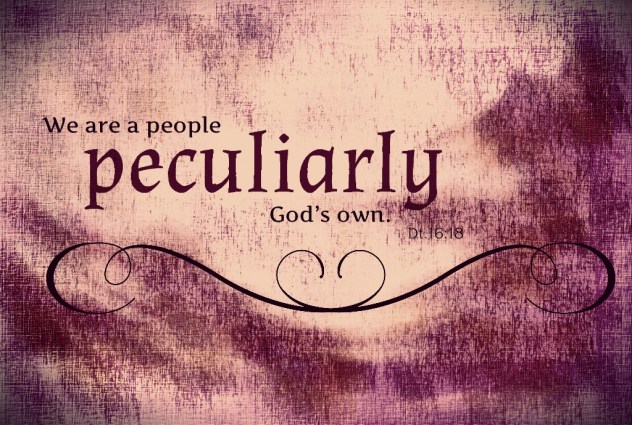
Today, in Mercy, in our reading from Deuteronomy, God tells the People that they are loved in a unique way. So are you!
God says: And today the LORD is making this agreement with you:
You are to be a people peculiarly his own
The word “peculiarly” may strike us exactly as it says. It is a word whose usage has changed over the centuries. We think of it today as “odd” or “unusual”, a meaning given it only since the 18th century.
The word’s actual derivation is this:
Mid-15th century: “belonging exclusively to one person,” from Latin peculiaris “of one’s own (property),” from peculium “private property,” literally “property in cattle” (in ancient times the most important form of property).
So Deuteronomy is telling us that we are to God as the herdsman’s possessions are to herdsman. We belong to God Who has invested everything in us. God will protect, nurture and strengthen us in a relationship of mutual investment and harmony — IF we do our part which is:
… provided you keep all his commandments, he will then raise you high in praise and renown and glory above all other nations he has made, and you will be a people sacred to the LORD, your God, as he promised.
In our Gospel, Jesus outlines exactly how to do this.
Love your enemies, and pray for those who persecute you, that you may be children of your heavenly Father, for he makes his sun rise on the bad and the good, and causes rain to fall on the just and the unjust.
In today’s world, so full of hate, greed and retribution, I suppose we are “peculiar”, in both senses of the word, when we live as Jesus asks.
Music: How He Loves Is ~David Crowder Band ( The Song may not resonate with at first, but stick with it. There is something deep in this melody..)
Today, in Mercy, the voice of the Lord, in both Leviticus and Matthew, makes one thing abundantly clear: God lives in the “least ones”, and this is where we must love and serve God.
In our first reading, God tells the people to be holy – not by offering God sacrifice and praise, but like this:
Don’t steal.
Don’t lie.
Don’t make an empty vow.
Don’t cheat.
Don’t hurt those already hurting.
Don’t make false judgments.
Don’t be prejudiced.
Don’t do nasty gossip.
Don’t ignore your neighbor’s need.
Don’t hate, take revenge on, or begrudge others.
In other words,
You shall love your neighbor as yourself.
I am the LORD.
We are so accustomed to this passage that we may miss how startling it is! God asks nothing of us for himself! God asks only that we love God through our neighbor.
In Matthew’s Gospel, Jesus reiterates this command in the form of positive actions, adding how we will be judged by it. Jesus says:
Feed the hungry.
Hydrate the thirsty.
Welcome the stranger.
Clothe the naked.
Care for the sick.
Visit the imprisoned.
We are called to these works of mercy on many levels. Certainly the call is first to the physically suffering – the homeless, the refugee, the uncared for, the abused.
But we also know from our own experience that there are all kinds of hungers and thirsts in the human heart. There is a loneliness that persists even in a crowd. There is naked fear, depression and isolation even among those otherwise warmly dressed. There are sicknesses that come from selfishness and others that come from abandonment. There are prisons without bars.
We do not have to look far to find the “least ones” whom God wishes us to love and serve.
We do not have to look far to find God. We just have to look deep.
Music: The Circle of Mercy – Jeannette Goglia, RSM
Today, in Mercy, our reading from 1 Samuel tells the intriguing tale of David’s magnanimity toward Saul. Saul is enraged and jealous of David whom Samuel has anointed as king to replace Saul. David is continually in Saul’s crosshairs.
But one night, David stealthily enters Saul’s camp. Even though he has a chance to kill Saul, David spares his life out of respect for his kingship.
While it’s not exactly “love for his enemies”, David does demonstrate a largeness of spirit that foretells today’s Gospel. This gracious spirit demonstrates that David is in right relationship (covenant) with God.
Our Gospel is part of Jesus’s Great Sermon in which he restates and renews the covenant of right relationship. If our spirits are true to God, we will love as God loves. We are to be merciful as God is merciful.
This Law of Love is the essence of life in Christ. It is a profoundly challenging call.
How hard it must have been for David as he stood, spear in hand, over his sleeping enemy – over the one trying to kill him!
How hard it is for us not to be vengeful, retaliatory, and parsimonious when we feel threatened or exploited.
But we are called, in Christ, to the New Covenant of love. By that call, we are endowed with a right spirit.
Today, Jesus asks us to love, forgive, and judge all others as we ourselves would want to be treated. He asks us to live with a divinely magnanimous heart.
Let us pray for the strength to respond.
Music: O Mercy – Stu Garrard, Matt Maher and Audrey Assad
Today, in Mercy, hidden in our readings, are three challenges.
Where do we put our
and
How do we
?
In our Jeremiah reading, an unfortunate person has placed faith in an untrustworthy “friend”, and the results – typical of Jeremiah – are dire. But the prophet goes on to say that the one who puts trust and faith in the Lord will flourish like a tree near running water.
In the reading from Corinthians, Paul has some strong words about hope:
If for this life only we have hoped in Christ,
we are the most pitiable people of all.
That sentence is powerful! It can be a life-long meditation.
In other words, where is our hope focused? Do we hope for comfort, success, healing, peace only for this earthly life? If so, we are missing the point, Paul says. Our one true hope is to be united with God in eternal life and our choices should lead to that fulfillment.
In our Gospel, Jesus shows us how to love by placing before us the “least ones” whom he loves best. We too are to love and comfort those who are poor, hungry, bereaved and despised by the heartless.
Today’s readings invite us to look at our life. Is it blossoming with joy, grace and spiritual vitality? Or are we struggling with all the doubts, worries, dramas and depression that come from a self-absorbed life?
Maybe, like me, you sometimes look at a person carrying great difficulty in their lives and wonder at their joy. How can they maintain that trust and joy in the midst of their challenges? These readings offer an answer. They have put their faith and hope in the right place. They have learned to love like God.
Music: Faith, Hope and Love ~ David Ogden ( Lyrics below.)
Faith, hope, and love: let these remain among you.
Faith, hope, and love: the greatest of these is love.
The love of Christ has gathered us together; let us rejoice and be glad in him.
Let us fear and love the living God, and love each other from the depths of the heart.
When we are together, we should not be divided in mind;
Let there be an end to bitterness and quarrels, and in our midst be Christ our God.
In company with the blessed, may we see your face in glory,
pure and unbounded joy for ever and ever.
I give you a new commandment, love one another as I have loved you.
Faith, hope, and love, let these remain among you.
Faith, hope and love; the greatest of these is love.
Today, in Mercy, our readings are about being opened by the grace and power of God.
In the Genesis passage, Eve and Adam eat fruit from the tree of knowledge. Their eyes are opened to good and evil.
In our reading from Mark, Jesus opens the ears of a deaf man, allowing him both to hear and to speak clearly.
In the first passage, Adam and Eve’s new “openness” brings a burden. Their innocence now fractured, they must forever exercise their free will to choose good over evil.
In the second passage, the deaf man’s burdens are lifted. He now has no obstacle to hearing and proclaiming God’s mercy.
Like Adam and Eve, we bear the burden of knowledge in a disturbing and sinful world. Every choice challenges us to be and do good in a culture of human degradation.
But like the man who was cured, we have been transformed by Christ’s touch. We see, not just with the discernment of good and evil, but with God’s eyes – with the power to see past death to life.
This power is expressed in our lives by:
our faith in a world filled with uncertainty
our hope in a world trapped in despair
our love in a world blinded by selfishness and greed
Every morning, God wakes us and says, “Ephphatha – be a sign of my gracious openness in your world because I am that Openness for you.”
Today, in our prayer, let us find what is closed in us. We may have judged and shut out someone. We may have given up on a good and necessary practice. We may have withdrawn from a generous responsibility. We may have capitulated to a life-sapping addiction. Inside us somewhere, we may have curled up into“No”!
God calls us to be a “Yes” to the abundance of life and grace God offers us. We are called to open, to be “uncurled”. This poem by e.e.cummings has helped me on occasion with such uncurling.
love is a place
& through this place of
love move
(with brightness of peace)
all places
yes is a world
& in this world of
yes live
(skillfully curled)
all worlds






 Lavish Mercy