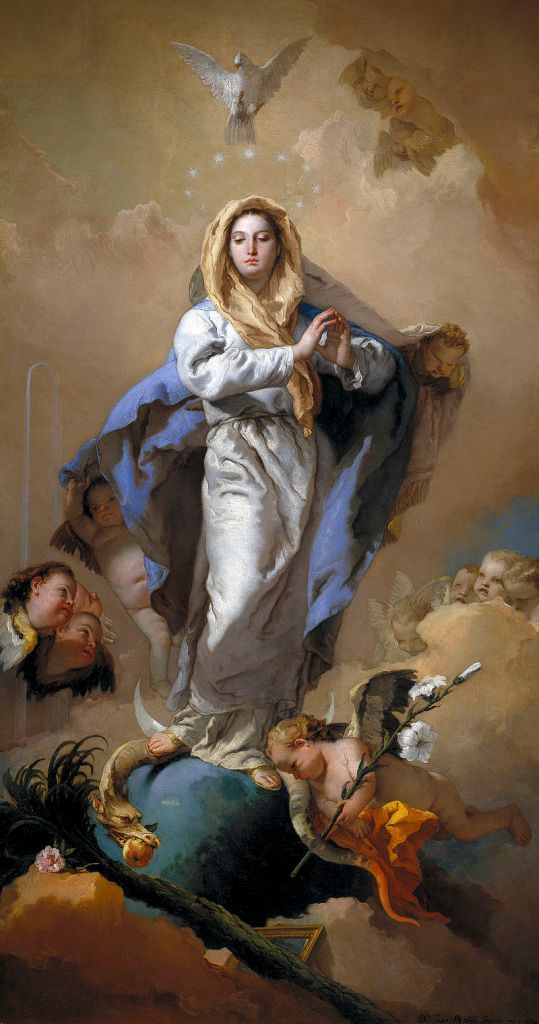
Today, in God’s Lavish Mercy, we celebrate the feast of the Immaculate Conception, the belief that Mary was conceived without the mark of Original Sin.
Beyond the intricate theology underlying the feast, what we treasure is that Mary made a holy place for Christ to dwell as he became incarnate, grew, lived and redeemed the world in loving mercy.
Mary chose to be God’s partner in our salvation!
Our Gospel story today invites us to pray with the most important word Mary ever said, “Yes. Fiat.” Think about it. Mary was not TOLD to become the mother of Jesus. She was asked. She could have said, “No” … for any number of logical reasons.
I’m too young.
I’ve got other plans.
Joseph won’t like this!
I don’t trust angels.
I’m afraid.
I’m sure all of us can think of a few more very rational excuses to tell our “angels” that we’re not ready for transforming grace. I know I have quite a few of them tucked away from over the years. But Mary calls us to something more – she calls us to an “irrational season” of love which responds to the irrational love God has for us!
Mary chose to say “Yes.” She may not have had to work too hard to find the courage for it within her heart. She was already “full of grace”, having lived her short young life with a faithfulness that made her ready to bear Christ to the world.
We pray that, with Mary’s love and guidance, we too may find the courage to make choices that sanctify our hearts, readying them to receive God.
God will come to us today – not on angel’s word – but in the human form of someone poor, sick, desperate, heart-broken, lonely, or just plain tired. May our faith allow us to respond as Mary did, with a grace-fullness that invites God into the situation.
Today, in God’s Lavish Mercy, we encounter readings that are probably not among anyone’s favorites. In the epistle, Paul is trying to demonstrate to the Galatians how blessed they are to have inherited the promise given to Abraham.
In the Gospel, there is a lot of talk about evil spirits, divided kingdoms, and good old Beelzebub. It’s not really a day when you’ll say, “Gosh, those readings inspired me!”
Is it worth sticking with the daily readings in such a case? I think so.
There is always a string lying among these sacred words that we can tie to our own hearts. For me today, that string is wrapped around the Responsorial Psalm:
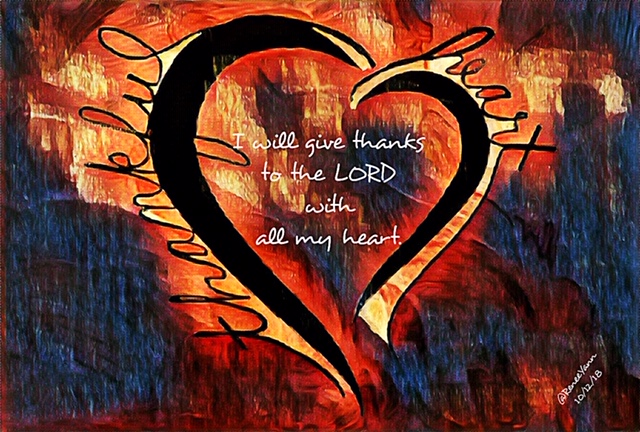
I will give thanks to the Lord with all my heart.
Just as the Galatians have inherited God’s promise, so have we. Just as the Kingdom of God has come upon Jesus’ followers, it has come upon us. God’s fidelity remains with us through all the “demons” that might annoy or threaten us. God’s graciousness has already redeemed us for an eternal life beyond their reach.
So let’s have intentionally grateful hearts today. Everything – yes, everything – in our lives is a gift, if we but have the grace to unwrap it with humility, openness and gratitude.
On this day when we pray in a special way to Our Lady of the Rosary, we can take the opportunity, while fingering our beads, to relive her life with her. We talk with her about the major mysteries of our own lives which have invited us to birth Christ into our own times and experiences.
Poetry: Theotokos – Malcolm Guite
You bore for me the One who came to bless
And bear for all and make the broken whole.
You heard His call and in your open ‘yes’
You spoke aloud for every living soul.
Oh gracious Lady, child of your own child,
Whose mother-love still calls the child in me,
Call me again, for I am lost, and  wild
Waves suround me now. On this dark sea
Shine as a star and call me to the shore.
Open the door that all my sins would close
And hold me in your garden. Let me share
The prayer that folds the petals of the Rose.
Enfold me too in Love’s last mystery
And bring me to the One you bore for me.
Today, in God’s Lavish Mercy, we pray with Our Mother of Sorrows.
Poetry: Pieta – R.S. Thomas
Always the same hills
Crown the horizon,
Remote witnesses
Of the still scene
And in the foreground
The tall Cross,
Sombre, untenanted,
Aches for the Body
That is back in the cradle
of a maid's arms.
Mary’s greatest sorrows came, not from circumstances she bore personally, but from her anguish at the sufferings of Jesus. Like so many mothers, fathers, spouses, children and friends, Mary suffered because she loved.
It is so hard to watch someone we love endure pain. We feel helpless, lost and perhaps angry. We may be tempted to turn away from our beloved’s pain because it empties us as well as them.
This is the beauty and power of Mary’s love: it did not turn. Mary’s devotion accompanied Jesus – even through crucifixion and death – for the sake of our salvation.
Today’s liturgy offers us the powerful sequence “Stabat Mater”.
Stabat Mater Dolorosa is considered one of the seven greatest Latin hymns of all time. It is based upon the prophecy of Simeon that a sword was to pierce the heart of His mother, Mary (Lk 2:35). The hymn originated in the 13th century during the peak of Franciscan devotion to the crucified Jesus and has been attributed to Pope Innocent III (d. 1216), St. Bonaventure, or more commonly, Jacopone da Todi (1230-1306), who is considered by most to be the real author.
The hymn is often associated with the Stations of the Cross. In 1727 it was prescribed as a Sequence for the Mass of the Seven Sorrows of Mary (September 15) where it is still used today. (preces-latinae.org)
Music: Stabat Mater Dolorosa – Giovanni Battista Pergolesi (1710-1736) This is a glorious rendition. If you have time, you might listen to it on a rainy afternoon or evening as you pray.
STABAT Mater dolorosa iuxta Crucem lacrimosa, dum pendebat Filius.
At the Cross her station keeping, stood the mournful Mother weeping, close to Jesus to the last.
Cuius animam gementem, contristatam et dolentem pertransivit gladius.
Through her heart, His sorrow sharing, all His bitter anguish bearing, now at length the sword has passed.
O quam tristis et afflicta fuit illa benedicta, mater Unigeniti!
O how sad and sore distressed was that Mother, highly blest, of the sole-begotten One.
Quae maerebat et dolebat, pia Mater, dum videbat nati poenas inclyti.
Christ above in torment hangs, she beneath beholds the pangs of her dying glorious Son.
Quis est homo qui non fleret, matrem Christi si videret in tanto supplicio?
Is there one who would not weep, whelmed in miseries so deep, Christ’s dear Mother to behold?
Quis non posset contristari Christi Matrem contemplari dolentem cum Filio?
Can the human heart refrain from partaking in her pain, in that Mother’s pain untold?
Pro peccatis suae gentis vidit Iesum in tormentis, et flagellis subditum.
Bruised, derided, cursed, defiled, she beheld her tender Child All with bloody scourges rent:
Vidit suum dulcem Natum moriendo desolatum, dum emisit spiritum.
For the sins of His own nation, saw Him hang in desolation, Till His spirit forth He sent.
Eia, Mater, fons amoris me sentire vim doloris fac, ut tecum lugeam.
O thou Mother! fount of love! Touch my spirit from above, make my heart with thine accord:
Fac, ut ardeat cor meum in amando Christum Deum ut sibi complaceam.
Make me feel as thou hast felt; make my soul to glow and melt with the love of Christ my Lord.
Sancta Mater, istud agas, crucifixi fige plagas cordi meo valide.
Holy Mother! pierce me through, in my heart each wound renew of my Savior crucified:
Tui Nati vulnerati, tam dignati pro me pati, poenas mecum divide.
Let me share with thee His pain, who for all my sins was slain, who for me in torments died.
Fac me tecum pie flere, crucifixo condolere, donec ego vixero.
Let me mingle tears with thee, mourning Him who mourned for me, all the days that I may live:
Iuxta Crucem tecum stare, et me tibi sociare in planctu desidero.
By the Cross with thee to stay, there with thee to weep and pray, is all I ask of thee to give.
Virgo virginum praeclara, mihi iam non sis amara, fac me tecum plangere.
Virgin of all virgins blest!, Listen to my fond request: let me share thy grief divine;
Fac, ut portem Christi mortem, passionis fac consortem, et plagas recolere.
Let me, to my latest breath, in my body bear the death of that dying Son of thine.
Fac me plagis vulnerari, fac me Cruce inebriari, et cruore Filii.
Wounded with His every wound, steep my soul till it hath swooned, in His very Blood away;
Flammis ne urar succensus, per te, Virgo, sim defensus in die iudicii.
Be to me, O Virgin, nigh, lest in flames I burn and die, in His awful Judgment Day.
Christe, cum sit hinc exire, da per Matrem me venire ad palmam victoriae.
Christ, when Thou shalt call me hence, by Thy Mother my defense, by Thy Cross my victory;
Quando corpus morietur, fac, ut animae donetur paradisi gloria. Amen.
While my body here decays, may my soul Thy goodness praise, safe in paradise with Thee. Amen.
From the Liturgia Horarum. Translation by Fr. Edward Caswall (1814-1878)
Today, in God’s Lavish Mercy, we have a choice in readings between the 24th Monday or the Holy Name of Mary. I’m going with Mary, especially since the passage from Corinthians is about people overeating and drinking (and stealing parking spots?) at their church meetings. Can you imagine! Well, yes, maybe we’ll save that for another day. 😉
When the fullness of time had come,
God sent his Son, born of a woman..
Galatians 4:4
It’s such a brief and simple phrase from Galatians, isn’t it? But it carries the whole possibility of our redemption, and the infinite hope of our eternal life.
We owe it all, of course to God’s Mercy, but in a very real way, we owe it to this “woman” who is not even named in Galatians!
Today, let’s simply say her holy name in prayer, asking to be strengthened in faith, courage, hope, fidelity, and love – the hallmarks of her life.
Praying her name slowly – Mary……… Mary…… Mary …. let each breath deepen our love for her. Let each quiet thought ask for the grace to learn from her.
Today, in God’s Lavish Mercy, on our Blessed Mother’s birthday, we pray with the beautiful final verses of Psalm 13.
These verses embody an immense shift in form from the psalm’s early lines. Early on, the psalmist cries out four times, “How long, O Lord?”.
How long:
Will you forget me?
Will you hide your face from me?
Must I carry sorrow in my soul?
Will my enemy triumph over me?
Referring to these early verses reminds us that Mary’s life was full of sorrow as well as joy. On a feast like today, we think of Mary in her heavenly glory. But in her lifetime, Mary suffered many sorrows. She was an unwed mother, a refugee, and a widow. She was the mother of an executed “criminal” and a leader of his persecuted band.
The Julian of Norwich, “Her Showing of Love”
What was it that allowed Mary to transcend sorrow and claim joy? Our psalm verses today help us to understand. They show the psalmist turning to heartfelt prayer., trusting God’s abiding protection.
Look upon me, answer me, LORD, my God! Give light to my eyes lest I sleep in death, Lest my enemy say, “I have prevailed,” lest my foes rejoice at my downfall.
That deep trust ultimately yields not only peace, but joy. Mary, singer of the Magnificat, is the quintessence of that holy joy.
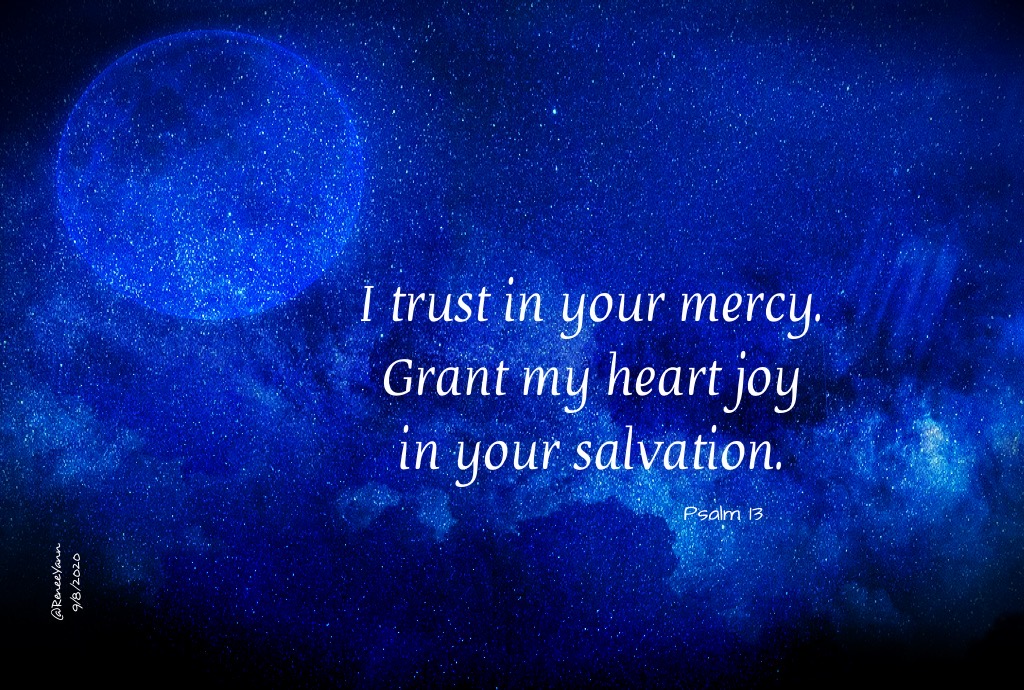
But I trust in your mercy. Grant my heart joy in your salvation, I will sing to the LORD, Who has dealt bountifully with me!
Today, in our prayer, we ask Mary to love and guide us through the challenges of our lives.
Poetry: Three Days – Madeleine L’Engle
Friday:
When you agree to be the mother of God
you make no conditions, no stipulations.
You flinch before neither cruel thorn nor rod.
You accept the tears; you endure the tribulations.
But, my God, I didn't know it would be like this.
I didn't ask for a child so different from others.
I wanted only the ordinary bliss,
to be the most mundane of mothers.

Saturday:
When I first saw the mystery of the Word
made flesh I never thought that in his side
I'd see the callous wound of Roman sword
piercing my heart on the hill where he died.
How can the Word be silenced? Where has it gone?
Where are the angel voices that sang at his birth?
My frail heart falters. I need the light of the Son.
What is this darkness over the face of the earth?
Sunday:
Dear God, He has come, the Word has come again.
There is no terror left in silence, in clouds, in gloom.
He has conquered the hate; he has overcome the pain.
Where, days ago, was death lies only an empty tomb.
The secret should have come to me with his birth,
when glory shone through darkness, peace through strife.
For every birth follows a kind of death, and only after pain comes life.
Alleluia, alleluia. Mary is taken up to heaven; a chorus of angels exults.
Today, in God’s Lavish Mercy, we honor Mary on the Feast which celebrates her assumption, “that the Immaculate Mother of God, the ever Virgin Mary, having completed the course of her earthly life, was assumed body and soul into heavenly glory.”
The Catholic Church’s teaching on the Assumption of Mary was promulgated in 1950 by Pope Pius XII in an Apostolic Constitution entitled “MUNIFICENTISSIMUS DEUS (the Most Bountiful God). Having experienced the horrors of a world war, and aware of the ensuing evils of the Cold War, Pope Pius XII looked to Mary for healing for himself and the whole world:
We, who have placed our pontificate under the special patronage of the most holy Virgin, to whom we have had recourse so often in times of grave trouble, we who have consecrated the entire human race to her Immaculate Heart in public ceremonies, and who have time and time again experienced her powerful protection, are confident that this solemn proclamation and definition of the Assumption will contribute in no small way to the advantage of human society, since it redounds to the glory of the Most Blessed Trinity, to which the Blessed Mother of God is bound by such singular bonds. It is to be hoped that all the faithful will be stirred up to a stronger piety toward their heavenly Mother, and that the souls of all those who glory in the Christian name may be moved by the desire of sharing in the unity of Jesus Christ’s Mystical Body and of increasing their love for her who shows her motherly heart to all the members of this august body. And so we may hope that those who meditate upon the glorious example Mary offers us may be more and more convinced of the value of a human life entirely devoted to carrying out the heavenly Father’s will and to bringing good to others. Thus, while the illusory teachings of materialism and the corruption of morals that follows from these teachings threaten to extinguish the light of virtue and to ruin the lives of men by exciting discord among them, in this magnificent way all may see clearly to what a lofty goal our bodies and souls are destined. Finally it is our hope that belief in Mary’s bodily Assumption into heaven will make our belief in our own resurrection stronger and render it more effective.
MUNIFICENTISSIMUS DEUS (42)
Maybe, like me, the fact of the Assumption doesn’t matter a whole lot to you. I love Mary whether she was “assumed” or not. But in its time, the declaration of this dogma was important in order to turn the world’s focus toward Mary, a figure of goodness, courage, love, mercy and justice – virtues desperately necessary for healing in the aftermath of war.
Our own world could surely benefit from a prayerful, loving contemplation of Mary.
Mary was a woman so open to God that she enfleshed God’s Spirit in the person of Jesus. She was a vessel of love – for God and for all Creation. By living her ordinary life with extraordinary love and holy courage, she became blessed.
Mary, the Blessed Mother of all of us, can teach us to love, reverence, strengthen and support one another when we pray with her as we meet her in the Gospel.
Elizabeth said:
“Blessed are you who believed that what was spoken to you by the Lord would be fulfilled.”
And Mary said: “My soul proclaims the greatness of the Lord; my spirit rejoices in God my Savior for God has looked on my simplicity with favor . From this day all generations will call me blessed: the Almighty has done great things for me and holy is God’s Name. In every generation, God has mercy on those with holy reverence and awe.
Poetry: The Blessed Virgin compared to the air we breathe… by Gerard Manley Hopkins, SJ
( I know this is a really long poem, and Hopkins can seem a little convoluted. But the images in this poem are spectacular … even if you just read a bit at a time. It’s so worth it.)
Wild air, world-mothering air, Nestling me everywhere, That each eyelash or hair Girdles; goes home betwixt The fleeciest, frailest-flixed Snowflake; that’s fairly mixed With, riddles, and is rife In every least thing’s life; This needful, never spent, And nursing element; My more than meat and drink, My meal at every wink; This air, which, by life’s law, My lung must draw and draw Now but to breathe its praise, Minds me in many ways Of her who not only Gave God’s infinity Dwindled to infancy Welcome in womb and breast, Birth, milk, and all the rest But mothers each new grace That does now reach our race— Mary Immaculate, Merely a woman, yet Whose presence, power is Great as no goddess’s Was deemèd, dreamèd; who This one work has to do— Let all God’s glory through, God’s glory which would go Through her and from her flow Off, and no way but so.
I say that we are wound With mercy round and round As if with air: the same Is Mary, more by name. She, wild web, wondrous robe, Mantles the guilty globe, Since God has let dispense Her prayers his providence: Nay, more than almoner, The sweet alms’ self is her And men are meant to share Her life as life does air. If I have understood, She holds high motherhood Towards all our ghostly good And plays in grace her part About man’s beating heart, Laying, like air’s fine flood, The deathdance in his blood; Yet no part but what will Be Christ our Saviour still. Of her flesh he took flesh: He does take fresh and fresh, Though much the mystery how, Not flesh but spirit now And makes, O marvellous! New Nazareths in us, Where she shall yet conceive Him, morning, noon, and eve; New Bethlems, and he born There, evening, noon, and morn Bethlem or Nazareth, Men here may draw like breath More Christ and baffle death; Who, born so, comes to be New self and nobler me In each one and each one More makes, when all is done, Both God’s and Mary’s Son. Again, look overhead How air is azurèd; O how! nay do but stand Where you can lift your hand Skywards: rich, rich it laps Round the four fingergaps. Yet such a sapphire-shot, Charged, steepèd sky will not Stain light. Yea, mark you this: It does no prejudice. The glass-blue days are those When every colour glows, Each shape and shadow shows. Blue be it: this blue heaven The seven or seven times seven Hued sunbeam will transmit Perfect, not alter it. Or if there does some soft, On things aloof, aloft, Bloom breathe, that one breath more Earth is the fairer for. Whereas did air not make This bath of blue and slake His fire, the sun would shake, A blear and blinding ball With blackness bound, and all The thick stars round him roll Flashing like flecks of coal, Quartz-fret, or sparks of salt, In grimy vasty vault. So God was god of old: A mother came to mould Those limbs like ours which are What must make our daystar Much dearer to mankind; Whose glory bare would blind Or less would win man’s mind. Through her we may see him Made sweeter, not made dim, And her hand leaves his light Sifted to suit our sight. Be thou then, thou dear Mother, my atmosphere; To wend and meet no sin; Above me, round me lie Fronting my froward eye With sweet and scarless sky; Stir in my ears, speak there Of God’s love, O live air, Of patience, penance, prayer: World-mothering air, air wild, Wound with thee, in thee isled, Fold home, fast fold thy child.
Music: Magnificat – Mina
Magnificat anima mea Magnificat Dominum et exsultavit spiritus meus In Deo salutari meo Magnificat, Magnificat Quia respexit humilitatem ancillae suae Ecce enim ex hoc beatam me dicent omnes generationes Magnificat anima mea Magnificat Dominum et exsultavit spiritus meus In Deo salutari meo Magnificat, Magnificat Quia fecit mihi magna qui potens est Et sanctum nomen ejus Magnificat, Magnificat Dominum et exsultavit spiritus meus In Deo Magnificat, Magnificat
Lyrics translation
My soul magnifies the The lord and my spirit rejoices In God my saviour Magnificat, Magnificat For he has looked on his servant in her lowliness Behold this blessed shall call me blessed all generations The Magnificat my soul Magnifies the The lord and my spirit rejoices In God my saviour Magnificat, Magnificat Because I made a big who is able And holy is his name Magnificat, Magnificat The lord and my spirit rejoices In God Magnificat, Magnificat
Today, in God’s Lavish Mercy, we have the option of celebrating the Memorial of Our Lady of Mount Carmel in place of the 15th Saturday in Ordinary Time. And since it is Saturday, traditionally Mary’s day, I have chosen to pray with those readings.
Our Alleluia Verse captures in a short sentence exactly why Mary is the perfect model for a Christian life: she heard and acted on God’s word.
Alleluia, alleluia. Blessed are those who hear the word of God and observe it.
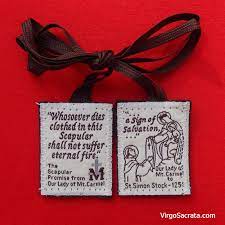
Many of you will have been introduced to Our Lady of Mt Carmel as young children. Perhaps you, as I did, received a brown scapular when you made your First Communion. My second grade teacher convinced me that, by wearing that scapular, I had become a very dedicated Christian and friend of Jesus and the Blessed Mother.
According to the Vatican’s Congregation for Divine Worship, the Brown Scapular is “an external sign of the filial relationship established between the Blessed Virgin Mary, Mother and Queen of Mount Carmel, and the faithful who entrust themselves totally to her protection, who have recourse to her maternal intercession, who are mindful of the primacy of the spiritual life and the need for prayer.
Wikipedia
My little brown scapular is long gone, set aside perhaps when my maturing fashions were inhibited by it in seventh of eighth grade. But the devotion to Mary which it initiated has never left me. It has grown, changed and deepened over these seventy years, but its roots are still entwined with that sepia necklace Sister Grace Loretta once placed in my little hand.
When I entered the Sisters of Mercy in the early 60s, I was so delighted that Our Lady of Mt. Carmel was honored as one of our patron saints. We did it up big back then by wearing our church cloaks and special habit sleeves to Mass on her feastday.
As I pray the Magnificat in today’s Responsorial Psalm, I reflect that Mary has become not only a trusted friend and model for my spiritual life. Her profound faith and poverty of spirit challenge and inspire my deeper understanding of the Gospel in today’s world.
The Mary I love today is a very different woman from the one I idealized in my youth. This change in perception has come about through reflection on the works of modern theologians such as those referred to below. Some of these books are out of print and/or expensive but reviews and excerpts are available online and can be helpful to one’s prayerful study.
For today’s prayer, let us open our hearts to the deep inspiration of Mary of Nazareth. I have referred readers to this excellent article by Elizabeth Johnson — and I do so again — as a great place to start:
Today, in God’s Lavish Mercy, we pray with Mary, blessed mother of Jesus, and thus of us all who have been born anew in him.
Alleluia, alleluia. Blessed is the Virgin Mary who kept the word of God and pondered it in her heart.
What can this beautiful mother teach us, she who kept and pondered the very Word of God?
In order to grow fully in to God’s heart and will, this holy woman held the Word – the way the dough holds yeast to allow its own transformation.
So that she might blossom into the fullness of her own beauty, she caressed faith’s slow-forming bud in the dark protection of her prayer.
Like all of us, Mary was not divine. She was not supernatural. She was an ordinary, good woman who loved God with extraordinary passion.
She spent her days clearing her heart-space of any clutter that would keep her from God. And slowly, that Divine Presence ripened and revealed itself in the flash of an angel wing and the soundless message that would transform all time.
We too, in our particular ways, are asked to allow God the space to imagine Divinity into flesh through our human experience.
Mary believed that God could and would do such a miracle for love of us. She let the Truth of Jesus live, not only in Him, but in her own mother’s life.
This generous mother then became the first disciple, keeping company with Jesus through his Passion, Death and Resurrection
Indeed, we have much to learn from her.
Poetry: Annunciation – Denise Levertov
We know the scene: the room, variously furnished,
almost always a lectern, a book; always the tall lily. Arrived on solemn grandeur of great wings, the angelic ambassador, standing or hovering, whom she acknowledges, a guest.
But we are told of meek obedience. No one mentions courage. The engendering Spirit did not enter her without consent. God waited.
She was free to accept or to refuse, choice integral to humanness.
____________________________
Aren’t there annunciations of one sort or another in most lives? Some unwillingly undertake great destinies, enact them in sullen pride, uncomprehending. More often those moments when roads of light and storm open from darkness in a man or woman, are turned away from in dread, in a wave of weakness, in despair and with relief. Ordinary lives continue. God does not smite them. But the gates close, the pathway vanishes.
______________________________
She had been a child who played, ate, slept like any other child – but unlike others, wept only for pity, laughed in joy not triumph. Compassion and intelligence fused in her, indivisible.
Called to a destiny more momentous than any in all of Time, she did not quail, only asked a simple, ‘How can this be?’ and gravely, courteously, took to heart the angel’s reply, perceiving instantly the astounding ministry she was offered:
to bear in her womb Infinite weight and lightness; to carry in hidden, finite inwardness, nine months of Eternity; to contain in slender vase of being, the sum of power – in narrow flesh, the sum of light. Then bring to birth, push out into air, a Man-child needing, like any other, milk and love –
but who was God.
This was the moment no one speaks of, when she could still refuse.
A breath unbreathed, Spirit, suspended, waiting.
______________________________
She did not cry, ‘I cannot. I am not worthy,’ Nor, ‘I have not the strength.’ She did not submit with gritted teeth, raging, coerced. Bravest of all humans, consent illumined her. The room filled with its light, the lily glowed in it, and the iridescent wings. Consent, courage unparalleled, opened her utterly.
Music: Two versions of the magnificent “Ave Maria”.
Ave Maria – Franz Schubert – sung by Ms. Jessye Norman, in German as written by Schubert.
( I had the immense privilege and pleasure of meeting and working with the great Jessye Norman when I chaired a UNCF event in Philadelphia many years ago. She, in her own way, was a bit “divine”!)
Ave Maria – Charles Gounod – sung by Ms. Jessye Norman in Latin, as written
Today, in God’s Lavish Mercy, we celebrate the Memorial of the Blessed Virgin Mary, Mother of the Church.
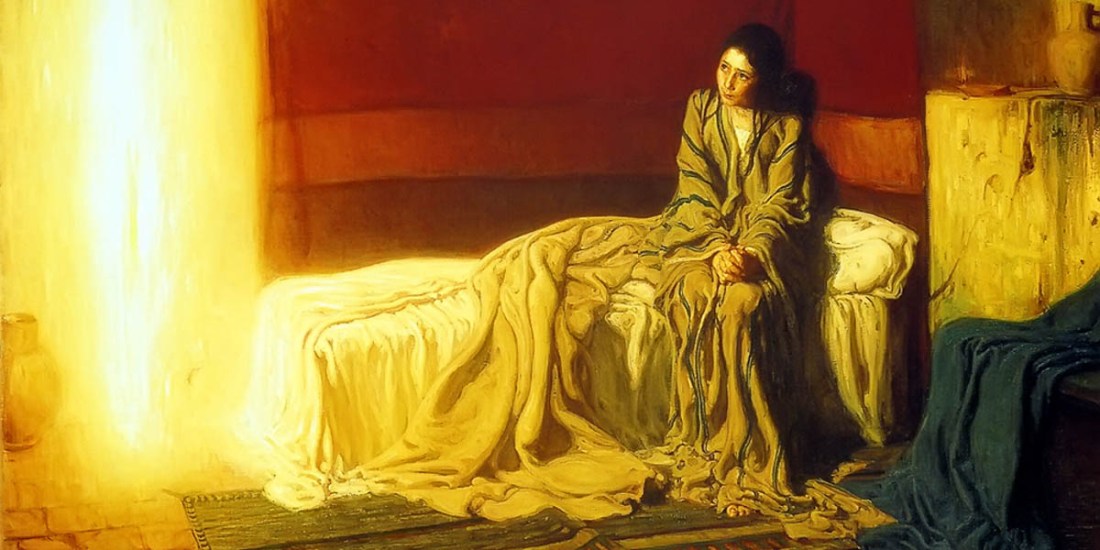
Annunciation by Henry Ossawa Tanner
It is a day to honor Mary for giving life to Jesus for the sake of all humanity.
It is day to beg her intercession for a world so desperately in need of Christ’s continued revelation.
Mary is the Door through which Heaven visited earth to heal it from sinful fragmentation.
May Mary continue to carry her beautiful grace to broken hearts and even to the twisted souls who broke them.
Through her, may we all find healing.
Mary, Mother of Mercy, intercede for all Creation that we may embrace the Love your Son taught us.
Poetry: How Do I See Her – by Judith Evans
How do I see her? Blessed Mother, Queen of Heaven, Virgin Mary: these are names that people have given her. But who is she?
When I see the mother of our Savior, I see the courage of women:
She said “yes” and stepped into the never-before, the great unknown, unfairly judged by neighbors, nearly losing her betrothed at a time when “unmarried” and “pregnant” meant banishment or death by stoning.
I see the strength of women:
A pregnant teenage girl, she rode 100 miles on a donkey, sleeping on the ground, surrounded by Roman oppression.
I see the wisdom of women:
It was time. She knew that her son was ready before he knew it. “Do as he tells you,” she told the servants at the wedding. And then there was wine, and the greatest ministry of all time began.
I see the anguish of women:
She visualized her son’s destiny as she nursed him, cleaned him, baked bread for him. Her heart nearly stopped when she couldn’t find him, and then rejoiced when he turned up discussing theology with scholars: a prelude to a future loss, that horrific afternoon at the foot of the cross.
I see women celebrating:
Beyond all human-sized hope, her son conquered death. She had dared to believe in hope, and when hope’s light seemed extinguished, she hoped one more time.
Who is she? She is each and every one of us. Whole, messy, wounded, blessed.
Bewildered by the mystery of it all, yet willing to try one more time to comprehend God’s purpose.
Learning to receive God’s mercy and grace, realizing that we are seen and loved beyond our understanding.
Today, in God’s Lavish Mercy, we celebrate the Feast of the Visitation, when a newly-pregnant Mary travels to be with her shockingly pregnant older cousin, Elizabeth. Although a universal feast, it is certainly a feast for women to treasure.
The Carmignano Visitation, a unique masterpiece by one of sixteenth-century Italy’s greatest painters, Jacopo da Pontormo (1494-1557)
The Gospel is replete with the quiet but powerful understandings women share with one another:
the haste to support one another
the blessing and bolstering of each other’s faith
the shared joy to cause a baby’s leap in the womb
the desire for mercy and justice for the suffering
the “staying with” until need’s end
Of course, men too experience many of these holy sensibilities, but today most certainly invites women to celebrate the gifts of God within their bodies, minds and spirits.
Perhaps we might pray on these things while watching this movie clip of the imagined scene:
Poetry: Two poems to honor the two blessed women of this scene
The Visitation by Joyce Kilmer (For Louise Imogen Guiney)
There is a wall of flesh before the eyes
Of John, who yet perceives and hails his King.
It is Our Lady’s painful bliss to bring
Before mankind the Glory of the skies.
Her cousin feels her womb’s sweet burden rise
And leap with joy, and she comes forth to sing,
With trembling mouth, her words of welcoming.
She knows her hidden God, and prophesies.
Saint John, pray for us, weary souls that tarry
Where life is withered by sin’s deadly breath.
Pray for us, whom the dogs of Satan harry,
Saint John, Saint Anne, and Saint Elizabeth.
And, Mother Mary, give us Christ to carry
Within our hearts, that we may conquer death.
Visitation Villanelle by Sarah O’Brien
She came to me, the mother of my Lord,
and grinned with amazement at the sight.
All creation with me seemed to roar.
Grey haired, belly swollen like a gourd,
I stood to kiss her in the morning light.
She came to me, the mother of my Lord.
Her voice, as she crossed the threshold of my door,
rang through my womb –  from a great height,
all creation with me seemed to roar.
The baby leapt – tethered only by the cord.
The joy coursing through us! I shouted outright.
She came to me, the mother of my Lord.
Already she faced her share of the sword
She who believed all God said would be, might –
All creation with me seemed to roar.
Blessed one! With your yes you moved us toward
the home we long for, and all things made right.
She came to me, the mother of my Lord.
All creation with me seemed to roar.
Music: Also two selections for this wonderful Feastday:
Ave Maria (Schubert) sung in German, as Schubert wrote it, by the incomparable Marian Anderson
Magnificat (Bach) Imagine composing this powerful first movement based on only a single word: “Magnificat”








 Lavish Mercy