The Muddied Healer

Memorial of Saints Cyril, monk, and Methodius, bishop

February 14, 2020

Click here for readings

Today, in Mercy, our Gospel gives us one my favorite portrayals of Jesus. It’s what I think of as “down in the dirt with us” Jesus. Let me give you some background on the image.

When I was a kid in North Philly, my buddy’s dog was hit by a car. We were playing baseball in a cinder lot about a half block away. We saw it happen and watched the injuring car speed off.

Petey ran screaming toward his dog, the rest of us streaming behind him. I can still see Petey lie down beside that whimpering mutt who had been tossed into a muddy gully along Philip Street. He cradled the bruised head and whispered to the frightened eyes. Then Petey quietly said, “Get my Dad”, as he stroked Lightening’s heaving back.

In that moment in my memory, Petey became an image of the Divine Healer who – muddied and bloodied — has taken a place beside all of us as we suffer.

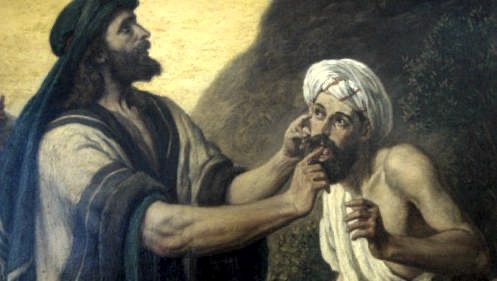
In today’s Gospel, there is stunning humanness. The suffering man doesn’t just ask for a miracle. He asks for a hand to be laid on him, for a touch, for a connection he can feel. And Jesus hears his deep human need.

Some miracles are accomplished by a fleshless, electric word shot through the air. But not this one.

tongue
Be Opened – Thomas Davidson (1872)

With this lonely, isolated man, feel Jesus caress your head, finger the ears that have heard so much criticism and frustration. Feel Jesus touch your tongue, so twisted in its attempts to speak your meaning into the world. Receive the surprising gift of Divine spittle that intends to insure, “I am part of you now. You will never be alone again.”

Hear Christ’s groan as he prays for you in sounds that plead, “Get my Dad. ABBA, Father.”

Ephphatha

Hear the definite pronouncement of your liberation from anything that tongue-ties, heart-ties, soul-ties your life:

“Ephphatha!” (that is, “Be opened!”)

Music:  Lord, You Put a Tongue in My Mouth – Divine Hymns

Shine!

Fifth Sunday in Ordinary Time

February 9, 2020

Click here for readings

Today, in Mercy, our readings are threaded on a theme of light, justice, and healing.

Is58_8wound

Isaiah writes to a formerly exiled community trying to restore itself after returning to Jerusalem. Tensions, meanness, and dissatisfactions tear at the community. Focus on religious rituals becomes excessive while communitarian practices are ignored.

It is a sad and fractious time for Israel.

Isaiah tells them they are missing the whole point.  The path to healing their national soul is not through empty religious words and practices.

If you remove from your midst
oppression, false accusation and malicious speech;
if you bestow your bread on the hungry
and satisfy the afflicted;
then light shall rise for you in the darkness,
and the gloom shall become for you like midday.


In our second reading, Paul writes to the Corinthian community similarly disturbed. He reminds the Corinthians that he came to build Christian community among them humbly and open to the Holy Spirit. Like Isaiah in the first reading, Paul now reminds his community not to miss the point:

I came to you in weakness …
so that your faith might rest
not on human wisdom

but on the power of God.


Jesus tells his disciples to let that power of God shine in them by virtue of their good deeds — the very same deeds Isaiah recommends to his listeners:

Share your bread with the hungry,
shelter the oppressed and the homeless;
clothe the naked when you see them,
and do not turn your back on your own.


In sum, our readings caution us that failures in charity and mercy wound us, both as individuals and as a community. Meanness kills – not only its object, but its subject as well.

When we remove all meanness from our actions, the Light shines, healing all our wounds.

Music:  Let Your Light Shine – Mike Balhoff and Darryl Ducote

Got Baggage?

Memorial of Saint Paul Miki and Companions, martyrs

February 6, 2020

Click here for readings

Today, in Mercy, “journey” is a central theme. David takes his final journey after commissioning his son Solomon as his successor. In our Gospel, Jesus commissions the disciples for their first missionary journey.

Each of these journeys has its own “baggage requirements”.


David’s situation is easy and can be stated in a phrase we are all familiar with:

“You can’t take it with you.”

The writer of Job expresses the same sentiment:

chick-154490_960_720And Job said,
“Naked I came from my mother’s womb,
and naked shall I return.
The LORD gave,
and the LORD has taken away;
blessed be the name of the LORD.”
Job 1:2


It’s a lesson we seem to have a hard time learning. Whenever I pack for a trip, the challenge resurfaces.

baggage
For anyone wondering, yes this is actually me at the airport, except for the heels! 🙂

Back in my early days of flying, when there were no baggage fees, some passengers took everything but the kitchen sink on their journeys. I have a clear picture of petite women hauling suitcases bigger than themselves over to the check-in counter.

Often in life we carry a lot of baggage we don’t need. Some of it is good stuff we just can’t part with, and some of it is junk we should have tossed long ago. The point is that it’s all weight we don’t need if we want to reach our desired destination easily.


Mk6_8journey
Jesus drives that point home to his disciples in today’s Gospel:

He instructed them to take nothing for the journey but a walking stick
– no food, no sack, no money in their belts.


Now that’s a pretty stringent packing list! So what might it mean for our spiritual journey?

Let’s ask ourselves this:

  • What weighs me down from being a loving, generous, just and merciful person?
  • Are there things I won’t let go of because I am fearful, insecure, or selfish?

When the disciples heeded Jesus’s advice, their ensuing freedom made them capable of miracles. Might such courage do the same thing for us?


Music: Have a little fun this morning with this great old country song. Apologies to all grammarians who will spot the blatant contradiction in the title!
I Wouldn’t Take Nothing for My Journey Now – Goodman Revival

Refrain:
Well, I wouldn’t take nothin’ for my journey now
Gotta make it to Heaven somehow
Though the devil tempt me and he tried to turn me around
He’s offered everything that’s got a name
All the wealth I want and worldly fame
If I could still I wouldn’t take nothin’ for my journey now

Well, I started out travellin’ for the Lord many years ago
I’ve had a lot of heartache and I met a lot of grief and woe
But when I would stumble then I would humble down
And there I’d say, I wouldn’t take nothin’ for my journey now

Oh, there’s nothin’ in this world that’ll ever take the place of God’s love
All the silver and gold wouldn’t buy a touch from above
When the soul needs healin’ and I begin to feelin’ His power
Then I can say, thank the Lord, I wouldn’t take nothing for my journey now

Oh, I wouldn’t take nothin’ for my journey now
Gotta make it to Heaven somehow
Though the devil tempts me and he tried to turn me around
He’s offered everything that’s got a name
All the wealth I want and worldly fame
If I could still I wouldn’t take nothin’ for my journey now.

Mercy Surrounds Us

Memorial of Saint Agatha, virgin and martyr

February 5, 2020

Click here for today’s readings

Today, in Mercy, David gets himself in trouble once again.

In the later years of his kingship, David is pretty impressed with himself. The kingdom has grown exponentially. There is peace and prosperity. David wants a census taken so that he can assess his capacity for new expansion.

So why does God get so mad about this census? The Book of Exodus sets out that a person has the right to number only his own belongings. The People belong to God, not to David. David’s pride and self-satisfaction has taken him over.

Ps32_deep waters

However, as usual, David repents. This is probably the best lesson we can learn from him. Then, in a greatly allegorized treatment, God gives David a choice of three punishments.


Passages like this can confuse us if we interpret them literally. Does God really interact and punish like this? 

It helps to remember the purpose of these writings — not to relay a factual history, but rather to tell a story that helps us grow in relationship with God.

What I believe happened here is that a pestilence did fall upon the country. At the same time, David realized that his heart had grown selfish and graceless. He took the natural event as a sign to turn back to God. And then the writers told the story in a way that the ancient peoples could relate to – with a God that forgives but gets even.


In our Gospel, Jesus preaches another vision of God – a vision of Complete Mercy, especially toward the vulnerable, weak, and sinful. That pretty much includes all of us.

Jesus releases the power of this Divine Mercy by his words and miracles. But his own family and neighbors reject him. They are more comfortable with a God who behaves like they do – meting out more judgement and punishment (preferably toward others!😉) than mercy and inclusive benediction.

In this Gospel, we begin to see Jesus as One who asks not only for repentance but for conversion – for a new way of being with God and neighbor, the way of Love.

How might we have responded had we been in that neighborhood synagogue? How are we responding today?

Music: Today’s Responsorial Psalm 32 – Marty Goetz ( Lyrics below)

Psalm 32 – Marty Goetz

These are periled times we live in, trouble everywhere
Weary hearts will often give in to this world’s despair
But high and over all, our Father knows our every care
And in His Book, if you will look, you’ll find His promise there

(Chorus)
He who trusts in the Lord
Mercy shall surround him
He who trusts in the Lord
Mercy shall surround him
Be glad in the Lord and rejoice
You upright in heart, lift up your voice
For great is His mercy toward all who trust in the Lord

Soon will be the time when we will see the Holy One
Oh how sweet to know that He’ll complete what He’s begun
And blessed is the man who stands forgiven in God’s son
And blessed are they who in that day will hear Him say, “Well done”

(Chorus)

Gracious is He and slow to anger
His loving kindness has no end
With love to embrace both friend and stranger
Reaching out to one and all, who upon His name will call

(Chorus)

Mercy is His reward
For all who trust, for the pure and just
Who put their trust in the Lord
For all who trust for the pure and just who put their trust in the Lord

Regret

Tuesday of the Fourth Week in Ordinary Time

February 4, 2020

Click here for readings

Today, in Mercy, we read one of the saddest lines in Scripture.

2Sam18_32

You have followed the story in these daily passages. Absalom rebels, designing to usurp his father’s throne. A massive battle rises between them. David, as commander-in-chief, remains behind, but gives instructions to his generals to spare Absalom’s life. Joab ignores the command, killing Absalom in a moment of vulnerability.

David is devastated.

david mourns
David Mourning Absalom’s Death – Jean Colombe

I think there is no more wrenching human emotion than regret. When I ministered for nearly a decade as hospice chaplain, and later in the emergency room, I saw so much regret.

People who had waited too long to say “I’m sorry”, “I forgive you”, “Let’s start over”, “Thank you for all you did for me”, “I love you”…..

Instead, these people stood at lifeless bedsides saying things like, “I should have”, “I wish…”, “If only…”


Life is complex and sometimes difficult. We get hurt, and we hurt others — sometimes so hurt that we walk away from relationship, or stay but wall ourselves off.

We might think that what is missing in such times is love. But I think it is more likely truth. In times of painful conflict, if we can hear and speak our truth to ourselves and one another, we open the path to healing.


If you want the truth, I’ll tell you the truth.
Listen to the secret sound,
the real sound, which is inside you.
~ Kabir


That healing may demand adjustments, agreements, even a willingness to step apart in mutual respect. But if the changes emerge from shared truth, restoration and wholeness are possible.

David and Absalom never found that path because they were so absorbed in their own self-interests. Theirs was the perfect formula for regret – that fruitless stump that perpetually sticks in the heart.

I remember a trauma surgeon leaving the hospital late one night after an unsuccessful effort to save a young boy who had been shot. The doctor carried the loss so heavily as he walked into the night saying to me, “I’m just going to go home and hug my kids.”

As we pray over David and Absalom today, let us examine our lives for the fractures that are still healable and act on them. Let us “hug” the life we have. Regret is a useless substitute.

When David Heard – Eric Whitaker ( The piece builds. Be patient. Lyrics below)

When David heard that Absalom was slain,
he went up into his chamber over the gate and wept,
and thus he said;

My son, my son,
O Absalom my son,
would God I had died for thee!

When David heard that Absalom was slain,
he went up into his chamber over the gate and wept,
and thus he said;

My son, my son.

Outrageous Grace

Monday of the Fourth Week in Ordinary Time

February 3, 2020

Click here for readings

Today, in Mercy, we have two highly dramatic passages. If there were an Oscar category for “Best Biblical Drama”, these stories would definitely be nominees!

In our ongoing “David Saga”, the troubled king flees Jerusalem because his own son Absalom is plotting to overthrow him. David, at this point in time, is humbled and not a little wearied by the theatrics of his life. His sins continue to haunt him and wreak a recompense. 


dirt thrower
Shimei curses David by Julius Schnorr von Karolsfeld

In today’s passage, we meet Shimei who has his own little miniseries going on in the Bible. Shimei is part of Saul’s family and holds David responsible for Saul’s demise. When meeting David in this passage, Shimei dangerously, and we might say stupidly, sets on him, throwing dirt and stones at the King. David prevents the troops from responding to the wildly outraged man. David even suggests that God may be trying to teach David something in the attack.


In our Gospel, we meet another wildly outraged man. This one is tormented by his inner demons, causing him also to put himself in dangerous situations. Jesus names this man’s tormentor and casts it out, giving the man control of himself again.


Have you ever been so offended, humiliated or injured that you felt outrage for yourself or another? Such fury chains us, making rationality and reconciliation close to impossible. Sometimes, it renders us impotent to name and address the deep source of our indignation. Instead, we lash out with stones of anger and hate – throwing the dirt of condemnation rather than seeking inner balance and healing.

dementor

Most of us have encountered large or small “dementors” in our life. (Thanks for the term AND the image, Harry Potter) 


But when I think of those who have endured unbelievable degrees of torment, I am amazed at their stories of faith and resolution: Anne Frank, Victor Frankel, Nelson Mandela, Harriet Tubman …. Jesus Christ. How did they come through it whole and blessed?


Mk5_1_20demoniac

Maybe the possessed man in Mark’s Gospel was just lucky that day to run into Jesus. Or maybe he sought out Christ, trying to find stability in the midst of his derangement.

When we face our own imbalances can we stay still long enough to ask, as David did, “What is God teaching me in this. How can this lead me closer to God?” If we could, might we not be surprised to see our demons named, cast into the greater sea of God’s eternal wisdom, peace and love?

Music: Amazing Grace – Sean Clive

Welcome, Christ, Our Light!

Second Sunday in Ordinary Time

January 19, 2020

Click here for readings

Is49_6 Light

Today, in Mercy, our readings invite us to witness the debut of Jesus Christ as he begins his public ministry.  The world has been waiting since the beginning of time and now… here He is!

Now the LORD has spoken
who formed me as his servant from the womb,
that Jacob may be brought back to him
and Israel gathered to him;
and I am made glorious in the sight of the LORD,
and my God is now my strength!

Remember when Pope Francis visited Philadelphia in 2015? The excitement? The preparation? The fanfare? What was that all about?

09222016_Pope_Francis_TC.2e16d0ba.fill-735x490
from phillyvoice.com

I think that, in one form or another, we all wanted to see and be touched by goodness. We wanted to see someone who confirmed that the world could be better than our current experience. We wanted to see the beauty of God in a human being.

The people of Jesus’s time wanted the same things. They longed for a wholeness that was beyond their grasp. They longed for healing that had continually eluded them. They longed to be renewed in faith, hope and love.

That deep longing is universal in every human life. Seeing the Pope on the Parkway won’t fill it. Even seeing Jesus one afternoon in Capernaum won’t do that. Our Alleluia Verse from John’s Gospel tells us the only way to such fulfillment:

The Word of God became flesh and dwelt among us.
To those who accepted him,
he gave power to become children of God.

In our Gospel, we see John the Baptist’s full acceptance of Jesus into his life. After that moment in the Jordan River when the Spirit descended, John’s life changed. It became a life patterned on and completed in the reality of Jesus Christ, not only his expectation.

John changed because he saw and believed. Our Gospel today invites us to the same kind of witness and testimony in our lives:

John testified further, saying,
“I saw the Spirit come down like a dove from heaven
and remain upon him.
I did not know him,
but the one who sent me to baptize with water told me,
‘On whomever you see the Spirit come down and remain,
he is the one who will baptize with the Holy Spirit.’
Now I have seen and testified that he is the Son of God.

May God give us the grace to see and respond to the reality of Christ in our own lives – in the poor, the sick, the persecuted, those longing to know God. Drawing on the beautiful Light of Christ, may we also be a testimony to God’s Merciful Presence in our world.

Music: He Shall Come Again in Glory – Philip Webb (Lyrics below)

This majestic modern hymn proclaims the hope of Christ’s second coming. Crafted for success; the arrangement captures the mystery and majesty of the text and delivers it adroitly to the choir loft with full; satisfying harmonies. Powerful! (from the East Coast Music website)

He who wept above the grave
Who stilled the raging of the wave
Meek to suffering, strong to save,
He shall come again in glory

He who sorrow’s pathway trod
He that every good bestowed
Son of Man, Son of God,
He shall come again in glory.

He who bled with scourgings sore,
He who scarlet meekly wore,
He who every sorrow bore,
He shall come again in glory.

Monarch of the smitten cheek,
Scorn of Jew and scorn of Greek,
Priest and King divinely meek,
He shall come again glory.

He who died to set us free,
He Who comes whom I shall see,
Jesus, only, only He,
He shall ever reign in glory.

Be Careful What You Ask For

Memorial of Saint Anthony, abbot

January 17, 2020

Click here for readings

www-St-Takla-org--b3h-50-israel-demands-a-king
1 Samuel 8:19 – Israel demands a king. J. Winter – from “The Bible and its Story” book, authored by Charles Horne, 1909

Today, in Mercy, our first reading startles us with how foolish the Israelites are about their leaders. Oh, wait a minute, why are we so surprised? Don’t we see the same dynamics all around us?

Israel is desperate for a “strong man” who will mimic the tyrants leading their enemies. They say a king will “rule us and to lead us in warfare and fight our battles.” They begin to envision a nation of their own design, not God’s.

They believe that having an absolute leader will make them strong. They are indifferent to Samuel’s warnings that such a choice will usurp their freedom, and lead to their devastation and enslavement.

lossy-page1-441px-Olivetan_Master_-_Leaf_from_an_Antiphonary-_Historiated_Initial_P_with_the_Prophet_Samuel;_Ar_-_1999.131_-_Cleveland_Museum_of_Art.tif
This leaf is distinguished by a large initial P depicting Samuel, the last and one of the greatest of Israel’s judges. It introduces the text Preparte corda vestra domino et servite (“Prepare your hearts for the Lord and serve”). In the lower margin are the arms of the Visconti family, rulers of Milan, featuring an eagle (left) and a coiled serpent (right). At bottom center is the emblem of the Olivetan Order, a reformed branch of the Benedictines founded in 1319 known as the “white monks.” The Olivetan monastery in Milan was founded in 1400 and it appears that this leaf belonged to a set of choral books presented to the monastery by one of the Visconti, perhaps about 1439–47. The so-called Olivetan Master takes his name from a luxuriously illustrated psalter made for the order’s monastery in Milan, where he was undoubtedly a monk

God tells Samuel that, in rejecting the choice for responsible, spiritually-grounded, and mutually sustained leadership, the people are rejecting God and God’s plan for them.

In a nutshell, Israel’s problem is this: they have forgotten who and whose they are. For the sake of expected political dominance, they are willing to sacrifice their identity as a people formed and led by God.


Centuries later, in today’s Gospel, Jesus comes among these dispirited people. Their choice hasn’t worked. They are still a politically dominated nation. Their religious practice has lost its vigor, denigrating into lifeless rules and practices. A corrupt religious class manipulates them.

Jesus, ignoring their religiously manufactured limitations on the Spirit, cures a paralytic. The scribes are scandalized. But Jesus confronts their equivocation:

Jesus said, “Why are you thinking such things in your hearts?
Which is easier, to say to the paralytic,
‘Your sins are forgiven,’
or to say, ‘Rise, pick up your mat and walk’?
But that you may know
that the Son of Man has authority to forgive sins on earth”
–he said to the paralytic,
“I say to you, rise, pick up your mat, and go home.”
He rose, picked up his mat at once,
and went away in the sight of everyone.
They were all astounded
and glorified God …

What would the world be like if we left ourselves so open to grace and mercy that God could work through us for the good of all Creation? Can we even imagine such freedom and trust? Can we even imagine the marriage of our faith and politics to the point that we all live for the common good?

Ps89 name_justice

Music: Come, Holy Spirit – Bright City

Mercy says, “Of course…”

Thursday of the First Week in Ordinary Time

January 16, 2020

Click here for readings

( Our Gospel today nearly repeats a passage in Luke about which I wrote last year. Being a little lazy tonight, and wanting to watch Jeopardy- GOAT, I am offering that earlier reflection to you again. Besides, I liked it.  I hope you do, dear Friends.)

Mk1_41-of-course
This is the Greek word for “Of course!”

Today, in Mercy, Jesus shows us how to live a merciful life – through loving, generous, joyfully responsive service.

A pitiable leper interrupts Jesus on his journey to ask for help. People like this man were scorned, feared, and isolated. Their leprosy impoverished them, making them annoying beggars. Their cries usually met with indifference at best and banishment at worst.

But when this leper poses his proposal to Jesus – “If you want to, you can heal me.” — Jesus gives the spontaneous answer of a true, merciful heart: “Of course I want to!”

There is no annoyance, no suggestion that other concerns are more important. There is just the confirmation that – Yes- this is the purpose of my life: to heal, love, show mercy toward whatever suffering is in my power to touch. There is just the clear message that “You, too, poor broken leper, are Beloved of God.”

What an example and call Jesus gives us today! We are commissioned to continue this merciful touch of Christ along the path of our own lives. When circumstances offer us the opportunity to be Mercy for another, may we too respond with enthusiasm, “Of course I want to!” May we have the eyes to see through any “leprosy” to find the Beloved of God.

Music: Compassion Hymn – Kristyn and Keith Getty

Exult in God’s Power

Tuesday of the First Week in Ordinary Time

January 14, 2020

Click here for readings

Today, in Mercy, our readings demonstrate God’s power to change human lives.

hannah
The Travail of Hannah

Our first reading from the Book of Samuel completes the story of Hannah, Samuel’s mother. Hannah, one of the two wives of Elkanah, was childless. In today’s passage, Hannah takes her grief to the Temple and places it before the Lord. God hears her prayer and she conceives her son.

When the story is summarized, as I have just done, it seems like a cookie-cutter miracle story. A skeptic might wonder, had she waited long enough, would Hannah have conceived – Temple or not.

That’s because the summary has drained out all the human angst, emotional roller-coastering, denial, and frustration that finally brought Hannah to God’s arms. It could have taken her so many others places. Unrelieved pain often does. It takes some into unresolved anger, depression, addiction, even suicide.

The miracle of this story is Hannah’s faith and the power of God’s love in her. It just so happens that there was also Samuel.

1Sam2_1 exult


Mark, in these early chapters of his Gospel, presents Jesus as the personification of that Divine Power. Both Christ’s “astonishing “ teaching and his stunning authority over evil convince us of this power.

With Jesus, the believer’s reality is transformed by faith and grace. Divine life blossoms even in formerly barren circumstances. Wholeness emerges even from that which had seemed fragmented.

This is the miracle: there is Divine Life inside that we had not seen until we looked, by faith, with the God’s eyes.

Music: Everyday Miracles – Sarah Grove