Today, in Mercy,Zechariah channels God, with the most intense of human emotion.
The prophet wants Israel to have some understanding of God’s infinite love and hope for them, so he puts these words in God’s mouth:
I am intensely jealous for Zion, stirred to jealous wrath for her.
Like a spouse longing for a lost beloved, God longs for the restoration of Israel to the Divine embrace.
Wherever our relationship with God is frayed or broken, God is jealous for us too. If we can turn our hearts in repentance, prayer, and hope, we too will hear God’s longing for us.
In our Gospel, Jesus tries to refocus his disciples on that loving call. In a classic example of missing the obvious, they are distracted over who is the most important. Here is the Lord of all sitting beside them, and they are arguing about their personal status!
By pointing to a child in their midst, Jesus reminds his followers of the innocence and transparency we need in order to open ourselves to God.
Let’s pray for that openness today so that we can hear and rejoice in a promise such as Israel heard through Zechariah:
You shall be my people, and I will be your God, with faithfulness and justice.
Today, in Mercy, Ezra carries on his shoulders the whole repentant nation of Israel. He is bent in “shame and humiliation” for them as he begins his prayer for God’s mercy.
It is a highly dramatic prayer, ripping out from Ezra’s soul. He not only wants to get God’s attention. Ezra wants to make an indelible impression on the community he prays for.
Picture the scene as you wish. What comes to my imagination, (although somewhat sacrilegious) is something like a James Brown brand of intensity:
God doesn’t shout back an answer to Ezra’s expressive prayer. Instead, we get the sense of God’s still, eternal Presence waiting for Israel’s eyes to clear in recognition, like finally seeing the mountain peak through the mist:
And now, but a short time ago,
mercy came to us from the LORD, our God, who left us a remnant
and gave us a stake in his holy place; thus our God has brightened our eyes and given us relief in our servitude.
“ …God has given us a stake in his holy place”….
That place is ever-present,
ever-available Mercy
– always awaiting us
if we can clear our hearts to see it.
Once we do see the faithfulness of God, we are ready to chance the journey Jesus invites us to in today’s Gospel:
Take nothing for the journey ….
set out and go from village to village proclaiming the good news
and restoring wholeness everywhere.
Music: Great Is Thy Faithfulness – written by Thomas O. Chisholm.
Sung here by AustinStoneWorship – Jaleesa McCreary (Note the sweet smile on her beautiful face just before she begins to sing. Grace!)
Today, in Mercy, Sisters of Mercy throughout the world will commemorate the date on which, in 1827, Catherine McAuley opened the House of Mercy in Dublin, Ireland. We count this day as our Founding Day, the day thousands and thousands of souls – for that time and for the future – would be anchored to God in a special way – the way of Mercy.
The experiences of Catherine’s life led her to touch the heart of God in a unique and transformative manner. She imagined, with God, a resurgence of mercy in a harsh, painful and selfish world. She believed that God could effect change through the generous service of her life.
Her holy imagination was so infectious that others caught her fire. Together they began to believe new possibilities into the lives of those who were poor, sick, uneducated and abandoned.
Over these nearly two centuries, Catherine’s invitation to Mercy has caught the hearts of tens of thousands of women, all over the world, who call her their Sister. It has impelled the spirits of millions more women and men who live and are changed by her mission.
Catherine has shown us a particular pathway into the Lavish Mercy of God. She heard the word of God and acted on it with the fullness of her being. By grace, she became Mercy for the world.
That Divine Word, spoken to her in the faces of her poor and suffering sisters and brothers, speaks to us still. As we give thanks for her witness today, may we open our hearts to hear and act on the call of Mercy for our time.
Happy Mercy Day to all our Sisters, Associates, Companions, Co-ministers and Family of Mercy throughout the World!
We praise and thank God together
for the gift of Mercy in our lives!
Today, in Mercy, our readings make one thing very clear: we cannot serve both God and “mammon”.
The problem is that we have a hard time figuring out what mammon is. Experience tells us that it’s a lot more than just money, because there are people with money who do a good job serving God.
It seems to me that “mammon” is more the illusion that we are only our money … our possessions, and that we – or anybody else- is nothing without them.
This misperception is so fundamental to our inability to live the Gospel that it cripples our souls. The love of “mammon” becomes an overwhelming, incurable addiction that feeds on the well-being of our neighbor.
As our first reading tells us, living by this addiction invokes God’s eternal anger:
The LORD has sworn by the pride of Jacob: Never will I forget a thing they have done!
Our Gospel tells us that we can’t have it both ways. We either live within the generosity and inclusivity of God, or we’re outside it:
No servant can serve two masters. He will either hate one and love the other, or be devoted to one and despise the other.
This is a challenging but fundamental teaching of the Gospel. It is essential that we consider how we live it.
Walter Bruggemann, in his book Money and Possessions says this:
Jesus said it … succinctly. You cannot serve God and mammon. You cannot serve God and do what you please with your money or your sex or your land. And then he says, “Don’t be anxious, because everything you need will be given to you.” But you must decide. Christians have a long history of trying to squeeze Jesus out of public life and reduce him to a private little Savior. But to do this is to ignore what the Bible really says. Jesus talks a great deal about the kingdom of God—and what he means by that is a public life reorganized toward neighborliness. . . .
Let’s have the courage to pray with that thought today.
Music: a simple mantra, but powerful if we can live it: Love God, Love Neighbor by Dale Sechrest
Today, in Mercy, we celebrate the feast of St. Matthew. The Gospel chosen for the day is Matthew’s own account of his call and the subsequent event lodged in his memory – the first meal he shared with Jesus.
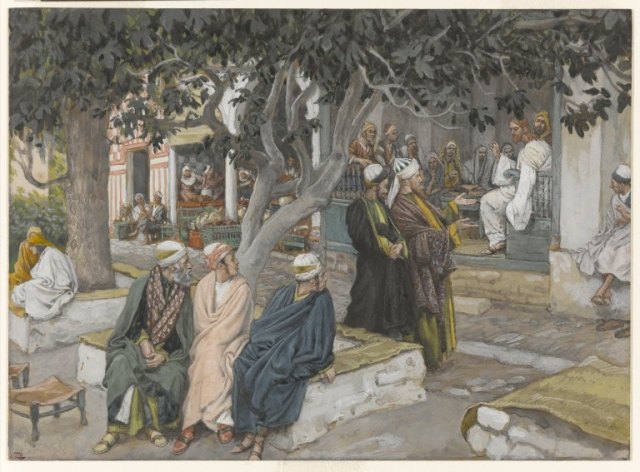
The Meal in the House of Matthew by James Tissot from the Brooklyn Museum
Apparently Matthew’s house was a do-drop-in kind of house. Matthew’s friends easily gathered at the meal. Even the Pharisees got a view of his table.
I doubt that Matthew did the cooking. Perhaps his wife or mother, though never mentioned, were the true authors of his hospitality. She may have been that type of cook who lifts the sweet and savory scent of spices into the air, capturing in their welcome all who pass by.
Jesus settles in to that welcome as do his table companions – disciples, tax collectors and sinners. They seem comfortable in their shared humanity. But today, with Jesus, they are invited to the perfection of that humanity in his abundant grace. They too receive a call this day.
We know only how some of these guests responded to this amazing invitation in their lives.
Matthew became an apostle and a saint.
The Pharisees retreated to their self-protective criticisms and condemnations.
How the others embraced or rejected this graceful moment is left unspoken.
With every Eucharistic moment of our lives, Jesus invites us to humanity’s table – a table transformed by his becoming one of us. His presence changes us all from sinners, tax collectors, or however else we are categorized. With Jesus, we are simply God’s children, fed and replenished by mercy, changed by a sacred invitation.
May we be aware of our “eucharists ” today, every encounter with another human being. The table may or may not be visible in the everyday circumstances around which we gather. Jesus will not be visible either – unless we have the eyes to see him in ourselves and those with whom we share life.
Today, in Mercy, I would like to share a piece from a book I am (slowly….) writing:
The scene is heavy with color, sounds, scents and movement. The summer sun has begun its long descent through the western sky, filling the garden with orange light and umber shadows. Simon and his household make final preparations for the arrival of Jesus. The dining area is meticulously set in the arbored courtyard, the klinai or dining couches angled so that Simon may have the full consideration of Jesus once the supper begins. The scent of roasting lamb drifts from a nearby spit, incensing the entire space with heightened appetite. Slowly, the scene fills with the ancient Gospel characters, each carrying his or her own hungers to the table.
What is it that Simon the Pharisee most craves from this momentous opportunity to capture Jesus’ attention? He is a man of intellect who rationalizes that Jesus should respond in a certain way to the approaches of a sinful woman. Would his hunger have been satisfied had Jesus met this prediction? Or was a deeper hunger challenged when Jesus defied Simon’s expectation, inviting him to a fresh relationship with his own heart?
What spectrum of hungers comes with the many guests at this dinner? Are the disciples longing for Jesus to successfully argue his theology with this prominent Pharisee? Are the other guests hoping to have their allegiances – whatever they may be – proven by the evening’s conversation? And Jesus himself, what hunger does he carry to the diverse gathering of his Father’s children? What yet unmet hopes for his ministry might he long to feed on this special evening?
But there is one among the many whose hunger is obvious. At first unnoticed by the party, she slips in through the open hedge, advancing toward Jesus with a natural grace even the greatest wealth cannot bestow. Her lustrous hair falls freely down her long, slender back. She is bejeweled and bangled with the ornaments of her trade. Her face, though beautiful, reflects the weight of her desperate loneliness and forced self-sufficiency.
She is a woman no longer with pretense. The entire town already has cast her in a mold she will never escape. She has come as she is to the feet of Jesus, presenting her unadorned hope in an alabaster jar.
As we begin our prayer today, what hungers do we take to the feet of Jesus? Let us lift the alabaster jar. Let us decant the ointment of our prayer. Let us anoint our lives.
Today, in Mercy, Paul gives the Church a job description for bishops. I’m not even going to, as they say, “go there”. Just read it. Just pray over your own thoughts.
The Gospel story of the widow of Nain is where my prayer rests today. Reading it, I remember standing by a large walkway window at the Louisville Airport on a sweltering July day in 2005.
Down on the heat-softened tarmac, a small bevy of soldiers stood at attention. Slowly, a flag-draped casket was lowered into their waiting arms. Just to the side, a huddled family, waited as well. Two children clung to either side of their young mother. An older couple stood behind her, hands gentled on her shoulders.
At the window, several other travelers gathered in silence. A few teenage boys removed their inverted baseball caps when they noticed a distinguished older gentleman stand tall and hold a salute.
No one who witnessed that brief ceremony will ever forget it. The grief, reverence and astonishment at life’s fragility emblazoned the moment on every witnessing heart.
When Jesus passed the gates of Nain on that ancient morning, he had a like experience. He saw this “only son of a widowed mother”. Once again, shaken to his roots with compassion –splancha, he pulled heaven down to heal heart-breaking loss.
How I wished Jesus were flying out of Louisville that day in 2005! But then I realized He was there. The miracle was hidden, but still real. The Divine Compassion flowed through me, through the reverent gathering beside me, through the soldiers’ honoring arms, through the long prayerful memory we would all forever share.
That young man from Nain was raised from the dead… for a while. He, like all of us, eventually died. The miracle was not about him and his life. The miracle was the visible sign of God’s infinite compassion for us – God’s “feeling-with-us” in all our experiences. That compassion, whether miraculously visible or not, is always with us.
It just took a different form that day in Louisville.
Music:I was reminded of this consoling country song for today’s prayer. Like much country music, it hits the heart where it matters, even if the theology is a little frayed.
God Only Cries – written by Tim Johnson, sung here by Diamond Rio Lyrics below
On an icy road one night
A young man loses his life
They marked the shoulder with a cross
An’ his family gathers round
On a piece of Hallowed ground
Their hearts are heavy with their loss
As the tears fall from their eyes
There’s one who’ll always sympathise
God only cries for the living
‘Cause it’s the living that are left to carry on
An’ all the angels up in Heaven
They’re not grieving because they’re gone
There’s a smile on their faces
‘Cause they’re in a better place than…
They’ve ever known.
God only cries for the living
‘Cause it’s the living that are so far from home
It still makes me sad
When I think of my Grand-dad
I miss him each and every day
But I know the time will come
When my own grandson
Wonders why I went away
Maybe we’re not meant to understand
Till we meet up in the Promised Land
Today, in Mercy, we turn our hearts to the mystery of the Holy Cross.
Let’s face it. Most of us would prefer a life without ANY suffering. So how does the Cross help us understand that we will never have that kind of life?
The mystery of suffering is integral to all life and transformation. The ability to live and deepen with that mystery doesn’t happen in the mind. It happens in the soul.
The desert Israelites in our first reading don’t get it. They think an angry God is fed up with their complaining and so sends snakes to bite them and cause them suffering.
Not really.
Indeed, snakes have bitten them. But a loving God tells them: Hold up a symbol of my love. It will strengthen you to pass through your suffering because I am always in relationship with you.
The deep love of the Holy Cross was the sacred gift of Catherine McAuley to her Mercy Family. Let us listen to her counsel.
Paul, in the powerful passage from Philippians, takes us much deeper into the heart of this mystery. He tells us how Jesus put on human suffering to show us how suffering is transformed by the love it attempts to overcome.
Paul says that by becoming obedient – by listening – to the deep mystery of suffering and death in his life, Jesus shows us how to hear the whisper within it … the whisper of eternal life that can only be found when we pass through that awesome mystery in transcendent and enduring faith.
John suggests to us that, in some way that we cannot here understand, the mystery of suffering reveals something of the nature of God. It is an overwhelming, incomprehensible revelation that the Father could convey to us only in the visible gift of Jesus Christ.
For God so loved the world that he gave his only Son, so that everyone who believes in him might not perish but might have eternal life. For God did not send his Son into the world to condemn the world, but that the world might be saved through him.
Praying with these deep considerations, we are invited to enter “the mind of Jesus”. May we wholeheartedly respond with today’s Alleluia verse:
We adore you, O Christ, and we bless you, because by your Cross you have redeemed the world.
Music: Philippians Canticle- John Michael Talbot (Lyrics below)
And if there be therefore any consolation
And if there be therefore any comfort in his love
And if there be therefore any fellowship in spirit
If any tender mercies and compassion
We will fulfill His joy
And we will be like-minded
We will fulfill His joy
We can dwell in one accord
And nothing will be done
Through striving or vainglory
We will esteem all others better than ourselves
This is the mind of Jesus
This is the mind of Our Lord
And if we follow Him
Then we must be like-minded
In all humility
We will offer up our love
Though in the form of God
He required no reputation
Though in the form of God
He required nothing but to serve
And in the form of God
He required only to be human
And worthy to receive
Required only to give
This is the mind of Jesus
This is the mind of Our Lord
And if we follow Him
Then we must be like-minded
In all humility
We will offer up our love
In all humility
We will offer up our love
Today, in Mercy, we have one of the most beautiful yet demanding readings in the Bible – Colossians 3:12-17.
Therefore, as God’s chosen people, holy and dearly loved,
clothe yourselves with compassion, kindness,
humility, gentleness and patience. Bear with each other and forgive one another
if any of you has a grievance against someone.
Forgive as the Lord forgave you. And over all these virtues put on love,
which binds them all together in perfect unity.
I remember our beloved Mother Mary Bernard recommending this passage to us when we were only novices – so unripe in our pursuit of spirituality. Since that treasured recommendation, I have prayed with this passage thousands of times. It never fails to reveal something new, deeper, and challenging.
A particularly pregnant verse is this:
Put on, as God’s chosen ones, holy and beloved, heartfelt compassion…
Gosh, the way it’s translated there makes it sound like a Valentine, doesn’t it?
But take a look at the Douay-Rheims Version, the translation popular before the Jerusalem Bible of the 1960s:
Put ye on therefore, as the elect of God, holy, and beloved, the bowels of mercy…
The Greek word for “mercy” here is σπλάγχνα – splagchnon or splancha. And it means “guts” – bowels. So there goes our Valentine! You wouldn’t want to get that picture on a greeting card!
What Paul is preaching is not a lovey-dovey sweet religiosity. He wants mercy, and all the accompanying virtues, to grab our guts and never let go until we love as radically as Jesus loves.
We all know what “splancha” feels like:
It’s the way your heart twists with adrenaline when a truck runs the red light just hair in front of you.
It’s the way your stomach tosses when it’s your turn for your first public speaking foray.
It’s the way your throat catches when you have to speak the words of a beloved’s death.
It’s the tears that well up unbidden when you kiss your sleeping child.
Splancha is the place where we are tied to other human beings so deeply that it is visible only to God.
It is the place where our soul’s umbilical cord is knit with God’s womb, that sacred place where we are recreated again and again in the Holy Spirit by our acts of mercy and love for one another.
God wants us to have “splancha love” for every one of God’s Creatures. God wants us to make that love real in our acts of mercy and justice. Paul is telling us how to do it today.
Music: How He Loves Us – sung by Kim Walker Smith with Jesus Culture
This song was composed by John Mark McMillan. This beautiful video about his composition is a real witness story. I encourage you to take the time to watch it.
Today, in Mercy, our readings challenge us to see things differently- to see with God’s eyes.
Paul invites us first with the glorious Colossians Hymn. No words can enhance it. Let us savor it in itself:
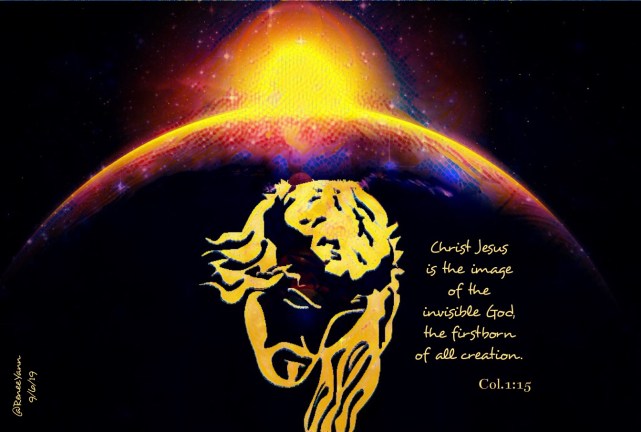
Christ Jesus is the image of the invisible God, the firstborn of all creation. For in him were created all things in heaven and on earth, the visible and the invisible, whether thrones or dominions or principalities or powers; all things were created through him and for him. He is before all things, and in him all things hold together. He is the head of the Body, the Church. He is the beginning, the firstborn from the dead, that in all things he himself might be preeminent. For in him all the fullness was pleased to dwell, and through him to reconcile all things for him, making peace by the Blood of his cross through him, whether those on earth or those in heaven.
Ancient wineskins were not like the fancy botas we see today. They were formed from the entire skin of the animal. As the new wine fermented inside, the skin expanded with the fermentation. It ultimately stretched beyond further use. – thus the necessity for new skins for new wine.
Jesus, in our Gospel, tells us we must become new wineskins in order to hold the vibrant gift of new life in Christ. He says the old ways, stiffened by pharisaical pretensions, have lost the elasticity of grace. He warns us to avoid the accretions of showy religious practice which may bury and inhibit sincere faith.
Jesus is the new wine of love and mercy, and our hearts must become his new wineskins.
As we pray, this poetic musical piece may inspire us. … in Him, all things hold together …






 Lavish Mercy