… the children, for God’s sake

Friday, December 28, 2018

Feast of the Holy Innocents

Click here for readings

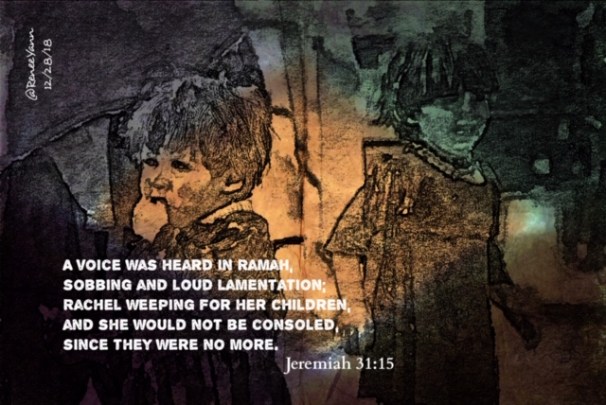
Jer 31_15 Ramah

Today, in Mercy, we are lifted to Light by John’s sacred words in our first reading:

Beloved:
This is the message that we have heard from Jesus Christ
and proclaim to you:
God is light, and in him there is no darkness at all.

Simply hearing it, we long to abide in that whole and healing Light.

But then we read our Gospel, among the saddest accounts in all of Scripture – the slaughter of the Holy Innocents. Their needless deaths come at the hands of a power-crazed and fearful man.  So hungry for his own aggrandizement, he tries to assure it by killing a generation of children.

It sounds impossible, doesn’t it, that anyone could be so hardened by evil? It sounds impossible that good people would execute this order of a mad man! It sounds impossible that human beings could be so blind to the sanctity of another’s life!

Dear friends, we must confront our own blindness. We must look into the eyes of our 21st century children – the border children, the children of Yemen, Syria, … the children of war, violence, drugs and poverty.

We must hear the cry of God, their Mother, and choose legislators and leaders who will honor life; who will shape global policies and relationships recognizing the common life we share in God – who will make true pro-life choices regarding gun control, arms sales, and an economy of endless war.

Our attitudes, our advocacy and our votes will either condemn or exonerate us when that Great Light ultimately reveals our hearts. When a society’s children become the victims of its indefensible corruption, we must say “Enough!”

Music: The Mediaeval Baebes – Coventry Carol

The “Coventry Carol” is an English Christmas Carol dating from the 16th century. The carol was traditionally performed in Coventry, England as part of a mystery play called “The Pageant of the Shearmen and Tailors”. The play depicts the Christmas story from chapter two in the Matthew’s Gospel. The carol itself refers to the massacre of the Holy Innocents in which Herod ordered all male infants under the age of two in Bethlehem to be killed, and takes the form of a lullaby sung by mothers of the doomed children.(Information from Wikipedia)

Our Lady of Guadalupe

Wednesday, December 12, 2018

Readings: Click here for readings

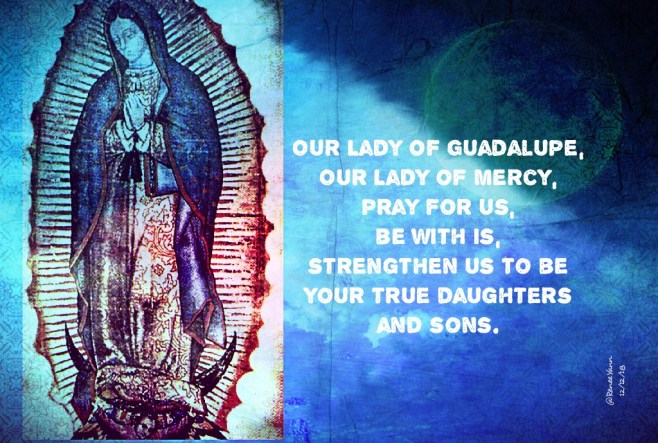
Today, in Mercy, we celebrate the Feast of Our Lady of Guadalupe, commemorating the apparitions of Mary to the Mexican peasant Juan Diego in 1531. 

OLofGuadalupeJPG

It is also on this date, 300 years later, that Catherine McAuley founded the Sisters of Mercy in Dublin, Ireland. 

Both Mary and Catherine found their joy in total commitment to God’s will and presence in their lives. May they inspire and help  to make God the center of our lives. May that discovery fill us with joy.

Perhaps  by increasing our spiritual simplicity, trust and humility like Juan Diego, we can grow closer to Mary and to her Son.

Today’s beautiful readings can lead us closer into Mary’s arms.  Zecharia, even without knowing her, named Mary the Holy Dwelling from whom Christ would come forth.

Revelation captures multiple images from the Hebrew scriptures, fashioning a glorious picture of Mary’s significance in salvation history.

And our treasured passage from Luke — can we not read it like a beloved family story that gives us roots and wings?

Mary is not so far away from us.  She chose to enter Juan Diego’s life, looking like a queen he would recognize in his own culture. She has chosen to do the same thing in many other struggling cultures. 

How is Mary present to us today? How was she present to Catherine McAuley? A homeless woman? An immigrant mother? An incarcerated young woman/? A sickly neighbor? An annoying, lonely grandmother?

What language is Mary speaking to us?

Music: Tota Pulchra Es Maria – Latin words and translation below. This lovely hymn reflects our responsorial psalm for today.

Tota pulchra es, Maria,
et macula originalis non est in te.
Vestimentum tuum candidum quasi nix, et facies tua sicut sol.
Tota pulchra es, Maria,
et macula originalis non est in te.
Tu gloria Jerusalem, tu laetitia Israel, tu honorificentia populi nostri.
Tota pulchra es, Maria.


You are all beautiful, Mary,
and the original stain [of sin] is not in you.
Your clothing is white as snow, and your face is like the sun.
You are all beautiful, Mary,
and the original stain [of sin] is not in you.
You are the glory of Jerusalem, you are the joy of Israel, you give honour to our people.
You are all beautiful, Mary.

Christ the King

Sunday, November 25, 2018

Click here for readings

Today, in Mercy, we celebrate The Solemnity of Christ the King.

Rev1_7JPG

For some, the lofty, politically-tinged title might obscure the rich devotion offered by this feast. The title “king” carries with it suggestions of exaggerated power, wealth and dominance not compatible with our Gospel perception of Jesus.

We may be more comfortable with images of Christ as infant, brother, shepherd, lamb, vine, gate, way, truth, life…

But what all these images point out is that our ability to comprehend the fullness of Christ is severely limited by our humanity. We usually choose a specific image based on our circumstances and spiritual needs.

Pope Pius XI promoted the concept of Christ the King in his 1925 encyclical Quas Primas, in response to growing international secularism and nationalism. His intent was not to compare Christ to the challenged world leaders of the time. It was to raise the perceptions of all people to the lessons of Divine Leadership: mercy, justice, inclusivity, and peace.

Oh, how we could benefit from the same understanding today! 

In this age with its culture of continual war, the human pain it causes, refugee crises, climate devastation, wealth distortion and indifference to the poor, how our hearts long for just, wise and loving leadership!

In his encyclical, Pius XI wrote:

Christ the King reigns “in the human hearts,” both by reason of the keenness of his intellect and the extent of his knowledge, and also because he is very truth, and it is from him that truth must be obediently received by all humanity. He reigns, too, in our wills, for in him the human will was perfectly and entirely obedient to the Holy Will of God, and further by his grace and inspiration he so subjects our free-will as to incite us to the most noble endeavors. He is King of hearts, too, by reason of his “charity which exceedeth all knowledge.”

— Quas primas, §7[4]

Let’s pray for these virtues for all who are charged with any form of power or leadership:

  • keen spiritual intellect
  • deep heart’s knowledge
  • uncompromising truth
  • obedience to grace
  • holy inspiration 
  • noble character
  • and surpassing charity for all Creation

May Christ the King truly live and reign among us. May we behold the “sweet light in His eyes”!

Music: We Shall Behold Him – offered in American Sign Language by Kayla Seymour; sung by Sandi Patty

“Beyond Gold” Friday

Friday, November 23, 2018

Readings: http://www.usccb.org/bible/readings/112318.cfm

Today in Mercy,  we continue in the mood of thanksgiving. 

Do you  have a computer calendar that pops up reminders for you — appointments, due dates, anniversaries, etc.?

TGVNG cal

On this date, I am reminded of two very happy events:

  • the birth of one of my precious grand-nephews three years ago – a gift of beauty, love and hope to our family
  • the jubilant wedding of two dear friends six years ago – a covenant and sign of love, fidelity and courage in today’s unloving world

As we get older (as I have been blessed to do), our calendar blocks become more crowded with memories – with the years’ accumulation of joys and blessings. “Thanksgiving Friday” is a good day to mentally page through the gift of years, remembering, thanking, praying for all that has brought love, hope and encouragement to our hearts.

Every life we love copy

It’s a good strategy to resist the commercial lure of “Black Friday” and to keep our focus on what truly counts as GIFT – those treasures that are beyond gold in our life’s story.

Hopefully, God’s goodness came to us yesterday, and comes to us daily, in abundance and joy – of family, friends and blessings shared. 

But for some, God draws us closer through loneliness, loss or sadness shared. The great grace is that God abides with us in every season, and reveals Mercy’s loving face in both our sorrows and our joys. 

May we praise God and know the Comforting Presence in whatever the season of our hearts. Let us pray this for one another.

Music:  10,000 Reasons – Matt Redman

Reflection for Thanksgiving

TY print

Emma, skewered by indecision, stared into her mother ‘s jewelry box. She had always loved those silver earrings, a gift to her mother from her grandmother—an heirloom now, a treasure beyond price. She wanted so to wear them on this special date, but they were “hands off” and she knew it. Still, her mother at work and unaware of her desire, Emma had succumbed to temptation.

The dance had been wonderful, a whirlwind of such delight that Emma had not noticed when her left earring had brushed against her partner’s shoulder, tumbling hopelessly under the dancers’ trampling feet. Only at evening’s end, approaching her front door exhausted and dreamy, had she reached up to unclip the precious gems.

Her mother sat waiting for her in the soft lamplight, having already noticed the earrings missing from her dresser. Awaiting retribution, Emma knelt beside her mother and confessed the further sacrilege of loss. But her mother simply cupped Emma’s tearful face in her hands, whispering, “You are my jewel. Of course, I forgive you.” Though accustomed to her mother’s kindness, this act of compassion astonished Emma, filling her with an indescribable, transformative gratitude.

Surely it was a gratitude like this that brought Mary to the feet of Jesus in Luke’s Gospel. It was a similar loving gratitude that Mary poured out from her treasured alabaster jar—every drop carrying her thanks for life, for faith restored, for forgiveness, for hope renewed.

We come to this Thanksgiving season with our own stories, with our own alabaster jars. Perhaps there is a great forgiveness we are thankful for, or just the small kindnesses that allow us to rise each morning with joy and hope. Perhaps there is a memory of compassion, like Emma’s or Mary’s, that we treasure—one that in turn has made us kinder and more honest.

God is our Mother waiting in the lamplight of this Thanksgiving to cup our face with love, to receive our joyful thanks for divine mercies. Like Emma, we may be astonished at the graciousness that has been given to us. Like Mary, we may respond by pouring out our thanks to God in a silent act of prayer.

Indeed, the deepest thanksgiving is wordless. It is the bowing of the spirit before God—who is Presence; who is Grace; who is Lavish Mercy. As we celebrate the season of harvest and thanksgiving, we sit quietly with our loving, generous God. We rejoice in the awareness of our many blessings: the gift of life, the beauty of Creation, the people who have loved us, the ability to choose, to love, to hope, to believe. We pour out to God our humble, grateful hearts. We listen for God’s own heart beating gently in the lamplight of our prayer.

Happy Thanksgiving, dear friends. May God bless you and your loved ones with every reason for gratitude and joy.

( I published this early in case you’re using workplace computers to access the site. I wanted you all to have it for Thanksgiving. 🙏)

Bread and Roses

Saturday, November 17, 2018

Readings: Click here for readings

Eliz_bread

Today, in Mercy, we celebrate the Memorial of St. Elizabeth of Hungary.  Elizabeth, a princess in Hungary, was married at the age of fourteen to Louis IV of Thuringia, a German state. Both rulers were kind and saintly. 

Elizabeth used her considerable royal resources to help the poor and hungry. She met them outside the walls of the palace, even building a small hospital there to care for the sick among them. 

But there was some controversy within the castle, questioning her charity as a depletion of the governmental treasures. 

Eliz windowJPG

Once, on a charitable journey, Elizabeth met her husband traveling with a band of such questioners. She carried baskets of bread to the poor, covered with her traveling cloaks. They demanded she reveal her cargo at which the bread is said to have been miraculously transformed into roses.

(St Elizabeth of Hungary with her crown and apron full of flowers. Blois château, France. One of a series of female saints in the Oratory (once the queen’s private chapel). Designed by Michel Dumas in 1858, the windows were painted by Claude Lavergne in 1859.)

As indicated by Pope Benedict XVI, Elizabeth is part of that long line of holy ones, whose relationship with Jesus moved them to justice and mercy for all people.

Praying with Elizabeth today, asking for insight on how to be loving and charitable in today’s world, one might consider this:

  • What would it be like to greet our border refugees with baskets of bread rather than barbed wire?
  • What would it be like if we built rose hedges rather than walls?

The caravan of refugees seeking asylum at our border mirrors many similar marchers throughout history, searching for a measure of equality and a livable life.

The music for today, aptly titled “Bread and Roses”, originated in the early 1900s, as women marched for improved working conditions and the right to vote.

Music: Bread and Roses

But God Does Notice

Sunday, November 11, 2018

 Click here for readings.

Today, in Mercy, we learn lessons from widows – those whose place in biblical times was uncertain and frightening. Without a husband, a woman experienced diminished standing in the legal, financial and political life of the community. 

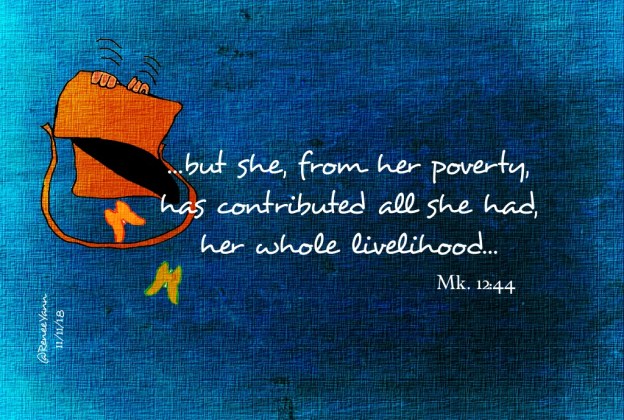
Mk12_44 miteJPG

She was often dependent on charity, and was deemed fortunate to capture a bit of good will from those in better circumstances. 

There are several examples of widows being blessed by miracles, because they were among those most in need of them.

In today’s first reading and in the Gospel, we meet two widows displaying amazing charity and character strength.  The widow of Zarephath steadfastly prepares for death because she has nothing left to live on. When Elijah asks to share in her last few cornmeal cakes, she does not hesitate to feed him.

In our Gospel, it is significant that, just across the road from the well-stocked treasury, a nearly penniless widow gives her last coins to the poor.

In Elijah’s account, we learn the outcome of the widow’s generosity.  She reaps an abundant reward in perpetual flour and oil to sustain her.

We never learn what happens to Jesus’s widow. We are left to imagine that, in some way, her selflessness is rewarded.

It is so hard to give it all to God, especially if we feel we have little left for ourselves.  It is hard to give our love when we feel empty-hearted.  It is hard to give care when we feel unappreciated.  It is hard to assist others when we ourselves are exhausted. It is hard to do good if no one, not even God, seems to notice.

But God does notice.  Like Jesus on that long-ago afternoon, God is watching as we empty our coffers in service and care for the poor, sick, troubled and lost.

What we have to give may be small — a single corn cake or two little coins. It is the act of giving it that is large — and will make our hearts large by the choice.

One this date in 1841, Catherine McAuley, the first Sister of Mercy, died. She had given everything she had — a fortune actually.. and a life — for God’s poor and needy.  Let’s call on her to inspire us to greater charity and mercy. God knows we need to do something for this aching world!

Music:: Matthew West – Do Something

God Knows Our Hearts

Saturday, November 10, 2018

Click here for readings

Lk 16_45 knows heart

Today, in Mercy, we celebrate the Memorial of Pope St. Leo the Great.  He was a remarkable 5th century leader who consolidated essential elements of theology and administration for the yet emerging Church.

Our first reading today reflects Paul doing the same thing in the very early days of Christianity.  His ministry throughout the Mediterranean basin guided early Christians as the Church planted its first harvest.

Paul lets us know that this ministry of leadership is not easy – that he relies on the good will of the communities he serves:

You were, of course, concerned about me but lacked an opportunity.
Not that I say this because of need,
for I have learned, in whatever situation I find myself,
to be self-sufficient.

Paul seems to refer specifically to material help,  but certainly he values even more the spiritual and moral loyalty of his followers.

In our Gospel, Jesus offers us a sermonette that can, at first, seem a little confusing. His tone, as he speaks to a group of Pharisees, is somewhat ironic. But his bottomline message is this: loyalty to God, not to material things.

The thread running through all these passages?  The work of the Church needs both our spiritual and material loyalty to thrive  – whether in Paul’s time, or Christ’s, or our own.

The Pharisees pretended such loyalty, but Jesus challenged them:

You justify yourselves in the sight of others,
but God knows your hearts …

A sobering challenge against which to measure ourselves!

Music: Thank You for Giving to the Lord _ Ray Boltz

The Grace at Our Border

Monday, November 5, 2018

Readings: http://www.usccb.org/bible/readings/110518.cfm

Today, in Mercy,  we continue our readings from Paul’s inspiring letter to the Philippians. Paul sincerely loves this community and wants them to be perfected in Christ. 

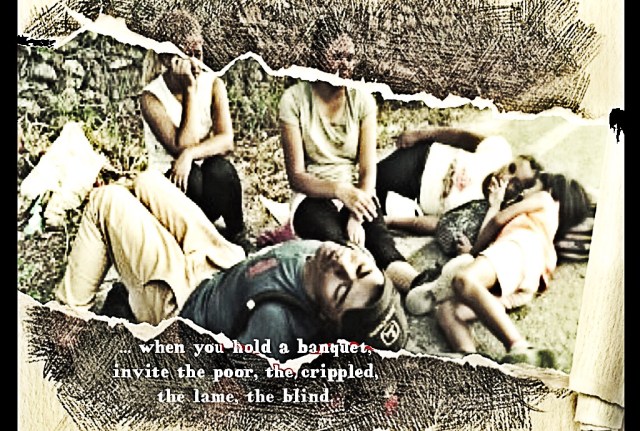
This is what Jesus wants for us too.  Today’s Gospel is just one example of Jesus showing his followers the way to holiness. He uses the opportunity of a dinner to remind those gathered that they are very fortunate. Their lives are like a banquet compared with the lives of those who are poor and burdened.

He suggests that his followers do what God would do:

When you hold a banquet,
invite the poor, the crippled, the lame, the blind;
blessed indeed will you be
because of their inability to repay you….

Just such an opportunity to be blessed awaits us, in the USA, at our southern border. A wave of God’s beloved poor and besieged washes toward us. Will we meet them with true mercy and justice born out of Christian charity? Or will we confront them with a brutal show of power born of fear and alienation?

Lk14_14 banquet

Of course, there are legitimate concerns with such a large migration. But these concerns must be met with wisdom and prudence, not prejudice and vilification. This is not a horde of animals attacking us. These are human beings desperately seeking a better life.

Jesus thought that his table companions, gifted as they were by God, had the moral capacity to respond to his challenge. Can he expect the same of us?

Let’s hope so, because our Gospel closes with a very compelling reason:

“For you will be repaid
(one way or the other, I might add)
at the resurrection of the righteous.”

Music: God of the Poor – Graham Kendrick

In Prayer, Memory, and Light

Friday, November 2, 2018

Click here for Readings

Today, in Mercy, we remember the beloved Holy Souls who have gone before us. They are never far from us. Some of us may visit cemeteries today. Some will place a list of names upon the altar. But all of us will whisper their names: grandparents, parents, spouses, children, brothers, sisters and beloved friends — meeting each name in a sacred memory.

Romans6_8 All Souls

May those memories, whatever they contain, be transformed by our loving prayers. May whatever grief remains in us be blessed by the grace of faith and thanksgiving. And may the Holy Ones we honor today brighten us with some of their overwhelming Eternal Light in God.

Music: Lux Aeterna- Eternal Light – Michael Hoppé

Lux aeterna
Lux aeterna luceat eis, Domine,
cum sanctis tuis in aeternum,
quia pius es.

Requiem aeternam
dona eis, Domine,
et lux perpetua luceat eis.

May light eternal shine upon them, O Lord,
with Your saints forever,
for You are Mercy.

Eternal rest
give to them, O Lord,
and let perpetual light shine upon them.