Memorial of Our Lady of Sorrows

Wednesday, September 15, 2021

Today, in God’s Lavish Mercy, we pray with Psalm 111, a rather exultant prayer for such a somber feast.

I will give thanks to the LORD with all my heart
    in the company and assembly of the just.
Great are the works of the LORD,
    exquisite in all their delights.

Psalm 111:1-2

The psalm allows us to see beyond the sorrows we commemorate today. At the same time, the memorial reminds us that these sorrows of Mary were real human sufferings endured for Love.

Through her heart, his sorrow sharing,
All his bitter anguish bearing,
Now at length the sword had passed.
Oh, how sad and sore distressed
Was that Mother highly blessed
Of the sole begotten One!
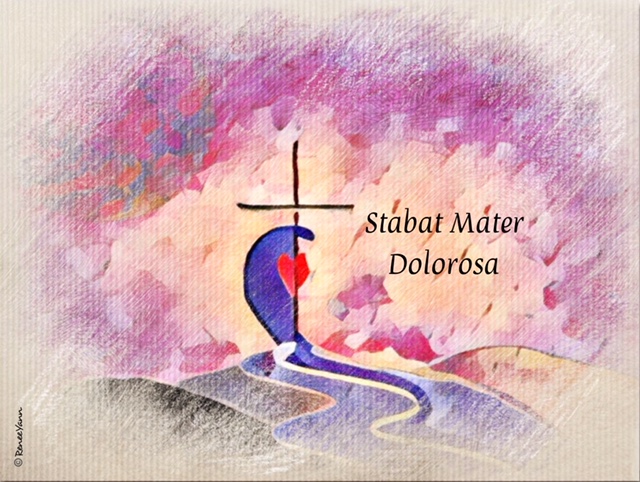
from The Stabat Mater

The scriptures give us precious little of Mary’s life. But each small account demonstrates the same thing: Mary responded, she showed up, she acted, she stood by Jesus until the end.

As Christ continues the work of redemption in our times, where do we stand?


Poetry: Today’s poetic passage is from one of the great classics of Christian literature, A Woman Wrapped in Silence by Father John W. Lynch.

The book is a masterpiece best appreciated in reflective contemplation. I have chosen a sliver of its beauty today, one of many that captures Mary’s joy born of faith-filled suffering. This selection imagines what it was like when Mary remained in the Upper Room as the others, not knowing what to expect, went to the tomb early on Easter morning. The Resurrected Jesus comes to Mary first, before any other appearance.

Or is 
it true or thought of her she found no need
To search? And better said that she had known
Within, they’d not discover him again
Among the dead? That he would not be there
Entombed, and she had known, and only watched
Them now as they were whispering of him,

And let them go, and listened afterward
To footsteps that were fading in the dark.

To wait him here. Alone. Alone. A woman
Lonely in the silence and the trust
Of silence in her heart that did not seek,
Or cry, or search, but only waited him.

We have no word of this sweet certainty
That hides in her. There is not granted line
Writ meager in the scripture that will tell
By even some poor, unavailing tag
Of language what she keeps within the silence.
This is hers. We are not told of this,
This quaking instant, this return, this Light
Beyond the tryst of dawn when she first lifted
Up her eyes, and quiet, unamazed,
Saw He was near.

Music: Much magnificent music is available for the Stabat Mater, a 13th century poem written by Franciscans and interpreted by many musical masters.

  1. Stabat Mater – Antonio Vivaldi
    A short piece – Section 5: Eja Mater, fons amoris performed by Tim Mead

Eja, Mater, fons amóris
me sentíre vim dolóris
fac, ut tecum lúgeam

O thou Mother! fount of love!
Touch my spirit from above,
make my heart with thine accord.


2. The complete work by Vivaldi is below for those who would like to hear it:


3. A little bit of Pergolesi’s Stabat Mater here with the same fabulous Tim Mead and Lucy Crow
Feast of the Exaltation of the Holy Cross

Tuesday, September 14, 2021

Today, in God’s Lavish Mercy, we pray with Psalm 78 which commands us:

Do not forget the works of the Lord!


The psalm, in its entirety, is a recital of God’s faithfulness to Israel over time, culminating in the triumph of David/Jerusalem/Temple.

God chose David his servant,
took him from the sheepfolds.
From tending ewes God brought him,
to shepherd Jacob, the people,
Israel, God’s heritage.
He shepherded them with a pure heart;
with skilled hands he guided them.

Psalm 78: 70-73

David foreshadows Jesus, the Good Shepherd who not only tends the sheep but becomes the Lamb of God. Jesus completes our salvation by his death on the Cross. In him, the long journey of Psalm 78 is ultimately fulfilled.


Philippians’ exquisite hymn captures the profound nature of that fulfillment:

Christ Jesus, though he was in the form of God,
    did not regard equality with God something to be grasped.
    Rather, he emptied himself,
    taking the form of a slave,
    coming in human likeness;
    and found human in appearance,
    he humbled himself,
    becoming obedient to death,
    even death on a cross.

Philippians 2:5-8

Each of our lives reflects, in its own way, the salvation journey we find in scripture. We experience the same kind of twists and turns, highs and lows as those described in Psalm 78.

In each of these moments, we are held in the mystery of the Cross wherein Christ transforms all suffering to grace:

Because of this, God greatly exalted him
    and bestowed on him the name
    that is above every name,
    that at the name of Jesus
    every knee should bend,
    of those in heaven and on earth and under the earth,
    and every tongue confess that
    Jesus Christ is Lord,
    to the glory of God the Father.

Philippians 2: 9-11

Poetry: Good Friday – Christina Rossetti (1830-1894)

Am I a stone and not a sheep 
That I can stand, O Christ, beneath thy cross, 
To number drop by drop Thy blood’s slow loss, 
And yet not weep?
Not so those women loved 
Who with exceeding grief lamented thee; 
Not so fallen Peter weeping bitterly; 
Not so the thief was moved;
Not so the sun and moon 
Which hid their faces in a starless sky, 
A horror of great darkness at broad noon— 
I, only I.
Yet give not o’er, 
But seek thy sheep, true Shepherd of the flock; 
Greater than Moses, turn and look once more 
And smite a rock.

Music: Adoramus Te, Christe

Memorial Of St. John Chrysostom

Monday, September 13, 2021

Today, in God’s Lavish Mercy, we pray with Psalm 28, a prayer of nine succinct verses in which the psalmist rides a seesaw emotion.

My prayer is like that sometimes. I try to pray the way Jesus would pray — the “Our Father” type of goodness and all.

But to be honest, “Thy Will be done” and “as we forgive those who trespass” are not always easy sentiments for me. How about you?


Our psalmist seems to have some trouble too … but with points of light and redemption in the end:

O Lord, I call to you;
my rock, do not be deaf to my cry;
lest, if you do not hear me,
I become like those who go down to the pit.
FEAR
Hear the voice of my prayer when I cry out to you, 
when I lift up my hands to your holy of holies.
PLEADING
Do not snatch me away with the wicked or with the evildoers,
who speak peaceably with their neighbours,
while strife is in their hearts.
JUDGEMENT
Repay them according to their deeds,
and according to the wickedness of their actions.
According to the work of their hands repay them,
and give them their just deserts.
VENGEANCE
They have no understanding of your doings,
nor of the works of your hands;
therefore you will break them down
and not build them up.
PRIDE
Blessed are you, O Lord!
For you have heard the voice of my prayer.
FAITH
O Lord, you are my strength and my shield;
my heart trusts in you, and I have been helped;
therefore my heart dances for joy,
and in my song will I praise you.
TRUST
You are the strength of your people,
a safe refuge for your anointed.
SECURITY
Save your people and bless your inheritance;
shepherd them and carry them for ever.
PRAYER

What I learn from this psalm is to tell God the truth when I pray – but the real truth -the truth that we hear back from God when we listen in our prayer. And that listening should always be done in sync with the Gospel. It is as if we cup the Gospel around our prayer the way we bend an ear to the faint but longed-for sound.


Poetry: Lost – David Whyte

Stand still. 
The trees ahead and the bushes beside you 
Are not lost. 
Wherever you are is called Here,
And you must treat it as a powerful stranger,
Must ask permission to know it and be known.

The forest breathes. 
Listen. It answers,
I have made this place around you,
If you leave it you may come back again, saying 
Here.

No two trees are the same to Raven.
No two branches are the same to Wren.
If what a tree or a bush does is lost on you,
You are surely lost. Stand still.
The forest knows Where you are.
You must let it find you.”

Music: The Golden Forest – Tim Janis

Friday of the Twenty-third Week in Ordinary Time

Friday, September 10, 2021

Today, in God’s Lavish Mercy, we pray with Psalm 16, complementing as it does today our first reading from 1 Timothy.

Both these scripture passages
speak to us
of finding
– and being found by –
God.


Paul, in guiding his beloved disciple Timothy, defines the phenomenon as “Grace”:

Indeed, the grace of our Lord has been abundant,
along with the faith and love that are in Christ Jesus.

1 Timothy 1:14

According to the Catechism of the Catholic Church, “Grace is a participation in the life of God, which is poured unearned into human beings, whom it heals of sin and sanctifies.”

Paul agrees:

I was once a blasphemer and a persecutor and an arrogant man,
but I have been mercifully treated
because I acted out of ignorance in my unbelief.

1 Timothy 1:13

But how do we open ourselves do the gift of grace? How do we engage God’s desire to deepen us in holiness?

Psalm 16 offers us wisdom:

I bless the LORD who counsels me;
    even in the night my heart exhorts me.
I set the LORD ever before me;
    with him at my right hand I shall not be disturbed.

Psalm 16: 7-8

We invite God’s counsel 

  • by an ardent study of scripture
  • by a sacramental faith
  • by a prayer that listens more than it speaks
  • by a life centered on the works of mercy
  • by a reverence for all Creation
  • by a love that loves as God loves

I have set the Lord always before me;
because you are at my side I shall not fall.
My heart, therefore, is glad, and my spirit rejoices;
my body also shall rest in hope.
For you will not abandon me to the grave,
nor let your holy one see destruction.
You will show me the path of life;
in your presence there is fullness of joy,
and in your hand are graces for evermore.

Psalm 16: 8-11

Poetry: BELOVED IS WHERE WE BEGIN —Jan Richardson

from Circle of Grace: A Book of Blessings for the Seasons

If you would enter
into the wilderness,
do not begin
without a blessing.

Do not leave
without hearing
who you are:
Beloved,
named by the One
who has traveled this path
before you.

Do not go
without letting it echo
in your ears,
and if you find
it is hard
to let it into your heart,
do not despair.
That is what
this journey is for.

I cannot promise
this blessing will free you
from danger,
from fear,
from hunger
or thirst,
from the scorching
of sun
or the fall
of the night.

But I can tell you
that on this path
there will be help.

I can tell you
that on this way
there will be rest.

I can tell you
that you will know
the strange graces
that come to our aid
only on a road
such as this,
that fly to meet us
bearing comfort
and strength,
that come alongside us
for no other cause
than to lean themselves
toward our ear
and with their
curious insistence
whisper our name:

Beloved.
Beloved.
Beloved.


Music: Lead Me, Lord

Feast of the Nativity of the Blessed Virgin Mary

Wednesday, September 8, 2021

Today, in God’s Lavish Mercy, we pray with Psalm 13. We can imagine it being sung in Mary’s voice as we celebrate her birth.

Though I trusted in your mercy,
    let my heart rejoice in your salvation.
Let me sing of the LORD 
    Who has been good to me.

Psalm 13:6

These psalm verses can bring us deeply into Mary’s generous, prophetic soul. She is, even before the Annunciation, a holy young woman, at peace and unity with God ….

I have trusted in your mercy


But when she is invited to donate her solitary peace to the infinite self-giving of God, Mary says, “Yes!”.

Let my heart rejoice in your salvation


With her “Yes”,
Mary’s sacred peace
no longer belongs to herself.
She has given it
in order to become
an agent in our salvation.


Mary realizes that the moment Israel has longed for has dawned in her little room, her little cottage, in little Nazareth. And her faith is large enough to believe that God could do such a thing!

Annunciation – Henry Osawa Tanner

Mary calls us to make our dream of salvation larger than ourselves – to allow God to release the power of mercy, astoundingly, from our small and simple lives.


In this great fiat of the little girl Mary, the strength and foundation of our life of contemplation is grounded, for it means absolute trust in God, trust which will not set us free from suffering but will set us free from anxiety, hesitation, and above all from the fear of suffering. Trust which makes us willing to be what God wants us to be, however great or however little that may prove. Trust which accepts God as illimitable Love.

Caryll Houselander – The Reed of God

Poetry: After the Annunciation- Madeleine L’Engle

This is the irrational season
when love blooms bright and wild.
Had Mary been filled with reason
there’d have been no room for the child.

From A Cry Like a Bell:Poems 


Music: Hail Mary – Boyce and Stanley

Tuesday of the Twenty-third Week in Ordinary Time

Tuesday, September 7, 2021

Today, in God’s Lavish Mercy, we pray with Psalm 145 in which the psalmist, filled with gratitude and joy, makes a prodigious promise:

Every day will I bless you,
    and I will praise your name forever and ever.
Everyday! Forever and ever!

Psalm 145:2

Such a promise requires all one’s attention, discipline and practice. We must learn to see all experience in God’s Light so that everything becomes a reason for praise.


Paul, guiding the Colossians to live that kind of life, tells them:

As you received Christ Jesus the Lord, walk in him,
rooted in him and built upon him
and established in the faith as you were taught,
abounding in thanksgiving.

Colossians 2:6-7

Powerful words:
~ walk in Christ
~ be rooted and built in Christ
~ be established in faith
~ be abundant in thanksgiving 


God is gracious and merciful toward us as we pray for the psalmist’s prayer to be fulfilled in us and in our lives:

Let all your works give you thanks, O LORD,
    and let your faithful ones bless you.
Let them discourse of the glory of your Kingdom
    and speak of your might.

Psalm 145:10-11

Poetry: from the Book of Hours – Rainer Maria Rilke

You are the future, the great sunrise red
above the broad plains of eternity.
You are the cock-crow when time’s night has fled,
You are the dew, the matins, and the maid,
the stranger and the mother, you are death.

You are the changeful shape that out of Fate
rears up in everlasting solitude,
the unlamented and the unacclaimed,
beyond describing as some savage wood.

You are the deep epitome of things
that keeps its being’s secret with locked lip,
and shows itself to others otherwise:
to the ship, a haven — to the land, a ship.

Music: Psalm 145 – Travis Cottrel

Twenty-third Sunday in Ordinary Time

Today, in God’s Lavish Mercy, we pray in the power of the Gospel:

Ephphatha!  Be opened:

All minds to God’s omnipresence

All hearts to God’s infinite love

All spirits to God’s tender proposals

All eyes to God’s eternal vision 

All ears to God’s cry in the poor

All mouths to speak God’s Word in justice

All plans to the rhythm of God’s freedom

All dreams to God’s dream for all.

Be opened – especially in me today.
🙏 Amen!


Poetry: Be Opened! – Malcolm Guite

Be opened. Oh if only we might be!
Speak to a heart that’s closed in on itself:
‘Be opened and the truth will set you free’,
Speak to a world imprisoned in its wealth:
 
'Be opened! Learn to learn from poverty’,
 Speak to a church that closes and excludes,
And makes rejection its own litany:
‘Be opened, opened to the multitudes
 
For whom I died but whom you have dismissed
 Be opened, opened, opened,’ how you sigh
And still we do not hear you. We have missed
Both cry and crisis, we make no reply.
 
Take us aside, for we are deaf and dumb
Spit on us Lord and touch each tongue-tied tongue.

Saturday of the Twenty-second Week in Ordinary Time

Saturday, September 4, 2021

Today, in God’s Lavish Mercy, we pray with Psalm 54, clearly described in its first two lines as a prayer of David when he was in deep trouble:

For the leader. On stringed instruments. A maskil of David,
when the Ziphites came and said to Saul, “David is hiding among us.”

Psalm 54:1-2

You can watch the whole story here – (and it’s a good one):


Psalm 54 goes to the heart of this traumatic experience for David. It allows us to be part of his prayer for deliverance. It lays open to us the deep intimacy and trust of David’s relationship with God.

Throughout his prayer, David calls on God for protection. He does so in a tone like that of a child who, in fear and necessity, runs to a powerful parent.


David’s situation reminds me of my gang when we were kids in the old neighborhood. If Big Jimmy, the block bully, threatened any of us, we would invoke the strength of a bigger brother or uncle as protection. It always worked —- just by the power of our sheer belief that it would.


Saul Looking like Big Jimmy 🙂

David is besieged by Saul, so he makes recourse to his “bigger” protector, his God. David’s prayer is more than a request. It is an insistent plea, almost a demand:

  • save
  • defend
  • hear
  • listen

And like many prayers of desperation, it is offered with promises:

When I am delivered,  I will offer you generous sacrifice
and give thanks to your name, LORD, for it is good.
Because it has rescued me from every trouble,
and my eyes look down on my foes.

Psalm 54:9

So what does Psalm 54 teach me?
That God will do what I “demand” if I pray hard enough?
That if I promise God something, I will get what I want?
No, not that. 


What I find in this prayer is the encouragement to live always
in honest and trusting relationship with God.
When troubles come, we can call to God for help,
and our practiced faith will allow us

to discern God’s steady companionship –
God’s Grace to find a deliverance for which
we might not otherwise have had the courage.


God is present as my helper;
the Lord sustains my life.

Psalm 54:6

Poetry: Keeping Watch – Hafiz

In the morning
When I began to wake,
It happened again—
That feeling
That you, Beloved,
Had stood over me all night
Keeping watch,
That feeling
That as soon as I began to stir
You put Your lips on my forehead
And lit a Holy Lamp
Inside my heart.

Music: I Will Trust – Lauren Daigle

Wednesday of the Twenty-second Week in Ordinary Time

Wednesday, September 1, 2021

Today, in God’s Lavish Mercy, we pray with Psalm 52, whose chosen verses today form an exquisite prayer – one that can be held like a diamond to the Light:

I, like a green olive tree
    in the house of God,
Trust in the mercy of God
    forever and ever.
I will thank you always for what you have done,
    and proclaim the goodness of your name
    before your faithful ones.

Psalm 52: 10-11

It is ironic that these tenderly beautiful verses close one of the most virulent curses of the Psalms! It’s better to let them stand alone for today’s prayer. Like that, they perfectly complement Paul’s gorgeous blessing poured over the Colossians in our first reading:

Grace to you and peace from God our Father.
We always give thanks to God, the Father of our Lord Jesus Christ,
when we pray for you,
for we have heard of your faith in Christ Jesus
and the love that you have for all the holy ones
because of the hope reserved for you in heaven.

Colossians 1:2-5

As this first day of September breaks over us, it is a good day to give thanks within these scriptural blessings:

  • for courage given and hope sustained
  • for storms weathered and favors received
  • for the resilience of new promises 
  • and the polished incandescence of the long-kept vow
  • for fields turned over toward a season of rest
  • for sweaters shaken out and ready to warm
  • for the smell of a sharpened pencil, the endless possibilities of a fresh notebook, 
  • and a new box of crayons ( to follow in a later post. I mistakenly send a fragment earlier today. I hope it wasn’t a distraction to you.)

Poetry: First Day of School – by Howard Nemerov (February 29, 1920 – July 5, 1991), an American poet. He was twice Poet Laureate Consultant in Poetry to the Library of Congress, from 1963 to 1964 and again from 1988 to 1990. For The Collected Poems of Howard Nemerov (1977), he won the National Book Award for Poetry,Pulitzer Prize for Poetry,and Bollingen Prize.

I

My child and I hold hands on the way to school,

And when I leave him at the first-grade door

He cries a little but is brave; he does

Let go. My selfish tears remind me how

I cried before that door a life ago.

I may have had a hard time letting go.

Each fall the children must endure together

What every child also endures alone:

Learning the alphabet, the integers,

Three dozen bits and pieces of a stuff

So arbitrary, so peremptory,

That worlds invisible and visible

Bow down before it, as in Joseph’s dream

The sheaves bowed down and then the stars bowed down

Before the dreaming of a little boy.

That dream got him such hatred of his brothers

As cost the greater part of life to mend,

And yet great kindness came of it in the end.

II

A school is where they grind the grain of thought,

And grind the children who must mind the thought.

It may be those two grindings are but one,

As from the alphabet come Shakespeare’s Plays,

As from the integers comes Euler’s Law,

As from the whole, inseperably, the lives,

The shrunken lives that have not been set free

By law or by poetic phantasy.

But may they be. My child has disappeared

Behind the schoolroom door. And should I live

To see his coming forth, a life away,

I know my hope, but do not know its form

Nor hope to know it. May the fathers he finds

Among his teachers have a care of him

More than his father could. How that will look

I do not know, I do not need to know.

Even our tears belong to ritual.

But may great kindness come of it in the end.


Music: September Morn – instrumental version of Neil Diamond’s song. The words don’t exactly work for our prayer, but the melody does 🙂

Tuesday of the Twenty-second Week in Ordinary Time

Tuesday, August 31, 2021

Today, in God’s Lavish Mercy, we pray with Psalm 27 which pivots around two themes:

  • the first theme in verses 1-6: God’s infinite power and our convinced hope in God’s protection 

One thing I ask of the LORD;
this I seek:
To dwell in the LORD’s house
all the days of my life,
To gaze on the LORD’s beauty,
to visit his temple.
For God will hide me in his shelter
in time of trouble,
He will conceal me in the cover of his tent;
and set me high upon a rock.

Psalm 27: 4-5

  • the second theme in verses 7-14: a confession of faith and a call to perseverance 

I believe that I shall see the bounty of the LORD
in the land of the living.
Wait for the LORD with courage;
be stouthearted, and wait for the LORD.

Psalm 27: 13-14

The psalm follows so well on our reading from Thessalonians in which Paul calls upon that community to:

trust
hope
believe
persevere

These practices are the linchpins of a vibrant faith. They hold us fast to God’s heart, allowing us to live in God’s house – and God in ours.


Our Gospel today shows us that it is certainly possible for dark spirits to take up residence in our hearts. Praying a prayer like Psalm 27 puts a watchman on our heart’s door, inviting the Holy One alone to live at our core.


Poetry: Covenant – Margaret Halaska, OSF

God
knocks at my door
seeking a home for his son.

Rent is cheap, I say.

I don’t want to rent. I want to buy, says God.

I’m not sure I want to sell, 
but you might come in and look around.

I think I will, says God.

I might let you have a room or two.

I like it, says God. I’ll take the two. You might decide to give me more some day. 
I can wait, says God.

I’d like to give you more, 
but it’s a bit difficult. I need some space for me.

I know, says God, but I’ll wait. I like what I see.

Hm, maybe I can let you have another room. 
I really don’t need that much.

Thanks, says God, I’ll take it. I like what I see.

I’d like to give you the whole house 
but I’m not sure …

Think on it, says God. I wouldn’t put you out. 
Your house would be mine and my son would live in it. 
You’d have more space than you’d ever had before.

I don’t understand at all.

I know, says God, but I can’t tell you about that. 
You’ll have to discover it for yourself. 
That can only happen if you let me have the whole house.

A bit risky, I say.

Yes, says God, but try me.

I’m not sure – 
I’ll let you know.

I can wait, says God, I like what I see.

Music: Psalm 27 – Marc Antoine Charpentier

This Latin chant is noted here as Psalm 26 which would have been its designation in the Vulgate translation of the Bible in Charpentier’s era.)