Wednesday of the Thirteenth Week in Ordinary Time

June 30, 2021

Today, in God’s Lavish Mercy, we pray with Psalm 34. We do so in the light of our first reading which tells us the heart-wrenching story of Hagar. 
As Hagar sat opposite Ishmael, he began to cry.
God heard the boy’s cry,
and God’s messenger called to Hagar from heaven:
“What is the matter, Hagar?
Don’t be afraid; God has heard the boy’s cry in this plight of his.
Arise, lift up the boy and hold him by the hand;
for I will make of him a great nation.”
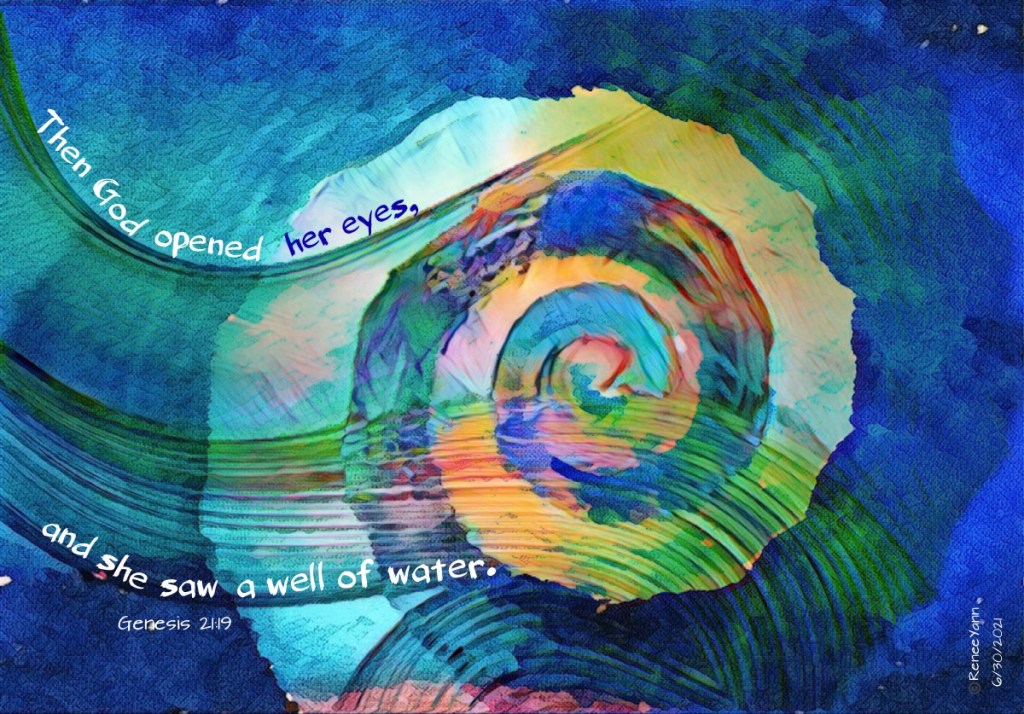
Then God opened her eyes, and she saw a well of water.
She went and filled the skin with water, and then let the boy drink.

Genesis 21: 15-19

Surely Hagar, and her baby Ishmael, are “poor ones” whose cries the Lord hears.

When the poor ones called out, the LORD heard,
and from all distress saved them.
The angel of the LORD encamps
around those who fear God, and delivers them.

Psalm 34: 7-8

Hagar is the embodiment of a faith that has surrendered everything to God. She is pressed to it by the circumstances of her life. But even in that press, she has a choice: God or godlessness. 

God sees her heart choice and opens her eyes to its power:

Then God opened her eyes,
and she saw a well of water.
She went and filled the skin with water,
and then let the boy drink.

The revelation I take from today’s readings?

Even in our deepest thirsts, there is a “well of water” awaiting us when we live in faith and reverence for God:

Fear the LORD, you holy ones,
for nought is lacking to those who fear God.
The great grow poor and hungry;
but those who seek God want for no good thing.

Psalm 34: 10-11

Poetry: Hagar in the Wilderness by Tyehimba Jess

My God is the living God,
God of the impertinent exile.
An outcast who carved me
into an outcast carved
by sheer and stony will
to wander the desert
in search of deliverance
the way a mother hunts
for her wayward child.
God of each eye fixed to heaven,
God of the fallen water jug,
of all the hope a vessel holds
before spilling to barren sand.
God of flesh hewn from earth
and hammered beneath a will
immaculate with the power
to bear life from the lifeless
like a well in a wasteland.
I'm made in the image of a God
that knows flight but stays me
rock still to tell a story ancient as
slavery, old as the first time
hands clasped together for mercy
and parted to find only their own
salty blessing of sweat.
I have been touched by my God
in my creation, I've known her caress
of anointing callus across my face. 
I know the lyric of her pulse
across these lips...  and yes,
I've kissed the fingertips
of my dark and mortal God.
She has shown me the truth
behind each chiseled blow
that's carved me into this life,
the weight any woman might bear 
to stretch her mouth toward her
one true God, her own
beaten, marble song.
sculptor: Edmonia Lewis (1845-1907), an African/Native American expatriate who was phenomenally successful in Rome.

Music: El Roi (Hagar’s Song)
Saturday of the Twelfth Week in Ordinary Time

June 26, 2021

Today, in God’s Lavish Mercy, we pray once again with Mary’s exquisite prayer, the Magnificat. This prayer is so rich that we can pray it in many ways. Today’s other readings suggest to me to pray it as a prayer of spirited possibility.

For you, my God,
have done great things for me,
and Holy is your Name.
Your Mercy is from age to age
for those wrapped in awe of you.


In our first reading, Abraham and Sarah are the prototypes of such holy awe. Recognizing something godly in his visitors, Abraham welcomes them extravagantly.

Sarah is so struck by their predictions that she turns giddy.

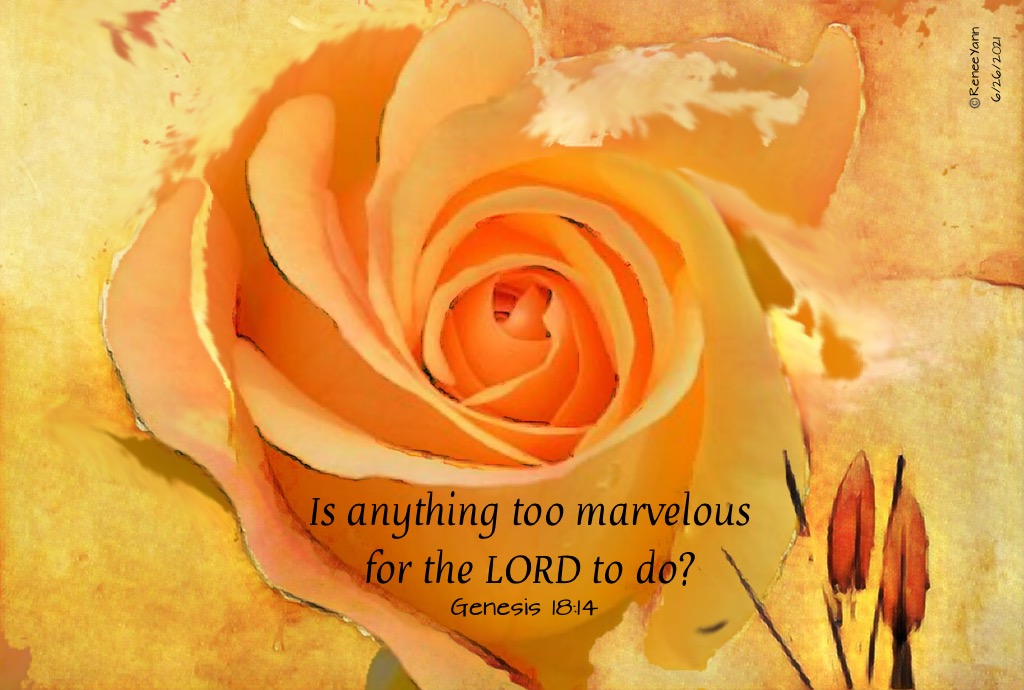
Sometimes when we are overawed by our circumstances, we dissemble rather than quiet ourselves in reverence. God calls Abraham and Sarah to be still within the holy moment by asking the divine rhetorical question:


In our Gospel, the centurion has his own holy moment. Already committed in faith, he hopes for more from Jesus because of his need. With profound trust and humility, the centurion  invites God’s Word to act completely and spontaneously in his life.


We may not have visible angels visiting our homes today, like Abraham and Sarah did.

We may not find Jesus walking into our local town like the centurion did.

Still, by faith, we trust that the Holy is present in every moment of our lives.


With Abraham and Sarah, may we open the tent of our lives to heavenly intervention.

With Mary, let us ask God to release the miracle of sacred possibility over our lives and over our world.

Your mercy reaches from age to age 
for those in awe of you.
You have shown strength with your arm; 
you have scattered the proud in their conceit; 
you have deposed the mighty from their thrones 
and raised the lowly to high places.
You have filled the hungry with good things, 
while you have sent the rich away empty. 
You have come to the aid of Israel your servant, 
mindful of your mercy―
the promise you made to our ancestors―
to Sarah and Abraham and their decendants forever.


Poem: SARAH’S LAUGHTER (GENESIS 18:1–15) by Irene Zimmerman, OSF

When Abraham had hurried back
to the three Strangers with bread
and meat, milk and curds,
Sarah, obediently hiding her faded
beauty behind the tent flaps,
watched them feasting beneath the oak.

From there the Strangers’ words
came winging to where she stood—
in shocked disbelief at first,
having grown old and used to
the sterile disfavor of Abraham’s God,
then exploding in peals of laughter
that ricocheted off the oaks of Mamre
and the stony hills of promise. 

“How many can you count, Sarah?”
Abraham asked as they held each other
beneath a blanket of stars.
“How many children will there be?”

The words set her off again,
and Abraham too,
with irrepressible mirth
till the hills whooped and hollered
and the stars blazed their Aha
in the pregnant desert night.

Music: Two songs today. One just to laugh! Enjoy the possibilities!🤗

  1. Sarah Laughed – Joe Buchanan
Miracles abound, In front of you and all around 
You and I, she and him, It’s a miracle that life begins 
Every time we think we’re lost for good 
The world keeps turning, just like it should 

And out of the darkness came let there be light 
And it’s a miracle we’re sharing space, here in this life 
The universe is a concert, everything moves in time 
Anything can happen when the moment is right 
And Sarah laughed… 

The day begins the same way each time 
The sun and moon and stars, they all know their lines 
Life has a heartbeat of its own, you know 
The only thing unpredictable… the human soul 

And out of the darkness came let there be light 
And it’s a miracle we’re sharing space, here in this life 
The universe is a concert, everything moves in time 
Anything can happen when the moment is right 
And Sarah laughed… 

And we’re the change in things 
The dreamers and the shapers, we’re the crafters and makers 
All building our lives 
And I try so hard to find G-d’s plan in mine 
But I’m a rocky start… maybe that’s by design 
And then I laugh, And Sarah laughed 

And out of the darkness came let there be light 
And it’s a miracle we’re sharing space, here in this life 
The universe is a concert, everything moves in time 
Everything can happen when the moment is right 
And Sarah laughed… 

2. Abraham and Sarah Had to Laugh – Bryan Sirchio

Abraham and Sarah were very old and gray
And angel of the LORD showed up and said to them one day
We know you’re very old and that you’ve never had a kid
But God says, “better find a baby crib!”
And they said…

(Chorus)
Ha, ha, ha! Ho, ho, ho!
You can’t have a baby when you get this old
Abraham and Sarah had to laugh
O boy that’s a knee slapper!
Ha, ha, ha! Ho, ho, ho!
But now Abraham and Sarah know
That nothing is too hard for God

Friday of the Twelfth Week in Ordinary Time

June 25, 2021

This reflection on Psalm 128 was published earlier this year, but I thought it deserved another day. I hope you do too. 🙂

Today, in God’s Lavish Mercy, we pray with Psalm 128 which some describe as a blueprint for a happy home.

Happy are they all who fear the Lord, 
and who follow in the ways of God!
You shall eat the fruit of your labor;
happiness and prosperity shall be yours.
Your wife shall be like a fruitful vine 
within your house, 
your children like olive shoots 
round about your table.

Psalm 128, Canadian Inclusive Psalter

As lovely as it is, this interpretation may be overly simple. 

Psalm 128, written in the post-exilic period, is the people’s song of gratitude for the chance to return to their homeland after the Babylonian captivity.

For Israel, the captivity was the result of their faithlessness to their covenant with God. The core sentiment of the psalm is awareness, repentance, and conviction to live life more intentionally – to live in fear of the Lord and thus preserve oneself from future calamity:

Blessed are you who fear the LORD,
    who walk in the Lord’s ways!


I think that word “fear” is a tough one. It seems to contradict our desired relationship with the God who is Love, the God we have met in the person of Jesus Christ. How do we reconcile the contradiction?

But Proverbs tells us this:

The fear of the LORD is the beginning of wisdom, 
and knowledge of the Holy One is understanding.

Proverbs 9:10

So this “fear” is significantly different from the emotion we might feel when, for example, we hear an unfamiliar noise in our darkened house.

Thus the ‘fear of the Lord’ is a relational term signifying the Israelites’ response to God’s grace displayed in salvation (especially the Exodus). As Walter Brueggemann has aptly written, it means: to take God with utmost seriousness as the premise and perspective from which life is to be discerned and lived. That ‘utmost seriousness’ requires attentiveness to some things rather than others, to spend one’s energies in response to this God who has initiated our life.

Mark J. Boda, Professor of Old Testament, McMaster Divinity College

This, in fact, is the rich sentiment underlying Psalm 128, and that will yield the security of an intimate relationship with God

May the LORD bless you from Zion;
may you see Jerusalem’s prosperity
all the days of your life,
and live to see your children’s children.
Peace upon Israel!

Psalm 128:4-5
May we live to see our lives unfold in grace.

The psalmist’s “fear” might be more akin to awe, reverence, glad obedience to our God who loves us and wills our good. It is a virtue rooted in our search for a holy awe and wisdom as our life unfolds in God’s Grace:

Old Testament scholar, Walter Brueggemann, says we live in a technological society that has grossly confused knowledge and wisdom. He says wisdom is the mystery, held by God, about how and why life works…how creation holds together…and how human reason has its limits. Wisdom is God’s secret and even our bold Enlightenment expectations barely lay a finger on that secret. Wisdom involves recognizing limits before the mystery of God. Knowledge has to do with control, says Brueggemann. Wisdom has to do with awe.

Walter M. Klein, Pastor, Lexington Presbyterian Church

Poem: I Am Bending My Knee

Originally from the Carmina Gadelica I, 3. Taken from Esther de Waal, editor, The Celtic Vision (Liguori, MO: Liguori/Triumph, 1988, 2001), p. 7.

I am bending my knee
In the eye of the Father who created me,
In the eye of the Son who purchased me,
In the eye of the Spirit who cleansed me,
In friendship and affection.

Through Thine own Anointed One, O God,
Bestow upon us fullness in our need,
Love towards God,
The affection of God,
The smile of God,
The wisdom of God,
The grace of God,
The fear of God,
And the will of God

To do on the world of the Three,
As angels and saints
Do in heaven;
Each shade and light,
Each day and night,
Each time in kindness,
Give Thou us Thy Spirit.

Music: The Fear of the Lord – First Baptist Dallas (Wow! How about this music ministry!)

Solemnity of the Nativity of Saint John the Baptist

June 24, 2021

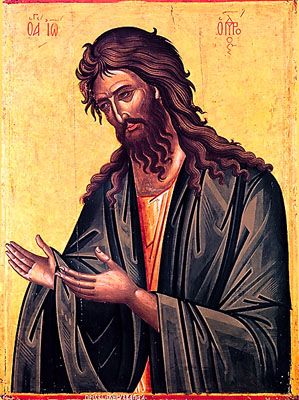
Icon of St. John the Baptist (16th c.) Dionysiou Monastery

Today, in Mercy, we celebrate one of the greatest figures of the Bible, John the Baptist. He prepared the way for the Lord.

Thinking of John’s role in Salvation History, I am reminded of a captivating poem by Geoffrey Brown, author of Road of the Heart Cave:

The Heart Cave

I must remember

To go down to the heart cave
& sweep it clean; make it warm
with a fire on the hearth,
& candles in their niches,
the pictures on the walls
       glowing with a quiet light.
       I must remember

To go down to the heart cave
       & make the bed
with the quilt from home,
strew
the rushes on the floor
hang
lavender and sage
         from the corners.
         I must go down
                                           To the heart cave & be there
                                           when You come.


John the Baptist went down to the heart cave of our human perception of God.  He understood, in an inexpressible way, that God was about to do something astounding in human history.  God was about to become part of it!

John understood this with unquestioning faith, the way we understand heaven but cannot rationalize it. Understanding it, he knew that the world needed to turn itself toward God – to repent – in radical and ardent expectation.

This was his call and his message – this extraordinary man, dressed in his camel hair vestments, preaching at the desert’s edge.


We might pray with John today to be turned from anything that distracts us from God, to long for God’s presence in our hearts and in our world, to love deeply and make a welcome home for Christ within us.


( On this Feast, 55 years ago, my entrance companions and I professed our vows. I think of all of them with love today. May I humbly ask you, dear readers, to join me in prayer for us as we thank God for the gift of our lives in Mercy.)


Music: “Utqueant laxis” or “Hymnus in Ioannem” is a Latin hymn in honor of John the Baptist written in Horatian Sapphics and traditionally attributed to Paulus Diaconus, the eighth-century Lombard historian. It is famous for its part in the history of musical notation, in particular solmization (do-re-mi-fa-so-la-ti-do). The hymn is sung to a Gregorian chant, and introduces the original do-re-mi music

1. O for your spirit, holy John, to chasten
Lips sin-polluted, fettered tongues to loosen;
So by your children might your deeds of wonder
Meetly be chanted.

2. Lo! a swift herald, from the skies descending,
Bears to your father promise of your greatness;
How he shall name you, what your future story,
Duly revealing.

3. Scarcely believing message so transcendent,
Him for a season power of speech forsaketh,
Till, at your wondrous birth, again returneth,
Voice to the voiceless.

4. You, in your mother’s womb all darkly cradled,
Knew your great Monarch, biding in His chamber,
Whence the two parents, through their offspring’s merits,
Mysteries uttered.

5. Praise to the Father, to the Son begotten,
And to the Spirit, equal power possessing,
One God whose glory, through the lapse of ages,
Ever resounding. Amen.

Wednesday of the Twelfth Week in Ordinary Time

Wednesday, June 23, 2021

Today, in God’s Lavish Mercy, we pray with Psalm 105, a sacred invitation to rest confidently in God.

Glory in God’s holy name;
    rejoice, O hearts that seek the LORD!
Look to the LORD’s strength;
    seek to serve God wholeheartedly.

Psalm 105:3-4

Our trust is based on God’s infinite memory, mindful of us with every breath of our lives. We are asked to remember too.

The Lord remembers the covenant for ever.

Psalm 105:8

Jesus reminds us of this covenant in our Alleluia verse from John’s Gospel:

Let’s just be cradled in these holy promises as we pray today.


Poetry: Trust by Thomas R. Smith

It’s like so many other things in life   
to which you must say no or yes.                                    
So you take your car to the new mechanic.   
Sometimes the best thing to do is trust.   
The package left with the disreputable-looking   
clerk, the check gulped by the night deposit,   
the envelope passed by dozens of strangers—   
all show up at their intended destinations.   
The theft that could have happened doesn’t.   
Wind finally gets where it was going   
through the snowy trees, and the river, even               
when frozen, arrives at the right place.                        
And sometimes you sense how faithfully your life   
is delivered, even though you can’t read the address.


Music: two songs today. I liked them both a lot and didn’t want to deprive you of either.

Rest in God – Brian Doerksen

Rest – Steve Green

Tuesday of the Twelfth Week in Ordinary Time

June 22, 2021

Today, in God’s Lavish Mercy, we pray with Psalm 15 which begins by asking a crystal clear question:

LORD, who may abide in your tent?
Who may dwell on your holy mountain?

Psalm 15:1

In other words, “What is it you’re looking for in me that I may be your friend, living under your protection?”.


In our first reading, Abraham is in the process of deciphering the answer to this question by responding wholeheartedly to God’s invitation and promise.

One of Abraham’s first actions when becoming God’s friend is an act of justice toward  his nephew Lot. Both their holdings had grown very large and their families began competing for resources. So Abraham gave Lot a choice to have his own land so both could live in security and peace.


Justice is the core of today’s readings, and it’s the ticket to God’s tent. I think it is a virtue which confuses many of us. We get it mixed up with concepts of law, vengeance, preferential judgements. But here’s the definition from the Catholic Catechism and I like it. It sounds academic, but it’s exactly what Abraham did for Lot in our first reading – he acted for “right relationship” which is the heart of justice. All in all, justice is just another face of Mercy.

Justice is the moral virtue that consists in the constant and firm will to give their due to God and neighbor. Justice toward God is called the “virtue of religion.” Justice toward persons disposes one to respect the rights of each and to establish in human relationships the harmony that promotes equity with regard to persons and to the common good.

Catechism of the Catholic Church

Thomas Aquinas must have thought people were confused about justice too. He defined and explained it exhaustively in the Summa Theologiae


Psalm 15, though, makes it simpler for us. Here’s Christine Robinson’s transliteration:

How do truly good people live?
They speak the truth from their hearts
  have no hidden agendas, are
  loyal friends. 
They offer respect to their neighbors, but
  avoid the company of the selfish and the foolish,
They honor good people wherever they find them.
They live to do good, keep their word
   make their living with honest work
   and give generously from their abundance.
Their way of life makes them strong in heart.


I like people like that, and I want to be one of them – for God’s sake, other people’s, and my own. Praying with Psalm 15 can help us do that.


Poetry: Making Peace – Denise Levertov

A voice from the dark called out,
             ‘The poets must give us
imagination of peace, to oust the intense, familiar
imagination of disaster. Peace, not only
the absence of war.’
                                   But peace, like a poem,
is not there ahead of itself,
can’t be imagined before it is made,
can’t be known except
in the words of its making,
grammar of justice,
syntax of mutual aid.
                                       A feeling towards it,
dimly sensing a rhythm, is all we have
until we begin to utter its metaphors,
learning them as we speak.
                                              A line of peace might appear
if we restructured the sentence our lives are making,
revoked its reaffirmation of profit and power,
questioned our needs, allowed
long pauses . . .
                        A cadence of peace might balance its weight
on that different fulcrum; peace, a presence,
an energy field more intense than war,
might pulse then,
stanza by stanza into the world,
each act of living
one of its words, each word
a vibration of light—facets
of the forming crystal.

Music: Conserva Me, Domine (Psalm 15) – Marc Antoine Charpentier

Memorial of Saint Aloysius Gonzaga

Monday, June 21, 2021

Today, in God’s Lavish Mercy, we pray with Psalm 33 in which the human family remembers and gives thanks for God’s creative omnipotence.

Following upon our reading from Genesis, our psalm moves past Eden to the practical world of the psalmist. It is a world where centuries have passed and human beings have progressively made a mark on Creation – for good or for ill.

God has watched the progression, blessing or redeeming it in Mercy:

The One who fashioned together their hearts
is the One who knows all their works.

Psalm 33:15

The psalmist reminds us that all Creation generates within God’s power. To cooperate with that infinite grace, we must wait, listen, trust, and deepen in holy understanding:

Our soul waits for the LORD,
who is our help and shield.
For in God our hearts rejoice;
in God’s holy name we trust.
May your mercy, LORD, be upon us;
as we put our hope in you.

Psalm 33:20-22

We are not the actors. We are simply the instruments of God’s gracious unfolding in the symmetry of Creation – both in the cosmos and in the delicate blossom of our own hearts.

How is God growing in the world today within my life?


Poetry:The light shouts in your tree-top, and the face – Rilke

The light shouts in your tree-top, and the face
of all things becomes radiant and vain;
only at dusk do they find you again.
The twilight hour, the tenderness of space,
lays on a thousand heads a thousand hands,
and strangeness grows devout where they have lain.
With this gentlest of gestures you would hold
the world, thus only and not otherwise.
You lean from out its skies to capture earth,
and feel it underneath your mantle’s folds.
You have so mild a way of being.
……………………………………………They
who name you loudly when they come to pray
forget your nearness. From your hands that tower
above us, mountainously, lo, there soars,
to give the law whereby our senses live,
dark-browed, your wordless power.

Our gifted Mercy artist, Sister Judy Ward, has created greeting cards using some of my designs. This “Sunrise Tree” is one of them. If you would like to purchase any of Sister Judy’s beautiful work, you can connect with her here. She’s nice to talk with on the phone.


Music: Awaking Moment – Joe Bongiorno

Twelfth Sunday in Ordinary Time

Sunday, June 20, 2021

Today, in God’s Lavish Mercy, we pray with Psalm 107, a poem filled with images that hold secrets for our spiritual journey:

They who sailed the sea in ships,
    trading on the deep waters,
These saw the works of the LORD
    and God’s wonders in the abyss.

Psalm 107:23-24

Those who have the opportunity to see the ocean in its many moods will quickly understand the analogy. 

Life is an ocean, but we are not sailing it alone.

That’s what the Lord suggests to Job in our first reading, and what Jesus points out to the nervous disciples in our Gospel.

Psalm 107 tells us that when life distresses us we should do just what the disciples did:

They cried to the LORD in their distress;
    from their straits he rescued them,
God hushed the storm to a gentle breeze
    and the billows of the sea were stilled

Psalm 107: 28-29

It also suggests us that we can hope for this result:

They rejoiced that they were calmed,
    and  brought to their desired haven.
Let them give thanks fo the Lord’s kindness
    and  wondrous deeds to us all.

Psalm 107:30-31

The message of today’s readings for me is trust and hope
— in both calm and storm. Let’s pray for it.


Poetry: blessing of the boats – Lucille Clifton

                                    (at St. Mary’s)

may the tide
that is entering even now
the lip of our understanding
carry you out
beyond the face of fear
may you kiss
the wind then turn from it
certain that it will
love your back     may you
open your eyes to water
water waving forever
and may you in your innocence
sail through this to that.


Music: Secret Ocean – Peter Kater

Saturday of the Eleventh Week in Ordinary Time

Saturday, June 19, 2021

Today, in God’s Lavish Mercy, we pray with Psalm 34 once again. With its two accompanying readings, the psalm hits me right between the eyes with this awareness:

Those of us trying to live in God’s presence, the world isn’t going to help us. We will be in contradiction to many, if not most, popular values. Our choices may be questioned, if not ridiculed. Our values may be explained away. Our integrity may be challenged. 

What’s it like to live a faith-based life in today’s culture? The image that comes to my mind is that of trying to play soccer with a square ball! 

Paul felt the dissonance:

But the Lord said to me, “My grace is sufficient for you,
for power is made perfect in weakness.”
So I will rather boast most gladly of my weaknesses,
in order that the power of Christ may dwell with me.
Therefore, I am content with weaknesses, insults,
hardships, persecutions, and constraints,
for the sake of Christ …


Jesus put the contradiction in a nutshell for us:

No one can serve two masters.
You will either hate one and love the other,
or be devoted to one and despise the other.
You cannot serve God and mammon.


So we need to figure out our “mammon” and vanquish it. We need to make the choice that Paul, the psalmist, and Jesus made. Let’s pray on it today.


Poetry: Contraband – Denise Levertov

The tree of knowledge was the tree of reason.
That’s why the taste of it
drove us from Eden. That fruit
was meant to be dried and milled to a fine powder
for use a pinch at a time, a condiment.
God had probably planned to tell us later
about this new pleasure.
                                   We stuffed our mouths full of it,
gorged on but and if and how and again
but, knowing no better.
It’s toxic in large quantities; fumes
swirled in our heads and around us
to form a dense cloud that hardened to steel,
a wall between us and God, Who was Paradise.
Not that God is unreasonable – but reason
in such excess was tyranny
and locked us into its own limits, a polished cell
reflecting our own faces. God lives
on the other side of that mirror,
but through the slit where the barrier doesn’t
quite touch ground, manages still
to squeeze in – as filtered light,
splinters of fire, a strain of music heard
then lost, then heard again.


Music: I Choose You Now – Rend Collective

Friday of the Eleventh Week in Ordinary Time

June 18, 2021

Today, in God’s Lavish Mercy, we pray with Psalm 34 which carries forward the thread of sage advice running through all of our readings


I’m going to state the obvious here: distress is not a pretty thing. 


We all have stress in our lives and, guess what, it can be a good thing. Stress is a reaction in us when a situation calls for our response. If such reactions never occurred, we would be living in isolation from our environment or community. We would not grow as persons.

This positive stress can be called “eustress”. Distress, on the other hand, occurs when we cannot respond effectively to our experiences or situation. We become overwhelmed, fearful, or anxious.


Paul, in our first reading, has a lot of opportunity to grow from stress! Maybe too much. It sounds like Paul’s experiences had certainly bordered on “distress”.

So did our psalmist’s experiences. In later verses of the psalm, we get a hint of that. The writer is broken-hearted, crushed in spirit, and under physical threat — just like Paul:

The LORD is close to the brokenhearted,
saves those whose spirit is crushed.
Many are the troubles of the righteous,
but the LORD delivers us from them all.
God watches over all our bones;
not one of them shall be broken.
Evil will slay the wicked;
those who hate the righteous are condemned.
But the  LORD redeems the faithful servant
and none are condemned who take refuge in God.

Psalm 34:19-23

Jesus has a word for us about dealing with distress:

Do not store up for yourselves treasures on earth,
where moth and decay destroy,
and thieves break in and steal.
But store up treasures in heaven,
where neither moth nor decay destroys,
nor thieves break in and steal.


So it all depends on what we treasure, on what we allow to become most important in our lives. If wealth, reputation, power, and self-aggrandizement are our treasures, we’re going to live in distress all our lives trying to protect these trophies.

If charity, hope, faith, and merciful justice are our treasures, it doesn’t mean we will never have stress or pain. But we will understand the prayer of Psalm 34:

Glorify the LORD with me,
    let us together extol God’s name.
I sought the LORD who answered me
    and delivered me from all my fears. 
From all their distress God rescues the just.
Look to God that you may be radiant with joy,
    and your faces may not blush with shame.
When the poor one called out, the LORD heard,
    and was delivered from all distress.

Psalm 34:4-7

Poetry: Do not be troubled, God, though they say “mine” – Rainer Maria Rilke

Do not be troubled, God, though they say “mine”
of all things that permit it patiently.
they are like wind that lightly strokes the boughs
and says: MY tree.
They hardly see
how all things glow that their hands seize upon,
so that they cannot touch
even the utmost fringe and not be singed.
They will say “mine” as one will sometimes call
the prince his friend in speech with villagers,
this prince being very great — and far away.
They call strange walls “mine,” knowing not at all
who is the master of the house indeed.
They still say “mine,” and claim possession, though
each thing, as they approach, withdraws and closes;
a silly charlatan perhaps thus poses
as owner of the lightning and the sun.
And so they say: my life, my wife, my child,
my dog, well knowing all that they have styled
their own: life, wife, child, dog, remain
shapes foreign and unknown,
that blindly groping they must stumble on.
This truth, be sure, only the great discern,
who long for eyes. The others WILL not learn
that in the beggary of their wandering
they cannot claim a bond with any thing,
but, driven from possessions they have prized,
not by their own belongings recognized,
they can OWN wives no more than they own flowers,
whose life is alien and apart from ours.
God, do not lose your equilibrium.
Even he who loves you and discerns your face
in darkness, when he trembles like a light
you breathe upon, — he cannot own you quite.
And if at night one holds you closely pressed,
locked in his prayers so you cannot stray,
…..you are the guest
…..who comes, but not to stay.
God, who can hold you? To yourself alone
belonging, by no owner’s hand disturbed,
you are like unripened wine that unperturbed
grows ever sweeter and is all alone.


Music: Me and Bobby McGee written and sung by Kris Kristofferson

I don’t know if you will appreciate this song, but I thought I’d give it a try. 
I have always identified today’s Gospel with a verse in the song:
Freedom’s just another word for nothin’ left to lose.
Nothin’, it ain’t nothin’ honey, if it ain’t free
I have never fully spiritually plumbed that verse, but I love to explore it every time I hear this song.