Psalm 128: Fear?

Thursday of the Fifth Week in Ordinary Time

February 11, 2021


Today, in God’s Lavish Mercy, we pray with Psalm 128 which some describe as a blueprint for a happy home.

Happy are they all who fear the Lord, 
and who follow in the ways of God!
You shall eat the fruit of your labor;
happiness and prosperity shall be yours.
Your wife shall be like a fruitful vine 
within your house, 
your children like olive shoots 
round about your table.

Psalm 128, Canadian Inclusive Psalter

As lovely as it is, this interpretation may be overly simple. 

Psalm 128, written in the post-exilic period, is the people’s song of gratitude for the chance to return to their homeland after the Babylonian captivity.

For Israel, the captivity was the result of their faithlessness to their covenant with God. The core sentiment of the psalm is awareness, repentance, and conviction to live life more intentionally – to live in fear of the Lord and thus preserve oneself from future calamity:

Blessed are you who fear the LORD,
    who walk in the Lord’s ways!


For us, that word “fear” is a tough one. It seems to contradict our desired relationship with the God who is Love, the God we have met in the person of Jesus Christ. How do we reconcile the contradiction?

Proverbs tells us this:

The fear of the LORD is the beginning of wisdom,
and knowledge of the Holy One is understanding.

Proverbs 9:10

So this “fear” is significantly different from the emotion we might feel when, for example, we hear an unfamiliar noise in our darkened house.

Thus the ‘fear of the Lord’ is a relational term signifying the Israelites’ response to God’s grace displayed in salvation (especially the Exodus). As Walter Brueggemann has aptly written, it means: to take God with utmost seriousness as the premise and perspective from which life is to be discerned and lived. That ‘utmost seriousness’ requires attentiveness to some things rather than others, to spend one’s energies in response to this God who has initiated our life.

Mark J. Boda, Professor of Old Testament, McMaster Divinity College

This, in fact, is the rich sentiment underlying Psalm 128, and that will yield the security of an intimate relationship with God

May the LORD bless you from Zion;
may you see Jerusalem’s prosperity
all the days of your life,
and live to see your children’s children.
Peace upon Israel!

Psalm 128: 4-5
…as our life unfolds in God’s grace.

The psalmist’s “fear” might be more akin to awe, reverence, glad obedience to our God who loves us and wills our good. It is a virtue rooted in our search for a holy awe and wisdom as our life unfolds in God’s Grace:

Old Testament scholar, Walter Brueggemann, says we live in a technological society that has grossly confused knowledge and wisdom. He says wisdom is the mystery, held by God, about how and why life works…how creation holds together…and how human reason has its limits. Wisdom is God’s secret and even our bold Enlightenment expectations barely lay a finger on that secret. Wisdom involves recognizing limits before the mystery of God. Knowledge has to do with control, says Brueggemann. Wisdom has to do with awe.

William M. Klein, Pastor, Lexington Presbyterian Church

Poem: I Am Bending My Knee
Originally from the Carmina Gadelica I, 3. Taken from Esther de Waal, editor, The Celtic Vision (Liguori, MO: Liguori/Triumph, 1988, 2001), p. 7.

I am bending my knee
In the eye of the Father who created me,
In the eye of the Son who purchased me,
In the eye of the Spirit who cleansed me,
In friendship and affection.
Through Thine own Anointed One, O God,
Bestow upon us fullness in our need,
Love towards God,
The affection of God,
The smile of God,
The wisdom of God,
The grace of God,
The fear of God,
And the will of God
To do on the world of the Three,
As angels and saints
Do in heaven;
Each shade and light,
Each day and night,
Each time in kindness,
Give Thou us Thy Spirit.

Music: The Fear of the Lord – First Baptist Dallas (Wow! How about this music ministry!)
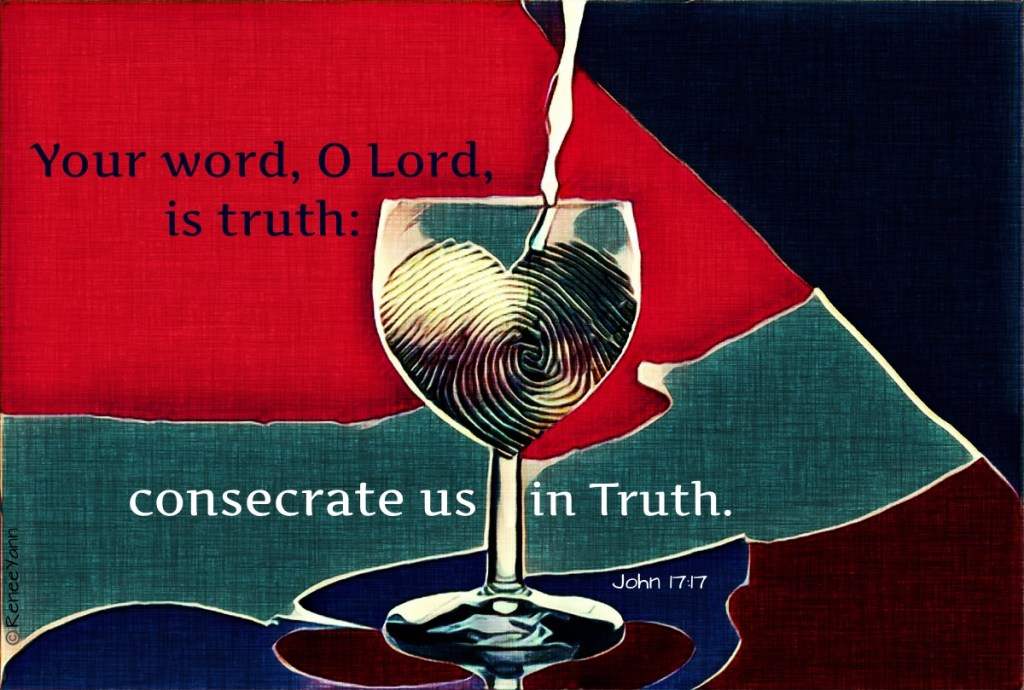
Gospel Verse: Truth

Memorial of Saint Scholastica, Virgin

February 10, 2021


Today, in God’s Lavish Mercy, we once again meet Psalm 104. Since we have had a very recent reflection on this psalm, we might instead like to reflect on our Gospel verse for today:

“Truth”, which would appear to be an evident reality, is in fact quite elusive. In his master work Summa Theologica, Thomas Aquinas writes extensively, and some might say exhaustively 🧐, in an effort to define truth.

For this reason truth is defined by
the conformity of intellect and thing;
and hence to know this conformity is to know truth.


Reflecting on the concept of Truth today, I remember Jesus’s self-description:

I am the Way and the Truth and the Life. 
No one comes to the Father except through Me.

John 14:6

By journeying through life with Jesus, we come to comprehend truth more clearly – both the truth around us and the truth within us. It is an unfolding which brings us ever closer to God’s complete imagination for us when we were created.

It is as if God’s fingerprint, first poured into on souls at our conception, becomes ever clearer in our lives. Let us pray each day to be consecrated in that Truth.

Poetry: truth by Gwendolyn Brooks
And if sun comes
How shall we greet him?
Shall we not dread him,
Shall we not fear him
After so lengthy a
Session with shade?

Though we have wept for him,
Though we have prayed
All through the night-years—
What if we wake one shimmering morning to
Hear the fierce hammering
Of his firm knuckles
Hard on the door?

Shall we not shudder?—
Shall we not flee
Into the shelter, the dear thick shelter
Of the familiar
Propitious haze?

Sweet is it, sweet is it
To sleep in the coolness
Of snug unawareness.

The dark hangs heavily
Over the eyes.

Music: Heaven’s Window – Peter Kater (Angels of Hope)

Psalm 8: God’s Handiwork

Tuesday of the Fifth Week in Ordinary Time

Tuesday, February 9, 2021

Today, in God’s Lavish Mercy, we pray with Psalm 8 which, in keeping with our first reading from Genesis, describes our Creator God in terms we can humanly understand.

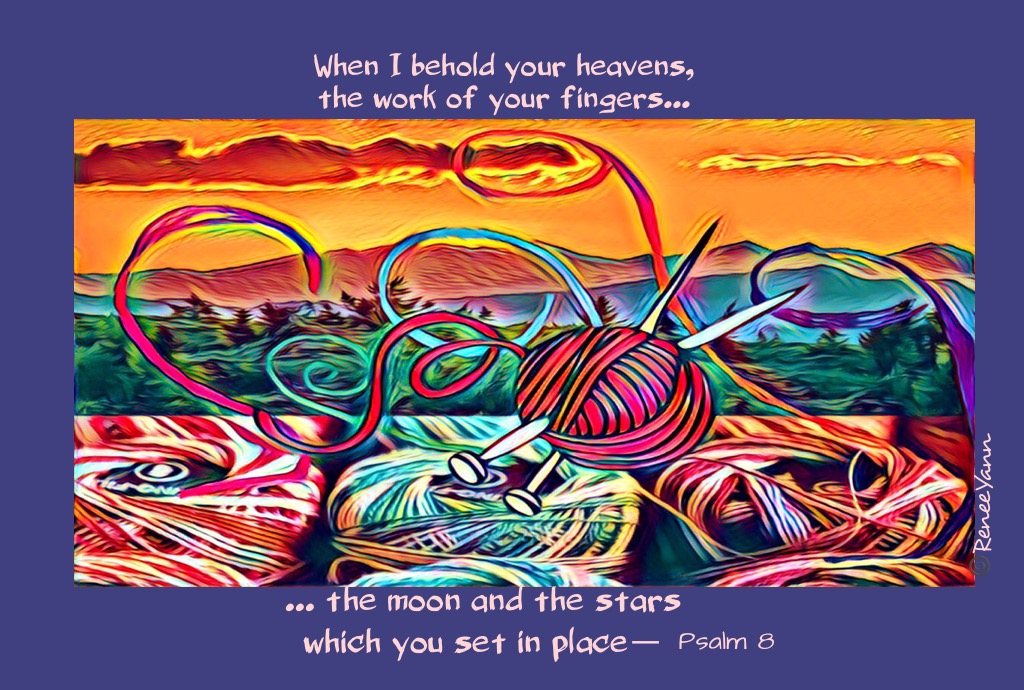
I have always thought of these verses as the “Psalm of the Knitting God” who weaves the cloth of Creation to clothe us:

When I behold your heavens, the work of your fingers,
    the moon and the stars which you set in place—
What are we that you should be mindful of us ,
    or that you should care for us?

Psalm 8:4

As beautiful as its images are, Psalm 8 contains a challenging verse which some, over time, have interpreted to support human domination of all creation:

You have made humans little less than the angels,
    and crowned them with glory and honor.
You have given them rule over the works of your hands,
    putting all things under their feet.

Psalm 8:6-7

Elephant Trophy Hunting

The verse has been manipulated to justify an attitude of supremacy rather than unity and cooperation with nature. That misinterpretation supports such activities as uncontrolled extraction mining, land seizure, trophy hunting and many other forms of natural exploitation.

More recent theology has helped to understand our role in Creation in a humbler, truer light, as stated in the introduction to Laudato Sí:


LAUDATO SI’, mi’ Signore” – “Praise be to you, my Lord”. In the words of this beautiful canticle, Saint Francis of Assisi reminds us that our common home is like a sister with whom we share our life and a beautiful mother who opens her arms to embrace us. “Praise be to you, my Lord, through our Sister, Mother Earth, who sustains and governs us, and who produces various fruit with coloured flowers and herbs”.

This sister now cries out to us because of the harm we have inflicted on her by our irresponsible use and abuse of the goods with which God has endowed her. We have come to see ourselves as her lords and masters, entitled to plunder her at will. The violence present in our hearts, wounded by sin, is also reflected in the symptoms of sickness evident in the soil, in the water, in the air and in all forms of life. This is why the earth herself, burdened and laid waste, is among the most abandoned and maltreated of our poor; she “groans in travail” (Rom 8:22). We have forgotten that we ourselves are dust of the earth (cf. Gen 2:7); our very bodies are made up of her elements, we breathe her air and we receive life and refreshment from her waters.


To prepare for prayer this morning, I reflected on “The Way of Beauty”, Stations of the Cross composed by Gilbert Choondal, SDB, a Salesian Priest of Don Bosco. He holds a PhD in Catechetics and Youth Ministry from the Salesian Pontifical University, Rome. Presently he is the president of the Indian Catechetical Association.
You may find these prayerful reflections helpful, especially as we approach the season of Lent. (You may have to double-click the picture of the Good Shepherd to make the document come up.)


Poetry: Hovering – Joseph Stroud

(for Tom Marshall)
Tom and I are walking Last Chance Road
down from the mountain where we had been
hunting mushrooms under a stand of coast oaks,
walking down and looking out to the Pacific
shimmering in the late fall sun, the light
on the surface like glittering flakes of mica,
when we see a white-tailed kite hovering
in the air, hovering over a green pasture,
hovering over the day, over the two of us,
our very lives hovering as well, there
on the California coast, in the fall, in the sun,
on our way home, with a sack of chanterelles,
with our love for this world, with so much time,
and so little time—all of it—hovering—
and hovering still.


Music: Take Care of the Planet – a delightful reminder from Australia🤗

Psalm 104: Beautiful Creator

Monday of the Fifth Week in Ordinary Time

Monday, February 8, 2021


Today, in God’s Lavish Mercy, we pray with Psalm 104, a lyrical hymn of praise for the wonders of Creation. As I write this morning, an ermine snow coats the evergreens in soft white feathers. There is a quiet whisper in the trees, like God might make while sleeping

To prepare for prayer, I turn to my favorite theologian who writes extensively about Psalm 104 in his book, From Whom No Secrets Are Hid: Introducing the Psalms.

I have outlined my reading here for those who might like to approach Psalm 104 from Brueggemann’s perspective. If you benefit from his work, I highly recommend his book:

From Walter Brueggemann:

Psalm 104 divides roughly into two parts. The first part (vv. 1–24) provides an inventory of the components of creation, framed by a doxological formula. I suggest that inventory framed by doxology (praise prayer) is a good way to begin our thinking about creation.


In the second half of the poem, verses 25–35, we are offered four themes that may serve as reference points as we trace the paradigmatic power and significance of creation:

  1. Creation and Chaos
    These verses attest to the reliable, generative ordering of creation that makes use of all available creaturely possibilities.

There is the sea, great and wide!
It teems with countless beings,
living things both large and small.
There ships ply their course
and Leviathan,* whom you formed to play with.

Psalm 104: 25-26
  1. Creation and Provision

The creator “gives, gives, opens”; the creatures “gather, receive, eat,” and “are filled.” This transaction between the giver and the recipients is endless, reliable, and necessary. The creatures are always on the receiving end of the generous giving of the creator.

These all look to you to give them their food in due season;
when you give it to them, they gather it up;
when you open your hand,
they are filled with good things.

Psalm 104: 27-28
  1. Creation and Ruach

“Rauch” is a Hebrew word which images God as a breath, a wind, or a life force that sustains all living things, human beings included. in Psalm 104, “rauch” describes God’s generous, life-initiating, life-sustaining gift of vitality without which no creature can live:

When you hide your face, they panic.
Take away their breath, they perish
and return to the dust.
Send forth your spirit, they are created
and you renew the face of the earth.

Psalm 104: 29-30
  1. Creation and Righteous Judgement 

Righteousness is glad acceptance of the good ordering of reality given and guaranteed by the creator, an ordering that culminates in confident Sabbath from all our destructive drives for self-worth.

May sinners vanish from the earth,
and the wicked be no more.
Bless the LORD, my soul! Hallelujah!

Psalm 104: 35

My humble prayer, wrought in light of Brueggemann’s elegant theology is this:

I praise and thank You, God, for the wonder of Creation.
I am in awe of your Power to order all things toward Beauty.
From that balance of beauty and power,
you offer me the joys and challenges of life.
You sustain and nourish me, even in the overwhelming times.
I want to respond fully and gratefully
to your creative power in my life and in our world.
Please give me clarity and courage
to live within your life-giving creative Grace.

Amen


Poetry: The Creation by James Weldon Johnson (1871-1938)


And God stepped out on space,
And he looked around and said:
I’m lonely—
I’ll make me a world.

And far as the eye of God could see
Darkness covered everything,
Blacker than a hundred midnights
Down in a cypress swamp.

Then God smiled,
And the light broke,
And the darkness rolled up on one side,
And the light stood shining on the other,
And God said: That’s good!

Then God reached out and took the light in his hands,
And God rolled the light around in his hands
Until he made the sun;
And he set that sun a-blazing in the heavens.
And the light that was left from making the sun
God gathered it up in a shining ball
And flung it against the darkness,
Spangling the night with the moon and stars.
Then down between
The darkness and the light
He hurled the world;
And God said: That’s good!

Then God himself stepped down—

And the sun was on his right hand,
And the moon was on his left;
The stars were clustered about his head,
And the earth was under his feet.
And God walked, and where he trod
His footsteps hollowed the valleys out
And bulged the mountains up.

Then he stopped and looked and saw
That the earth was hot and barren.
So God stepped over to the edge of the world
And he spat out the seven seas—
He batted his eyes, and the lightnings flashed—
He clapped his hands, and the thunders rolled—
And the waters above the earth came down,
The cooling waters came down.

Then the green grass sprouted,
And the little red flowers blossomed,
The pine tree pointed his finger to the sky,
And the oak spread out his arms,
The lakes cuddled down in the hollows of the ground,
And the rivers ran down to the sea;
And God smiled again,
And the rainbow appeared,
And curled itself around his shoulder.

Then God raised his arm and he waved his hand
Over the sea and over the land,
And he said: Bring forth! Bring forth!
And quicker than God could drop his hand,
Fishes and fowls
And beasts and birds
Swam the rivers and the seas,
Roamed the forests and the woods,
And split the air with their wings.
And God said: That’s good!

Then God walked around,
And God looked around
On all that he had made.
He looked at his sun,
And he looked at his moon,
And he looked at his little stars;
He looked on his world
With all its living things,
And God said: I’m lonely still.

Then God sat down—
On the side of a hill where he could think;
By a deep, wide river he sat down;
With his head in his hands,
God thought and thought,
Till he thought: I’ll make me a man!

Up from the bed of the river
God scooped the clay;
And by the bank of the river
He kneeled him down;
And there the great God Almighty
Who lit the sun and fixed it in the sky,
Who flung the stars to the most far corner of the night,
Who rounded the earth in the middle of his hand;
This great God,
Like a mammy bending over her baby,
Kneeled down in the dust
Toiling over a lump of clay
Till he shaped it in is his own image;

Then into it he blew the breath of life,
And man became a living soul.
Amen. Amen.

Music: Creation Song – Fernando Ortega

Psalm 147: Brokenhearted?

Fifth Sunday in Ordinary Time

Sunday, February 7, 2021


Today, in God’s Lavish Mercy, we pray with Psalm 147 which invites us to:

Praise the LORD, for he is good;
    sing praise to our God, Who is gracious;
    Whom it is fitting to praise.

It is a psalm for the left-brained who, like Job in our first reading, might need some explanation about just why we should praise when life seems so unpraiseworthy at times!

Job spoke, saying:
Is not man’s life on earth a drudgery?
    Are not his days those of hirelings?
He is a slave who longs for the shade,
    a hireling who waits for his wages.
So I have been assigned months of misery,
    and troubled nights have been allotted to me.

Job 7: 1-4

Job, like many of us when we suffer, feels crushed under life’s burdens. However, an extended reading of the Book of Job reveals that humility and repentance allow Job to “see God”, and to rediscover the richness and flavor of his life.

Calling us to the same kind of awareness, Psalm 147 presents a series of reasons for praising God, including God’s continual attention to the city of Jerusalem, to brokenhearted and injured individuals, to the cosmos, and to nature.

For me, the most moving of these reasons comes in verse 3:

The Lord heals the brokenhearted
    and binds up their wounds.
The Lord tells the number of the stars;
    calling each by name.


This is a beautiful picture of our infinitely compassionate God who is able to recognize our broken-heartedness. 

This loving God, who knows the stars by name, knows us as well. We, like Job, begin to heal within the divine lullaby God patiently sings over our broken hearts.

Jesus is that Healing Song, the Word hummed over the world by the merciful Creator. In today’s Gospel, we see that Melody poured out over the suffering:

When it was evening, after sunset,
they brought to him all who were ill or possessed by demons.
The whole town was gathered at the door.
He cured many who were sick with various diseases,
and he drove out many demons,
not permitting them to speak because they knew him.

Mark 1: 32-34

As we pray today,

let us hear God’s song of mercy
being sung over all Creation.
Let us rest our own brokenness
there in its compassionate chords.
Let us bring the world’s pain to our prayer.

Poetry: A Cure Of Souls by Denise Levertov

The pastor
of grief and dreams
guides his flock towards
the next field
with all his care.
He has heard
the bell tolling
but the sheep
are hungry and need
the grass, today and
every day. Beautiful
his patience, his long
shadow, the rippling
sound of the flocks moving
along the valley.

Music: God Heals My Broken Heart – Patty Felker

If Job were singing his sadness today, it might sound like this song.

Psalm 48: The Temple

Thursday of the Fourth Week in Ordinary Time

February 4, 2021


Today, in God’s Lavish Mercy, we pray with Psalm 48 which has been called “a celebration of the security of Zion”.

Great is the LORD and wholly to be praised
    in the city of our God.
His holy mountain, fairest of heights,
    is the joy of all the earth.

Indeed, the Temple is a symbol of God’s favor and protection for Israel. Some scholars believe that the outburst of praise in Psalm 48 comes after the Jewish victory over the Assyrians. This victory is interpreted as a sign of God’s special favor symbolized in the power and permanence of the Temple.

As we had heard, so have we seen
    in the city of the LORD of hosts,
In the city of our God;
    God makes it firm forever.

Psalm 48:9

In our own lives, that kind of interpretation can be a slippery slope. Does God love and protect us only in our victories? What about when we fail, suffer, or collapse? Does God still favor us then?

The psalmist invites to look deeper than the visible signs of triumph. God’s mercy is expressed in the glorious “temples”, but it also reaches to “the ends of the earth” – to all our experiences.

O God, we ponder your mercy
    within your temple.
As your name, O God, so also your praise
    reaches to the ends of the earth.
Of justice your right hand is full.

Psalm 48: 10-11

But we must ponder God’s mercy to fully recognize and appreciate it.
We must pray God’s mercy into full expression in our lives
by our trusting and grateful awareness.


Poetry: Washed Up – Laurie Klein

Some tunes move the foot, inside a shoe, 
some elevate the soul, while others,
numinous as the song of Zion, play on
without us.
Remember winging it?
Fingers and toes and spirits
surrendered to more than the moment,
hearts drafting off each other,
daring
as swifts, weaving aerial fractals, our voices
ascending a groove, a line of thought,
into the upper reaches, then coasting
into rarified silence—the Mystery
humming within and
beyond all things.
No one leads the singing as you did, love.
No one else intuits my pulse
and impulse, improvising
new settings befitting
the inner lark.
Old friends ask about you, tender
their prayers. I am counting on this:
how greatly you’re loved,
and the kingdom emerging
in guises we never knew.

Music: Beautiful Zion Built Above – George Gill

Beautiful Zion, built above;
Beautiful city that I love;
Beautiful gates of pearly white;
Beautiful temple—God its light;
He who was slain on Calvary
Opens those pearly gates for me.
Zion, Zion, lovely Zion;
Beautiful Zion;
Zion, city of our God!

Beautiful heav’n, where all is light;
Beautiful angels clothed in white;
Beautiful strains that never tire;
Beautiful harps thru all the choir;
There shall I join the chorus sweet,
Worshiping at the Savior’s feet.
Zion, Zion, lovely Zion;
Beautiful Zion;
Zion, city of our God!

Beautiful crowns on ev’ry brow;
Beautiful palms the conq’rors show;
Beautiful robes the ransomed wear;
Beautiful all who enter there;
Thither I press with eager feet;
There shall my rest be long and sweet.
Zion, Zion, lovely Zion;
Beautiful Zion;
Zion, city of our God!

Psalm 103: Praise List

Wednesday of the Fourth Week in Ordinary Time

February 3, 2021

Today, in God’s Lavish Mercy, we pray with Psalm 103, an extended exhortation to bless and praise the Lord.

Bless the LORD, O my soul;
    and all my being, bless his holy name.
Bless the LORD, O my soul,
    and forget not all his benefits.

Psalm 103: 1-2

Running through all of Psalm 103, the psalmist creates a list of reasons to bless God.

For me, it was a good morning to create my own list and simply pray with that opening phrase:

I bless you, Lord and thank you…for …

The beauty outside my window was a good place to start.

Where would you start your “praise list” today?


Poetry: Stopping by Woods on a Snowy Evening – Robert Frost
Appreciating God’s beauty and blessings may lead us to act on our prayer, as it seems to for the poet:

Whose woods these are I think I know.   
His house is in the village though;   
He will not see me stopping here   
To watch his woods fill up with snow.
   
My little horse must think it queer   
To stop without a farmhouse near   
Between the woods and frozen lake   
The darkest evening of the year.
  
He gives his harness bells a shake   
To ask if there is some mistake.   
The only other sound’s the sweep   
Of easy wind and downy flake.
  
The woods are lovely, dark and deep,   
But I have promises to keep,   
And miles to go before I sleep,   
And miles to go before I sleep.

Music: Winter Snow – Chris Tomlin

Psalm 24: The Gates Are Lifted

Feast of the Presentation of the Lord

February 2, 2021


Today, in God’s Lavish Mercy, we pray once more with Psalm 24, still knocking on God’s door. As it is the Feast of the Presentation, we might picture Anna and Simeon murmuring this psalm as they await the appearance of their Savior.

Lift up, O gates, your lintels;
    reach up, you ancient portals,
that the king of glory may come in!

Psalm 24: 7

Anna and Simeon longed for the promised Redemption. They hoped and believed that Creation would be restored by the Messiah. They waited faithfully in the dark for the Light to come. And on that wondrous morning, sparks flew through the Temple door wrapped in a baby blanket!


In pre-Vatican II days, we nuns had sparse communication with our families. Throughout my over 1000 days of initial formation, I spoke with my mother fewer than 30 times. I stood it well because I was all wrapped up in my new life. But Mom languished. She pined for me and for our little daily chats.

So when the post-Vatican II era hit, Mom got on that phone. She called me every night just about seven o’clock – a brief, but treasured, check-in. Mom likened our phone calls to Stevie Wonder’s popular song at that time. Every now and again, even though it has been over thirty years, I still long for that ring.

For Mom and me, the gates had been unlocked, the lintels lifted up. The ancient portals had opened at the touch of John XXIII and his like-minded buddies. A mother-child light flowed back into us. We were both renewed by the reconnection.


On the Feast of the Presentation, we pray with Anna and Simeon, two so deeply practiced in prayer. As the child Jesus was carried into the Temple that morning, the plea of Psalm 24 was answered before their eyes. In our prayer today, let us joyfully welcome God into our hearts. Let us talk and walk with God as easily as we might with a beloved parent or a dearest friend on any given evening.

Lift up, O gates, your lintels;
    reach up, you ancient portals,
    that the God of glory may come in!

Poem: You, neighbor God, if sometimes in the night — Rainer Maria Rilke

You, neighbor God, if sometimes in the night
I rouse you with loud knocking, I do so
only because I seldom hear you breathe
and know: you are alone.
And should you need a drink, no one is there
to reach it to you, groping in the dark.

Always I hearken. Give but a small sign.
I am quite near.
Between us there is but a narrow wall,
and by sheer chance; for it would take
merely a call from your lips or from mine
to break it down,
and that without a sound.

The wall is builded of your images.
They stand before you hiding you like names.
And when the light within me blazes high
that in my inmost soul I know you by,
the radiance is squandered on their frames.

And then my senses, which too soon grow lame,
exiled from you, must go their homeless ways.

Music: He Walks with Me – Anne Murray

I come to the garden alone
While the dew is still on roses
And the voice I hear falling on my ear
The son of God discloses

And he walks with me and he talks with me
And he tells me I am his own
And the joy we share as we tarry there
None other has ever known

He speaks and the sound of his voice
Is so sweet, the birds hush their singing
And the melody that he gave to me
Within my heart is ringing

And he walks with me and he talks with me
And he tells me I am his own
And the joy we share as we tarry there
None other has ever known

Psalm 31: An Inextinguishable Light

Monday of the Fourth Week in Ordinary Time

February 1, 2021


Today, in God’s Lavish Mercy, we pray with Psalm 31 which assures us that we can rest in God’s love if we will just hope.

Let your hearts take comfort,
all who hope in the Lord.

Psalm 31: 25

Hope can be a complex virtue to understand.
The Catholic Catechism describes Hope in this way:
Hope is the theological virtue
by which we desire the kingdom of heaven
and eternal life as our happiness,
placing our trust in Christ’s promises
and relying not on our own strength,
but on the help of the grace of the Holy Spirit.
(CCC 1817)


This definition offers an important key. The kind of hope we are praying about in our psalm is a “virtue”, not a feeling. And in particular, hope is one of the three theological virtues which, according to the brilliant Thomas Aquinas means this:

… these virtues are called theological virtues
“because they have God for their object,
both in so far as by them we are properly directed to Him,
and because they are infused into our souls by God alone,
as also, finally, because we come to know of them
only by Divine revelation in the Sacred Scriptures”.


Now, you know, Thomas wasn’t probably that fun to talk with, given all that theological Latin. But, wow, he nailed this one.

What I think he meant, in other words, is that we are not talking about the feeling of hope, as when we put a soufflé in the oven and hope it doesn’t collapse. Or when we study like crazy and hope the right questions are on the exam. Or even when, more importantly, we make a life choice like marriage or religious life and hope it will bring us a fulfilling, lasting joy.

These kinds of “hopes” might be better defined as optimistic expectations. If they fail to be fulfilled, we might give up on them, perhaps even stop trying to achieve the kind of joy they promised. (That’s a whole other reflection! 🙂 )

Instead, the Hope we are praying about today is not a feeling. It is a gift, given by God and nurtured by our faithful practice of scriptural prayer.

Just like “Life” which is breathed into us by God without any cooperation of our own, the virtue of Hope – along with Faith and Love – is infused into our souls in God’s loving act of creation.

And just like the principle of life,
Faith, Hope, and Love
reside in us forever.


These theological realities can be hard to grasp. To make it easier, I turn them into images for my prayer. I picture Faith, Hope and Love as three small but inextinguishable candle flames deep in my spirit. God is the One who fires their light and warmth.

The circumstances of my life, chosen or imposed, can affect my ability to see and feel the power of these gifts. But circumstances cannot extinguish them because they belong to God not to me.

Once I said in my anguish,
    “I am cut off from your sight”;
Yet you heard the sound of my pleading
    when I cried out to you.

Psalm 31: 23

By prayer, and the faithful effort to be open to God’s Presence in my life, these virtues deepen in me. I can rest assured in their divine constancy. Their power and energy fuel my life both in the favorable and unfavorable “winds” of my circumstances.

Love the LORD, all you his faithful ones!
    The LORD keeps those who are constant,
    but more than requites those who act proudly.

Psalm 31: 24

I found this tender transliteration of Psalm 31 by Christine Robison helpful for my prayer:

I have come to you, O God, please, take me in.
Hear my prayers, be my rock, my stronghold, my castle.
Help me untangle myself from the web of confusions 
and self-deceptions that I’m stuck in.

I put my trust in you—I give you my life.
I have turned
from the temptation to trust the ten thousand things.
I have turned
from the temptation to despair of your love and help.

I have learned
to see you in my sorrows and afflictions
A lot of my life went by before I managed this,
which makes me sad.

Now, I practice trust and open-hearted acceptance
of my life as it is.
Now I practice trust and open-hearted acceptance
of You as You are.

Poetry: Hope – Lisel Mueller

It hovers in dark corners
before the lights are turned on,
it shakes sleep from its eyes
and drops from mushroom gills,
it explodes in the starry heads
of dandelions turned sages,
it sticks to the wings of green angels
that sail from the tops of maples.

It sprouts in each occluded eye
of the many-eyed potato,
it lives in each earthworm segment
surviving cruelty,
it is the motion that runs
from the eyes to the tail of a dog,
it is the mouth that inflates the lungs
of the child that has just been born.

It is the singular gift
we cannot destroy in ourselves,
the argument that refutes death,
the genius that invents the future,
all we know of God.
It is the serum which makes us swear
not to betray one another;
it is in this poem, trying to speak.

Music: Lavender Shadows – Michael Hoppé

Psalm 95: Listening Softly

Fourth Sunday in Ordinary Time

January 31, 2021


Today, in God’s Lavish Mercy, we pray with Psalm 95, once again a call to a holy tenderheartedness – that mix of love, discernment, and generosity that magnetizes us into dynamic relationship with God.

Oh, that today you would hear his voice:
    “Harden not your hearts as at Meribah,
    as in the day of Massah in the desert,
Where your fathers tempted me;
    they tested me though they had seen my works.”

Psalm 95: 7-9

Our other Sunday readings, which Psalm 95 anchors, clarify the reason we seek this tenderheartedness. It is so that we might not only hear, but really listen and respond to the Truth of God in our lives.

Those who will not listen to my words
which a prophet speaks in my name,
I myself will make them answer for it.

Deuteronomy 18:18

In our first reading from Deuteronomy, the people were confused. They were passing into a new land with lots of rivaling religions and spiritualities. Moses was nearing the end of his life and leadership over them. They wanted to know who to listen to and how to behave in order to stay in God’s favor.

God promises that God’s voice will come through a prophet like Moses:

I will raise up for them a prophet like you from among their kin,
and will put my words into his mouth;
he shall tell them all that I command him.

Deuteronomy 18: 19

In our Gospel, we see Jesus – the fulfillment of the Deuteronomic Promise. The people witnessing his power are amazed. They struggle with whether they can believe in him when he seems just one of them, a Nazarene, Joseph’s son.

But some could believe – readily. Some, like the disciples, discerned quickly the Truth Jesus was. They heard, listened, believed and obeyed the Word.

Our psalm suggests that such readiness, such tenderheartedness comes from the consistent practice of relationship with God through praise, witness, thanksgiving, prayer, worship, humility, and obedience.


To me, it boils down to this:

  • let your life unfold in God’s Presence
  • be silent under God’s loving gaze
  • thank God for all you have been given
  • realize you are nothing without God
  • listen to your life as God speaks it to you
  • act on what you hear
Come, let us sing joyfully to the LORD;
    let us acclaim the rock of our salvation.
Let us come into God’s presence with thanksgiving;
    let us joyfully sing psalms to the Lord.
R. If today you hear God’s voice, harden not your hearts.
Come, let us bow down in worship;
    let us kneel before the LORD who made us.
For the Lord is our God,
    and we are the people God shepherds, the flock God guides.

Poetry: Rumi

I keep telling my heart,
“Go easy now.
I am submerged in golden treasure.”
It replies,
“Why should I be afraid of love?”

Music: Soften My Heart – by Music Meets Heaven