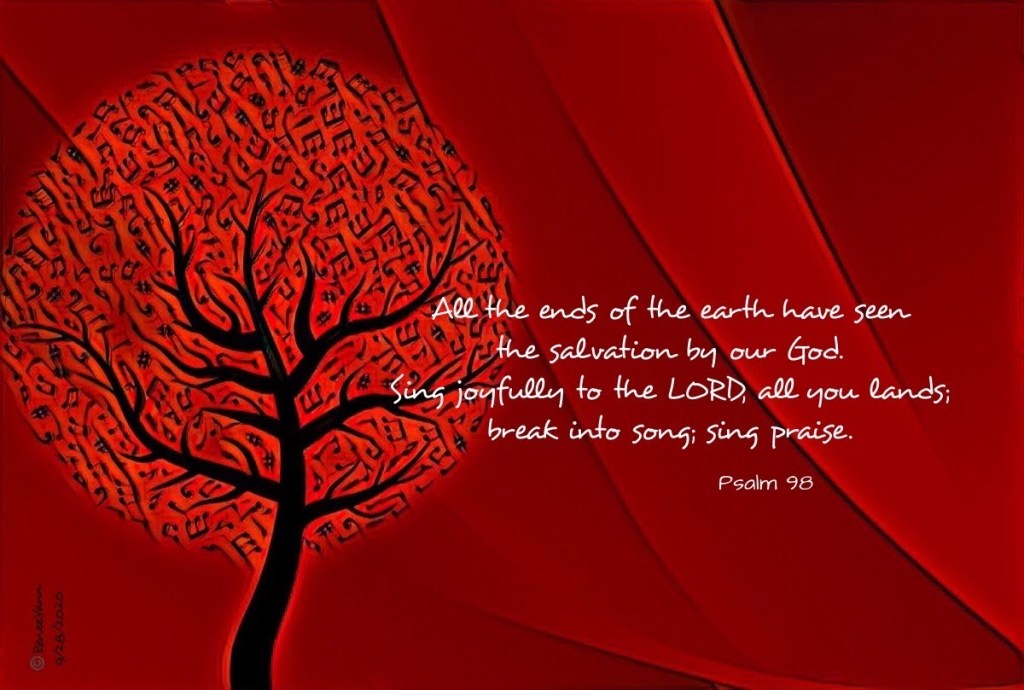
Today, in God’s Lavish Mercy, we pray with Psalm 98. If it sounds familiar as you read it today, no wonder. It looks like Mr.98 might have peeked and copied from Ms. 96 whose verses we read yesterday!🤗
Still, there are some new lovely thoughts to consider this morning as we pray just one month from Christmas. The psalm’s melodic, celebratory tone offers a welcome contrast to the other two rather daunting readings today.
Psalm 98 describes God’s redemption of Israel and the rejoicing that will ensue. It also features many expressions and instruments of music and song. The psalm’s exultant and joyful character inspired Sir Isaac Watts, in 1719, to compose an interpretation we all love: Joy to World. Watts’s poem was set to the music of George Frideric Handel.
Although this glorious song is normally preserved for Christmas, it describes the condition of grace we actually live within every day. Christ already has come into time, already has been born in our hearts.
Our liturgical year is a commemoration and celebration of a salvation already achieved.
So let’s have a bit of early Christmas today. Let’s reach for the full joy of our “Christing” by praying Psalm 98 as Isaac Watts prayed it.
Joy to the World; the Lord is come!
Let earth receive her King!
Let ev'ry heart prepare Him room,
And Heaven and nature sing.

Joy to the earth, the Savior reigns!
Let men their songs employ;
While fields & floods, rocks, hills & plains
Repeat the sounding joy.

No more let sins and sorrows grow,
Nor thorns infest the ground;
He comes to make his blessings flow
Far as the curse is found.

He rules the world with truth and grace,
And makes the nations prove
The glories of His righteousness,
And wonders of His love.
Today is a good day, as we are about to begin our Advent journey this Sunday, to remind ourselves of exactly where that journey takes us – to the humble center of our hearts where, in every moment, God desires to take flesh for the world.
Poetry: Into the Darkest Hour by Madeleine L’Engle
It was a time like this,
War & tumult of war,
a horror in the air.

Hungry yawned the abyss-
and yet there came the star
and the child most wonderfully there.

It was time like this
of fear & lust for power,
license & greed and blight-

and yet the Prince of bliss
came into the darkest hour
in quiet & silent light.

And in a time like this
how celebrate his birth
when all things fall apart?

Ah! Wonderful it is
with no room on the earth
the stable is our heart.
Music: John Rutter – The Falcon – first movement based on Psalm 98
Memorial of the Presentation of the Blessed Virgin Mary
Saturday, November 21, 2020
From 2018 Post: We celebrate the Memorial of the Presentation of the Blessed Virgin Mary. This feast memorializes a story not present in Scripture. We know of it only from apocryphal writings, those considered of unsubstantiated origin. It tells of Mary’s dedication in the Temple at the age of three. Some versions say she remained there until the age of twelve, thus giving her life fully to God even from youth.
On the day of the Presentation of the Blessed Virgin Mary, “we celebrate that dedication of herself which Mary made to God from her very childhood under the inspiration of the Holy Spirit who filled her with grace … .” (Liturgy of the Hours)
Today, in God’s Lavish Mercy, on Mary’s holy feast, we pray with Psalm 144, a song attributed to David as he thanks God for his war victories.
Blessed be the LORD, my rock, who trains my hands for battle, my fingers for war.
How strange that the Church would use this psalm to celebrate gentle Mary as we commemorate her Presentation in the Temple. The traditional story, not included in scripture, is that Mary’s grateful parents brought her, at age three, to be dedicated to God.
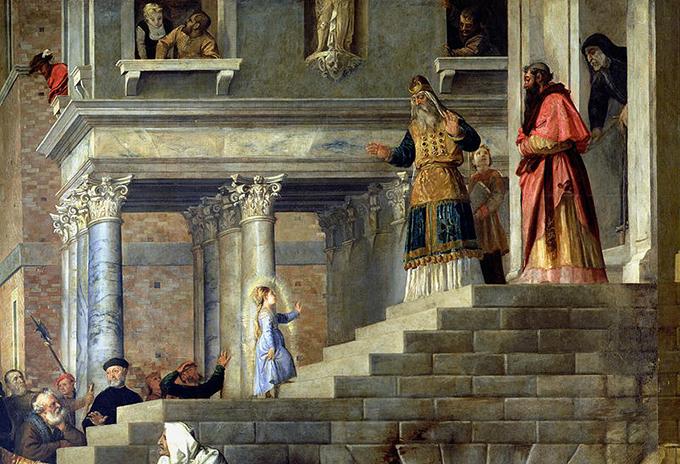
The Presentation of Mary by Titian
Psalm 144 reminds us, as we pray with Mary today, that life can be filled with daunting challenges. It can even, at times, seem like a war. Pope Francis has described our times as beset by a “culture of death’:
It is difficult both to recognize and to contradict the overwhelming barrage of selfish, materialistic messaging our culture throws at us. It really is an ongoing battle.
But it is a battle we face not with weapons of violence. We stand up, like Mary, by the power of the God in whom we trust.
My mercy and my fortress, my stronghold, my deliverer, My shield, in whom I trust, who rallies strength around me.
We pray with Mary:
to discern the path of grace for our lives
to turn our whole lives over to God,
to become a portal for God to enter our world
We pray for the courage to be God’s new song of hope for our times.
O God, I will sing a new song to you; with a ten stringed lyre I will chant your praise, You who give victory to your beloved, and deliver us from the grasp of evil.
Poem: To the Immaculate Virgin, On a Winter Night – Thomas Merton
Lady, the night is falling and the dark
Steals all the blood from the scarred west.
The stars come out and freeze my heart
With drops of untouchable music, frail as ice
And bitter as the new year's cross.

Where in the world has any voice
Prayed to you, Lady, for the peace that's in your power?
In a day of blood and many beatings
I see the governments rise up, behind the steel horizon,
And take their weapons and begin to kill.

Where in the world has any city trusted you?
Out where the soldiers camp the guns begin to thump
And another winter time comes down
To seal our years in ice.
The last train cries out
And runs in terror from this farmer's valley
Where all the little birds are dead.

The roads are white, the fields are mute
There are no voices in the wood
And trees make gallows up against the sharp-eyed stars.
Oh where will Christ be killed again
In the land of these dead men?

Lady, the night has got us by the heart
And the whole world is tumbling down.
Words turn to ice in my dry throat
Praying for a land without prayer,

Walking to you on water all winter
In a year that wants more war.
Music: Blessed Be the Lord, My Rock – by Abbie Betinis sung by St. Pius X Choir, Atlanta, Georgia
Today, in God’s Lavish Mercy, we pray with Psalm 149 which calls the community to sing and dance because God has delivered them.
This happy, celebratory summons is set, contrastingly, between two readings that mention weeping.
Then I saw a mighty angel who proclaimed in a loud voice, “Who is worthy to open the scroll and break its seals?” But no one in heaven or on earth or under the earth was able to open the scroll or to examine it. I shed many tears because no one was found worthy to open the scroll or to examine it.
Revelation 5:2-4
As Jesus drew near Jerusalem, he saw the city and wept over it, saying, “If this day you only knew what makes for peace– but now it is hidden from your eyes.
Luke 19; 41-42
The readings leave us with a sense that there is a secret to eternal life – a secret to which only grace can open our eyes and hearts.
John writes that “the Lion of Judah” has the key:
One of the elders said to me, “Do not weep. The lion of the tribe of Judah, the root of David, has triumphed, enabling him to open the scroll with its seven seals.”
Revelation 5:5-6
Jesus, Uncreated Grace, is the Lion of Judah. He has incarnated the sacred key in his Life, Death, and Resurrection. For those who receive him and share his life, the door is opened, the scroll unrolled.
So what is the path to such union with Jesus?
Our psalm contains a brief line tucked at its center which foreshadows the entire message of the Gospel.
Let them praise God’s name in the festive dance, let them sing praise with timbrel and harp. For the LORD loves us, and adorns the lowly with victory.
We will find a dancing, singing joy when we give ourselves to these truths:
God loves us irrevocably
We can fully receive this great love to the degree that we become like Christ whose image we find among the poor, lowly, and suffering.
Poetry: Dance from Rumi
Come to me, and I shall dance with you
In the temples, on the beaches, through the crowded streets
Be you man or woman, plant or animal, slave or free
I shall show you the brilliant crystal fires, shining within
I shall show you the beauty deep within your soul
I shall show the path beyond Heaven.
Only dance, and your illusions will blow in the wind
Dance, and make joyous the love around you
Dance, and your veils which hide the Light
Shall swirl in a heap at your feet.
Today, in God’s Lavish Mercy, we pray with Psalm 150, the final chapter of the Book of Psalms.
When any of us writes or speaks an important message, we usually take pains to make sure the final comments are direct and powerful. We want our last words to make an significant impact on our audience.
I think the Book of Psalms wants to do the same thing.
So what’s the ultimate ringing word these sacred chapters leave with us?
And it’s not a gentle suggestion. The psalm charges us to SHOUT our praise! To make noise with our acclamations of God! To be absolutely cacophonous in our exaltation. We are to praise God:
with the blast of the trumpet,
with lyre and harp,
with timbrel and dance,
with strings and pipe.
with sounding cymbals,
with clanging cymbals
One might come away thinking we must be noisy in showing our love for God. But there are so many ways we “shout”, even in our silence.
I think this morning of my Sisters at McAuley Convent, in the quiet accumulation of their elder years. There is very little noise in that beloved community. Still, everything about them shouts praise, gratitude, and faith – all without their even having to say a word.
True praise is an energy, not a sound. It is the direction of our whole being toward the God Who gives us life. It is the gathering of everything about our existence and lifting it all toward God in confidence of its transformation.
It is the quiet sound of our every breath streaming “Alleluias” over all Creation. It is the final word of our being after everything else is said.
Let everything that has breath praise the LORD! Alleluia
Poetry: Praising Manners by Rumi
We should ask God
To help us toward manners. Inner gifts
Do not find their way
To creatures without just respect.
If a man or woman flails about, they not only
Destroy their own house,
They incinerate the whole world.
Your depression is connected to your insolence
And your refusal to praise. If a man or woman is
On the path, and refuses to praise — that man or woman
Steals from others every day — in fact is a shoplifter!
The sun became full of light when it got hold of itself.
Angels began shining when they achieved discipline.
The sun goes out whenever the cloud of not-praising comes near.
The moment that foolish angel felt insolent, he heard the door close.
Music:J.S. Bach: Singet dem Herrn ein neues Lied, BWV. 225
“Singet!” Bach’s motet springs to life with the insistent repetition of this word, bouncing between two choirs. It’s a joyful and dazzlingly virtuosic celebration of the human voice, culminating in a mighty four-voice fugue. This motet was performed for Mozart when he visited Leipzig’s St. Thomas Church in 1789. (Bach was music director at the church from 1723 until his death in 1750). Johann Friedrich Doles, a student of Bach who directed the performance wrote, As soon as the choir had sung a few bars, Mozart started; after a few more he exclaimed: ‘What is that?’ And now his whole soul seemed to be centered in his ears. When the song was ended, he cried out with delight: ‘Now, here is something one can learn from!’( taken from https://thelistenersclub.com/2019/10/11/joyful-sounds-of-praise-five-musical-settings-of-psalm-150/ )
Today, in God’s Lavish Mercy, we pray with Psalm 15 which often is called an ‘entrance liturgy’, where a worshipper asks the conditions of entering the worship place and a priest answers.
The psalm’s first line, not included in today’s verses, asks that question of the Lord:
LORD, who may abide in your tent? Who may dwell on your holy mountain?
Psalm 15:1
Reading this line immediately reminded me of Jesus’s first encounter with his chosen twelve. Upon meeting Jesus, and obviously struck with his unique charisma, the disciples ask, “Lord, where do you live?”. They want to be with him, to learn about him. We do too.
It’s a gift to be invited to someone’s home – to see where and how they live, to share their dailyness. It is a first portal to the intimacy of friendship, a gift beyond price when it proves mutual and true.
In today’s Gospel, in a sort of reverse proposal, Jesus invites himself to dinner at Zaccheus’s home. Throughout all the Gospels, we often see Jesus inviting and accepting invitations which prove to be conversions and calls for his followers.
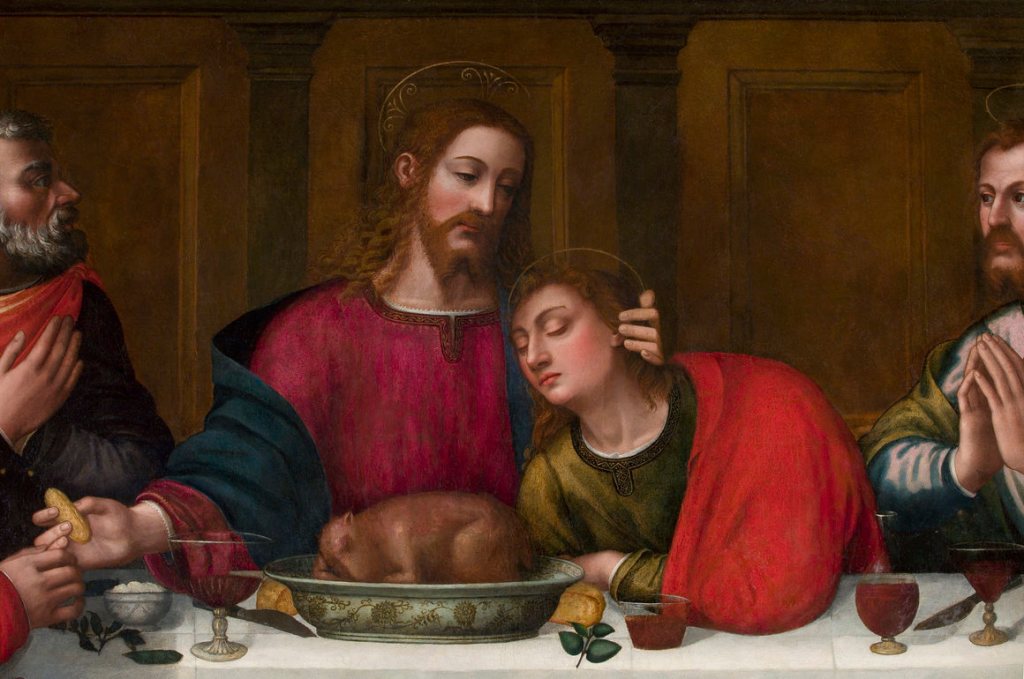
by Plautilla Nelli, an Italian nun who is said to have taught herself to paint in the 16th century. This is a section of her “Last Supper,” painted around 1568, and now newly installed in the old refectory of the Santa Maria Novella Museum.Of course, it shows Jesus with the “beloved” disciple.
In the reading from Revelation, the invitation takes an apocalyptic and corrective tone, but its heart is the same. In essence, God invites us to an intimacy of which we are capable only under certain conditions, i.e. “if you hear my voice“:
Behold, I stand at the door and knock. If you hear my voice and open the door, then I will enter and dine with you, and you with me. I will give the victor the right to sit with me on my throne, as I myself first won the victory and sit with my Father on his throne.
Today’s segment from Psalm 15 tells us what some of those conditions look like. It says to be someone who:
walks blamelessly and does justice
thinks the truth in your heart
slanders not with your tongue.
harms not your fellow human beings,
takes up no reproach against your neighbor
despises not the reprobate
honors those who fear the LORD
lends not your money at usury
accepts no bribe against the innocent
Our challenge from the psalm is to meditate on that list to see what such behavior looks like in modern terms. Beneath the psalmist’s ancient language, we might discover our attitudes and examine our conscience toward issues like:
criminal justice
capital punishment
war
poverty
immigration policy
refugee resettlement
propagandist media
economic equity
felon rehabilitation
respect for other religions
political oppression
– just to suggest a few.
Psalm 15 tells us, and our other readings affirm, that the one who gets these things right not only gets invited, but gets to remain in God’s house, God’s “tent”.
The one who does these things shall never be disturbed.
I know that’s Who I want to go eternally camping with! How about you?
Poem: Rainer Maria Rilke, Poems from the Book of Hours
You, neighbor God, if sometimes in the night
I rouse you with loud knocking, I do so
only because I seldom hear you breathe
and know: you are alone.
And should you need a drink, no one is there
to reach it to you, groping in the dark.
Always I hearken. Give but a small sign.
I am quite near.

Between us there is but a narrow wall,
and by sheer chance; for it would take
merely a call from your lips or from mine
to break it down,
and that without a sound.

The wall is builded of your images.

They stand before you hiding you like names.
And when the light within me blazes high
that in my inmost soul I know you by,
the radiance is squandered on their frames.

And then my senses, which too soon grow lame,
exiled from you, must go their homeless ways.
Today, in God’s Lavish Mercy, we pray with Psalm 1 which tells us that a vigorous spiritual life roots us firmly in God.
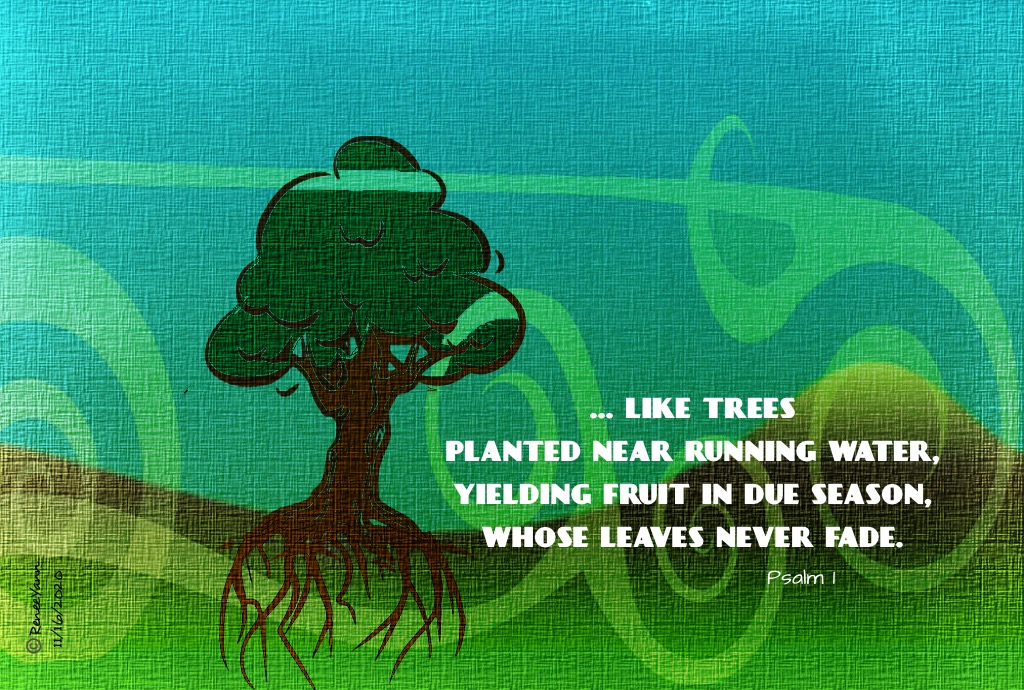
One who delights in the law of the LORD, and meditates on God’s law day and night is like a tree planted near running water.
That rootedness steadies us even in life’s fierce winds, unlike the fate of the spiritually lifeless.
… they are like chaff which the wind drives away. For the LORD watches over the way of the just, but the way of the faithless vanishes.
We all can think of Saints, living and dead, in our lives who are like these deeply rooted trees. Gratefully recognizing them helps us to grow and deepen our own faith.
I think of my parents who were ordinary people, not scripture scholars or recognized prophets. They simply prayed every day, and tried to do good for and with the people in their lives. Their energy was focused on God and others, not themselves. They were honest, humble, grateful people. They never realized how holy they really were.
They were like those trees planted near running streams, feeding on the waters of generosity not greed. They were strong in life’s winds, which were many and sometimes ferocious. Theirs was a quiet and unassuming faith, but immovable as rock.
My brother and I were blessed to grow up in the shade of those trees, a blessing which made us want to be like them.
Today:
Let’s pray for continuing grace to deepen our roots in God.
Let’s pray for a faith that nurtures and encourages those God has placed under our branches.
Let’s stretch the reach of our tree’s caring shade to all our sisters and brothers, especially those scorched by pain and poverty.
Let’s drink deeply of the life-giving waters God offers us.
Poetry: I learned that her name was Proverb by Denise Levertov
And the secret names
of all we meet who lead us deeper
into our labyrinth
of valleys and mountains, twisting valleys
and steeper mountains—
their hidden names are always,
like Proverb, promises.
Rune, Omen, Fable, Parable,
those we meet for only
one crucial moment, gaze to gaze,
or for years know and don’t recognize
but of whom later a word
sings back to us
as if from high among leaves,
still near but beyond sight
drawing us from tree to tree
towards the time and the unknown place
where we shall know
what it is to arrive.
Music: Tree Song by Evie Karlsson If you have young ones in your life, you may want to listen to this song together. A very simply expressed, yet profound, message.
Today, in God’s Lavish Mercy, we pray with Psalm 128 which is used this Sunday to connect a series of readings about “fruitfulness” and its eternal endurance.
Our readings today intensify a tone evident in recent weeks – a theme I call “end of the line warnings”. Just two weeks out from Advent, and the end of the 2020 Liturgical Year, we have our annual confrontation with “The End Times”.
I have never enjoyed these readings. They actually scared me as a child, and they don’t make me too carefree even now. The only thing that makes them tolerable is that they herald the coming of Advent, a favorite time for hope-filled readings.
But to get to those Advent scriptural delights, we have to face:
sudden disaster like labor pains
darkness like a thief in the night
alert and sober sleeplessness
and, if we’re not vigilant, a potential toss into the darkness outside where there will be wailing and grinding of teeth.
In the midst of these terror-producing readings, Psalm 128 can be like a calming cup of camomile tea. It reminds us – serenely, yet directly – of enduring blessings and how we secure them.
Blessed are you who fear the LORD, who walk in the Lord’s ways! For you shall eat the fruit of your handiwork; blessed shall you be, and favored.
Today’s readings are sprinkled with two usually contrasting words: fear and blessing. However, our prayer may lead us to realize that these actions can be complementary from a spiritual perspective.
When we live in awe, or holy fear, before God’s Presence and Power, our life is blessed with fruitful – just and merciful – relationships with all Creation, including an anticipated joy in our eternal home. As Christine Robinson transliterates Psalm 128:
You are blessed, who know God’s grace and who follow the Way of Life. Happiness and contentment are yours. Your home is a place of growth and love. Your city a better place for your life in it. Your life of faithful work, prayerful reflection,and shared love blesses those around you with life and peace.
…and you can look forward with joy to your continuing eternal life with God and God’s beloved family.
Poetry: To Heaven by Ben Johnson who is among the best-known writers and theorists of English Renaissance literature, second in reputation only to Shakespeare. A prolific dramatist and a man of letters highly learned in the classics, he profoundly influenced the Augustan age through his emphasis on the precepts of Horace, Aristotle, and other classical Greek and Latin thinkers.
Good and great God, can I not think of thee
But it must straight my melancholy be?
Is it interpreted in me disease
That, laden with my sins, I seek for ease?
Oh be thou witness, that the reins dost know
And hearts of all, if I be sad for show,
And judge me after; if I dare pretend
To ought but grace or aim at other end.
As thou art all, so be thou all to me,
First, midst, and last, converted one, and three;
My faith, my hope, my love; and in this state
My judge, my witness, and my advocate.
Where have I been this while exil'd from thee?
And whither rap'd, now thou but stoop'st to me?
Dwell, dwell here still. O, being everywhere,
How can I doubt to find thee ever here?
I know my state, both full of shame and scorn,
Conceiv'd in sin, and unto labour borne,
Standing with fear, and must with horror fall,
And destin'd unto judgment, after all.
I feel my griefs too, and there scarce is ground
Upon my flesh t' inflict another wound.
Yet dare I not complain, or wish for death
With holy Paul, lest it be thought the breath
Of discontent; or that these prayers be
For weariness of life, not love of thee.
Today, in God’s Lavish Mercy, we pray with Psalm 119 which is filled with repeated invitations to awake to the beauty of God’s Law all around and within us. But sometimes in our spiritual life, just as in our physical life, we just don’t want to wake up, do we?😉
Our psalm today tells us we need to be alert, to actively seek God in our lives:
Blessed are they who observe the Lord’s decrees, who seek God with all their heart.
Psalm 119: 2
It’s not easy to believe that God can be found in everything, even the things that challenge and hurt us. It requires a new way of looking, of seeing.
God’s presence isn’t always sweet and comforting. In our bitter times, God may be with us in a push to change, or to resist, or to protest. It helps to trust that there is an integrity to God’s path in our lives, and that, by grace, we will be led to holiness, even in challenge.
With all my heart I seek your path, let me not stray from your commands. Within my heart I treasure your promise, that I may not stray from your law.
Walking a labyrinth is a good way to intentionally practice this type of trusting prayer. Doing this, we rediscover the times God has already led us through life’s surprising, and sometimes immobilizing, twists.
We begin to see an order in what we thought was chaos, the order of God’s immutable law of love:
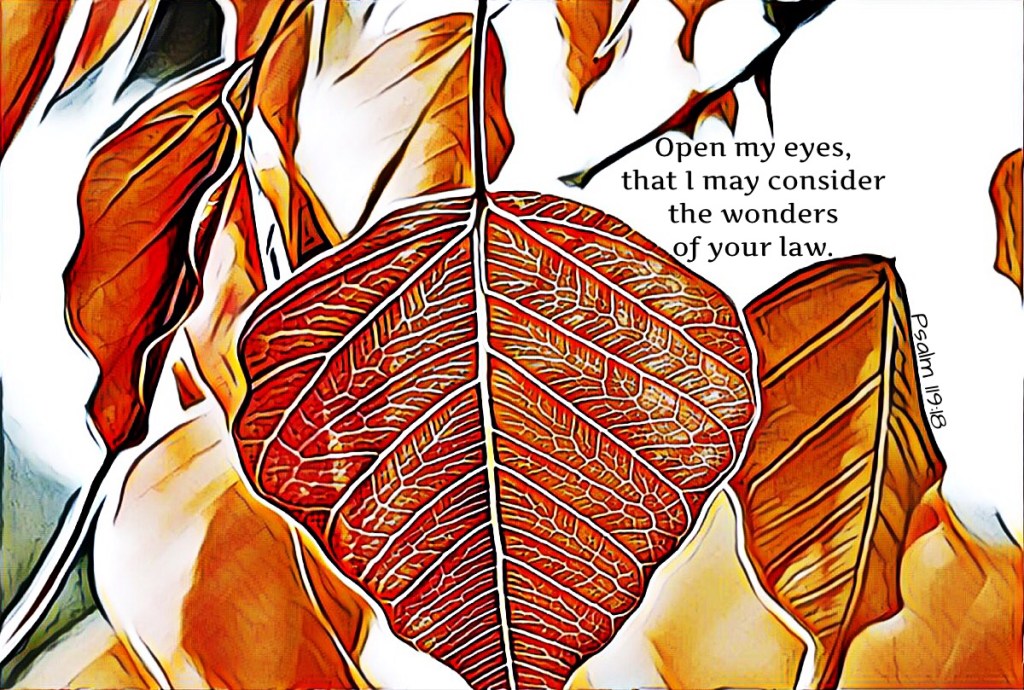
Open my eyes, that I may consider the wonders of your law.
If you would like to pray with a labyrinth, this website is a great start. The Dominican Sisters of Peace take us through praying with a “finger labyrinth”.
Poem: Excerpt from THE HOUND OF HEAVEN by Francis Thompson Here is just the beginning of Thompson’s great poem, which speaks of the “labyrinthine” ways…
I fled Him, down the nights and down the days;
   I fled Him, down the arches of the years;
I fled Him, down the labyrinthine ways
   Of my own mind; and in the midst of tears
I hid from Him, and under running laughter.
             Up vistaed hopes I sped;
             And shot, precipitated,
Adown Titanic glooms of chasmed fears,
   From those strong Feet that followed, followed after.
             But with unhurrying chase,
             And unperturbéd pace,
     Deliberate speed, majestic instancy,
             They beat — and a Voice beat —
             More instant than the Feet
     'All things betray thee, who betrayest Me'.
Music: The Peace of God – from Labyrinth by David Baloche
Ode: Intimations of Immortality from Recollections of Early Childhood
BY WILLIAM WORDSWORTH


   The child is father of the man;
And I could wish my days to be
   Bound each to each by natural piety.
          (Wordsworth, "My Heart Leaps Up")

There was a time when meadow, grove, and stream,
       The earth, and every common sight,
                          To me did seem
                      Apparelled in celestial light,
            The glory and the freshness of a dream.

It is not now as it hath been of yore;—
                      Turn wheresoe'er I may,
                          By night or day.
The things which I have seen I now can see no more.


                      The Rainbow comes and goes,
                      And lovely is the Rose,
                      The Moon doth with delight
       Look round her when the heavens are bare,
                      Waters on a starry night
                      Are beautiful and fair;
       The sunshine is a glorious birth;
       But yet I know, where'er I go,
That there hath past away a glory from the earth.


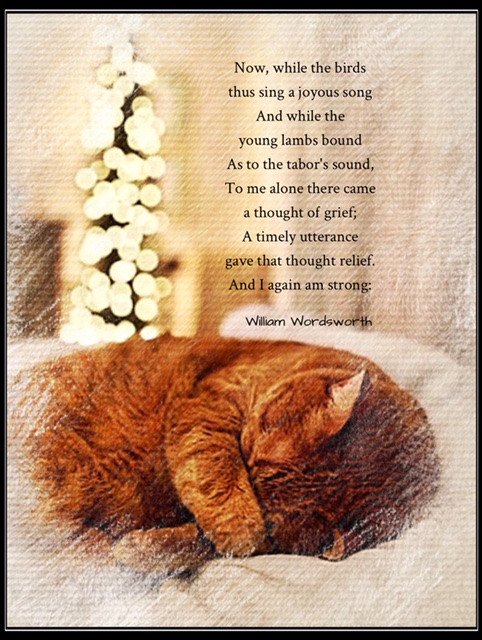
Now, while the birds thus sing a joyous song,
       And while the young lambs bound
                      As to the tabor's sound,
To me alone there came a thought of grief:
A timely utterance gave that thought relief,
                      And I again am strong:
The cataracts blow their trumpets from the steep;
No more shall grief of mine the season wrong;
I hear the Echoes through the mountains throng,
       The Winds come to me from the fields of sleep,
                      And all the earth is gay;
                           Land and sea
                Give themselves up to jollity,
                      And with the heart of May
                 Doth every Beast keep holiday;—
                      Thou Child of Joy,
Shout round me, let me hear thy shouts, thou happy Shepherd-boy.


Ye blessèd creatures, I have heard the call
      Ye to each other make; I see
The heavens laugh with you in your jubilee;
      My heart is at your festival,
            My head hath its coronal,
The fulness of your bliss, I feel—I feel it all.
                      Oh evil day! if I were sullen
                      While Earth herself is adorning,
                         This sweet May-morning,
                      And the Children are culling
                         On every side,
In a thousand valleys far and wide,
                      Fresh flowers; while the sun shines warm,
And the Babe leaps up on his Mother's arm:—
                      I hear, I hear, with joy I hear!
                      —But there's a Tree, of many, one,
A single field which I have looked upon,
Both of them speak of something that is gone;
                      The Pansy at my feet
                      Doth the same tale repeat:
Whither is fled the visionary gleam?
Where is it now, the glory and the dream?


Our birth is but a sleep and a forgetting:
The Soul that rises with us, our life's Star,
                      Hath had elsewhere its setting,
                         And cometh from afar:
                      Not in entire forgetfulness,
                      And not in utter nakedness,
But trailing clouds of glory do we come
                      From God, who is our home:
Heaven lies about us in our infancy!
Shades of the prison-house begin to close
                      Upon the growing Boy,
But he beholds the light, and whence it flows,
                      He sees it in his joy;
The Youth, who daily farther from the east
                      Must travel, still is Nature's Priest,
                      And by the vision splendid
                      Is on his way attended;
At length the Man perceives it die away,
And fade into the light of common day.


Earth fills her lap with pleasures of her own;
Yearnings she hath in her own natural kind,
                      And, even with something of a Mother's mind,
                      And no unworthy aim,
The homely Nurse doth all she can
To make her Foster-child, her Inmate Man,
                      Forget the glories he hath known,
And that imperial palace whence he came.


Behold the Child among his new-born blisses,
A six years' Darling of a pigmy size!
See, where 'mid work of his own hand he lies,
Fretted by sallies of his mother's kisses,
With light upon him from his father's eyes!
See, at his feet, some little plan or chart,
Some fragment from his dream of human life,
Shaped by himself with newly-learn{e}d art
                     A wedding or a festival,
                      A mourning or a funeral;
                         And this hath now his heart,
                      And unto this he frames his song:
                         Then will he fit his tongue
To dialogues of business, love, or strife;
                      But it will not be long
                      Ere this be thrown aside,
                      And with new joy and pride
The little Actor cons another part;
Filling from time to time his "humorous stage"
With all the Persons, down to palsied Age,
That Life brings with her in her equipage;
                      As if his whole vocation
                      Were endless imitation.


Thou, whose exterior semblance doth belie
                      Thy Soul's immensity;
Thou best Philosopher, who yet dost keep
Thy heritage, thou Eye among the blind,
That, deaf and silent, read'st the eternal deep,
Haunted for ever by the eternal mind,—
                      Mighty Prophet! Seer blest!
                      On whom those truths do rest,
Which we are toiling all our lives to find,
In darkness lost, the darkness of the grave;
Thou, over whom thy Immortality
Broods like the Day, a Master o'er a Slave,
A Presence which is not to be put by;
Thou little Child, yet glorious in the might
Of heaven-born freedom on thy being's height,
Why with such earnest pains dost thou provoke
The years to bring the inevitable yoke,
Thus blindly with thy blessedness at strife?
Full soon thy Soul shall have her earthly freight,
And custom lie upon thee with a weight,
Heavy as frost, and deep almost as life!


                      O joy! that in our embers
                      Is something that doth live,
                      That Nature yet remembers
What was so fugitive!
The thought of our past years in me doth breed
Perpetual benediction: not indeed
For that which is most worthy to be blest;
Delight and liberty, the simple creed
Of Childhood, whether busy or at rest,
With new-fledged hope still fluttering in his breast:—
                      Not for these I raise
                      The song of thanks and praise
                But for those obstinate questionings
                Of sense and outward things,
                Fallings from us, vanishings;
                Blank misgivings of a Creature
Moving about in worlds not realised,
High instincts before which our mortal Nature
Did tremble like a guilty thing surprised:
                      But for those first affections,
                      Those shadowy recollections,
                Which, be they what they may
Are yet the fountain-light of all our day,
Are yet a master-light of all our seeing;
                Uphold us, cherish, and have power to make
Our noisy years seem moments in the being
Of the eternal Silence: truths that wake,
                To perish never;
Which neither listlessness, nor mad endeavour,
                      Nor Man nor Boy,
Nor all that is at enmity with joy,
Can utterly abolish or destroy!
                Hence in a season of calm weather
                      Though inland far we be,
Our Souls have sight of that immortal sea
                      Which brought us hither,
                Can in a moment travel thither,
And see the Children sport upon the shore,
And hear the mighty waters rolling evermore.


Then sing, ye Birds, sing, sing a joyous song!
                      And let the young Lambs bound
                      As to the tabor's sound!
We in thought will join your throng,
                      Ye that pipe and ye that play,
                      Ye that through your hearts to-day
                      Feel the gladness of the May!
What though the radiance which was once so bright
Be now for ever taken from my sight,
                Though nothing can bring back the hour
Of splendour in the grass, of glory in the flower;
                      We will grieve not, rather find
                      Strength in what remains behind;
                      In the primal sympathy
                      Which having been must ever be;
                      In the soothing thoughts that spring
                      Out of human suffering;
                      In the faith that looks through death,
In years that bring the philosophic mind.
And O, ye Fountains, Meadows, Hills, and Groves,
Forebode not any severing of our loves!
Yet in my heart of hearts I feel your might;
I only have relinquished one delight
To live beneath your more habitual sway.
I love the Brooks which down their channels fret,
Even more than when I tripped lightly as they;
The innocent brightness of a new-born Day
                      Is lovely yet;
The Clouds that gather round the setting sun
Do take a sober colouring from an eye
That hath kept watch o'er man's mortality;
Another race hath been, and other palms are won.
Thanks to the human heart by which we live,
Thanks to its tenderness, its joys, and fears,
To me the meanest flower that blows can give
Thoughts that do often lie too deep for tears.
Today, in God’s Lavish Mercy, we pray with Psalm 37, a song of promise and encouragement to live a good life. Although I don’t usually choose to write a subjective reflection, a life-shaping memory keeps rising up from this psalm today.
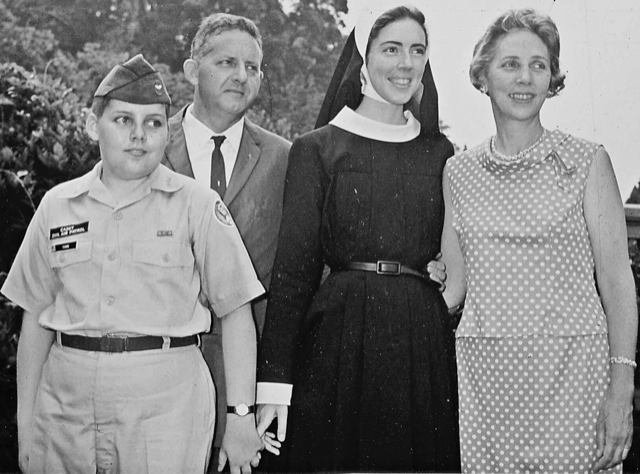
I was nineteen years old, kneeling on an antique prie-dieu in front of the Superior General. She was about to rename me “Sister Something” for the rest of my life. You know, something like this picture – except that novice couldn’t sing quite as well as I did! 🙂
We postulants had been able to submit three suggestions, so I was expecting a name in honor of my mother or father, or my own baptismal name. How stunned was I when Mother intoned, “God bless you, Sister Mary Nathaniel”- a name I had heard maybe once in American Lit class! (You remember Hawthorne, right?)
But my shock is not the point of the story. Later, Mother took me aside and told me that she gave me the name because I reminded her of Nathaniel in the Gospel – the guileless one. Being guileless I guess, I told her I didn’t know what “guileless” meant. She said, “It means whole hearted. Be wholehearted, without pretense.”
The LORD watches over the lives of the wholehearted; their inheritance lasts forever. By the LORD are your steps made firm, as the Lord blesses your way.
Psalm 37 gave me the gift of that word, and that memory, again today. I realized that it is still taking me a lifetime to live into Mother’s long-ago challenge.
Trust in the LORD and do good, that you may dwell in the land and be fed in security. Take delight in the LORD, and God will grant you your heart’s requests.
Even though, after Vatican II, I eventually returned to my baptismal name, my heart has remained “Nathaniel”. Like the disciple under the fig tree, I am still trying to weave a true and loving life out of life’s tangled threads – still trying to do so wholeheartedly and without guile.
Gratefully and humbly, I thank God for watching over me. But God is not the only one. Mother Bernard came once more this morning, borne on memory’s beloved wing, to bless me with renewed hope and challenge.
As we pray this psalm today, let us call on the memory of those who have blessed us by their confidence and hope in us. Let us call on the God who watches over our desire to be truly wholehearted disciples.
Poem: Desiderata by Max Ehrmann (1927) – a writing I loved in my youth and have often passed on to those just beginning the glorious journey.
GO PLACIDLY amid the noise and the haste,
and remember what peace there may be in silence.
As far as possible, without surrender,
be on good terms with all persons.
Speak your truth quietly and clearly; and listen to others,
even to the dull and the ignorant; they too have their story.

Avoid loud and aggressive persons; they are vexatious to the spirit.
If you compare yourself with others, you may become vain or bitter,
for always there will be greater and lesser persons than yourself.
Enjoy your achievements as well as your plans.

Keep interested in your own career, however humble;
it is a real possession in the changing fortunes of time.
Exercise caution in your business affairs,
for the world is full of trickery.
But let this not blind you to what virtue there is;
many persons strive for high ideals,
and everywhere life is full of heroism.

Be yourself. Especially do not feign affection.
Neither be cynical about love;
for in the face of all aridity and disenchantment,
it is as perennial as the grass.

Take kindly the counsel of the years,
gracefully surrendering the things of youth.
Nurture strength of spirit to shield you in sudden misfortune.
But do not distress yourself with dark imaginings.
Many fears are born of fatigue and loneliness.
Beyond a wholesome discipline, be gentle with yourself.

You are a child of the universe no less than the trees and the stars;
you have a right to be here.
And whether or not it is clear to you,
no doubt the universe is unfolding as it should.

Therefore be at peace with God, whatever you conceive God to be.
And whatever your labors and aspirations,
in the noisy confusion of life, keep peace in your soul.

With all its sham, drudgery and broken dreams,
it is still a beautiful world.
Be cheerful. Strive to be happy.

















 Lavish Mercy