Boxing God?

February 8, 2022
Tuesday of the Fifth Week in Ordinary Time

(Some of my longtime followers might recognize an old story today. I like it so much that iI repeated it. Hope you don’t mind. Thanks for sticking with me.)

Today, in God’s Lavish Mercy, our readings talk about how we try to “house” God.

Because God is bigger than BIG, our minds struggle. More than struggle, they actually fail, repeatedly, to define God. Yet we still try, don’t we?

We try to picture, describe, paint, quote, and interpret God. We even decide what God wants and create laws to insure God gets that.

We dilute Divinity to our human dimensions. We just can’t take it straight. We mix it and bottle it in our laws, and box it in our rituals — because we can’t manage Omnipotence. 


Praying with these thoughts today, I think of my Dad. He liked an occasional jigger of really fine bourbon – savored in its unadulterated state, without water or soda – what today’s purists call “sipping whisky”.

When the doctor informed him, unfortunately in my mother’s presence, that whisky was a no-no, Dad didn’t like it. But he acquiesced. At least we thought he did. 

After Dad died, my brother and I found his bottle of Kentucky bourbon wrapped in a towel in the basement dryer. You see, only Dad did the wash. Mom never liked machines.


I think Jesus would have really enjoyed my Dad as one of his original disciples. Dad liked life “straight”. His faith was simple, direct, complete and undiluted. Sitting with Jesus that Gospel day, Dad wouldn’t have washed his hands either. He would have been too busy listening to the pure, unbottled Word pouring over him.

The message I took from today’s prayer: 

  • Be very wary of anyone who thinks they know exactly what God wants.
  • Let God out of the boxes I put Him in.
  • Invite God’s Spirit to run free through my heart.
  • Don’t bottle God up; don’t box God in.
  • Enjoy sipping God’s surprising and infinite grace.

Poetry: Hypocrisy – attributed to Omar Khayyam

If you will listen to me, I will give you some advice:
[Here it is] For the love of God put not on the mantle
of hypocrisy. Eternity is for all time, and this world
is but an instant. Then sell not for an instant the empire of eternity.

Music:  New Pharisees – Charlie Daniels Band (Lyrics below)

New Pharisees

They go walking into church every Sunday morning
They the self-appointed sin patrol
Well they whisper and they gossip behind the back
Of anybody that they can’t control

See that girl in the choir she’s got evil desires
She must be drinking from the devil’s well
She’s a downright disgrace with that paint on her face
She looks just like a Jezebel

And they’re running around putting everybody down
What are you trying to do?
You need to pick up the Book and take another look
‘Cause brother I’ve got the news for you

You know Jesus was sent with a new covenant
And he even died for you
New pharisees like a fatal disease
Always flapping your jaws trying to live by the law

You see that boy over there with that long shaggy hair
Ought to be ashamed of his self
He wearing hip-hop clothes got a ring in his nose
Don’t he know he going straight to hell

And then yesterday morning me and sister Johnson
Were talkin’ on the party line
She said that Deacon Brown was having dinner downtown
Somebody seen him with a glass of wine

And you act so righteous and you look so pious
You always pay your tithe
But there’s a rock in your heart and a fire on your tongue
And there ain’t no love in your eyes

Bad news is begotten and the devil is smiling
You gossip and you criticize
New pharisees like a fatal disease
Always flapping your jaws trying to live by the law

Well you can’t get by the law so quit flapping your jaws
New pharisees yes, you’re a lot like me

Come Away Awhile

February 5, 2022
Memorial of Saint Agatha, Virgin and Martyr

Today, in God’s Lavish Mercy, in our readings, both Solomon and Jesus seek a quiet place to pray, reflect, recenter, and commune with God.

Solomon went to Gibeon to sacrifice there,
because that was the most renowned high place.
Upon its altar Solomon offered a thousand burnt offerings.
In Gibeon the LORD appeared to Solomon in a dream at night.
God said, “Ask something of me and I will give it to you.”

1 Kings 3:4
Dream of Solomon – Luca Giordano

Solomon’s retreat is characterized by his sincere humility and gratitude. In this, his first documented encounter with God, Solomon hits a homer in relationship. God is pleased with Solomon’s self-abnegating request for only wisdom to benefit others.

O LORD, my God, you have made me, your servant,
king to succeed my father David;
but I am a mere youth, not knowing at all how to act.
I serve you in the midst of the people whom you have chosen,
a people so vast that it cannot be numbered or counted.
Give your servant, therefore, an understanding heart
to judge your people and to distinguish right from wrong.
For who is able to govern this vast people of yours?”

1 Kings 3:7-9

In his prayer, Solomon has been able to get himself out of the way in order to really see and hear God – to fully receive God’s Presence in his life.


In our Gospel, Jesus seeks retreat for himself and his disciples because of the pressures of their ministries and the recent gut-punch news of John the Baptist’s execution.

Turns out, they don’t really get much of a chance for a “holy chill”. As with many of us, the responsibilities are so pressing that they conspire to find us no matter what.

So they went off in the boat by themselves to a deserted place.
People saw them leaving and many came to know about it.
They hastened there on foot from all the towns
and arrived at the place before them.

When Jesus disembarked and saw the vast crowd,
his heart was moved with pity for them,
for they were like sheep without a shepherd;
and he began to teach them many things.

Mark 6: 32-34

We too, like Solomon and Jesus, need times of retreat and dedicated prayer in our lives. But sometimes, our responsibilities and work follow us as we attempt to find that sacred space.

How can we free ourselves for such spiritual renewal? By planning, asking for assistance, disciplining our time and choices. But the key is that we really have to want that precious deserted place for meeting God in a special way.

These “retreats” must be a way of life for us, consistent choices to bring our busy lives before God, humbly open our hearts, and ask to see ourselves in a new and graced way.

Our “going off to rest awhile” in God can be as short as a few minutes morning and evening, or as long as a 30 day retreat. But they must be a consistent and disciplined desire of our hearts.


“Discipline” may seem like a hard word for it, especially if we think of our high school demerits when we hear that word🤪 But remember, without disciple music would be just noise, art would be just scribble, dance would be contortion, and conversation would be babble.

When you consider “discipline”, think instead of the elegant balance of a beautiful dance and let God lead, or of the sweet perfection of glorious music and let God sing to you.


Prose: A treasured thought of the Jesuit Pedro Arrupe suggests itself here:

Nothing is more practical than
finding God, than
falling in Love
in a quite absolute, final way.
What you are in love with,
what seizes your imagination, will affect everything.
It will decide
what will get you out of bed in the morning,
what you do with your evenings,
how you spend your weekends,
what you read, whom you know,
what breaks your heart,
and what amazes you with joy and gratitude.
Fall in Love, stay in love,
and it will decide everything.

Music: These Alone Are Enough – Dan Schutte

My eyes have seen …

February 2, 2022
Feast of the Presentation of Our Lord

Today, in God’s Lavish Mercy, we begin with a reading from the prophet Malachi, a hurler of fire and brimstone in the 4th-5th century before Christ. The reading is an interesting choice and begs the question of how it relates to this Feast when a little baby comes to be blessed in the Temple.

Presentation of Our Lord – Ambrogio Lorenzetti

Ah, perhaps that’s the hinge – the Temple, both actual and symbolic.

Malachi writes at a time when the second Temple has been restored. In other words, God is about giving the people a second chance to behave according to the Covenant. But they’re not doing such a good job — especially those in charge, the priests:

A son honors his father,
and a servant fears his master;
If, then, I am a father,
where is the honor due to me?
And if I am a master,
where is the fear due to me?
So says the LORD of hosts to you, O priests,
who disdain my name.

Malachi 1:6

Through a series of prophetic oracles, Malachi admonishes the people to repent before it is too late because no unrepentant soul will withstand the judgement.

Handel interpreted the Malachi passage below, sung here by the prize winning countertenor, Jakob Orlinski.

Yes, he is coming, says the LORD of hosts.
But who will endure the day of his coming?
And who can stand when he appears?
For he is like the refiner’s fire,
or like the fuller’s lye.


In the passage from Hebrews, Paul presents the perfect priest, Jesus Christ. In taking flesh, Christ’s Body becomes the new Temple of our redemption. We stand before judgement already saved by his Passion, Death, and Resurrection.


In our Gospel, two aged and venerable prophets wait in the Temple for the Promised One. Their extended years of prayer already have proven them faithful. Now, Simeon’s and Anna’s long and complete fidelity is rewarded by seeing their Savior. They know Him because they have already created a place for him in the temple of their hearts. Now, they will meet their judgement in total peace. As Simeon’s prays:

“Now, Master, you may let your servant go
in peace, according to your word,
for my eyes have seen your salvation,
which you prepared in the sight of all the peoples:
a light for revelation to the Gentiles,
and glory for your people Israel.”

Luke 2:29-32

The Nunc Dimittis is a beautiful,

total-hearted prayer!

Don’t we all hope to be able

to offer something like it

when the time comes?

Poetry: A Song for Simeon – T. S. Eliot

Lord, the Roman hyacinths are blooming in bowls and
The winter sun creeps by the snow hills;
The stubborn season has made stand.
My life is light, waiting for the death wind,
Like a feather on the back of my hand.
Dust in sunlight and memory in corners
Wait for the wind that chills towards the dead land.
Grant us thy peace.
I have walked many years in this city,
Kept faith and fast, provided for the poor,
Have taken and given honour and ease.
There went never any rejected from my door.
Who shall remember my house, where shall live my children’s children
When the time of sorrow is come ?
They will take to the goat’s path, and the fox’s home,
Fleeing from the foreign faces and the foreign swords.
Before the time of cords and scourges and lamentation
Grant us thy peace.
Before the stations of the mountain of desolation,
Before the certain hour of maternal sorrow,
Now at this birth season of decease,
Let the Infant, the still unspeaking and unspoken Word,
Grant Israel’s consolation
To one who has eighty years and no to-morrow.
According to thy word,
They shall praise Thee and suffer in every generation
With glory and derision,
Light upon light, mounting the saints’ stair.
Not for me the martyrdom, the ecstasy of thought and prayer,
Not for me the ultimate vision.
Grant me thy peace.
(And a sword shall pierce thy heart,
Thine also).
I am tired with my own life and the lives of those after me,
I am dying in my own death and the deaths of those after me.
Let thy servant depart,
Having seen thy salvation.

Music: Music: Nunc Dimittis – Taizé (Latin and English text below)

Nunc dimittis servum tuum,
Now dismiss your servant
Domine, Domine,
Lord, Lord,
Secundum verbum tuum in pace.
according to your word in peace
Domine.
Lord.

Blossoming Exultation!

January 11, 2022
Tuesday of the First Week in Ordinary Time

Ordinary Time 2022:
The extraordinary reality is that we have been given the gift of life!
Each day we are given a new portion of grace to deepen in God!
Let us focus our reflections on the “hidden extraordinary”
– a word, thought, or challenge in each day’s readings
that we might otherwise have taken for granted.
May God give us the graceful appreciation to unwrap these gifts!


Today, in God’s Lavish Mercy, we awaken to extraordinary gifts revealed in three words from our readings:

Downcast – Amazed – Exultant

In our first reading, Hannah’s story continues to unfold. And we feel for her, don’t we? The woman is desperate to bear life! Not only does she long for her own sweet child; she longs as well for restored standing in her neighborhood and family as one who is fertile not barren. This meant everything in Hannah’s community as fertility defined a woman’s importance.

Have you ever prayed like Hannah prays in this chapter? Has any need in your life ever so demanded God’s mercy? These are times that ask for our complete vulnerability before God’s Omnipotence.

In her bitterness she prayed to the LORD, weeping copiously,
and she made a vow, promising: “O LORD of hosts,
if you look with pity on the misery of your handmaid,
if you remember me and do not forget me,
if you give your handmaid a male child,
I will give him to the LORD for as long as he lives…

1 Samuel 1: 10-11
Vasili Petrovich Vereshchagin (1864)

Eli witnesses Hannah’s vulnerable prayer. He blesses her and hope cracks through her gloom:
She replied, “Think kindly of your maidservant,” and left.
She went to her quarters, ate and drank with her husband,
and no longer appeared downcast.

1 Samuel 1:18

Extraordinary Vulnerability!


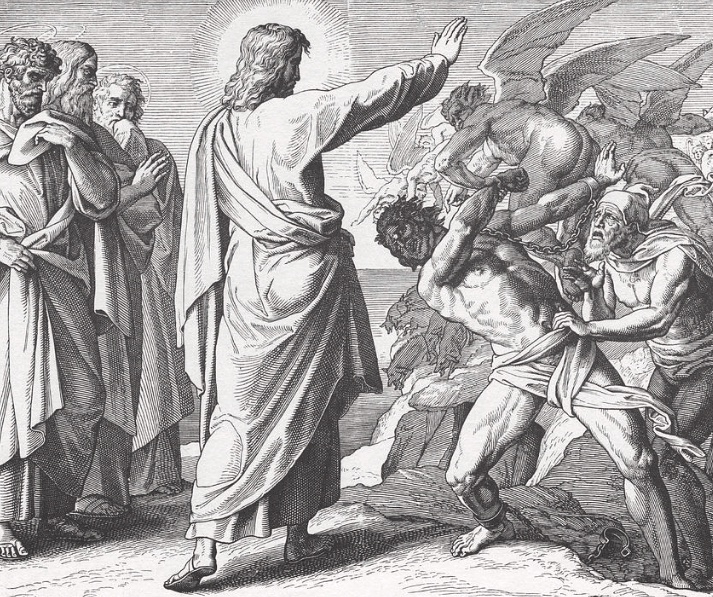
Jesus Casts Out Demons – Julius Schnorr von Carolsfeld

In the Gospel reading, Jesus is still very early in his ministry. He has come to the synagogue to teach and people are “astonished” to hear the depth of his authority. But their astonishment grows even more when Jesus successfully commands the unclean spirit to leave the tortured man.
All were amazed and asked one another,
“What is this?
A new teaching with authority.
He commands even the unclean spirits and they obey him.”

Mark 1:27

Can we let ourselves be constantly amazed at God’s Presence, Power, and Mercy in all Creation?


Extraordinary Holy Amazement!


Once again, our Responsorial Psalm offes a way to pray when our downcast desperation meets God’s amazing, transforming grace. It is the “Magnificat” of Hannah:

And Hannah prayed:

“My heart exults in the LORD,
my horn is exalted by my God.
I have swallowed up my enemies;
I rejoice in your victory.
There is no Holy One like the LORD;
there is no Rock like our God.
1 Samuel 2: 1-2

1 Samual 2: 1-2

Extraordinary Exultation!

Through our scripture-nourished prayer,
may we open the gifts of extraordinary vulnerability, extraordinary hope, and extraordinary exultation
wrapped in our own ordinary lives this day.

Poetry: Bare Tree – Anne Morrow Lindbergh

Already I have shed the leaves of youth,
stripped by the wind of time down to the truth
of winter branches. Linear and alone
I stand, a lens for lives beyond my own,
a frame through which another's fire may glow,
a harp on which another's passion, blow.
The pattern of my boughs, an open chart
spread on the sky, to others may impart
its leafless mysteries that I once prized,
before bare roots and branches equalized,
tendrils that tap the rain or twigs the sun
are all the same, shadow and substance one.
Now that my vulnerable leaves are cast aside,
there's nothing left to shield, nothing to hide.
Blow through me, Life, pared down at last to bone,
so fragile and so fearless have I grown!


Music: Listen to the Trees

Rain Down, Lord!

December 15, 2021
Wednesday of the Third Week in Advent

Today, in God’s Lavish Mercy, we pray with Isaiah and Luke who both offer us passages in which God self-describes in displays of omnipotence and tenderness.

In Isaiah, we meet the powerful Creator Who dispenses both justice and mercy.

In Luke, we meet the merciful Savior Who tenderly uses that power to heal.

With our psalm response from Isaiah, we voice our longing to be healed by God’s infinite power – a power which finds the world’s brokenness, seeps into it like rain, transforms it with love.


Poetry: I Rain by Hafiz

The poem came to mind when I prayed the verse:
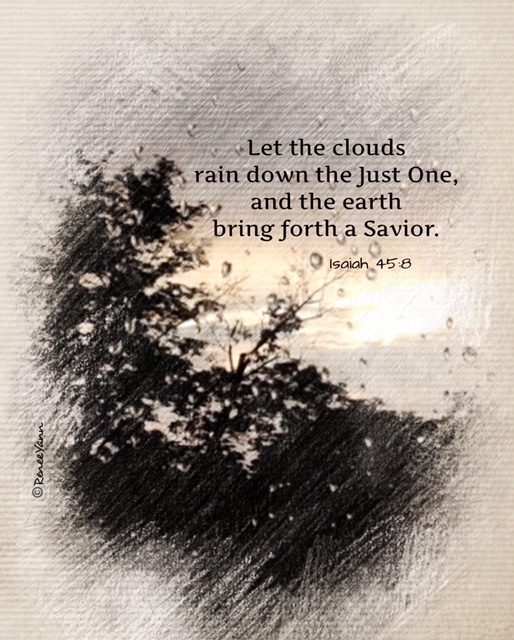
Let the clouds rain down the Just One, and the earth bring forth a Savior.

I rain
Because your meadows call
For God.

I weave light into words so that
When your mind holds them

Your eyes will relinquish their sadness,
Turn bright, a little brighter, giving to us
The way a candle does
To the dark.

I have wrapped my laughter like a gift
And left it beside your bed.

I have planted my heart’s wisdom
Next to every signpost in the sky.

A wealthy one, seeing all this,
May become eccentric,

A divinely wild soul
transformed to infinite generosity

Tying gold sacks of gratuity
To the dangling feet of moons, planets, ecstatic
Midair dances, and singing birds.

I speak
Because every cell in your body
Is thirsty
For God.

Music: Waiting for the Rain – Kathryn Kaye

Images of Joy

December 10, 2021
Friday of the Second Week of Advent

Today, in God’s Lavish Mercy, Isaiah paints a poetic picture of the soul fully taught by God. He describes that sacred obedience, or heart’s listening to God, which leads to fullness of joy, peace and eternal life.

I, the LORD, your God,
    teach you what is for your good,
    and lead you on the way you should go.
If you would hearken to my commandments,
    your prosperity would be like a river,
    and your vindication like the waves of the sea;
Your descendants would be like the sand,
    and those born of your stock like its grains,
Their name never cut off
    or blotted out from my presence.

Isaiah 48:17-19

When looking for music to complement Isaiah’s passage, I found a hymn written in 1876 by Frances R. Havergal, an English Anglican poet and hymn writer.

Her hymn Like a River Glorious, although written in older style language, contains several beautiful metaphors, many reflective of today’s passage from Isaiah.

You might want to pray with one or two of these images today:

river
A river of grace – perfect, yet deepening
stand_anchor
Our hearts “stayed” upon God, anchored in faith
chick
Being hidden in the hollow of God’s hand
wind
“no blast of hurry” to disturb our peace (so appropriate to this busy season)
sundial
Our joys and sorrows falling like shadows across the sundial of our lives

I hope you enjoy praying with this hymn, and the accompanying pictures, as much as I did. Be peaceful with them, and let the one meant for you find you


Music: Like a River Glorious – Frances R. Havergal – 1876; performed here by the Parkview Mennonite Church. Follow the images and verses below.

Like a river glorious is God’s perfect peace,
Over all victorious, in its bright increase;
Perfect, yet it floweth fuller every day,
Perfect, yet it groweth deeper all the way.

Refrain:
Stayed upon Jehovah, hearts are fully blest
Finding, as He promised, perfect peace and rest.

Hidden in the hollow of His blessed hand,
Never foe can follow, never traitor stand;

Not a surge of worry, not a shade of care,
Not a blast of hurry touch the spirit there.

(Refrain then …)

Every joy or trial falleth from above,
Traced upon our dial by the Sun of Love;
We may trust Him fully, all for us to do;
They who trust Him wholly find Him wholly true.

Mary, Beautiful Beloved

Wednesday, December 8, 2021
Solemnity of the Immaculate Conception of the Blessed Virgin Mary

Today, in God’s Lavish Mercy, we celebrate one of the many feasts honoring Mary, Mother of Jesus.

Anna and Joachim

Today’s feast can be confusing to people. It is sometimes mixed up with the Virgin Birth – the moment when Jesus was born. What we celebrate today, however, is the moment Mary was conceived by her parents, Anna and Joachim.

Over the centuries, devotional practice has tended to make Mary more than human – to separate her from the rest us because of her great holiness. However, many theologians today encourage us to find in Mary the same human struggles and triumphs we all meet in life. In this way, we can learn from her and be supported on our own path to holiness.

Today, as we pray with our many images, devotions and understandings of Mary, may we open our hearts to be inspired by her singular witness to God’s desire to be among us.


Poetry: On a separate entry today, I have copied a few passages from the beautiful classic, ” A Woman Wrapped in Silence”. I absolutely love this book and it has been my treasured companion through at least fifty Advents (and Lents). I highly recommend it to you. Read it in small doses that you can break open in your prayer.


Music: The Magnificat – Mary’s radical prayer for justice and mercy, sung here in Latin by the Daughters of Mary (English below)

My soul magnifies the Lord,
and my spirit rejoices in God my Savior.
For he has regarded the lowliness of his handmaiden.
For behold, from henceforth all generations shall call me blessed.
And his mercy is on them that fear him throughout all generations.
He has shown strength with his arm.
He has scattered the proud in the imagination of their hearts.
He has put down the mighty from their seat s
and has exalted the humble and meek.
He has filled the hungry with good things.
And the rich he has sent empty away.
Remembering his mercy, he has helped his servant Israel
as he promised to our forefathers Abraham, and his posterity forever. 

Love or Hate, hmm?

November 3, 2021
Wednesday of the Thirty-first Week in Ordinary Time

Today, in God’s Lavish Mercy, we pray with Psalm 112, a hymn to the human generosity which mirrors God’s own:

Happy are they who fear the Lord
and have great delight in the divine commandments! 

Light shines in the darkness for the upright;
the righteous are merciful and full of compassion. 

For they will never be shaken;
their righteousness will be kept in everlasting remembrance.

Psalm 112: 1-6

Paul and Jesus seem to give us contradictory messages about how to achieve this “righteousness”. Paul talks about love, and Jesus tells us what we must “hate” – a bit of a challenge to untangle the core message.

Here’s one way.

We probably don’t like Jesus telling us to hate anything, as in:

If anyone comes to me without hating his father and mother,
wife and children, brothers and sisters,

and even his own life,
he cannot be my disciple.

Come on, Jesus! You don’t mean that do you – my sweet mom, my precious kids???


No, the scholars say, Jesus doesn’t mean “hate” the way we interpret it in modern English. He is using the common, hyperbolic language of the ancient East which, in this circumstance, would mean “love less”.

So what is Jesus really saying? 

This, I think.

We love many people and things in our lives. But we must love God, and God’s dream for all people, above and within all things. 


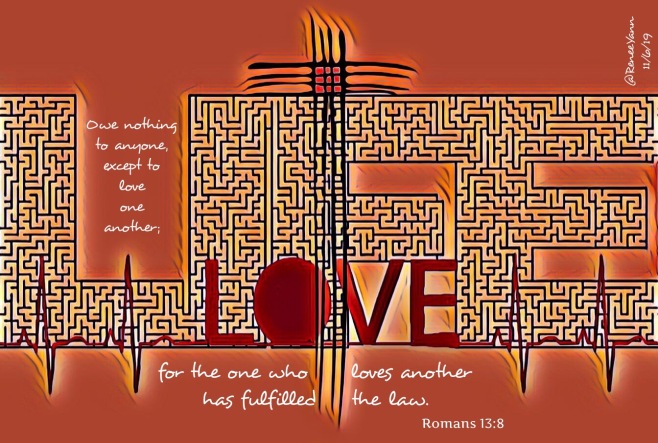
And that’s not easy! Life is a maze of relationships and situations that can get us very confused about what is most important. That’s why Jesus uses such strong language to remind us that there is only one way through the maze: to love as God loves. This is the heartbeat of our life in God!


Paul says this too, indicating how to negotiate the maze by keeping Love’s commandments.

Brothers and sisters:
Owe nothing to anyone, except to love one another;
for the one who loves another has fulfilled the law.

Romans 13:8

If we love with God’s love, of course we will love those we cherish. But we will love them selflessly, with an infinite generosity that always chooses their eternal good. And we will try always to love all Creatures in the same way. This is the kind of love Jesus taught us on the Cross. May God give us the courage to learn.


Poetry: Prayer of Mother Teresa and Brother Roger of Taize 

Oh God, the Creator of all,
you ask every one of us to spread
Love where the poor are humiliated,
Joy where the Church is brought low,
And reconciliation where people are divided. . . 
Father against son, mother against daughter,
Husband against wife,
Believers against those who cannot believe,
Christians against their unloved fellow Christians.

Music: Ubi Caritas performed by Stockholm University Choir (texts below)

Latin Text

Ubi caritas et amor, Deus ibi est.
Congregavit nos in unum Christi amor.
Exsultemus, et in ipso jucundemur.
Timeamus, et amemus Deum vivum.
Et ex corde diligamus nos sincero.
Ubi caritas et amor, Deus ibi est.
Simul ergo cum in unum congregamur:
Ne nos mente dividamur, caveamus.
Cessent iurgia maligna, cessent lites.
Et in medio nostri sit Christus Deus.
Ubi caritas et amor, Deus ibi est.
Simul quoque cum beatis videamus,
Glorianter vultum tuum, Christe Deus:
Gaudium quod est immensum, atque probum,
Saecula per infinita saeculorum. Amen.

English Translation
Where charity and love are, God is there.
Love of Christ has gathered us into one.
Let us rejoice in Him and be glad.
Let us fear, and let us love the living God.
And from a sincere heart let us love one.
Where charity and love are, God is there.
At the same time, therefore, are gathered into one:
Lest we be divided in mind, let us beware.
Let evil impulses stop, let controversy cease.
And in the midst of us be Christ our God.
Where charity and love are, God is there.
At the same time we see that with the saints also,
Thy face in glory, O Christ our God:
The joy that is immense and good,
Unto the World without end. Amen.

Catch the Word!

October 29, 2021
Friday of the Thirtieth Week in Ordinary Time

Today, in God’s Lavish Mercy, we pray with Psalm 147 which calls upon Israel to praise God for gifts received.

God has not done for others what has been done for you;
the Divine Way God has not made known to them. Alleluia.

Psalm 147: 20

The psalm gives us deeper insight into our reading from Romans. In Romans, chapters 9-11, Paul focuses on Israel’s quintessential place in the unfolding of salvation history.

In today’s passage, Paul laments the recalcitrance of some of his kin to open their hearts to the Gospel:

I have great sorrow and constant anguish in my heart. 
For I could wish that I myself were accursed and cut off from Christ
for the sake of my own people,
my kindred according to the flesh. 
They are children of Israel…

Romans 9: 2-3

Paul’s lament is not a condemnation. Rather he mourns the fact that his fellow Israelites, who are uniquely blessed by God, choose not to accept the new and transformative Gift offered them in the person of Jesus Christ.


The lesson for us when praying with this psalm and reading? Perhaps this:

God is always doing something new and wonderful in us and in Creation. God is always inviting us deeper into the relationship of love and mercy.

The path to that sacred depth is laid out for us in the Gospel where we learn to imitate Christ.


Sometimes we too are recalcitrant. We like things to be ordered and controlled, just like today’s Gospel Pharisees liked to control the Sabbath.

But the God of the Sabbath is not to be controlled by our fears, demands, or securities. That God will continue to challenge, invite, surprise, and love us into deeper relationship.

Our work is to stay open and responsive to this dynamic God Whose graces are “new every morning” – in fact, every moment…

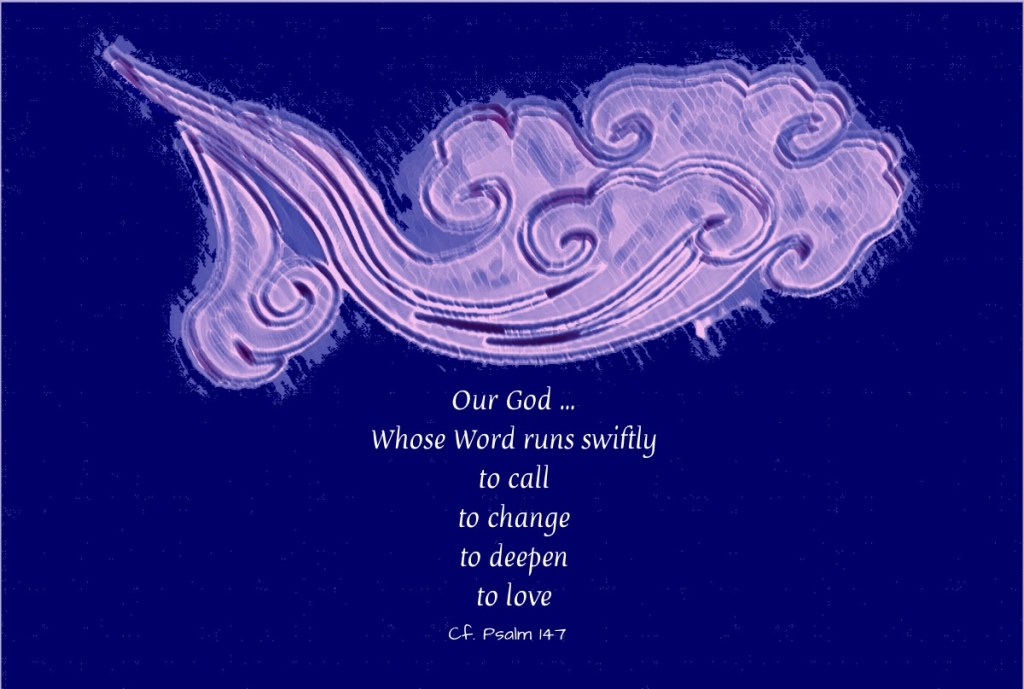
Who sends forth the command to the earth;
Whose Word runs swiftly!

Psalm 147: 15

Poetry: He Comes Ever Again – Rowan Williams

He will come like last leaf’s fall.
One night when the November wind
has flayed the trees to bone, and earth
wakes choking on the mould,
the soft shroud’s folding.

He will come like frost.
One morning when the shrinking earth
opens on mist, to find itself
arrested in the net
of alien, sword-set beauty.

He will come like dark.
One evening when the bursting red
December sun draws up the sheet
and penny-masks its eye to yield
the star-snowed fields of sky.

He will come, will come,
will come like crying in the night,
like blood, like breaking,
as the earth writhes to toss him free.
He will come like child.

Music: Blue Dream – Fiona Jay Hawkins

Declare God’s Glory

October 28, 2021
Feast of Saints Simon and Jude, Apostles

Photo by my talented Sister-in-Law

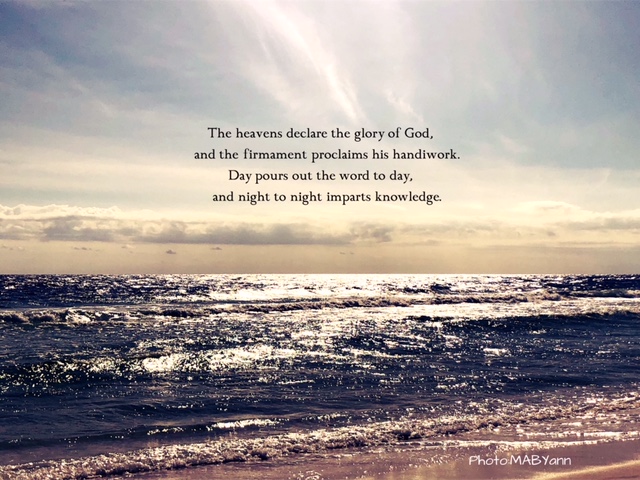
Today, in God’s Lavish Mercy, we pray with Psalm 19. Today’s beautiful verses alert us to the magnificence of the Heavens as a testament to God’s Glory:

The heavens declare the glory of God,
    and the firmament proclaims God’s handiwork.
Day pours out the word to day,
    and night to night imparts knowledge.

Psalm 19: 2-3

We might picture the psalmist, perhaps burdened, confused, or exhausted by the exigencies of daily life, walking outside under an October sky such as the ones we are given this time of year. The walk may have happened in a crystal blue Noon, or late under a black canopy sprayed with October’s meteor showers.

Photo by my talented Niece

Whatever the hour, that ancient psalmist’s heart is stilled in nature’s constant, silent yet resounding adoration of our Creator:

Not a word nor a discourse
    whose voice is not heard;
Through all the earth their voice resounds,
    and to the ends of the world, their message.

Psalm 19: 4-5

Psalm 19, after today’s introductory stanzas, compares nature’s elegant and eternal balance to the perfection of God’s Law…

The law of the LORD is perfect,
refreshing the soul.

Psalm 19:8

… Psalm 19
where the searching and cleansing sun
becomes an image of
the searching and cleansing Law.

C. S. Lewis: Reflections on the Psalms

On this Feast of Saints Simon and Jude, the Church uses Psalm 19 to describe the work of an Apostle. Like the heavens whose beauty and constancy declare God’s glory, the Apostle lives and preaches that Divine Elegance – that Law of Love perfected in Jesus Christ.

Paul, in our first reading from Ephesians, says that these Apostles lay the foundation for all of us to become – like Sacred Creation – “a dwelling place of God in the Spirit.”

Our Gospel recounts the calling of the first twelve of these “foundation builders”. But the call continues eternally. It comes to each of us.


Under the constant sun and other stars, that call to witness and declare God’s glory summons us to live a life that sings:

We praise you, O God,
we acclaim you as Lord;
with the glorious company of Apostles,
we praise you.

Today’s Alleluia Verse taken from the Te Deum

Poetry: Pied Beauty- Gerard Manley Hopkins

Glory be to God for dappled things – 
   For skies of couple-colour as a brinded cow; 
      For rose-moles all in stipple upon trout that swim; 
Fresh-firecoal chestnut-falls; finches’ wings;
 
   Landscape plotted and pieced – fold, fallow, and plough; 
      And áll trádes, their gear and tackle and trim. 
All things counter, original, spare, strange; 
   Whatever is fickle, freckled (who knows how?) 

      With swift, slow; sweet, sour; adazzle, dim; 
He fathers-forth whose beauty is past change: 
                                Praise him.

Music: Benedictus – Karl Jenkins