Friday of the Twelfth Week in Ordinary Time

June 25, 2021

This reflection on Psalm 128 was published earlier this year, but I thought it deserved another day. I hope you do too. 🙂

Today, in God’s Lavish Mercy, we pray with Psalm 128 which some describe as a blueprint for a happy home.

Happy are they all who fear the Lord, 
and who follow in the ways of God!
You shall eat the fruit of your labor;
happiness and prosperity shall be yours.
Your wife shall be like a fruitful vine 
within your house, 
your children like olive shoots 
round about your table.

Psalm 128, Canadian Inclusive Psalter

As lovely as it is, this interpretation may be overly simple. 

Psalm 128, written in the post-exilic period, is the people’s song of gratitude for the chance to return to their homeland after the Babylonian captivity.

For Israel, the captivity was the result of their faithlessness to their covenant with God. The core sentiment of the psalm is awareness, repentance, and conviction to live life more intentionally – to live in fear of the Lord and thus preserve oneself from future calamity:

Blessed are you who fear the LORD,
    who walk in the Lord’s ways!


I think that word “fear” is a tough one. It seems to contradict our desired relationship with the God who is Love, the God we have met in the person of Jesus Christ. How do we reconcile the contradiction?

But Proverbs tells us this:

The fear of the LORD is the beginning of wisdom, 
and knowledge of the Holy One is understanding.

Proverbs 9:10

So this “fear” is significantly different from the emotion we might feel when, for example, we hear an unfamiliar noise in our darkened house.

Thus the ‘fear of the Lord’ is a relational term signifying the Israelites’ response to God’s grace displayed in salvation (especially the Exodus). As Walter Brueggemann has aptly written, it means: to take God with utmost seriousness as the premise and perspective from which life is to be discerned and lived. That ‘utmost seriousness’ requires attentiveness to some things rather than others, to spend one’s energies in response to this God who has initiated our life.

Mark J. Boda, Professor of Old Testament, McMaster Divinity College

This, in fact, is the rich sentiment underlying Psalm 128, and that will yield the security of an intimate relationship with God

May the LORD bless you from Zion;
may you see Jerusalem’s prosperity
all the days of your life,
and live to see your children’s children.
Peace upon Israel!

Psalm 128:4-5
May we live to see our lives unfold in grace.

The psalmist’s “fear” might be more akin to awe, reverence, glad obedience to our God who loves us and wills our good. It is a virtue rooted in our search for a holy awe and wisdom as our life unfolds in God’s Grace:

Old Testament scholar, Walter Brueggemann, says we live in a technological society that has grossly confused knowledge and wisdom. He says wisdom is the mystery, held by God, about how and why life works…how creation holds together…and how human reason has its limits. Wisdom is God’s secret and even our bold Enlightenment expectations barely lay a finger on that secret. Wisdom involves recognizing limits before the mystery of God. Knowledge has to do with control, says Brueggemann. Wisdom has to do with awe.

Walter M. Klein, Pastor, Lexington Presbyterian Church

Poem: I Am Bending My Knee

Originally from the Carmina Gadelica I, 3. Taken from Esther de Waal, editor, The Celtic Vision (Liguori, MO: Liguori/Triumph, 1988, 2001), p. 7.

I am bending my knee
In the eye of the Father who created me,
In the eye of the Son who purchased me,
In the eye of the Spirit who cleansed me,
In friendship and affection.

Through Thine own Anointed One, O God,
Bestow upon us fullness in our need,
Love towards God,
The affection of God,
The smile of God,
The wisdom of God,
The grace of God,
The fear of God,
And the will of God

To do on the world of the Three,
As angels and saints
Do in heaven;
Each shade and light,
Each day and night,
Each time in kindness,
Give Thou us Thy Spirit.

Music: The Fear of the Lord – First Baptist Dallas (Wow! How about this music ministry!)
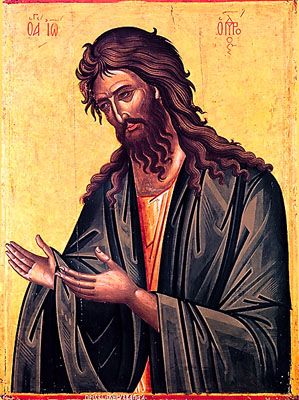
Solemnity of the Nativity of Saint John the Baptist

June 24, 2021

Icon of St. John the Baptist (16th c.) Dionysiou Monastery

Today, in Mercy, we celebrate one of the greatest figures of the Bible, John the Baptist. He prepared the way for the Lord.

Thinking of John’s role in Salvation History, I am reminded of a captivating poem by Geoffrey Brown, author of Road of the Heart Cave:

The Heart Cave

I must remember

To go down to the heart cave
& sweep it clean; make it warm
with a fire on the hearth,
& candles in their niches,
the pictures on the walls
       glowing with a quiet light.
       I must remember

To go down to the heart cave
       & make the bed
with the quilt from home,
strew
the rushes on the floor
hang
lavender and sage
         from the corners.
         I must go down
                                           To the heart cave & be there
                                           when You come.


John the Baptist went down to the heart cave of our human perception of God.  He understood, in an inexpressible way, that God was about to do something astounding in human history.  God was about to become part of it!

John understood this with unquestioning faith, the way we understand heaven but cannot rationalize it. Understanding it, he knew that the world needed to turn itself toward God – to repent – in radical and ardent expectation.

This was his call and his message – this extraordinary man, dressed in his camel hair vestments, preaching at the desert’s edge.


We might pray with John today to be turned from anything that distracts us from God, to long for God’s presence in our hearts and in our world, to love deeply and make a welcome home for Christ within us.


( On this Feast, 55 years ago, my entrance companions and I professed our vows. I think of all of them with love today. May I humbly ask you, dear readers, to join me in prayer for us as we thank God for the gift of our lives in Mercy.)


Music: “Utqueant laxis” or “Hymnus in Ioannem” is a Latin hymn in honor of John the Baptist written in Horatian Sapphics and traditionally attributed to Paulus Diaconus, the eighth-century Lombard historian. It is famous for its part in the history of musical notation, in particular solmization (do-re-mi-fa-so-la-ti-do). The hymn is sung to a Gregorian chant, and introduces the original do-re-mi music

1. O for your spirit, holy John, to chasten
Lips sin-polluted, fettered tongues to loosen;
So by your children might your deeds of wonder
Meetly be chanted.

2. Lo! a swift herald, from the skies descending,
Bears to your father promise of your greatness;
How he shall name you, what your future story,
Duly revealing.

3. Scarcely believing message so transcendent,
Him for a season power of speech forsaketh,
Till, at your wondrous birth, again returneth,
Voice to the voiceless.

4. You, in your mother’s womb all darkly cradled,
Knew your great Monarch, biding in His chamber,
Whence the two parents, through their offspring’s merits,
Mysteries uttered.

5. Praise to the Father, to the Son begotten,
And to the Spirit, equal power possessing,
One God whose glory, through the lapse of ages,
Ever resounding. Amen.

Wednesday of the Twelfth Week in Ordinary Time

Wednesday, June 23, 2021

Today, in God’s Lavish Mercy, we pray with Psalm 105, a sacred invitation to rest confidently in God.

Glory in God’s holy name;
    rejoice, O hearts that seek the LORD!
Look to the LORD’s strength;
    seek to serve God wholeheartedly.

Psalm 105:3-4

Our trust is based on God’s infinite memory, mindful of us with every breath of our lives. We are asked to remember too.

The Lord remembers the covenant for ever.

Psalm 105:8

Jesus reminds us of this covenant in our Alleluia verse from John’s Gospel:

Let’s just be cradled in these holy promises as we pray today.


Poetry: Trust by Thomas R. Smith

It’s like so many other things in life   
to which you must say no or yes.                                    
So you take your car to the new mechanic.   
Sometimes the best thing to do is trust.   
The package left with the disreputable-looking   
clerk, the check gulped by the night deposit,   
the envelope passed by dozens of strangers—   
all show up at their intended destinations.   
The theft that could have happened doesn’t.   
Wind finally gets where it was going   
through the snowy trees, and the river, even               
when frozen, arrives at the right place.                        
And sometimes you sense how faithfully your life   
is delivered, even though you can’t read the address.


Music: two songs today. I liked them both a lot and didn’t want to deprive you of either.

Rest in God – Brian Doerksen

Rest – Steve Green

Friday of the Eleventh Week in Ordinary Time

June 18, 2021

Today, in God’s Lavish Mercy, we pray with Psalm 34 which carries forward the thread of sage advice running through all of our readings


I’m going to state the obvious here: distress is not a pretty thing. 


We all have stress in our lives and, guess what, it can be a good thing. Stress is a reaction in us when a situation calls for our response. If such reactions never occurred, we would be living in isolation from our environment or community. We would not grow as persons.

This positive stress can be called “eustress”. Distress, on the other hand, occurs when we cannot respond effectively to our experiences or situation. We become overwhelmed, fearful, or anxious.


Paul, in our first reading, has a lot of opportunity to grow from stress! Maybe too much. It sounds like Paul’s experiences had certainly bordered on “distress”.

So did our psalmist’s experiences. In later verses of the psalm, we get a hint of that. The writer is broken-hearted, crushed in spirit, and under physical threat — just like Paul:

The LORD is close to the brokenhearted,
saves those whose spirit is crushed.
Many are the troubles of the righteous,
but the LORD delivers us from them all.
God watches over all our bones;
not one of them shall be broken.
Evil will slay the wicked;
those who hate the righteous are condemned.
But the  LORD redeems the faithful servant
and none are condemned who take refuge in God.

Psalm 34:19-23

Jesus has a word for us about dealing with distress:

Do not store up for yourselves treasures on earth,
where moth and decay destroy,
and thieves break in and steal.
But store up treasures in heaven,
where neither moth nor decay destroys,
nor thieves break in and steal.


So it all depends on what we treasure, on what we allow to become most important in our lives. If wealth, reputation, power, and self-aggrandizement are our treasures, we’re going to live in distress all our lives trying to protect these trophies.

If charity, hope, faith, and merciful justice are our treasures, it doesn’t mean we will never have stress or pain. But we will understand the prayer of Psalm 34:

Glorify the LORD with me,
    let us together extol God’s name.
I sought the LORD who answered me
    and delivered me from all my fears. 
From all their distress God rescues the just.
Look to God that you may be radiant with joy,
    and your faces may not blush with shame.
When the poor one called out, the LORD heard,
    and was delivered from all distress.

Psalm 34:4-7

Poetry: Do not be troubled, God, though they say “mine” – Rainer Maria Rilke

Do not be troubled, God, though they say “mine”
of all things that permit it patiently.
they are like wind that lightly strokes the boughs
and says: MY tree.
They hardly see
how all things glow that their hands seize upon,
so that they cannot touch
even the utmost fringe and not be singed.
They will say “mine” as one will sometimes call
the prince his friend in speech with villagers,
this prince being very great — and far away.
They call strange walls “mine,” knowing not at all
who is the master of the house indeed.
They still say “mine,” and claim possession, though
each thing, as they approach, withdraws and closes;
a silly charlatan perhaps thus poses
as owner of the lightning and the sun.
And so they say: my life, my wife, my child,
my dog, well knowing all that they have styled
their own: life, wife, child, dog, remain
shapes foreign and unknown,
that blindly groping they must stumble on.
This truth, be sure, only the great discern,
who long for eyes. The others WILL not learn
that in the beggary of their wandering
they cannot claim a bond with any thing,
but, driven from possessions they have prized,
not by their own belongings recognized,
they can OWN wives no more than they own flowers,
whose life is alien and apart from ours.
God, do not lose your equilibrium.
Even he who loves you and discerns your face
in darkness, when he trembles like a light
you breathe upon, — he cannot own you quite.
And if at night one holds you closely pressed,
locked in his prayers so you cannot stray,
…..you are the guest
…..who comes, but not to stay.
God, who can hold you? To yourself alone
belonging, by no owner’s hand disturbed,
you are like unripened wine that unperturbed
grows ever sweeter and is all alone.


Music: Me and Bobby McGee written and sung by Kris Kristofferson

I don’t know if you will appreciate this song, but I thought I’d give it a try. 
I have always identified today’s Gospel with a verse in the song:
Freedom’s just another word for nothin’ left to lose.
Nothin’, it ain’t nothin’ honey, if it ain’t free
I have never fully spiritually plumbed that verse, but I love to explore it every time I hear this song.

Wednesday of the Eleventh Week in Ordinary Time

Wednesday, June 16, 2021

Today, in God’s Lavish Mercy, we pray with Psalm 112, a poem about why and how to live a generous life.

Blessed the one who is in awe of the LORD,
    who greatly delights in God’s commands.
That person’s posterity shall be mighty upon the earth;
    the upright generation shall be blessed.
Wealth and riches shall be in their house;
   their generosity shall endure forever.

Psalm 112:2-4

The psalm nicely complements our readings: 

  • Paul, nudging the Corinthians for a general collection
  • Jesus, preaching sincerity and humility in our giving – both to humans and to God.

Generosity is the fruit of the theological virtue of charity. 

I think “charity” gets a flimsy definition in our modern culture. Many think of it only as a noble intermittent gesture toward those who are disadvantaged, like change tossed into the Salvation Army bucket.

But it’s a way bigger deal. Here are a few clips from the Catechism of the Catholic Church. They offer so much thought for our meditation. After that, we might pray to deepen in true charity and to manifest it in quiet, sustained generosity.


The theological virtues are the foundation of Christian moral activity;
they animate it and give it its special character.
They inform and give life to all the moral virtues.
They are infused by God into the souls of the faithful
to make them capable of acting as God’s children and of meriting eternal life.
They are the pledge of the presence and action of the Holy Spirit
in the faculties of the human being.
There are three theological virtues: faith, hope, and charity.


Charity is the theological virtue
by which we love God above all things for God’s own sake,
and our neighbor as ourselves for the love of God.


The practice of all the virtues is animated and inspired by charity,
which “binds everything together in perfect harmony”;
it is the form of the virtues;
it articulates and orders them among themselves;
it is the source and the goal of their Christian practice.
Charity upholds and purifies our human ability to love,
and raises it to the supernatural perfection of divine love.


The fruits of charity are joy, peace, and mercy;
charity demands beneficence and fraternal correction;
it is benevolence;
it fosters reciprocity and remains disinterested and generous;
it is friendship and communion:.

Love is itself the fulfillment of all our works.
There is the goal; that is why we run:
we run toward it, and once we reach it,
in it we shall find rest.

Music: Ubi Caritas – Taize

Tuesday of the Eleventh Week in Ordinary Time

Tuesday, June 15, 2021

Today, in God’s Lavish Mercy, we pray with Psalm 146, a lilting song of praise, remembrance, hope, trust, gratitude, and joy.

Praying with this inclusive translation, I let my life story unfold in the Presence of the Beloved, turning each petal over and over in the Light of God’s incomprehensible grace and mercy. No words … just the grateful turning. And I listened…listened to the silence.

Psalm 146

Alleluia
Praise the Lord, O my soul!
I will praise the Lord as long as I live;
I will sing praise to my God while I live.

Happy are they who look to God for their help! 
For their hope is in the Lord their God,
who made heaven and earth, the seas, and all that is in them;
who keeps promises for ever;

who gives justice when we are oppressed,
food when we hunger
freedom when we are entrapped.

The Lord breaks through our blindness
The Lord lifts us up wthe we have been bowed.
and loves our desire for good.

I remember how the Lord cares for us
when we are brokenhearted,
but frustrates the way of the faithless. 
I know the Lord shall reign for ever.
Alleluia!

Poetry: “I Happened To Be Standing” by Mary Oliver

I don’t know where prayers go,
or what they do.
Do cats pray, while they sleep
half-asleep in the sun?
Does the opossum pray as it
crosses the street?
The sunflowers? The old black oak
growing older every year?
I know I can walk through the world,
along the shore or under the trees,
with my mind filled with things
of little importance, in full
self-attendance.  A condition I can’t really
call being alive.
Is a prayer a gift, or a petition,
or does it matter?
The sunflowers blaze, maybe that’s their way.
Maybe the cats are sound asleep.  Maybe not.
While I was thinking this I happened to be standing
just outside my door, with my notebook open,
which is the way I begin every morning.
Then a wren in the privet began to sing.
He was positively drenched in enthusiasm,
I don’t know why.  And yet, why not.
I wouldn’t pursuade you from whatever you believe
or whatever you don’t.  That’s your business.
But I thought, of the wren’s singing, what could this be
if it isn’t a prayer?
So I just listened, my pen in the air.

Music: Praise You – Brooklyn Tabernacle Choir

Lord I come to you today,
With a simple prayer to pray.
In everything I do,
Let my life O Lord praise you.

Praise you, praise you, praise you
Let my life, praise you
Praise you, praise you, praise you
Let my life, O lord praise you

Lord you formed me out of clay,
And for your glory I was made.
Use this vessel as you choose.
Let my life O Lord praise you

Eleventh Sunday in Ordinary Time

Sunday, June 12, 2021

Today, in God’s Lavish Mercy, we pray with Psalm 92, the only psalm in the Hebrew Bible assigned to a particular day – Shabbat. Combined with our readings, especially Ezekiel, it invites us to heartfelt prayer.

Shabbat (שַׁבָּת; related to Hebrew verb “cease, rest”) is the seventh day of the Jewish week and is the day of rest and abstention from work as commanded by God. Shabbat involves two interrelated commandments: to remember (zachor) and to observe (shamor).

from jewishvirtuallibrary.org

Psalm 92 captures the spirit we hope for in all our Sundays- peace, reflective gratitude, patient hope, recognized blessing. It is a time to remember God’s goodness to us and to reflect on God’s presence.


But, as you may know, I write these reflections a day ahead. And my Saturday morning was anything but “Shabbatish”! I stayed up too late last night, slept too late this morning, and had to handle an early grocery order. To top it all off, a glass exploded in my housemate’s face as she emptied the dishwasher! (She’s fine, but it was like lightening hit our kitchen.)

It all left me a little distracted!


I tell you this to say that – yes – prayer comes begrudgingly when we don’t make the space for it.

But when we do take a breath and quiet ourselves, it can be amazingly generous.

Over time, the seeds of a consistently prayerful life will bear fruit even under challenging conditions. As Jesus tells us today:

It is like a mustard seed that, when it is sown in the ground,
is the smallest of all the seeds on the earth.
But once it is sown, it springs up and becomes the largest of plants
and puts forth large branches,
so that the birds of the sky can dwell in its shade.


Our #92 psalmist prays that kind of a prayer today. Here’s the way I read it with my heart:

It is good to give thanks to you LORD,
    to sing praise to your name, Beloved,
To proclaim your kindness at daybreak,
and even later if I miss its rising!
    To know your faithfulness
even in my distractions.

You let my prayer bear fruit 
even in the shade of time and its pressures,
    my faith to be vigorous and sturdy.
I sing of your goodness,LORD,
    You, my Steady Love who is always faithful.


Poetry: The Spirit’s Whispers by Colten Biro, S.J.

If only my words were 
poised, precise, perfect ballerinas.
If only they could pirouette on a point,

Holding a pose, arresting rapt attention,
Meaning twirling out past paradox of The Ineffable,
convincing the very orbit of the Son to stop and listen,
to nothing more significant—than me.

If only my words were quick, sharp, exact,
halting in the air for emphasis and recognition.
All of which calm, careful, and controlled.
All of which holding the attention of the Heavens,
interrupting an unceasing song of seraphim and cherubim.

If only my words were anything, 
but garbled, goofy, grating,
and less akin to rodeo clowns than en pointe figurines.
But they are bumbling and boisterous, 
dancing dunces, 
threading a thin, thimble-like thought
that the gait of my racing heart
could avoid running into either 
lines of bull—or truth too true.
Which means my words, in effect, 
avoid bearing my very heart, directly to You.

If only the words, with a gentle extension
and a faint flourish, could entwine:
        my desires—Your Will. 
        my loneliness—Your Presence.
        my pain—the Resurrection.
      my disquiet—Your Peace.

Completing a grand jete,
coupling cacophonous 
concepts midair—and mid-heart.

And yet, 
my words
don’t dance
or sing
at all.

So, I don’t speak.
My words don’t waltz, so much as whimper.
And my seat here in the pew feels too quiet
in the muffled silence of the sanctuary.

Maybe, Lord, You have the words 
I can perfectly perform,
to cry anything but Abba.
Which for now,
is the only word I pray,
while paralyzed in the repeating echoes
of my pointless pirouetting.


Music: Vento di Passioni – James Horner

As we pray today, may a flight of prayerful gratitude spring from our spirits!

Memorial of the Immaculate Heart of Mary

Saturday, June 12, 2021

Today, in God’s Lavish Mercy, we pray with Psalm 103, a well-known and loved hymn of praise. It is a fitting psalm for today’s feast which unites us with Mary as we pray.

Bless the Lord, O my soul,
and all that is within me, bless God’s holy name.
Bless the Lord, O my soul,
and forget not all the benefits of the Lord.

Psalm 103:1

Mary lived much of her life in the actual presence of God, in the person of Jesus her Son. And no doubt, she received this holy proximity as a surpassing gift.

But even more importantly, Mary lived her whole life in total awareness of God – before and after Jesus was present with her.


There is a practice many of us learned as children called “Blessing the Hour”. The prayer goes like this:

Let us remember the holy presence of God
Let us adore God’s Divine Majesty.

Sometimes a classmate was assigned to watch the clock and ring a little bell to trigger our prayer. We needed a reminder, every hour, that our whole life is held in the Breath of God.


But Mary always remembered. She lived so completely within God’s promise of mercy that she became the vessel of its accomplishment.

My soul proclaims your greatness, O God, 
and my spirit rejoices in you, my Savior. 
For you have looked with favor upon your lowly servant, 
and from this day forward all generations will call me blessed.
For you, the Almighty, have done great things for me, 
and holy is your Name.
 
Your mercy reaches from age to age for those who fear you.
You have shown strength with your arm; 
you have scattered the proud in their conceit; 
you have deposed the mighty from their thrones 
and raised the lowly to high places.
You have filled the hungry with good things, 
while you have sent the rich away empty.
 
You have come to the aid of Israel your servant, 
mindful of your mercy
—the promise you made to our ancestors―
to Sarah and Abraham and their decendants forever.

So today, like Mary, let us remember the holy Presence of God in our every moment –

  • the Lord who is kind and merciful.
  • and pardons all our iniquities,
  • and heals all our ills
  • and redeems our life from destruction,
  • and crowns us with kindness and compassion

Psalm 103:2-3,8


Poetry: John O’Donohue, ‘The Annunciation’, in Conamara Blues

Cast from afar before the stones were born
And rain had rinsed the darkness for colour,
The words have waited for the hunger in her
To become the silence where they could form.
The day’s last light frames her by the window,
A young woman with distance in her gaze,
She could never imagine the surprise
That is hovering over her life now.
The sentence awakens like a raven,
Fluttering and dark, opening her heart
To nest the voice that first whispered the earth
From dream into wind, stone, sky and ocean.
She offers to mother the shadow’s child;
Her untouched life becoming wild inside.

Music: In His Presence – Sandi Patty

Solemnity of Most Sacred Heart of Jesus

Friday, June 11, 2021

Today, in God’s Lavish Mercy, we pray with Isaiah for our Responsorial Psalm:

God indeed is my savior;
    I am confident and unafraid.
My strength and my courage is the LORD,
    who has been my savior.
With joy you will draw water
    at the fountain of salvation.

Isaiah 12:2-3

This fountain of salvation is the Sacred Heart of Jesus.


I woke up before dawn today. Not really wanting to formally begin my day, I lingered on the pillows for my early morning prayer. Having always loved this feast, I began placing all my suffering loved ones into Jesus’s heart – one by one, asking for their strength and healing.

The list was long, because there are all kinds of suffering, and I love a lot of people – even ones I don’t know personally! Finally I said to Jesus, “You know, life is HARD!” 

And in my spirit, I heard this answer,
“I know. I lived it for the love of every one of you.”

To me, this is the meaning
of the Sacred Heart of Jesus
– that merciful companionship
which Infinity assumed for us
in the person of Jesus Christ.

That fountain of love and mercy continues to nourish our lives in the Eucharistic community of faith practicing the works of mercy. We are the threads which bind one other to God’s heart.


Paul knew this. That’s why he prayed this beautiful prayer for his beloved Ephesian community. Our second reading offers an example of Paul’s magnificent benedictions and doxologies. As he prays for the Ephesians, so he prays for us. These prayers are exalted, yet simple. They thrill the soul who prays them. They place us, in awe and thanksgiving, fully in the divinely generous, Sweet Heart of Christ.

Let’s pray for our beloveds today and for the world:

For this reason I kneel before the Father,
from whom every family in heaven and on earth is named,
that he may grant you in accord with the riches of his glory
to be strengthened with power through his Spirit in the inner self,
and that Christ may dwell in your hearts through faith;
that you, rooted and grounded in love,
may have strength to comprehend with all the holy ones
what is the breadth and length and height and depth,
and to know the love of Christ which surpasses knowledge,
so that you may be filled with all the fullness of God.


Music: Two songs today:

Threads – by David Leonard

We beseech the Sacred Heart today that all who suffer any kind of fragmentation may find tenderness, wholeness, and comfort in him.
(To hear the song, click on “Watch on YouTube” in the black clock below.)

This one is old school, but it still works for me:

Sacred Heart of Jesus – James Kilbane

Thursday of the Tenth Week in Ordinary Time

June 10, 2021

Today, in God’s Lavish Mercy, we pray with Psalm 85 and its enchanting metaphors for heavenly bliss:

  • glory dwells with us
  • kindness and truth meet
  • justice and peace kiss.
  • truth springs out of the earth,
  • justice looks over heaven’s edge

Our souls long for such an environment, don’t they?

In his letter to the Corinthians, Paul says that the way to find it is to remove the veil from our hearts:

… whenever a person turns to the Lord the veil is removed.
Now the Lord is the Spirit and where the Spirit of the Lord is, 
there is freedom.
All of us, gazing with unveiled face on the glory of the Lord,
are being transformed into the same image from glory to glory,
as from the Lord who is the Spirit.

2 Corinthians 3:16-18
Edited in Prisma app with Tears

Our prayer with Psalm 85 today might echo that of Rev. Christine Robinson, Minister Emerita of the First Unitarian Church of Albuquerque, New Mexico.

O God, you have given us a beautiful earth—
Grant us the wisdom to use it well.
Lead us to an inner life in which we can rejoice.
Speak peace to us, that we may live in peace.
May your mercy and truth meet together
Righteousness and peace kiss each other,
Surrounding us with your light.
Help us know true prosperity,
And be gentle with your Earth.
Guide our feet in the ways of peace.

Poetry: Lift Not the Painted Veil – Percy Bysshe Shelley

The advice in this poem by Shelley is a rather gloomy antithesis of Paul’s advice to the Corinthians (kind of like looking at the negative instead of the photograph, for those of us who remember the non-digital dream 😉) Still, the poem’s images offer much to think about if we choose not to “lift the veil”.


Lift not the painted veil which those who live
Call Life: though unreal shapes be pictured there,
And it but mimic all we would believe
With colours idly spread,-behind, lurk Fear
And Hope, twin Destinies; who ever weave
Their shadows, o'er the chasm, sightless and drear.

I knew one who had lifted it-he sought,
For his lost heart was tender, things to love,
But found them not, alas! nor was there aught
The world contains, the which he could approve.
Through the unheeding many he did move,
A splendour among shadows, a bright blot
Upon this gloomy scene, a Spirit that strove
For truth, and like the Preacher found it not.

Music: Layers of Tranquility- Karunesh