Today, in Mercy, the deep undercurrent of our readings is about the power and difficulties of faith.
James talks about how our faith can be choked by the weeds of “bitter jealousy and selfish ambition”. These chokers make us “boast and be false to the truth”. They fill us with a “pretend wisdom” that is not from the Holy Spirit.
Praying with this passage, I asked myself why we allow these ugly constraints to grasp our souls when the alternative James describes is so beautiful:
… the wisdom from above is first of all pure, then peaceable, gentle, compliant, full of mercy and good fruits, without inconstancy or insincerity. And the fruit of righteousness is sown in peace for those who cultivate peace.
The Gospel helped me with an answer.
Unconditional faith is scary. It requires us to give control over to God. It asks us to let go of fear and to trust God’s Spirit within us. It needs us to empty our hearts of pretense and self-protection in order to make room for God’s transforming Mercy and Love.
This kind of faith will change us. It will make us “foolish” and insecure in worldly terms. It will cause us to live from a Wisdom the world misunderstands and mocks.
It’s hard to live that kind of faith. The dad in today’s Gospel admits it. He wants to have a faith that invites Christ’s power into his life. But he’s afraid. What if God wants something different for him and his son? What happens if he gives control over to God?
This yearning father confesses his ambivalence in a plea for Christ’s assistance:
We all find ourselves within that plea sometimes in our lives. It’s a faith of “if”, “maybe”, and “but” – all of which are hardly faith at all. Unconditional faith is “Yes”, no matter what. It is the place where Faith and Love merge.
Our faithful “Yes”, as the e.e.cummings poem might describe it:
love is a place
& through this place of
love move
(with brightness of peace)
all places
yes is a world
& in this world of
yes live
(skillfully curled)
all worlds
Music:When we live this “Yes Faith”, God’s love, God’s heart lives in us. This song by Michael Hedges, based on another poem by e.e.cummings, can be a prayer for us. We may be unused to calling God “my dear”, “my darling”. But a loving name for God can be helpful to our prayer. Substitute what works for you. Don’t be hesitant about being in love with God❤️
I Carry Your Heart – Michael Hedges (Lyrics below)
I carry your heart with me
I carry it in my heart
I am never without it
Anywhere i go you go, my dear
And whatever is done by only me
Is your doing, my darling.
I fear no fate
For you are my fate, my sweet
I want no world
For beautiful you are my world, my true
And it’s you are whatever a moon has always meant
And whatever a sun will always sing is you
Here is the deepest secret nobody knows
Here is the root of the root
And the bud of the bud
And the sky of the sky
Of a tree called life;
Which grows higher than the soul can hope
Or mind can hide
And this is the wonder that’s keeping the stars apart
I carry your heart
I carry it in my heart
Today, in Mercy, our readings are around the theme of our spiritual senses.
James tells us to listen, look, see, and act on the Word planted within our hearts. Once again, he gives us great images to help our understanding.
For if anyone is a hearer of the word and not a doer, he is like a man who looks at his own face in a mirror. He sees himself, then goes off and promptly forgets what he looked like.
If anyone thinks he is religious
and does not bridle his tongue but deceives his heart, his religion is vain.
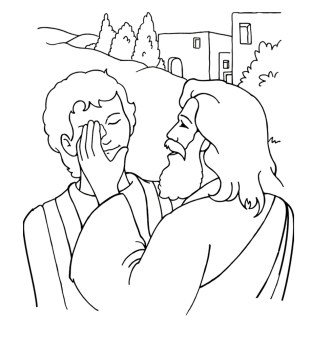
In our Gospel, once again our dear, earthy Jesus heals someone in a deeply human way. Jesus takes the blind man aside, holding his hand to lead him. As he did in a passage recently, Jesus spits on his fingers and massages the blind man’s eyes.
The man tries to work with Jesus, exclaiming that he sees “people like trees walking”.
I’ve always loved that line because it makes me feel like I’m right there, listening to the man’s amazement!
As we pray this morning, we might wonder what Jesus said back to that overwhelmed man as they sat together. What might he say to us as he lifts one of our many blindnesses from our hearts?
Music:I See Men As Trees Walking – Johnny Cash (lyrics below)
Today, in Mercy, our readings leave me wondering about what makes God tick.
In our first reading, God exacts justice for Solomon’s unfaithfulness, but He does it sort of like a prosecutor in a plea bargain.
I will deprive you of the kingdom … but not during your lifetime It is your son whom I will deprive … but I won’t take away the whole kingdom.
What’s going on with God in this reading? Well, it’s more like “What’s going on with the writer as he tries, retrospectively, to interpret God’s role in Israel’s history?”
The passage is much more than a report on exchanges between God and Solomon.
It is a testament to Israel’s unwavering faith that God is intimately involved in their lives. In every circumstance, the believing community returns to the fact that experience leads to God and not away from Him.
So “Solomon … had TURNED his heart to strange gods” BUT God had not turned from Solomon. Nor would God EVER turn because God has CHOSEN Israel.
In our Gospel, the Syrophoenician woman tries to get the favor of Jesus to turn toward her. And actually, Jesus sounds pretty mean and stingy about it.
Again the writer Mark is portraying, retrospectively, a significant time in Christ’s ministry. Jesus has really gone into hiding in a remote place. Apparently, he wants space to figure some things out. The story indicates that one of those things might be whether or not his ministry should embrace the Gentiles.
The persistence of this woman’s faith is a turning point for Jesus Who evolved, as we all do, in his understanding of his sacred role and meaning in the world.
These passages encourage us to constantly turn toward God Who lives our life with us. Such conversation helps us to grow spiritually. As we become bigger in heart and soul, so does our concept of God and what God’s hope is for us.
Music: Perfect Wisdom of Our God – The Gettys (See poem after music video)
All this “turning” brought to mind some favorites lines from T.S. Eliot:
At the still point of the turning world. Neither flesh nor fleshless; Neither from nor towards; at the still point, there the dance is, But neither arrest nor movement. And do not call it fixity, Where past and future are gathered. Neither movement from nor towards, Neither ascent nor decline. Except for the point, the still point, There would be no dance, and there is only the dance.
I happened across a website where Eliot himself reads “Burnt Norton”, the poem from which these lines are taken. Eliot fans might enjoy this. Eliot’s poems take time and work as well as simple reading. But the effort is so worth it!
Time present and time past
Are both perhaps present in time future
And time future contained in time past.
If all time is eternally present
All time is unredeemable.
What might have been is an abstraction
Remaining a perpetual possibility
Only in a world of speculation.
What might have been and what has been
Point to one end, which is always present.
Footfalls echo in the memory
Down the passage which we did not take
Towards the door we never opened
Into the rose-garden. My words echo
Thus, in your mind.
But to what purpose
Disturbing the dust on a bowl of rose-leaves
I do not know.
Other echoes
Inhabit the garden. Shall we follow?
Quick, said the bird, find them, find them,
Round the corner. Through the first gate,
Into our first world, shall we follow
The deception of the thrush? Into our first world.
There they were, dignified, invisible,
Moving without pressure, over the dead leaves,
In the autumn heat, through the vibrant air,
And the bird called, in response to
The unheard music hidden in the shrubbery,
And the unseen eyebeam crossed, for the roses
Had the look of flowers that are looked at.
There they were as our guests, accepted and accepting.
So we moved, and they, in a formal pattern,
Along the empty alley, into the box circle,
To look down into the drained pool.
Dry the pool, dry concrete, brown edged,
And the pool was filled with water out of sunlight,
And the lotos rose, quietly, quietly,
The surface glittered out of heart of light,
And they were behind us, reflected in the pool.
Then a cloud passed, and the pool was empty.
Go, said the bird, for the leaves were full of children,
Hidden excitedly, containing laughter.
Go, go, go, said the bird: human kind
Cannot bear very much reality.
Time past and time future
What might have been and what has been
Point to one end, which is always present.
II
Garlic and sapphires in the mud
Clot the bedded axle-tree.
The trilling wire in the blood
Sings below inveterate scars
Appeasing long forgotten wars.
The dance along the artery
The circulation of the lymph
Are figured in the drift of stars
Ascend to summer in the tree
We move above the moving tree
In light upon the figured leaf
And hear upon the sodden floor
Below, the boarhound and the boar
Pursue their pattern as before
But reconciled among the stars.
At the still point of the turning world. Neither flesh nor fleshless;
Neither from nor towards; at the still point, there the dance is,
But neither arrest nor movement. And do not call it fixity,
Where past and future are gathered. Neither movement from nor towards,
Neither ascent nor decline. Except for the point, the still point,
There would be no dance, and there is only the dance.
I can only say, there we have been: but I cannot say where.
And I cannot say, how long, for that is to place it in time.
The inner freedom from the practical desire,
The release from action and suffering, release from the inner
And the outer compulsion, yet surrounded
By a grace of sense, a white light still and moving,
Erhebung without motion, concentration
Without elimination, both a new world
And the old made explicit, understood
In the completion of its partial ecstasy,
The resolution of its partial horror.
Yet the enchainment of past and future
Woven in the weakness of the changing body,
Protects mankind from heaven and damnation
Which flesh cannot endure.
Time past and time future
Allow but a little consciousness.
To be conscious is not to be in time
But only in time can the moment in the rose-garden,
The moment in the arbour where the rain beat,
The moment in the draughty church at smokefall
Be remembered; involved with past and future.
Only through time time is conquered.
III
Here is a place of disaffection
Time before and time after
In a dim light: neither daylight
Investing form with lucid stillness
Turning shadow into transient beauty
Wtih slow rotation suggesting permanence
Nor darkness to purify the soul
Emptying the sensual with deprivation
Cleansing affection from the temporal.
Neither plentitude nor vacancy. Only a flicker
Over the strained time-ridden faces
Distracted from distraction by distraction
Filled with fancies and empty of meaning
Tumid apathy with no concentration
Men and bits of paper, whirled by the cold wind
That blows before and after time,
Wind in and out of unwholesome lungs
Time before and time after.
Eructation of unhealthy souls
Into the faded air, the torpid
Driven on the wind that sweeps the gloomy hills of London,
Hampstead and Clerkenwell, Campden and Putney,
Highgate, Primrose and Ludgate. Not here
Not here the darkness, in this twittering world.
Descend lower, descend only
Into the world of perpetual solitude,
World not world, but that which is not world,
Internal darkness, deprivation
And destitution of all property,
Dessication of the world of sense,
Evacuation of the world of fancy,
Inoperancy of the world of spirit;
This is the one way, and the other
Is the same, not in movement
But abstention from movement; while the world moves
In appetency, on its metalled ways
Of time past and time future.
IV
Time and the bell have buried the day,
the black cloud carries the sun away.
Will the sunflower turn to us, will the clematis
Stray down, bend to us; tendril and spray
Clutch and cling?
Chill
Fingers of yew be curled
Down on us? After the kingfisher’s wing
Has answered light to light, and is silent, the light is still
At the still point of the turning world.
V
Words move, music moves
Only in time; but that which is only living
Can only die. Words, after speech, reach
Into the silence. Only by the form, the pattern,
Can words or music reach
The stillness, as a Chinese jar still
Moves perpetually in its stillness.
Not the stillness of the violin, while the note lasts,
Not that only, but the co-existence,
Or say that the end precedes the beginning,
And the end and the beginning were always there
Before the beginning and after the end.
And all is always now. Words strain,
Crack and sometimes break, under the burden,
Under the tension, slip, slide, perish,
Will not stay still. Shrieking voices
Scolding, mocking, or merely chattering,
Always assail them. The Word in the desert
Is most attacked by voices of temptation,
The crying shadow in the funeral dance,
The loud lament of the disconsolate chimera.
The detail of the pattern is movement,
As in the figure of the ten stairs.
Desire itself is movement
Not in itself desirable;
Love is itself unmoving,
Only the cause and end of movement,
Timeless, and undesiring
Except in the aspect of time
Caught in the form of limitation
Between un-being and being.
Sudden in a shaft of sunlight
Even while the dust moves
There rises the hidden laughter
Of children in the foliage
Quick now, here, now, always —
Ridiculous the waste sad time
Stretching before and after.
Today, in Mercy, David has received a wake up call from God, delivered by the prophet Nathan:
Go and tell David my servant, Thus says the LORD: Is it you who would build me a house to dwell in? 2 Samuel 7:5
As a follow up to David’s big idea of building a house for God, God says,”Wait a minute! I don’t think so!” Gently, but ever so clearly, God reminds David of a phrase very popular on social media today:
It seems David has gotten a little full of himself. He likes being King. He decides to use his power and position to do something nice for God. But God uses the occasion to remind David that all that David has comes from God. David is not God’s King, he is God’s servant. David can’t do anything for God except to offer thanks, praise and worship.
This huge spiritual insight turns David’s heart to see himself truly as God sees him. His subsequent prayer is full of humility and gratitude as David asks God for continued blessing on David’s House.
The lesson for me today is this: God is God. I am nothing without God. Everything I have and am comes from the Divine Goodness.
Meister Eckhart echoes here:
If the only prayer we say in our entire lives is “Thank You”, it is enough.
Music: Thank You, God – mantra video composed by Michelle Sherliza
Today, in Mercy, vigorous, grace-filled David dances with abandon before the Lord.
It is an image so rich that the rest of the passage must await another day for prayer.
Just to pause with that dancing image, to consider all the ways God longs to dance with us throughout our lives, and we with God — dances of both:
joy and sorrow, faith and questioning, hope and shadow.
…dances in which we must abandon ourselves to the sacred music of the moment, and respond to God’s mysterious, leading step.
Whatever the emotion we bring to prayer, what matters is only that we carry it close to God’s heart, listening to our circumstances for the Divine Heartbeat.
Each of our prayer-dances is so personal, so sacred. I thought a few poems might be good today as you treasure your own dances with God. Perhaps one of the poems will resonate with you where you are at this moment in your Lifesong.
I Long for You
Powerless to reach any further, longing shakes my soul. You are so near, but, paralyzed, I cannot touch you.
I feel you, Electric, in the veins of my life. but, paralyzed, I cannot touch you.
I cannot stand that You be a symphony I, lonely, rest in.
I want to dance with You. ~ Renee Yann, RSM
After a Chilling Death
You look so beautiful, God
so young,
sky swaddled, like a young brave
awaiting the future
on a smoky horizon.
I can’t stop
looking at You.
I can’t stop waiting,
as if crowds held their breath in me,
for clouds to fall open and for
your Celestial Body to be revealed,
diamond moon at the navel.
My breath stretches
like transparent skin,
toward the hope of You,
the memory of You,
magnified by faith and need.
I can’t stop
waiting for You
to dance toward me in the darkness,
to take these frozen fingers
to your jubilant, holy lips
and kiss them back to life.
No grave can make me stop
looking at You,
even though gravesmen
throw dirt in my eyes and say
that I see things where things are not.
I know You are there
in the tantalizing darkness.
~ Renee Yann, RSM
At the still point of the turning world. Neither flesh nor fleshless; Neither from nor towards; at the still point, there the dance is, But neither arrest nor movement. And do not call it fixity, Where past and future are gathered. Neither movement from nor towards, Neither ascent nor decline. Except for the point, the still point, There would be no dance, ~ T.S. Eliot
Easter Exultet
Shake out your qualms.
Shake up your dreams.
Deepen your roots.
Extend your branches.
Trust deep water
and head for the open,
even if your vision
shipwrecks you.
Quit your addiction
to sneer and complain.
Open a lookout.
Dance on a brink.
Run with your wildfire.
You are closer to glory
leaping an abyss
than upholstering a rut.
Not dawdling.
Not doubting.
Intrepid all the way
Walk toward clarity.
At every crossroad
Be prepared
to bump into wonder.
Only love prevails.
Enroute to disaster
insist on canticles.
Lift your ineffable
out of the mundane.
Nothing perishes;
nothing survives;
everything transforms!
Honeymoon with Big Joy!
~ James Broughton
Today, in Mercy, David spares Saul’s life even though Saul is in murderous pursuit of him.(Here is a video for kids featuring the moment. But I thought it was pretty cool. Maybe you will too.)
Is David noble or naïve? Is he magnanimous or stupid? As I pray this morning, I ask myself what it is that God might be saying to me through this passage.
Two things rise up:
Above all else, David is motivated by a deep respect for God’s Will and Presence in his life.
David said to his men, “The LORD forbid that I should do such a thing to my master, the LORD’s anointed, as to lay a hand on him, for he is the LORD’s anointed.”
2. David engages Saul directly and respectfully in the hope of reaching a resolution of their issues.
When David finished saying these things to Saul, Saul answered, “Is that your voice, my son David?” And Saul wept aloud.
Reverence and honesty rooted in sincere love and respect for one another! What a world we would live in if each of us practiced these things unfailingly!
In our Gospel, Jesus calls his disciples to live in the world in just such a way – to bring healing and wholeness in the Name of Christ, for the sake of Love.
Our Alleluia Verse today captures the essence of Christ’s call to them —- and to us:
God was reconciling the world to himself in Christ, and entrusting to us the message of that reconciliation.
Music: To Fill the World with Love sung by Richard Harris
(Lyrics below, but you will no doubt recall them from the fabulous film “Goodbye Mr. Chips”.)
In the morning of my life I shall look to the sunrise.
At a moment in my life when the world is new.
And the blessing I shall ask is that God will grant me,
To be brave and strong and true,
And to fill the world with love my whole life through.
And to fill the world with love
And to fill the world with love
And to fill the world with love my whole life through
In the noontime of my life I shall look to the sunshine,
At a moment in my life when the sky is blue.
And the blessing I shall ask shall remain unchanging.
To be brave and strong and true,
And to fill the world with love my whole life through
In the evening of my life I shall look to the sunset,
At a moment in my life when the night is due.
And the question I shall ask only You can answer.
Was I brave and strong and true?
Did I fill the world with love my whole life through?
Today, in Mercy, our first reading is stuff worthy of an action movie! Even today, in my seventh decade, I remember the first time I heard it as a spellbound child. Could young, virtually unarmed David really conquer a GIANT!
Wrapped in the story, of course, is the spiritual nugget we are meant to take to our own heart:
…thus the whole land shall learn that Israel has a God. All this multitude, too, shall learn that it is not by sword or spear that the LORD saves. For the battle is the LORD’s and he shall deliver you into our hands.
We have battles of every description all around us: military, political, economic, cultural, moral, and personal. Today’s Day of Prayer highlights one of those battles – the right to life for unborn children.
On January 22, 1973, the Supreme Court issued a 7–2 decision in favor of Roe that held that women in the United States have a fundamental right to choose whether or not to have abortions without excessive government restriction, and struck down Texas’s abortion ban as unconstitutional. (Wikipedia)
Since that fateful day, many people of faith, and certainly the Catholic Church, have fought this decision. It has been a contentious and divisive battle which has divided people into pro and anti-abortion factions.
From my perspective, one unfortunate dimension of the situation is an insufficient effort by Catholic bishops to provide wholistic definition, research, teaching, and support to Catholics on the moral imperative for the right to life in all its aspects.
Episcopal support for right to life often degenerates into a single-issue approach which fails to instruct on other life issues such as war, death penalty, poverty, adequate health care, civil and women’s rights, and environmental justice.
At the same time, morality statements around these issues often fail to address legitimate concerns around birth control, maternity care, newborn nutritional programs, and other issues parents struggle with.
Probably what most infuriates me is the political hijacking of this single issue by those whose own moral and policy choices mock a comprehensive culture of life.
Benedictine Sister Joan Chittister said this in a 2004 interview:
“I do not believe that just because you are opposed to abortion, that that makes you pro-life. In fact, I think in many cases, your morality is deeply lacking if all you want is a child born but not a child fed, a child educated, a child housed. And why would I think that you don’t? Because you don’t want any tax money to go there. That’s not pro-life. That’s pro-birth. We need a much broader conversation on what the morality of pro-life is.”
Personally, I am deeply opposed to abortion. And I am just as deeply opposed to an inconsistent morality and a policy-making which isolates this issue to the point of stagnating ignorance and indifference on other critical life issues.
A phrase in today’s Gospel struck me as I prayed on these things. Perhaps it will strike you as well:
Jesus said to the Pharisees, “Is it lawful to do good on the sabbath
rather than to do evil, to save life rather than to destroy it?
Jesus acknowledges that finding moral perfection requires a balancing of goods, some of which are weightier than others. The Sabbath laws were designed to foster the spiritual life. But if their observance consigns this crippled man to hopelessness, have the laws met their goal?
If indeed a life is saved from abortion, society must continue to save that life by fostering a culture which supports it for ALL of its life..
Today, in Mercy, we read about God’s call of Samuel, Hannah’s son.
New things are about to happen in Israel. The People have lived under the questionable leadership of a series of Judges. But now, threats from inside and outside loom. So God chooses to move in a new way among the community.
Samuel is going to be God’s bridge to that new way. In today’s reading and subsequent verses, he hears God’s call, listens, receives a vision, and prophesies to Eli.
In our reading from Mark, Jesus is the Divine Bridge to a new reality. Early now in his ministry, his call is blossoming in his heart, as he realizes that he must go all over Israel preaching and healing.
When Simon told Jesus the local villagers were looking for him, Jesus told them,
“Let us go on to the nearby villages that I may preach there also. For this purpose have I come.” So he went into their synagogues,
preaching and driving out demons throughout the whole of Galilee.”
Jesus continues his healing and enlightening mission through all who call themselves Christian. He calls each of us in different ways to be a “Bridge” with him to the Reign of God.
How are you hearing and listening to your particular call every day? Maybe, like Samuel, by the time God calls us three times, we may understand!😉
Music: Since I mentioned “bridge”, I can’t help including one of my favorite songs, Bridge Over Troubled Water by Simon and Garfunkel. It’s not really a religious song, but their popular song actually was inspired by a great Gospel song, Oh Mary, Don’t You Weep and its one freely interpreted verse very near the end: “I’ll be your bridge over deep water/If you trust in my name.’
Bridge Over Troubled Waters
Oh, Mary Don’t You Weep (Lyrics below, but they are VERY liberally interpreted by these wonderful Gospel singers.)
Lord, I’m singing . . . (solo)
Oh, Mary, don’t you weep. (group)
Tell Martha not to mourn. (solo)
Tell Martha not to mourn. (group)
Listen, Mary, (solo)
Oh, Mary, don’t you weep. (group)
Tell Martha not to mourn. (solo)
Tell Martha not to mourn. (group)
Pharaoh’s army, (solo)
Oh, Mary, don’t you weep. (group)
They got drownded in the sea, (solo)
Drowned in the Red Sea. (group)
Jesus said, Mary, (solo)
Oh, Mary, don’t you weep. (group)
Tell Martha not to mourn. (solo)
Tell Martha not to mourn. (group)
Can’t you hear me singing, Mary? (solo)
Oh, Mary don’t you weep. (group)
I want you to know, Martha don’t have to mourn. (solo)
Tell Martha not to mourn. (group)
Oh, listen, Mary, (solo)
Oh, Mary don’t you weep. (group)
Tell Martha not to mourn. (solo)
Tell Martha not to mourn. (group)
Pharaoh’s army, (solo)
Oh, Mary, don’t you weep, (group)
They got drownded in the sea, (solo)
Drowned in the Red Sea. (group)
Jesus said, Mary, (solo)
Oh, Mary don’t you weep, (group)
Tell Martha not to mourn, (solo)
Tell Martha not to mourn, (group)
Lord, and if I could tonight, (solo)
If I could, (group)
I want to tell you I surely would right now. (solo)
Surely would, (group)
I would stand on the rock. (solo)
Stand on the rock, (group)
Right on the rock where Moses stood. (solo)
Moses stood, (group)
Pharaoh’s army, (solo)
Oh, Mary don’t you weep (group)
They got drownded in the sea, (solo)
Drowned in the Red Sea. (group)
Jesus say, Mary, (solo)
Oh, Mary don’t you weep. group)
He said Mary . . . (solo)
Oh, Mary don’t you weep .(group)
Oh, Mary . . . (solo)
Oh, Mary, don’t you weep. group)
Tell Martha not to mourn. (solo)
Tell Martha not to mourn. group)
Today, in Mercy, our readings demonstrate God’s power to change human lives.
The Travail of Hannah
Our first reading from the Book of Samuel completes the story of Hannah, Samuel’s mother. Hannah, one of the two wives of Elkanah, was childless. In today’s passage, Hannah takes her grief to the Temple and places it before the Lord. God hears her prayer and she conceives her son.
When the story is summarized, as I have just done, it seems like a cookie-cutter miracle story. A skeptic might wonder, had she waited long enough, would Hannah have conceived – Temple or not.
That’s because the summary has drained out all the human angst, emotional roller-coastering, denial, and frustration that finally brought Hannah to God’s arms. It could have taken her so many others places. Unrelieved pain often does. It takes some into unresolved anger, depression, addiction, even suicide.
The miracle of this story is Hannah’s faith and the power of God’s love in her. It just so happens that there was also Samuel.
Mark, in these early chapters of his Gospel, presents Jesus as the personification of that Divine Power. Both Christ’s “astonishing “ teaching and his stunning authority over evil convince us of this power.
With Jesus, the believer’s reality is transformed by faith and grace. Divine life blossoms even in formerly barren circumstances. Wholeness emerges even from that which had seemed fragmented.
This is the miracle: there is Divine Life inside that we had not seen until we looked, by faith, with the God’s eyes.
It was a scrawny excuse for a plant, relegated to an after-holiday sale at Home Depot. Nothing distinguished it except that it was the only green promise on a frozen, white January day.
I bought that Christmas cactus well over ten years ago with at least some small hope that it might someday yield the magnificent flower from which it draws its lofty name. No such thing! For ten years, it remained just green and alive, but otherwise unremarkable.
Then one day in its eleventh year, I noticed a deep red spot at its tip. Hopeless as I had become about the disappointing plant, I assumed someone had dropped a little spaghetti sauce over its perch in our kitchen. But to my delight the next morning, that “sauce” had blossomed into a luxurious flower — a soft, pink symbol of the sacred power of life hidden within the ordinary.
Life is like that cactus. If we are young, or when we once were, we often expect life to blossom quickly with some extraordinary design for our existence. More often than not, the years teach us that our great promise wears ordinary clothes and that we will find our deep happiness within the mundane routine of life.
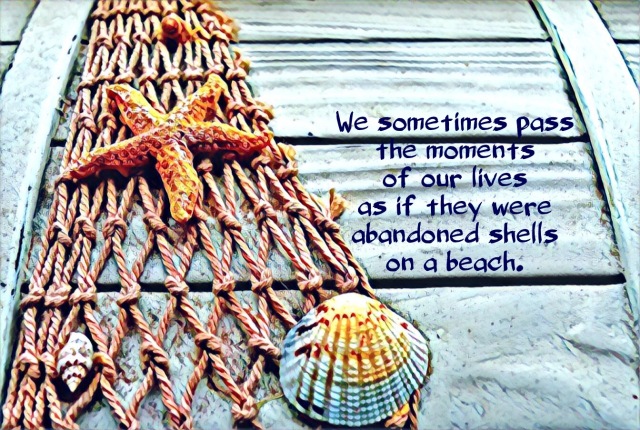
We sometimes pass by the moments of our lives as if they were abandoned shells on a beach. And yet, if coaxed open by the gentle attention of hope, each moment contains its own precious pearl, sometimes realized only after we have lost the opportunity to cherish it.
There are times in life when our jobs, our relationships, our dreams for our children, our dreams for ourselves take on the tone of those grey, abandoned shells. We get so caught up in our ordinary lives that we lose the capacity to see their inherent power and extraordinarybeauty.
As we begin the long season of “Ordinary Time”, may we be blessed by our “Sacred Ordinary”. Through the grace of attentive love and patient hope, may we find in our daily lives a Light to inspire and delight us. May we discover the Love that gave us life and waits to blossom every day in our hope – that wants to make everything better





 I Long for You
 After a Chilling Death
 Easter Exultet




 Lavish Mercy