The Lord’s Prayer

Wednesday of the Twenty-seventh Week in Ordinary Time

October 9, 2019

Click here for today’s reading

(Some of you may recognize this reflection as a “recycle”, but I think it may be worth another read.)
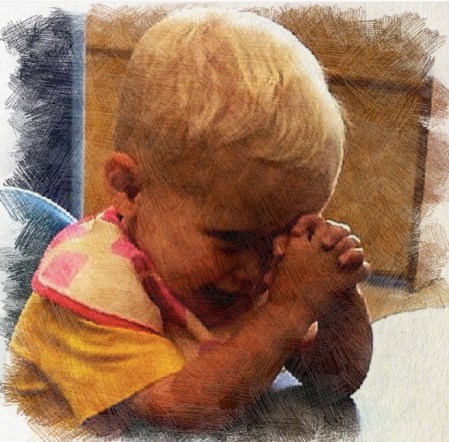
Ollie praying

Today, in Mercy,  Jesus teaches his disciples how to pray. His prayer is simple and direct, like talking to your Dad over a morning cup of coffee.

What about us? How do we pray?

Our first learned prayers are a lot like Jesus’s simple Our Father. We praise God, giving thanks, and asking for what we need.

Then we grow up and get sophisticated. We may begin to “say” or read prayers rather than use our own words. While such a practice can deepen our understanding of prayer, it places a layer between us and our conversation with God.

Sometimes others lead our prayer in the community of faith. This too can enrich us as we are inspired by a shared faith. But it is a little like trying to have a private conversation in an elevator.

Just as Jesus often went off in solitude to pray, this kind of prayer is our most intimate time with God – a time when God allows us to know God and ourselves in a deeper way. This sacred time alone with God may be spent in words, song, or the silence that speaks beyond words.

It is a time to be with the Beloved as we would our dearest, most faithful companion. We rest in the field of our experiences, letting them flow over God’s heart in tenderness. We listen with the ear of absolute trust to the secrets God tells us in the quiet.

Pray Always

Tuesday of the Twenty-seventh Week in Ordinary Time

October 8, 2019

Click here for today’s readings

Today, in Mercy, our readings suggest that there are many different ways to pray – to acknowledge and respond to God’s Presence in our lives, to deepen in relationship with God.

png-divider-lines--1400

Jonah has just finished his prayer of thanksgiving for deliverance from the chaos. This prayer is transformative. Jonah is different – open to God’s call – after it. The Ninivites, after hearing only one day of Jonah’s preaching, respond by acts of fasting and mortification . Their king, when he hears of their actions, himself formalizes a drastic national atonement. The repentant prayer of the Ninivite Kingdom is also transformative. They turn from their evil ways and open their hearts to God’s sovereignty.

png-divider-lines--1400

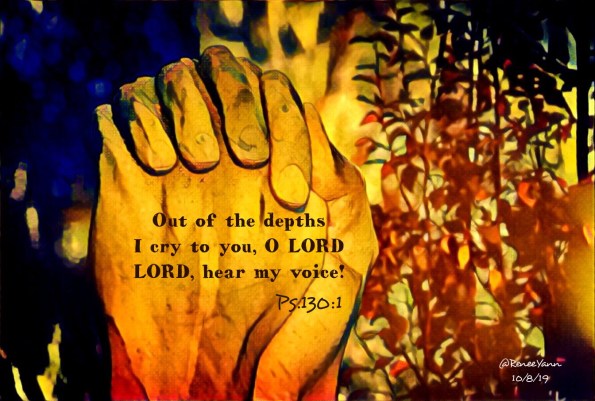
ps130_1 lament

Our Responsorial Psalm 130, a treasured and classic song of lament, shows us the transformative power of this kind of prayer. The one praying from the depths of her heart:

  • names her suffering
  • weeps with God because of it
  • begs deliverance
  • in the begging, relinquishes the outcome to God
  • receives peace in the relinquishment
  • is transformed by that peace and offers praise

png-divider-lines--1400

Our Gospel offers us another classic example of types of prayer, that of contemplation and that of service. In the story, Mary is affirmed for her singular attention to the presence of Christ – her contemplative prayer. Martha, on the other hand, pays attention to Christ by her service. Some have interpreted Martha’s as a lesser form of prayer. However, Macrina Weirdekehr, in her new book “The Flowing Grace of Now”, gives us this powerful insight into Martha’s prayer:

“Mary’s listening annoys Martha, who is busy serving. Yet if the full truth be known, Martha was also sitting at the feet of the teacher. She is sitting at the feet of service. Later, after dinner was served, with Jesus gone and Mary retired for the evening, I envision Martha finally sitting down by herself, and listening to the experience of the evening. As she reviewed the evening and her lament in the midst of her service, perhaps she began to realize that all of this was part of the wisdom offered by the school of life. We learn by contemplating our daily struggles.”


(I so highly recommend this deeply beautiful book available from:

Click here to go to Ave Maria Press or

Click here to go to Amazon


Today, we might consider our many ways to talk with and be with God, to give time and awareness to this all-encompassing relationship in our lives.

Music: Lord, I Need You – Matt Maher 


Transparent Prayer

Memorial of Our Lady of the Rosary

Monday, October 7, 2019

Click here for today’s readings

Today, in Mercy, our first reading is from the Book of Jonah, a drama with which we are all familiar.  Because of the fantastical nature of the tale, we may tend to read it simply on the level of allegory – the way we might read Aesop’s fables. But there is much spiritual depth to be found in this well-known story.

As I pray with the Jonah passages for these three days, I am using an article by Walter Bruggemann to inform my prayer.

You can access Bruggemann’s article here

Since today is the feast of the Holy Rosary, a prayer which has blessed the Church for centuries, Bruggemann’s consideration of Jonah’s prayer caught my attention:

The complexity of (Jonah’s) prayer is reflective of the complexity of all prayer.  Prayer purports to be single-minded in its communication with Yahweh.  Everyone who prays is complex, given to deception, distortion, and willfulness; our prayers are most often thick with mixed motives, distortions, and exhibits, even if only to the self.  There are “saints” who are more mature and more disciplined than this in their prayer.  But evidently Jonah is not among those mature, disciplined saints.  For that reason his compromising and manipulative maneuvers are highly visible in the prayer.  We may spot such maneuvers in his prayer and be driven to reflect on our own acts of seduction in prayer whereby we deceive ourselves, even if God is not deceived.

The Rosary, intended as a contemplation not a recitation, allows us the silence and time to sort out the complexities of our own prayer. It is a prayer not to be rushed. Praying it well requires us to lay aside our busy existence and excuses, and to place ourselves in the stillness of Divine Transparency.

rosary

The Rosary invites us to enter more deeply into the truth of Christ’s life, but also into our own. Seen in the light of Mary’s and Jesus’s lives, what is our own life teaching us?

So many of us have a Rosary in our drawer or purse that we haven’t touched for a while. Many of these beads were given to us by, or belonged to, someone who loved us – who wished us the blessings that come from its devotion. Perhaps we might like to rekindle our love for the Rosary today while remembering that beloved person. In the drawer beside my bed, my Dad’s well worn rosary is waiting for me.

Music: Ave Maria – Bach, sung by Jessye Norman

Walk in Him

Tuesday of the Twenty-third Week in Ordinary Time

September 10, 2019

Click here for readings

Today in Mercy, Beloveds, our first reading allowed the reflection to almost write itself. Savor the sweet words. They are all we need today.

Col2_6 Walk

Walk in Him.

Trust in Him.

Hope in Him.

Delight in Him.

Risk in Him.

Act in Him.

Love in Him.

Rest in Him.

Believe in Him.

Walk in Him. (Hold hands.)

Music: Just a Closer Walk with Thee – anonymous composition from the 1800s, sung here by the great Patsy Cline and the inimitable Willie Nelson
Lyrics below

1 I am weak but Thou art strong;
Jesus, keep me from all wrong;
I’ll be satisfied as long
As I walk, let me walk close to Thee.

Refrain:
Just a closer walk with Thee,
Grant it, Jesus, is my plea,
Daily walking close to Thee,
Let it be, dear Lord, let it be.

2 Thro’ this world of toil and snares,
If I falter, Lord, who cares?
Who with me my burden shares?
None but Thee, dear Lord, none but Thee. [Refrain]

3 When my feeble life is o’er,
Time for me will be no more;
Guide me gently, safely o’er
To Thy kingdom shore, to Thy shore. [Refrain]

Big Prayers

Thursday of the Twenty-second Week in Ordinary Time

September 5, 2019

Click here for readings

Today, in Mercy, Jesus and Paul teach us how to pray for one another.

I like to call it “gifting prayer” because it is, indeed, a generous offering we give to others.


Little Prayers

little prayers

I sometimes pray for simple things – that a family member wins the lottery, or it doesn’t rain on a friend’s wedding.

And I pray for consequential things – improved health for a neighbor, safety for travelers, deliverance from disaster.

These prayers are rooted in the wish for material improvement. But there is a deeper kind of prayer that we can offer.


The Big Prayer

Gifting Prayer is a wide halo of love and hope we generate
by our desire for someone else’s eternal good – for their holiness.

This kind of prayer is much bigger than the small prayers we say for others. 

Paul describes what such prayer should ask for – that our beloved:

  • be filled with the knowledge of God’s will
  • gain all spiritual wisdom and understanding
  • walk in a manner worthy of the Lord
  • be fully pleasing, in every good work 
  • bear fruit and grow in the knowledge of God,
  • be strengthened with all endurance and patience,
  • and give thanks, with joy, to the Father for the gift of faith

Now THAT’S a prayer!


Gospel Clues

Jesus, in today’s Gospel, gives us a clue about how to pray such a prayer. He says that it’s kind of like catching fish. The Gospel fishermen have labored all night with no results. Sometimes our prayer feels like that, doesn’t it?

Lk5_4 nets

Jesus says no matter. Keep on fishing – keep on praying. Shift perspective a little bit “to the other side of the boat” – to God’s way of seeing good for those we pray for.

Ask for God to do what God deems best. This attitude in prayer opens us to divine possibilities. It hopefully brings unimagined resolutions to those we pray for.

Put out into deep water and lower your nets for a catch…
…When they had done this, they caught so great a number of fish
that their nets were bursting.

Let God burst the tight net by which we might define our prayer. Let’s be amazed by all that God desires to give us beyond our small wishes.

Music: Trust His Heart – Babbie Mason

Faithful Monica

Memorial of Saint Monica

Tuesday, August 27, 2019

Click here for readings

Today, in Mercy, we celebrate St. Monica, mother of St. Augustine of Hippo.

Monica
Santa Monica e Sant’Agostino by Giuseppe Riva (This work is in the public domain n its country of origin and other countries and areas where the copyright is the author’s life plus 100 years or less.)

Monica had a difficult life, burdened by an autocratic pagan husband. She was forbidden to have her children baptized. Augustine worried her deeply because he developed into a wayward and lazy young man. Eventually he was wooed by the Manichaean heresy which denied Christ as God. This was too much for Monica. She asked him to leave her house.

But Monica continued for seventeen years to pray for and encourage Augustine to return to a faithful, moral life. Finally through the influence of St. Ambrose, Augustine was converted.

How many mothers and fathers, friends and spouses have prayed like this for someone they love? How many of us have had a “lost sheep” right in the center of our family but beyond its touch?

Monica’s great love and faithful devotion to her son are reminiscent of Paul’s love for his Thessalonian flock:

… we were gentle among you,
as a nursing mother cares for her children.
With such affection for you, we were determined to share with you
not only the Gospel of God, but our very selves as well,
so dearly beloved had you become to us.

This is the way God loves us and draws us to himself. It is the way that we, who carry God’s love in the world, must be with one another.

Our Gospel gives us another example of how disgusted Jesus is with those who pretend the “exteriors” of faith but on the inside are “blind hypocrites… full of plunder and self-indulgence”.

Instead, we need a faith like Monica’s, humble and generous but at the same time tenacious and persevering in seeking good.

Music: Give Me the Faith Which Can Remove – written by Charles Wesley, younger brother of John Wesley, founder of Methodism

God’s Thank You Note

Monday of the Twenty-first Week in Ordinary Time

August 26, 2019

Click here for readings

Today, in Mercy, we begin eight days of Thessalonians, coupled with the final section of Matthew’s Gospel before the Passion, Death and Resurrection narrative.

First Thessalonians is a love note, a thank you note. In it, Paul speaks to the community with great affection and gratitude because they have caught fire with the Gospel he shared with them.

Paul’s words carry the loving, grateful voice of God to us who also try, with all our hearts, to give ourselves to the Gospel.

1 Thes 1:5 Thank You

In today’s Gospel, Matthew gives us the sad counterpoint to Paul’s joy. Jesus thunders woe over the Pharisees who, unlike the Thessalonians, smother the ardent message he offers them.

They bind. They control. They peddle a religion rooted in parsimonious law rather than generous freedom. They promote a system that sustains their privilege.

Jesus tells us that Pharisaical religion sucks the soul from people, binding them in a self-serving, spiritless law – where power and material prosperity supersede truth, loving community, and sincere worship.

In Paul’s words, God blesses and thanks us for our true faith which – by generosity, hope, love, sacrifice and hopeful endurance – builds the Community of God.

Throughout history, some people have used the scripture to justify the kind of pharisaical selfishness bewailed in today’s Gospel. They isolate and demonize other human beings by the deceitful turning of the holy Word. They are clever and convincing. They appeal to our rationality rather than our souls.

Today’s readings remind us to take great care in discerning the Spirit. We will never find Her where there is no love, mercy, kindness, freedom, forgiveness, and joy.

Music: one of my favorite hymns. Though from Ephesians, it carries the same message as our reading from Thessalonians today. I pray this prayer for all of you, dear friends.

Ephesians 1 – by Suzanne Toolan, RSM


Blessed be the God and Father of our Lord Jesus Christ.
In him we were chosen to live through love in his light.
That is why I never cease to give thanks to God for you.
And pray that the God of our Lord Jesus Christ
will grant you the Spirit of wisdom
and knowledge of himself
that you may  glory, glory in his goodness.

Marking the Hours

Friday of the Seventeenth Week in Ordinary Time

August 2, 2019

Click here for readings

Today, in Mercy, we begin a few days of reading Leviticus. The reading today provides a long list of when and how the community should gather to worship. It is a lexicon on how to honor the sacred presence in their lives. Such honoring includes aspects of celebration, decoration, sharing, remembering and hoping together.

Lv23_37 hoursJPG

While the particular enjoinments detailed in Leviticus might not pertain to us, their spirit does. It is a spirit that encourages us to cherish the gift of time – moments, days, years – as precious opportunities to encounter God.

Down through the ages, people seeking holiness have used various, ritualized practices to remember and honor God’s omnipresence in their lives. They include morning and nighttime prayers, Grace before Meals, the Blessing of the Hour, the Angelus at noontime, the great liturgical practices of Advent and Lent, and the Divine Office. Each of these spiritual practices helps us to be more intentional about the true meaning and purpose of our daily life. 

Macrina Wiederkehr, a Benedictan monastic, has published a beautiful book to help people mark the hours of their day. She says this in Seven Sacred Pauses:


When I speak of “the hours” I am referring to those times of the day that the earth’s turning offers us: midnight, dawn, midmorning, noon, midafternoon, evening, and night. Although every hour is sacred, these special times have been hallowed by centuries of devotion and prayer…..

The daily and nightly dance of the hours is a universal way of honoring the earth’s turning as well as the sacred mysteries that flow out of our Christian heritage.


I think this is exactly what our Leviticus passage is doing as well. Our time is so precious and it flows so quickly! What a tragedy if we fail to stop and realize that it is the holy river on which we are meant to float to God!

robson-hatsukami-morgan-454S_xB0ReA-unsplash
Photo by Robson Hatsukami Morgan on Unsplash

Music: Teach Us to Number Our Days – Marty Goetz

Ask and Receive

Seventeenth Sunday in Ordinary Time

July 28, 2019

Click here for readings

Today, in Mercy, our readings are connected by two often oppositional themes: BARGAINING and TRUST.

The Genesis passage is a familiar story, mainly because “Mrs. Lot” later gets turned into a pillar of salt. But the beginning of the story, today’s reading, is all about Moses bargaining with God to spare the inhabitants of sinful Sodom and Gomorrah. 

The Divine conversation is painted in very human terms, a ping-pong match of “what if”s and “OK”s between Moses and God. Moses finally bargains God down to the hope of finding just ten good men in these depraved cities. And Moses trusts God to be merciful, a trust delivered in the salvation of Lot and his family.

In the second reading from Colossians, Paul reminds us of our own deliverance through baptism and sharing in the Resurrection of Christ. This is the infinite gift in which we put our hope and trust as believers.

Our Gospel reading from Luke opens with the Our Father, the ultimate prayer of trust. Jesus goes on to tell us that we can always trust God’s care for us.

Ask and you will receive;
seek and you will find;
knock and the door will be opened to you.
For everyone who asks, receives;

and the one who seeks, finds;
and to the one who knocks, the door will be opened.

Jesus isn’t talking about magic, where we just say the word and automatically get what we imagined, or where we bargain with God as if we had something to offer. 

Lk11_12 Ask_Egg

Jesus is talking about that fundamental trust which believes in God’s faithfulness to us in all circumstances. He will not “hand us a serpent when we ask for an egg”. But it may be a very different “egg” (outcome) from the one we expected. Trust allows us to crack it open to find the unimagined grace inside.

Music: I Will Trust in You – Lauren Daigle

Vigil

Saturday of the Fifteenth Week in Ordinary Time

July 20, 2019

Click here for readings

Today, in Mercy, we keep vigil with the “Children of Israel” as they begin the great Exodus.

Ex12_42 Vigil

Even the youngest of us understands what it means to “keep vigil”. Toddlers, on Christmas Eve, keep vigil for the sound of Santa’s footsteps on the roof.

Throughout our lives, the kinds of vigils we keep deepen in meaning. Any given night holds an array of vigil-keepers:

  • A nervous student pulls an all-nighter before a big exam.
  • An anxious parent watches over a feverish child.
  • A faith-filled soul sits in pre-dawn prayer.
  • A vigilant elder prays quietly at the death bed of a long-beloved.

As families and communities, we wait together for each other’s lives.

  • Together, we expect the births of each generation’s babies.
  • We wait and hope for college acceptances and new jobs.
  • We wait for test results of all kinds.
  • We wait to listen to one another’s stories of success or disappointment.
  • We wait and prepare for the dawning of great feasts like Christmas and Easter

When we keep vigil, we live in expectation of something or someone coming to us. But there is another important aspect to every vigil.

As we wait, something is also happening within us.
In the deep quiet of our waiting, we are transformed.

Thomas Merton, monk of Gethsemane, was assigned to keep a particular type of vigil at the abbey. It was called “fire watch”, a night-long lookout to ensure that no fire erupted in the old wooden buildings as the other monks slept.  Merton writes about that watch at the end of his book The Sign of Jonas:

The fire watch is an examination of conscience in which your task as watchman suddenly appears in its true light:  a pretext devised by God to isolate you, and to search your soul with lamps and questions, in the heart of darkness.
“Fire Watch, July 4, 1952”

Today, as we pray with Israel’s Passover vigil, let us consider our own vigils – current or past. Beyond their apparent meaning, to what secret transformation might God be inviting us? What is happening deep in our soul as we watch far out to the horizon of our hope?

Music: Firewatch – Chris Remo