Today, in Mercy, our readings are filled with God’s glory and blessings. The magnificent passage from Ephesians is considered an example of the great Pauline Hymns. These are places in Paul’s writing where he breaks into lyrical songs of praise and thanksgiving, so overwhelmed is he by the goodness of God.
Have you ever felt like that – just so grateful to God for the blessings of your life? So blessed to wake up in the morning, with the capacity to believe, to hope, and to love!
A practice I learned many years ago has helped me focus on this kind of prayerful gratitude. As soon as I realize I am awake in the morning (and sometimes that takes a while😀), I say this simple prayer:
Thank you, God, for my life.
On a special morning, I might pause and expand that prayer quite a bit. But every day, I start with at least that brief phrase.
Savor St. Paul’s eloquence in his hymn of praise today. Let your heart recognize God’s goodness and sing even a silent, personal Thank You.
Blessed be the God and Father of our Lord Jesus Christ, who has blessed us in Christ with every spiritual blessing in the heavens. Ephesians 1:3
Music: Ephesians Hymn ~ Suzanne Toolan, RSM, who is Sister of Mercy at Mercy Center in Burlingame, CA. She has mentored many people in centering prayer in retreats and in prisons. She is prolific composer of liturgical music, including the iconic hymn, “I Am the Bread of Life”. Suzanne recently celebrated her 90th birthday.
Today, in Mercy, on this feast of St. Benedict, we pray with the words of Psalm 105:
Seek always the face of the Lord.
One of the fundamental questions a spiritual director might ask us when we share our life experiences is this: “Where is God in this for you?” It is a steadying question which we can ask ourselves as we try to navigate our life challenges.
We can trust that God is somewhere in every situation, either encouraging us to go forward or to retreat — in either case, calling us toward the Divine and Loving Will. As we deepen in our habits of prayer, grateful quiet, and merciful practice, we begin to see God more clearly in everything.
St. Benedict prayed for this kind of vision. May we share in his prayer.
“Almighty God, give me wisdom to perceive You, intelligence to understand You, diligence to seek You, patience to wait for You, eyes to behold You, a heart to meditate upon You and life to proclaim You, through the power of the Spirit of our Lord Jesus Christ. Amen.”
Music: I Can See – Steve Green
This song shares the experience of the Emmaus disciples as their eyes were opened and the saw Jesus walking with them along their life’s road.
Today, in Mercy, Jesus cures a demoniac who is mute.
In Jesus’ time, the connection between ordinary disease and demonical possession was quickly drawn – perhaps too quickly. As we read some of the Gospel cures, our modern understanding recognizes epilepsy, glaucoma, cataracts and mental illness in the people Jesus touched and healed. But two thousand years ago, these conditions were assigned to demons.
This doesn’t mean demons don’t exist. Remember the Gerasene miracle where Jesus cast demons into pigs who then threw themselves into the sea? Dramatic evidence that demons are real!
Demons are real in our world too, embodiments of the evil that is always competing for control of Creation, that is always resisting the supremacy of Goodness and Love.
These demons masquerade in various costumes of power, prestige and pleasure. But they are all eventually exposed as addictive, self-consuming and destructive.
How dangerous and deceptive these demons are! The word itself comes from the same Greek root as the word “genius”. And they do have a genius for rendering us:
blind to narcissistic motivations
crazed with exaggerated self-importance
crippled by deceptive rhetoric
mute in the face of systemic evil
deaf to the cries of the suffering
dead to the power of transforming Mercy in our own souls
Even as you read this list, faces and moments of history and current events are flashing before your eyes. Circumstances in your own life, family and work suggest themselves. Bring these to your transforming prayer today. The touch of Jesus can deliver us from such demons. We pray for that touch in our own hearts and in our world.
Today, in Mercy,our readings are harsh. We don’t want to think about our sinfulness, do we? We’re doing the best we can. Right?
Well, maybe not.
Our Old Testament brethren thought they were doing fine, too. But today’s reading from Amos lashes out at the societal sins of Israel: slavery, prostitution, systemic oppression of the poor, obstinate immorality, and idolatry. Beloved Israel – the nation that God had delivered from Egypt – had lost its way!
The prophet Amos demands that the people look in a mirror to see what they have become. He tells them that they are not doing OK, that they are a selfish mess, that they face the crushing wrath of God!
Today’s psalm reinforces the dire warning:
~ You use religion to justify your misdeeds ~ You deal with thieves and adulterers ~ You lie and provoke violence by your words ~ You slander and spread rumors in order to keep power over others Remember this, you who never think of God!
Sounds kind of familiar, maybe? Describes our 21st century reality too, doesn’t it?
Many of us read these passages and think, “Thank God I’m not doing any of this terrible stuff!” But that’s not enough. What we must ask ourselves is how we passively contribute to any of these societal sins by a myopic faith, plastic morality, prejudiced politics, and unexamined cultural choices.
Do we approve, or at least stay silent, when religion is used to ostracize people? When political power crushes the rights of those we disagree with? When our entertainment relies on violence and dehumanization of people?
It is painful and difficult to do this deep examination of conscience. We might all find ourselves complicit, in some way, with the evils we hate and fear.
Let the closing words of today’s psalm encourage us:
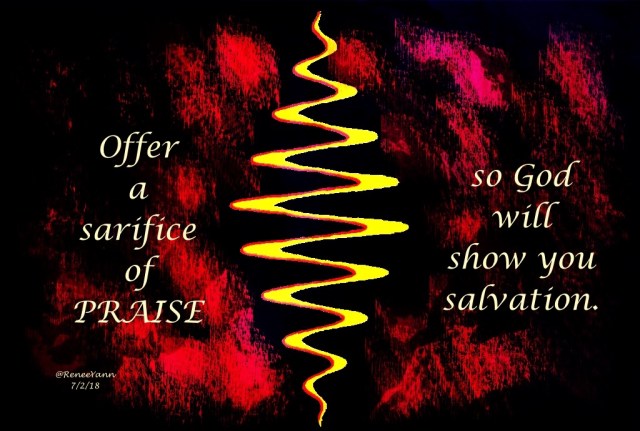
“Consider this, you who forget God, lest I rend you and there be no one to rescue you. The one who offers a sacrifice of praise glorifies me; and to the one that goes the right way I will show the salvation of God.”
Music: Sacrifice of Praise ~ Alvin Slaughter
Lord I lift a song of worship
For Your glory and Your grace
Let my heart reveal all my words fail to say
Lord receive this sacrifice of praise
On the mountain in the valley
As I wait in my secret place
I will trust trust in the name of the Lord
Now receive this sacrifice of praise
Now receive this sacrifice of praise
You’re my shield. You’re my shelter
From the storm and from the rain
Cover me beneath the shadow of Your wings
Lord receive this sacrifice of praise
Hallelujah hallelujah
Hallelujah to Your name
For all You’ve done
You are and evermore will be
Lord receive this sacrifice of praise
Lord receive this sacrifice of praise
Lord receive this sacrifice of praise
Today, in Mercy, our readings tell the story of the woman with the hemorrhage, and the little girl raised to life. I wrote the following homily about this passage for the Catholic Health association in 2015. I hope you find it worth reading.
For more inspiring prayer and scripture resources from CHA, please see:
Healing of the Daughter of Jairus and the Woman with a Hemorrhage
It is a soft, summer morning in Capernaum and Jesus is in the height of his ministry. Large crowds follow him wherever he goes, crowds hungry with hope; crowds fired by his counter-cultural words and miraculous deeds. This morning, Jesus prepares to speak to them, to translate into language they can comprehend the Eternal Life that lives in his heart. His back is to the gentle, sunlit sea. The hubbub softens to a murmur, finally stilled by the lapping waves.
But before Jesus can begin, a distressed man bursts through the gathered crowd. His robes fly about him as he runs to Jesus and falls at his feet. This man is important, so important that we all have known his name for two thousand years. This is Jairus who lives nearby and organizes the worship in the synagogue. Now breathless and swallowing sobs, Jairus pleads with Jesus: Please! My daughter! You can give her life!
Every loving father has been Jairus at least once in his life. We know these fathers. We are these fathers. They are the ones who burst into emergency rooms with a seizing infant in their arms. They are the ones who stare blankly at the pronouncement of a stillborn child. They are the old men in war-ravaged countries who kneel at the sides of their fallen sons and desecrated daughters. They are all the men throughout history rendered helpless by the forces of unbridled power, greed and death.
The merciful heart of Jesus understands this man and his desperate urgency. Without even a word, Jesus gets up and accompanies Jairus to the place of his pleading.
But there is another urgency pushing forward from the crowds: a woman, apparently of low importance for we have never known her name. She is a woman whom the ages have defined by her affliction. She is “The Woman with the Hemorrhage”. Without the status of Jairus, she approaches Jesus as such a woman must. She crawls behind him at his heels, reaching through the milling masses to even scrape the hem of his garment.
This is a troubled woman, a stigmatized woman. Her life has been spent, literally, in embarrassment, isolation, fatigue and, no doubt, abuse. For twelve years – coincidentally the life span of Jairus’ s daughter – her vitality has bled out of her. Her face is gaunt; her eyes sunken. Her soul’s light is all but extinguished. She is a woman who knows a particular kind of scorn.
We know these women. We are these women. They are the ones filled with remorse for an aborted baby. They are the ones who miscarry their longed-for child. They are the women whose beautiful young sons are profiled, stereotyped and hunted on the violent streets. They are the mothers of “The Disappeared”. They are the women who suffer disproportionately from war, poverty, hunger and violence. They are trafficked women, prostituted women, women victimized by the long saga of domination. They are the women whose children have been torn from them at the borders.
It is just such a broken woman who stretches her fingers through the Galilean dust in a last reckless reach for healing. She finds only the hem of his robe. Touching it, she is transformed, like a parched meadow in the spring rain. Her whole being reaches up to receive the holy restoration. She knows herself to be healed. And it is enough; it is everything. She retreats into the resignation of her otherwise lonely life.
But Jesus wants more for us than just the practical miracles we beg for. We ask for one healing; Jesus wants our eternal salvation. We ask for one blessing; Jesus wants our entire lives to be filled with grace. We ask for one prayer to be answered; Jesus wants our life to become a prayer.
Jesus feels the electrical touch of her hope. He feels the secret healing she has extracted from him. He turns to seek her. Can you see their eyes meet? Yes, the bleeding has been stemmed, but he sees the deeper wounds that scar her soul. His look of immense mercy invites her to tell him “the whole truth”. By her touch, she has commandeered a physical healing. But by his gracious turning toward her, her entire being is renewed. In this sacred glance, her history has been healed. Her future has been pulled from darkness into light. Her capacity to love has been rekindled. She now and forever will remember herself as a child of God.
Jairus waits, no doubt impatiently, at the edge of this miracle, anxious for such power to touch his daughter’s life. He fears they have lingered too long with the woman. His servants arrive, confirming his fears. He receives the dreaded report, “Your daughter has died.”
Jesus now pushes Jairus to the gauntlet of pure faith. In the face of this devastating news, Jesus tells him, “Do not be afraid; just have faith.” Is this not an almost impossible command? Like Jairus, we all know what it is to worry for our children:
Fathers of color teach their sons behaviors to protect them from profiling.
Immigrant parents fear their children will be ripped from them in a pre-dawn raid.
Famine-ravaged mothers watch their children disappear into hunger.
In hospitals and doctors’ offices, devastated parents summon the courage to accompany their critically ill child.
And Jesus says, “Don’t be afraid. Have faith.”! What can he possibly mean?
Perhaps it is this simple. In Jairus’s home, Jesus takes the dead girl’s hand. He says, “Talitha, koum – Little girl, arise.” His call to her heart tells her there is no darkness, devastation or death from which God cannot draw us into life. This is the truth Jesus brings to the little girl and to us. But it is a truth that, in our fear and need, we cannot always see.
For the moment, this girl lives. But at some time in history she, like all of us, will die. So the miracle is not the restoration of her life. The miracle is that her eyes, and her parents’ eyes, are opened to the power of God over death. Despite all appearances, God’s life endures eternally.
This is the revelation of this Gospel passage. If we live by faith, we live beyond cure into healing. If we live by faith, even death can bring life. If we live by faith, we are free to release all worry into the abundant mercy of God who grants us healing even beyond our asking or desire.
Man or woman, old or young, at some time in our lives each one of us has been Jairus. Each one of us has been one or the other of these two women. Within their stories of woundedness and deep faith, our stories shelter. Jairus and the afflicted women – unnamed like so many women throughout time – believed there was a way to new life. They reached for it. They begged for it. What is it in us that cries out for such healing? What is it in us that, without the touch of Jesus, teeters on the verge of death?
Simply by believing, these three Gospel figures became new beings. Simply by believing, their orientation changed from darkness to light. By their example, let us lift up those wounded and deadened places in our hearts and world before the loving gaze of Jesus.
To what suffering in our souls is God whispering the encouragement, “Talitha, koum”? What is the “whole truth” Jesus is inviting us to confide? Let us arise and respond to him in the full energy of our faith. Let us gaze with boundless confidence into the eyes of God’s mercy.
Today, in Mercy, our Gospel reading leaves us with a question: are God and I really friends? Are we more than vague acquaintances who might pass by each other on a Sunday morning, maybe even wave from a distance?
Jesus talks about such people in today’s Gospel. They used God’s name a lot. They claimed that God supported their words and actions. But their actions were rooted in themselves not in the Word. Their faith was a pretense to justify their own agendas.
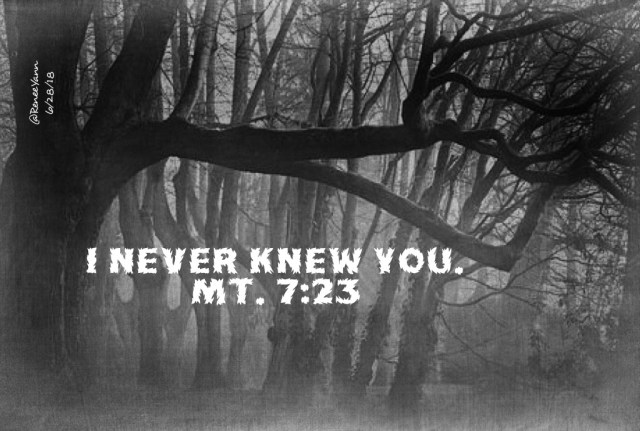
We human beings are very clever. We can take a scripture snippet and twist and turn it to our own designs. We can bastardize the Word of God to make it vindicate our prejudices. But Jesus says that if we do this, we will hear these dreaded words when we meet Him in eternity:
I never knew you.
How terrible that would be! Let the thought of it inspire us to open our hearts and souls to the deep truth of the Gospel. May that truth convert any selfishness and sinfulness in us into mercy and justice. May it turn our gaze from ourselves toward God and God’s dear Creation.
It is a continual transformation, but God is waiting, lovingly, to lead us.
Music: Lord, You have Searched Me and Known Me ~ Bernadette Farrell
Today, in Mercy, Jesus tells us how to pray and do good. He says that it is our deep-hearted intention that matters in these things. It is there, in the hidden heart, that God dwells with us and reads our love for its sincerity.
God is not impressed with any bling in our words or actions. Not impressed with the big, loud, or wow of what we do. God knows whether we truly love, and it is that which touches Him.
Let the words of Jesus today take you to that inner heart-room where God knows and loves you like no one else can. In that precious quiet, enter the silence of prayer. Listen to God with the soul’s ear that needs no sound. Speak to God with the humble love that needs no words.
Music: Yo Yo Ma playing Meditation from Thaïs by Jules Massenet
Today, in Mercy, we celebrate the Solemnity of the Most Sacred Heart of Jesus.We are blessed with several powerful and profound readings, including the final moments on Calvary.
The second reading offers an example of Paul’s magnificent benedictions and doxologies. As he prays for the Ephesians, so he prays for us. These prayers are exalted, yet simple. They thrill the soul who prays them. They place us, in awe and thanksgiving, fully in the divinely generous, Sweet Heart of Christ.
Let yourself be there, allowing God to love and bless you, as you pray these words:
For this reason I kneel before the Father,
from whom every family in heaven and on earth is named,
that he may grant you in accord with the riches of his glory
to be strengthened with power through his Spirit in the inner self,
and that Christ may dwell in your hearts through faith;
that you, rooted and grounded in love,
may have strength to comprehend with all the holy ones
what is the breadth and length and height and depth,
and to know the love of Christ which surpasses all knowledge,
so that you may be filled with all the fullness of God.
Music: Two offerings today. The first captures Ephesians Prayer. The second harkens back to my childhood — and maybe to yours. (I couldn’t resist the lovely nostalgia!)
Today, in Mercy, we have the first of a few readings from Timothy, Paul’s beloved protégé in the faith.Timothy had the blessing of not only Paul’s mentorship, but also of his own mother and grandmother who were devout Christian converts.
Rembrandt’s Timothy and Lois
Today, we might give thanks for all those who have nurtured us in faith and love. We might also consider those who depend on us for the example and encouragement which leads them closer to God and to their best selves.
We might also pray for those desperate families and children seeking refuge at the US border. They also belong to us in Christ. May our prayer and advocacy help them to avoid harm.
It is our duty, in gratitude and mercy, to keep all these beloveds in our constant prayer, as Paul did Timothy in today’s tender reading.
Music: The Prayer
I pray you’ll be our eyes
And watch us where we go
And help us to be wise
In times when we don’t know
Let this be our prayer
When we lose our way
Lead us to a place
Guide us with your grace
To a place where we’ll be safe.
I pray we’ll find your light
And hold it in our hearts
When stars go out each night
Remind us where you are.
Let this be our prayer
When shadows fill our day
Lead us to a place
Guide us with your grace
To a place where we’ll be safe.
A world where pain and
sorrow will be ended
And every heart that’s
broken will be mended
And we’ll remember we
are all God’s children
Reaching out to touch you
Reaching to the sky.
We ask that life be kind
And watch us from above
We hope each soul will find
Another soul to love.
Let this be our prayer
Just like every child.
Needs to find a place
Guide us with your grace.
Give us faith so we’ll be safe
Today, in Mercy, we remember St. Boniface, the great Apostle of Germany, and considered one of Europe’s founders. A quote from his extensive writings says: “What we ourselves cannot bear, let us bear with the help of Christ.”
Today’s psalm carries a similar sentiment:
“In every age, O Lord,
you have been our refuge.”
This prayer offers us at least two considerations for our meditation:
Consider how faithful God has been to you throughout your “generations “, and to the many generations of your family on whose shoulders you stand.
What is it, at this age in your life, for which you most need God’s help and “refuge”?
In your prayer, let yourself rest against God’s love and strength, as you would rest against a sturdy rock. Imagine that the afternoon sun has warmed a crevice in that rock, just your size, and waiting to embrace you. When you leave it at the end of your prayer, leave all your worries, fears and anxieties with it – trusting them to God’s kindness and power.








 Lavish Mercy