Unrecognized Abundance

Memorial of Saint Scholastica, Virgin
Saturday of the Fifth Week in Ordinary Time
February 10, 2024

Today’s Readings:

https://bible.usccb.org/bible/readings/021024.cfm


Today, in God’s Lavish Mercy, we finish with the Book of Kings. And, as several of my readers have told me, they’ll be glad for it. There may have been points in our journey through Samuel and Kings, when you thought, “WHY am I even reading this! Who cares about Rehoboam, Jeroboam or any other “boams”!

I understand, but here are two of my “WHY”s:

The Hebrew Scriptures show us how human beings deepened, over thousands of years, in their understanding of God. Throughout that extended deepening, God remains unchangingly faithful. Even though the cultural context of some Old Testament stories may upset, befuddle, or offend us, they still express the human attempt to find God in one's experience.
The Hebrew Scriptures inform and underlie the theology of the Christian Scriptures, and the culture in which Jesus lived and taught. Like a butterfly is the fulfillment of the chrysalis, Jesus was the fulfillment of the Promise to Abraham. Without an appreciation of that Promise, and how Israel lived out its long realization, our comprehension of Christ's meaning is limited.
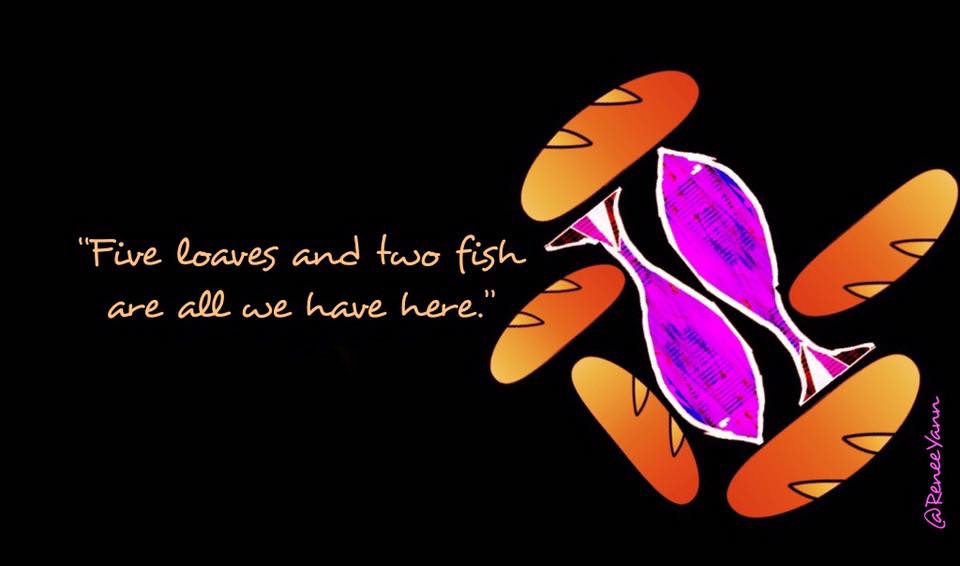
Our Gospel today gives us the familiar story of the feeding of the multitude. Mark describes a large crowd engaged in the search for God. They follow Jesus for three days, listening, learning, and being amazed at his miracles. They are so hungry to find something to believe in that they forget to feed their human hungers!

I love the compassionate way Jesus takes notice of their predicament:

“My heart is moved with pity for the crowd,
because they have been with me now for three days
and have nothing to eat.
If I send them away hungry to their homes,
they will collapse on the way,
and some of them have come a great distance.”


In this pivotal miracle, Jesus teaches a core lesson of faith.

In Christ, we are given the gift of full and abundant life. Our hearts then must become like his, moved in mercy toward those who are still hungry, both spiritually and physically.

The miracle of the loaves and fishes calls the faithful community to the practice of shared abundance. It invites us to notice the hungers around us and within our world. It moves us to understand the distances people experience from love, inclusion, respect, security, and peace. It convinces us that the need to have more and more will only yield less and less for our spirits.


Our culture works to convince us that we can never work hard enough or accumulate enough. It deludes us to believe that we matter because of what we have, not because of who we are. In this miracle, Jesus models another way to live in relationship with God, ourselves and with Creation:

Trust in and respect for the abundant generosity of God’s Creation

His disciples answered him, “Where can anyone get enough bread
to satisfy them here in this deserted place?”
Still he asked them, “How many loaves do you have?”
They replied, “Seven.”
He ordered the crowd to sit down on the ground.

Deep reverence and gratitude for God’s Presence in all life

Then, taking the seven loaves he gave thanks, broke them,
and gave them to his disciples to distribute,
and they distributed them to the crowd.
They also had a few fish.
He said the blessing over them
and ordered them distributed also.
They ate and were satisfied.

Acknowledgement of our need to replenish our spirits in rest and solitude

He dismissed the crowd and got into the boat with his disciples
and came to the region of Dalmanutha.

Somewhere in each of our lives, we might find a few loaves or minnows hidden away. Or we might be the famished one with an empty basket after a long journey. Today’s Gospel tells us to invite God’s transformative grace into our needs, hungers, inhibitions, or emptiness. Like this amazed Gospel crowd, we might be wowed at what God can do with our generous hearts!


Poetry: In the Storm – Mary Oliver

Some black ducks
were shrugged up
on the shore.
It was snowing
hard, from the east,
and the sea
was in disorder.
Then some sanderlings,
five inches long
with beaks like wire,
flew in,
snowflakes on their backs,
and settled
in a row
behind the ducks --
whose backs were also
covered with snow --
so close
they were all but touching,
they were all but under
the roof of the duck's tails,
so the wind, pretty much,
blew over them.
They stayed that way, motionless,
for maybe an hour,
then the sanderlings,
each a handful of feathers,
shifted, and were blown away
out over the water
which was still raging.
But, somehow,
they came back
and again the ducks,
like a feathered hedge,
let them
crouch there, and live.
If someone you didn't know
told you this,
as I am telling you this,
would you believe it?
Belief isn't always easy.
But this much I have learned --
if not enough else --
to live with my eyes open.
I know what everyone wants
is a miracle.
This wasn't a miracle.
Unless, of course, kindness --
as now and again
some rare person has suggested --
is a miracle.
As surely it is.

Music: Krystian Zimerman – Beethoven: Piano Concerto No. 5 in E Flat Major, Op. 73: II. Adagio un poco moto

A lovely piece to accompany our reflection on faith, miracles, and abundance.

The Soul’s Rhythm

Tuesday of the Third Week in Ordinary Time
January 23, 2024

Today’s Readings:

https://bible.usccb.org/bible/readings/012324.cfm


David danced

Today, in God’s Lavish Mercy Mercy, vigorous, grace-filled David dances with abandon before the Lord. It is a beautiful moment to imagine!

David went to bring up the ark of God from the house of Obed-edom
into the City of David amid festivities.
As soon as the bearers of the ark of the LORD had advanced six steps,
he sacrificed an ox and a fatling.
Then David, girt with a linen apron,
came dancing before the LORD with abandon,
as he and all the house of Israel were bringing up the ark of the LORD
with shouts of joy and to the sound of the horn.

2 Samuel 6: 12-15

David dances with unselfconscious joy because he has brought the Presence of God home to the heart of the community. The joy comes from recognizing that God wants to be with the People. This joy, inexpressible in words, takes the form of a dance with the Spirit of God.


Let’s pause today with that dancing image, to consider all the ways God longs to dance with us throughout our lives, and we with God — dances of both:

joy and sorrow,
faith and questioning,
hope and shadow

… dances in which we must abandon ourselves to the moment’s sacred music and respond to God’s mysterious, leading step.


Whatever the emotion we bring to prayer, what matters is only that we carry it close to God’s heart, listening to our circumstances for the Divine Heartbeat. We may not be the “Fred Astaire” or “Ginger Rodgers” of prayer, but each one of us has a holy dance somewhere in their heart.

I think our children can teach us something about this kind of uninhibited prayer – one filled with trust, hope, joy, and innocence.


Poetry: T. S. Eliot

IMG_2326


At the still point of the turning world.
Neither flesh nor fleshless;
Neither from nor towards;
at the still point, there the dance is,
But neither arrest nor movement.
And do not call it fixity,
Where past and future are gathered.
Neither movement from nor towards,
Neither ascent nor decline.
Except for the point, the still point,
There would be no dance,
~ T.S. Eliot


A second lovely poem, even though it is not Easter 🙂

IMG_2327


Easter Exultet

Shake out your qualms.
Shake up your dreams.
Deepen your roots.
Extend your branches.

Trust deep water
and head for the open,
even if your vision
shipwrecks you.

Quit your addiction
to sneer and complain.
Open a lookout.
Dance on a brink.

Run with your wildfire.
You are closer to glory
leaping an abyss
than upholstering a rut.

Not dawdling.
Not doubting.
Intrepid all the way
Walk toward clarity.

At every crossroad
Be prepared
to bump into wonder.
Only love prevails.

Enroute to disaster
insist on canticles.
Lift your ineffable
out of the mundane.

Nothing perishes;
nothing survives;
everything transforms!
Honeymoon with Big Joy!
~ James Broughton


Music: No Reason Not to Dance – Kathryn Kaye

Rise and Fall of Kings

Day of Prayer for the Legal Protection of Unborn Children
Monday of the Third Week in Ordinary Time
January 22, 2024

Today’s Readings:

https://bible.usccb.org/bible/readings/012224.cfm


Today, in God’s Lavish Mercy, our readings place us at watershed moments in the lives of David and Jesus.

All the tribes of Israel came to David in Hebron and said:
“Here we are, your bone and your flesh.
In days past, when Saul was our king, 
it was you who led the children of Israel out and brought them back.
And the LORD said to you, ‘You shall shepherd my people Israel 
and shall be commander of Israel.’”
When all the elders of Israel came to David in Hebron, 
King David made an agreement with them there before the LORD, 
and they anointed him king of Israel.

2 Samuel 5:1-4

In 2 Samuel 5, David fully assumes the kingship through the approbation of the community. The scene marks the culmination of his rise to power and “the beginning of the rest of his life”.

Through our readings in Samuel until now, we have ascended with David to the pinnacle of his life. We are about to begin weeks of moving down “the other side of the mountain”.


Scholars generally see the David narrative in two primary units, the Rise of David (I Sam. 16:1—II Sam. 5:10) and the Succession Narrative (II Sam. 9:1—20:26; I Kings 1:1—2:46). Chapters 5:11—8:18, fall between two larger units. Whereas the first presents David in his ascendancy, the second presents David in his demise and expresses pathos and ambiguity. Our chapters thus come after the raw vitality of the rise of David and before the terrible pathos of the succession narrative. They show the painful process whereby this beloved chieftain is transformed into a hardened monarch, who now has more power than popular affection.

Walter Brueggemann: First and Second Samuel

In our Gospel, Jesus also comes to a sort of “continental divide”. But rather than community approbation, Jesus encounters the condemnation of the scribes who have come from Jerusalem to assess him.

The scribes who had come from Jerusalem said of Jesus, 
“He is possessed by Beelzebul,” and
“By the prince of demons he drives out demons.”

Mark 3: 22

From this moment in his life, Jesus too launches into his “kingship”, one that looks very different from David’s. The ensuing chapters of Samuel will reveal how David struggles and succumbs to the temptations of power and domination. The Gospels, on the other hand, describe Jesus’s “kingdom” as one of humility, mercy, and love for those who are poor and suffering.


Only through faith can we understand the inverse power of God present in the Life, Death and Resurrection of Jesus, and in our own lives. Jesus, the “new David”, is anointed in the Spirit to reveal and incorporate us into the kingdom of God.


Prose: from Immanuel Jakobovits who was the Chief Rabbi of the United Hebrew Congregations of the Commonwealth from 1967 to 1991.

To those without faith
there are no answers.
To those with faith, 
there are no questions.


Music: King David, music by Herbert Howells, sung by Sarah Connolly from a poem by Walter de la Mare

King David – Walter de la Mare

King David was a sorrowful man:
    No cause for his sorrow had he;
    And he called for the music of a hundred harps,
    To ease his melancholy.

    They played till they all fell silent:
    Played-and play sweet did they;
    But the sorrow that haunted the heart of King David
    They could not charm away.

    He rose; and in his garden
    Walked by the moon alone,
    A nightingale hidden in a cypress-tree
    Jargoned on and on.

    King David lifted his sad eyes
    Into the dark-boughed tree-
    ''Tell me, thou little bird that singest,
    Who taught my grief to thee?'

    But the bird in no wise heeded
    And the king in the cool of the moon
    Hearkened to the nightingale's sorrowfulness,
    Till all his own was gone.

Elusive Peace

Thursday of the Second Week in Ordinary Time
January 18, 2024

Today’s Readings:

https://bible.usccb.org/bible/readings/011824.cfm


Today, in God’s Lavish Mercy, our readings are about the growing popularity and power of David and Jesus. Accompanying that growth is the fearful jealousy of their peers, requiring both Jesus and David to take precautions.

David Calming Saul’s Fury with the Harp by Silvestro Lega

In our first reading, Saul is plagued by a lethal insecurity. As David’s star rises among the people, a plot to kill him festers in Saul’s heart. Right in the middle of this developing drama, Jonathan attempts to conciliate the relationship between his father and his friend.

Saul was very angry and resentful of the song, for he thought:
“They give David ten thousands, but only thousands to me.
All that remains for him is the kingship.”
And from that day on, Saul was jealous of David.

Saul discussed his intention of killing David
with his son Jonathan and with all his servants.
But Saul’s son Jonathan, who was very fond of David, told him:
“My father Saul is trying to kill you.

1 Samuel 18:8; 19:1

Over the course of our lives, haven’t we found ourselves in one, or maybe all, of these roles? Jealous, insecure, envious, like Saul? Unexpectedly successful, perhaps to another’s disadvantage, like David? Trying to make peace between two beloveds who can’t see past themselves, like Jonathan?

Praying with this passage leads us to ask ourselves, “How is God with me when I find myself in such situations?” What would have been God’s hope for Saul at this point in his life? For David? For Jonathan?


When I think of Saul, I wonder what could have happened if he had been big-hearted, if he had been brave enough to offer David mentorship and encouragement. It can be very hard to step back from a role where we have been in control and prominence. Generously advancing a successor is the sign of a graceful heart. Sadly, Saul did not meet the challenge.


When I think of David, I wonder how he might have better included Saul in his success. None of us achieves success alone. Sometimes the people and circumstances that have supported us are invisible — even to us. Especially in the vigor of youth, we may be tempted to think that we are solely responsible for our achievements. Developing an aware and grateful heart can help us realize life’s profound interdependence.


When I think of Jonathan, I just want to be like him. He was such a good person who loved without self-interest. Jonathan is a figure of Christ who sought reconciliation and loved generously to the point of death. Praying with Jonathan is an invitation to holiness.


In our Gospel, we meet Jesus as he seeks the same peace, reconciliation, and love. Still, even as Jesus heals and does good among the people, he is aware of the sinful weakness in some people’s hearts. He therefore calls for care in making his name known:

He had cured many and, as a result, those who had diseases
were pressing upon him to touch him.
And whenever unclean spirits saw him they would fall down before him
and shout, “You are the Son of God.”
He warned them sternly not to make him known.

Mark 3: 10-12

So many ways to pray with today’s Scripture! Given your place with God today, what are these passages suggesting for you?


Poetry: Not Like a Cypress by Yehuda Amichai, (1924 – 2000) was an Israeli poet and author, one of the first to write in colloquial Hebrew in modern times. Much of his work tries “to make sense of the world that created the Holocaust”.

Amichai was invited in 1994 by Prime Minister Yitzhak Rabin to read his poems at the ceremony in Oslo when Rabin, Yasser Arafat, and Shimon Peres were awarded the Nobel Peace Prize for their efforts to establish peace in the Middle East. Perhaps we might send a prayer to these honored men for a blessing of sanity and peace over today’s Middle East leaders.

I chose this poem because it mentions Saul, “the single man” whom the “multitudes” made great. But not like Saul does one find meaning and peace. The poet suggests that “becoming like the rain” and giving one’s life is the way to meaning, so reflective of Jesus’s advice, “Unless the grain of wheat …”


Not like a cypress,
not at once, not all of me,
but like the grass, in thousands of cautious green exits,
to be hiding like many children
while one of them seeks.

And not like the single man,
like Saul, whom the multitude found
and made king.
But like the rain in many places
from many clouds, to be absorbed, to be drunk
by many mouths, to be breathed in
like the air all year long
and scattered like blossoming in springtime.

Not the sharp ring that wakes up
the doctor on call,
but with tapping, on many small windows
at side entrances, with many heartbeats.

And afterward the quiet exit, like smoke
without shofar-blasts, a statesman resigning,
children tired from play,
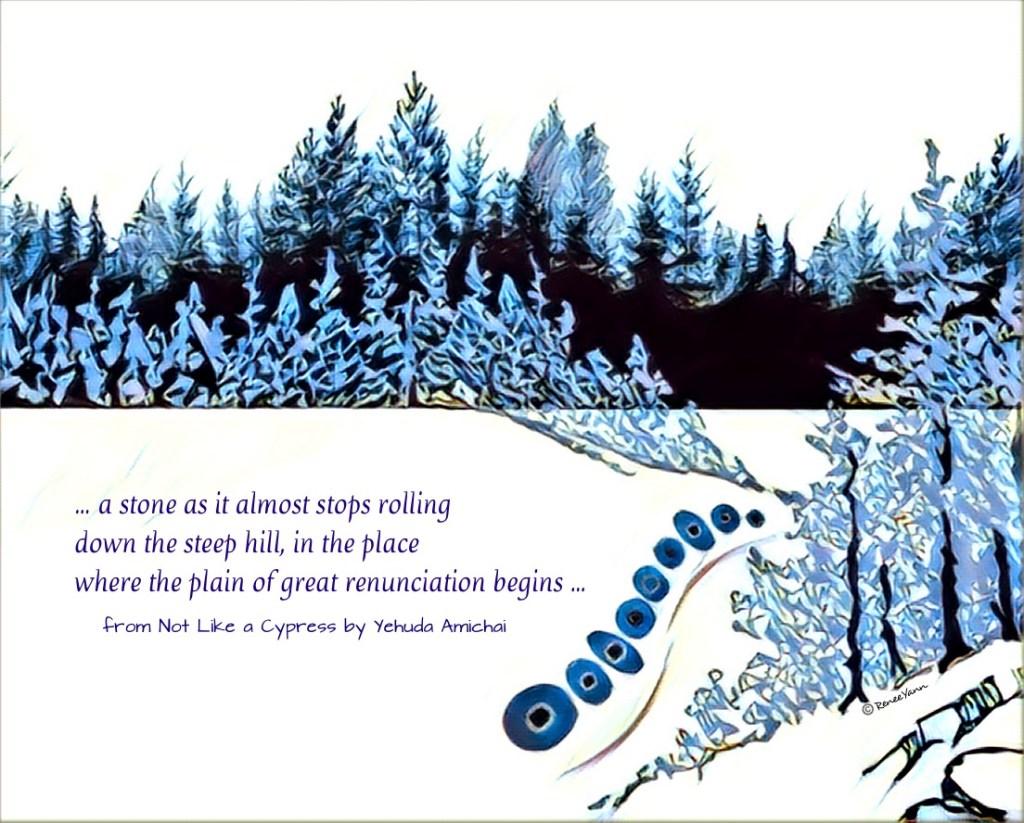
a stone as it almost stops rolling
down the steep hill, in the place
where the plain of great renunciation begins,
from which, like prayers that are answered,
dust rises in many myriads of grains.


Music: Paintbox – Ofra Haza and Kobi Oshrat

Ofra Haza accompanied by pianist and composer Kobi Oshrat at the Nobel Peace Prize Award Ceremony on December 10, 1994 at the Oslo City Hall in Oslo, Norway, honoring Nobel Laureates Israeli Prime Minister Yitzhak Rabin (1922-1995), Israeli Foreign Minister Shimon Peres (1923-2016) and Palestine Liberation Organization Chairman Yasser Arafat (1929-2004) for their efforts to create peace in the Middle East. She performed here at the request of Israeli Prime Minister Yitzhak Rabin. (Lyrics below)

I had a paintbox
Each color glowing with delight
I had a paintbox with colors
Warm and cool and bright

I had a paintbox
Each color glowing with delight
I had a paintbox with colors
Warm and cool and bright

I had no red
I had no red for wounds and blood
I had no black for an orphaned child

I had no white
I had no white for the face of the dead
I had no yellow for burning sands

I had a paintbox
Each color glowing with delight
I had a paintbox with colors
Warm and cool and bright

I had orange
I had orange for joy and life
I had green
Green for buds and blooms

I had blue
I had blue for a clear, bright skies
I had pink
Pink for dreams and rest

I had a paintbox
Each color glowing with delight
I had a paintbox with colors
Warm and cool and bright

I had a paintbox
Each color glowing with delight
I sat down
I sat down and painted peace
Peace, peace

David’s Vocation

Tuesday of the Second Week in Ordinary Time
January 16, 2024

Today’s Readings:

https://bible.usccb.org/bible/readings/011624.cfm


Today, in God’s Lavish Mercy, our first reading introduces us to David, whose thrilling and passionate story unfolds and echoes throughout the rest of biblical history.

In today’s passage, David is called in from the fields to receive, quite unexpectedly, Samuel’s anointing:

David
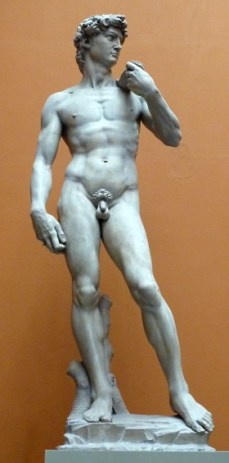
Michelangelo’s David

“The LORD has not chosen any one of these.”
Then Samuel asked Jesse,
“Are these all the sons you have?”
Jesse replied,
“There is still the youngest, who is tending the sheep.”
Samuel said to Jesse,
“Send for him;
we will not begin the sacrificial banquet until he arrives here.”
Jesse sent and had the young man brought to them.
He was ruddy, a youth handsome to behold
and making a splendid appearance.
The LORD said,
“There–anoint him, for this is he!”  

1 Samuel 16: 10-12

Now, the passage doesn’t indicate which field David was in. But maybe he was out in proverbial “left field”, the place from which many human beings are called to do important things, to respond in courageous ways.

Most of us, like David, are just living our ordinary daily lives –relatively oblivious to grace – when the life-changing moments come. Those moments may not be as momentous as David’s, but they are big deals for us. 

  • We get a college acceptance (or rejection) letter.
  • We get a job offer (or we get laid off).
  • We get elected to a position (or we don’t)

Someone asks us:

  • Want to go steady?
  • Will you marry me?
  • Have you ever considered religious life?

Young people, like young David, seem to meet a lot of these obvious directional points in their unfolding lives. But, in reality, we continue to meet them as we move to full maturity. Until the day we die, God is always calling to become deeper, more honest, more loving, more gracefully beautiful, more fully in God’s image.


Where have the pivotal calls and turning points come in your life? What are the junctures at which everything would have been different had you made another choice? What made young, innocent David ready when his first, and ensuing, calls came? 

Here’s why:
David had an exquisite love and constant relationship with God.
And God loved him back, just like God loves us.


Every critical point in our life’s journey is charged with the power of God’s love. That power comes disguised in routine circumstances, like a parent calling his shepherd son home for dinner. But if our hearts are tuned to God, we hear the call deep within those ordinary appearances and we receive the moment’s anointing.

May it be so, until we meet the Beloved Face to face.


Poetry: Vocation – William Stafford

This dream the world is having about itself 
includes a trace on the plains of the Oregon trail,
a groove in the grass my father showed us all
one day while meadowlarks were trying to tell
something better about to happen.

I dreamed the trace to the mountains, over the hills,
and there a girl who belonged wherever she was;
but then my mother called us back to the car:
she was afraid; she always blamed the place,
the time, anything my father planned.

Now both of my parents, the long line through the plain,
the meadowlarks, the sky, the world's whole dream remain,
and I hear him say while I stand between the two,
helpless, both of them part of me:
"Your job is to find what the world is trying to be."

Music: Anoint Me, Lord – written by Vickie Yohe, sung by Jonathan Matthews

Anointing

Saturday of the First Week in Ordinary Time
January 13, 2024

Today’s Readings:

https://bible.usccb.org/bible/readings/011324.cfm


Today, in God’s Lavish Mercy, Samuel anoints Saul King of Israel.

Then, from a flask he had with him, Samuel poured oil on Saul’s head;
he also kissed him, saying:
“The LORD anoints you commander over his heritage.
You are to govern the LORD’s people Israel,
and to save them from the grasp of their enemies.

1 Samuel 10:1
1Sam10_1

Throughout Scripture, the act of anointing signifies being blessed, commissioned by grace. The sacred oil heals and strengthens the anointed to do the work of God.

We share in the grace of anointing through the sacraments – Baptism, Confirmation and Anointing of the Sick. We may not think about the power these rituals give us to live our lives in the pattern of Christ. But it is an amazing power which creates saints out of ordinary human beings like you and me!


Caritas_Bruegel
Caritas, The Seven Acts of Mercy, pen and ink drawing by Pieter Bruegel the Elder, 1559. Counter-clockwise from lower right: feed the hungry, give drink to the thirsty, ransom the captive, bury the dead, shelter the stranger, comfort the sick, and clothe the naked

As many of you know, 2023 was a year of unexpected and intense health challenges for me. On three critical occasions, compassionate priests carried the Sacrament of the Sick to me. Both Fr. Lynn and Fr. Gleason gently asked me, “Would you like to be anointed?”. The question reminded me of Jesus when he asks the paralytic, “Do you want to be cured?”.

Clearly, healing isn’t a one-sided enterprise from God. We must be willing to open our hearts to the movement of the Spirit in our lives. The Sacrament of Anointing is a sacred gift to help us to that openness. For me, anointing from these ministers opened my heart to understand that, by grace, suffering had the potential to make me someone new. Sacramental grace invited me to find that newness in the pattern of Jesus Christ.


In a less formal way, we can anoint one another by our acts of generosity, honesty, justice and love. Think of the woman who anointed Jesus with nard from her alabaster jar. How that act strengthened him for the suffering he had to face!

There are so many chaffed and sore places in our world longing for the oil of mercy!

works of Mercy

We can also “anoint” our own life by gratefully remembering God’s abiding presence with us:  the blessings we have received, the challenges we have gracefully met, the love we have both given and received – all that strengthened us to do the work of God over our lifetime.


Poetry: Her Hands, Her Hair by Steve Garnass-Holmes

Mary took a pound of costly perfume made of pure nard,
anointed Jesus’ feet, and wiped them with her hair.
—John 12.3

God does not promise to save you from suffering,
or to remove you from this life and its jagged edges.
God shares your space in it, offers blessing in it,
anointing your nights as well as days.
The cross is no scheme to get you off a hook somewhere;
it’s the Beloved, with you in your pain.
Let the Beloved pour herself out on your troubles,
let her pour out a jar of tears for you,
wipe your aching feet with her hair.
Let the whole house of you be filled
with the fragrance of God’s blessing.
Others don’t feel your pain but she does,
they will flee but she will be with you.
Lay before her your sorrows and your rage.
Feel her hands upon you, her hair, her heart.
You are in the holy of holies.
The world’s derision fades away outside the gate.
She looks at you with love
that will stay with you forever

Music:  Holy, Anointed One – Vineyard Worship

Petitioning God

Tuesday of the First Week in Ordinary Time
January 9, 2023

Today’s Reading:

https://bible.usccb.org/bible/readings/010924.cfm


Today, in God’s Lavish Mercy, we resume our journey through “Ordinary Time”. Advent and Christmastide of 2023 seem to have passed very swiftly! Just a week or so beyond the New Year, life resumes the “everyday-ness” that can be either comforting or humdrum.

The Church calls this “everyday-ness” Ordinary Time. It is a time during which we are invited to recognize the extraordinary gift of each day by praying with the ordinary lives of ancient Israel and early Christianity. Key to their lives, and to ours, is this: God abides with us. Praying with the Scriptures helps us to recognize and deepen within that Presence.


Now and for several weeks, we will read from the Books of Samuel. These Books present a point of profound change in the character of ancient Israel. Before 1 Samuel, Israel is a disorganized group of tribes with an amorphous societal infrastructure. After II Samuel, Israel is characterized by a power and theology centralized around a king and kingly political power.

We could read these books simply as history, or as a fictionalized narrative, but that would be unfortunate. Praying with the Books of Samuel, and all scripture, allows us to witness God’s intervention in the human heart. We can learn from and compare our challenges to those of these ancient believers. Samuel – and his mother Hannah – is an engaging place to begin.


As 1 Samuel opens in our reading today, Israel is a mess. Externally, they are mortally threatened by the Philistines. Internally, they have devolved into a brutal, amoral, rudderless gaggle. They ache for the Leader who will restore their safety and prosperity.

The Prayer of Hannah – Julius Schnorr von Carolsfeld


Samuel’s mother, Hannah, is the first inkling of that restoration. Frustrated with her barrenness, she turns in desperation to God. She makes the ultimate promise of returning the child God might give her. Her desolation is met with mercy. With the conception of Samuel, Hannah sets in motion the dynamic line that will lead through David to Jesus, the Messiah.

Hannah rose after a meal at Shiloh,
and presented herself before the LORD;
at the time, Eli the priest was sitting on a chair
near the doorpost of the LORD’s temple.
In her bitterness she prayed to the LORD, weeping copiously,
and she made a vow, promising: “O LORD of hosts,
if you look with pity on the misery of your handmaid,
if you remember me and do not forget me,
if you give your handmaid a male child,
I will give him to the LORD for as long as he lives;


This passage is a pre-figuring of Mary and the Son she will give back to God. It offers us so many ways to pray as we live to gratefully return our lives to the Creator.

  • As we consider Hannah as an expression of Israel’s journey, where do we stand on our journey into God’s grace?
  • How do we respond to frustration in our lives, especially when our prayers seem unanswered?
  • How do we place our frustrations before God? How do we wait for an answer?
  • How do we live out and fulfill our promises, vows, and covenants with God and neighbor?
  • Are we aware, and reverent of, the influence of our salvation journey on the journeys of those around us?

It matters how we live our ordinary time. We are not just place markers in history. Like Hannah, how we live, pray, and love affects the whole flow of Creation. Like Hannah, by our faithful relationship with God, we influence a future we do not yet see.


Poetry and Music: MARBLE FLOOR – (A song in Hannah’s voice) by Alicia Jo Rabins

The composer writes that this is a song about Hannah – and what it means to ask for what you need. The story of Hannah appears in I Samuel 1-2. Hannah (Chana in Hebrew) prayed so hard her lips moved, but no sound came out; the priest threw her out of the temple, thinking she was drunk. But not only was Hannah’s prayer answered, she also became the model for the Amidah, one of the most important moments in the Jewish prayer service.
The chorus is inspired by the Chassidic story of the holiest prayer being that of the illiterate man who only knew the alphabet but recited it with perfect intention.

I opened my mouth but no words came
I lay down to sleep but I did not dream
I looked up at the stars but the sky was dark
like a mirror held up to my heart
A B C, D E F

Take away this alphabet
it’s heavy on my tongue

You can want a thing so bad it seems
That you lose yourself and everybody else
So I got down on my knees on the marble floor
And I cried until my throat was sore
A B C D, E F G

Tell me what you want from me
I’ll do it all I swear
I was not drunk, I was awake
I could not open so I had to break
to let the light come in
A B C D, E F G
Take away this alphabet from me
it’s heavy on my tongue

A Message in Crisis

Friday of the Thirty-fourth Week in Ordinary Time
December 1, 2023

Today’s Readings:

https://bible.usccb.org/bible/readings/120123.cfm


Today, in God’s Lavish Mercy, our Responsorial Psalm from Daniel gives us a beautiful prayer. But, in the first reading, we pray with some pretty dramatic passages from the Book of Daniel. I mean, it’s the stuff of a rather scary special effects movie!

Even Daniel indicates how disturbing his visions are:

Because of this, my spirit was anguished and I, Daniel,
was terrified by my visions.

Daniel 7:15

So does the Church, or maybe even God, want us to be disturbed in our prayer today and tomorrow with our last two readings before Advent?

Listen! If you’re not disturbed already by the strain of unholiness in the world, then Daniel isn’t going to rock your boat! But if you, like most good people, have trouble even watching the evening news without anguish, then Daniel is speaking to you.


The writer of Daniel was delivering a message to the people of their time. The visions of chapters 7–12 reflect the crisis which took place in Judea in 167–164 BCE when Antiochus IV Epiphanes, the Greek king of the Seleucid Empire, threatened to destroy traditional Jewish worship in Jerusalem.

The message was:

  • pay attention to the changing world
  • focus on God in the disturbing change
  • choose to be faithful, hopeful, and brave
  • God will always remain faithful to us and most important of all:
  • God is coming to deliver us!

As with all Scripture, texts that spoke to an ancient people continue to speak to us. Our world suffers and hopes in the same way Daniel’s did. For us, the elements of today’s passage can serve as pre-Advent encouragements. Trusting them, we are moved to pray with all Creation which is ever steadfast in praising God:

Give glory and eternal praise to him!
“Mountains and hills, bless the Lord;
    praise and exalt him above all forever.”
“Everything growing from the earth
“You springs, bless the Lord;
“Seas and rivers, bless the Lord;
“You dolphins and all water creatures, bless the Lord;
“All you birds of the air, bless the Lord;
“All you beasts, wild and tame, bless the Lord;
    praise and exalt him above all forever.”
R.    Give glory and eternal praise to him!

Poetry: The Second Coming – William Butler Yeats

Turning and turning in the widening gyre
The falcon cannot hear the falconer;
Things fall apart; the centre cannot hold;
Mere anarchy is loosed upon the world,
The blood-dimmed tide is loosed, and everywhere
The ceremony of innocence is drowned;
The best lack all conviction, while the worst
Are full of passionate intensity.
Surely some revelation is at hand;
Surely the Second Coming is at hand.
The Second Coming! Hardly are those words out
When a vast image out of Spritus Mundi
Troubles my sight: somewhere in the sands of the desert.

A shape with lion body and the head of a man,
A gaze blank and pitiless as the sun,
Is moving its slow thighs, while all about it
Reel shadows of the indignant desert birds.
The darkness drops again; but now I know
That twenty centuries of stony sleep
were vexed to nightmare by a rocking cradle,
And what rough beast, its hour come round at last,
Slouches towards Bethlehem to be born?


Music: Michael Hoppé – Shadows Fall

To Hear and Believe Anew

Thursday of the Twenty-sixth Week in Ordinary Time
October 5, 2023

Today’s Readings:

https://bible.usccb.org/bible/readings/100523.cfm


Today, in God’s Lavish Mercy, our first reading comes from the pragmatical prophet Nehemiah. Compared to the lyrical works of writers like Isaiah and Jeremiah, Nehemiah and his buddy Ezra can sound pretty pedantic. But today’s passage is powerful, rendered so by the tears of Ezra’s listeners:

Then Nehemiah and Ezra the priest-scribe
and the Levites who were instructing the people
said to all the people:
“Today is holy to the LORD your God.
Do not be sad, and do not weep”–
for all the people were weeping as they heard the words of the law.
He said further: “Go, eat rich foods and drink sweet drinks,
and allot portions to those who had nothing prepared;
for today is holy to our LORD.

Nehemiah 8: 9-10

Why were these people crying? (besides the fact that they had stood for six hours listening to Ezra’s filibuster!!!)

Ezra Reads the Law – Julius Schnorr von Carolsfeld’


The people cried because they had restored to them something they thought was lost. Israel had been smothered in Babylon for seven decades – more than a lifetime in ancient Israel. Perhaps they had tried to hold on to the faith of their ancestors, but seventy years of remembering can become wearisome. Now, by God’s mercy, Jerusalem had been restored to them where they could stand in freedom to hear the Word that held them together. Notice that ALL the people were gathered, even the women and children, to be touched by the Word.

The whole people gathered as one in the open space before the Water Gate,
and they called upon Ezra the scribe
to bring forth the book of the law of Moses
which the LORD prescribed for Israel.

Nehemiah 8:1

Picturing the size and circumstances of Ezra’s large assembly, I was reminded of the first baseball game after 9/11/2001. Two weeks after that abominable day, Atlanta played the New York Mets at Citi Field, just a little over ten miles from the World Trade Center. The whole nation was brokenhearted, and certainly, all of us mourned deeply for the people of New York City. The video below recalls that game. There is a well of tears in every face — loss, hope, courage, gratitude, determination, and love for country. And I think even the Braves wanted the Mets to win!


This passage from Nehemiah comes at an opportune time for the Church as we gather in Rome to open the Synod on Synodality. Yesterday, Pope Francis convened representatives of the whole Church to hear the promptings of the Holy Spirit.


Many in the Church feel disoriented and disaffected by issues corroding the Church’s integrity. The continuing waves of the clerical abuse scandal have poisoned the waters of trust and devotion. The failure to recognize women as full human beings paralyzes half the Holy Spirit’s energy. Fractious, self-interested criticisms of papal authority, even by some bishops, have distracted the simple believer from a life of faith. The weaponizing of Catholic social media by the powerful against the marginalized dishonors and vitiates the Gospel in the public sector. Inadequacies in liturgical understanding, preaching, and pastoral leadership have alienated many cradle Catholics from pursuing Church membership.


Not unlike Ezra and Nehemiah, Pope Francis challenges the Church to hear the Word of God rekindled among us. For those who believe the Church is only the hierarchy, or the magisterium, this gathering may be a threat to a status quo which serves their interests. To those who see the Church as the whole people of God, the Synod may be a sacred tonic to a languishing Church.


We should all pray for the success of the Synod. When received with an open and honest heart, the Holy Spirit does astounding things within us. This synod can move the whole Church closer to its sacred perfection, but more specifically, it can do the same for you and me if we desire it. Let’s take Nehemiah’s words to heart, rejoicing and believing that God will delight in the Church’s invitation to speak to us anew:

Do not be saddened this day,
for rejoicing in the LORD must be your strength!”
And the Levites quieted all the people, saying,
“Hush, for today is holy, and you must not be saddened.”
Then all the people went to eat and drink,
to distribute portions, and to celebrate with great joy,
for they understood the words that had been expounded to them.

Nehemiah 8: 10-12

Music: Holy Spirit Living Breath of God – Keith and Kristyn Getty

Radical Choices

Tuesday of the Twenty-fifth Week in Ordinary Time
September 26, 2023

Today’s Readings:

https://bible.usccb.org/bible/readings/092623.cfm


Today, in God’s Lavish Mercy, Luke gives us a jolt with this Gospel passage that has always disturbed me:

The mother of Jesus and his brothers came to him
but were unable to join him because of the crowd.
He was told, “Your mother and your brothers are standing outside
and they wish to see you.”
He said to them in reply, “My mother and my brothers
are those who hear the word of God and act on it.”

Luke 8:19-21

Honestly, I don’t want Jesus to sound officious like that with his family! I want him to wiggle through the crushing crowd and run into Mary’s loving arms. I want him to hug his mom to bits and pummel his little brothers on the back with callow delight.

And you know what – I think that might be exactly what Jesus did, on the way uttering the seemingly callous phrase which Luke has isolated and immortalized.


Like all scripture passages, we can read this one in the slant of our own light. At the same time, it is important to access the wisdom of scripture scholars in order to understand depths we might not otherwise discern. There is a scholarly consensus that this Lucan passage is intended to show us how radically dedicated Jesus was to his mission. The passage affirms that the mission is more important even than family ties … in other words, more important than anything. For thirty years Jesus had lived a quiet life somewhere within his mother’s circle of care. In this Gospel, that quiet time is over and he is on the path to his Passion, Death, and Resurrection.


I understand that radicality and the courage it takes to live it. I failed at it once (at least) but learned immensely from the failure.

When I was a young religious, there was a call for US nuns to minister in Nicaragua. I wanted to answer that call. When I told my mother about my emerging decision, she froze in time. My father had died just about a year and a half before. The thought of also “losing” me to a socio-politically volatile Central America traumatized my mom.

But my mom was so brave. She didn’t say, “Don’t go.” She simply said, “Take me with you. I can cook for all of you.”

Mom and I at the 41st Eucharistic Congress
Philadelphia (1976)


Needless to say, I wasn’t going to take my mom into a political boiler in order to satisfy my plans. But I also wasn’t going to leave her alone in the thinly-veiled desperation of her offer. I didn’t go to Nicaragua and, like Robert Frost’s split road, that has made a profound difference in my life.


That decision almost fifty years ago was a good one, and opened the way for me into other opportunities to serve God’s people. The Gospel did not suffer because of my hesitations or my mother’s. We both trusted our humanity that had, for all our lives, been directed toward God’s love.


But at this juncture in Jesus’s life, the Gospel demands that he open his heart beyond any familial or personal ties in order to embrace all people in the Gospel.

There are frequent times in each of our lives when we must choose for the largeness of the Gospel over limited self-interest. Enriching ourselves daily in scriptural wisdom will strengthen us to respond generously at those times.


Prose: Pope Francis on praying with the scriptures:

Through prayer a new incarnation of the Word takes place. And we are the “tabernacles” where the words of God want to be welcomed and preserved, so that they may visit the world. This is why we must approach the Bible without ulterior motives, without exploiting it. The believer does not turn to the Holy Scriptures to support his or her own philosophical and moral view, but because he or she hopes for an encounter; the believer knows that those words were written in the Holy Spirit, and that therefore in that same Spirit they must be welcomed and understood, so that the encounter can occur.


Music: O Word of God – Ricky Manolo – In this hymn, passages from the Psalms – snippets of God’s Word – are sung in a round within the plea for God’s Word to come into our hearts.

O Word of God, come into this space.
O Word of God, come send us your grace.
Open our minds; show us your truth.
Transform our lives anew.

O Word of God, come into this space.
O Word of God, come send us your grace.
Open our minds; show us your truth.
Transform our lives anew.

Here I am, O Lord my God
I come to do your Will.

Blessed are the poor in spirit,
the Kingdom of Heaven is theirs.

To the upright, I will show
the saving power of God.

Let all the nations
praise You, O God.
Let all the nations praise You.

The Lord is my shepherd,
there is nothing I shall want.