Lent: Healing the Wounds

March 4, 2022
Friday after Ash Wednesday

Today, in God’s Lavish Mercy, Isaiah cuts his listeners no slack — and, remember, we too are his listeners.
In this powerful passage, the prophet shatters the pretenses of those who make a show of religion. Speaking with God’s voice, Isaiah lambastes those who fast and pray but practice no works of justice and mercy.

Lo, on your fast day you carry out your own pursuits,
and drive all your laborers.
Yes, your fast ends in quarreling and fighting,
striking with wicked claw.

These “fake fasters” are left wondering why God doesn’t answer their prayers. The prophet tells them that God isn’t fooled by their pretenses:

Is this the manner of fasting I wish,
of keeping a day of penance:
That a man bow his head like a reed
and lie in sackcloth and ashes?


Isaiah says that God’s not into sackcloth and ashes. God’s into good works of mercy and justice. These are the actions that change our hearts, opening us to deeper relationship with God.

This, rather, is the fasting that I wish:
releasing those bound unjustly,
untying the thongs of the yoke;
Setting free the oppressed,
breaking every yoke;
Sharing your bread with the hungry,
sheltering the oppressed and the homeless;
Clothing the naked when you see them,
and not turning your back on your own.


Listen, dear friends. It can’t be clearer than that.

In a world full of “prosperity gospels”, false piety and pretend religion – used to justify all kinds of injustice – we may get mixed up sometimes about what pleases God.

Let’s really open our hearts to Isaiah’s message and try to rid our own lives of any pretense about these things.

Let’s confront such hypocrisy when we see it used to subtly oppress rather than to lift up others.

Then your light shall break forth like the dawn,
and your wound shall quickly be healed.


Perhaps we might spend sometime today thinking about that “wound” we need healed. Might there be some harbored prejudice, indifference, fear, or ignorance that distances us from others who are different, vulnerable, or in need?

Isaiah cautions that until that wound is healed,
we will never hear God’s true answer to our prayers.


Poetry: from Gitanjali by Rabindranath Tagore

Then said a rich man, “Speak to us of Giving”.

And he answered:
“You give but little when you give of your possessions.
It is when you give of yourself that you truly give.
For what are your possessions but things you keep and guard
for fear you may need them tomorrow?
And tomorrow, what shall tomorrow bring
to the overprudent dog burying bones in the trackless sand
as he follows the pilgrims to the holy city?

And what is fear of need but need itself?
Is not dread of thirst when your well is full, thirst that is unquenchable?

There are those who give little of the much which they have

and they give it for recognition and their hidden desire
makes their gifts unwholesome.
And there are those who have little and give it all.
These are the believers in life and the bounty of life,
and their coffer is never empty.

There are those who give with joy, and that joy is their reward.
And there are those who give with pain, and that pain is their baptism.
And there are those who give and know not pain in giving,
nor do they seek joy, nor give with mindfulness of virtue;
They give as in yonder valley the myrtle breathes its fragrance into space.
Through the hands of such as these God speaks,
and from behind their eyes He smiles upon the earth.

It is well to give when asked,
but it is better to give unasked, through understanding;
And to the open-handed
the search for one who shall receive is joy greater than giving.

And is there aught you would withhold?
All you have shall some day be given;
Therefore give now, that the season of giving
may be yours and not your inheritors’.

You often say, “I would give, but only to the deserving.”
The trees in your orchard say not so, nor the flocks in your pasture.
They give that they may live, for to withhold is to perish.

Surely he who is worthy to receive his days and his nights
is worthy of all else from you.
And he who has deserved to drink from the ocean of life
deserves to fill his cup from your little stream.
And what desert greater shall there be than that which lies
in the courage and the confidence, nay the charity, of receiving?

And who are you that men should rend their bosom and unveil their pride,
that you may see their worth naked and their pride unabashed?
See first that you yourself deserve to be a giver,
and an instrument of giving.
For in truth it is life that gives unto life –
while you, who deem yourself a giver, are but a witness.

And you receivers – and you are all receivers –
assume no weight of gratitude,
lest you lay a yoke upon yourself and upon him who gives.
Rather rise together with the giver on his gifts as on wings;
For to be overmindful of your debt, is to doubt his generosity
who has the free-hearted earth for mother, and God for father.

Music: Respond – Collin Campbell (Lyrics below)

Oh how long will you cry out
And never truly seek my face
You come to me with heavy hearts
But you ignore what makes mine break

I see your thoughts, I hear your words
And I have watched you as you’ve prayed
I’ve told you my desires
But you don’t follow all the way

Children, I’m crying out
Break the chains
Let the oppressed go free
Empty yourselves to those in need
Be my hands Be my feet
What you do unto them You do unto Me

Every day you lift your voice
And await my swift response
But I see only what’s inside
And it’s (what i see on the inside) an offering I don’t want

Children, I’m crying out
Break the chains
Let the oppressed go free
Empty yourselves to those in need
Be my hands Be my feet
What you do unto them You do unto Me

Then your Salvation will come like the dawn
And my glory will be your shield
When you call on My name I will not turn away
I am Your God And I am here
And your light it will shine from the dark
You will be like a free flowing stream
And when you call on My name I will not turn away
I am your God And I am here
Lent: The Choice

March 3, 2022
Thursday after Ash Wednesday

Today, in God’s Lavish Mercy, our readings confirm that a life patterned on Christ contradicts worldly definitions.

Deuteronomy gives us stark, either-or, advice:

I have set before you life and death,
the blessing and the curse.
Choose life, then,
that you and your descendants may live,
by loving the LORD, your God,
heeding his voice,
and holding fast to him.

Deuteronomy 30: 15-16

It’s definitive advice, but we could probably do these things, right?

  • Choose life
  • Love God
  • Heed God’s voice
  • Hold fast to God

Sounds OK, doesn’t it?


It’s when Jesus comes along that it begins to sound difficult.
Jesus tells us, “Here’s how you choose life:

“Whoever wishes to save his life will lose it,
but whoever loses his life for my sake will save it.”


Jesus tells us, “Here’s the God you must love, one who:

“suffers greatly, is rejected, and is killed.”


Jesus tells us, “Here’s what my voice says to you :

“What profit is there for you to gain the whole world
yet lose or forfeit yourself?”


Jesus tells us, “Here’s how you hold fast to me:

‘Take up your cross daily and follow me.”

The deep love of the Holy Cross was the sacred gift of Catherine McAuley to her Mercy Family.
Let us listen to her counsel.

Some have huge crosses to carry in their lives – war, famine, enslavement, untended illness, homelessness, persecution, poverty. Those who carry such crosses are singularly loved by God who dwells with them.

But if we don’t have big, obvious crosses in our lives – if we are among those the world deems fortunate – how do we follow the crucified Jesus to find our way to eternal life?

How do we really CHOOSE LIFE?

We need to get close to the ones God singularly loves. We need to walk beside them and lift some of their heavy crosses. We need to help their voices be heard, their needs be met, their rights be honored.

Not all of us can do this by direct service. But we can do it by our advocacy, our material contributions, and our articulated support for justice.

We need to make these choices for LIFE all the time. But Lent is a great time to examine the vigor and commitment of our choices, a time to take a closer walk with our suffering Christ and ask him to inspire our courage.


Poetry: Simon the Cyrenian Speaks – Countée Cullen, an American poet, novelist, children’s writer, and playwright, particularly well known during the Harlem Renaissance. I picked his poem today because Simon of Cyrene is someone who chose to carry the cross just as we are asked to do.

He never spoke a word to me,
And yet He called my name;
He never gave a sign to me,
And yet I knew and came.

At first I said, “I will not bear
His cross upon my back;
He only seeks to place it there
Because my skin is black.”

But He was dying for a dream,
And He was very meek,
And in His eyes there shone a gleam
Men journey far to seek.

It was Himself my pity bought;
I did for Christ alone
What all of Rome could not have wrought
With bruise of lash or stone.


Music: Just a Closer Walk with Thee – Patsy Cline and Willie Nelson

Lent: Time of Holy Listening

March 2, 2022
Ash Wednesday

Today, in God’s Lavish Mercy, we resolve to turn our hearts more fully to God. The sacred journey of Lent, one we have traveled so often over the years, invites us each time to go deeper into the Well of Mercy.

Joel’s pregnant phrase summons us:

Think of the “even now” moments of your life, those times when, despite darkness and cold, you turned toward light and warmth. Think of a time when, in contradiction to all negativity, your soul proclaimed:

  • Even now I hope
  • Even now I believe
  • Even now I love
  • Even now I care
  • Even now I repent
  • Even now I forgive
  • Even now I begin again

The rise of an “Even Now” moment in our souls is like the hint of spring pushing its head through the winter snow.

It is the reddish-green thread suggesting life at the tip of the brown, cold-cracked branch.

It is the moment we believe that what we desire and love will turn toward us and embrace us.

Can you imagine God having such moments, longing for our attention, love, presence, catching a glimpse of our turning?

Our reading from Joel describes such a God.

Even now, says the LORD,
return to me with your whole heart…
These words suggest God’s longing for us, for our devotion and love.

But our holy intentions weaken and we often drift away from our “first fervors”. Our hearts attach to distractions from God. So God says:

Rend your hearts …
and return to the LORD, your God.
For I am gracious and merciful,
slow to anger, rich in kindness …
Come back to Me, with all your heart.

Joel 2: 13-14

This is what Lent is all about. Each of us knows where our hearts have wandered. Each of knows what we must turn from — even now — to return to God’s embrace.

If we can hear God’s longing in this haunting reading from Joel perhaps the true turning will begin. A blessed Lent, a holy listening, my friends.


Poetry: God’s Longing – from Rumi

All night, a man called out “God! God!”
Until his lips were bleeding.
Then the Adversary of mankind said, “Hey! Mr Gullible!
… How come you’ve been calling all night
And never once heard God say, “Here, I AM”?
You call out so earnestly and, in reply, what?
I’ll tell you what. Nothing!”

The man suddenly felt empty and abandoned.
Depressed, he threw himself on the ground
And fell into a deep sleep.
In a dream, he met an angel, who asked,
“Why are you regretting calling out to God?”

The man said, “ I called and called
But God never replied, “Here I AM.”

The Angel explained, “God has said,
“Your calling my name is My reply.
Your longing for Me is My message to you.
All your attempts to reach Me
Are in reality My attempts to reach you.
Your fear and love are a noose to catch Me.
In the silence surrounding every call of “God”
Waits a thousand replies of “Here I AM.”


Music: Come Back to Me – Gregory Norbet, sung by John Michael Talbot

Advice Before Take-off

Tuesday, March 1, 2022
Tuesday of the Eighth Week in Ordinary Time

Today, in God’s Lavish Mercy, as we prepare to launch into Lent, we receive wonderful advice from Peter.

Peter talks about the Hebrew prophets who, even before the birth of Jesus, shared in the same Holy Spirit with Whom Jesus is One God. Peter says that the Spirit testifies that Christ’s suffering will lead to glory and will, at the same time, transform us:

Concerning the salvation of our souls …
… the Spirit of Christ within the prophets indicated
when it testified in advance
to the sufferings destined for Christ
and the glories to follow them.

1 Peter 1: 10-13

Peter says, basically, “Don’t be dopes! Jump on that blessing and make the most of it!”


Lent offers us a great opportunity to do just what Peter encourages. By our sincere, thoughtful and open prayer with the Lenten scriptures, we can come closer to the Christ Who loves and redeems us.

Peter puts it very simply – simply enough that I am going to leave it at this profound invitation:


Photo by Engin Akyurt on Pexels.com

Poetry: from Rumi

There comes a holy
and transparent time
when every touch
of beauty
opens the heart
to tears.
This is the time
the Beloved of heaven
is brought tenderly on earth.
This is the time
of the opening
of the ROSE.

Music: The Rose – Bette Midler

As I prayed with this beautiful song, I thought of the Rose as the Resurrected Jesus.

What Is Hope?

February 28, 2022
Monday of the Eighth Week in Ordinary Time

Today, in God’s Lavish Mercy, the word “HOPE” binds our readings together.

Blessed be the God and Father of our Lord Jesus Christ,
who in his great mercy gave us a new birth to a living hope
through the resurrection of Jesus Christ from the dead,
to an inheritance that is imperishable, undefiled, and unfading,
ept in heaven for you…

1 Peter 1:3

Wow! That’s uplifting isn’t it!

But praying with this passage, I am aware of how hard it is to really define hope. We can get it mixed up with wishing or imagining.

Hope is very different,
and much more powerful, than wishing.
It is a share in the power of God
to animate our world with divine life.

When we wish, we imagine better things and often do what we can to make them happen. Sometimes our prayers take the form of wishes – our desire for people or circumstances to be well or better. Those wishes may or may not come true. And if they don’t, we may lose what we incorrectly defined as “hope”.


We see that kind loss happen in the young man from our Gospel today. He wishes to be a better person. He wishes to truly center his life on God. He even takes the first step to make his wish come true by asking Jesus for advice:

As Jesus was setting out on a journey, a man ran up,
knelt down before him, and asked him,
“Good teacher, what must I do to inherit eternal life?”

Mark 10:17

Jesus immediately loves this sincere young man. But says tells him that he has too many “wishes” cluttering his hope for God. Jesus encourages him to clear out space in his life for God’s Presence to transform him. Then everything will become an expression of the divine life within him.

Jesus, looking at him, loved him and said to him,
“You are lacking in one thing.
Go, sell what you have, and give to the poor
and you will have treasure in heaven;
then come, follow me.”

Mark 17:21

Sadly, the man cannot summon the spiritual strength to tap into his gift of hope – to rely fully on God in his life. The gift of hope is within him, as it is within all of us. But the way to it is so tangled with all his possessions that he despairs of finding it.

At that statement, his face fell,
and he went away sad,
for he had many possessions.

Mark 17:22

The Catholic encyclopedia says this:

Hope is defined to be a Divine virtue by which we confidently expect, with God’s help, to reach eternal felicity as well as to have at our disposal the means of securing it.


Being a “Divine virtue” means that hope, like faith and love, is given by God to each of us as a share in God’s own nature. It’s like a “divine” family trait that marks us as children of God.

When we see a child that looks exactly like a parent, we might hear people say, “You could never deny him. He looks exactly like you!” That’s how it is with the “divine virtues”. They allow people to see God in us and so to deepen their own faith.

Hope is that confidence in God which is so complete that it does not have to be proven by miracles or fulfilled wishes. Hope endures in all circumstances. It throbs within us like sacred DNA. All we have to do is clear the way for it to shine.


Poetry: Two of my favorite poems today:

  1. Emily Dickinson, in her masterfully woven metaphor, says that hope is feathered:

“Hope” is the thing with feathers –
That perches in the soul –
And sings the tune without the words –
And never stops – at all –

And sweetest – in the Gale – is heard –
And sore must be the storm –
That could abash the little Bird
That kept so many warm –

I’ve heard it in the chillest land –
And on the strangest Sea –
Yet – never – in Extremity,
It asked a crumb – of me.


And one of my favorite poets, Lisel Mueller, says that hope is “all we know of God”:

It hovers in dark corners
before the lights are turned on,
it shakes sleep from its eyes
and drops from mushroom gills,
it explodes in the starry heads
of dandelions turned sages,
it sticks to the wings of green angels
that sail from the tops of maples.

It sprouts in each occluded eye
of the many-eyed potato,
it lives in each earthworm segment
surviving cruelty,
it is the motion that runs
from the eyes to the tail of a dog,
it is the mouth that inflates the lungs
of the child that has just been born.

It is the singular gift
we cannot destroy in ourselves,
the argument that refutes death,
the genius that invents the future,
all we know of God.

It is the serum which makes us swear
not to betray one another;
it is in this poem, trying to speak.


Music: Living Hope – Phil Wickham

Primed for Transformation

February 27, 2022
Eighth Sunday in Ordinary Time

Today, in God’s Lavish Mercy, our readings prime us for the coming of Lent. Lent is all about the transformation of our hearts within of the Passion, Death, and Resurrection of Jesus.

But before we are ready for such transformation, we must be totally aware of ourselves and open to God’s Presence in our lives.


Our readings call us to a deep look at our spiritual integrity as it is revealed in our words and actions. The image of a good tree, bearing fruit, suffuses all our scriptures today.

What about the integrity of our words:

The fruit of a tree shows the care it has had;
so too does one’s speech disclose the bent of one’s mind.
Praise no one before he speaks,
for it is then that people are tested.

Sirach 27:6-7

What about the integrity of our faith:

The just one shall flourish like the palm tree,
like a cedar of Lebanon shall he grow.
They that are planted in the house of the LORD
shall flourish in the courts of our God.

Psalm 92: 13-14

What about the perseverance of our faithful labor:

Be firm, steadfast, always fully devoted to the work of the Lord,
knowing that in the Lord your labor is not in vain.

1 Corinthians 92:15-16

What about our actions – the fruit we bear to the world:

A good tree does not bear rotten fruit,
nor does a rotten tree bear good fruit.
For every tree is known by its own fruit.
For people do not pick figs from thornbushes,
nor do they gather grapes from brambles.
A good person out of the store of goodness in his heart produces good,
but an evil person out of a store of evil produces evil;
for from the fullness of the heart the mouth speaks.

Luke 6:43-54

Let’s set our sights on the beginning of Lent which is now on the near horizon. How do we want to begin the transformative journey offered us once again in this magnificent liturgical cycle? Now is the time to prepare.


Poetry: Birches BY ROBERT FROST

When I see birches bend to left and right
Across the lines of straighter darker trees,
I like to think some boy’s been swinging them.
But swinging doesn’t bend them down to stay
As ice-storms do. Often you must have seen them
Loaded with ice a sunny winter morning
After a rain. They click upon themselves
As the breeze rises, and turn many-colored
As the stir cracks and crazes their enamel.
Soon the sun’s warmth makes them shed crystal shells
Shattering and avalanching on the snow-crust—
Such heaps of broken glass to sweep away
You'd think the inner dome of heaven had fallen.
They are dragged to the withered bracken by the load,
And they seem not to break; though once they are bowed
So low for long, they never right themselves:
You may see their trunks arching in the woods
Years afterwards, trailing their leaves on the ground
Like girls on hands and knees that throw their hair
Before them over their heads to dry in the sun.
But I was going to say when Truth broke in
With all her matter-of-fact about the ice-storm
I should prefer to have some boy bend them
As he went out and in to fetch the cows—
Some boy too far from town to learn baseball,
Whose only play was what he found himself,
Summer or winter, and could play alone.
One by one he subdued his father's trees
By riding them down over and over again
Until he took the stiffness out of them,
And not one but hung limp, not one was left
For him to conquer. He learned all there was
To learn about not launching out too soon
And so not carrying the tree away
Clear to the ground. He always kept his poise
To the top branches, climbing carefully
With the same pains you use to fill a cup
Up to the brim, and even above the brim.
Then he flung outward, feet first, with a swish,
Kicking his way down through the air to the ground.
So was I once myself a swinger of birches.
And so I dream of going back to be.
It’s when I’m weary of considerations,
And life is too much like a pathless wood
Where your face burns and tickles with the cobwebs
Broken across it, and one eye is weeping
From a twig’s having lashed across it open.
I'd like to get away from earth awhile
And then come back to it and begin over.
May no fate willfully misunderstand me
And half grant what I wish and snatch me away
Not to return. Earth’s the right place for love:
I don’t know where it's likely to go better.
I'd like to go by climbing a birch tree,
And climb black branches up a snow-white trunk
Toward heaven, till the tree could bear no more,
But dipped its top and set me down again.
That would be good both going and coming back.
One could do worse than be a swinger of birches.

Music: Tree Song – sung by Evie Karlsson

Prayer

February 26, 2022
Saturday of the Seventh Week in Ordinary Time

Today, in God’s Lavish Mercy, each of our readings encourages us to live a life of prayer – with fervor, perseverance, and childlike simplicity

The fervent prayer of a righteous person is very powerful.

James 5:16

O LORD, to you I call; hasten to me;
hearken to my voice when I call upon you.
Let my prayer come like incense before you;
the lifting up of my hands, like the evening sacrifice.

Psalm 141:1-2

Let the children come to me; do not prevent them,
for the Kingdom of God belongs to such as these.

Mark 10:14

Rather than make any theological comment on prayer, I thought I might simply offer some of my own poetry-prayers today, if you would care to pray with them.


Awaking

Sunrise paints 
the hedge's morning side
rosy gold.
But I choose
the western side.
There, midnight's purple leaves
awake in lazy grey, 
then stripes
of green and silver.
There, the awesome 
grace of living
rises slowly in the heart,
a liquor savored,
a prayer lingering
In genuflected silence

Photo credit: Mary Pat Garvin, RSM

Prayer

Still ourselves,
we are more one
than separate now,
Heart over heart,
heart within Heart,
like a word's meaning
held within its sound.
I drink from that union
like the verdant earth drinks
from its deep reserve of water.
It is Your color
that flushes
every blossom
sprung from me.
But that water, once tasted
precludes satiety
by any other water.
There is
no return for me now
to a season
not fed by You.
What I have given You, then
is the whole seed of my life.
Love it in that way.

Music: Inside This River – Gary Schmidt

Live in Truth

February 25, 2022
Friday of the Seventh Week in Ordinary Time

Today, in God’s Lavish Mercy, our readings instruct us on one of life’s most important realities: truthful relationship – with God, nature, other people, and ourselves.

James reminds us that the prophets spoke the truth at great personal cost.

Take as an example of hardship and patience, brothers and sisters,
the prophets who spoke in the name of the Lord.
Indeed we call blessed those who have persevered.

James 5:10

Culture sometimes characterizes a “prophet” as one who can foresee the future, one who has a greater capacity than the normal person. And indeed there are great leaders who fit that understanding. They see things rightly and help us to realign our vision.


But, in an everyday sense, a prophet is simply someone who sees the truth and is unafraid to speak it. A prophet doesn’t pretend, deflect, lie, ignore, hide, distort or abuse Truth. The call to this kind of prophecy is one that we all share.

Such a call requires that we are honest, first and foremost, with God and with ourselves. It asks that we live a discerning and courageous life, reverently telling our truth as best we understand before God:

… let your “Yes” mean “Yes” and your “No” mean “No,”
that you may not incur condemnation.

James 5:12

In our Gospel, we find the Pharisees trying trip up Jesus with their pretend concern for the Law. Instead, what they are really concerned about is that they could lose their hold on power if the people turn to Jesus and his teaching.


Jesus calls them “hard of heart” because they are not open to the Spirit. They hide in a labyrinth of minutiae rather than the clarity of Love and Truth.

Living in the Truth of God’s grace and mercy, we grow in our ability to be prophetic. It means that people know they will get the truth from us — not opinion or advice; not bluntness or unnecessary critique — but a discernment offered in love, reverence, and mutual hope.

Like the biblical prophets, and like Jesus himself, we will meet people who don’t want that kind of truth. They haven’t been able to espouse it in themselves, so they don’t want to hear it from us. We see this played out daily in a sham political world that continually creates its own version of reality to suit its selfish ends.

In such situations, James would offer us this encouragement:

You have heard of the perseverance of Job,
and you have seen the purpose of the Lord,
because the Lord is compassionate and merciful.

And our Alleluia Verse offers us a prayer for such times:

Your word, O Lord, is truth;
consecrate us in the truth.


So persevere.
Seek your truth in prayer.
Give it to the world generously
with compassion and mercy.

Poetry: A Legend of Truth – Rudyard Kipling
“A Friend of the Family”
From “Debits and Credits” (1919-1923)

Once on a time, the ancient legends tell,
Truth, rising from the bottom of her well,
Looked on the world, but, hearing how it lied,
Returned to her seclusion horrified.
There she abode, so conscious of her worth,
Not even Pilate’s Question called her forth,
Nor Galileo, kneeling to deny
The Laws that hold our Planet ‘neath the sky.
Meantime, her kindlier sister, whom men call
Fiction, did all her work and more than all,
With so much zeal, devotion, tact, and care,
That no one noticed Truth was otherwhere.

Then came a War when, bombed and gassed and mined,
Truth rose once more, perforce, to meet mankind,
And through the dust and glare and wreck of things,
Beheld a phantom on unbalanced wings,
Reeling and groping, dazed, dishevelled, dumb,
But semaphoring direr deeds to come.

Truth hailed and bade her stand; the quavering shade
Clung to her knees and babbled, “Sister, aid!
I am–I was–thy Deputy, and men
Besought me for my useful tongue or pen
To gloss their gentle deeds, and I complied,
And they, and thy demands, were satisfied.
But this–” she pointed o’er the blistered plain,
Where men as Gods and devils wrought amain–
“This is beyond me! Take thy work again.”

Tablets and pen transferred, she fled afar,
And Truth assumed the record of the War…
She saw, she heard, she read, she tried to tell
Facts beyond precedent and parallel–
Unfit to hint or breathe, much less to write,
But happening every minute, day and night.
She called for proof. It came. The dossiers grew.
She marked them, first, “Return. This can’t be true.”
Then, underneath the cold official word:
“This is not really half of what occurred.”

She faced herself at last, the story runs,
And telegraphed her sister: “Come at once.
Facts out of hand. Unable overtake
Without your aid. Come back for Truth’s own sake!
Co-equal rank and powers if you agree.
They need us both, but you far more than me


Music: Beautiful Truth – Angela Predhomme

Pepper and Salt

February 24, 2022
Thursday of the Seventh Week in Ordinary Time

Today, in God’s Lavish Mercy, both James and Jesus pepper us with some fire and brimstone.

James is preaching against the sin of exploitation, especially as it relates to economic justice, the sanctity of work, and reverence for the worker.

Come now, you rich, weep and wail over your impending miseries…
Behold, the wages you withheld from the workers who harvested your fields are crying aloud; and the cries of the harvesters have reached the ears of the Lord of hosts.

James 5: 1;4

James, in his time, is condemning a sin that has endured throughout history. In a 2020 address, Pope Francis confronted the same evil:

The pandemic has exposed and aggravated social problems, above all that of inequality…These symptoms of inequality reveal a social illness; it is a virus that comes from a sick economy. And we must say it simply: the economy is sick. It has become ill. It is the fruit of unequal economic growth — this is the illness: the fruit of unequal economic growth — that disregards fundamental human values. In today’s world, a few wealthy people possess more than all the rest of humanity. I will repeat this so that it makes us think: a few wealthy people, a small group, possess more than all the rest of humanity. This is pure statistics. This is an injustice that cries out to heaven!

General Audience, August 26, 2020

James and Francis – speaking the same message for different times.


In our Gospel, Jesus teaches that the rewards of a well-lived life are measured in mutuality and generosity, not dollars:


In concluding his above referenced address, Pope Francis, like Jesus, focused on children:

Let us think about the children. Read the statistics: how many children today are dying of hunger because of broken distribution of riches, because of a sick economic system; and how many children today do not have the right to education for the same reason. May this image of children in want due to hunger and the lack of education help us understand that after this pandemic crisis we must learn and do better.


Jesus too measured a soul’s health by its effect on children:

Whoever causes one of these little ones who believe in me to sin,  it would be better for him if a great millstone were put around his neck and he were thrown into the sea.

Mark 9:42

These readings teach hard lessons, lessons which society still seems unable to learn. Let’s ask for the grace to see our own role in helping to realize the sacred balance of goods that Jesus, James, and Francis call for.

Let us not tire in advocating for social Justice because, as our Gospel warns:

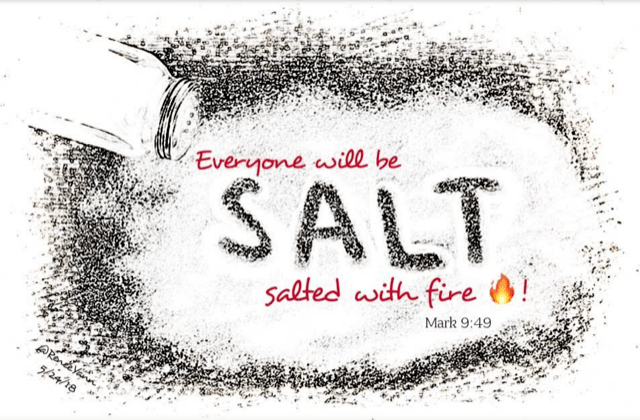
Everyone will be salted with fire. Salt is good,
but if salt becomes insipid,
with what will you restore its flavor?

Mark 9:49

Poetry and Music: Salt of the Earth – The Rolling Stones
In this song, Mick Jagger writes an anthem to the working class. But in a twice-repeated stanza, the singer professes a distance from this very group, perhaps loosing touch because of his own material success:

And when I search a faceless crowd
A swirling mass of grey and black and white
They don’t look real to meIn fact, they look so strange

The song uses a quote that refers to a passage in the Bible where Jesus encourages people to give the best of themselves:

You are the salt of the earth; but if the salt loses its flavor, how shall it be seasoned ? It is then good for nothing but to be thrown out and trampled underfoot.

Matthew 5:13

Tell It Like It Is

February 23, 2022
Wednesday of the Seventh Week in Ordinary Time
Memorial of St. Polycarp, Bishop and Martyr

Today, in God’s Lavish Mercy, James continues to “tell it like it is”.

Come now, you who say,
“Today or tomorrow we shall go into such and such a town,
spend a year there doing business, and make a profit”–
you have no idea what your life will be like tomorrow.

James 4: 13

James offers that hard truth to his listeners, Jewish Christians dispersed outside of Israel. It’s an insight many of us might not like hearing, because we thrive on making plans for future growth and improvement.

When a current situation is looking a little dim, we like to think that “there is always tomorrow”. James says, “Maybe not! Make sure you humbly do all that you can TODAY.”


James reminds me of my Nana.

My great-grandmother was born in Ireland in 1869. She was no-nonsense Irish, probably because of the no-nonsense times during which she grew up. She was highly religious and stringently moral, and she worked to insure that the family benefitted from all the lessons she had learned in her challenging life.


Her accent was as thick as porridge, but after a while I, a perspicacious little toddler, began imitating it. I listened intently to her oft-repeated phrases and folded them into my own conversations. One such phrase made an indelible impression on me to the point that I can hear it even now in her soft, rolling brogue.

When one of the family retired for the night, it was common to say, ” Good night. God bless you.” Sometimes we added, ” I’ll see you in the morning” and if we did, Nana invariably responded:

if God spares us!


I think that is exactly what James is saying in his no-nonsense epistles.

We depend on God’s goodness and mercy for everything. We need to remember and acknowledge that truth, and to live in hopeful gratitude.

… you should say,
“If the Lord wills it, we shall live to do this or that.”
But instead you are boasting in your arrogance.
All such boasting is evil.
So for one who knows the right thing to do
and does not do it, it is a sin.

I think that most of us aren’t really arrogant. We just forget. We get confused. We let our lives slip off their center on God. And then we might start to think that we are the center of everything! Big mistake!


Our Responsorial Psalm for today reinforces these truths. I love the way Pastor Christine Robinson has interpreted Psalm 49:

Here is my wisdom—Listen to my song!
I am surrounded by those who put their trust
in possessions and money
I am not taken in.

What is precious in life can’t be had in the marketplace
What is important about us is not what we acquire,
but what we do to add love, goodness, and
beauty to the world.

It’s the size of our hearts, not the size of our houses,
It’s our understanding, not our fame.
What we own is taken from the earth and from others.
It returns to them when we die.

But love, wisdom, and beauty,
they strengthen the fabric of creation.
They accrue to God, enlarge our very souls.
These are our true legacy and our ongoing life.


Music: Who Am I? – Casting Crowns