Wednesday of the Eleventh Week in Ordinary Time

Wednesday, June 16, 2021

Today, in God’s Lavish Mercy, we pray with Psalm 112, a poem about why and how to live a generous life.

Blessed the one who is in awe of the LORD,
    who greatly delights in God’s commands.
That person’s posterity shall be mighty upon the earth;
    the upright generation shall be blessed.
Wealth and riches shall be in their house;
   their generosity shall endure forever.

Psalm 112:2-4

The psalm nicely complements our readings: 

  • Paul, nudging the Corinthians for a general collection
  • Jesus, preaching sincerity and humility in our giving – both to humans and to God.

Generosity is the fruit of the theological virtue of charity. 

I think “charity” gets a flimsy definition in our modern culture. Many think of it only as a noble intermittent gesture toward those who are disadvantaged, like change tossed into the Salvation Army bucket.

But it’s a way bigger deal. Here are a few clips from the Catechism of the Catholic Church. They offer so much thought for our meditation. After that, we might pray to deepen in true charity and to manifest it in quiet, sustained generosity.


The theological virtues are the foundation of Christian moral activity;
they animate it and give it its special character.
They inform and give life to all the moral virtues.
They are infused by God into the souls of the faithful
to make them capable of acting as God’s children and of meriting eternal life.
They are the pledge of the presence and action of the Holy Spirit
in the faculties of the human being.
There are three theological virtues: faith, hope, and charity.


Charity is the theological virtue
by which we love God above all things for God’s own sake,
and our neighbor as ourselves for the love of God.


The practice of all the virtues is animated and inspired by charity,
which “binds everything together in perfect harmony”;
it is the form of the virtues;
it articulates and orders them among themselves;
it is the source and the goal of their Christian practice.
Charity upholds and purifies our human ability to love,
and raises it to the supernatural perfection of divine love.


The fruits of charity are joy, peace, and mercy;
charity demands beneficence and fraternal correction;
it is benevolence;
it fosters reciprocity and remains disinterested and generous;
it is friendship and communion:.

Love is itself the fulfillment of all our works.
There is the goal; that is why we run:
we run toward it, and once we reach it,
in it we shall find rest.

Music: Ubi Caritas – Taize
Eleventh Sunday in Ordinary Time

Sunday, June 12, 2021

Today, in God’s Lavish Mercy, we pray with Psalm 92, the only psalm in the Hebrew Bible assigned to a particular day – Shabbat. Combined with our readings, especially Ezekiel, it invites us to heartfelt prayer.

Shabbat (שַׁבָּת; related to Hebrew verb “cease, rest”) is the seventh day of the Jewish week and is the day of rest and abstention from work as commanded by God. Shabbat involves two interrelated commandments: to remember (zachor) and to observe (shamor).

from jewishvirtuallibrary.org

Psalm 92 captures the spirit we hope for in all our Sundays- peace, reflective gratitude, patient hope, recognized blessing. It is a time to remember God’s goodness to us and to reflect on God’s presence.


But, as you may know, I write these reflections a day ahead. And my Saturday morning was anything but “Shabbatish”! I stayed up too late last night, slept too late this morning, and had to handle an early grocery order. To top it all off, a glass exploded in my housemate’s face as she emptied the dishwasher! (She’s fine, but it was like lightening hit our kitchen.)

It all left me a little distracted!


I tell you this to say that – yes – prayer comes begrudgingly when we don’t make the space for it.

But when we do take a breath and quiet ourselves, it can be amazingly generous.

Over time, the seeds of a consistently prayerful life will bear fruit even under challenging conditions. As Jesus tells us today:

It is like a mustard seed that, when it is sown in the ground,
is the smallest of all the seeds on the earth.
But once it is sown, it springs up and becomes the largest of plants
and puts forth large branches,
so that the birds of the sky can dwell in its shade.


Our #92 psalmist prays that kind of a prayer today. Here’s the way I read it with my heart:

It is good to give thanks to you LORD,
    to sing praise to your name, Beloved,
To proclaim your kindness at daybreak,
and even later if I miss its rising!
    To know your faithfulness
even in my distractions.

You let my prayer bear fruit 
even in the shade of time and its pressures,
    my faith to be vigorous and sturdy.
I sing of your goodness,LORD,
    You, my Steady Love who is always faithful.


Poetry: The Spirit’s Whispers by Colten Biro, S.J.

If only my words were 
poised, precise, perfect ballerinas.
If only they could pirouette on a point,

Holding a pose, arresting rapt attention,
Meaning twirling out past paradox of The Ineffable,
convincing the very orbit of the Son to stop and listen,
to nothing more significant—than me.

If only my words were quick, sharp, exact,
halting in the air for emphasis and recognition.
All of which calm, careful, and controlled.
All of which holding the attention of the Heavens,
interrupting an unceasing song of seraphim and cherubim.

If only my words were anything, 
but garbled, goofy, grating,
and less akin to rodeo clowns than en pointe figurines.
But they are bumbling and boisterous, 
dancing dunces, 
threading a thin, thimble-like thought
that the gait of my racing heart
could avoid running into either 
lines of bull—or truth too true.
Which means my words, in effect, 
avoid bearing my very heart, directly to You.

If only the words, with a gentle extension
and a faint flourish, could entwine:
        my desires—Your Will. 
        my loneliness—Your Presence.
        my pain—the Resurrection.
      my disquiet—Your Peace.

Completing a grand jete,
coupling cacophonous 
concepts midair—and mid-heart.

And yet, 
my words
don’t dance
or sing
at all.

So, I don’t speak.
My words don’t waltz, so much as whimper.
And my seat here in the pew feels too quiet
in the muffled silence of the sanctuary.

Maybe, Lord, You have the words 
I can perfectly perform,
to cry anything but Abba.
Which for now,
is the only word I pray,
while paralyzed in the repeating echoes
of my pointless pirouetting.


Music: Vento di Passioni – James Horner

As we pray today, may a flight of prayerful gratitude spring from our spirits!

Memorial of Saint Justin, Martyr

Tuesday, June 1, 2021

Today, in God’s Lavish Mercy, we pray with Psalm 112, a hymn deeply rooted in the biblical concept of law and justice.

Blessed the one who fears the LORD,
who greatly delights in God’s commands.
That person’s posterity shall be mighty upon the earth;
the upright generation shall be blessed.

Psalm 112:1-2

In our first reading, as Tobit and Anna share a familiar type of marital spat, we see that there are many perspectives from which one can approach the concept of justice. Anna knows her actions to be just from experience. Tobit analyzes the situation from judgement and law.

But in our Gospel, the wily Pharisees try to manipulate the law in order to ensnare Jesus:

Teacher, we know that you are a truthful man
and that you are not concerned with anyone’s opinion.
You do not regard a person’s status
but teach the way of God in accordance with the truth.
Is it lawful to pay the census tax to Caesar or not?

Mark 12:14

Jesus, who is the essence of Truth, is not trapped. After examining the coin which was given him:

Jesus said to them,
“Repay to Caesar what belongs to Caesar
and to God what belongs to God.
They were utterly amazed at him.”

Mark 12:15

Our psalm tells us that understanding God’s law is grounded in the transparency of our own truth:

The just one’s heart is firm, 
trusting in the LORD.
It is steadfast and fearless.
From its abundant confidence, 
such a heart lavishly gives to the poor;
with a generosity that shall endure forever,
standing firm to glorify God.

Psalm 112: 7-9

Our readings give us a lot to think about. And if nothing else, a delightful story from Tobit. 🤗


Poetry: Truth by Rumi

The truth was a mirror 
in the hands of God. 
It fell, 
and broke into pieces. 
Everybody took a piece of it, 
and they looked at it 
and thought they had the truth.


Music: The Voice of Truth – Casting Crowns

Monday of the Fourth Week of Easter

April 26, 2021


Today, in God’s Lavish Mercy, we pray with Psalm 42, the only psalm that opens with a simile, and it is a memorable one:

As the deer longs for streams of water,
so my soul longs for you, O God.

Psalm 42:2

One pictures the psalmist crossing a desert-like expanse, longing for water. A deer wanders across the distance, also showing the effects of a deep, physical thirst. The psalmist is moved by the sight to consider a deeper thirst, that profound longing for God’s consolation and grace.

Athirst is my soul for God, the living God.
    When shall I go and behold the face of God?


Not included in today’s Responsorial Psalm is this stark verse which gives us insight into the depth of the psalmist’s longing. This soul is not just thirsty, but rather desperate to imbibe Grace, yearning to slake a nearly disabling aridity.

My tears have been my bread day and night,
as they ask me every day, “Where is your God?”

Psalm 42: 4A

Psalm 42 is a powerful poem with a deep psychological message about relationship with God, particularly when that relationship suffers shadows.

Luis Alonso Schökel, SJ, professor at the Pontifical Biblical Institute in Rome, offers insight into this depth that may enlighten our own prayer:

(In Psalm 42) the manner of God’s presence is awareness of his absence. Absence which is not noticed nor deeply felt is a simple absence which causes no grief. But absence which is felt is a means of being present in the consciousness, bringing anxiety and grief.

Paradoxically, the taunts of the enemies sharpen the sensation of God’s absence and thus,in the form of nostalgia, increase the sense of God’s presence.

The presence of God in the psalm is pervasive, God’s relationship with the psalmist personal and intimate. This means to say that God communicates most intensely by creating an awareness of his absence (as in the book of Job, throughout the entire construction of the poem on two levels, and explicitly in ch. 23). If communion with God is the meaning of worship, it is difficult to deny that the psalmist worships “in spirit and in truth”…

…With its wealth of structure, its dynamics, its lyrical and dramatic intensity, this psalm exceeds mere classification. In the theme of the eclipse of God and in the lucid consciousness which expresses this theme, the psalm is of especial relevance to our time.

from The Poetic Structure of Psalm 42-43

Music: Quemadmodum (As the hart desireth the waterbrooks…) – John Taverner

In finem. Intellectus filiis Core.
2  Quemadmodum desiderat cervus ad fontes aquarum, ita desiderat anima mea ad te, Deus.
3  Sitivit anima mea ad Deum fortem, vivum; quando veniam et apparebo ante faciem Dei?
4  Fuerunt mihi lacrimae meae panis die ac nocte, dum dicitur mihi quotidie: Ubi est Deus tuus?
5  Haec recordatus sum, et effudi in me animam meam, quoniam transibo in locum tabernaculi admirabilis, usque ad domum Dei, in voce exsultationis et confessionis sonus epulantis.
6  Quare tristis es, anima mea? et quare conturbas me? Spera in Deo, quoniam adhuc confitebor illi, salutare vultus mei,
7  et Deus meus. Ad meipsum anima mea conturbata est: propterea memor ero tui de terra Jordanis et Hermoniim a monte modico.
8  Abyssus abyssum invocat, in voce cataractarum tuarum; omnia excelsa tua, et fluctus tui super me transierunt.
9  In die mandavit Dominus misericordiam suam, et nocte canticum ejus; apud me oratio Deo vitae meae.
10  Dicam Deo: Susceptor meus es; quare oblitus es mei? et quare contristatus incedo, dum affligit me inimicus?
11  Dum confringuntur ossa mea, exprobraverunt mihi per singulos dies: Ubi est Deus tuus?
12  Quare tristis es, anima mea? et quare conturbas me? Spera in Deo, quoniam adhuc confitebor illi, salutare vultus mei, et Deus meus.

1  Like as the hart desireth the water-brooks: so longeth my soul after thee, O God.
2  My soul is athirst for God, yea, even for the living God: when shall I come to appear before the presence of God?
3  My tears have been my meat day and night: while they daily say unto me, Where is now thy God?
4  Now when I think thereupon, I pour out my heart by myself: for I went with the multitude, and brought them forth into the house of God;
5  In the voice of praise and thanksgiving: among such as keep holy-day.
6  Why art thou so full of heaviness, O my soul: and why art thou so disquieted within me?
7  Put thy trust in God: for I will yet give him thanks for the help of his countenance.
8  My God, my soul is vexed within me: therefore will I remember thee concerning the land of Jordan, and the little hill of Hermon.
9  One deep calleth another, because of the noise of the water-pipes: all thy waves and storms are gone over me.
10  The Lord hath granted his loving-kindness in the day-time: and in the night-season did I sing of him, and made my prayer unto the God of my life.
11  I will say unto the God of my strength, Why hast thou forgotten me: why go I thus heavily, while the enemy oppresseth me?
12  My bones are smitten asunder as with a sword: while mine enemies that trouble me cast me in the teeth;
13  Namely, while they say daily unto me: Where is now thy God?
14  Why art thou so vexed, O my soul: and why art thou so disquieted within me?
15  O put thy trust in God: for I will yet thank him, which is the help of my countenance, and my God.

Friday of the Second Week of Easter

April 16, 2021


Today, in God’s Lavish Mercy, we pray with Psalm 27, the prayer of one confident in God’s loving protection, no matter any surrounding threat. The psalmist exudes the equanimity of one who has given everything over to Love, who seeks only one fulfillment:

One thing I ask of the LORD;
this I seek:
To dwell in the LORD’s house
all the days of my life,
To gaze on the LORD’s beauty,
to visit his temple.

Psalm 27:4

I remember praying this psalm so intently as a young novice! I so wanted to understand and deepen in the spiritual life. I so wanted to be completely in love with God.


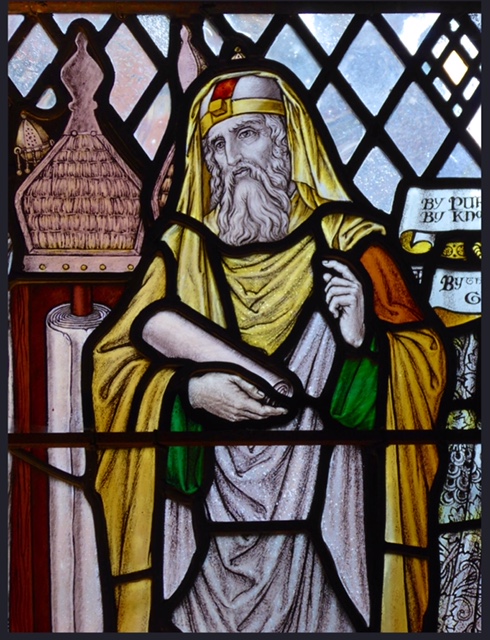
Gamaliel, from our first reading, has grown into such a love. It has freed him to respond to the Spirit even when the Spirit astounds, contradicts, and demands change.

Gamaliel said to the Sanhedrin…“So now I tell you,
have nothing to do with these men, and let them go.
For if this endeavor or this activity is of human origin,
it will destroy itself.

But if it comes from God, you will not be able to destroy them; you may even find yourselves fighting against God.”

Acts 5: 38-39

It seems that Gamaliel is speaking from experience. He likely had his big or little tussles with the Spirit along the now long road of his life. He has one even today as Jesus’s pesky disciples challenge Gamaliel’s long-held religious practice.


But it is likely that a prayer like Psalm 27 rose up in the heart of this longtime friend of God:

The LORD is my light and my salvation;
whom should I fear?
The LORD is my life’s refuge;
of whom should I be afraid?

For I am protected in the Lord’s shelter
when troubles threaten,
wrapped in the folds of the Lord’s tent,
set high upon the rock’s safety.

Psalm 27: 1,5

As we pray beautiful Psalm 27 today, may we remember our early, enthusiastic love. May we give thanks for the accumulated blessings of the years that have enriched and matured us in wisdom and faith. May we seek the courage to journey ever deeper into God’s heart.

I believe that I shall see the bounty of the LORD
    in the land of the living.
Wait for the LORD with courage;
    be stouthearted, and wait for the LORD.

Psalm 27: 13-14

Poetry: Old Age by Edmund Waller

The seas are quiet when the winds give o’er; 
So calm are we when passions are no more. 
For then we know how vain it was to boast 
Of fleeting things, so certain to be lost. 
Clouds of affection from our younger eyes 
Conceal that emptiness which age descries. 
The soul’s dark cottage, batter’d and decay’d, 
Lets in new light through chinks that Time hath made: 
Stronger by weakness, wiser men become 
As they draw near to their eternal home. 
Leaving the old, both worlds at once they view 
That stand upon the threshold of the new.

Music: Depths – Hillsong

Psalm 27: Unchained Psalmody

Memorial of Saint Agatha, Virgin and Martyr

February 5, 2021


Today, in God’s Lavish Mercy, we pray with Psalm 27, a song of intimate relationship with God. The psalmist is suffused with God’s Presence in the way morning light permeates the shadows.

The LORD is my light and my salvation;
    whom should I fear?
The LORD is my life’s refuge;
    of whom should I be afraid? 

Psalm 27:1

Because of this deeply abiding Love,  the psalmist fears nothing – not armies, nor any other threat to peace and grace-filled confidence.

Though an army encamp against me,
    my heart will not fear;
Though war be waged upon me,
    even then will I trust.

Psalm 27:3

We have little, or maybe big, wars at times, don’t we? Armies of pain, or sadness, struggle or confusion standing at the border of our hearts? In such times, Psalm 27 invites to remember and trust:

For God will hide me in the holy abode
    in the day of trouble;
will conceal me in the shelter of God’s tent,
    will set me high upon a rock.

With the psalmist, we pray with longing – we implore God to show us this comforting, protective love.

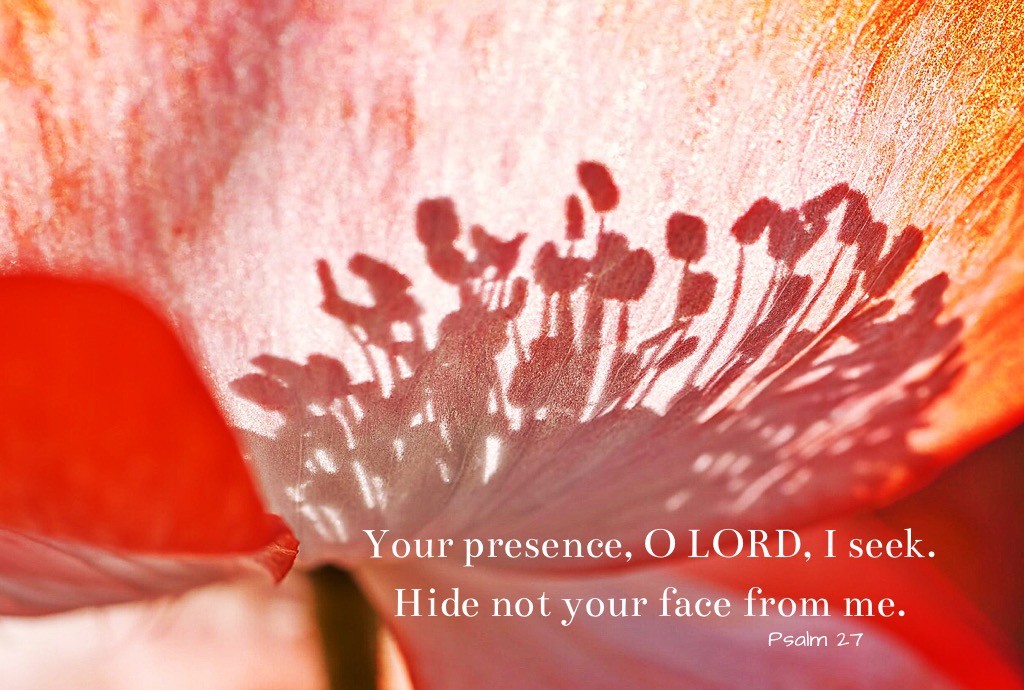
Your presence, O LORD, I seek.
Hide not your face from me;
    do not in anger repel your servant.
You are my helper: cast me not off.


Poetry: from The Spiritual Canticle – John of the Cross

Oh, then, soul, 
most beautiful among all creatures, 
so anxious to know 
the dwelling place of your Beloved 
so you may go in search of him 
and be united with him, 
now we are telling you that 
you yourself are his dwelling 
and his secret inner room and hiding place. 
There is reason for you to be elated 
and joyful in seeing that all your good and hope 
is so close as to be within you, 
or better, that you cannot be without him. 
Behold, exclaims the Bridegroom, 
the kingdom of God is within you.

Music: Unchained Melody – sung by Susan Boyle

Psalm 27 reminds me of this modern classic which, no doubt, was written about a different kind of love. But listening to the song as a prayer, a holy longing can be unchained in our spirits.

Psalm 24: The Gates Are Lifted

Feast of the Presentation of the Lord

February 2, 2021


Today, in God’s Lavish Mercy, we pray once more with Psalm 24, still knocking on God’s door. As it is the Feast of the Presentation, we might picture Anna and Simeon murmuring this psalm as they await the appearance of their Savior.

Lift up, O gates, your lintels;
    reach up, you ancient portals,
that the king of glory may come in!

Psalm 24: 7

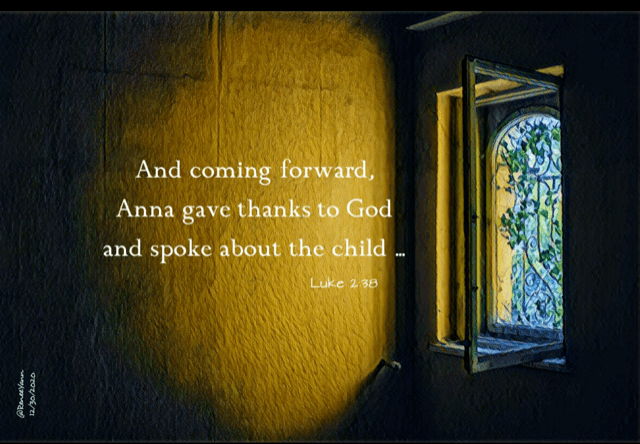
Anna and Simeon longed for the promised Redemption. They hoped and believed that Creation would be restored by the Messiah. They waited faithfully in the dark for the Light to come. And on that wondrous morning, sparks flew through the Temple door wrapped in a baby blanket!


In pre-Vatican II days, we nuns had sparse communication with our families. Throughout my over 1000 days of initial formation, I spoke with my mother fewer than 30 times. I stood it well because I was all wrapped up in my new life. But Mom languished. She pined for me and for our little daily chats.

So when the post-Vatican II era hit, Mom got on that phone. She called me every night just about seven o’clock – a brief, but treasured, check-in. Mom likened our phone calls to Stevie Wonder’s popular song at that time. Every now and again, even though it has been over thirty years, I still long for that ring.

For Mom and me, the gates had been unlocked, the lintels lifted up. The ancient portals had opened at the touch of John XXIII and his like-minded buddies. A mother-child light flowed back into us. We were both renewed by the reconnection.


On the Feast of the Presentation, we pray with Anna and Simeon, two so deeply practiced in prayer. As the child Jesus was carried into the Temple that morning, the plea of Psalm 24 was answered before their eyes. In our prayer today, let us joyfully welcome God into our hearts. Let us talk and walk with God as easily as we might with a beloved parent or a dearest friend on any given evening.

Lift up, O gates, your lintels;
    reach up, you ancient portals,
    that the God of glory may come in!

Poem: You, neighbor God, if sometimes in the night — Rainer Maria Rilke

You, neighbor God, if sometimes in the night
I rouse you with loud knocking, I do so
only because I seldom hear you breathe
and know: you are alone.
And should you need a drink, no one is there
to reach it to you, groping in the dark.

Always I hearken. Give but a small sign.
I am quite near.
Between us there is but a narrow wall,
and by sheer chance; for it would take
merely a call from your lips or from mine
to break it down,
and that without a sound.

The wall is builded of your images.
They stand before you hiding you like names.
And when the light within me blazes high
that in my inmost soul I know you by,
the radiance is squandered on their frames.

And then my senses, which too soon grow lame,
exiled from you, must go their homeless ways.

Music: He Walks with Me – Anne Murray

I come to the garden alone
While the dew is still on roses
And the voice I hear falling on my ear
The son of God discloses

And he walks with me and he talks with me
And he tells me I am his own
And the joy we share as we tarry there
None other has ever known

He speaks and the sound of his voice
Is so sweet, the birds hush their singing
And the melody that he gave to me
Within my heart is ringing

And he walks with me and he talks with me
And he tells me I am his own
And the joy we share as we tarry there
None other has ever known

Psalm 8: Hymn of the Universe

Memorial of Saint Ignatius of Antioch, Bishop and Martyr

October 17, 2020


Today, in God’s Lavish Mercy, we pray with Psalm 8.

O LORD, our LORD,
how glorious is your Name over all the earth!
You have exalted your majesty above the heavens.
Out of the mouths of babes and sucklings
you have fashioned praise ….

Psalm 8:2-3

Just yesterday, I got an email from the amazingly organized Sister who manages our grounds. She wanted to alert us that there would be a small “star-gazing” event this weekend, sponsored by our school, in case we might wonder about unusual nighttime visitors.


The note took me back to my own star-gazing days, residues of which percolate from time to time, especially during meteor showers. These days I do most of my “gazing” out our kitchen window, but when I studied for my certification in Earth Sciences, I had several opportunities for “instructed” star-gazing with excellent West Chester University astronomers. In a subsequent reflection, I described one such experience like this:

There are a few places where nature offers an experience of darkness so absolute it can be terrifying.  Assateague Island lies along the barrier coast of Virginia.  On a winter night, darkness there feels complete, enveloping.  As evening lengthens, night pulls its velvet canopy from the black ocean, covering the beach in silence. The whisper of rustling sea oats along invisible dunes is the only link to a land left behind.  But slowly, like sparks rolling through dry tinder, stars burn one by one through heaven’s blanket.  By midnight, their incomparable brilliance convinces the soul that it has never been and can never be alone.


Three thousand years ago, our psalmist felt the same way:

When I behold your heavens, the work of your fingers,
the moon and the stars which you set in place—
What are we  that you should be mindful of us,
we human beings that you should care for us?

Psalm 8:4-5

Charles Spurgeon, revered Baptist preacher, calls this psalm “the song of the Astronomer“, as gazing at the heavens inspires the psalmist to meditate on God’s creation and humanity’s place in it.

You have made us little less than the angels,
and crowned us with glory and honor.
You have given us rule over the works of your hands,
putting all things under our feet.

Psalm 8:6-7

Pope John Paul II said this:

 …. for those who have attentive ears and open eyes, creation is like a first revelation that has its own eloquent language: it is almost another sacred book whose letters are represented by the multitude of created things present in the universe. St. John Chrysostom says: “The silence of the heavens is a voice that resounds louder than a trumpet blast: this voice cries out to our eyes and not to our ears, the greatness of Him who made them.

General Audience – January 30, 2002

And our dear Pope Francis reiterates this thought so beautifully in his epic encyclical:

At the end, we will find ourselves face to face with the infinite beauty of God, and be able to read with admiration and happiness the mystery of the universe, which with us, will share in unending plenitude.

Laudato Si’

Let’s rest in all this beauty as we pray today with Psalm 8


Music: Beautiful Universe – Tim Janis

Psalm 1: The First Word

Wednesday of the Twenty-eighth Week in Ordinary Time

October 14, 2020


Today, in God’s Lavish Mercy, we pray with Psalm 1.

Patrick D. Miller, Hebrew Scriptures scholar, suggests that Psalm 1 “sets the agenda for the Psalter through its identification of the way of the righteous and the way of the wicked as well as their respective fates” along with “its emphasis on the Torah, the joy of studying it and its positive benefits for those who do“.

Blessed the one who follows not
the counsel of the wicked
Nor walks in the way of sinners,
nor sits in the company of the insolent,
But delights in the law of the LORD
and meditates on God’s law day and night.

Psalm 1:1-2

What does it really mean to “meditate on God’s law day and night”? Become a monk? Read the Bible all day? Never sleep?

Of course not. I think it means to live in the firm belief that God is in everything, and to train our hearts to see and respond to that Omnipresent Love.

We all know people who, no matter the circumstances, are focused on good and radiate a joyful confidence. There is a light within them and a peace around them. The living of their ordinary lives is a meditation on God’s order in all things.

Such a person …

… is like a tree
planted near running water,
That yields its fruit in due season,
and whose leaves never fade.
Whatever that faithful one does, prospers.

Psalm 1:3

It doesn’t mean there aren’t challenges … even protests, righteous anger, sadness and pain. Think of Jesus as he overturned the Temple tables!

It means rather that the focus is never lost because …
Creation’s sacred order is our Light;
and God’s law has taught ours hearts 
to find our joy in its Beauty.

my transliteration of Psalm 1:2

Let’s be that tree near
the running water of Grace!🙏


Poem: On Beauty by Khalil Gibran

And a poet said, Speak to us of Beauty.
     And he answered:
     Where shall you seek beauty, and how
shall you find her unless she herself be your
way and your guide?
     And how shall you speak of her except
she be the weaver of your speech?
    
The aggrieved and the injured say,
“Beauty is kind and gentle.
     Like a young mother half-shy of her
own glory she walks among us.”
     And the passionate say, “Nay, beauty is
a thing of might and dread.
     Like the tempest she shakes the earth
beneath us and the sky above us.”
    
The tired and the weary say, “Beauty is
of soft whisperings. She speaks in our spirit.
     Her voice yields to our silences like a faint
light that quivers in fear of the shadow.”
     But the restless say, “We have heard her
shouting among the mountains,
     And with her cries came the sound of
hoofs, and the beating of wings and
the roaring of lions.”
    
At night the watchmen of the city say,
“Beauty shall rise with the dawn from the
east.”
     And at noontide the toilers and 
the wayfarers say, 
“We have seen her leaning over
the earth from the windows of the sunset.”
    
In winter say the snow-bound, “She shall
come with the spring leaping upon the hills.”
     And in the summer heat the reapers say,
“We have seen her dancing with the autumn
leaves, and we saw a drift of snow in her hair.”
     All these things have you said of beauty,
     Yet in truth you spoke not of her but of
needs unsatisfied,
     And beauty is not a need but an ecstasy.
     It is not a mouth thirsting nor an empty
hand stretched forth,
     But rather a heart enflamed and a soul enchanted.
     It is not the image you would see nor the
song you would hear,
     But rather an image you see though you
close your eyes and a song you hear though
you shut your ears.
     It is not the sap within the furrowed bark,
nor a wing attached to a claw,
     But rather a garden for ever in bloom and
a flock of angels for ever in flight.
    
People of Orphalese, beauty is life when
life unveils her holy face.
     But you are life and you are the veil.
     Beauty is eternity gazing at itself in a mirror.
But you are eternity and you are the mirror.


Music: I Delight in You, Lord – David Baroni

Psalm 105: God at the Center

Saturday of the Twenty-seventh Week in Ordinary Time

October 10, 2020


Today, in God’s Lavish Mercy, we pray with Psalm 105, a recounting of the marvelous works God has done from the Abrahamic covenant to the Exodus.

Sing to God, sing praise,
proclaim all God’s wondrous deeds.
Glory in the Holy Name;
rejoice, O hearts that seek the LORD!

Psalm 105: 2-3

Our psalm today enjoins us to remember God’s faithful mercy to us and to praise God as we remember.

Such sacred “remembering” is an act of radical faith which, first, recognizes God as the Center of our life, and second, acts from that radical awareness.


The word “obedience”, so commonly misconstrued as subservience, is another way of describing this radical faith which hears, listens, acknowledges, responds and centers itself on the voice of God. The word “obedience” comes from the same root as the word “listen”.

This freely-given and continually deepened obedience allows us to hear and discern the loving truth God weaves through our lives.

The counter-world of the Psalms contradicts our closely held world of amnesia and mediates to us a world of lively remembering….
… In Psalm 105, a long recital of the great deeds climaxes, “in order that they might keep his statutes and observe his laws” (v. 45). The purpose of remembering is thus to evoke a contemporary practice of obedience in the wake of the memory. The implied negative is that when the inventory of miracles is forgotten, there will be no contemporary obedience .

Walter Brueggemann, From Whom No Secrets Are Hid

In the encyclical Fratelli Tutti, Pope Francis points out how this obedience, (this holy remembering, listening and acting), is tied to the course of human affairs. Francis quotes JPII here:

In this regard, I wish to cite the following memorable statement: “If there is no transcendent truth, in obedience to which the human person achieves full identity, then there is no sure principle for guaranteeing just relations between people. Their self-interest as a class, group or nation would inevitably set them in opposition to one another. If one does not acknowledge transcendent truth, then the force of power takes over, and each person tends to make full use of the means at their disposal in order to impose personal interests or opinion, with no regard for the rights of others… The root of modern totalitarianism is to be found in the denial of the transcendent dignity of the human person who, as the visible image of the invisible God, is therefore by very nature the subject of rights that no one may violate – no individual, group, class, nation or state.

St. John Paul II, Encyclical Letter Centesimus Annus (1 May 1991)

Rootedness in this “remembering obedience” begins with each person’s own sincere prayer. With the psalmist, let us remember God’s loving fidelity to us and, in grateful response, live that Love faithfully into our conflicted world:

Look to the LORD’s strength;
seek to serve the Lord constantly.
Recall the wondrous deeds that God has wrought,
the signs, and the graces God has spoken in your life.

Psalm 105: 4-5

Poem: Called to Become – Edwina Gateley

You are called to become
A perfect creation.
No one else is called to become
Who you are called to be.
It does not matter
How short or tall
Or thick-set or slow
You may be.
It does not matter
Whether you sparkle with life
Or are as silent as a still pool.
Whether you sing your song aloud
Or weep alone in darkness.
It does not matter
Whether you feel loved and admired
Or unloved and alone
For you are called to become
A perfect creation.
No one's shadow
Should cloud your becoming.
No one's light
Should dispel your spark.
For the Lord delights in you.
Jealously looks upon you
And encourages with gentle joy
Every movement of the Spirit
Within you.
Unique and loved you stand.
Beautiful or stunted in your growth
But never without hope and life.
For you are called to become
A perfect creation.
This becoming may be
Gentle or harsh.
Subtle or violent.
But it never ceases.
Never pauses or hesitates.
Only is—
Creative force—
Calling you
Calling you to become
A perfect creation.

Music: Psalm 105 – Give Thanks – Sean Dayton