The seed is the word of God, Christ is the sower; all who come to him will live for ever.
Encapsulating today’s Gospel, our Responsorial Psalm delivers the clear message that Christ sows the Word of God in our hearts. Will that Divine Seed be overwhelmed by selfish weeds? Or will it thrive? The answer comes with very high stakes – eternal life.
Today, in God’s Lavish Mercy: We pray for a fertile soul, open to God’s Word, vibrant with the Gospel of Christ.
Poetry:May we raise children who love the unloved things – Nicolette Sowder
May we raise children
who love the unloved things – the dandelion, the
worms & spiderlings.
Children who sense
the rose needs the thorn
& run into rainswept days
the same way they turn towards sun…
And when they’re grown &
someone has to speak for those
who have no voice
may they draw upon that
wilder bond, those days of
tending tender things
and be the ones.
Many of the Jews had come to Martha and Mary to comfort them about their brother [Lazarus, who had died]. When Martha heard that Jesus was coming, she went to meet him; but Mary sat at home. Martha said to Jesus, “Lord, if you had been here, my brother would not have died. But even now I know that whatever you ask of God, God will give you.” John 11:19-22
Jesus needed and had friends, just like we do. Martha, Mary, and Lazarus were that kind of close friends. Jesus could hang out at their house, be comfortable at their table. They loved when he visited, bustling about to tidy the house and make him a special meal. They could sit with him for the afternoon in the comfortable silence between close friends. And could expect him to share their joys and sorrows.
Today, in God’s Lavish Mercy: Jesus wants to be that kind of friend with us – sharing presence, refreshment, a quiet comfort, a lively conversation. He wants to share our ups and downs and in-betweens.He wants us to love him as he loves us.
Poetry: Malcolm Guite – The Anointing at Bethany
Come close with Mary, Martha, Lazarus so close the candles stir with their soft breath and kindle heart and soul to flame within us, lit by these mysteries of life and death. For beauty now begins the final movement in quietness and intimate encounter. The alabaster jar of precious ointment is broken open for the world’s true Lover. The whole room richly fills to feast the senses with all the yearning such a fragrance brings. The heart is mourning but the spirit dances, here at the very center of all things, here at the meeting place of love and loss, we all foresee, and see beyond the cross.
Music: Pour My Love on You by Craig and Dean Phillips
Jesus said, “Have the people recline.” Now there was a great deal of grass in that place. So the men reclined, about five thousand in number. Then Jesus took the loaves, gave thanks, and distributed them to those who were reclining, and also as much of the fish as they wanted. When they had had their fill, he said to his disciples, “Gather the fragments left over, so that nothing will be wasted.” So they collected them, and filled twelve wicker baskets with fragments from the five barley loaves that had been more than they could eat. John 6:10-13
Today’s readings are about being fed – not only in a physical sense, but also in a spiritual sense. Jesus’s miracle with the loaves and fishes fed a lot of hungry people, but it more importantly opened their eyes to his power to redeem them. It gave them hope, the spiritual food for which we all hunger.
Today, in God’s Lavish Mercy: We realize that the same Lavish Mercy which fed those on the ancient hillside feeds and transforms us throughout our lives. As Paul indicates in the second reading, it makes us one in the infinite abundance of God’s grace and call.
May we therefore “live in a manner worthy of the call we have received.”
Poetry: When a Little Was Enough – Irene Zimmerman, OSF
“Send the people away from this deserted place to find food and lodgings,” the twelve urged Jesus, “for the day is advanced and it is almost evening.”
Jesus looked at the crowd (there were about five thousand) and looked at his disciples, still excited and tired from their first mission journey.
What had they learned from the villagers of Galilee who shared bread and sheltered them from cold night winds? What had they learned of human coldness on the way?
He remembered the pain in his mother’s voice as she told of his birth night when they found no room in all of Bethlehem, House of Bread.
“You give them something to eat!” he said.
“We have only five loaves and two fish!” they protested. “How can we feed so many with so little?” He understood their incredulity.
They had yet to learn that a little was enough when it was all they had— that God could turn these very stones to bread.
“Have the crowd sit down in groups of fifty,” he said. Jesus took the food and looked up to heaven. He blessed it, broke it, gave it to the disciples to distribute to the new-formed churches.
Afterwards, when everyone was satisfied, the twelve filled twelve baskets of bread left over— as faith stirred like yeast within them.
Music: I Am – by Finding Favor
While you were sleeping While the whole world was dreaming I never left your side And I can promise I won’t be leaving
I watch you breathing And I hear you singing I feel your heart beat and I know every pain That you’re feeling
And I am the comfort when you are afraid I am the refuge when you call my name I was, I’ll be, I am
I know you’re broken You’re busted wide open You’ve fallen to pieces and you feel there’s nothing left You can hope in
But I’ll hold you together We’ll stand the weather Cause I paid the price for you And I won’t let you go, no never
And I am the comfort when you are afraid I am the refuge when you call my name I was, I’ll be, I am
And I am the future, and I am the past I am the first and I am the last I was, I’ll be, I am
I am the Father, I am the Son I am the Spirit, I am the One I was, I’ll be, I am
And I wore the thorns and I took the nails I am love, and love never fails I was, I’ll be, I am I am, I am, I am
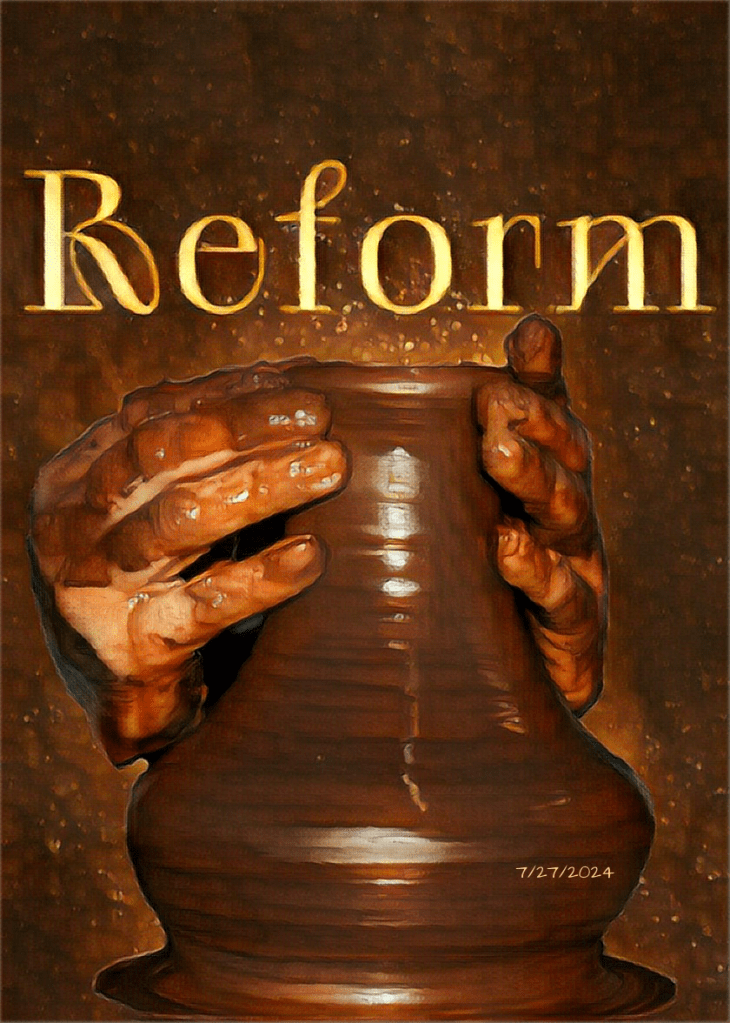
Thus says the LORD of hosts, the God of Israel: Reform your ways and your deeds, so that I may remain with you in this place. Put not your trust in the deceitful words: “This is the temple of the LORD! The temple of the LORD! The temple of the LORD!” Only if you thoroughly reform your ways and your deeds; if each of you deals justly with his neighbor; if you no longer oppress the resident alien, the orphan, and the widow; if you no longer shed innocent blood in this place, or follow strange gods to your own harm, will I remain with you in this place, in the land I gave your fathers long ago and forever. Jeremiah 7:3-7
Jeremiah tells the people that God wants to reform them in a very particular way. They are to be reshaped by justice, truthfulness, mercy, holy hospitality, non-violence, and faithful worship.
Today, in God’s Lavish Mercy: We examine our lives for where we need reformation. Don’t tell me you don’t need it. Everybody needs it. We get weary, distracted, hurt, stubborn, fooled, proud, and arrogant. These human conditions knock us out of spiritual shape. How great that God grants us the indulgence to reform and gladly assists us in the process!
Wisdom:
“In a higher world it is otherwise, but here below to live is to change, and to be perfect is to have changed often.”
But the seed sown on rich soil is the one who hears the word and understands it, who indeed bears fruit and yields a hundred or sixty or thirtyfold. Matthew 13:23
How appropriate, on this feast of Anne and Joachim, that the Gospel describes the abundant yield of love and fidelity. Those virtues in Anne and Joachim shaped the heart of Mary as the Vessel of God.
Today, in God’s Lavish Mercy: We gratefully remember those in our own lives who helped shape us by their faith, guardianship, and generosity – parents, grandparents, aunts and uncles, trusted mentors, generous friends.
Poetry: The Splendor Falls – Alfred Lord Tennyson
The splendor falls on castle walls
And snowy summits old in story;
The long light shakes across the lakes,
And the wild cataract leaps in glory.
Blow, bugle, blow, set the wild echoes flying,
Blow, bugle; answer, echoes, dying, dying, dying.
O, hark, O, hear! how thin and clear,
And thinner, clearer, farther going!
O, sweet and far from cliff and scar
The horns of Elfland faintly blowing!
Blow, let us hear the purple glens replying,
Blow, bugles; answer, echoes, dying, dying, dying.
O love, they die in yon rich sky,
They faint on hill or field or river;
Our echoes roll from soul to soul,
And grow forever and forever.
Blow, bugle, blow, set the wild echoes flying,
And answer, echoes, answer, dying, dying, dying.
I found a reference to this poem in a lovely reflection by Franciscan Sister Kathleen Murphy which you may read here:
Chorus: We are standing on the shoulders of the ones who came before us. They are giving us their courage, and they say we are glad you’re in this world.
May the strength of the ancestors encircle you. May the strength of the ancestors encircle you. And may this strength stay with you your whole life through. May the strength of the ancestors encircle you.
We are standing on the shoulders of the ones who came before us. They are giving us their courage, and they say we are glad you’re in this world.
Refrain: May you have all your choices. May you have all your voices. May your wisdom now be heard. They say we are glad you’re in this world.
May the trust of the ancestors be healing you. (2x) And may this trust stay with you your whole life through. May the trust of the ancestors be healing you.
We are lifting up our vision to the ones who will come after. We are sending them our courage, as they wait to come into this world.
Refrain: May you have all your choices. May you have all your voices. May your wisdom now be heard. They say we are glad you’re in this world.
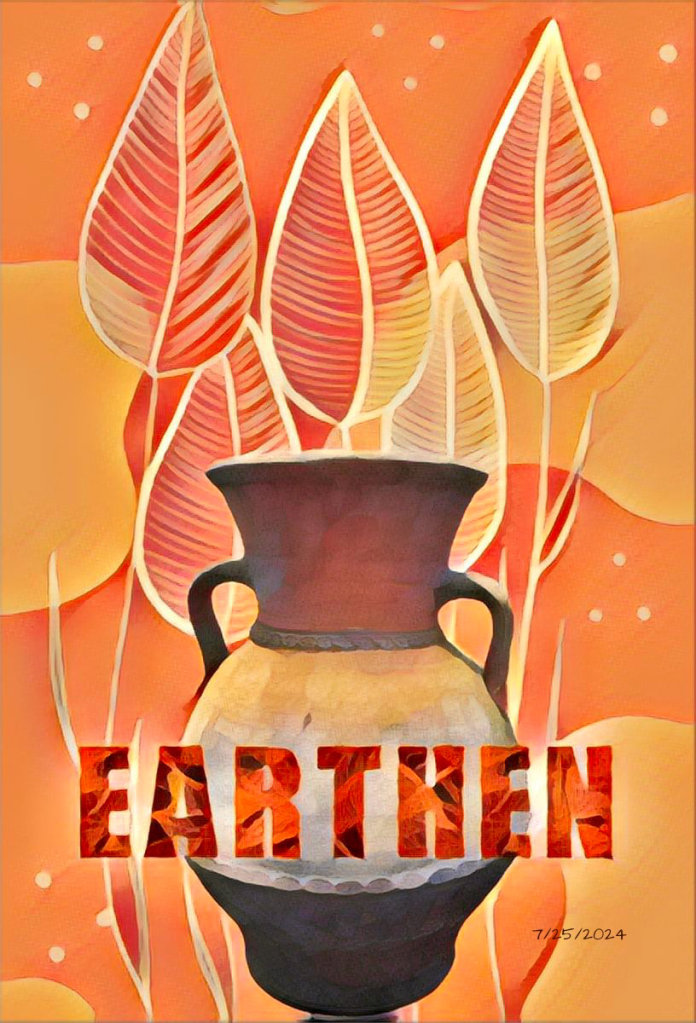
We hold this treasure in earthen vessels, that the surpassing power may be of God and not from us. We are afflicted in every way, but not constrained; perplexed, but not driven to despair; persecuted, but not abandoned; struck down, but not destroyed; always carrying about in the body the dying of Jesus, so that the life of Jesus may also be manifested in our body. For we who live are constantly being given up to death for the sake of Jesus, so that the life of Jesus may be manifested in our mortal flesh. 2 Corinthians 4:7-11
Today’s passage from Corinthians reminds us that any beauty and goodness in us is a gracious gift from God. That gift strengthens us beyond any human or personal capacity so that our lives may give God glory.
Today, in God’s Lavish Mercy: We prayerfully relax in the Potter’s hands Who shapes our lives according to Mercy. We realize with Paul that, even in affliction, we give glory to God by our fidelity and trust.
Poetry: Within this earthen vessel – Kabir, (1398–1518) a well-known Indian mystic poet and saint.
Within this earthen vessel are bowers and groves, and within it is the Creator: Within this vessel are the seven oceans and the unnumbered stars. The touchstone and the jewel-appraiser are within; And within this vessel the Eternal soundeth, and the spring wells up. Kabir says: “Listen to me, my Friend! My beloved Lord is within.”
Before I formed you in the womb I knew you, before you were born I dedicated you, a prophet to the nations I appointed you. “Ah, Lord GOD!” I said, “I know not how to speak; I am too young.” But the LORD answered me, Say not, “I am too young.” To whomever I send you, you shall go; whatever I command you, you shall speak. Have no fear before them, because I am with you to deliver you, says the LORD. Jeremiah 1: 5-8
This passage recounting the call of Jeremiah is full of tenderness and encouragement. God assures Jeremiah that the world is bigger than his present hesitations, fears, and inadequacies.
God has known him and been with him even before he was born.
Today, in God’s Lavish Mercy: We give thanks that God has been with us always, even before we were born. God accompanies us through whatever fears and hesitations we have in living a good and holy life. Trust is the key that opens our hearts to this blessed truth.
Poetry: Before the World Was Made – W.B. Yeats
In this intriguing poem, Yeats writes from the perspective of a woman whose efforts at physical beauty leave her unfulfilled. She longs for the spiritual beauty she possessed “before the world was made”.
If I make the lashes dark And the eyes more bright And the lips more scarlet, Or ask if all be right From mirror after mirror, No vanity’s displayed: I’m looking for the face I had Before the world was made.
What if I look upon a man
As though on my beloved,
And my blood be cold the while
And my heart unmoved?
Why should he think me cruel
Or that he is betrayed?
I’d have him love the thing that was
Before the world was made.
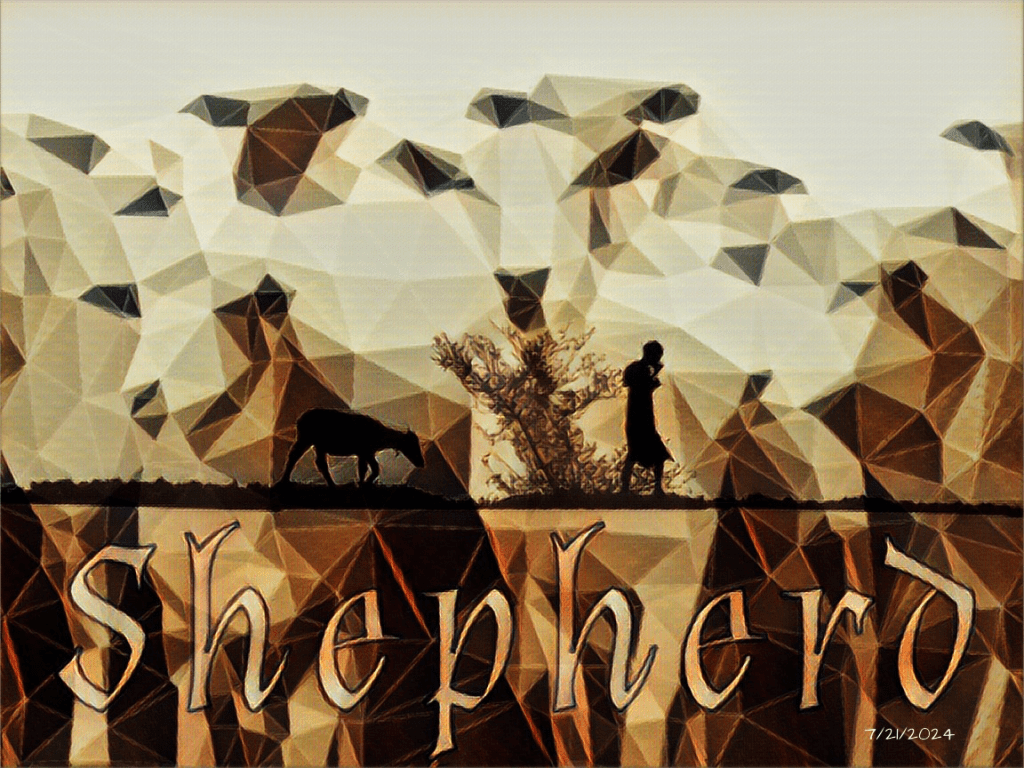
Shepherd your people with your staff, the flock of your inheritance, That dwells apart in a woodland, in the midst of Carmel. Let them feed in Bashan and Gilead, as in the days of old; As in the days when you came from the land of Egypt, show us wonderful signs… Who is there like you, the God who removes guilt and pardons sin for the remnant of his inheritance; Who does not persist in anger forever, but delights rather in mercy… Micah 7:14-15; 18
Micah prophesied about 700 years before Christ. His world was under siege by Sennacherib the Assyrian king. In the midst of this devastation, many abandoned the one true faith. But there was a small faithful portion of believers – the remnant – whom Micah sought to both warn and encourage by his prophecies.
Today, in God’s Lavish Mercy: We, too, live in a time of siege. Our faith is constantly challenged by our culture, our politics, religious institutionalization, and our self-serving economy.
But Micah reminds us that still God shepherds us tenderly. God awaits our recognition of God’s graces and call to be among the remnant who do not lose faith.
Poetry: Friday – Elizabeth Jennings (1926-2001) Jennings ranks among the finest British poets of the second half of the twentieth century. She is also England’s best Catholic poet since Gerard Manley Hopkins.
We nailed the hands long ago,
Wove the thorns, took up the scourge and shouted
For excitement's sake, we stood at the dusty edge
Of the pebbled path and watched the extreme of pain.

But one or two prayed, one or two
Were silent, shocked, stood back
And remembered remnants of words, a new vision,
The cross is up with its crying victim, the clouds
Cover the sun, we learn a new way to lose
What we did not know we had
Until this bleak and sacrificial day,
Until we turned from our bad
Past and knelt and cried out our dismay,
The dice still clicking, the voices dying away.
Music: Arise and Shine – New Wine
Not a pleasing piece of music, but perhaps what Micah would sound like were he preaching today?
The Bride says: On my bed at night I sought him whom my heart loves– I sought him but I did not find him. I will rise then and go about the city; in the streets and crossings I will seek Him whom my heart loves. I sought him but I did not find him. The watchmen came upon me, as they made their rounds of the city: Have you seen him whom my heart loves? I had hardly left them when I found him whom my heart loves. Song of Songs 3:1-48
This exquisite poem from the Song of Songs captures the spirit of Mary Magdalen who, throughout her life, sought a deep and transformative relationship with God.
When she anointed his feet, when she relentlessly sought him at the tomb, Mary longed for the Presence of Jesus. When she found Him whom she had sought, this premier Apostle of the Resurrection preached the first Easter news to her companions.
Today, in God’s Lavish Mercy:
We honor Mary Magdalen, so long mischaracterized in Church history. We ask to be inspired by her deep love of Jesus and resolute desire to be united with him.
Poetry: The Magdalen, a Garden, and This – Kathleen O’Toole
She who is known by myth and association as sinful, penitent, voluptuous perhaps… but faithful to the last and then beyond.
A disciple for sure, confused often with Mary, sister of Lazarus, or the woman caught in adultery, or she who angered the men
by anointing Jesus with expensive oils. She was the one from whom he cast out seven demons-she’s named in that account.
Strip all else away and we know only that she was grateful, that she found her way to the cross, and that she returned
to the tomb, to the garden nearby, and there, weeping at her loss, was recognized, became known in the tender invocation
of her name. Mary: breathed by one whom she mistook for the gardener, he who in an instant brought her back to herself-
gave her in two syllables a life beloved, gave me the only sure thing I’ll believe of heaven, that if it be, it will consist
in this: the one unmistakable rendering of your name.
Music: I Know That My Redeemer Liveth – G. F. Handel
Today’s Alleluia Verse encapsulates the theme of all the readings:
My sheep hear my voice, says the Lord; I know them, and they follow me.
John 10:27
Today, in God’s Lavish Mercy: We LISTEN – one of the hardest things to do in life. Really listen – to what we hear with our ears, but more importantly, what we hear with our hearts. God is always speaking to us. May we listen.
Poetry: You, Neighbor God – Ranier Maria Rilkë
You, neighbor god, if sometimes in the night I rouse you with loud knocking, I do so only because I seldom hear you breathe and know: you are alone. And should you need a drink, no one is there to reach it to you, groping in the dark. Always I hearken. Give but a small sign. I am quite near.
Between us there is but a narrow wall, and by sheer chance; for it would take merely a call from your lips or from mine to break it down, and that without a sound.
The wall is builded of your images.
They stand before you hiding you like names. And when the light within me blazes high that in my inmost soul I know you by, the radiance is squandered on their frames.
And then my senses, which too soon grow lame, exiled from you, must go their homeless ways.







 Lavish Mercy