Responsible Membership

Memorial of Saints Andrew Kim Tae-gŏn, Priest,
and Paul Chŏng Ha-sang, and Companions, Martyrs
September 20, 2023

Today’s Readings:

https://bible.usccb.org/bible/readings/092023.cfm


Today, in God’s Lavish Mercy, our readings lead us in prayer to the concept of responsible membership in community, specifically the Church.

Paul counsels Timothy in this regard, reminding the Ephesian community, whom Timothy shepherded, how profoundly graced they are in their Church membership :

… you should know how to behave in the household of God,
which is the Church of the living God,
the pillar and foundation of truth.
Undeniably great is the mystery of devotion,
Who was manifested in the flesh,
vindicated in the spirit,
seen by angels,
proclaimed to the Gentiles,
believed in throughout the world,
taken up in glory.


In today’s Gospel, Jesus assesses the “membership potential” of the surrounding crowd and finds it wanting. He compares them to a gaggle of immature children taunting and gossiping in the streets:

Jesus said to the crowds:
“To what shall I compare the people of this generation?
What are they like?
They are like children who sit in the marketplace and call to one another,

‘We played the flute for you, but you did not dance.
We sang a dirge, but you did not weep.’


Membership in any community is a serious commitment. It requires our sincere and charitable investment in the daily give-and-take of life.

As a creature of God, Who exists in the Trinitarian Community, every human being – even a hermit in the desert – subsists in some dimension of sustaining community. We live, and exchange life, in our families, neighborhoods, countries, world, and universe. We choose communities of faith, ministry, political belief, philosophical understanding, and social interaction. We have a bearing on the lives of those with whom we share the gifts of time and space.


These commitments, to be life-giving, demand our sincere, honest, and reverent participation. Community is never a perfect circle, but more like an interlaced wreath requiring courage to navigate, as David Whyte describes here:

Courage is the measure of our heartfelt participation with life, with another, with a community, a work; a future. To be courageous is not necessarily to go anywhere or do anything except to make conscious those things we already feel deeply and then to live through the unending vulnerabilities of those consequences.


Pope Francis has called all of us to a “culture of encounter”, a way of living together in compassionate community:

An invitation to work for “the culture of encounter”, in a simple way, “as Jesus did”: not just seeing, but looking; not just hearing, but listening; not just passing people by, but stopping with them; not just saying “what a shame, poor people!”, but allowing yourself to be moved with compassion; “and then to draw near, to touch and to say: ‘Do not weep’ and to give at least a drop of life”.

Pope Francis, in a 2016 homily on the Gospel of the Widow of Nain

Pope Francis has also said that the most common and insidious way to kill this culture of encounter is the evil of gossip:

Gossip is a weapon and it threatens the human community every day; it sows envy, jealousy and power struggles. It has even caused murder. Therefore, discussing peace must take into account the evil that can be done with one’s tongue.

Sometimes we become so used to gossip that we don’t even recognize it in ourselves and others. Sometimes our motivations, unexamined, seem innocent enough. However, consider this:

Some bad motivations are more wicked than others. Backstabbing gossip bent on revenge is birthed in malice and threatens to sink whole fellowships (2 Corinthians 12:19–13:2; 3 John 9–10). That kind of gossip is worse than being a busybody who is too interested in other peoples’ business (2 Thessalonians 3:11; 1 Peter 4:15). Yet Jesus said that we will give an account for every careless word we have spoken (Matthew 12:36), not just for the malicious ones.

Matt Mitchell, author – Resisting Gossip: Winning the War on the Wagging Tongue

We don’t want to be like the thoughtless children mocking and teasing in the streets. I know that, for me, it warrants taking a good look at myself, my investment in my many communities, and the reverence of my conversations about them.


Poetry: A Word by Emily Dickinson

A word is dead
When it is said,
Some say.
I say it just
Begins to live
That day.

Music: Neighbor, Neighbor – Jimmy Hughes

While this song presents a rather isolationist interpretation of relationships, it still has its valid points — and definitely a great beat to wake up your morning. 😉

Neighbor, neighbor, don’t wonder what goes on in my home
You’re always lookin’ for somethin’ to gossip about
You’re goin’ around from door to door
Runnin’ your mouth about things you don’t know
Neighbor, neighbor, don’t wonder what goes on in my home

[Verse 2]
Neighbor, neighbor, don’t worry how I make my bread
‘Cause my success is drivin’ you out of your head
You got in those troubles, my trouble, too
Something bad’s gonna happen to you
Neighbor, neighbor, don’t worry what goes on in my home

[Guitar Solo]

[Verse 3]
Neighbor, neighbor, don’t worry how I treat my wife
Quit tellin’ ev’rybody we fuss and fight ev’ry night
You’re sweepin’, peepin’ through the hall
Keepin’ your big ears glued to my wall
Neighbor, neighbor, don’t worry what goes on in my home

[Verse 4]
Neighbor, neighbor, don’t worry who knocks on my front door
You’re walkin’, a-talkin’, a-pacin’ all over the floor
You’re sweepin’, peepin’ through the hall
Keepin’ your big ears glued to my wall
Neighbor, neighbor, don’t worry who goes in and out of my door

Eternal Compassion

Tuesday of the Twenty-fourth Week in Ordinary Time
September 19, 2023

Today’s Readings:

https://bible.usccb.org/bible/readings/tuesday-twenty-fourth-week-ordinary-time


Today, in God’s Lavish Mercy, Paul gives the Church a job description for bishops. Obviously, there was a time when the worshipping community had significant input into the choice of its spiritual leaders. Therefore, Paul counsels the community to look for appointees who are well-balanced at:

  • the family level
  • the ministry level
  • the societal level

While directed toward bishops and deacons, Paul’s words could serve as an examen for anyone who professes to minister in God’s name.


nain

However, it is the Gospel story of the widow of Nain where my prayer rests today. Reading it, I remember standing by a large walkway window at the Louisville Airport on a sweltering July day nearly twenty years ago.

Down on the heat-softened tarmac, a small bevy of soldiers stood at attention. Slowly, a flag-draped casket was lowered into their waiting arms. Just to the side, a huddled family waited as well. Two children clung to either side of their young mother. An older couple stood behind her, hands gentled on her shoulders.

At the window with me, several other travelers gathered in silence. A few teenage boys removed their inverted baseball caps when they noticed a distinguished older gentleman stand tall and hold a salute.

No one who witnessed that brief ceremony will ever forget it. The grief, reverence and astonishment at life’s fragility emblazoned the moment on every witnessing heart.


When Jesus passed the gates of Nain on that ancient morning, he had a like experience. He saw this “only son of a widowed mother”. Once again, shaken to his roots with compassion –splancha– he pulled heaven down to heal heart-breaking loss.


How I wished Jesus were flying out of Louisville that day in 2005! But then I realized He was there. The miracle was hidden, but still real. The Divine Compassion flowed through me, through the reverent gathering beside me, through the soldiers’ honoring arms, through the long prayerful memory we would all forever share.


That young man from Nain was raised from the dead… but only for a while. He, like all of us, eventually died. The miracle was not about him and the restoration of his life. The miracle was the visible sign of God’s infinite compassion for his mother, and for all of us – God’s “feeling-with-us” in all our experiences. That compassion, whether miraculously visible or not, is always with us.

It just took a different form that day in Louisville.

military funeral

Poetry: First Born Sons and the Widow of Main by Irene Zimmerman, OSF

Jesus halted on the road outside Nain
where a woman’s wailing drenched the air.
Out of the gates poured a somber procession
of dark-shawled women, hushed children,
young men bearing a litter that held
a body swathed in burial clothes,
and the woman, walking alone.
A widow then—another bundle 
of begging rags at the city gates. 
A bruised reed! 
Her loud grief labored and churned in him till
“Halt!” he shouted.
The crowd, the woman, the dead man stopped.
Dust, raised by sandaled feet,
settled down again on the sandy road.
Insects waited in shocked silence.
He walked to the litter, grasped a dead hand.
“Young man,” he called
in a voice that shook the walls of Sheol,
“I command you, rise!”
The linens stirred.
Two firstborn sons from Nazareth and Nain
met, eye to eye.
He placed the pulsing hand into hers.
“Woman, behold your son,” he smiled.

Music:  I was reminded of this consoling country song for today’s prayer. Like much country music, it hits the heart where it matters, even if the theology is a little frayed.

God Only Cries – written by Tim Johnson, sung here by Diamond Rio
Lyrics below

On an icy road one night
A young man loses his life
They marked the shoulder with a cross
An’ his family gathers round
On a piece of Hallowed ground
Their hearts are heavy with their loss
As the tears fall from their eyes
There’s one who’ll always sympathise

God only cries for the living
‘Cause it’s the living that are left to carry on
An’ all the angels up in Heaven
They’re not grieving because they’re gone
There’s a smile on their faces
‘Cause they’re in a better place than…
They’ve ever known.

God only cries for the living
‘Cause it’s the living that are so far from home

It still makes me sad
When I think of my Grand-dad
I miss him each and every day
But I know the time will come
When my own grandson
Wonders why I went away
Maybe we’re not meant to understand
Till we meet up in the Promised Land

Diving In…

Monday of the Twenty-fourth Week in Ordinary Time
September 18, 2023

Today’s Readings:

https://bible.usccb.org/bible/readings/091823.cfm


Today, in God’s Lavish Mercy, our readings describe where two worlds meet and contend with each other – the world of the “divine understory” and the world of appearances.

What I mean by “understory” is this: every reality is more than it seems. There is a depth to everything, a depth that gives it meaning. As we achieve deeper relationship – learn the understory – of a person or a situation, we ourselves deepen in wisdom and move closer to encountering our ever-present God.


Paul gives us an example in our first reading:

First of all, I ask that supplications, prayers,
petitions, and thanksgivings be offered for everyone,
for kings and for all in authority,
that we may lead a quiet and tranquil life
in all devotion and dignity.

1 Timothy 2:1-2

It may appear that Paul is simply encouraging his followers to respect civil authorities and to pray for them. But in the next verses, it becomes clear that Paul is also reminding civil leaders that they are not gods and that Christians will not worship them as such.

This is good and pleasing to God our savior,
who wills everyone to be saved
and to come to knowledge of the truth.

For there is one God.
There is also one mediator between God and men,
the man Christ Jesus,
who gave himself as ransom for all.

1 Timothy 2:3-6

After his assassination in 27 BCE, Julius Caesar was soon proclaimed divine and accepted among the gods of the state, officially allowing for the initiation of his worship. Later in the first century CE, this type of Emperor Cult gradually developed in the whole Roman Empire as a unifying and politically stabilizing force. However, it gave rise to the custom of praying to the divinized Caesars.

In this kind of imperial milieu, the request in 1 Timothy 2:2 to pray “for kings” instead of “to the kings” takes on new meaning. It implies most ostensibly that rulers, like everybody else, depend on the guidance and mercy of God. Furthermore, it indirectly implies that they are not divine but mortal humans.

Dr. Christian A. Eberhart is Professor of Religious Studies, University of Houston.

Civil power is a power of appearances. God’s power is the “understory” of all human relationships. The more we all understand this truth, the more likely we are to achieve the equanimity Paul prays for:

.. that we may lead a quiet and tranquil life
in all devotion and dignity.
This is good and pleasing to God our Savior,
who wills everyone to be saved
and to come to knowledge of the truth.


The centurion in our Gospel harbored such a deep understanding. He realizes that there is a divine authority profoundly superseding any apparent power he possesses – to the extent that he feels unworthy even to be in its presence:

Lord, do not trouble yourself,
for I am not worthy to have you enter under my roof.
Therefore, I did not consider myself worthy to come to you;
but say the word and let my servant be healed.
For I too am a person subject to authority,
with soldiers subject to me.
And I say to one, Go, and he goes;
and to another, Come here, and he comes;
and to my slave, Do this, and he does it.”

Luke 7:6-8

Like the early Christians trying to live a Gospel life in the Roman Empire, we will encounter contradictions, challenges, and crosses. Paul’s advice and the centurion’s example may help us in our daily choices.

Luke tells us that Jesus was amazed at the profound faith motivating the centurion’s actions. Wouldn’t it be wonderful if our grace-filled choices could be that amazing too!

When Jesus heard this he was amazed at him
and, turning, said to the crowd following him,
“I tell you, not even in Israel have I found such faith.”

Luke 7:9

Poetry: The Way Under the Way by Mark Nepo

For all that has been written,
for all that has been read, we
are led to this instant where one
of us will speak and one of us will
listen, as if no one has ever placed
an oar into that water.

It doesn’t matter how we come
to this. We may jump to it or be
worn to it. Because of great pain.
Or a sudden raw feeling that this
is all very real. It may happen in a
parking lot when we break the eggs
in the rain. Or watching each other
in our grief.

But here we will come. With very
little left in the way.

When we meet like this, I may not
have the words, so let me say it now:
Nothing compares to the sensation
of being alive in the company of
another. It is God breathing on
the embers of our soul.

Stripped of causes and plans
and things to strive for,
I have discovered everything
I could need or ask for
is right here—
in flawed abundance.

We cannot eliminate hunger,
but we can feed each other.
We cannot eliminate loneliness,
but we can hold each other.
We cannot eliminate pain,
but we can live a life
of compassion.

Ultimately,
we are small living things
awakened in the stream,
not gods who carve out rivers.

Like human fish,
we are asked to experience
meaning in the life that moves
through the gill of our heart.

There is nothing to do
and nowhere to go.
Accepting this,
we can do everything
and go anywhere.


Music: O Lord, I Am Not Worthy – This is a Victorian era Communion hymn. It was originally published as four stanzas, without “O Sacrament Most Holy” which appears to have been later added to it as a chorus and/or an extra verse. The author and composer are unknown.

Although some of the hymn’s concepts are now theologically outdated, I remember it fondly as an inspirational part of my very young spirituality. Learning it at the time of my First Communion, the hymn helped me grow in intimacy with Jesus in the Holy Eucharist.

O Lord, I am not worthy
That Thou should’st come to me,
But speak the words of comfort,
My spirit healed shall be.

And humbly I receive Thee,
The bridegroom of my soul,
No more my sin to grieve Thee,
Nor fly Thy sweet control.

O Eternal Holy Spirit,
Unworthy tho’ I be,
Prepare me to receive Him,
And trust the Word to me.

Increase my faith, dear Jesus,
In Thy Real Presence here;
And make me feel most deeply
That Thou to me art near.

O Sacrament most holy,
O Sacrament divine!
All praise and all thanksgiving
Be ev’ry moment Thine.

Be Merciful

Twenty-fourth Sunday in Ordinary Time
September 17, 2023

Today’s Readings:

https://bible.usccb.org/bible/readings/091723.cfm


Today, in God’s Lavish Mercy, we pray with Psalm 103, and its gentle comforting refrain:

The Lord is kind and merciful, 
slow to anger, and rich in compassion.


Our Sunday readings encourage to become like this merciful, forgiving, patient, compassionate God.

I’m not doing so well at that. Anybody else with me? Sometimes I feel like we’re living in a desert devoid of humanness and reverence, and I am an unfortunate part of it!

Somehow, in our current political and cultural environment, too often I feel angry and even outraged. Those kinds of feelings don’t leave much room for compassion and its accompanying virtues!


Recently I witnessed two wonderful friends openly spat on social media because of their opposing political camps. I’ve seen family members shut each other out for the same reasons. We can’t turn on the TV without seeing a barrage of hateful words and actions unleashed against other human beings.

I feel poisoned and sick when I see the culture we have brewed for ourselves!


In our first reading, Sirach seems to have felt pretty sickened by his environment too. He counsels his listeners:

Forgive your neighbor’s injustice;
then when you pray, your own sins will be forgiven.
Could anyone nourish anger against another
and expect healing from the LORD?

Sirach 28:2-3

Paul, in our second reading, tells us why we should change our hateful behavior:

None of us lives for oneself, and no one dies for oneself.
For if we live, we live for the Lord,
and if we die, we die for the Lord;
so then, whether we live or die, we are the Lord’s.

Romans 14:7-8

In our Gospel, Jesus uses a stunning parable to drive home the commandment for forgiveness. I don’t think any of us really wants to end up like the selfish, wicked servant – handed over to the torture of our own hatreds.

Then in anger his master handed him over to the torturers
until he should pay back the whole debt.
So will my heavenly Father do to you,
unless each of you forgives your brother from your heart.

Matthew 18:35

This Sunday’s readings are serious. They’re not kidding. We have to change any sinful incivility or hate that resides in our hearts. We may not be able to change our feelings. But we can stop feeding them with lies, propaganda, and conspiracy theories.

What we can change are our actions and words. And we must.


Poetry: Love my enemies, enemy my love by Rebecca Seiferle

Oh, we fear our enemy’s mind, the shape
in his thought that resembles the cripple
in our own, for it’s not just his fear
we fear, but his love and his paradise .

We fear he will deprive us of our peace
of mind, and, fearing this, are thus deprived,
so we must go to war, to be free of this
terror, this unremitting fear, that he might

he might, he might. Oh it’s hard to say
what he might do or feel or think.
Except all that we cannot bear of
feeling or thinking—so his might

must be met with might of armor
and of intent—informed by all the hunker
down within the bunker of ourselves.
How does he love? and eat? and drink?

He must be all strategy or some sick lie.
How can reason unlock such a door,
for we bar it too with friends and lovers,
in waking hours, on ordinary days?

Finding the other so senseless and unknown,
we go to war to feel free of the fear
of our own minds, and so come
to ruin in our hearts of ordinary days.


Music: Kyrie Eleison – Lord, have Mercy

This is an extended, meditative singing of the prayer. I like to listen to it in the very early morning. Just doing that is a good prayer for me.

“Keeping” the Word

Memorial of Saints Cornelius, Pope, and Cyprian, Bishop, Martyrs
Saturday of the Twenty-third Week in Ordinary Time
September 16, 2023

Today’s Readings:

https://bible.usccb.org/bible/readings/091623.cfm


Today, in God’s Lavish Mercy, in his letter to Timothy, we see that Paul thought he had been the foremost of bad dudes.

This saying is trustworthy and deserves full acceptance:
Christ Jesus came into the world to save sinners.
Of these I am the foremost.

1 Timothy 1:15

Well, maybe – maybe not! It’s hard to imagine that a really bad guy could end up with the sacred portfolio Paul compiled before he met his maker. Jesus says as much in today’s Gospel:

A good tree does not bear rotten fruit,
nor does a rotten tree bear good fruit.
For every tree is known by its own fruit.

Luke 6:43-44

So let’s say Paul wasn’t really a “bad guy” before he got knocked off his Damascus-bound horse. Then what was he? The key word in Paul’s self-description is this: SINNER. Paul was a sinner.

Sinners are otherwise “good guys” who make bad choices for their spiritual lives. When those bad choices multiply and begin to feed on one another, the soul deteriorates like the rotten tree in Jesus’s image.


Jesus uses an additional metaphor to describe the process of continual spiritual conversion:

“Why do you call me, ‘Lord, Lord,’ but not do what I command?
I will show you what someone is like who comes to me,
listens to my words, and acts on them.
That one is like a man building a house,
who dug deeply and laid the foundation on rock;
when the flood came, the river burst against that house
but could not shake it because it had been well built.

Luke 6:46-48

We open our hearts to Mercy by these commitments to God’s Word in our daily spiritual life:

  • listening
  • acting
  • deepening

Integrity in these three spiritual practices requires dedicated prayer and reflection, a faithful “keeping” with the Word of God. As our Alleluia Verse assures us:

Alleluia, alleluia.
Whoever loves me will keep my Word,
and my Father will love them,
and we will come to them.

John 14:23

Poetry: [i carry your heart with me(i carry it in] – e.e.cummings

i carry your heart with me(i carry it in
my heart)i am never without it(anywhere
i go you go,my dear;and whatever is done
by only me is your doing,my darling)
i fear
no fate(for you are my fate,my sweet)i want
no world(for beautiful you are my world,my true)
and it’s you are whatever a moon has always meant
and whatever a sun will always sing is you
here is the deepest secret nobody knows
(here is the root of the root and the bud of the bud
and the sky of the sky of a tree called life;which grows
higher than soul can hope or mind can hide)
and this is the wonder that's keeping the stars apart

i carry your heart(i carry it in my heart)


Music: Remain in Me – Steve Angrisano

Her Joys and Her Sorrows

Memorial of Our Lady of Sorrows
September 15, 2023

Today’s Readings:

https://bible.usccb.org/bible/readings/091523.cfm


Today, in God’s Lavish Mercy, as we pray with Our Mother of Sorrows, we follow the liturgical cycle and return to Paul’s letter to Timothy for our first reading. However, we break from the cycle to honor Mary, Mother of Sorrows for our Gospel and Sequence.

What a solemn title this is for Mary! It is so much more comforting to think of her as the young, lively mother of Jesus, or the exuberant girl who happily visited her cousin Elizabeth.

But today, the Church remembers Mary’s suffering by which she intimately shared in Jesus’s redemption of the world.

At the cross her station keeping,
Stood the mournful Mother weeping,
Close to Jesus to the last.
Through her heart, his sorrow sharing,
All his bitter anguish bearing,
Now at length the sword had passed.

Mary’s life was full of both mind-blowing and heart-wrenching experiences!

  • Just imagine what it felt like to find an angel in one’s living room with an invitation to star in salvation history.
  • Imagine Mary’s pride, and perhaps frightened astonishment, at Cana when she tasted that “wine-formerly-known-as-water.”
  • Imagine how she fought the urge to slow Jesus down, to call him back to the comfort, safety and anonymity of their Nazareth home.
  • Imagine the utter bereavement of mind, heart, and spirit Mary suffered at the foot of the Cross.

Mary’s life was so full of joys and sorrows that there could be little in our lives she would not fully understand. Let’s be with her in prayer today, turning over our own blessings and difficulties with her – and those of our world – asking for her counsel and care.


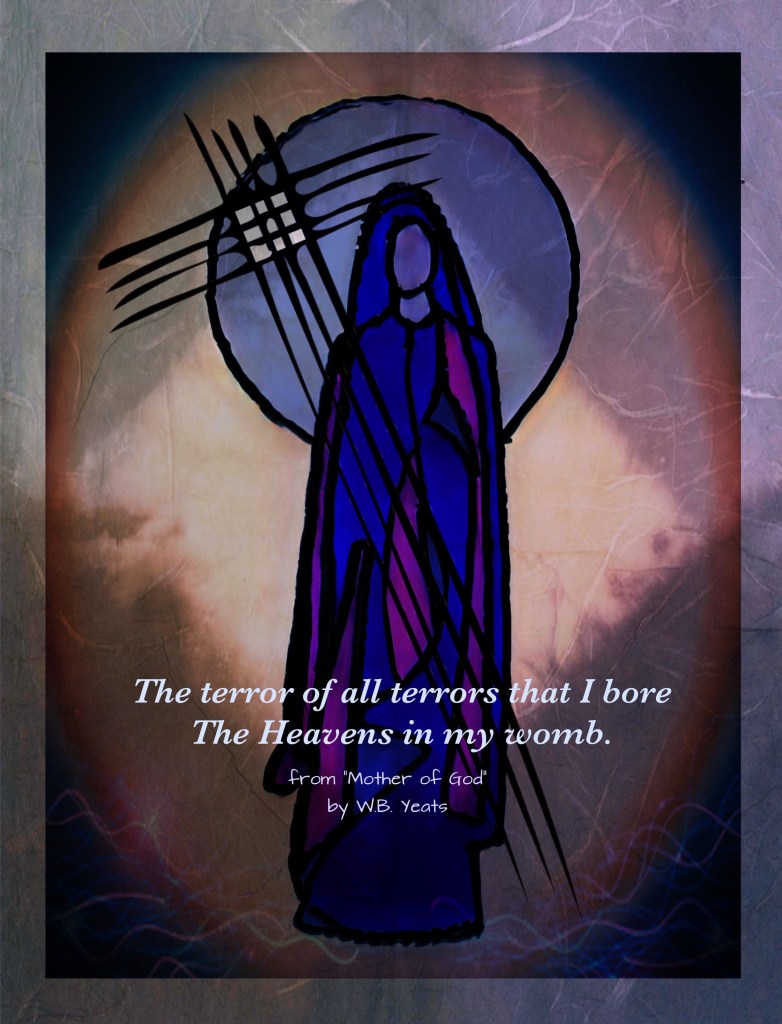
Poetry: Mother of God – W. B. Yeats

The threefold terror of love; a fallen flare
Through the hollow of an ear;
Wings beating about the room;
The terror of all terrors that I bore
The Heavens in my womb.
Had I not found content among the shows
Every common woman knows,
Chimney corner, garden walk,
Or rocky cistern where we tread the clothes
And gather all the talk?
What is this flesh I purchased with my pains,
This fallen star my milk sustains,
This love that makes my heart’s blood stop
Or strikes a Sudden chill into my bones
And bids my hair stand up?

Music: Mary’s Heart – Danielle Rose

Oh Mary
Mother of Jesus
Give me your heart
That I might receive Jesus
Give me your heart
So beautiful, so pure
So immaculate, so full
Of love and humanity

Oh Mary
Mother of Jesus
Give me your heart
That I might receive Jesus
Give me your heart
To love him as you loved him
And serve him as you served him
In the distressing disguise of the poorest of the poor

Oh Mary
Mother of Jesus
Give me your heart
That I might receive Jesus
In the bread of life
In the poorest of the poor
In distressing disguise
In Christ our Lord
In the bread of life
In the poorest of the poor
In distressing disguise
In Christ our Lord

Oh Mary
Mother of Jesus
Give me your heart
That I might receive Jesus
Jesus

We Adore You, O Christ

Feast of the Exaltation of the Holy Cross
September 14, 2023

Today’s Readings:

https://bible.usccb.org/bible/readings/091423.cfm


Today, in God’s Lavish Mercy, we pray with Psalm 78 which commands us:

Do not forget the works of the Lord!


The psalm, in its entirety, is a recital of God’s faithfulness to Israel over time, culminating in the triumph of David/Jerusalem/Temple.

God chose David his servant,
took him from the sheepfolds.
From tending ewes God brought him,
to shepherd Jacob, the people,
Israel, God’s heritage.
He shepherded them with a pure heart;
with skilled hands he guided them.

Psalm 78: 70-73

David foreshadows Jesus, the Good Shepherd who not only tends the sheep but becomes the Lamb of God. Jesus completes our salvation by his death on the Cross. In him, the long journey of Psalm 78 is ultimately fulfilled.


Philippians’ exquisite hymn captures the profound nature of that fulfillment:

Christ Jesus, though he was in the form of God,
    did not regard equality with God something to be grasped.
    Rather, he emptied himself,
    taking the form of a slave,
    coming in human likeness;
    and found human in appearance,
    he humbled himself,
    becoming obedient to death,
    even death on a cross.

Philippians 2:5-8

Each of our lives reflects, in its own way, the salvation journey we find in scripture. We experience the same kind of twists and turns, highs and lows as those described in Psalm 78.

In each of these moments, we are held in the mystery of the Cross wherein Christ transforms all suffering to grace:

Because of this, God greatly exalted him
    and bestowed on him the name
    that is above every name,
    that at the name of Jesus
    every knee should bend,
    of those in heaven and on earth and under the earth,
    and every tongue confess that
    Jesus Christ is Lord,
    to the glory of God the Father.

Philippians 2:9-11

Poetry: Good Friday – Christina Rossetti (1830-1894)

Am I a stone and not a sheep 
That I can stand, O Christ, beneath thy cross, 
To number drop by drop Thy blood’s slow loss, 
And yet not weep?
Not so those women loved 
Who with exceeding grief lamented thee; 
Not so fallen Peter weeping bitterly; 
Not so the thief was moved;
Not so the sun and moon 
Which hid their faces in a starless sky, 
A horror of great darkness at broad noon— 
I, only I.
Yet give not o’er, 
But seek thy sheep, true Shepherd of the flock; 
Greater than Moses, turn and look once more 
And smite a rock.


Music: Adoramus Te, Christe

Simplicity Yields Freedom

Memorial of Saint John Chrysostom, Bishop and Doctor of the Church
September 13, 2023

Today’s Readings:

https://bible.usccb.org/bible/readings/091323.cfm


Today, in God’s Lavish Mercy, our Gospel gives us a quick and intense course in the upside-down, inside-out world of Jesus Christ. The course is known by various names:

  • the Blessings and Woes
  • the Sermon on the Plain
  • the “other” Beatitudes

But the passage might just as well be called, “The Loving Slap in the Face Wake-up Call”.


Picture it. The Twelve have just been commissioned by Jesus as his Apostles (refer to yesterday’s Gospel). I mean this is a big deal! They’ve passed the toughest job interview ever … to stand in for God in the world! They probably want to go home and tell their families, “Guess what! I have a new, fabulous job!”


But then Jesus gives them the orientation manual – the Blessings and Woes – and it’s shocking!

“Blessed are you who are poor,
for the Kingdom of God is yours.
Blessed are you who are now hungry,
for you will be satisfied.
Blessed are you who are now weeping,
for you will laugh.
Blessed are you when people hate you,
and when they exclude and insult you,
and denounce your name as evil
on account of the Son of Man.”


Really? This is what will make me successful in this new gig?

I am called to honor and accompany those who are poor, hungry, heartbroken, hated, excluded and insulted? THEY are the blessed, the “successful” in God’s estimation?


Like many of us, the Apostles may have thought success looked just the opposite – a lot of money, extravagant possessions, careless jocularity, universal adulation, and unquestioned consumption of common resources. You know. – a big boat, a lot of fish, an unconscious immunity from worrying about the poor, hungry guy outside the boatyard.


Jesus turns all of this upside-down and inside-out. He warns that excessive satisfaction with the world’s goods distracts us from true life in God. It hardens us against a loving compassion for one another. It weakens our capacity to receive the immense joy and freedom of life in the Spirit. Jesus calls us to a simplicity of heart that frees us to see and love God in ourselves and others.


As we proceed through Luke’s Gospel, Jesus continues to teach his apostles its contradictory truth. Eleven of the aspirants absorbed his words, transforming their life in a holy “inversion”. Only one, in the long run, proved resistant.

Where might we find ourselves if we stood among them?


Poetry: by C. Austin Miles

A little more kindness, a little less creed
A little more giving, a little less greed
A little more smile, a little less frown
A little less kicking, A man when he's down
A little more "we" a little less "I",
A little more laugh, a little less cry,
A little more flowers on the pathway of life
And fewer on graves at the end of the strife.

Music: A Simple Man – by Lynyrd Skynyrd

Rooted in God

Tuesday of the Twenty-third Week in Ordinary Time
September 12, 2023

Today’s Readings:

https://bible.usccb.org/bible/readings/091223.cfm


Today, in God’s Lavish Mercy, we hear Paul’s beautiful encouragement to the Colossians to rejoice in their radical union with Christ. This unity, Paul points out, should be the cause for profound thanksgiving and steadfast fidelity.

The world against which Paul cautions his readers sounds similarly antagonistic as our own:

See to it that no one captivate you
with an empty, seductive philosophy
according to the tradition of men,
according to the elemental powers of the world
and not according to Christ.

Colossians 2:8

The command to “see to it” is a bit intimidating. Paul is saying, “It’s on you, buddy, to stay on course now that you have chosen Christ.” Well just how am I supposed to do that, Paul, in this messy world????

Paul doesn’t leave us simply to our own resources. He reminds us of this powerful truth:

You were buried with Christ in baptism,
in which you were also raised with him
through faith in the power of God,
who raised him from the dead.

Colossians 2:12

Through Baptism, and through living a Baptismal life, we have experienced our own Resurrection in Christ! We are no longer rooted in the destructible shell of this world. We are tethered to its heart which is the fullness of God.

For in Christ dwells the whole fullness of the deity bodily,
and you share in this fullness in him,
who is the head of every principality and power.

Colossians 2:9-10

In North America, we are coming into the heart of hurricane season. Even if our neighborhood doesn’t suffer a direct hit, we often feel the powerful fringe effects of a passing storm. Some of our trees stand fast in such winds; some do not.

So it is with us who set out to follow Christ. If we forget our roots, failing to nourish them in the graces offered us, the winds will overcome us. And the overcoming doesn’t have to look as dramatic as a hurricane. It manifests itself in the small, constant choices for self rather than others – those tiny, debilitating acts of uncharity, indifference, judgementalism, gossip, and self-indulgence. These small branches, when they fall one after another from the tree, eventually leave it bare against the heavens.


Our Alleluia Verse reminds us that we, like the disciples in today’s Gospel, were not chosen to splinter in the wind, but to flourish in the grace of our call, bearing fruit toward eternity:

I chose you from the world,
that you may go and bear fruit that will last,
says the Lord.

John 15:16

Poetry: from Rumi

Everything you see 
has its roots in the unseen world.
The forms may change,
yet the essence remains the same.
Every wonderful sight will vanish,
every sweet word will fade,
But do not be disheartened,
The source they come from is eternal, growing,
Branching out, giving new life and new joy.
Why do you weep?
The source is within you
And this whole world is springing up from it.

Music: The Memory of Trees – Enya

September 11, 2023

Let us remember, heal, learn, choose, and act.

Remembering

Any of us over thirty years old remembers where we were on September 11, 2001. Like our elders who remember Pearl Harbor and President Kennedy’s assassination, current generations will always be marked by that infamous day.
Evil became visible that day. We saw its face in the terrorists.
We saw its deadly scars on 2,819 innocent people and their loved ones.
We have watched its echoes across a score of years that have become more vigilant and less trusting.
Besides the victims in the Twin Towers, the Pentagon, and Shanksville, so much else died on September 11th. Innocence died; universal trust died; unconditional acceptance died. And with their loss, our national soul was put in jeopardy.

Healing
But within a few hours of the attacks, we saw the human spirit raise its head. Acts of
tremendous courage, love, support, and generosity became the new face of September 11th. A dormant patriotism was unfurled in millions of flags across America. Who will ever forget how KIND we became to one another when faced with the reality of one another’s loss.

Learning
And so, all indications to the contrary, we learn even from the darkest evil. Throughout history, good people have learned from bad things. Consider these magnanimous leaders:

The Holocaust:

In spite of everything, I still believe that people are truly good at heart….that
this cruelty too will end…

Anne Frank, who died in a Nazi concentration camp

War:

Every gun that is made, every warship launched, every rocket fired signifies, in the final
sense, a theft from those who hunger and are not fed, those who are cold and not clothed.

Dwight D. Eisenhower, Supreme Commander, Allied Forces, World War II

Institutionalized Slavery:

I had reasoned this out in my mind, there was one of two things I had a right to, liberty or death; if I could not have one, I would have the other.

Harriet Tubman, formerly enslaved woman who navigated the ‘Underground Railroad

Choosing
What have we learned from September 11th and who will we choose to be as a result of our learning? All of us want a better world for ourselves and for our children. We want less fear and more trust. We want less struggle and more peace. We want less tension and more
freedom. What we want will never come to us unless we choose to live it into being.
Leading such change requires great bravery. Mahatma Gandhi said this, A coward is incapable of exhibiting love; it is the prerogative of the brave.


Acting
So, on this 22nd Commemoration of September 11th, let us be brave enough to change the world. Courage and kindness stand side by side because they both require self-sacrifice. As a way of healing and remembering, perhaps we could do one act of anonymous, unrewarded kindness.
Do it to make the world kinder, to contribute to a legacy for the future, to send a message that evil never triumphs, and to honor the lives that were lost on September 11, 2001.

Some ideas that won’t cost you much (from helpothers.org):

  • Treat someone to a cup of their favorite coffee
  • Pay the toll for the person behind you
  • Write a note of appreciation to someone
  • Smile from your heart when you meet people.
  • Greet others when you pass them.
  • Buy flowers for someone who is having a rough time.
  • Call someone who lost a friend or beloved recently
  • Leave a good book out for others.
  • Instead of following normal tipping etiquette, leave a little extra.
  • Be kind to someone who isn’t always kind to you.
  • Pay someone’s expired parking meter.
  • If you experience great service, compliment the worker and tell their manager.
  • Give sincere compliments whenever you can.
  • Leave the coupons you didn’t use at the register for someone else.
  • Spend time with people who might be lonely and just need to talk.