The Pretender

Wednesday of Holy  Week
April 5, 2023

Today’s Readings:

https://bible.usccb.org/bible/readings/040523.cfm
Today, in God’s Lavish Mercy, we stand beside Jesus in a tangled world of insults, violence,  plots, and dirty money. How sickening and painful such an atmosphere must have been to him who is Love and Divine Innocence. The psalmist describes the pain like this:

Insult has broken my heart, and I am weak,
I looked for sympathy, but there was none;
for consolers, not one could I find.
Rather they put gall in my food,
and in my thirst they gave me vinegar to drink.

Psalm 69: 21-22

Despite such trauma, we see Christ’s trust and holy determination to embrace the Father’s Will however it is revealed to him.

The Lord GOD is my help,
therefore I am not disgraced;
I have set my face like flint,
knowing that I shall not be put to shame.
Isaiah 50:7

As we look to Jesus’s fidelity to find courage in our own challenges, we must also be starkly aware of what opposing infidelity looks like. We see it in the face of Judas – the Pretender who reclines at the Lord’s table, still eats the sacred food, dissembles his innocence while the blood-coins jingle in his pocket.

Once again, as the Passion story unfolds before us, we can find ourselves somewhere – perhaps many places – in its lines. Wherever that is, let us pray there with Jesus to be open in trust and fidelity to its transformative grace.


Poetry: Slow through the Dark – Paul Lawrence Dunbar

Slow moves the pageant of a climbing race;
   Their footsteps drag far, far below the height,
   And, unprevailing by their utmost might,
Seem faltering downward from each hard won place.
No strange, swift-sprung exception we; we trace
   A devious way thro’ dim, uncertain light,—
   Our hope, through the long vistaed years, a sight
Of that our Captain’s soul sees face to face.

   Who, faithless, faltering that the road is steep,
Now raiseth up his drear insistent cry?
   Who stoppeth here to spend a while in sleep
Or curseth that the storm obscures the sky?
   Heed not the darkness round you, dull and deep;
The clouds grow thickest when the summit’s nigh.


Music: The Betrayal of Judas – George Sviridov

The Twisted Kiss

Tuesday of Holy Week
April 4. 2023

Today’s Readings:

https://bible.usccb.org/bible/readings/040423.cfm

Today, in God’s Lavish Mercy, the clouds thicken around Jesus.

Reclining at table with his disciples, Jesus was deeply troubled and testified,
“Amen, amen, I say to you, one of you will betray me.”
The disciples looked at one another, at a loss as to whom he meant.

John 13:21

How painful for Jesus, and for these who have shared the glorious years of his ministry, to now sit with suspicion among yesterday’s friends. How lonely for each one as the dark force of doubt pushes them away from one another!

Only love can break through this kind of doubt, courageously exposing the truth in order that it might be reconciled and offered forgiveness:

One of his disciples, the one whom Jesus loved,
was reclining at Jesus’ side.
So Simon Peter nodded to him to find out whom he meant.
He leaned back against Jesus’ chest and said to him,
“Master, who is it?”

Jesus answered,
“It is the one to whom I hand the morsel after I have dipped it.”
So he dipped the morsel and took it and handed it to Judas,
son of Simon the Iscariot.

John 13: 21-26

As the rest of the Passion story unfolds, both Judas and Peter will need the kind of forgiveness these readings describe. Both prove false to Jesus’s trust. But one has the humble contrition to seek forgiveness. The other cannot forget himself enough to do so.


This “doubtful Tuesday” can teach us much about expectations, courage, truth, love, trust, humility, and forgiveness. Let us sit beside Jesus at the Gospel table and ask him, like the Disciples, how we measure up to his hope for us.


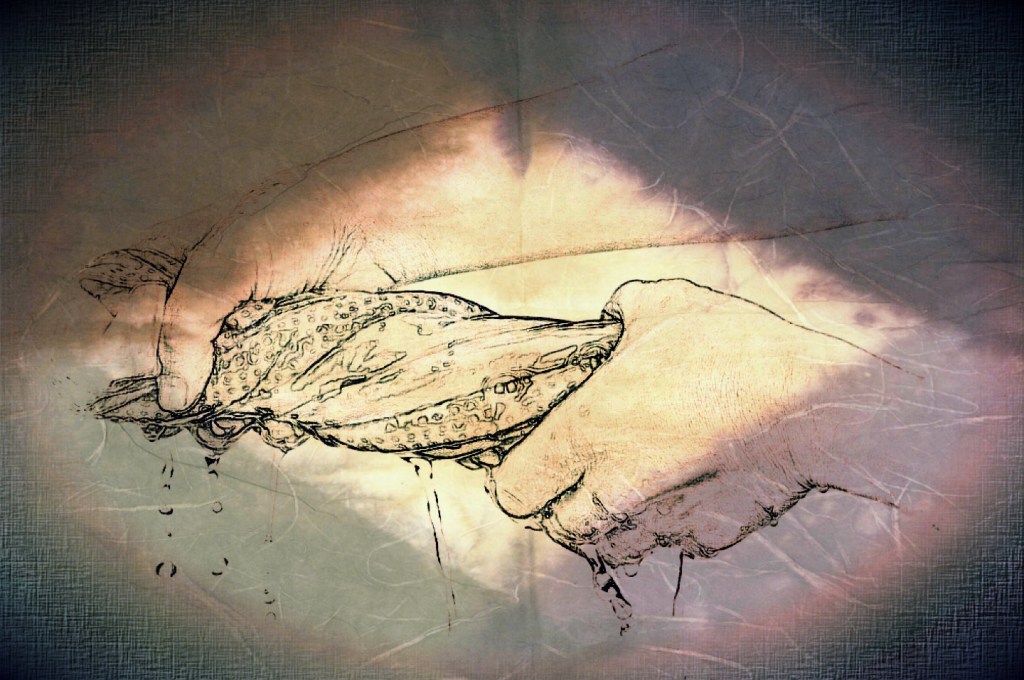
Poetry: Christ Washed the Feet of JudasGeorge Marion McClellan

Christ washed the feet of Judas!
The dark and evil passions of his soul,
His secret plot, and sordidness complete,
His hate, his purposing, Christ knew the whole.
And still in love he stooped and washed his feet.

Christ washed the feet of Judas!
Yet all his lurking sin was bare to him,
His bargain with the priest, and more than this,
In Olivet, beneath the moonlight dim,
Aforehand knew and felt his treacherous kiss.

Christ washed the feet of Judas!
And so ineffable his love ’twas meet,
That pity fill his great forgiving heart,
And tenderly to wash the traitor’s feet,
Who in his Lord had basely sold his part.

Christ washed the feet of Judas!
And thus a girded servant, self-abased,
Taught that no wrong this side the gate of heaven
Was ever too great to wholly be effaced,
And though unasked, in spirit be forgiven.

And so if we have ever felt the wrong
Of Trampled rights, of caste, it matters not,
What e’er the soul has felt or suffered long,
Oh, heart! this one thing should not be forgot:
Christ washed the feet of Judas


Music:  The Kiss – Joe Niemand 

Meet me in the garden
My love
Meet me there at midnight

At the place only we know
My love
A kiss awaits tonight

In the darkness between the flowers
My love
In the shadows of the moon

Your lips will tear the pretense like the curtain tomorrow afternoon

And so the glow of approaching torches
Makes the darkness dance like black flames
Ever faster to the music of every heart that refuses to be saved

I prayed this could be different
That my death could save you too
But your choices are your own
Now my friend, do what you came to do

Day of Light and Darkness

Monday of Holy Week
April 3, 2023

Today’s Readings:

https://bible.usccb.org/bible/readings/040323.cfm

Today, in God’s Lavish Mercy we find Jesus standing at the edge of Light and Darkness.

Isaiah, speaking in the Father’s voice, summons and commissions Jesus to the act of Redemption:

Thus says God, the LORD,
who created the heavens and stretched them out,
who spreads out the earth with its crops,
Who gives breath to its people
and spirit to those who walk on it:

I, the LORD, have called you for the victory of justice,
I have grasped you by the hand;
I formed you, and set you
as a covenant of the people,
a light for the nations,

To open the eyes of the blind,
to bring out prisoners from confinement,
and from the dungeon, those who live in darkness.

Isaiah 42: 1-8

The divine mandate is triumphant in tone and looks to the other side of Good Friday for its power and hope. But Jesus is no fool. He realizes that Sunday’s paper-thin adulation will shrivel in the coming week’s turmoil. He knows that before the Alleluias sound there will be a sorrowful adagio.

So as enemies seethe in Jerusalem’s shadows, Jesus seeks the light and warmth of his beloved friends. Among them, Mary in particular reaches into his silence, touching threads of hope tangled with disappointment, of courage knotted with fear.

In Bethany, they gave a dinner for him, and Martha served,
while Lazarus was one of those reclining at table with him. 
Mary took a liter of costly perfumed oil
made from genuine aromatic nard
and anointed the feet of Jesus and dried them with her hair;
the house was filled with the fragrance of the oil.

John 12: 1-3

Into this warm comfort, Judas injects his icy venom. This is no surprise to John who clearly describes Judas not as a spontaneous betrayer, but as a long-smoldering “thief” who had never fully embraced his discipleship:

Then Judas the Iscariot, one of his disciples,
and the one who would betray him, said,
“Why was this oil not sold for three hundred days’ wages
and given to the poor?”
He said this not because he cared about the poor
but because he was a thief and held the money bag
and used to steal the contributions.

John 12: 4-6

Today’s readings are filled
with the emotions and personalities
that Jesus experienced.
We will find ourselves
somewhere among these
as we walk by his side
toward Calvary.


Poetry: I Should Not Dare to Leave My Friend – Emily Dickinson

I should not dare to leave my friend,
Because—because if he should die
While I was gone—and I—too late—
Should reach the Heart that wanted me—
If I should disappoint the eyes
That hunted—hunted so—to see—
And could not bear to shut until
They ‘noticed’ me—they noticed me—
If I should stab the patient faith
So sure I’d come—so sure I’d come—
It listening—listening—went to sleep—
Telling my tardy name—
My Heart would wish it broke before—
Since breaking then—since breaking then—
Were useless as next morning’s sun—
Where midnight frosts—had lain!

Music: Gautier Capuçon & friends play Adagio in G minor (Albinoni, arr. Werner Thomas-Mifune)

We Begin Again

Palm Sunday of the Lord’s Passion
April 2, 2023

Today’s Readings:

https://bible.usccb.org/bible/readings/040223.cfm

Today, in God’s Lavish Mercy, we begin once again – and we know the journey so well.

When Jesus and the disciples drew near Jerusalem
and came to Bethphage on the Mount of Olives,
Jesus sent two disciples, saying to them,
“Go into the village opposite you,
and immediately you will find an ass tethered,
and a colt with her.
Untie them and bring them here to me.

Matthew 21:1-2

We have traveled this story many times with Jesus. We have seen the Sunday-green palms shrivel and darken by Friday. We have heard the careless cheers turn to frightened whispers. We have seen the thick crowd thin with fear and faithlessness.

The very large crowd spread their cloaks on the road,
while others cut branches from the trees
and strewed them on the road.
The crowds preceding him and those following
kept crying out and saying:
“Hosanna to the Son of David;
blessed is he who comes in the name of the Lord;
hosanna in the highest.”
And when he entered Jerusalem
the whole city was shaken and asked, “Who is this?”
And the crowds replied,
“This is Jesus the prophet, from Nazareth in Galilee.”

Matthew 21: 8-11

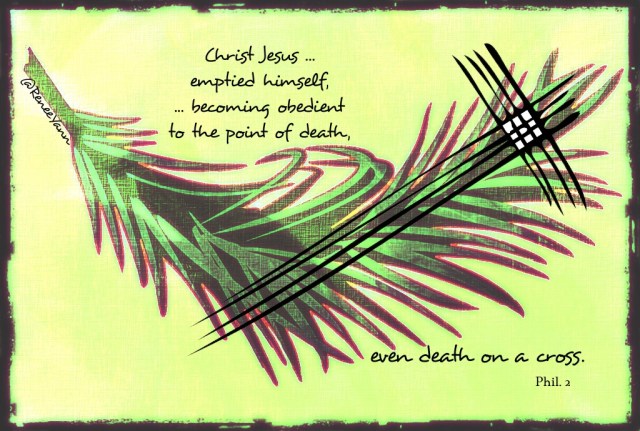
With each succeeding Holy Week, if we give ourselves to grace, Love maps itself more deeply in our souls. Our own lives, laid beside his in prayer, align us more closely to our own unique Redemption, as we can pray in this most beautiful of scripture passages:

Christ Jesus, though he was in the form of God,
    did not regard equality with God
    something to be grasped.
Rather, he emptied himself,
    taking the form of a slave,
    coming in human likeness;
    and found human in appearance,
    he humbled himself,
    becoming obedient to the point of death,
    even death on a cross.

Philippians 2:6-8

The rich treasures of our Holy Week readings and rituals carry us deeper into the eternal current of Love Who is Jesus Christ. We are changed, if we let ourselves, because we witness and believe the Divine Contradiction of the Cross and Resurrection – and we let it happen within our own souls.

Indeed, we are privy to the profound intimacy between Jesus and his Father … between Love Incarnate and Love Enlivening. It is an intimacy we pray to be part of because it changes everything to Love.

Because of this, God greatly exalted him
    and bestowed on him the name
    which is above every name,
    that at the name of Jesus
    every knee should bend,
    of those in heaven and on earth and under the earth,    
    and every tongue confess that
    Jesus Christ is Lord,
    to the glory of God the Father.

Philippians 2: 9-11

In our readings today, and each day this week, try to find the small phrase where your life meets Christ’s journey. Listen with Jesus to the Father’s stunning revelation that Life is accomplished through death to all that is not born of God.

But Jesus cried out again in a loud voice,
and gave up his spirit.
And behold, the veil of the sanctuary
was torn in two from top to bottom.
The earth quaked, rocks were split, tombs were opened,
and the bodies of many saints who had fallen asleep were raised.
And coming forth from their tombs after his resurrection,
they entered the holy city and appeared to many.
The centurion and the men with him who were keeping watch over Jesus
feared greatly when they saw the earthquake
and all that was happening, and they said,
“Truly, this was the Son of God!”

Matthew 27:50-54

Poetry: Primary Wonder – Denise Levertov

Days pass when I forget the mystery.
Problems insoluble and problems offering
their own ignored solutions
jostle for my attention, they crowd its antechamber
along with a host of diversions, my courtiers, wearing
their colored clothes; cap and bells.
                                                        And then
once more the quiet mystery
is present to me, the throng's clamor
recedes: the mystery
that there is anything, anything at all,
let alone cosmos, joy, memory, everything,
rather than void: and that, O Lord,
Creator, Hallowed One, You still,
hour by hour sustain it.

Music: Jerusalem, My Destiny by Rory Cooney

The Other Side of Light

April 1, 2023

Dear Friends,

It feels appropriate that, before we resume gathering together in Lavish Mercy tomorrow, I comment a bit on my time away from the blog.

First, I sincerely thank you all for your prayers and encouragement. In a shadowy time, you gave me the generous lights of comfort and joy. I am deeply grateful.

Now, as I continue to heal from a time of unexpected vulnerability, I have the advantage of being able to reflect in peace on what has happened to me. 

Part of that peace and healing has been a move to our Motherhouse, a loving community where I have the support and care I need right now. I am blessed beyond words by this gift.


This photo was taken in the early 1900s for the Merion Historical Society


My new room is on the very western end of the building (See blue arrow above.) However, I look out my ample windows not to a sunset horizon – but instead to the imposing wall of our magnificent chapel. Some were concerned that the “wall view” might not be optimal. They didn’t realize that the wall housed an unexpected gift – a bird’s eye view of the glorious rose window that, for over a century, has blessed our chapel with dawn Light.

And I am now on the other side of that Light as it flows over my beloved community – a place that feels ever closer to God with each sunrise.


Sometimes, especially in the evening, I will catch a lovely glow within chapel on one of the several stained glass windows. I consider these my own special sunsets given only to me for my unique reflection. These windows are icons for me as I pray and learn from my own little “passover experience” this winter. 

Evening Window from the Outside!

During times of suffering, loss, or unchosen change in our lives, it is hard to turn to the Light. As we begin our Holy Week walk, consider that Jesus faced this struggle in the shadows of Gethsemane. There, he taught us what it takes not only to turn toward Light, but to become It.

Then going out he went, as was his custom, to the Mount of Olives, and the disciples followed him. 

When he arrived at the place he said to them, “Pray that you may not undergo the test.”

After withdrawing about a stone’s throw from them and kneeling, he prayed, saying, “Father, if you are willing, take this cup away from me; still, not my will but yours be done.”

And to strengthen him an angel from heaven appeared to him.

Matthew 22: 40-43

As it was with Jesus, a “Gethsemane moment” in any of our lives is an invitation to abandon ourselves in trust to God’s inscrutable Love — a falling helplessly, but hopefully, into a Love that changes everything.

For Jesus, his embrace of God’s Will in that tenebrous garden opened his heart to the glory of the Resurrection and led him to the other side of Light. How might such self-giving open and lead us?


Love Changes Everything – Andrew Lloyd Webber, Don Black, and Charles Hart

Who art Thou, my God…..

Saturday of the Second Week in Ordinary Time

Today’s Readings

https://bible.usccb.org/bible/readings/012123.cfm

Memorial of St. Agnes – January 21, 2023


Today, in God’s Lavish Mercy, we pray with Psalm 47 which describes God as a King ascending to the throne amid shouts of joy.

God mounts the throne amid shouts of joy;
the LORD, amid trumpet blasts.
Sing praise to God, sing praise;
sing praise to our king, sing praise.PSALM 47: 6-7


This description reminds me of a pageant like an inauguration, where fanfare horns announce the President’s arrival. For the psalmist, the horn might have been a shofar.

It’s a beautiful and triumphant way to imagine what God might be like. But that’s all it is – an image, a product of human imagination. Like the psalmist, we all engage in that creative effort – we picture God. We draw God out of the media stored in our own hearts and spirits.


The freedom we have to imagine God can be both a blessing and a curse. As a blessing, it has allowed us to create tender, triumphant, and splendid constructs of an otherwise unimaginable Love. As a curse, it has given us the power to distort God’s image for our own selfish ends.


It is an awesome power. Even the great Saint Augustine struggled with it:

Augustine by Philippe de Champaigne

What art Thou then, my God? 
Most highest, most good, 
most potent, most omnipotent; 
most merciful and most just; 
most hidden and most present; 
most beautiful and most strong, 
standing firm and elusive, 
unchangeable and all-changing; 
never new, never old; 
ever working, ever at rest; 
gathering in and [yet] lacking nothing; 
supporting, filling, and sheltering;
creating, nourishing, and maturing; 
seeking and [yet] having all things. 
And what have I now said, 

my God, my life, my holy joy? 
or what says anyone who speaks of Thee? 
And woe to the one who keeps silent about you, 
since many babble on and say nothing.


Praying with Psalm 47, I consider my own “photo album” of the Holy One. I talk with God about those pictures. I ask to know and love God more clearly, so that, made in God’s image, I may more honestly reflect it.

God has given us the ultimate self-portrait in the Person of Jesus who is:

… the image of the unseen God, 
the firstborn over all creation.COLOSSIANS 1: 15

Poetry: from Paul’s letter to the Philippians 

Have among yourselves the same attitude 
that is also yours in Christ Jesus,
Who, though he was in the form of God,
did not regard equality with God something to be grasped.
Rather, he emptied himself,
taking the form of a slave,
coming in human likeness;
and found human in appearance,
he humbled himself,
becoming obedient to death, even death on a cross.
Because of this, God greatly exalted him
and bestowed on him the name
that is above every name,
that at the name of Jesus
every knee should bend,
of those in heaven and on earth and under the earth,
and every tongue confess that
Jesus Christ is Lord,
to the glory of God the Father.PHILIPPIANS 2: 6-11


Music: Philippians Hymn – John Michael Talbot

The Glorious Community

Friday of the Second Week in Ordinary Time

January 20, 2023

Today’s Readings:

https://bible.usccb.org/bible/readings/012023.cfm

Today, in God’s Lavish Mercy, we pray with Psalm 85, a Psalm we have prayed with so often in our daily liturgy.. Have we wrung it dry, do you think?

Never! That’s the beauty of scripture and particularly of the Psalms. They speak to us in a new voice with each new day’s blessings and challenges.

The verse that grasps my heart this morning is this:

Near indeed is salvation to those who fear God
glory dwelling in our land.PSALM 85: 10


What will “glory”, or well-being, 
look like when it dwells in our land, 
throughout our earth?


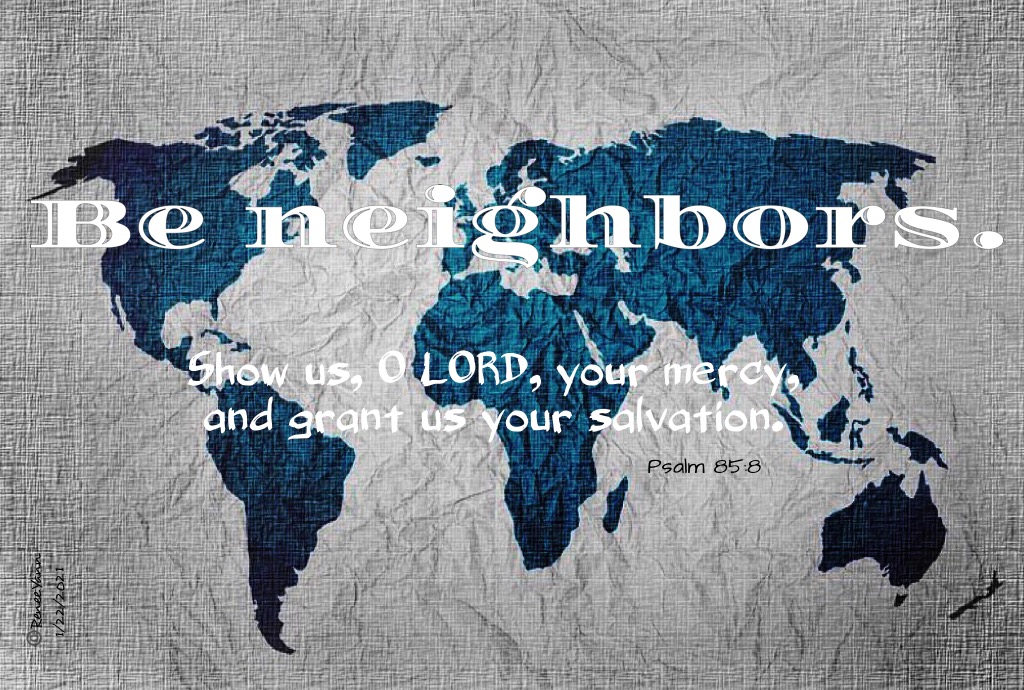
Walter Brueggemann, in his many writings about the Old Testament and the Psalms, stresses the concept of “neighborliness” as integral to communal well-being.

The well-being of the neighborhood, inspired by the biblical texts, makes possibleand even insists uponan alternative to the ideology of individualism that governs our society’s practice and policy. This kind of community life returns us to the arc of God’s giftsmercy, justice, and law. The covenant of God in the witness of biblical faith speaks now and demands that its interpreting community resist individualism, overcome commoditization, and thwart the rule of empire through a life of radical neighbor love.
(Description of Brueggemann’s book, God, Neighbor, Empire: The Excess of Divine Fidelity and the Command of Common Good)


Thousands of years ago, the psalmist clearly described the glorious community which God promises to those who live in mercy, truth, justice and peace:

Mercy and truth shall meet;
justice and peace shall kiss.
Truth shall spring out of the earth,
and justice shall look down from heaven.

The LORD  will give benefits;
our land shall yield its increase.
Justice shall walk before the Lord,
and salvation, along the way of God’s pattern.PSALM 85


Prose: In his Inaugural Address, President Biden referenced the concept of neighborliness. Here is the quote from St. Augustine used by the President, as well as the passage from Cicero which inspired Augustine.

If one should say, ‘a people is the association of a multitude of rational beings united by a common agreement on the objects of their love,’ then it follows that to observe the character of a people we must examine the objects of its love.” ST. AUGUSTINE, CITY OF GOD 19.24

A republic is a numerous gathering brought together by legal consent and community of interest. The primary reason for this coming together is not so much weakness as a sort of innate desire on the part of human beings to form communities. For our species is not made up of solitary individuals. CICERO, REPUBLIC, 1.39-40 


Music: After Cicero and Augustine, a little music from our own modern philosopher, Mr. Rogers

Finding Jesus

Thursday of the Second Week in Ordinary Time

January 19, 2023

Today’s Readings

https://bible.usccb.org/bible/readings/011923.cfm

Today, in God’s Lavish Mercy, Mark’s Gospel portrays Jesus in his “heyday”.

heydayjpg

It is early in his ministry. Word is spreading about his teaching and his miracles. He is the “hot ticket” in any town he visits. But what was Jesus thinking in the midst of all the hubbub?

We get a few good hints in our Gospel.

  • Jesus withdrew toward the sea
  • He wanted a boat ready lest the crowd would crush him
  • He warned the unclean spirits not to make him known

These phrases suggest that Jesus was a bit overwhelmed by the furor. No doubt he realizes that his identity and message go far beyond the show of miracles. Can the “fandom” of these early crowds be converted to deep and committed discipleship?

This reading might incline me to consider my own faith. 

Do I love and follow just the “heyday Jesus” – the One who is powerful over the demons and deaths I fear?

Or have I learned to love and follow the deeper Jesus, the One who suffers and dies for justice, goodness and love – the One Who lives in the poor?

One way to answer these questions is to ask ourselves where we find Jesus in our daily lives.

Is he confined to our Bible, our church, our prayerbooks and our moral judgments?

Or is our faith deep enough to see and love him in the suffering face of humanity – perhaps where it is inconvenient, costly and sometimes unsettling to find him?

Poetry: Viriditas by Hildegard of Bingen

I am the one whose praise echoes on high.
I adorn all the earth.
I am the breeze that nurtures all things green.
I encourage blossoms to flourish with ripening fruits.
I am led by the spirit to feed the purest streams.
I am the rain  coming from the dew that causes the grasses to laugh with the joy of life.
I call forth tears. I am the yearning for good.

Good people, Most royal greening verdancy, Rooted in the sun,
You shine with radiant light, in this circle of earthly existence.
You shine so finely, it surpasses understanding.
God hugs you. You are encircled by the arms of the mystery of God.

Music: God of the Poor ~ Graham Kendrick

Law Yields to Love

Wednesday of the Second Week in Ordinary Time
January 18, 2023

Today’s Readings:

https://bible.usccb.org/bible/readings/011823.cfm

Today, in God’s Lavish Mercy,  the writer of Hebrews continues to shine light on the superior “priesthood” of Jesus Christ – that aspect of Christ’s ministry that breaks heaven open for us and reinstates us as God’s children.

heb2 priest

Hebrews calls Christ a priest “according to the order of Melchizedek” – an order above and beyond the priesthood of Aaron and Levi.

Although there are a few references to Melchizedek in scripture, only one narrative refers to him:

After Abram returned from defeating Kedorlaomer and the kings allied with him,
the king of Sodom came out to meet him in the Valley of Shaveh (that is, the King’s Valley).
Then Melchizedek king of Salem brought out bread and wine.
He was priest of God Most High, and he blessed Abram, saying,
“Blessed be Abram by God Most High,
    Creator of heaven and earth.
And praise be to God Most High,
    who delivered your enemies into your hand.”
Then Abram gave him a tenth of everything.

Genesis 14: 17-20

Melchizedek, whose priesthood preceded even Abraham, is offered in Hebrews as a prototype of Jesus who fulfills and perfects the Old Testament promises.

Does this matter to us modern day Christians who can barely say “Melchizedek “, let alone spell it? And if it does matter, how?

An answer may be revealed in our Gospel today. 

In it, Jesus challenges the old, pharisaical, law-bound way of thinking. As the new and perfect “priest”, Jesus breaks that way of thinking with the transformation of love. Jesus is the perfection of that which Melchizedek was only the forerunner.

Then he said to the Pharisees,
“Is it lawful to do good on the sabbath rather than to do evil,
to save life rather than to destroy it?”
But they remained silent.
Looking around at them with anger
and grieved at their hardness of heart,
Jesus said to the man, “Stretch out your hand.”
He stretched it out and his hand was restored.
The Pharisees went out and immediately took counsel
with the Herodians against him to put him to death.

Mark 3:3-6
  • This man with the withered hand is more important than the law. 
  • This act of healing and wholeness is more important than ritual adherence. 
  • The priesthood of Jesus is the breakthrough revelation of what God really desires – mercy, not sacrifice.

Poetry: Excerpt from John Berryman’s Eleven Addresses to the Lord

John Berryman (1914 – 1972) was an American poet and scholar. He was a major figure in American poetry in the second half of the 20th century and is considered a key figure in the “confessional” school of poetry. Eleven Addresses to the Lord describes, with an interplay of sincerity and irony, the poet’s struggle to believe. Section 10 below reveals love over law as a key factor in Berryman’s evolving faith.

10

Fearful I peer upon the mountain path
where once Your shadow passed, Limner of the clouds
up their phantastic guesses. I am afraid,
I never until now confessed.
I fell back in love with you, Father, for two reasons:
You were good to me, & a delicious author,
rational & passionate. Come on me again,
as twice you came to Azarias & Misael.
President of the brethren, our mild assemblies
inspire, & bother the priest not to be dull;
keep us week-long in order; love my children,
my mother far & ill, far brother, my spouse.
Oil all my turbulence as at Thy dictation
I sweat out my wayward works.
Father Hopkins said the only true literary critic is Christ.
Let me lie down exhausted, content with that.

Music: Love Broke Thru ~ Toby Mac