Wisdom, please ….

Twenty-third Sunday in Ordinary Time
September 4, 2022

Today, in God’s Lavish Mercy, we continue to move into the final segments of Luke’s Gospel which we have been reading on Sundays throughout this liturgical year.
Today, the Church links three readings which, at first glance, might seem unrelated.

  • Our first reading from Wisdom reminds us of God’s infinite wisdom, incomprehensible to our human minds.
  • Paul, in his letter to Philemon, begs for the loving inclusion of Onesimus, an enslaved person, into the Colossian community.
  • In our Gospel, Jesus makes this harsh pronouncement:

If anyone comes to me without hating his father and mother,
wife and children, brothers and sisters,
and even his own life,
he cannot be my disciple.


How might we interpret these disparate passages to find a message of wholeness for our prayer?

Wis9_13 gods mind

Let’s start with Jesus. In no uncertain terms, he challenges his disciples to move out of their small worlds into God’s big world. That Godly world is not defined by family, nor by any condition other than our common Creaturehood in God … not by:

word gram

Jesus says the sacred community is defined only by shared and irrevocable commitment to the Gospel of love and mercy.


Paul knows and loves Onesimus, the slave, as a brother in this community. In his letter, Paul encourages Philemon to do the same.


Sometimes as human beings, filled with all kinds of insecurities, we tend to build enclaves that make us feel safe. We like to be with “our kind”. We invent borders to filter out those whose differences we don’t understand. We allow fear to grow with that lack of understanding. Within the enclosure of our self-protectionism, we eventually forget that we are all one, equal, precious, beautiful and beloved by God.

Such toxic attitudes are the soil for slavery, war, ethnic cleansing, racial supremacy, human trafficking, destructive nationalism, and all the other sacrileges committed by humans against the human family.

Wisdom reminds us that only God can open
the tight circle of our fears, judgments and isolations
– only God whose infinite love encompasses all.
Jesus tells us that we find that love
only by lifting up the cross and following him.

Wisdom tells us to put it in God’s hands, and to respond to God’s challenge in the preaching of Jesus Christ.

Who can know your way of thinking, O God
… except you give us wisdom

 and send your Holy Spirit from on high
 thus stretching the hearts of those on earth

Today I pray, may God do this for me,
and for all our tight, convoluted
and troubled world.


Poetic Prayer of Hildegard of Bingen

Hildegard of Bingen (c. 1098 – 17 September 1179), was a German Benedictine abbess and polymath active as a writer, composer, philosopher, mystic, visionary, and as a medical writer and practitioner during the High Middle Ages. She is one of the best-known composers of sacred monophony, as well as the most recorded in modern history. She has been considered by scholars to be the founder of scientific natural history in Germany.

I am Wisdom. 
Mine is the blast of the resounding Word 
through which all creation came to be, 
and I quickened all things with my breath 
so that not one of them is mortal in its kind; 
for I am Life.

Indeed I am Life, whole and undivided 
-- not hewn from any stone, 
or budded from branches, 
or rooted in virile strength; 
but all that lives has its root in Me.
 
For Wisdom is the root 
whose blossom is the resounding Word....
I flame above the beauty of the fields 
to signify the earth 
-- the matter from which humanity was made.

I shine in the waters to indicate the soul, 
for, as water suffuses the whole earth, 
the soul pervades the whole body. 

I burn in the sun and the moon to denote Wisdom, 
and the stars are the innumerable words of Wisdom.

Music: Who Has Known (an Advent hymn, but perfect I think for today’s readings)

Alleluia: Poppin’ Good Faith

Memorial of Saint Gregory the Great,
Pope and Doctor of the Church
Saturday, September 2, 2022

Today’s Readings:

https://bible.usccb.org/bible/readings/090322.cfm

Alleluia, alleluia.
I am the way and the truth and the life, says the Lord;
no one comes to the Father except through me.

Today, in God’s Lavish Mercy, our readings encourage us to live a Spirit-inspired faith rather than one of appearances.

At first, I found our first reading uninspiring. So I did a little research which helped me to appreciate that 1 Corinthians shows us a “toddler Church” trying to discover itself. 

Paul is her teacher, but Paul is not always with her. Other influences, theories and even conspiracies can influence her emerging self-awareness. Some of these influences might include those who think they are in charge, and begin to set rules and roles for the early Church’s life without Paul’s direction.

In today’s passage from Corinthians, Paul uses a lot of sarcasm to warn the community not to get ahead of themselves in shaping their faith community. He wants them not to rely on structures and functions but on the uncontainable power of the Holy Spirit to inspire and create a path for God’s love and mercy in the world.

Paul reminds the Corinthians that everything they have they received. They are not to feel entitled by their gifts but humble, grateful and open to his apostolic teaching and example.

Brothers and sisters:
Learn from myself and Apollos not to go beyond what is written,
so that none of you will be inflated with pride
in favor of one person over against another.
Who confers distinction upon you?
What do you possess that you have not received?
But if you have received it,
why are you boasting as if you did not receive it?

Jesus is saying the same thing to the Pharisees in our Gospel today. They boast that they are the arbiters and interpreters of the faith.

But faith is not about refraining from corn-picking on the Sabbath! We make rules like this because we are afraid of the power of the Holy Spirit to transform us. So instead, we push God’s Spirit into the confines of a corn husk where we are safe from God’s transformative call that might upset our comfort.

Jesus tells the Pharisees to be like David. Although not faultless, David got it! He lived a life of passionate love for and relationship with God which refused to be confined by imposed definitions.

David and the Temple Bread

Jesus said to them in reply,
“Have you not read what David did
when he and those who were with him were hungry?
How he went into the house of God, took the bread of offering,
which only the priests could lawfully eat,
ate of it, and shared it with his companions?”
Then he said to them, “The Son of Man is lord of the sabbath.”


Surely there are lessons here for our own Church as we are invited to transformation by the Gospel and by the inspired teaching of Pope Francis. Like Jesus, he is a breaker of corn husks and some are frightened by the charismatic challenges he places before us.

Our Verse assures us that by opening our hearts to the Gospel’s call, we will find true life.

Alleluia, alleluia.
I am the way and the truth and the life, says the Lord;
no one comes to the fullness of God except through me.


Poetry: TO LIVE WITH THE SPIRIT – Jessica Powers

To live with the Spirit of God is to be a listener.
It is to keep the vigil of mystery,
earthless and still.
One leans to catch the stirring of the Spirit,
strange as the wind’s will.
The soul that walks where the wind of the Spirit blows
turns like a wandering weather-vane toward love.
It may lament like Job or Jeremiah,
echo the wounded hart, the mateless dove.
It may rejoice in spaciousness of meadow
that emulates the freedom of the sky.
Always it walks in waylessness, unknowing;
it has cast down forever from its hand
the compass of the whither and the why.
To live with the Spirit of God is to be a lover.
It is becoming love, and like to Him
toward Whom we strain with metaphors of creatures:
fire-sweep and water-rush and the wind’s whim.
The soul is all activity, all silence;
and though it surges Godward to its goal,
it holds, as moving earth holds sleeping noonday,
the peace that is the listening of the soul.

In Place of Music: John Michael Talbot speaking on today’s Gospel

And a beautiful song for your quiet:

Alleluia: New Wine, Holy Changes

Friday of the Twenty-second Week in Ordinary Time
September 2, 2022

Today’s Readings:

https://bible.usccb.org/bible/readings/090222.cfm

Alleluia, alleluia.
I am the light of the world, says the Lord;
whoever follows me will have the light of life.

Today, in God’s Lavish Mercy, Jesus changes the narrative for living a good and holy life. He offers the Pharisees “new wine”, the freedom of his law of love over their accustomed law of requirements.

Lk5_38 Wine

Have you ever found yourself in circumstances where you’re saying or hearing things like this:

  • It’s the law
  • That’s the way we’ve always done it
  • Sorry. They’re the rules.
  • Doesn’t matter. No exceptions.

In such situations, we are experiencing a code of limitations where we are defined either by what we must do or must not do. 

The Pharisaical law had become such a code, its spirit and freedom worn away by ages of control, authoritarianism, and brittle institutionalization.

Jesus preaches the new law of love, which can sound a little squishy and self-indulgent at first, because our navel-gazing culture has so eviscerated the meaning of love.

But real Christian love is the hardest “code” we will ever practice. Patterned on Jesus’ life, it is a discipline of mercy, self-sacrifice, radical inclusivity, non-violence, and forgiveness. Such a love will die for the sake of the beloved’s life in God.

Drinking this “new wine” brings us a profound freedom in God Who loves us like this — but infinitely.


Poetry:

Music: New Wine – Hillsong

Alleluia: Call to Discipleship

Thursday of the Twenty-second Week in Ordinary Time
September 1, 2022

Today, in God’s Lavish Mercy, our readings lead us to consider our call.

Lk5_11 leftJPG

The call to discipleship comes to us within the other calls of our life: the call to be a good parent, spouse, sibling, child. It comes in the call to be a moral, values-driven employer; an honest, hard-working employee; a supportive, engaged co-worker. Christ asks us to mirror him as neighbor, friend, colleague, and citizen.

In whatever skill or profession we practice, Christ asks us to exercise it as he would – to choose, judge and behave as he would.


In our Gospel, the first disciples are astonished at the miracle of the fishes. Like a lightening bolt, that astonishment transforms their world view. They now see Christ as the Center of their lives. They drop their nets on the seashore. They leave everything to follow him.


What is it that we must leave to make Christ the center of our lives? What nets are we caught in that keep us from freeing the call within us?

We are challenged by a world filled with the entanglements of greed, destructive power, aggression, bigotry, lies, and political & social pretense. How much have these infected the purity of our desire to follow Jesus?


Poetry: On St. Peter Casting Away His Nets at Our Saviour’s Call – Richard Crashaw

Thou hast the art on't Peter; and canst tell 
To cast thy Nets on all occasions well. 
When Christ calls, and thy Nets would have thee stay: 
To cast them well's to cast them quite away.

Music: Lord, You Have Come to the Seashore- Caesareo Gabarain

Lord, You have come to the seashore
Neither searching for…the rich nor the wise,…
desiring only…that I should follow
Refrain:
O Lord, with your eyes set upon me,
gently smiling, you have spoken my name;
all I longed for I have found by the water.
At your side, I will seek other shores.

Lord, see my goods, my possessions;
in my boat you find…no power, no wealth…
Will you accept then…my nets and labor?

Lord,…take my hands and direct them
Help me spend myself in seeking the lost,…
returning love for…the love you gave me.

Lord,…as I drift on the waters…
be the resting place…of my restless heart,…
my life’s companion,…my friend and refuge.

Alleluia: True Ministry

Wednesday of the Twenty-second Week in Ordinary Time
August 31, 2022

Today, in God’s Lavish Mercy, both Paul and Luke talk about ministry – our loving and merciful service to one another through prayer, word, and action.

LK4_18 good news

Paul says this ministry must be humble and mutual. This is because all the good that any of us does comes from God, not from us.

What is Apollos, after all, and what is Paul?
Ministers through whom you became believers,
just as the Lord assigned each one.
I planted, Apollos watered, but God caused the growth.
Therefore, neither the one who plants nor the one who waters is anything,
but only God, who causes the growth.


Jesus shows us that our ministry must be immediate and practical, responding to the present needs of our sisters and brothers. You wouldn’t think Jesus had time to pay attention to Peter’s mother-in-law, but he did. Her need drew his ministry out of him.

After Jesus left the synagogue, he entered the house of Simon.
Simon’s mother-in-law was afflicted with a severe fever,
and they interceded with him about her.
He stood over her, rebuked the fever, and it left her.
She got up immediately and waited on them.

At sunset, all who had people sick with various diseases
brought them to him.
He laid his hands on each of them and cured them.


You will meet your own “Peter’s mother-in-law” today – someone whose apparent need touches your goodness. They may need a smile, an encouragement, an invitation or a gentle correction from you. They may come to you from a distance, in a request for service or funding. They may come in news story crying out for your prayers or civic action.

People can be poor in many ways.  Even the apparently free can be held captive by hidden burdens. Sometimes these burdens hide under a false bravado, impudence, indifference, or pride that make it difficult to pity their bearers. 

We will meet these people in our families, workplaces, schools and neighborhoods. 

Our response should reflect the humble and spontaneous Mercy and Love of Jesus who was always honest, respectful and kind. This is the ministry of every Christian because…

Music: Christ Has No Body Now But Yours ~ David Ogden

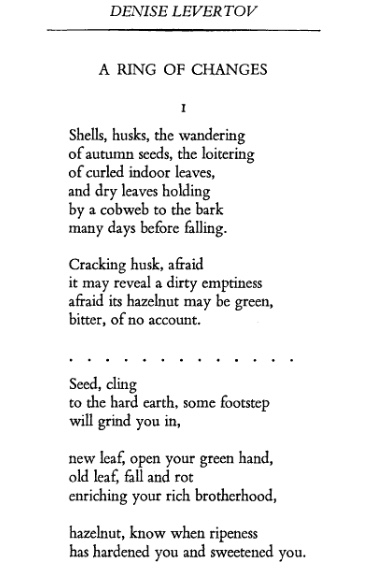
Poetry: The Woman – I wrote this poem about 30 years ago but I thought of it this morning when I reflected on Peter’s mother-in-law and her need for Jesus’s touch.

One bitter day in February
I sat inside a sunlit room,
offered you warm prayer and promises,
and she passed outside my window
dressed uncarefully against the wind,
steadied on a cane, though she was young.
She seemed searching for
a comfort, unavailable and undefined.

The wound of that impossibility
fell over her the way it falls
on every tender thing that cries
but is not gathered to a caring breast.
Suddenly she was a single
anguished seed of You,
fallen into all created things.

Re-entering prayer,
I wear the thought of her  
like old earth wears fresh rain.
I’ve misconstrued You,
Holy One, to whom I offer my heart
as if I were a yearning field,
Holy One, already ripe within
her barest, leanest yearning.

Alleluia: Breathe

Tuesday of the Twenty-second Week in Ordinary Time
August 30, 2022

Today’s Readings:

https://bible.usccb.org/bible/readings/083022.cfm

Today, in God’s Lavish Mercy, we have an awesome first reading from Corinthians in which Paul assures us:

We have not received the spirit of the world
but the Spirit who is from God,
so that we may understand the things freely given us by God.

What joy to realize that God’s own Spirit dwells within us making us one with God, breath within Breath. We have that intimate comfort of knowing God as our dearest Friend, Confidant, and Lover.

Nothing in our lives falls outside God’s embrace and compassion. God’s kindness, graciousness and lavish mercy sustain and inspire us always to believe, to hope, and to love.

In thanksgiving, we pray today’s most fitting Psalm 145. remembering that in all things – yes, all things – Lavish mercy is waiting to embrace us.


Psalm 145 – Opening Heart – Rev. Christine Robinson

I exalt you, Holy One, and open my heart to you
by remembering your great love.
Your expansiveness made this beautiful world
in a universe too marvelous to understand.
Your desire created life, and you nurtured
that life with your spirit.
You cherish us all—and your prayer
in us is for our own flourishing.
You are gracious to us
slow to anger and full of kindness
You touch us with your love—speak to us
with your still, small voice, hold us when we fall.
You lift up those who are oppressed
by systems and circumstances.
You open your hand
and satisfy us.
You ask us to call on you—
and even when you seem far away, our
longings call us back to you.
Hear my cry, O God, for some days, it is all I have.


Music: Jeanne Cotter – With the Lord, There is Mercy

Alleluia: The Prophet

Memorial of the Passion of Saint John the Baptist
Monday, August 29, 2022

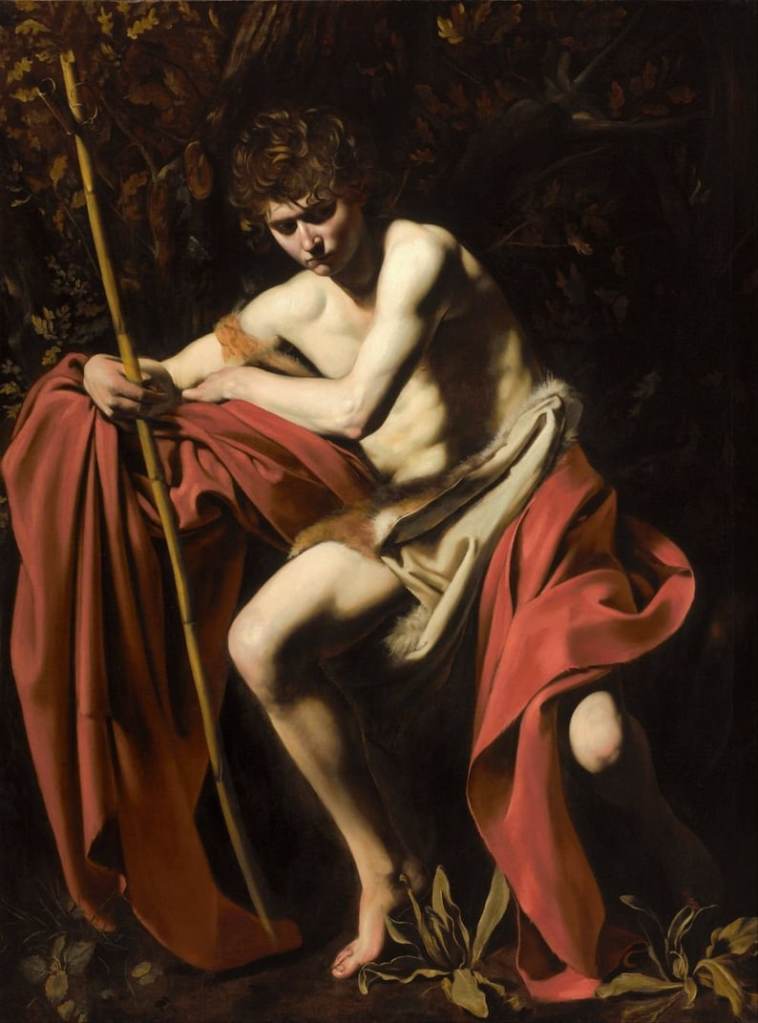
John the Baptist – Caravaggio

Today’s Readings

https://bible.usccb.org/bible/readings/082922.cfm

Alleluia, alleluia.
Blessed are those who are persecuted
for the sake of righteousness,
for theirs is the Kingdom of heaven.

Today, in God’s Lavish Mercy, we commemorate the Passion of John the Baptist who, besides Mary, was the greatest saint embracing both the Old and the New Testaments.

When I was young, the memorial was simply referred to as “The Beheading of John the Baptist”. The term “passion” captures its meaning so much more clearly:

  • it inclines us to realize the similarities between John’s passion and death and that of Jesus.
  • it shifts the power of the event to John, who chose his fate by the courage of his witness, rather than to see Herod, the “beheader”, as the agent of the story.

John’s whole prophetic life was part of his “passion”. It inevitably led him to this ultimate confrontation with evil.


Walter Bruggemann, in his transformational book “The Prophetic Imagination” writes about prophets. He indicates that prophets emerge in the context of “totalism” – those paralyzing systems which attempt to control and dominate all freedom and possibility.

Totalism kills ideas, hope, freedom, choice, self-determination, and creativity for the sake of controlling reality for its own advantage. Totalism is the ultimate “abusive relationship“.


Brueggemann defines the prophet as one engaged in these three tasks:

  • the prophet is clear on the force and illegitimacy of the totalism.
  • the prophet pronounces the truth about the force of the totalism that contradicts the purpose of God.
  • the prophet articulates the alternative world that God has promised, and that God is actually creating within the chaos around us.

Every age requires prophets because every age is infected with “Herods” trying to thwart God’s reign of love, mercy, truth, freedom, and joy. In our own time, the poison of totalism is quite evident in those systems fueled by racism, militarism, financial duplicity, desecration of the earth, and the sad array of other ideologies that cripple humanity.

Today, as we pray with this great saint, may we be inspired to respond to our own prophetic call – to be prophetic signs of love, mutual reverence, joy, Gospel justice, holy encouragement and lavish mercy for our world.


Poetry: On Reason and Passion – Rabindranath Tagore

And the priestess spoke again and said: Speak to us of Reason and Passion.
     And he answered, saying:
     Your soul is oftentimes a battlefield, upon which your reason and your judgement wage war against your passion and your appetite. 
     Would that I could be the peacemaker in your soul, that I might turn the discord and the rivalry of your elements into oneness and melody.
     But how shall I, unless you yourselves be also the peacemakers, nay, the lovers of all your elements?

     Your reason and your passion are the rudder and the sails of your seafaring soul.
     If either your sails or your rudder be broken, you can but toss and drift, or else be held at a standstill in mid-seas.
     For reason, ruling alone, is a force confining and passion, unattended, is a flame that burns to its own destruction.
     Therefore let your soul exalt your reason to the height of passion, that it may sing;
     And let it direct your passion with reason, that your passion may live through its own daily resurrection and like the phoenix rise above its own ashes.

     I would have your consider your judgment and your appetite even as you would two loved guests in your house.
     Surely you would not honour one guest above the other; for he who is more mindful of one loses the love and the faith of both.

     Among the hills, when you sit in the cool shade of the white poplars, sharing the peace and serenity of distant fields, and meadows—then let your heart say in silence, “God rests in reason.”
     And when the storm comes, and the mighty wind shakes the forest, and thunder and lightning proclaim the majesty of the sky,—then let your heart say in awe, “God moves in passion.”
     And since you are a breath in God’s sphere, and a leaf in God’s forest, you too should rest in reason and move in passion.

Music: I think of this song by Simon and Garfunkel as the modern day song of John the Baptist.

Alleluia: Everyone’s Invited

Twenty-second Sunday in Ordinary Time
August 28, 2022

Today’s Readings:

https://bible.usccb.org/bible/readings/082822.cfm

Today, in God’s Lavish Mercy, our readings share the common theme of humility, instructing us that the virtue is essential to our salvation.

Lk14_11 humbled

Alleluia, alleluia.
Take my yoke upon you, says the Lord,
and learn from me, for I am meek and humble of heart.

Humility, of course, gets a bad rap in our dominating, “me” culture. We tend to think of humiliation, servitude, inelegance rather than the actual root of the word: humus -“of the earth”.

I was fascinated a few years ago by a small fracas arising from the unconsidered remarks of one of our Phillies baseball players. The team had been running hot and cold – with a little bit too much cold for some fans. The famous Philly “boos” had been flying. Frustrated with these, then outfielder Sean Rodriguez referred to the disgruntled fans as “entitled”. 

angry

Uh oh! They didn’t like that. We prefer to think of ourselves as “deserving “, right?

Humility is that virtue which helps us realize that we are not “entitled” or “deserving” of anything over and above other human beings. It roots us in the respect for each other that refuses to rank the worth of other human beings. 

The social leverage that comes from wealth, power, and influence can beguile us. We become lost in a maze of stereotypes, rankings and prejudices which are the foundation of social injustice.


Do we ever hear among ourselves justifying phrases for our entitlement like these. Maybe the thoughts go unexpressed, but the attitude is unmistakably there:

  • well, I earned what I have
  • at least I paid for what I have
  • they” need to work if they want to have …(food, healthcare, housing…)
  • it’s their own fault for … (dropping out of school, taking drugs, ….)
  • that’s just the way it is in “those” countries. The people are …(lazy, stupid, violent …)
  • they” don’t need what I need. “They” are used to being … (poor, disabled, sick …)

And probably the most dangerous of all the phrases:

  • it’s not my problem
  • I’m not the one exiling, bombing, blocking, trafficking, enslaving “them”

Today’s readings enjoin us: it is my problem. My attitude, choices, vote, conversation, and lifestyle matter at the banquet of life we are all meant to share.

My intention to humbly join and rejoice with all Creation, to take a seat beside and never above my sister and brother – this is my only “entitlement” to the one banquet that matters.

When you hold a banquet,
invite the poor, the crippled, the lame, the blind;
blessed indeed will you be because of their inability to repay you.
For you will be repaid at the resurrection of the righteous.


Prose – from Mary Oliver in Upstream (Penguin Press, 2016)

Understand from the first this certainty. Butterflies don’t write books, neither do lilies, or violets. Which doesn’t mean they don’t know, in their own way, what they are. That they don’t know they are alive – that they don’t feel, that action upon which all consciousness sits, lightly or heavily.

Humility is the prize of the leaf-world.
Vainglory is the bane of us, the humans.  

Sometimes the desire to be lost again, as long ago, comes over me like a vapor. With growth into adulthood, responsibilities claimed me, so many heavy coats. I didn’t choose them, I don’t fault them, but it took time to reject them. Now in the spring I kneel, I put my face into the packets of violets, the dampness, the freshness, the sense of ever-ness. Something is wrong, I know it, if I don’t keep my attention on eternity. May I be the tiniest nail in the house of the universe, tiny but useful. May I stay forever in the stream. May I look down upon the windflower and the bull thistle and the coreopsis with the greatest respect. 


Music:  A Place at the Table – Lori True and Shirley Elena Murray

Alleluia: Restless Heart

Memorial of Saint Monica
Saturday, August 27, 2022

Today’s Readings:

https://bible.usccb.org/bible/readings/082722.cfm

Alleluia, alleluia.
I give you a new commandment:
love one another as I have loved you.

Today, in God’s Lavish Mercy, we pray in the spirit of St. Monica, that generous, loving mother who never gave up on her wild and wayward son.

St. Monica – by Benozzo Gozzoli c. 1464

Monica was a stalwart example of the humble faith and gratitude Paul describes in our first reading. Monica knew that her entire being depended on God’s graciousness:

God chose the foolish of the world to shame the wise,
and God chose the weak of the world to shame the strong,
and God chose the lowly and despised of the world,
those who count for nothing,
to reduce to nothing those who are something,
so that no human being might boast before God.
It is due to him that you are in Christ Jesus,
who became for us wisdom from God,
as well as righteousness, sanctification, and redemption…


Today’s Gospel, the insightful parable of the talents,  could very well capsulize Monica’s spirituality. For her, the foolish burier of the talents was her own son. He had been given amazing spiritual and natural gifts only to squander them in religious distortions and moral lassitude. Still she prayed, forgave, and encouraged Augustine until the light of grace dawned upon him.


Monica is such a powerful example for us. It’s hard to love that much and that long when there is no positive response to our hope and care. 

So many parents throughout the ages have shared Monica’s experience. So many family members and friends have agonized for their own beloveds who seemed lost in bad choices, addictions, or the other myriad forms of self-annihilation.

Let’s pray for one another today, especially for the “Monicas” among us who long for the spiritual wholeness of another to be healed and complete. May we/they be patient, honest, hopeful and loving. And may their own “talents” be multiplied and rewarded.


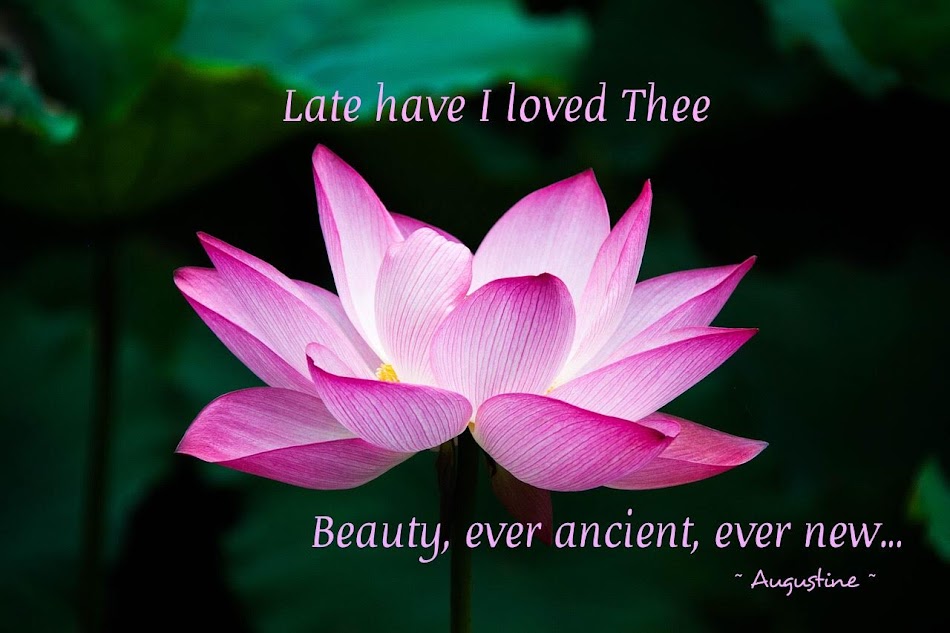
Prose: from Augustine’s autobiography about his mother Monica:

And now you stretched forth your hand from above
and drew up my soul out of that profound darkness
because my mother, your faithful one,
wept to you on my behalf more than mothers
are accustomed to weep
for the bodily deaths of their children.


Instead, she was fully confident that you
who had promised the whole would give her the rest,
and thus most calmly, and with a fully confident heart,
she replied to me that she believed, in Christ,
that before she died she would see me made whole in the faith.

Augustine of Hippo, Confessions, Book 1


Music: Augustine: The Way – Tony MacPherson

Alleluia: Wise or Foolish?

Friday of the Twenty-First Week in Ordinary Time
August 26, 2022

Today’s Readings:

https://bible.usccb.org/bible/readings/082622.cfm

Alleluia, alleluia.
Be vigilant at all times and pray,
that you may have the strength 
to stand before your God.

Today, in God’s Lavish Mercy, our readings are full of dichotomies and contrasts to help us understand the Truth.

Has not God made the wisdom of the world foolish?
For since in the wisdom of God
the world did not come to know God through wisdom,
it was the will of God through the foolishness of the proclamation
to save those who have faith.

1 Corinthians 1: 20-21

The core of Paul’s eloquent lesson is this:
Worldly wisdom = foolishness 
Heavenly foolishness = true wisdom

Reading this passage, we might feel like we’re back in our Logic 101 class in college. But remember, Paul is preaching to a Greek audience, inheritors of Socratic and Aristotelian language. They would be fascinated and moved by Paul’s presentation style.


Us? Maybe not so much. We might prefer the storytelling technique Jesus used to get the same point across.

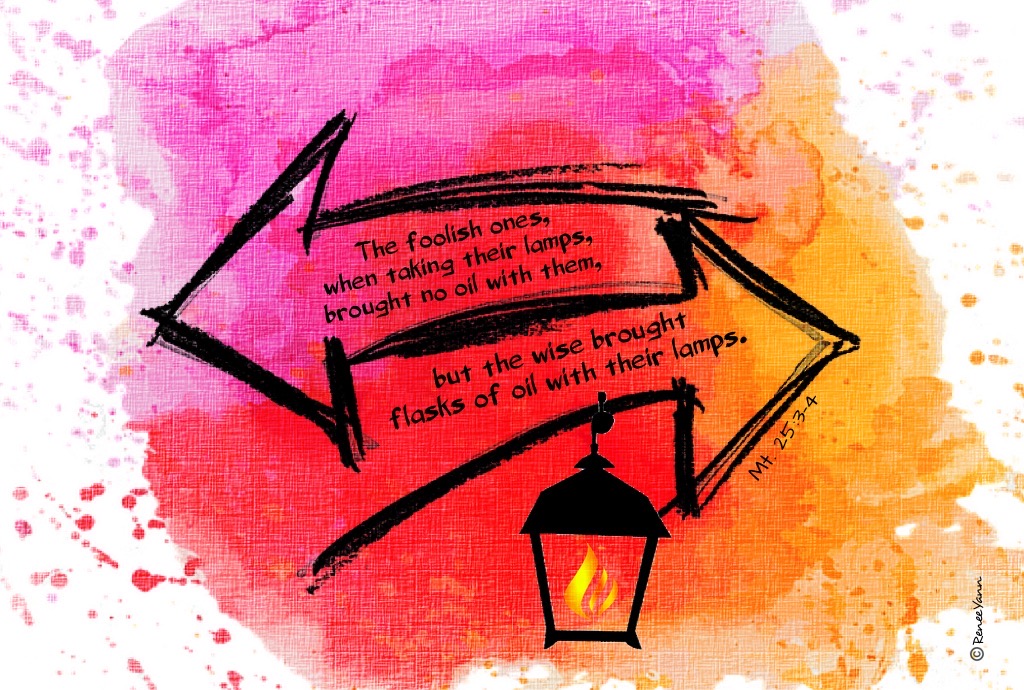
The foolish ones, when taking their lamps,
brought no oil with them,
but the wise brought flasks of oil with their lamps. 

Matthew 25:3-4

Jesus’s lesson:
Foolish virgins = no oil = can’t find Lord
Wise virgins = refreshed oil = find Lord easily

Our Alleluia Verse captures the essence of all our readings for us:

Pay attention to your spiritual life.

  • Keep the Light lit.
  • Don’t be fooled by the world’s false logic.
  • In Christ, we live by the true logic and light of the Cross and Resurrection 

Prose: Elizabeth Mattis Namgyel – The Logic of Faith: A Buddhist Approach to Finding Certainty Beyond Belief and Doubt

But if you are not careful, 
spirituality can quite easily allow you 
to bypass the human dilemma, 
because spirituality can be 
anything you want it to be, 
whereas faith will challenge you. 
It’s not so comfortable. 
It carries with it the undeniable tension 
between your search for security 
and the limits of your ability to know. 
Faith keeps your spiritual quest relevant 
and connected to the heart 
of the human predicament.


Music: Fool’s Wisdom – Malcolm and Alayna

Got myself some wisdom

From a leather-back book

Got myself a Savior

When I took a second look

Opened up the pages

And what did I find

A black and white portrait

Of a King Who’s a friend of mine

Funny how when you think you’re right

Everybody else must be wrong

Till someone with fool’s wisdom

Somehow comes along

His voice is strange and the words He said

I didn’t quite understand

Yet I knew that He was speaking right

By the leather-back book in His hand

Hey, hey

What a day

Fool’s wisdom

Hey, hey

What a day

Fool’s wisdom

Got myself some wisdom

From a leather-back book

Got myself a Savior

When I took a second look