Boxing God?

February 8, 2022
Tuesday of the Fifth Week in Ordinary Time

(Some of my longtime followers might recognize an old story today. I like it so much that iI repeated it. Hope you don’t mind. Thanks for sticking with me.)

Today, in God’s Lavish Mercy, our readings talk about how we try to “house” God.

Because God is bigger than BIG, our minds struggle. More than struggle, they actually fail, repeatedly, to define God. Yet we still try, don’t we?

We try to picture, describe, paint, quote, and interpret God. We even decide what God wants and create laws to insure God gets that.

We dilute Divinity to our human dimensions. We just can’t take it straight. We mix it and bottle it in our laws, and box it in our rituals — because we can’t manage Omnipotence. 


Praying with these thoughts today, I think of my Dad. He liked an occasional jigger of really fine bourbon – savored in its unadulterated state, without water or soda – what today’s purists call “sipping whisky”.

When the doctor informed him, unfortunately in my mother’s presence, that whisky was a no-no, Dad didn’t like it. But he acquiesced. At least we thought he did. 

After Dad died, my brother and I found his bottle of Kentucky bourbon wrapped in a towel in the basement dryer. You see, only Dad did the wash. Mom never liked machines.


I think Jesus would have really enjoyed my Dad as one of his original disciples. Dad liked life “straight”. His faith was simple, direct, complete and undiluted. Sitting with Jesus that Gospel day, Dad wouldn’t have washed his hands either. He would have been too busy listening to the pure, unbottled Word pouring over him.

The message I took from today’s prayer: 

  • Be very wary of anyone who thinks they know exactly what God wants.
  • Let God out of the boxes I put Him in.
  • Invite God’s Spirit to run free through my heart.
  • Don’t bottle God up; don’t box God in.
  • Enjoy sipping God’s surprising and infinite grace.

Poetry: Hypocrisy – attributed to Omar Khayyam

If you will listen to me, I will give you some advice:
[Here it is] For the love of God put not on the mantle
of hypocrisy. Eternity is for all time, and this world
is but an instant. Then sell not for an instant the empire of eternity.

Music:  New Pharisees – Charlie Daniels Band (Lyrics below)

New Pharisees

They go walking into church every Sunday morning
They the self-appointed sin patrol
Well they whisper and they gossip behind the back
Of anybody that they can’t control

See that girl in the choir she’s got evil desires
She must be drinking from the devil’s well
She’s a downright disgrace with that paint on her face
She looks just like a Jezebel

And they’re running around putting everybody down
What are you trying to do?
You need to pick up the Book and take another look
‘Cause brother I’ve got the news for you

You know Jesus was sent with a new covenant
And he even died for you
New pharisees like a fatal disease
Always flapping your jaws trying to live by the law

You see that boy over there with that long shaggy hair
Ought to be ashamed of his self
He wearing hip-hop clothes got a ring in his nose
Don’t he know he going straight to hell

And then yesterday morning me and sister Johnson
Were talkin’ on the party line
She said that Deacon Brown was having dinner downtown
Somebody seen him with a glass of wine

And you act so righteous and you look so pious
You always pay your tithe
But there’s a rock in your heart and a fire on your tongue
And there ain’t no love in your eyes

Bad news is begotten and the devil is smiling
You gossip and you criticize
New pharisees like a fatal disease
Always flapping your jaws trying to live by the law

Well you can’t get by the law so quit flapping your jaws
New pharisees yes, you’re a lot like me

Sailing home…

February 7, 2022
Monday of the Fifth Week in Ordinary Time

Today, in God’s Lavish Mercy, our readings are woven through with the theme of “coming home”.

In 1 Kings, Solomon believes he has constructed the perfect home for God:

Then Solomon said, “The LORD intends to dwell in the dark cloud;
I have truly built you a princely house,
a dwelling where you may abide forever.”

1 Kings 8:13

Psalm 132 invites God to dwell in that home, and in the home of the psalmist’s heart:

Lord, go up to the place of your rest!

Psalm 132: 8

And in our Gospel, Jesus sails toward a quiet, homey place for peace and quiet:

After making the crossing to the other side of the sea,
Jesus and his disciples came to land at Gennesaret
and tied up there.

Mark 6:53

Thinking of home, and sailing, and sea, my prayer this sunny morning is filled with thoughts of Ann. We, with fifty other young and vibrant souls, entered the convent together almost 60 years ago.

Among us, Ann was probably the only one who had ever sailed a boat. She was the child of surf and sand while most of us were children of bricks and trolley tracks.

She told me way back then how much she loved and missed the sea spray anointing her face as she sailed. She was then, and remained, a ray of freedom and delight.

Ann died a week ago after a Sunlit Life in God’s Mercy. I can almost see her grave from my window behind the Motherhouse, especially on this brilliant morning.

Reading Mark today, and picturing Jesus tie up his boat at the golden shore, I think of Ann on heaven’s morning – Spirit’s seaspray and sunlight come fully home.

Poem: Prayer – Renee Yann, RSM

You wait for me
to find morning’s
Eternal Edge.

Coiled prayer
slowly unwinds
within and around.

I see that You
sail forever
toward me.

Come,
tie up now
at my heart.

Music: Sailing

Witness for ?

February 6, 2022
Fifth Sunday in Ordinary Time

I bet I know the first word that popped into your mind when you read today’s headline: PROSECUTION!

But today, in God’s Lavish Mercy, our readings invite us to consider WITNESS — not for the prosecution, but for the RESURRECTION!

In our first reading, we see Isaiah dramatically commissioned to WITNESS to the vision of faith in his heart. He responds wholeheartedly:

Then I heard the voice of the Lord saying,
“Whom shall I send? Who will go for us?”
“Here I am,” I said; “send me!”

Isaiah 6:8

Our second reading, Paul describes how Christ appeared to him and commissioned him, “the least of the Apostles” to be his WITNESS. Paul, too, responds wholeheartedly:

He appeared to me.
Therefore, … so we preach and so you believed.

1 Corinthians 15:11

In our Gospel, Simon Peter, James and John are awed by the miraculous power of Jesus as their nets pull hundreds of fish from the otherwise unproductive sea. Jesus tells them that, by their WITNESS, they will attract hundreds of souls to his message. They also respond wholeheartedly:

When they brought their boats to the shore,
they left everything and followed him.

Luke 5:11

Macrina Wiederkehr, OSB, in her beautiful book, “Seven Sacred Pauses”, describes the level of WITNESS in the first disciples:

They were impelled to continue proclaiming the Gospel in the face of opposition. 
They were zealous in preaching because they felt passionate 
about being entrusted with the sacred message.

Think of this often-heard philosophical conundrum:

Photo by Vasilis Karkalas on Pexels.com

If a tree falls in the forest,
and no one is there to hear it,
does it make a sound?

Logic tells us that it does. But what does it matter if no one hears it?


If the Resurrection happened, and no one bears witness to it, what does it matter? That is the importance of our call to WITNESS – just like Isaiah, Paul, Peter, James, John, and two millennia of believers who carry on the sound of that tomb bursting open to eternal life.

How will we witness to our faith today –
not by preachy words or empty opinions,
but by our active passion for justice and mercy
in the world, and in our own everyday choices?


Poetry: In Whom We Live and Move and Have Our Being – Denise Levertov

Birds afloat in air's current,
sacred breath? No, not breath of God,
it seems, but God
the air enveloping the whole
globe of being.
It's we who breathe, in, out, in, in the sacred,
leaves astir, our wings
rising, ruffled -- but only the saints
take flight. We cower
in cliff-crevice or edge out gingerly
on branches close to the nest. The wind
marks the passage of holy ones riding
that ocean of air. Slowly their wake
reaches us, rocks us.
But storms or still,
numb or poised in attention,
we inhale, exhale, inhale,
encompassed, encompassed.

Music: I Will Stand as a Witness

Come Away Awhile

February 5, 2022
Memorial of Saint Agatha, Virgin and Martyr

Today, in God’s Lavish Mercy, in our readings, both Solomon and Jesus seek a quiet place to pray, reflect, recenter, and commune with God.

Solomon went to Gibeon to sacrifice there,
because that was the most renowned high place.
Upon its altar Solomon offered a thousand burnt offerings.
In Gibeon the LORD appeared to Solomon in a dream at night.
God said, “Ask something of me and I will give it to you.”

1 Kings 3:4
Dream of Solomon – Luca Giordano

Solomon’s retreat is characterized by his sincere humility and gratitude. In this, his first documented encounter with God, Solomon hits a homer in relationship. God is pleased with Solomon’s self-abnegating request for only wisdom to benefit others.

O LORD, my God, you have made me, your servant,
king to succeed my father David;
but I am a mere youth, not knowing at all how to act.
I serve you in the midst of the people whom you have chosen,
a people so vast that it cannot be numbered or counted.
Give your servant, therefore, an understanding heart
to judge your people and to distinguish right from wrong.
For who is able to govern this vast people of yours?”

1 Kings 3:7-9

In his prayer, Solomon has been able to get himself out of the way in order to really see and hear God – to fully receive God’s Presence in his life.


In our Gospel, Jesus seeks retreat for himself and his disciples because of the pressures of their ministries and the recent gut-punch news of John the Baptist’s execution.

Turns out, they don’t really get much of a chance for a “holy chill”. As with many of us, the responsibilities are so pressing that they conspire to find us no matter what.

So they went off in the boat by themselves to a deserted place.
People saw them leaving and many came to know about it.
They hastened there on foot from all the towns
and arrived at the place before them.

When Jesus disembarked and saw the vast crowd,
his heart was moved with pity for them,
for they were like sheep without a shepherd;
and he began to teach them many things.

Mark 6: 32-34

We too, like Solomon and Jesus, need times of retreat and dedicated prayer in our lives. But sometimes, our responsibilities and work follow us as we attempt to find that sacred space.

How can we free ourselves for such spiritual renewal? By planning, asking for assistance, disciplining our time and choices. But the key is that we really have to want that precious deserted place for meeting God in a special way.

These “retreats” must be a way of life for us, consistent choices to bring our busy lives before God, humbly open our hearts, and ask to see ourselves in a new and graced way.

Our “going off to rest awhile” in God can be as short as a few minutes morning and evening, or as long as a 30 day retreat. But they must be a consistent and disciplined desire of our hearts.


“Discipline” may seem like a hard word for it, especially if we think of our high school demerits when we hear that word🤪 But remember, without disciple music would be just noise, art would be just scribble, dance would be contortion, and conversation would be babble.

When you consider “discipline”, think instead of the elegant balance of a beautiful dance and let God lead, or of the sweet perfection of glorious music and let God sing to you.


Prose: A treasured thought of the Jesuit Pedro Arrupe suggests itself here:

Nothing is more practical than
finding God, than
falling in Love
in a quite absolute, final way.
What you are in love with,
what seizes your imagination, will affect everything.
It will decide
what will get you out of bed in the morning,
what you do with your evenings,
how you spend your weekends,
what you read, whom you know,
what breaks your heart,
and what amazes you with joy and gratitude.
Fall in Love, stay in love,
and it will decide everything.

Music: These Alone Are Enough – Dan Schutte

Paying Respect

February 4, 2022
Friday of the Fourth Week in Ordinary Time

Today, in God’s Lavish Mercy, Sirach gives us a beautiful eulogy for King David.

With his every deed he offered thanks 
            to God Most High, in words of praise.
With his whole being he loved his Maker
            and daily had his praises sung;
            He set singers before the altar and by their voices
                        he made sweet melodies…


A eulogy sets a particular frame of remembrance around a person’s life. Like Sirach today, that frame tries to capture the positive accomplishments of the person who has died. We set aside any mistakes and negativity. Or we acknowledge them as Sirach has done for David by invoking God’s forgiveness:

The LORD forgave him his sins
and exalted his strength forever.


To tell the truth, I’ve attended a few funerals where I wondered what the speaker might come up with in a positive regard. You know, you need more than a sentence or two for a decent eulogy! Despite my wondering, every tribute has provided an enriching lesson on the sacred beauty of a human life, and how hard most of us try — even if we make a ton of mistakes.

There are times when I leave such a life celebration thinking, “Gosh, I never realized that about him!” or “Wow, there are so many things we don’t understand about someone’s life!”

If only we could treat every living person with the same respect their eulogies inspire!


Icon of St. John the Baptist (16th c.) Dionysiou Monastery

In our Gospel, we read the sad and violent story of John the Baptist’s martyrdom. It’s a passage filled with the best and the worst of the human heart. One would wonder what kind of eulogy could have eventually been crafted for the likes of Herod, Herodias, and Salome!

But for John the Baptist, Jesus had given him the perfect epitaph even before John died.

I say to you, among those born of women 
there is no one greater than John;

In the verse, Jesus also reveals what it takes to earn greatest accolade in God’s eyes:

… yet the one who is least in the kingdom of God 
is greater than John.

Luke 7:28

When Jesus spoke that verse, John had not yet died. If Jesus said anything about John after his death, the words are not recorded. All we have is this poignant response from Matthew:

Photo by Maria Orlova on Pexels.com

Later, John’s disciples came for his body and buried it.
Then they went and told Jesus what had happened.
As soon as Jesus heard the news,
he left in a boat to a remote area to be alone.
But the crowds heard where he was headed
and followed on foot from many towns.
Jesus saw the huge crowd as he stepped from the boat,
and he had compassion on them and healed their sick.

Matthew 14:12-14


As we pray today with the legacies of David and the Baptist, we might consider what we’d want to see engraved on our own tombstones. I’ve told my friends I’d like to see this:

She was kind.

Still working on it! 😉

What about you?


Music: Lay Me Down – in this song, two icons of country music, Loretta Lynn and Willie Nelson sing their own kind of eulogy. (Lyrics below)

I raised my head and set myself
In the eye of the storm, in the belly of a whale
My spirit stood on solid ground
I’ll be at peace when they lay me down
When I was a child, I cried
Until my needs were satisfied
My needs have grown up, pound for pound
I’ll be at peace when they lay me down
When they lay me down someday
My soul will rise, then fly away
This old world will turn around
I’ll be at peace when they lay me down
This life isn’t fair, it seems
It’s filled with tears and broken dreams
There are no tears where I am bound
And I’ll be at peace when they lay me down
When they lay me down some day
My soul will rise, then fly away
This old world will turn around
I’ll be at peace when they lay down
When they lay me down some day
My soul will rise and fly away
This old world will turn around
I’ll be at peace when they lay me down
When I was a child, I cried

Baggage Fees?

February 3, 2022
Thursday of the Fourth Week in Ordinary Time

Today, in God’s Lavish Mercy, “journey” is a central theme. David takes his final journey after commissioning his son Solomon as his successor. In our Gospel, Jesus commissions the disciples for their first missionary journey.


Each of these journeys has its own “baggage requirements”.

David’s situation is easy and can be stated in a phrase we are all familiar with:

“You can’t take it with you.”

The writer of Job expresses the same sentiment:

And Job said,
“Naked I came from my mother’s womb,
and naked shall I return.
The LORD gave,
and the LORD has taken away;
blessed be the name of the LORD.”

Job 1:2


Back in my early days of business flying, when there were no baggage fees, some passengers took everything but the kitchen sink on their journeys. I have a clear picture of petite women, and a few guys, hauling suitcases bigger than themselves over to the check-in counter.

So often in life we carry a lot of baggage, both material and mental, that we don’t need. Some of it is good stuff we just can’t part with, and some of it is junk we should have tossed long ago. The point is that it’s all weight we don’t need if we want to reach our desired destination easily.


Jesus drives that point home to his disciples in today’s Gospel:

He instructed them to take nothing for the journey but a walking stick
– no food, no sack, no money in their belts.


Now that’s a pretty stringent packing list! So what might it mean for our spiritual journey?

Let’s ask ourselves this:

  • What weighs me down from being a loving, generous, joyful, just and merciful person?
  • Are there things I won’t let go of because I am fearful, insecure, or selfish?

When the disciples heeded Jesus’s advice, their ensuing freedom made them capable of miracles. Might such courage do the same thing for us?


Poetry: let it go – e.e. cummings

let it go – the
smashed word broken
open vow or
the oath cracked length
wise – let it go it
was sworn to
go
let them go – the
truthful liars and
the false fair friends
and the boths and
neithers – you must let them go they
were born
to go
let all go – the
big small middling
tall bigger really
the biggest and all
things – let all go
dear
so comes love

Music: Have a little fun this morning with this great old country song. Apologies to all grammarians who will spot the blatant contradiction in the title!

I Wouldn’t Take Nothing for My Journey Now – Goodman Revival

Refrain:
Well, I wouldn’t take nothin’ for my journey now
Gotta make it to Heaven somehow
Though the devil tempt me and he tried to turn me around
He’s offered everything that’s got a name
All the wealth I want and worldly fame
If I could still I wouldn’t take nothin’ for my journey now

Well, I started out travellin’ for the Lord many years ago
I’ve had a lot of heartache and I met a lot of grief and woe
But when I would stumble then I would humble down
And there I’d say, I wouldn’t take nothin’ for my journey now

Oh, there’s nothin’ in this world that’ll ever take the place of God’s love
All the silver and gold wouldn’t buy a touch from above
When the soul needs healin’ and I begin to feelin’ His power
Then I can say, thank the Lord, I wouldn’t take nothing for my journey now

Oh, I wouldn’t take nothin’ for my journey now
Gotta make it to Heaven somehow
Though the devil tempts me and he tried to turn me around
He’s offered everything that’s got a name
All the wealth I want and worldly fame
If I could still I wouldn’t take nothin’ for my journey now.

My eyes have seen …

February 2, 2022
Feast of the Presentation of Our Lord

Today, in God’s Lavish Mercy, we begin with a reading from the prophet Malachi, a hurler of fire and brimstone in the 4th-5th century before Christ. The reading is an interesting choice and begs the question of how it relates to this Feast when a little baby comes to be blessed in the Temple.

Presentation of Our Lord – Ambrogio Lorenzetti

Ah, perhaps that’s the hinge – the Temple, both actual and symbolic.

Malachi writes at a time when the second Temple has been restored. In other words, God is about giving the people a second chance to behave according to the Covenant. But they’re not doing such a good job — especially those in charge, the priests:

A son honors his father,
and a servant fears his master;
If, then, I am a father,
where is the honor due to me?
And if I am a master,
where is the fear due to me?
So says the LORD of hosts to you, O priests,
who disdain my name.

Malachi 1:6

Through a series of prophetic oracles, Malachi admonishes the people to repent before it is too late because no unrepentant soul will withstand the judgement.

Handel interpreted the Malachi passage below, sung here by the prize winning countertenor, Jakob Orlinski.

Yes, he is coming, says the LORD of hosts.
But who will endure the day of his coming?
And who can stand when he appears?
For he is like the refiner’s fire,
or like the fuller’s lye.


In the passage from Hebrews, Paul presents the perfect priest, Jesus Christ. In taking flesh, Christ’s Body becomes the new Temple of our redemption. We stand before judgement already saved by his Passion, Death, and Resurrection.


In our Gospel, two aged and venerable prophets wait in the Temple for the Promised One. Their extended years of prayer already have proven them faithful. Now, Simeon’s and Anna’s long and complete fidelity is rewarded by seeing their Savior. They know Him because they have already created a place for him in the temple of their hearts. Now, they will meet their judgement in total peace. As Simeon’s prays:

“Now, Master, you may let your servant go
in peace, according to your word,
for my eyes have seen your salvation,
which you prepared in the sight of all the peoples:
a light for revelation to the Gentiles,
and glory for your people Israel.”

Luke 2:29-32

The Nunc Dimittis is a beautiful,

total-hearted prayer!

Don’t we all hope to be able

to offer something like it

when the time comes?

Poetry: A Song for Simeon – T. S. Eliot

Lord, the Roman hyacinths are blooming in bowls and
The winter sun creeps by the snow hills;
The stubborn season has made stand.
My life is light, waiting for the death wind,
Like a feather on the back of my hand.
Dust in sunlight and memory in corners
Wait for the wind that chills towards the dead land.
Grant us thy peace.
I have walked many years in this city,
Kept faith and fast, provided for the poor,
Have taken and given honour and ease.
There went never any rejected from my door.
Who shall remember my house, where shall live my children’s children
When the time of sorrow is come ?
They will take to the goat’s path, and the fox’s home,
Fleeing from the foreign faces and the foreign swords.
Before the time of cords and scourges and lamentation
Grant us thy peace.
Before the stations of the mountain of desolation,
Before the certain hour of maternal sorrow,
Now at this birth season of decease,
Let the Infant, the still unspeaking and unspoken Word,
Grant Israel’s consolation
To one who has eighty years and no to-morrow.
According to thy word,
They shall praise Thee and suffer in every generation
With glory and derision,
Light upon light, mounting the saints’ stair.
Not for me the martyrdom, the ecstasy of thought and prayer,
Not for me the ultimate vision.
Grant me thy peace.
(And a sword shall pierce thy heart,
Thine also).
I am tired with my own life and the lives of those after me,
I am dying in my own death and the deaths of those after me.
Let thy servant depart,
Having seen thy salvation.

Music: Music: Nunc Dimittis – Taizé (Latin and English text below)

Nunc dimittis servum tuum,
Now dismiss your servant
Domine, Domine,
Lord, Lord,
Secundum verbum tuum in pace.
according to your word in peace
Domine.
Lord.

No Regrets

February 1, 2022
Tuesday of the Fourth Week in Ordinary Time

You have followed the story in these daily passages. Absalom rebels, designing to usurp his father’s throne. A massive battle rises between them. David, as commander-in-chief, remains behind, but gives instructions to his generals to spare Absalom’s life. Joab ignores the command, killing Absalom in a moment of vulnerability.

David is devastated.

David and Absalom – Marc Chagall
(Fair Use)

I think there is no more wrenching human emotion than regret. When I ministered for nearly a decade as hospice chaplain, and later in the emergency room, I saw so much regret.

People who had waited too long to say “I’m sorry”, “I forgive you”, “Let’s start over”, “Thank you for all you did for me”, “I love you”…..

Instead, these people stood at lifeless bedsides saying things like, “I should have”, “I wish…”, “If only…”


Life is complex and sometimes difficult. We get hurt, and we hurt others — sometimes so hurt that we walk away from relationship, or stay but wall ourselves off.

We might think that what is missing in such times is love. But I think it is more likely truth. In times of painful conflict, if we can hear and speak our truth to ourselves and one another, we open the path to healing.


If you want the truth, I’ll tell you the truth.
Listen to the secret sound,
the real sound, which is inside you.

Kabir

That healing may demand adjustments, agreements, even a willingness to step apart in mutual respect. But if the changes emerge from shared truth, restoration and wholeness are possible.


David and Absalom never found that path because they were so absorbed in their own self-interests. Theirs was the perfect formula for regret – that fruitless stump that perpetually sticks in the heart.


Poetry: How Clear, How Lovely Bright – A.E. Houseman

How clear, how lovely bright,
How beautiful to sight
    Those beams of morning play;
How heaven laughs out with glee
Where, like a bird set free,
Up from the eastern sea   
Soars the delightful day.
To-day I shall be strong,
No more shall yield to wrong,
    Shall squander life no more;
Days lost, I know not how,
I shall retrieve them now;
Now I shall keep the vow
    I never kept before.
Ensanguining the skies
How heavily it dies
    Into the west away;
Past touch and sight and sound
Not further to be found,
How hopeless under ground
    Falls the remorseful day

I remember a trauma surgeon leaving the hospital late one night after an unsuccessful effort to save a young boy who had been shot.

The doctor carried the loss so heavily as he walked into the night barely whispering to me, “I’m just going to go home and hug my kids.”

As we pray over David and Absalom today, let us examine our lives for the fractures that are still healable and act on them. Let us “hug” the life we have within and all around us. Regret is a lethal substitute.


When David Heard – Eric Whitaker ( The piece builds. Be patient. Lyrics below)

When David heard that Absalom was slain,
he went up into his chamber over the gate and wept,
and thus he said;

My son, my son,
O Absalom my son,
would God I had died for thee!

When David heard that Absalom was slain,
he went up into his chamber over the gate and wept,
and thus he said;

My son, my son.

Spirit Set Free

Today, in God’s Lavish Mercy, we have two highly dramatic passages in which a lot of people are annoying one another! If there were an Oscar category for “Best Biblical Drama”, these stories would definitely be nominees!

In our ongoing “David Saga”, the troubled king flees Jerusalem because his own son Absalom is plotting to overthrow him. David, at this point in time, is humbled and not a little wearied by the theatrics of his life. His sins continue to haunt him and wreak a recompense. 

Shimei curses David by Julius Schnorr von Karolsfeld

In today’s passage, we meet Shimei who has his own little miniseries going on in the Bible. Shimei is part of Saul’s family and holds David responsible for Saul’s demise. When meeting David in this passage, Shimei dangerously, and we might say stupidly, sets on him, throwing dirt and stones at the King. David prevents the troops from responding to the wildly outraged man. David even suggests that God may be trying to teach David something in the attack.

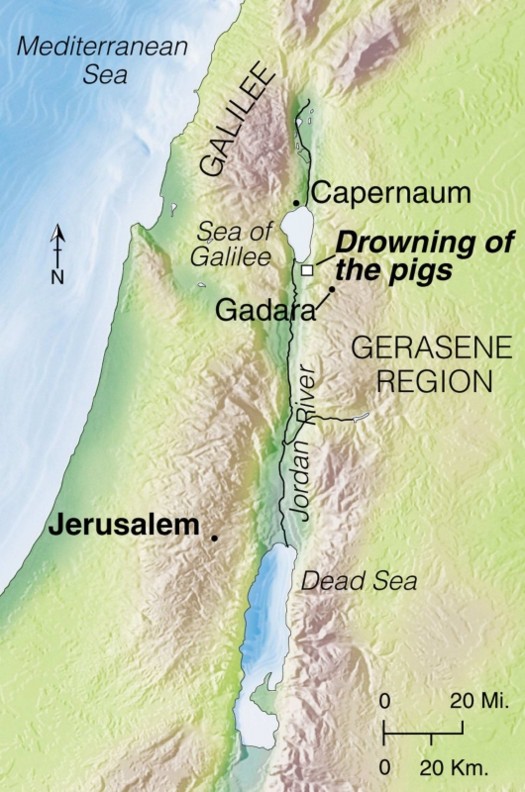
The Demoniac at Gadara

In our Gospel, we meet another wildly outraged man. This one is tormented by his inner demons, causing him also to put himself in dangerous situations. Jesus names this man’s tormentor and casts it out, giving the man control of himself again.


Have you ever been so offended, humiliated or injured that you felt outrage for yourself or another? Such fury chains us, making rationality and reconciliation close to impossible. Sometimes, it renders us impotent to name and address the deep source of our indignation.

Instead, we lash out with stones of anger or passive aggression – throwing the dirt of condemnation rather than seeking inner balance and healing.


Most of us have encountered large or small “dementors” in our life.
(Thanks for the term AND the image, Harry Potter)

But when I think of those who have endured unbelievable degrees of torment, I am amazed at their stories of faith and resolution: Anne Frank, Victor Frankel, Nelson Mandela, Harriet Tubman …. Jesus Christ. How did they come through it whole and blessed?

Maybe the possessed man in Mark’s Gospel was just lucky that day to run into Jesus. Or maybe he sought out Christ, trying to find stability in the midst of his derangement.

When we face our own imbalances can we stay still long enough to ask, as David did, “What is God teaching me in this. How can this lead me closer to God?” If we could, might we not be surprised to see our demons named, cast into the greater sea of God’s eternal wisdom, peace and love?


Poetry: Matthew VIII, 28 Fr. – Richard Wilbur
This poem, spoken by the residents of Gadara or Gerasa, imagines that they are more interested in their commerce than in miracles. They’re pretty disturbed about their pigs too

Rabbi, we Gadarenes
Are not ascetics; we are fond of wealth and possessions.
Love, as You call it, we obviate by means
Of the planned release of aggressions.
We have deep faith in properity.
Soon, it is hoped, we will reach our full potential.
In the light of our gross product, the practice of charity
Is palpably non-essential.
It is true that we go insane;
That for no good reason we are
possessed by devils;
That we suffer, despite the amenities
which obtain
At all but the lowest levels.
We shall not, however, resign
Our trust in the high-heaped table and the full trough.
If You cannot cure us without destroying our swine,
We had rather You shoved off.


Music: Set My Spirit Free – Maranatha Singers

Love – The Unfailing Bridge

Today, in God’s Lavish Mercy,  we begin our readings with God’s stern but magnificent commission to the prophet Jeremiah: 

… stand up and tell them
all that I command you.

What Jeremiah had to tell the Israelites was not comforting news. He prophesied that if they didn’t repent from their idolatry, Jerusalem would fall into the hands of foreign oppressors. Nobody wanted to hear it. They led Jeremiah a life, to the point that he is often referred to as “The Weeping Prophet”. Over the course of forty years and the reign of five Judean kings, Jeremiah’s message continues until, in the end, it comes to fulfillment in the Babylonian Captivity.

Jeremiah Lamenting the Fall of Jerusalem
Rembrandt

How did Jeremiah sustain such confrontational preaching in the face of intractable resistance?

Perhaps the answer lies in our second reading. He did it out of love.

Arthur Cundall, a British scripture scholar writes:

“God wanted a person
with a very gentle and tender heart
for this unrewarding ministry of condemnation.
Jeremiah’s subsequent career shows that
he had this quality in full measure.”

Jeremiah is a living example of the loving, humble, truth-seeking, hope-impelled soul described in 1 Corinthians, our second reading.

Strive eagerly for the greatest spiritual gifts.
But I shall show you a still more excellent way.
If I speak in human and angelic tongues,
but do not have love,
I am a resounding gong or a clashing cymbal.
And if I have the gift of prophecy,
and comprehend all mysteries and all knowledge;
if I have all faith so as to move mountains,
but do not have love, I am nothing.

1 Corinthians 13: 1-2

In Luke’s Gospel today, we see Jesus rejected in the same manner as Jeremiah. Jesus’s message calls his listeners to deep conversion of heart in order to be redeemed. Like the ancient Israelites, they don’t want to hear it. They cannot break through their comfortable existence to acknowledge its emptiness.

Jesus is Rejected at Nazareth
Maerten de Vos – 16th Century

And he said, “Amen, I say to you,
no prophet is accepted in his own native place….

… When the people in the synagogue heard this,
they were all filled with fury.
They rose up, drove him out of the town,
and led him to the brow of the hill
on which their town had been built,
to hurl him down headlong.
But Jesus passed through the midst of them and went away.

Luke 4:24; 28-30

The message for us today? Is there an emptiness somewhere in our hearts that we have not yet given over to God? Are we filling it with “false gods”, rather than the loving virtues described in Corinthians? Is there even a small resistance to the Word that keeps us in a “dead space”.

We know where our “dead spaces” are, and we deeply intend them to come alive again. Today, let’s choose to walk the bridge from intention to practice.


Poetry: Jeremiah – Saint John Henry Newman

"WOE'S me!" the peaceful prophet cried,
"Spare me this troubled life;
To stem man's wrath, to school his pride,
To head the sacred strife!

"O place me in some silent vale,
Where groves and flowers abound;
Nor eyes that grudge, nor tongues that rail,
Vex the truth-haunted ground!"

If his meek spirit err'd, opprest
That God denied repose,
What sin is ours, to whom Heaven's rest
Is pledged, to heal earth's woes?

Music:  One of my all time favorite songs (Wow! And how about the snow geese at the end of this video!)