Sibling Dilemma

Tuesday of the Twenty-seventh Week in Ordinary Time
October 10, 2023

Today’s Readings:

https://bible.usccb.org/bible/readings/101023.cfm

Today, in God’s Lavish Mercy, we pray with Martha and Mary. These sisters are the personification of the Benedictine motto: Ora et labora: Pray and work – the two essentials that we all struggle to balance in our lives.

They, with their brother Lazarus, are dear friends of Jesus. The scriptures show us that Jesus felt comfortable at their home, and that they loved to have him stay with them.

As all of us do with our closest friends, Jesus understood the lights and shadows of their personalities – and they of his. He knew that Martha was the organizer, the one who planned and worried about the incidentals. Mary was deeply spiritual, but maybe had her head in the clouds a bit when it came to getting things done. 

Perhaps these personality differences caused some tensions between the sisters, as they might between us and our family members or close friends. Sometimes these little, unnoticed frictions can suddenly become chasms between us and those we love. 

How and why does it happen?

Jesus gives us the answer in this Gospel passage. He hears Martha’s simmering frustration. He calms her, as one might a child – “Martha, Martha…”. We can hear his gentle tone. Jesus tells her that worry and anxiety are signs that we are not spiritually free. He tells her that Mary has focused on the important thing.

This may sound repetitious, but just think about it a while:

It is so important to know what is important. 

It is so freeing to agree on what matters with those closest to us. Talking with each other in openness, respect, and unconditional love is the only path to that freedom.

Maybe Martha and Mary slipped off that path a bit in this situation. But with Jesus’ help, they righted their relationship. 

That’s the best way for us to do it too. Let Jesus show us what is most important through sharing our faith, and even our prayer, with those closest to us. Let him show us where our self-interests, need for control, fears and anxieties are blocking us from love and freedom.

It is the same way that we, like Mary, can strengthen our relationship with God. It is not sufficient for our prayer to consist of incidentals — pretty words and empty practices. 

We must sit open-hearted at the feet of Jesus and let him love us, let him change us. Even in the midst of our responsibilities and duties, we must balance “the better part”.


Poetry: Bethany Decisions – Irene Zimmerman, OSF 

As Jesus taught the gathered brothers
and Martha boiled and baked their dinner,
Mary eavesdropped in the anteroom
between the great hall and the kitchen.
Her dying mother’s warning words
clanged clearly in her memory—
“Obey your sister. She has learned
the ways and duties of a woman.”

She’d learned her sister’s lessons well
and knew a woman’s place was not
to sit and listen and be taught.
But when she heard the voice of Jesus
call to her above the din
of Martha’s boiling pots and pans,
she made her choice decisively—
took off her apron and traditions,
and walked in.


Music: a charming little song by Peg Angell which leaves me with same practical question I always have when reading this passage: who actually did get the dinner ready?

Neighbor

Monday of the Twenty-seventh Week in Ordinary Time
October 9, 2023

Today’s Readings:

https://bible.usccb.org/bible/readings/100923.cfm


Today, in God’s Lavish Mercy, get ready for a three-day cruise with Jonah and a radical journey down the Jericho road with the Good Samaritan.

The message of Jonah is clear: all people, even hated Ninevites, are children of God’s Mercy. Resisting that understanding can be catastrophic to our spiritual life.


Patricia Tull, Rhodes Professor Emerita of Old Testament at Louisville Seminary, summarizes the Book of Jonah like this:

A postexilic book, Jonah’s story is atypical for prophetic works. Not only is it a narrative about the prophet rather than his speeches, but it also rebuffs Jonah for his refusal to preach to foreign enemies. Jonah’s story portrays foreigners as more than ready to repent and turn to God. The book uses humor, hyperbole, and irony to make its parabolic point.

Our Gospel gives us one of the most beloved yet challenging parables of Jesus – who is our “neighbor”. The infinite dimensions within this parable continue to unfold for us as we deepen in our mercy spirituality.

God does not see anyone as a “foreigner”. Every human being lives with the breath of God. We are “neighbors” because we share that breath, that “neighborhood” of God’s boundless Love.


But, oh my God, how we have forgotten or rejected that common bond of reverence for one another! Just yesterday, one of our sisters brought up the subject of a recent hit-and-run accident in Philadelphia. It now seems to be the common practice to leave the scene of such an occurrence, abandoning the victim to his fatal circumstance. She wondered, incredulously, how anyone could be that callous.


Our Gospel parable describes that callousness. Notice that both the priest and the Levite pass the victim by “on the opposite side“. The phrase implies that if I can build a wall to make you invisible to me, I can more easily ignore your claim on my merciful neighborliness.

The Samaritan lived without those walls. He did not see a Jew, or a foreigner, or an expendable “other”. He saw a human being, like himself – a neighbor who was struggling to live.

The Good Samaritan (1880) by Aimé Morot


Jesus’ parable of the Good Samaritan is a clear example of the call of the Gospel to neighborliness. In the story, such a call is an inconvenient truth because it summons outside the comfortable community to find the neighbor among the not-well-regarded “others.” 

Walter Brueggemann, Health Progress, January – February 2010

We don’t want to be like resistant Jonah, nor like the prejudicially blinded priest and Levite of our parable. But it is hard. The world conspires to separate us into the haves and the have-nots, the deserving and the undeserving, the winners and the losers, the sinners and the saints. Mercy not only resists but dismantles such walls. Do we have the courage to examine our own prejudices and to step across from “the opposite side” for the sake of our neighbor?


Poem: Neighbor – Iain Crichton Smith

Build me a bridge over the stream
to my neighbour’s house
where he is standing in dungarees
in the fresh morning.
O ring of snowdrops
spread wherever you want
and you also blackbird
sing across the fences.
My neighbor, if the rain falls on you,
let it fall on me also
from the same black cloud
that does not recognize gates.

Music: JJ Heller – Neighbor

Sometimes it's easier to jump to conclusions
Than walk across the street
It's like I'd rather fill the blanks with illusions
Than take the time to see
You are tryna close the back door of your car
You are balancing the groceries and a baby in your arms
You are more than just a sign in your front yard
You are my neighbor
I can get so lost in the mission
Of defending what I think
I've been surfing on a sea of opinions
But just behind the screen
You are grateful that the work day's finally done
You are stuck in miles of traffic, looking at your phone
You are tryin' to feel a little less alone
You are my neighbor
When the chasm between us feels so wide
That it's hard to imagine the other side
But we don't have to see things eye to eye
For me to love you like you are my neighbor
My neighbor
Oh, to fear the unfamiliar
Is the easy way to go
But I believe we are connected more than we might ever know
There's a light that shines on both the rich and poor
Looks beyond where we came from and who we voted for
'Til I can't see a stranger anymore
I see my neighbor
May my heart be an open door to my neighbor
You are my neighbor

The Lord’s Vineyard

Twenty-seventh Sunday in Ordinary Time
October 8, 2023

Today’s Readings:

https://bible.usccb.org/bible/readings/100823.cfm


Today, in God’s Lavish Mercy, we pray with Psalm 80, rather a desperate plea in the midst of devastation.

… the vineyard which  you planted …
Why have you broken down its walls,
so that every passer-by plucks its fruit,
The boar from the forest lays it waste,
and the beasts of the field feed upon it?

Psalm 80: 13-14

Angelus – Jean Francois Millet

Among my readers there are probably not too many farmers, but there may be a few serious gardeners. You would know what it feels like to lose a valued and tendered crop. And all of us have probably seen a movie or two where early settlers lose the crop which sustained their existence, or a news story of the same tragedy in real life. No words.


So Isaiah tells us that Israel, and by extension the People of God, is that precious vineyard, lovingly planted in hope by the Creator. The prophet paints the image of a deeply disappointed God:

The vineyard of the LORD of hosts is the house of Israel,
and the people of Judah are his cherished plant;
he looked for judgment, but see, bloodshed!
for justice, but hark, the outcry!

Isaiah 5:7

But Psalm 80 calls out to that “disappointed” God and asks for forgiveness and restoration. The psalmist is inspired by the same kind of relentless hope Paul encourages in our second reading:

Have no anxiety at all, but in everything,
by prayer and petition, with thanksgiving,
make your requests known to God.
Then the peace of God that surpasses all understanding
will guard your hearts and minds in Christ Jesus.

Philippians 4:6-7

Our Gospel demonstrates for us that the cycle continues throughout history: hope – sin – devastation- repentance – forgiveness – renewed hope. It continues in individuals, families, societies, churches.

But that cycle has been forever absorbed into the Passion, Death and Resurrection of Christ who once and for all redeemed us from its clutches. In the grace of Jesus Christ, we can never remain devastated or bereft of life. This is the glory of our Baptism into Christ, if we will but claim it!

Paul guides us, himself like a tender gardener, in this passage that is so worth our quiet reflection. It will be our “poem” for today! 

Finally, brothers and sisters,
whatever is true, whatever is honorable,
whatever is just, whatever is pure,
whatever is lovely, whatever is gracious,
if there is any excellence
and if there is anything worthy of praise,
think about these things.
Keep on doing what you have learned and received
and heard and seen in me.
Then the God of peace will be with you.


Music: Shen Khar Venakhi ( You are a Vineyard )
A hymn of praise to God’s perfect vineyard, the Virgin Mary who brought forth Christ

You are a vineyard newly blossomed.
Young, beautiful, growing in Eden,
A fragrant poplar sapling in Paradise.
May God adorn you. 
No one is more worthy of praise.
You yourself are the sun, shining brilliantly.


Thou Art a Vineyard (Georgian: შენ ხარ ვენახი, transliterated: Shen Khar Venakhi) is a medieval Georgian hymn. The text is attributed to King Demetrius I of Georgia (1093–1156). The composer of the music is unknown. Supposedly Demetrius wrote it during his confinement as a monk in the monastery. The hymn is dedicated to Georgia and the patronage of the Virgin Mary: it is also a prayer of praise to Mary in the Georgian Orthodox Church

As the lyrics did not mention any saints or gods, this was the only church-song that was permitted to be performed in the anti-religious Soviet Union. There are East Georgian (Kartli-Kakhetian) and West Georgian (Gurian) versions of this chant with very different musical compositions.

Got Sin?

Memorial of Our Lady of the Rosary
Saturday of the Twenty-sixth Week in Ordinary Time
October 7, 2023

Today’s Readings:

https://bible.usccb.org/bible/readings/100723.cfm


Today, in God’s Lavish Mercy, Baruch continues to instruct his flock on the necessity and practice of repentance.

Baruch puts this wonderful image into the mouth of personified Jerusalem as she calls her people to repentance:

As your hearts have been disposed to stray from God,
turn now ten times the more to seek him…

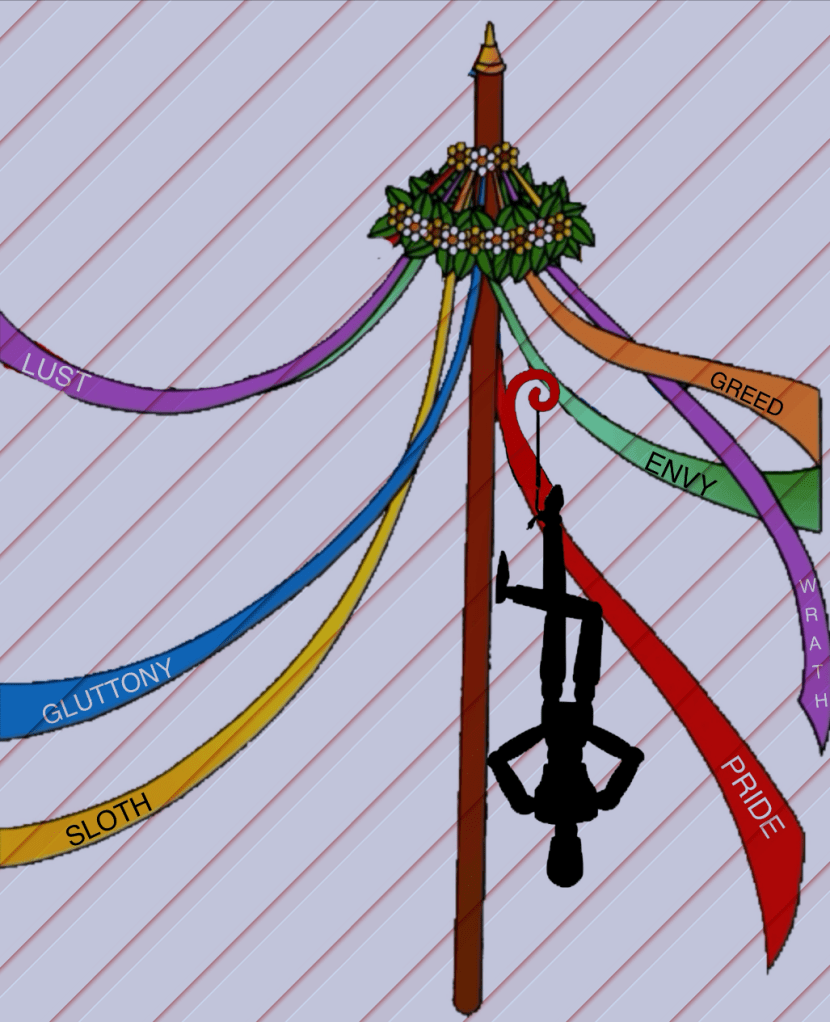
Doesn’t that verse perfectly describe how we struggle to move beyond our sinful fascinations into freedom and wholeness? I’m sure that, at some time in our lives, we have twirled more than once around some of the deadly sins to the point of getting ourselves all wound up!

Baruch says, “Rewind — even ten times! Go back to the heart of God!”


But that repentance to the tenth power may not be so easy to achieve. The topic of sin isn’t so popular today, although its practice seems to be doing just fine. Dr. Rebecca DeYoung, graduate of Notre Dame, specializes in research about the seven deadly sins and spiritual formation. She says this about our density to the power of sin in our lives:

We deceive ourselves about how powerful sin actually is, and when we finally do face our flaws, we often find ourselves, as Augustine said in his Confessions, “chained by the power of habit.” What would it look like to take sin seriously—to acknowledge how susceptible we are to the dark power of our own disordered desires? And what difference does it make to think of sin as self-destructive habit that shapes our lives from the inside out?


Prose: You may enjoy reading Professor DeYoung’s article as much as I did. Here is the link;


Music: Where I Find God – Larry Fleet

That moment of repentance and redemption can come in the most unexpected ways as attested to in this great country song. Fleet wrote this song which was one of the 50 most listened to country songs of 2021.

The night I hit rock bottom, sittin’ on an old barstool
He paid my tab and put me in a cab, but he didn’t have to
But he could see I was hurtin’, oh, I wish I’d got his name
‘Cause I didn’t feel worth savin’, but he saved me just the same

That day out on the water, when the fish just wouldn’t bite
I put my pole down, I floated around, was just so quiet
And I could hear my old man sayin’ “Son, just be still
‘Cause you can’t find peace like this in a bottle or a pill”

From a bar stool to that Evinrude
Sunday mornin’ in a church pew
In a deer stand or a hay field
An interstate back to Nashville
A Chevrolet with the windows down
Me and him just ridin’ around
Sometimes, whether I’m lookin’ for Him or not
That’s where I find God

Sometimes late at night, I lie there and listen
To the sound of her heart beatin’
And the song the crickets are singin’
And I don’t know what they’re sayin’
But it sounds like a hymn to me
Naw, I ain’t too good at prayin’
But thanks for everything

From a bar stool, to that Evinrude
Sunday mornin’ in a church pew
In a deer stand or a hay field
An interstate back to Nashville
A Chevrolet with the windows down
Me and him just ridin’ around
Sometimes, whether I’m lookin’ for Him or not
That’s where I find God

From a bar stool, to that Evinrude
Sunday mornin’ in a church pew
In a deer stand or a hay field
An interstate back to Nashville
A Chevrolet with the windows down
Me and him just ridin’ around
Talkin’, well I do that a lot
Well, I do that a lot
That’s where I find God

Pray for One Another

Friday of the Twenty-sixth Week in Ordinary Time
October 6, 2023

Today’s Readings:

https://bible.usccb.org/bible/readings/100623.cfm


Baruch Writing Jeremiah’s Prophecies – Gustave Doré


Today, in God’s Lavish Mercy (and tomorrow) we have a few words from Baruch – and he is not a happy camper. Baruch, the scribe for the prophet Jeremiah, did his own little bit of writing reflecting on the situation of the Jews exiled in Babylon.

The Book of Baruch takes the form of a letter from the captives to the high priest who remained in Jerusalem after the exile. The writer asks for prayers for the exiled community and sends money to support that request. He voices the people’s acknowledgment that their suffering is a result of their own sin. He even composes the prayers that he wishes to be said in Jerusalem:

Justice is with the Lord, our God;
and we today are flushed with shame,
we men of Judah and citizens of Jerusalem,
that we, with our kings and rulers
and priests and prophets, and with our ancestors,
have sinned in the Lord’s sight and disobeyed him.

Baruch 1:15-18

When I was growing up, we had a practice in my family very similar to that described in Baruch. When confusing troubles arose for the family, Mom would appeal to either of two sources for supportive prayer: The Shrine of Sainte-Anne-de-Beaupré in Canada or the “Pink Sisters” (The Holy Spirit Adoration Sisters) on Green Street in Philadelphia. I have written to the Pink Sisters myself on a few spiritually catastrophic occasions. A Sister always writes back with sustaining wisdom and the affirmation of prayer.

Remembering all this reminds me that it is so important to pray for one another! Doing so creates an invisible, almost magnetic connection that helps sustain us in times of doubt, suffering, loss, and sadness. It also helps the pray-er to affirm membership in a company of believers – all of us “just walking each other home.”(Ram Dass)


This is exactly what Baruch was doing for the Babylonian exiles:

  • reminding them of their true home in God
  • reconnecting them to a community from which they had been severed
  • voicing their suffering
  • showing them a path to repentance, hope, and restoration.

At those “exile times” in our lives, when we are somewhere on the fragile edge of faith and endurance, as our Psalm today reminds us, prayer refocuses us on God rather than ourselves. Trusting the glorious name of God, we slowly open to a Light we may not have seen because our own shadow was in the way.

Help us, O God our savior,
because of the glory of your name;
Deliver us and pardon our sins
for your name’s sake.

Psalm 79:9

Poetry: A Prayer – May Sarton

Help us to be the always hopeful
gardeners of the spirit
who know that without darkness
nothing comes to birth
as without light
nothing flowers.

Music: Anthem – Leonard Cohen

Keeping up with the Synod

October 5, 2023

I know many of you really enjoyed Fr. Timothy Radcliff. His retreat is over but you can follow daily updates on the Synod at the website below.

Pope Francis offered a selection of Patristic writings about the Holy Spirit for the assembly’s reflection.

They come from St. Basil the Great and are really very beautiful. I would take just one passage at a time though. Too much Basil can ruin a good meal!🧐

https://www.vaticannews.va/en/taglist.chiesa-e-religioni.Vaticano.sinodo.html

To Hear and Believe Anew

Thursday of the Twenty-sixth Week in Ordinary Time
October 5, 2023

Today’s Readings:

https://bible.usccb.org/bible/readings/100523.cfm


Today, in God’s Lavish Mercy, our first reading comes from the pragmatical prophet Nehemiah. Compared to the lyrical works of writers like Isaiah and Jeremiah, Nehemiah and his buddy Ezra can sound pretty pedantic. But today’s passage is powerful, rendered so by the tears of Ezra’s listeners:

Then Nehemiah and Ezra the priest-scribe
and the Levites who were instructing the people
said to all the people:
“Today is holy to the LORD your God.
Do not be sad, and do not weep”–
for all the people were weeping as they heard the words of the law.
He said further: “Go, eat rich foods and drink sweet drinks,
and allot portions to those who had nothing prepared;
for today is holy to our LORD.

Nehemiah 8: 9-10

Why were these people crying? (besides the fact that they had stood for six hours listening to Ezra’s filibuster!!!)

Ezra Reads the Law – Julius Schnorr von Carolsfeld’


The people cried because they had restored to them something they thought was lost. Israel had been smothered in Babylon for seven decades – more than a lifetime in ancient Israel. Perhaps they had tried to hold on to the faith of their ancestors, but seventy years of remembering can become wearisome. Now, by God’s mercy, Jerusalem had been restored to them where they could stand in freedom to hear the Word that held them together. Notice that ALL the people were gathered, even the women and children, to be touched by the Word.

The whole people gathered as one in the open space before the Water Gate,
and they called upon Ezra the scribe
to bring forth the book of the law of Moses
which the LORD prescribed for Israel.

Nehemiah 8:1

Picturing the size and circumstances of Ezra’s large assembly, I was reminded of the first baseball game after 9/11/2001. Two weeks after that abominable day, Atlanta played the New York Mets at Citi Field, just a little over ten miles from the World Trade Center. The whole nation was brokenhearted, and certainly, all of us mourned deeply for the people of New York City. The video below recalls that game. There is a well of tears in every face — loss, hope, courage, gratitude, determination, and love for country. And I think even the Braves wanted the Mets to win!


This passage from Nehemiah comes at an opportune time for the Church as we gather in Rome to open the Synod on Synodality. Yesterday, Pope Francis convened representatives of the whole Church to hear the promptings of the Holy Spirit.


Many in the Church feel disoriented and disaffected by issues corroding the Church’s integrity. The continuing waves of the clerical abuse scandal have poisoned the waters of trust and devotion. The failure to recognize women as full human beings paralyzes half the Holy Spirit’s energy. Fractious, self-interested criticisms of papal authority, even by some bishops, have distracted the simple believer from a life of faith. The weaponizing of Catholic social media by the powerful against the marginalized dishonors and vitiates the Gospel in the public sector. Inadequacies in liturgical understanding, preaching, and pastoral leadership have alienated many cradle Catholics from pursuing Church membership.


Not unlike Ezra and Nehemiah, Pope Francis challenges the Church to hear the Word of God rekindled among us. For those who believe the Church is only the hierarchy, or the magisterium, this gathering may be a threat to a status quo which serves their interests. To those who see the Church as the whole people of God, the Synod may be a sacred tonic to a languishing Church.


We should all pray for the success of the Synod. When received with an open and honest heart, the Holy Spirit does astounding things within us. This synod can move the whole Church closer to its sacred perfection, but more specifically, it can do the same for you and me if we desire it. Let’s take Nehemiah’s words to heart, rejoicing and believing that God will delight in the Church’s invitation to speak to us anew:

Do not be saddened this day,
for rejoicing in the LORD must be your strength!”
And the Levites quieted all the people, saying,
“Hush, for today is holy, and you must not be saddened.”
Then all the people went to eat and drink,
to distribute portions, and to celebrate with great joy,
for they understood the words that had been expounded to them.

Nehemiah 8: 10-12

Music: Holy Spirit Living Breath of God – Keith and Kristyn Getty

Living Gratitude

Memorial of Saint Francis of Assisi
October 4, 2023

Today’s Readings:

https://bible.usccb.org/bible/readings/1004-memorial-francis-assisi.cfm

(I chose to offer a reflection on the readings for the Memorial of St. Francis rather than for Wednesday of the Twenty-sixth Week)


Today, in God’s Lavish Mercy, we pray with St. Francis of Assisi (1181-1226) , one of the most revered figures in Christianity, an Italian mystic and Catholic friar who founded the Franciscans.

The simple holiness of St. Francis has had an immeasurable effect not only on Christianity but even on secular culture. No matter their religious interest, most people would recognize this humble, medieval itinerant preacher and understand the witness of his life.


Our current Holy Father, in a surprise move, chose St. Francis as his patron and model:

When the former Cardinal Jorge Mario Bergoglio went over the 77 votes needed to become pope, he said that his friend Cardinal Hummes “hugged me, kissed me and said, ‘Don’t forget the poor.’”
At the time of his election, Pope Francis told thousands of journalists that he took to heart the words of his friend and chose to be called after St. Francis of Assisi, “the man of poverty, the man of peace, the man who loves and protects creation.”


In our readings today, both the Responsorial Psalm and the Gospel echo a spirituality deeply compatible with the Franciscan spirit.

Francis, who renounced his wealthy lifestyle and inheritance for the riches of Christ, surely found inspiration when he prayed Psalm 16:

You are my inheritance, O Lord.
Keep me, O God, for in you I take refuge.
I say to the LORD, “My Lord are you.”
O LORD, my allotted portion and my cup,
you it is who hold fast my lot.

I bless the LORD who counsels me;
even in the night my heart exhorts me.
I set the LORD ever before me;
with him at my right hand I shall not be disturbed.

You will show me the path to life,
fullness of joys in your presence,
the delights at your right hand forever.


Most of us reading this reflection have so much in life. We are blessed beyond description with everything we need and even want. Praying in the spirit of St. Francis can help us discern how to honor and use what we have in a way that pleases God.

Keep a clear eye toward life’s end. Do not forget your purpose and destiny as God’s creature. What you are in God’s sight is what you are and nothing more. Remember that when you leave this earth, you can take nothing that you have received…but only what you have given; a full heart enriched by honest service, love, sacrifice, and courage.

Francis of Assisi

Poetry: ST. FRANCIS OF ASSISI – A SERMON TO THE BIRDS
Francis made his deep spirituality and radical teaching easily accessible with unpretentious parables like this one. He imitated Jesus himself who taught us how to live by telling simple stories in which we could find ourselves. So let’s learn from this one, my little “birds”.

My little sisters the birds,
Ye owe much to God, your Creator,
And ye ought to sing his praise at all times and in all places, 
Because he has given you liberty to fly about into all places; 
And though ye neither spin nor sew,
He has given you a twofold and a threefold clothing
For yourselves and for your offspring.
Two of all your species He sent into the Ark with Noah
That you might not be lost to the world;
Besides which, He feeds you, though ye neither sow nor reap.
He has given you fountains and rivers to quench your thirst, 
Mountains and valleys in which to take refuge,
And trees in which to build your nests;
So that your Creator loves you much,
Having thus favored you with such bounties.
Beware, my little sisters, of the sin of ingratitude, 
And study always to give praise to God.” Amen

Music: St. Francis of Assisi by Mendoza Musicals

Synod Retreat

Sessions 5 and 6

October 3, 2023

Thanks to all of you who let me know you were pleased to receive the links to the Synod Retreat. Below, you will see the official Synod Prayer, and Sessions 5 and 6 of the Retreat.

I have also included, at the end, Pope Francis’s response to a questioning letter sent to him by five retired conservative Cardinals, Walter Brandmüller and Raymond Leo Burke supported by three other Cardinals, Juan Sandoval Íñiguez, Robert Sarah, and Joseph Zen Ze-kiun. On the threshold of this momentous gathering, the men’s questions express their fears rather than their hopes for the Church, and attempt to limit the dynamism of the Synod solely to specific moral and doctrinal concerns. Their letter and questions may confuse and distract people from the real power and purpose of a synod. I found Pope Francis’s thoughtful, pastoral, and eloquent response most inspiring.

Session 5: Authority

https://www.vaticannews.va/en/church/news/2023-10/synod-retreat-meditation-authority.html


Session 6: The Spirit of Truth

https://www.vaticannews.va/en/church/news/2023-10/synod-retreat-meditation-the-spirit-of-truth-radcliffe.html


Response to the Dubia (Doubts)

https://www.vaticannews.va/en/pope/news/2023-10/pope-francis-responds-to-dubia-of-five-cardinals.html

Toward Jerusalem

Tuesday of the Twenty-sixth Week in Ordinary Time
October 3, 2023

Today’s Readings:

https://bible.usccb.org/bible/readings/100323.cfm


Today, in God’s Lavish Mercy, we pray with Psalm 87, a Song of Zion which imagines the future Jerusalem as the world’s center of worship.

The foundation upon the holy mountains
    the LORD loves:
The gates of Zion,
    more than any dwelling of Jacob.
Glorious things are said of you,
    O city of God!

Psalm 87: 1-3

For centuries, the Jews had been scattered through many alien countries. Some had lost their ties to their inherited faith. The psalm calls all people “home” to the worship of the one, true God.

Jerusalem from the Mount of Olives by Frederic Edwin Church

Jerusalem is a profoundly unifying symbol for Jews. That is why it is so important for Jesus to “go up to Jerusalem” in order to accomplish our redemption. As today’s Gospel tells us:

When the days for Jesus to be taken up were fulfilled,
he steadfastly turned his face to Jerusalem.

Luke 9:51

Praying with these passages may seem difficult for Christians if we have no emotional ties to the city of Jerusalem. But for us too, the concept of “Jerusalem” serves as a symbol of that stable and committed faith that allows us to live our lives in the pattern of Jesus.

We journey too, as Jesus did toward the fullness of life in God. Our journey takes singular steadfastness, just as his did, a commitment rooted in faith and grace.

Together in faith, we form a New Jerusalem, glorious in each one of us through our Baptism into Christ.


Poetry: A Sonnet – Malcolm Guite

Now to the gate of my Jerusalem,
The seething holy city of my heart,
The saviour comes. But will I welcome him?
Oh crowds of easy feelings make a start;
They raise their hands, get caught up in the singing,
And think the battle won. Too soon they’ll find
The challenge, the reversal he is bringing
Changes their tune. I know what lies behind
The surface flourish that so quickly fades;
Self-interest, and fearful guardedness,
The hardness of the heart, its barricades,
And at the core, the dreadful emptiness
Of a perverted temple. Jesus  come
Break my resistance and make me your home.


Music: Jerusalem, My Destiny – Rory Cooney