Shema Yisrael

Saturday of the Eighteenth Week in Ordinary Time
August 12, 2023

Today’s Readings:

https://bible.usccb.org/bible/readings/081223.cfm


Today, in God’s Lavish Mercy, our reading from Deuteronomy presents us with the central prayer of the Jewish faith and a key component of the Christian tradition. The prayer is called the Shema (pronounced Schma), and it captures the essence of what our faith is about.

Hear, O Israel! The LORD is our God, the LORD alone!


Hear, O Israel! The LORD is our God, the LORD alone!
Therefore, you shall love the LORD, your God,
with all your heart,
and with all your soul,
and with all your strength.
Take to heart these words which I enjoin on you today.
Drill them into your children.
Speak of them at home and abroad, whether you are busy or at rest.
Bind them at your wrist as a sign
and let them be as a pendant on your forehead.
Write them on the doorposts of your houses and on your gates.

Deuteronomy 6:4-9

Shema Yisrael is a Jewish prayer that serves as a centerpiece of the morning and evening Jewish prayer services. Its first verse encapsulates the monotheistic essence of Judaism: “Hear, O Israel: YHWH is our God, YHWH is one” found in Deuteronomy 6:4.

Observant Jews consider the Shema to be the most important part of the prayer service in Judaism, and its twice-daily recitation as a mitzvah (religious commandment). Also, it is traditional for Jews to say the Shema as their last words, and for parents to teach their children to say it before they go to sleep at night.

Wikipedia

In our prayer today, we might consider three key components of Shema for our personal faith life:

  1. “Hear” – The Presence and Voice of God is central to and inspires all my life
  2. our God” – It is my choice to live in covenantal relationship with God
  3. “the Lord alone” – There will be no other gods in my heart.

We could unpack any of these three elements to reflect extensively on the vitality of our relationship with God. For example:

“Hear”

  • How do I open my mind and heart to God?
  • What spiritual practices keep me focused on God’s Presence in my daily circumstances?
  • When I am confused or spiritually inert, how do I invite the inspiriting Voice of God into my consciousness?

Answering these questions does not have to lead us through a big theological maze. It can be as simple as waking up and saying,

"Dear God, good morning. 
Thank you for my life.
Please be with me throughout this day."

Or before we close our eyes at night:

"Holy One, thank you for this day.
I am sorry for any chance I missed to serve You.
As I sleep, please refresh my love for You and Your Creation."

The essence of the Shema is this: God is not simply a part of my life. God is my life. And every thread of my life should be woven into that wondrous Truth.


For those who might be interested in a more in depth study of the Shema, I found this article very helpful.

https://journals.sagepub.com/doi/full/10.1177/0008429819828670


Poetry: To Live With the Spirit – Jessica Powers

To live with the Spirit of God is to be a listener.
It is to keep the vigil of mystery,
earthless and still.
One leans to catch the stirring of the Spirit,
strange as the wind’s will.
The soul that walks where the wind of the Spirit blows
turns like a wandering weather vane toward love.
It may lament like Job or Jeremiah,
echo the wounded hart, the mateless dove.
It may rejoice in spaciousness of meadow
that emulates the freedom of the sky.
Always it walks in waylessness, unknowing;
it has cast down forever from its hand
the compass of the whither and the why.
To live with the Spirit of God is to be a lover.
It is becoming love, and like to Him
toward Whom we strain with metaphors of creatures:
fire-sweep and water-rush and the wind’s whim.
The soul is all activity, all silence;
and though it surges Godward to its goal,
it holds, as moving earth holds sleeping noonday,
the peace that is the listening of the soul.

Music: Intermezzo from Cavalleria Rusticana, Pietro Mascagni– played by the City of Prague Philharmonic Orchestra

Remember and Love Generously

Memorial of Saint Clare, Virgin
August 11, 2023
Friday of the Eighteenth Week in Ordinary Time

Today’s Readings:

https://bible.usccb.org/bible/readings/081123.cfm


Today, in God’s Lavish Mercy, our readings continue to take us through Deuteronomy, and for the next two weeks, through Joshua, Judges, and Ruth.

The word “Deuteronomy” means “second law” because the book is a reiteration and refinement of the Law given in Exodus. The Book of Deuteronomy is basically three big speeches by Moses, the commissioning of Joshua as Israel’s next leader, and a recounting of the death of Moses.


Today’s speech is powerful and beautiful. Moses calls on the people to remember and give thanks for the immense blessings they have received at the hand of God.

Ask now of the days of old, before your time,
ever since God created man upon the earth;
ask from one end of the sky to the other:
Did anything so great ever happen before?
Was it ever heard of? 
Did a people ever hear the voice of God
speaking from the midst of fire, as you did, and live?

Deuteronomy 4:32-33

At length, Moses recounts the sacred history of the people and tells them that, because of it, they are called to respond in covenanted fidelity.

This is why you must now know, and fix in your heart,
that the LORD is God in the heavens above and on earth below,
and that there is no other.
You must keep his statutes and commandments which I enjoin on you today,
that you and your children after you may prosper,
and that you may have long life on the land
which the LORD, your God, is giving you forever.”

Deuteronomy 4: 39-40

Moses offered these encouraging and directive speeches because he sensed he was near the end of his life and that Israel was moving into a new phase of its life.

In our Gospel, Jesus feels the same way. In the section immediately preceding today’s reading, Matthew says this:

From that time on, Jesus began to show his disciples that he must go to Jerusalem and suffer greatly from the elders, the chief priests, and the scribes, and be killed and on the third day be raised


In today’s passage, Jesus calls his disciples to live in covenanted fidelity by imitating his life.

Whoever wishes to come after me must deny himself,
take up his cross, and follow me.
For whoever wishes to save his life will lose it,
but whoever loses his life for my sake will find it.
What profit would there be for one to gain the whole world
and forfeit his life?
Or what can one give in exchange for his life?

Matthew 16: 25-26

I’ve read this Gospel passage a thousand times in the past sixty or seventy years. And I ask myself each time, “Do you really take this seriously? Do you really understand that your life is not for yourself but for God and all of God’s beloved creatures?”

It takes radical courage to live that kind of understanding. But continually remembering God’s Presence and Promises throughout our own lives strengthens us. That’s what Moses was trying to tell his people. That’s what Jesus is encouraging his disciples to recognize.

Jesus promises that, at the end of time, each will be repaid according to the level of their generosity. But the repayment doesn’t wait for the end times. Remembering our lives in grateful prayer will convince us of this: there is no true happiness, no deep joy, unless we learn to live beyond our own self-interests.


Poetry: Unless a Grain of Wheat Falls into the Ground and Dies – Malcolm Guite

Oh let me fall as grain to the good earth
And die away from all dry separation,
Die to my sole self, and find new birth
Within that very death, a dark fruition,
Deep in this crowded underground, to learn
The earthy otherness of every other,
To know that nothing is achieved alone
But only where these other fallen gather.

If I bear fruit and break through to bright air,
Then fall upon me with your freeing flail
To shuck this husk and leave me sheer and clear
As heaven-handled Hopkins, that my fall
May be more fruitful and my autumn still
A golden evening where your barns are full.

Music: Unless a Grain of Wheat – Bernadette Farrell


Unless a grain of wheat shall fall upon the ground and die,
it remains but a single grain with no life.

If we have died with him then we shall live with him;
if we hold firm, we shall reign with him.
Unless a grain of wheat shall fall upon the ground and die,
it remains but a single grain with no life.

If anyone serves me then they must follow me;
wherever I am my servants will be.
Unless a grain of wheat shall fall upon the ground and die,
it remains but a single grain with no life.

Make your home in me as I make mine in you;
those who remain in me bear much fruit.
Unless a grain of wheat shall fall upon the ground and die,
it remains but a single grain with no life.

If you remain in me and my word lives in you,
then you will be my disciples.
Unless a grain of wheat shall fall upon the ground and die,
it remains but a single grain with no life.

Those who love me are loved by my Father;
we shall be with them and dwell in them.
Unless a grain of wheat shall fall upon the ground and die,
it remains but a single grain with no life.

Peace I leave with you, my peace I give to you;
peace which the world cannot give is my gift.
Unless a grain of wheat shall fall upon the ground and die,
it remains but a single grain with no life.

Give Cheerfully

Feast of Saint Lawrence, deacon and martyr
August 10, 2023

Today’s Readings:

https://bible.usccb.org/bible/readings/081023.cfm


Today, in God’s Lavish Mercy, we pray with Psalm 112, particularly chosen for the Feast of St. Lawrence

Blessed the one who fears the LORD,
    who greatly delights in God’s commands.
That one’s posterity shall be mighty upon the earth;
    the upright generation shall be blessed.
Well for the one who is gracious and lends,
    who conducts all affairs with justice;
That person shall never be moved;
    the just one shall be in everlasting remembrance.


After the martyrdom of Pope Sixtus II in 258 AD, the prefect of Rome demanded that Lawrence turn over the riches of the Church. St. Ambrose is the earliest source for the narrative that Lawrence asked for three days to gather the wealth. He worked swiftly to distribute as much Church property to the indigent as possible, so as to prevent its being seized by the prefect. On the third day, at the head of a small delegation, he presented himself to the prefect, and when ordered to deliver the treasures of the Church he presented the indigent, the crippled, the blind, and the suffering, and declared that these were the true treasures of the Church. One account records him declaring to the prefect, “The Church is truly rich, far richer than your emperor.” This act of defiance led directly to his martyrdom.

– Wikipedia

There are many lessons for us in the life of St. Lawrence. The most striking for me is his gift for seeing the most vulnerable people as the Church’s greatest treasures.

Praying Psalm 112 today, we might ask God to deepen in us that gift of sublime generosity which imitates God’s own Mercy:

Lavishly they give to the poor, 
    Their generosity shall endure forever;
    Their name shall be exalted in glory.


Poetry: Khalil Gibran- On Giving

You give but little when you give of your possessions.
It is when you give of yourself that you truly give. 
For what are your possessions but things you keep 
and guard for fear you may need them tomorrow?

And tomorrow, what shall tomorrow bring 
to the over-prudent dog burying bones in the trackless sand 
as he follows the pilgrims to the holy city?

And what is fear of need but need itself? 
Is not dread of thirst when your well is full, 
the thirst that is unquenchable?

There are those who give little of the much which they have–
and they give it for recognition and their hidden desire 
makes their gifts unwholesome.

And there are those who have little and give it all.
These are the believers in life and the bounty of life, 
and their coffer is never empty.

There are those who give with joy,
and that joy is their reward.
And there are those who give with pain,
and that pain is their baptism.

And there are those who give and know not pain in giving, 
nor do they seek joy, nor give with mindfulness of virtue;
They give as in yonder valley
the myrtle breathes its fragrance into space.
Through the hands of such as these God speaks, 
and from behind their eyes, He smiles upon the earth.

It is well to give when asked, 
but it is better to give unasked, through understanding;
And to the open-handed 
the search for one who shall receive is joy greater than giving.

And is there aught you would withhold?
All you have shall some day be given;
Therefore give now, that the season of giving 
may be yours and not your inheritors’.

You often say, “I would give, but only to the deserving.”
The trees in your orchard say not so, nor the flocks in your pasture.
They give that they may live, for to withhold is to perish.

Surely he who is worthy to receive his days and his nights, 
is worthy of all else from you.
And he who has deserved to drink from the ocean of life 
deserves to fill his cup from your little stream.

And what desert greater shall there be, 
than that which lies in the courage and the confidence, 
nay the charity, of receiving?
And who are you that the poor should rend their bosom and unveil their pride, 
that you may see their worth naked and their pride unabashed?

See first that you yourself deserve to be a giver, and an instrument of giving.
For in truth it is life that gives unto life 
while you, who deem yourself a giver, are but a witness.

And you receivers… and you are all receivers…  assume no weight of gratitude, 
lest you lay a yoke upon yourself and upon him who gives.
Rather rise together with the giver on his gifts as on wings;
For to be overmindful of your debt, is to doubt his generosity 
who has the freehearted earth for mother, and God for father.


Music: God Loves a Cheerful Giver – Steve Green has fun with the kids. I hope you do too!

It’s All About Trust

Wednesday of the Eighteenth Week in Ordinary Time
August 9, 2023

Today’s Readings:

https://bible.usccb.org/bible/readings/080923.cfm


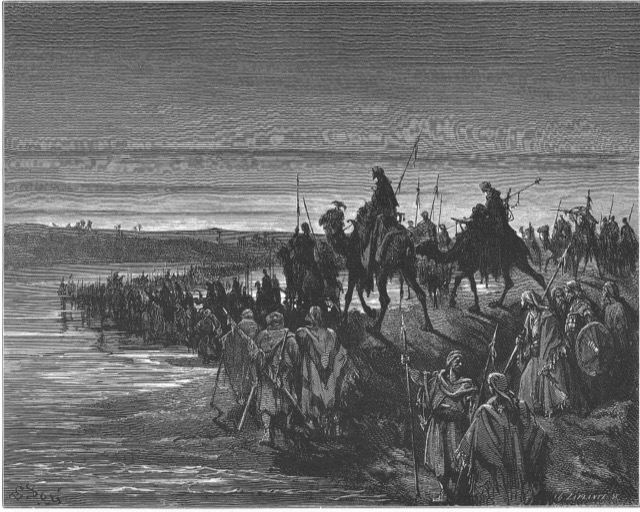
Today, in God’s Lavish Mercy, our reading from Numbers is about trust versus fear.  The Israelites have finally made it to the front door of the Promised Land. But they hesitate to go in. They get Moses to bargain with God to allow scouts to go ahead of them, checking out the lay of the land. These scouts return with a mixed report: arable land, but ferocious current residents! The community freezes in fear, refusing to go farther.

Israelites into Canaan
The Israelites Cross the Jordan River by Gustave Doré 1832-1883

So what’s this all about for us? Is it wrong for us to be deliberate about our decisions, reversing them when the situation becomes threatening? No, of course not. So what’s the difference here in our Numbers community?

At this moment in Israel’s history, God has made clear what is expected of them. They are in covenant with God – “all in” to follow God’s plan for their lives. God has demonstrated an irrevocable commitment to them in numerous ways, and forgiven earlier disloyalties. 

The question before them now is have they given God their whole hearts.

Or will this be a sham covenant in which they pick and choose when they will be for God and when they will be just for themselves?


The life of deep spiritual commitment to God is not always smooth. We get really mixed up sometimes in our self-concerns and fears. Many years ago, one of my eighth grade students asked me this: what if there really is no God and you’ve wasted your life believing there was?

It was quite a question, and I’ll bet you want to know my answer.

I said that I wouldn’t change a thing about how I have chosen to live my life. Trusting God and giving my life to God has given me a freedom beyond the limits of this world. Even if, at the end, her doubt proved true, I would have had a blessed and joyous life.

Psalm 106

The fact is that we, just like those Israelites standing on the edge of Canaan, don’t know what will happen to us if we trust God. Life and the future is an intimidating open border that challenges our faith and resolve.

But if we constantly hedge our self-gift to God, we will never be capable of receiving the fullness of God’s gift in return.

Today, let’s pray for the trust to step over into God’s country by our acts of faith, hope, love, mercy, generosity, truthfulness, hospitality and courage.


This beautiful reinterpretation of today’s Responsorial Psalm may inspire you as it did me. It is from the website of Christine Robinson, a Unitarian Universalist minister: Click here for Psalm renderings

Psalm 106: Returning
“Give thanks to God, who is good
whose mercy endures forever.”

We stand in awe of an infinity
which we cannot begin to comprehend
We set ourselves to live in tune with the universe—
that we may be glad with the gladness of people of faith.
Yes, time and time again we have gone astray,
We have despoiled this beautiful, wonderful world
dealt unjustly with our compadres
The law of love is a hard law.
In our prayer and then in our lives,
we return to the Way.

Music: Trust God – Rick Muchow 

Hidden Motives

Memorial of Saint Dominic, Priest
Tuesday of the Eighteenth Week in Ordinary Time
August 8, 2023

Today’s Readings:

https://bible.usccb.org/bible/readings/080823.cfm


Today, in God’s Lavish Mercy, we pray with Psalm 51 which expresses the ardent desire for forgiveness and reconciliation.

The psalm reflects back to our first reading – an episode of sibling rivalry, jealousy, and hidden motives.

Moses, favored of God and leader of the people, makes a questionable choice. He marries outside the tribe, after telling everyone else not to. Hmmm. His siblings, Aaron and Miriam, don’t like that. So they indignantly complain:

Is it through Moses alone that the LORD speaks?
Does God not speak through us also?

Numbers 12:2

God hears their complaint and sees through it. God sees that they are less concerned about the marriage and more concerned about themselves. They’re tired of Moses telling them what to do. They think God could have picked a better leader — one of them!

God sets them straight about how special Moses is, and their responsibility to support, not undermine, him.

Should there be a prophet among you,
in visions will I reveal myself to him,
in dreams will I speak to him;
not so with my servant Moses!
Throughout my house he bears my trust:
face to face I speak to him;
plainly and not in riddles.
The presence of the LORD he beholds.

Numbers 12:6-7

The whole story is really about motives. Everything we do must be done out of love – out of reverence for God, and out of respect and hope for ourselves and others. This is what it means to have a clean heart. And it is the plea of Psalm 51.

A clean heart create for me, O God,
and a steadfast spirit renew within me.
Cast me not off from your presence,
and your Holy Spirit take not from me.

Psalm 51: 12-13

Prose: This is a great piece by Sister Joyce Rupp on a clean heart (published in America magazine)

https://www.ncronline.org/blogs/clean-heart


Music: Psalm 51 – Chant of the Heart

But Not Yet

Monday of the Eighteenth Week in Ordinary Time
August 7, 2023

Today’s Readings:

https://bible.usccb.org/bible/readings/080723.cfm


Today, in God’s Lavish Mercy, with passages from Numbers and Deuteronomy, we begin a week and a half of readings that complete our scriptural journey through the Pentateuch.

The Book of Numbers, so named because of the two censuses within it, draws the Exodus journey to a close. The people are nearly at the edge of the Promised Land – but not yet. They are tired and frustrated and they let Moses know it:

The children of Israel lamented,
“Would that we had meat for food!
We remember the fish we used to eat without cost in Egypt,
and the cucumbers, the melons, the leeks,
the onions, and the garlic.
But now we are famished;
we see nothing before us but this manna.”


“Not Yet” is one of the hardest times in a journey. Driving from Philly to Knoxville to visit my family, I marveled at how the last two hours seemed so much longer than the eight which had preceded them! If there are kids in the car, the point is painfully driven home:

Are we there yet? x 1000!= Frustration


In today’s reading, the Israelites frustrate Moses with their “Are we there yet” attitude. Moses begs God to give him a break because his leadership is crumbling in the hungry unrest of the people:

“Why do you treat your servant so badly?” Moses asked the LORD.
“Why are you so displeased with me
that you burden me with all this people?
Was it I who conceived all this people? 
Or was it I who gave them birth,
that you tell me to carry them at my bosom,
like a foster father carrying an infant,
to the land you have promised under oath to their fathers?

Numbers 11:11-12

A core message from today’s Numbers passage is that the people need to be “fed” or they will not continue on the journey. Jesus acknowledges this universal fact in today’s Gospel. The story recounts the miracle of a physical feeding of the crowds, but the real miracle is the resuscitation of their faith because they witness the power of God in Christ.


We, individually and as a Church, need to be fed in order to continue our journey of faith. It is important for each of us to build into our lives those practices which will nourish our faith and spirituality: reflective prayer, enlivening spiritual reading, and merciful service. It is also critical for us to assess the kind of communal nourishment we receive within our faith communities and, where that nourishment is lacking, to acknowledge distress and seek alternatives as the hungry Israelites did in the desert.

Recently I was with a group of deeply faithful Christians where this shocking phrase was spoken and acknowledged: “The Catholic Church is dead“. What the phrase connotes is that, in light of the clerical abuse and other institutional scandals, coupled with the absence of inspirational Church leadership, many Catholics are starving for nourishment on the journey. Clearly, the same may be said of other Christian Churches.


To varying degrees, we may be familiar with the Synod 2021-24 initiated by Pope Francis in October 2021.

The word synod comes from the Greek: σύνοδος [ˈsinoðos], meaning “assembly” or “meeting”; the term is analogous with the Latin word concilium meaning “council”.

The word synod comes from the Greek meaning “assembly” or “meeting”; the term is analogous with the Latin word concilium meaning “council”.

Traditionally, we are familiar with such gatherings being constituted primarily by the hierarchy of the Church. Synod 2021-24 is different.


The Synod on Synodality represents a new and exciting phase in the life of the Church. This phase deepens the ecclesiology of the People of God developed at the Second Vatican Council and invites us to generate processes of conversion and reform of relationships, communicative dynamics and structures in the Church. This will require a process of common discernment and formation in the short, medium and long term to stimulate the awareness of a Church lived and understood in a synodal key.

Boston College – School of Theology and Ministry

Many of us are old enough to remember the intense enthusiasm and hope which sprang from the Second Vatican Council a half-century ago. The inspired Vatican II documents fueled a dynamic revitalization for the People of God.

But over the course of 5o years, the Church’s landscape has changed:

  • plummeting numbers in religious and priestly vocations
  • scars from the sexual abuse scandal
  • misalignment between practice and teaching on sexuality, gender, and marriage
  • disaffection of women and young adults with the Church
  • widespread persecution of the missionary Church in totalitarian and extremist Islamic states

These are issues that must be addressed by the whole Church acting in a synodal manner similar to that of the inaugural Christian community:

At that time, as the number of disciples continued to grow, the Hellenists complained against the Hebrews because their widows were being neglected in the daily distribution.

So the Twelve called together the community of the disciples and said, “It is not right for us to neglect the word of God to serve at table.* Select from among you seven reputable disciples, filled with the Spirit and wisdom, whom we shall appoint to this task.

… The proposal was acceptable to the whole community.

Acts 6:1-5

The aim of the current synodal process is not to provide a temporary or one-time experience of synodality, but rather to provide an opportunity for the entire People of God to discern together how to move forward on the path towards being a more synodal Church in the long-term.
A basic question prompts and guides us: How does this journeying together allow the Church to proclaim the Gospel in accordance with the mission entrusted to Her; and what steps does the Spirit invite us to take in order to grow as a synodal Church?

Vatican Commentary on the Synodal Process

The prayers, participation, and support of faithful people are critical to the success of this Synod because it is truly a synod of the people. It is important for us to pray for the Church, for the Pope, and assess the level of our own contribution to the life of the community. I know I need to take my awareness and attention up a notch, and I thought perhaps some of my readers might too. Many of us may look to this synod as the sign of hope we need in deeply challenging times.


Prose: from Pope Francis on World Youth Day

We recall that the purpose of the Synod 
is not to produce documents,
but to plant dreams,
draw forth prophecies and visions,
allow hope to flourish,
inspire trust,
bind up wounds,
weave together relationships,
awaken a dawn of hope,
learn from one another
and create a bright resourcefulness
that will enlighten minds, warm hearts,
give strength to our hands.

Music: I Am the Bread of Life – Suzanne Toolan, RSM

Transfigured before Them

Feast of the Transfiguration of the Lord
August 6, 2023

Today’s Readings:

https://bible.usccb.org/bible/readings/080623.cfm

Today, in God’s Lavish Mercy, on this glorious Feast of the Transfiguration, we pray with Psalm 97 which prophesies the messianic era when God will reign supreme over the earth. Its verses announce God’s sovereignty, the establishment of justice, and universal joy.

Transfiguration by Giovanni Bellini

Our Gospel describes the moment when Jesus gave his three disciples a glimpse of that future glory in order to sustain them through the sufferings to come.

Jesus took Peter, James, and his brother, John,
and led them up a high mountain by themselves.
And he was transfigured before them;
his face shone like the sun
and his clothes became white as light…

Matthew 17:1-2

As we pray Psalm 97 today, we might think of our experiences of God’s beauty, tenderness, and joy. Remembering and storing these small, accumulated revelations helps us to hold faith in times of darkness or trouble.

In Martin Luther King’s final speech the night before he was assassinated, he spoke of his own transfiguring moments and the courageous faith they inspired in him:

Well, I don’t know what will happen now. We’ve got some difficult days ahead. But it doesn’t matter with me now. Because I’ve been to the mountaintop. And I don’t mind. Like anybody, I would like to live a long life. Longevity has its place. But I’m not concerned about that now. I just want to do God’s will. And He’s allowed me to go up to the mountain. And I’ve looked over. And I’ve seen the promised land. I may not get there with you. But I want you to know tonight, that we, as a people, will get to the promised land. And I’m happy, tonight. I’m not worried about anything. I’m not fearing any man. Mine eyes have seen the glory of the coming of the Lord.


Also in our prayer today, we are mindful of the anniversary of the atomic bombings of Hiroshima and Nagasaki, events which represent the complete inversion of God’s will for the Peaceful Kingdom.

Majesty, turned inside out by our sin, becomes terror.

Oppenheimer is a popular film showing in theaters right now. Robert Oppenheimer, one of the designers of the atomic bomb, reflecting on the bomb’s first test, said that as he watched the huge blast wave ripple out over the New Mexico desert, a line from the Hindu scripture Bhagavad Gita came to mind: “Now I am become Death the Destroyer of Worlds.


Psalm 97 reminds us that all Creation belongs to God:

The LORD is king; let the earth rejoice;
let the many islands be glad.
Clouds and darkness are round about him,
justice and judgment are the foundation of his throne.

Psalm 97:1-2

If, by faith, we learn to see and reverence God’s glory in all things, we can be delivered from the terrors of war, racism, and every other deathly weapon which threatens us. As Psalm 97 so encouragingly closes:

You who love the LORD, hate evil,
God protects the souls of the faithful,
rescues them from the hand of the wicked.
Light dawns for the just,
and gladness for the honest of heart.
Rejoice in the LORD, you just,
and give thanks at the remembrance of his holiness.

Psalm 97:10-12

Poetry: Origami by Joyce Sutphen 

In Hiroshima’s Peace Park there is a statue of Sadako Sasaki lifting a crane in her arms. Sadako was two years old when the atomic bomb was dropped; she was diagnosed with leukemia ten years later. The Japanese believe that folding a thousand origami cranes brings good fortune. Sadako spent the last months of her young life folding hundreds of paper cranes. She folded 644 before she died.


Origami

It starts 
with a blank sheet,
an undanced floor,

air where no sound
erases the silence.
As soon as

you play the first note,
write down a word,
step onto the empty stage,

you've moved closer
to the creature inside.
Remember—

a square
can end up as frog, cardinal,
mantis, or fish.

You can make
what you want,
do what you wish.

Music: Our God Reigns – James Kilbane

How lovely on the mountains

Are the feet of him

Who brings good news,good news

Announcing peace, proclaiming

News of happiness.

Our God reigns; our God reigns!

Chorus:

Our God reigns!

Our God reigns!

Our God reigns!

Our God reigns!

He had no stately form;

He had no majesty,

That we should be

drawn to Him.

He was despised,

and we took no account of Him,

Yet now He reigns

With the Most High.

Out of the tomb He came

With grace and majesty;

He is alive, He is alive.

God loves us so see here His hands,

His feet, His side.

Yes, we know

He is alive.

Jubilee!

Saturday of the Seventeenth Week in Ordinary Time
Saturday, August 5, 2023

Today’s Readings:

https://bible.usccb.org/bible/readings/080523.cfm


One in a series of 60 paintings by Jacob Lawrence which captures
the journeys of millions of African-Americans
who left the Jim Crow South
in search of better lives elsewhere.


Today, in God’s Lavish Mercy, Leviticus offers us a reading critical to our moral clarity.

This fiftieth year you shall make sacred
by proclaiming liberty in the land for all its inhabitants.
It shall be a jubilee for you,
when every one of you shall return to his own property,
every one to his own family estate.

Leviticus 25:10

Leviticus 25 is the account of Jubilee which, for the Mosaic community, was the quintessential practice of justice.

When the Israelites came to the Promised Land, they came as an emancipated people to share in the abundance to which God had delivered them. There was initial equity in the sharing. But over time, power, influence and wealth were hoarded – endangerments that threaten all communities.

In the proclamation of Jubilee, God directs the people to return to an original justice in which all persons are freed from indebtedness of any kind in order to live in communal harmony.


Consider the hypothetical example of an Israelite family that lost their land twelve years before the Jubilee Year. On the tenth day of the seventh month, the entire community participates in the Day of Atonement and its ritual purging of sin. On this very same day, the trumpet is blown and the Jubilee year is announced; in this year, both sins and debts are forgiven, and the family that had been forced to live and work in another’s household for more than a decade regain possession of their land.

Imagine the joy of this moment! Imagine the dreams and desires! After having served as hired hands for a generation, now to be restored to a position of social and economic strength!

Michael J. Rhodes – Jubilee Formation: Cultivating Desire and Dependence in Leviticus 25

The concept of this type of justice is alien to our capitalist and consumerist orientations. We may have heard the attitude expressed, or we may hold it ourselves, that some people have and some people don’t. And the ones who “have” earned it and deserve it.

“Jubilee” instructs us that this is a false context for fulfilling God’s Will for the wholeness of Creation. In such a false context, reward ensues from avarice, dominance, possessiveness, and aggression, yielding a continually deeper gap between those who have and those who do not, between those who influence and those who cannot, between those who thrive and those who do not.


“Jubilee” resets the game board and in so doing resets attitudes about who owns what and how they must use it to enact the Reign of God.

I recently heard a story which speaks of forgetting to whom things belong. A very proper lady went to a tea shop. She sat at a table for two, ordered a pot of tea, and prepared to eat some cookies which she had in her purse. Because the tea shop was crowded, a man took the other chair and also ordered tea. As it happened, he was a Jamaican black, though that is not essential to the story. The woman was prepared for a leisurely time, so she began to read her paper. As she did so, she took a cookie from the package. As she read, she noticed that the man across also took a cookie from the package. This upset her greatly, but she ignored it and kept reading. After a while she took another cookie. And so did he. This unnerved her and she glared at the man. While she glared, he reached for the fifth and last cookie, smiled and offered her half of it. She was indignant. She paid her money and left in a great hurry, enraged at such a presumptuous man. She hurried to her bus stop just ouside. She opened her purse to get a coin for her bus ticket. And then she saw, much to her distress, that in her purse was her package of cookies unopened. The lady is not different from all of us. Sometimes we possess things so long that do not really belong to us that we come to think they are ours. Sometimes, by the mercy of God, we have occasion to see to whom these things in fact belong.

Walter Brueggemann, “Voices of the Night—Against Justice,” in To Act Justly, Love Tenderly, Walk Humbly: An Agenda for Ministers

The applications are abundant, obvious, and profound for our own lives in the various communites in which we live. But they are not easy applications to confront or practice. They pose the ultimate question to us: where do we place our security? The answer determines how fully we understand “Jubilee”.


You have two meaningful prose passages to consider today so let’s just add a little music for your prayer time.

Gabriel’s Oboe – Ennio Morricone played by Henrik Chaim Goldschmidt

Outside the Lines

Memorial of Saint John Vianney, Priest
Friday of the Seventeenth Week in Ordinary Time
August 4, 2023

Today’s Readings:

https://bible.usccb.org/bible/readings/080423.cfm


Today, in God’s Lavish Mercy, we dip our toes into the Book of Leviticus which is basically a set of instructions on how to live a good life.

Leviticus 23 establishes five holy times of prayer, reflection, and action for the people to grow in friendship with God.

  • the Sabbath (vv. 1–3)
  • the Feast of the Unleavened Bread, or Passover (vv. 4–14)
  • the Feast of Weeks, or Pentecost (vv. 15–23);
  • on the Day of Atonement (vv. 26-32)
  • the Feast of the Tabernacles (vv.33-44)

As Christians, we may be more familiar with Sabbath and Passover because their patterns are embodied in our Sunday and Easter celebrations. In the other less familiar feasts, we might recognize harvest sharing (Weeks), repentance (Atonement), reflection and recommitment (Tabernacles).


The Book of Leviticus is a formation manual for Israel’s spiritual life. Realizing that fact this morning, I thought about my Novitiate and early formation experiences in religious life. Readers who are religious sisters or brothers might share my experience, and those who are lay can probably think of their own comparisons. What were our earliest steps in our journey into God?

I wasn’t completely clueless when I came to the convent at 18 years of age. I did have a vigorous spiritual life and a deep desire to grow in relationship with God. What I needed was spiritual discipline and a quiet reverence in my whole being. And, in those early years, I received abundant amounts of both from multiple sources. It was my “Leviticus Time”.


But our “Leviticus Time” is only a launchpad. If we refuse to leave it, we will never fly. What we must move on to is a personal relationship with God, grounded in loving faith and Gospel commitment. While enhanced by exterior resources, the power of that relationship springs from an interior intimacy with God, as realized so clearly by our saint for today, John Vianney.


Today’s Gospel shows us a group of people unable to take that next step – beyond rules and practices into committed relationship. (“beyond” not “without” rules and practices – more on that in tomorrow’s reflection)

Jesus came to his native place and taught the people in their synagogue.
They were astonished and said,
“Where did this man get such wisdom and mighty deeds?
Is he not the carpenter’s son?
Is not his mother named Mary
and his brothers James, Joseph, Simon, and Judas?
Are not his sisters all with us?
Where did this man get all this?”
And they took offense at him.
But Jesus said to them,
“A prophet is not without honor except in his native place
and in his own house.”
And he did not work many mighty deeds there
because of their lack of faith.

Matthew 13:54-58

This is such a sad Gospel! Here God was right in the midst of these people! They could see him and hear him. He personally invited them to believe. But they refused to see God in Jesus. All they could see was their stagnated prejudgments and inert definitions.

These were probably good people. They more than likely kept all the Leviticus regulations. They colored within the lines, so to speak. Then Jesus came and asked them to step outside the lines. He asked them to believe that the poor are blessed and the persecuted happy. He asked them to cast their nets again into a sea that had denied them all night. He asked them to walk to him across the water. He asked them to sell everything they had and follow. He asked them to fall into the ground and die, as he would.

Only a courageous few set their safe scroll of Leviticus aside to give Jesus a wholehearted “Yes”.

What might we have done — what are we doing — when Jesus invites us outside the lines?


Poetry: Of Being – Denise Levertov

I know this happiness
is provisional:

the looming presences --
great suffering, great fear --

withdraw only
into peripheral vision:
but ineluctable this shimmering
of wind in the blue leaves:
this flood of stillness
widening the lake of sky:
this need to dance,
this need to kneel:
this mystery:

Music: Only You

Something a little different this morning – a picture to contemplate while you listen to a beautiful song. Just click the little white arrowhead in the grey bar below. Let the song take you where it will in your own spiritual landscape.

image by David Mark from Pixabay

Shekhinah – Indwelling Presence

Thursday of the Seventeenth Week in Ordinary Time
August 3, 2023

Today’s Readings:

https://bible.usccb.org/bible/readings/080323.cfm


Today, in God’s Lavish Mercy, our scripture passages focus on how God dwells with us and calls us to ever greater intimacy.

In Exodus, Moses meticulously performs God’s instructions to build a holy dwelling place – the Ark of the Covenant. When Moses’s work is finished, God settles in among the Israelites and begins the new work of leading them to the promised land. It is a “Finished. What’s Next” scenario.

The “next” is this: by manipulating a visible cloud, God signals when it is time to rest and when it is time to move forward on the journey.

Whenever the cloud rose from the Dwelling,
the children of Israel would set out on their journey.
But if the cloud did not lift, they would not go forward;
only when it lifted did they go forward.

Exodus 40:35-36

Verse 33, not included in today’s selection, says this:

Finally, Moses set up the court around the tabernacle and the altar and hung the curtain at the gate of the court.
Thus Moses finished all the work.

Exodus 40:33

The italicized phrase should ring a bell with us. It is reminiscent of this familiar phrase in Genesis:

By the seventh day God had finished the work he had been doing; so on the seventh day he rested from all his work.

Genesis 2:2

And it is predictive of this solemn phrase in John’s Gospel:

When he had received the sour wine, Jesus said, ‘It is finished,’ and he bowed his head and gave up his spirit.

John 19:30

Praying with Exodus today, we might consider how God continually finishes chapters in history and in our lives. With each completion, a new dynamic is initiated which reveals God’s deeper Presence to us. If our hearts are open, God always invites us deeper – that is the journey.


God enacts this ever-renewing revelation in the Scriptures as well as in our lives.

  • In Genesis, God comes to dwell in the Creation.
  • In Exodus, God comes to dwell in Presence.
  • In the Incarnation, God comes to dwell in our flesh.
  • In Pentecost, God comes to dwell in our spirits, giving us the capabilty of opening ourselves to the inexhaustible bounty of God’s Love.

God keeps coming to us anew, not with a new Face, but with a Face that, earlier, we may not have had the depth to recognize.


A word from the Hebrew, first encountered in ancient rabbinic literature, captures the concept of the eternal generative Presence dwelling among us: Shekhinah. The word means “dwelling” or “settling” and denotes the presence of God, as it were, in a particular place.


In today’s Gospel passage, Jesus finishes a significant chapter of his ministry. In five succinct parables, Jesus has painted a picture of our “next” – the Kingdom of Heaven.

  • the mustard seed
  • yeast
  • the hidden treasure
  • the merchant
  • the net

Image by chanwit whanset from Pixabay


Closing today’s lesson, Jesus charges the future teachers of the faith to remember the whole history of God’s indwelling as they guide the people to God’s penultimate revelation. As we move forward to a Parousia we can only imagine, we can be encouraged and consoled by the stories of God’s Presence in the past, and imaged for us in the parables.

“Then every scribe who has been instructed in the Kingdom of heaven
is like the head of a household who brings from his storeroom
both the new and the old.”

Matthew 13:52

Image by chanwit whanset from Pixabay


Before today, we may never have thought of ourselves as God’s “scribes”. But just as God used our first parents, and Moses, and the early disciples, God is using us to write the current and future story of God’s love for all Creation.

The chapter with your name will not be included in the Bible, but it will be written large in the Book of Life. It will be read by those who love you, depend on you, work with you, or need you. Each of our lives, in its own way, is a scipture for our times.


Poetry: Wellfleet Shabbat – Marge Piercy

The hawk eye of the sun slowly shuts.
The breast of the bay is softly feathered
dove grey. The sky is barred like the sand
when the tide trickles out.

The great doors of Shabbat are swinging
open over the ocean, loosing the moon
floating up slow distorted vast, a copper
balloon just sailing free.

The wind slides over the waves, patting
them with its giant hand, and the sea
stretches its muscles in the deep,
purrs and rolls over.

The sweet beeswax candles flicker
and sigh, standing between the phlox
and the roast chicken. The wine shines
its red lantern of joy.

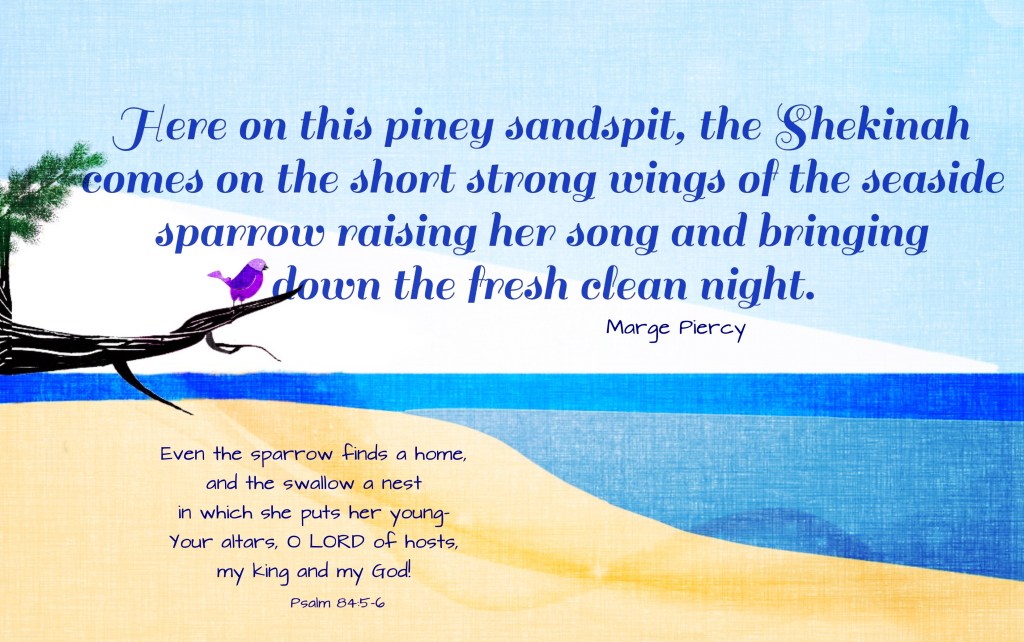
Here on this piney sandspit, the Shekinah
comes on the short strong wings of the seaside
sparrow raising her song and bringing
down the fresh clean night.

Music: Dwelling Place – John Foley, SJ