Today, in God’s Lavish Mercy, we celebrate the Feast of the Visitation, when a newly-pregnant Mary travels to be with her shockingly pregnant older cousin, Elizabeth. Although a universal feast, it is certainly a feast for women to plumb and to treasure.
The Carmignano Visitation, a unique masterpiece by one of sixteenth-century Italy’s greatest painters, Jacopo da Pontormo (1494-1557)
The Gospel is replete with the quiet but powerful understandings women share with one another:
the haste to support one another
the blessing and bolstering of each other’s faith
the shared joy to cause a baby’s leap in the womb
the desire for mercy and justice for the suffering
the “staying with” until need’s end
Of course, men too experience many of these holy sensibilities, but today most certainly invites women to celebrate the gifts of God within their bodies, minds and spirits.
Perhaps we might pray on these things while watching this movie clip of the imagined scene:
Poetry: Two poems to honor the two blessed women of this scene
The Visitation by Joyce Kilmer (For Louise Imogen Guiney)
There is a wall of flesh before the eyes Of John, who yet perceives and hails his King. It is Our Lady’s painful bliss to bring Before mankind the Glory of the skies. Her cousin feels her womb’s sweet burden rise And leap with joy, and she comes forth to sing, With trembling mouth, her words of welcoming. She knows her hidden God, and prophesies. Saint John, pray for us, weary souls that tarry Where life is withered by sin’s deadly breath. Pray for us, whom the dogs of Satan harry, Saint John, Saint Anne, and Saint Elizabeth. And, Mother Mary, give us Christ to carry Within our hearts, that we may conquer death.
Visitation Villanelle by Sarah O’Brien
She came to me, the mother of my Lord, and grinned with amazement at the sight. All creation with me seemed to roar.
Grey haired, belly swollen like a gourd, I stood to kiss her in the morning light. She came to me, the mother of my Lord.
Her voice, as she crossed the threshold of my door, rang through my womb – from a great height, all creation with me seemed to roar.
The baby leapt – tethered only by the cord. The joy coursing through us! I shouted outright. She came to me, the mother of my Lord.
Already she faced her share of the sword She who believed all God said would be, might – All creation with me seemed to roar.
Blessed one! With your yes you moved us toward the home we long for, and all things made right. She came to me, the mother of my Lord. All creation with me seemed to roar.
Music: Also two selections for this wonderful Feastday:
Ave Maria (Schubert) sung in German, as Schubert wrote it, by the incomparable Marian Anderson
Magnificat (Bach) Imagine composing this powerful first movement based on only a single word: “Magnificat”
Today, in God’s Lavish Mercy, we return to the Ordinary Time of the Church liturgical year. We might picture Ordinary Time as that great cycle of life which carries us through our “ordinary days”, the holy companion that helps us find God in our dailyness.
We left the ordinary cycle way back on February 22nd, when we launched into Lent, Holy Week, and Eastertide. Now we pick up where we left off and, over the next two weeks, will finish the Gospel of Mark and the Book of Tobit which we were reading in February.
How has your life been in the meantime?
As we begin our scriptural prayer today, we might want to list the ups and downs, the ins and outs of the past few months. Have we walked through these round-about days holding fast to the anchor of scriptural prayer? How have we changed, grown or deepened in the process?
I know it has been a time of immense change for me. The “me” who was reading Mark’s Gospel on February 21st was a different “me” from the one who will pick it up today.
Realizing the pattern and constancy of our liturgical cycle can be a stabilizing influence in our spiritual lives. The liturgical year is steadily revolving under the frenzied whirling of the world. The unfolding of the scriptures is constant and true at the still core of our sometimes spiraling lives.
As we left Mark in February, the rich young man had just walked away sad and Jesus was talking about a camel passing through the needle’s eye. The metaphor was meant to teach us how hard it can be to live the Christian life well. In today’s reading, Peter begins to ask how much harder can it get for them because the disciples have already given up everything for Jesus.
But Jesus doesn’t even let Peter finish before assuring him that his life will be blessedly different because of all that he has given over to Christ. It will not be without difficulty, but it will be eternally vital and confirmed in God. As we pray with this holy Gospel – in our ordinary time – may we be blessed with the same assurance.
Peter began to say to Jesus, ‘We have given up everything and followed you.” Jesus said, “Amen, I say to you, there is no one who has given up house or brothers or sisters or mother or father or children or lands for my sake and for the sake of the Gospel who will not receive a hundred times more now in this present age… … with persecutions, and eternal life in the age to come. But many that are first will be last, and the last will be first
Mark 18:28-31
Poetry: initial verses frrom Burnt Norton by T.S. Eliot
Burnt Northon is the first of the Four Quartets, a series of magnifcent (and at times confounding) poems that are well worth contemplating. Below Burnt Norton is a link to the whole work if you are interested.
segment from BURNT NORTON (No. 1 of ‘Four Quartets’)
Time present and time past
Are both perhaps present in time future,
And time future contained in time past.
If all time is eternally present
All time is unredeemable.
What might have been is an abstraction
Remaining a perpetual possibility
Only in a world of speculation.
What might have been and what has been
Point to one end, which is always present.
Footfalls echo in the memory
Down the passage which we did not take
Towards the door we never opened
Into the rose-garden. My words echo
Thus, in your mind.
Music: Blessed Assurance – written by Fanny J. Crosby, (1820 – 1915), was an American mission worker, poet, lyricist, and composer. She was a prolific hymnist, writing more than 8,000 hymns and gospel songs, with more than 100 million copies printed. She is also known for her teaching and her rescue mission work. By the end of the 19th century, she was a household name. Crosby was known as the “Queen of Gospel Song Writers” and as the “Mother of modern congregational singing in America”, with most American hymnals containing her work.
On Memorial Day and Veterans Day, I always remember one Saturday morning in February, when I stood with our Sisters in our community cemetery. As our religious community ages, it is a ritual we practice all too often, as we honor the lives of women with whom we have spent more than half our lives. But this Saturday was unique.
On this Saturday, we celebrated our first military funeral for one of our sisters. The burial was a solemn and thrilling sight. The cold February sky sparkled like blue crystal. Sun reflected off the time-polished tombstones, creating an honor guard of light. Three sailors awaited us at attentive salute as we processed to the graveside beside her flag-draped casket.
Sister Bernard Mary, a farm girl from Trenton, became a Navy nurse in World War II. After her service to our country, she entered the Sisters of Mercy and served in our healthcare ministries for over fifty years. She cared for the sick and poor with unrivaled perfection and compassion. Her entire life was marked by a profound sense of duty – a duty transformed by love.
As she was laid to rest, the clear notes of “Taps” rang out to the heavens, inviting her compassionate soul to “go to sleep”. Like everyone gathered there, I drew many lessons from her dedicated life. One that I share is this: understand your duty and execute it with perfection and love. If you do, no matter what life throws at you – be it economic, physical, or psychological downturn, the clarity of your spirit will endure — and it will ring out to others like the crystal notes of a golden bugle in the crisp morning air.
Sister Bernard Mary lived for ninety-one years, still I left her grave remembering these stirring words of Catherine McAuley: “Do all you can for God’s people, for time is short.”
Today, I remember her and Sister Dorothy Hillenbrand who served in the U.S. Army in World War II. Thank you both, and the many other Sisters of Mercy who have served in the military or ministered to our men and women in uniform. Thank you all for your generous service.
Today, in God’s Lavish Mercy, we pray with Mary, the Mother of Christ and thus of the Church.
With her “Yes”, Mary engaged the Spirit of God and, like the ancient Holy City, became a dwelling place of Grace.
Glorious things are said of you, O city of God! And of Zion they shall say: “One and all were born in her; And the One who has established her is the Most High LORD.
Psalm 87
In her book “Truly Our Sister”, theologian Elizabeth Johnson, CSJ, helps us to understand Mary as a companion, guide, and inspiration:
One fruitful approach to the theology of Mary, historically the mother of Jesus, called in faith the Theotokos or God-bearer, is to envision her as a concrete woman of our history who walked with the Spirit.
As I pray with Mary today, I picture her sitting with the young disciples after the mind-blowing experience of Pentecost. The whiff of Divine Electricity still pervades the room, still jars their senses to an indescribable timbre!
Mary is stilled with a silent understanding. From the abundance of her wisdom, gained in her daily presence with Jesus, Mary gently focuses, calms and directs these new evangelists for the task before them.
Mary is someone who has had her own “visitation by the Spirit”, many years before. Pentecost, for Mary, is a kind of “second Annunciation “. She knows what the willing reception of the Spirit will mean for one’s life.
Indeed, this moment – and their response, like hers so long ago – will bear God’s life into their world.
We call on Mary today, as Church and as individuals, to be with us as we are re-fired in the Holy Spirit. As we reflect on her and the way she opened her life to God, may we grow in faith and desire to open our own lives to the Spirit’s transformative power.
Elizabeth Johnson encourages us:
“to relate to Miriam of Nazareth as a partner in hope in the company of all the graced women and men who have gone before us; to be encouraged by her mothering of God to bring God to birth in our own world; to reclaim the power of her dangerous memory for the flourishing of suffering people; and to draw on the energy of her memory for a deeper relationship with the living God and stronger care for the world.”
Poetry: Annunciation – Denise Levertov
We know the scene: the room, variously furnished,
almost always a lectern, a book; always
the tall lily.
       Arrived on solemn grandeur of great wings,
the angelic ambassador, standing or hovering,
whom she acknowledges, a guest.

But we are told of meek obedience. No one mentions
courage.

       The engendering Spirit
did not enter her without consent.
         God waited.

She was free
to accept or to refuse, choice
integral to humanness.
____________________
Aren’t there annunciations
of one sort or another
in most lives?
         Some unwillingly
undertake great destinies,
enact them in sullen pride,
uncomprehending.
More often
those moments
      when roads of light and storm
      open from darkness in a man or woman,
are turned away from

in dread, in a wave of weakness, in despair
and with relief.
Ordinary lives continue.
                                 God does not smite them.
But the gates close, the pathway vanishes.
____________________
She had been a child who played, ate, slept
like any other child–but unlike others,
wept only for pity, laughed
in joy not triumph.
Compassion and intelligence
fused in her, indivisible.

Called to a destiny more momentous
than any in all of Time,
she did not quail,
  only asked
a simple, ‘How can this be?’
and gravely, courteously,
took to heart the angel’s reply,
the astounding ministry she was offered:

to bear in her womb
Infinite weight and lightness; to carry
in hidden, finite inwardness,
nine months of Eternity; to contain
in slender vase of being,
the sum of power–
in narrow flesh,
the sum of light.

                     Then bring to birth,
push out into air, a Man-child
needing, like any other,
milk and love–

but who was God.
This was the moment no one speaks of,
when she could still refuse.

A breath unbreathed,
                                Spirit,
                                          suspended,
                                                            waiting.
                  ____________________
She did not cry, ‘I cannot. I am not worthy,’
Nor, ‘I have not the strength.’
She did not submit with gritted teeth,
                                                       raging, coerced.
Bravest of all humans,
                                  consent illumined her.
The room filled with its light,
the lily glowed in it,
                               and the iridescent wings.
Consent,
              courage unparalleled,
opened her utterly.
Music: Vespro Della Beata Vergine – Claudio Monteverdi
From the baroque period, Monteverdi praises Mary in his masterpiece, Vespro Della Beata Vergine commonly referred to as Vespers of 1610. The work is monumental in scale and difficult to perform, requiring two large choirs who are skillful enough to cover up to 10 voice parts accompanied by an orchestral ensemble. Here is just an excerpt.
Lauda, Jerusalem, Dominum: lauda Deum tuum, Sion. Quoniam confortavit seras portarum tuarum: benedixit filiis tuis in te. Qui posuit fines tuos pacem: et adipe frumenti satiat te. Qui emittit eloquium suum terræ: velociter currit sermo ejus. Qui dat nivem sicut lanam: nebulam sicut cinerem spargit. Mittit crystallum suam sicut buccellas: ante faciem frigoris ejus quis sustinebit? Emittet verbum suum, et liquefaciet ea: flabit spiritus ejus, et fluent aquæ. Qui annunciate verbum suum Jacob: justitias et judicia sua Isræl. Non fecit taliter omni nationi: et judicia sua non manifestavit eis. Gloria Patri et Filio et Spiritui Sancto. Sicut erat in principio, et nunc, et semper, et in sæcula sæculorum. Amen
Praise the Lord, O Jerusalem; praise thy God, O Zion. For he hath strengthened the bars of thy gates; he hath blessed thy children within thee. He maketh peace in thy borders, and filleth thee with the finest wheat. He sendeth his commandment to the earth; his word runneth swiftly. He giveth snow like wool; he scattereth hoar frost like ashes. He casteth forth his ice like morsels; before his cold who can stand? He sendeth out his word, and melteth them; his spirit blows, and the waters flow. He sheweth his word unto Jacob, his statutes and judgements to Isræl. He hath not dealt so with any nation; and his judgments he hath not made manifest. Glory be to the Father and to the Son and to the Holy Spirit. As it was in the beginning, is now, and ever shall be, without end. Amen.
(This is a reflection I wrote for the Sisters of Mercy Communications Office.)
Come, Holy Spirit! It is a prayerful invitation we have offered innumerable times in our lives. How many Pentecosts have we lived through? How many sacred events have begun with this heartfelt plea?
But have we really thought about what we are requesting?
Picture the assembled disciples fifty days after Easter. They have just experienced the profound spiritual upheaval of Christ’s Passion, Death and Resurrection. In the aftermath, there are imprisonments, angelic deliveries, crippled people suddenly walking, dead people coming back to life. Their comfortable lives have been turned upside down!
Jesus has made a few appearances to help root their topsy-turvy world in the memory of his promises. But he is no longer physically present to them, having ascended into heaven just a few days past, in itself a bit of an astounding event!
Slowly but surely the disciples begin to realize that the work of ongoing salvation has fallen on them. So they pray continuously, just as we might when we are a little overwhelmed by our reality.
On this particular day, the small community likely gathered for the Jewish holiday of Shavuot, or Feast of Weeks, which celebrates the wheat harvest. Jewish tradition also holds this date as the one on which Moses received the Law on Mount Sinai. Shavout is determined by the date of Passover, occurring about seven weeks after.
Wrapped in this treasured religious legacy, the little band joins in prayer. Still honoring their Jewish heritage, they open their hearts to the God Who is writing a new covenant of love over all Creation. They are not unlike Moses as he walked to the top of Sinai, clueless to what the Fire might ask of him.
And suddenly there came from the sky a noise like a strong driving wind, and it filled the entire house in which they were. Then there appeared to them tongues as of fire, which parted and came to rest on each one of them.
Acts 2: 2-3
The Holy Spirit arrives in chaos – bolting from the sky, shaking the walls, and threatening to set their hair on fire. It was an amazing gift from heaven, but it had to be scary! It taught the disciples, and it teaches us, a critical lesson.
“Come, Holy Spirit” is a dangerous prayer! Don’t say it if you don’t want to be shaken out of your routine, blown off course, and ignited with a grace that refuses half-heartedness.
“Pour out your Spirit” is a prayer of continual conversion: • It resists expectations, normalization, definition, and institutionalization. • It demands that we are always ready to hope, to be surprised, to change. • It asks us to see possibility everywhere because God has drenched the world in love and mercy. • It asks us to find a new language of peace where the old words have failed. • It calls us to be agents of its fierce generosity by sharing the gifts of Wisdom, Understanding, Counsel, Fortitude, Knowledge, Piety, and Fear of the Lord wherever these are needed.
After the tornado settled and the rafters fell back in place, the disciples were changed people. We will be too if our prayer is open and poised on the edge of hope. Through the indwelling of the Holy Spirit, we become the means by which Christ lives in our own time. It is a wildly unsettling blessing offered by this breath-giving prayer, “Come, Holy Spirit.”
As Henry Nouwen writes:
Without Pentecost the Christ-event – the life, death, and resurrection of Jesus – remains imprisoned in history as something to remember, think about and reflect on. The Spirit of Jesus comes to dwell within us, so that we can become living Christs here and now.
May we, and our whole Church which celebrates its birth today, have the courage to pray this prayer and to live its answer.
Music: Veni Creator Spiritus
English version: Come, Holy Spirit, Creator blest, and in our souls take up Thy rest; come with Thy grace and heavenly aid to fill the hearts which Thou hast made. O comforter, to Thee we cry, O heavenly gift of God Most High, O fount of life and fire of love, and sweet anointing from above. Thou in Thy sevenfold gifts are known; Thou, finger of God’s hand we own; Thou, promise of the Father, Thou Who dost the tongue with power imbue. Kindle our sense from above, and make our hearts o’erflow with love; with patience firm and virtue high the weakness of our flesh supply. Far from us drive the foe we dread, and grant us Thy peace instead; so shall we not, with Thee for guide, turn from the path of life aside. Oh, may Thy grace on us bestow the Father and the Son to know; and Thee, through endless times confessed, of both the eternal Spirit blest. Now to the Father and the Son, Who rose from death, be glory given, with Thou, O Holy Comforter, henceforth by all in earth and heaven. Amen. Latin version: Veni, Creator Spiritus, mentes tuorum visita, imple superna gratia quae tu creasti pectora. Qui diceris Paraclitus, altissimi donum Dei, fons vivus, ignis, caritas, et spiritalis unctio. Tu, septiformis munere, digitus paternae dexterae, Tu rite promissum Patris, sermone ditans guttura. Accende lumen sensibus: infunde amorem cordibus: infirma nostri corporis virtute firmans perpeti. Hostem repellas longius, pacemque dones protinus: ductore sic te praevio vitemus omne noxium. Per te sciamus da Patrem, noscamus atque Filium; Teque utriusque Spiritum credamus omni tempore. Deo Patri sit gloria, et Filio, qui a mortuis surrexit, ac Paraclito, in saeculorum saecula. Amen.
Today, in God’s Lavish Mercy, we close the books on the Acts of the Apostles and the Gospel of John. Eastertide ebbs into the fiery sunset as Pentecost is paused to rush over the earth.
A large part of the Acts of the Apostles is devoted to Paul and his missionary journeys. The final verses today give us a last look at Paul as he finishes his ministerial life in Rome:
He remained for two full years in his lodgings. He received all who came to him, and with complete assurance and without hindrance he proclaimed the Kingdom of God and taught about the Lord Jesus Christ.
Acts 28:30-31
Paul is believed to have died a martyr’s death under the persecutions of Nero between 64-68 A.D. If you would like to read more about Paul’s extraordinary life, here are a few recommended biographies:
Paul and Jesus: How the Apostle Transformed Christianity by James D. Tabor, a professor of religious studies (Simon & Schuster, 320 pgs, 2012)
Paul Apostle of the Heart Set Free by F.F. Bruce, a professor of biblical criticism and exegesis (reprint: Wm. B. Eerdmans, 522 pgs, 2000)
Paul: A Critical Life by Jerome Murphy-O’Connor O.P., a professor of New Testament studies (Oxford UP, 432 pgs, 1996)
John the Evangelist – Valentin de Boulogne
John’s Gospel ends with this summary verse:
It is this disciple who testifies to these things
and has written them, and we know that his testimony is true.
There are also many other things that Jesus did,
but if these were to be described individually,
I do not think the whole world would contain the books
that would be written.
The book I have been using as a study guide for the past several weeks closes with this evaluation:
The Fourth Gospel preserves the testimony of the Beloved Disciple, which brings about an encounter with the divine Word to all who read it in faith, from the time of its author until today.
Martin, Francis; Wright, William M. IV. The Gospel of John (Catholic Commentary on Sacred Scripture, Baker Publishing Group
If you would like to delve a little deeper into John’s spirituality, I recommend Raymond E. Brown,S.S., one of my favorite Biblical scholars
A Retreat With John the Evangelist: That You May Have Life
Poetry: Apostle by Malcolm Guite
An enemy whom God has made a friend,
A righteous man discounting righteousness,
Last to believe and first for God to send,
He found the fountain in the wilderness.
Thrown to the ground and raised at the same moment,
A prisoner who set his captors free,
A naked man with love his only garment,
A blinded man who helped the world to see,
A Jew who had been perfect in the law,
Blesses the flesh of every other race
And helps them see what the apostles saw;
The glory of the lord in Jesus’ face.
Strong in his weakness, joyful in his pains,
And bound by love, he freed us from our chains.
Movie: If you need a movie to watch this weekend, this one is done quite well on the life of Paul.
Today, in God’s Lavish Mercy, we stand beside Peter as Jesus asks him the most important question of his life.
After Jesus had revealed himself to his disciples and eaten breakfast with them, he said to Simon Peter, “Simon, son of John, do you love me more than these?”
John 21:15
What was Jesus really getting at? Here they all are enjoying a nice breakfast on the beach. Their hearts are overjoyed to be in the presence of their Eastered Lord. Life must have felt good that sunny, post-Resurrection morning. And probably all that Peter really wanted out of life was another piece of fired fish or toasted bread, and for their seashore picnic to linger into an eternal evening.
Then here comes Jesus with his cosmic questions! What does he mean, “Do I love him”! Of course, I love him! Haven’t I hung around for three years trying to make this thing work, climbing out of my several missteps to try to be everything he wanted and needed? Oh my goodness, where is he going to call me now with this confusing question: Do you love me?
Yes, Jesus knows that Peter loves him in Peter’s way. He trusts Peter’s affection, devotion, and utter commitment to him. But Jesus’s question is pulling Peter way beyond the salted scents of that Tiberias beach. He wants Peter to love him in God’s way!
Jesus is calling Peter to a timeless answer and a transcendent love. What he is asking Peter is this:
Will you leave the man who was “Simon, son of John” to become “Peter, the Rock on which I build my Church”.
Will you love me to the point of giving yourself completely so that I may continue to love through you?
Today, as we settle into the sandy dunes with Jesus and his BFFs, Jesus might glance at us as he passes his smoked fish our way. His beautiful eyes might hold a question for us as well as for Peter. Through each of us, Jesus wants to continue to love the world into wholeness. Let’s ask his help in learning how to do that.
Maxim: from St. John of the Cross, a 16th century mystic, who understood Jesus’s eternal question and answered it in this way:
In the evening of our lives we will be judged on love. Let us therefore learn to love God as God wishes to be loved.
Music: Fill the World with Love – from “Goodbye, Mr. Chips”, music and lyrics by Leslie Bricusse
In the morning of my life I shall look to the sunrise. At a moment in my life when the world is new. And the blessing I shall ask is that God will grant me, To be brave and strong and true, And to fill the world with love my whole life through.
And to fill the world with love And to fill the world with love And to fill the world with love my whole life through.
In the noontime of my life I shall look to the sunshine, At a moment in my life when the sky is blue. And the blessing I shall ask shall remain unchanging. To be brave and strong and true, And to fill the world with love my whole life through.
And to fill the world with love And to fill the world with love And to fill the world with love my whole life through.
In the evening of my life I shall look to the sunset, At a moment in my life when the night is due. And the question I shall ask only God can answer. Was I brave and strong and true? Did I fill the world with love my whole life through?
Did I fill the world with love? Did I fill the world with love? Did I fill the world with love My whole life through?
Today, in God’s Lavish Mercy, Jesus prays for those he loves.
In our Gospel. we come to the last section of John 17, the High-Priestly Prayer of Jesus. In his prayer, Jesus prays for three things:
God’s glory,
the spiritual strength of his disciples
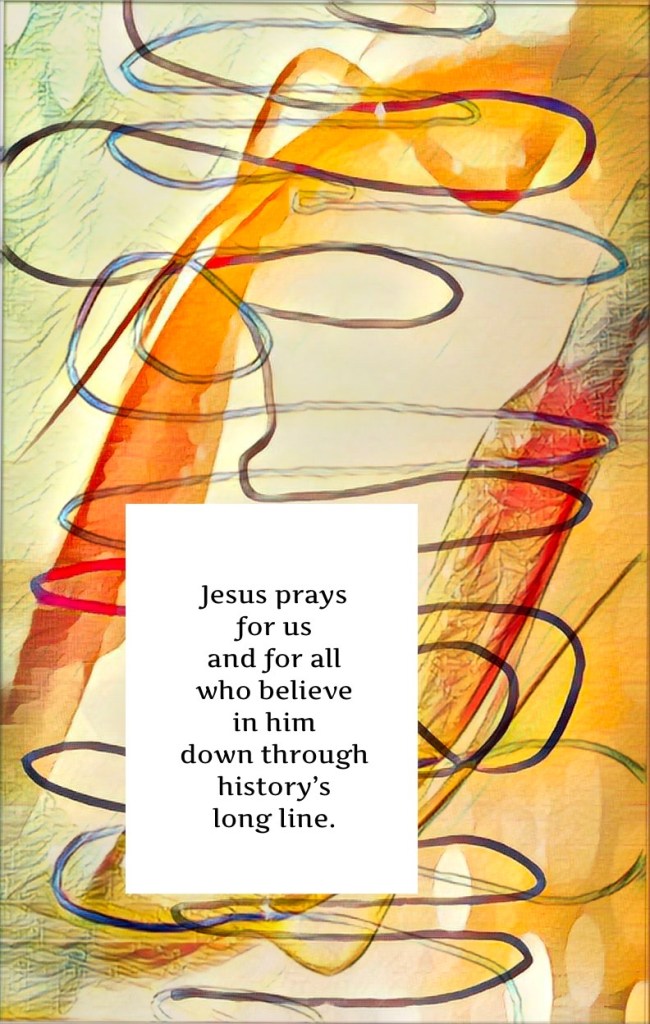
for us and all who will believe in him down through history
Today’s passage is the third part. It is about us, and the long line of believers preceding and following our lifetimes. Listen to how Jesus loves us all and begs the Creator to enfold us in the same Abundant Unity whch holds the Trinity together in Love :
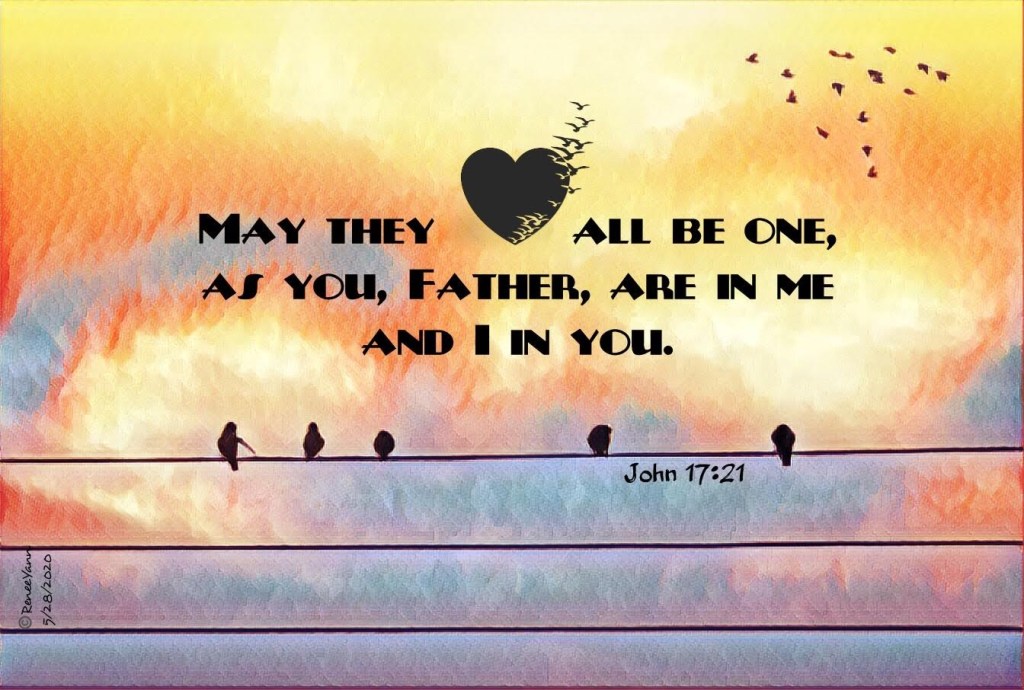
(I pray) for those who will believe in me through their word, so that they may all be one, as you, Father, are in me and I in you, that they also may be in us, that the world may believe that you sent me. And I have given them the glory you gave me, so that they may be one, as we are one, I in them and you in me, that they may be brought to perfection as one, that the world may know that you sent me, and that you loved them even as you loved me.
John 17:20-23
This is such a powerful passage. It tells us that when we truly love one another, with a love like God’s, we generate the image of God for our own time. That image is realized among us in many ways: Church, family, community, friendship, sisterhood, brotherhood. These are the constructs through which the human community experiences, learns ,and practices the Love which is Christ’s Gift to us.
Walter Brueggemann desribes this kind of love as “neighborliness” – that discipline of heart, mind, and spirit through which we are so connected to God’s Abundance that we willingly pass it along to one another. in a sacred mutuality of being. Brueggemann writes extensively and inspiringly on the topic, but I found some of his thoughts outlined in this excellent paper that you might want to reflect on someday at your leisure:
In his prayer, Jesus is tapping into the Infinite Generosity we call God,
that Generosity Who has loved us so much that we came into being,
that Generosity Who continues to love us eternally
into the abundance of life we call Heaven.
Being loved like this, can we be anything but generous in our love for others? It’s a good question to ask ourselves when we reflect on our day before we fall asleep each night.
Poetry: Neighbors by Rudyard Kipling – Kipling gives us an enjoyable interpretation of the Golden Rule to love our neighbors.
The man that is open of heart to his neighbor,
And stops to consider his likes and dislikes,
His blood shall be wholesome whatever his labor,
His luck shall be with him whatever he strikes.
The Splendor of Morning shall duly possess him,
That he may not be sad at the falling of eve.
And, when he has done with mere living, God bless him!
A many shall sigh, and one Woman shall grieve!
But he that is costive of soul toward his fellow,
Through the ways, and the works, and the woes of this life,
Him food shall not fatten, him drink shall not mellow;
And his innards shall brew him perpetual strife.
His eye shall be blind to God's Glory above him;
His ear shall be deaf to Earth's Laughter around;
His Friends and his Club and his Dog shall not love him;
And his Widow shall skip when he goes underground!
Music: Bring Him Home – original music by Claude-Michel Schönberg Lyrics written by Alain Boublil, Herbert Kretzmer
The sentiments of the beautiful song from Les Misérables are very similar in tone to the prayer that Jesus prays near the end of his life. Jesus wants his followers to live eternally. The singer seems to want the same thing.
Today, in God’s Lavish Mercy, Jesus and Paul continue to teach us how to say goodbye.
I think most big goodbyes are pretty hard. Even if we’re not completely in love with our situation, we might still be comfortable in it. We don’t want to make the effort to change or to disconnect from the dailyness to which we are accustomed.
And when we are in love with our situation – with the people and activities that give us life – then goodbyes can be brutal. These kinds of goodbyes are often unchosen, unwelcome, and disorienting.
We can all recall scores of goodbyes we have either chosen or been forced to say. Most of them, I think, are a mix of the two descriptions above – a little bit of sugar and a little bit of vinegar.
One of the many goodbyes I remember came after I had lived in and taught at a lovely parish for over a decade. Our convent was blessed with a wonderful community of sisters. We loved our generous pastors, our welcoming parishioners, and the engaging neighborhood around us. I loved my students and the work I did with them. I loved the sisters I lived with. We recognized our blessings and often quipped to one another that we were living in our “Golden Years”.
But after eleven years, I knew it was time for something different in my life, A call to a new ministry emerged in my heart and that was exciting. But the leave-taking still cut like a razor.
That story has repeated itself several times in my life with different settings and different casts of characters. And I know the same thing is true in each of your lives. When we pause to reflect on all those goodbyes, we may realize that each led to an unimagined hello – hellos that offered us new graces to deepen our lives.
In our readings today, Jesus and Paul stand on that fragile beam which leads from goodbye to hello. Their disciples stand there with them, so both Jesus and Paul make every effort to help them balance themselves to step into the future.
Paul does it like this:
Be vigilant and remember that for three years, night and day, I unceasingly admonished each of you with tears. And now I commend you to God and to that gracious word of his that can build you up and give you the inheritance among all who are consecrated.
Acts 20:31-32
Jesus does it with a prayer:
Holy Father, keep them in your name that you have given me, so that they may be one just as we are one. When I was with them I protected them in your name that you gave me, and I guarded them, and none of them was lost except the son of destruction, in order that the Scripture might be fulfilled. But now I am coming to you. I speak this in the world so that they may share my joy completely.
John 17:11-13
Today, we may want to spend a little time with Jesus and Paul looking back over the long beam of our lives, thanking God for the graces that poured from our many goodbyes and hellos.
Poetry: In My Dreams – Stevie Smith
In my dreams I am always saying goodbye and riding away, Whither and why I know not nor do I care. And the parting is sweet and the parting over is sweeter, And sweetest of all is the night and the rushing air.
In my dreams they are always waving their hands and saying goodbye, And they give me the stirrup cup and I smile as I drink, I am glad the journey is set, I am glad I am going, I am glad, I am glad, that my friends don’t know what I think.
Music: Every Goodbye Is Hello – Andrew Lippi from the musical “John and Jen”
There’s a wonderful place Just waiting for you There are wonderful things You’ll get to do Out there, somewhere, the world And all its wonders One small step is all it takes to know Every goodbye is hello There’s a magical phrase
I’ll tell it to you Always honor the old But live for the new Out there, somewhere
About to be discovered Trust yourself and each new day will show How every goodbye is hello I will always be near
To hear of all the things you’ll be Everyone needs a home to return to And you can turn to me There’s a time in our
lives when we will know (There’s a time in our lives when we will know) There’s a time to stay home And a time to grow Out there, somewhere, your life And all its promise Sometimes part of love is letting go But every goodbye is
Today, in God’s Lavish Mercy, we listen to both Jesus and Paul as they offer their farewell addresses to their beloved disciples.
It seems an appropriate time for these readings here as students close their educational years and move on to their future. The disciples of Jesus and Paul are doing the same thing. And their valedictorians are the beloved masters on whom they have come to depend.
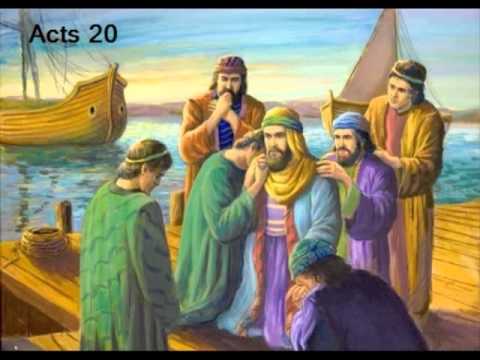
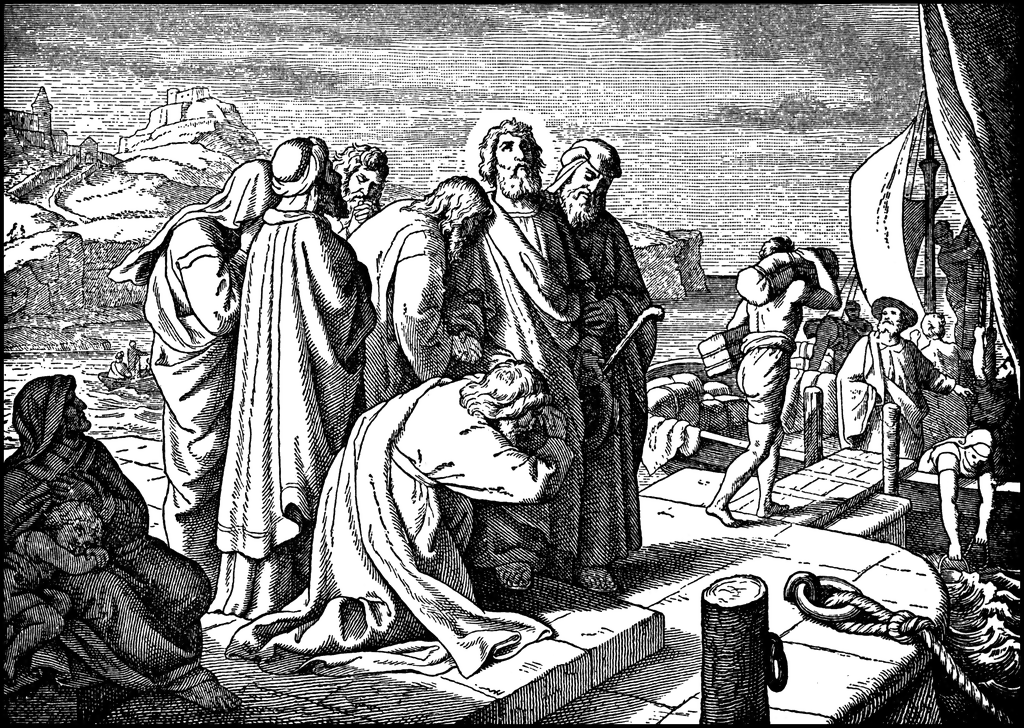
Paul and his disciples share a tearful good-bye as he departs for Rome
In Acts, Paul prepares to depart from Ephesus where he has lived for three years. It is his cherished community as we can assess from the beautiful letters Paul writes to the Church there. The disciples are heartbroken to see Paul leave, and he is quite emotional himself in his remarks:
I earnestly bore witness for both Jews and Greeks to repentance before God and to faith in our Lord Jesus. But now, compelled by the Spirit, I am going to Jerusalem. What will happen to me there I do not know…
But now I know that none of you to whom I preached the kingdom during my travels will ever see my face again. And so I solemnly declare to you this day that I am not responsible for the blood of any of you, for I did not shrink from proclaiming to you the entire plan of God.
Acts 20
Paul, declaring that he has done all that he can for the Gospel, sternly charges his followers to carry on the work of evangelization.
Jesus is a little gentler but no less dramatic in describing the charge to his disciples:
I pray for them. I do not pray for the world but for the ones you have given me, because they are yours, and everything of mine is yours and everything of yours is mine, and I have been glorified in them. And now I will no longer be in the world, but they are in the world, while I am coming to you
John 17
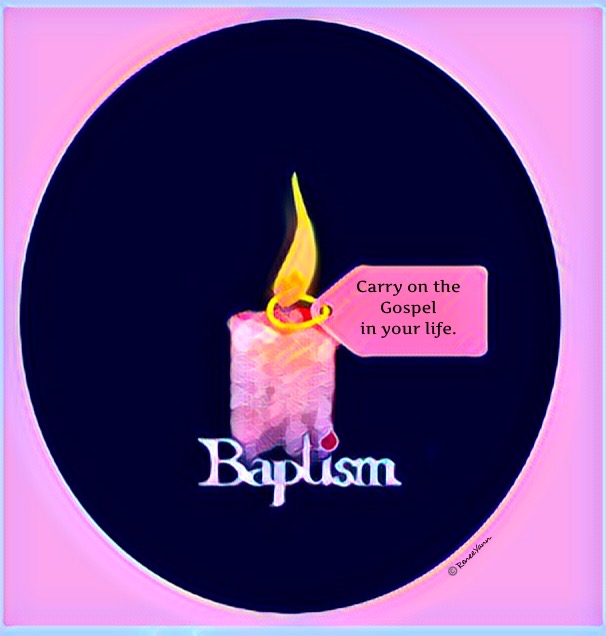
Both these readings speak to us, not only about the disciples’ experience of commissioning, but of our own. Our Baptismal incorporation into the faith came with a price tag — “Carry on the Gospel in your life.”
As we listen to the passion with which both Jesus and Paul advised their followers, let’s hear them speaking to us as well. Let’s listen for the unique call we are receiving through the circumstances of our particular life. Not everyone is called to be Paul, or Peter, or Lydia, or Apollos, or Silas or the others we have read about throughout Eastertide.
But we ARE called to be
_________________________________ (Fill in your name) a believer and doer in the Name of Jesus Christ
Poem: by Hafiz from Love Poems from God – Daniel Ladinsky
I am
a hole in a flute
that the Christ’s breath moves through—
listen to this
music.









 Lavish Mercy