Into the Light

December 29, 2021
The Fifth Day in the Octave of Christmas
Today, in God’s Lavish Mercy, our first reading offers us John’s perfect honesty and simplicity:

Whoever says, “I know him,” but does not keep his commandments
is a liar, and the truth is not in him.
But whoever keeps his word,
the love of God is truly perfected in him.
This is the way we may know that we are in union with him:
whoever claims to abide in him ought to walk just as he walked.

1 John 2:5-6

Yes, it’s that simple and that hard!


Then, in our Gospel, we meet Simeon who speaks with the holy confidence of a long and well-lived life. His lifelong dream was that he might not die before seeing the Messiah. That dream now fulfilled, Simeon intones one of the most beautiful prayers in Scripture:

Lord, now let your servant go in peace;
your word has been fulfilled:
my own eyes have seen the salvation
which you prepared in the sight of every people,
a light to reveal you to the nations
and the glory of your people Israel.

Luke 2: 29-32

If we live in the Light,
we too will see the Messiah
within our life’s experiences.
We too will come to our final days
confident and blessed
by that enduring recognition.

For as John also assures us:

Whoever says they are in the light,
yet hates their brother or sister is still in the darkness.
But whoever loves their brother and sister remains in the light …

1 John 2: 9-10

Let’s pray today for those who are dying, that they may know this kind of peace.

Let us pray for ourselves, that when our time comes, we too may experience this confidence.


Poetry: Nunc Dimittis – Joseph Brodsky
(from Joseph Brodsky, A Part of Speech by George L. Kline (NY: Noonday, 1996)
The poem is long but exceptionally beautiful I hope you can take the time to enjoy it.


‘Nunc Dimittis’

When Mary first came to present the Christ Child
to God in His temple, she found—of those few
who fasted and prayed there, departing not from it—
devout Simeon and the prophetess Anna.

The holy man took the Babe up in his arms.
The three of them, lost in the grayness of dawn,
now stood like a small shifting frame that surrounded
the Child in the palpable dark of the temple.

The temple enclosed them in forests of stone.
Its lofty vaults stooped as though trying to cloak
the prophetess Anna, and Simeon, and Mary—
to hide them from men and to hide them from Heaven.

And only a chance ray of light struck the hair
of that sleeping Infant, who stirred but as yet
was conscious of nothing and blew drowsy bubbles;
old Simeon's arms held him like a stout cradle.

It had been revealed to this upright old man
that he would not die until his eyes had seen
the Son of the Lord. And it thus came to pass. And
he said: ‘Now, O Lord, lettest thou thy poor servant,

according to thy holy word, leave in peace,
for mine eyes have witnessed thine offspring: he is
thy continuation and also the source of
thy Light for idolatrous tribes, and the glory

of Israel as well.' The old Simeon paused.
The silence, regaining the temple's clear space
oozed from all its corners and almost engulfed them,
and only his echoing words grazed the rafters,

to spin for a moment, with faint rustling sounds,
high over their heads in the tall temple's vaults,
akin to a bird that can soar, yet that cannot
return to the earth, even if it should want to.

A strangeness engulfed them. The silence now seemed
as strange as the words of old Simeon's speech.
And Mary, confused and bewildered, said nothing—
so strange had his words been. He added, while turning

directly to Mary: ‘Behold, in this Child,
now close to thy breast, is concealed the great fall
of many, the great elevation of others,
a subject of strife and a source of dissension,

and that very steel which will torture his flesh
shall pierce through thine own soul as well. And that wound
will show to thee, Mary, as in a new vision
what lies hidden, deep in the hearts of all people.’

He ended and moved toward the temple's great door.
Old Anna, bent down with the weight of her years,
and Mary, now stooping gazed after him, silent.
He moved and grew smaller, in size and in meaning,

to these two frail women who stood in the gloom.
As though driven on by the force of their looks,
he strode through the cold empty space of the temple
and moved toward the whitening blur of the doorway.

The stride of his old legs was steady and firm.
When Anna's voice sounded behind him, he slowed
his step for a moment. But she was not calling
to him; she had started to bless God and praise Him.

The door came still closer. The wind stirred his robe
and fanned at his forehead; the roar of the street,
exploding in life by the door of the temple,
beat stubbornly into old Simeon's hearing.

He went forth to die. It was not the loud din
of streets that he faced when he flung the door wide,
but rather the deaf-and-dumb fields of death's kingdom.
He strode through a space that was no longer solid.

The rustle of time ebbed away in his ears.
And Simeon's soul held the form of the Child—
its feathery crown now enveloped in glory—
aloft, like a torch, pressing back the black shadows,

to light up the path that leads into death's realm,
where never before until this present hour
had any man managed to lighten his pathway.
The old man's torch glowed and the pathway grew wider.

Music:  Nyne Otpushchayeshi ~Sergei Rachmaninoff (translated Nunc Dimittis, Now Let Your Servant Go). This was sung at Rachmaninoff’s funeral, at his prior request. (For musicians among you, point of interest: Nunc dimittis (Nyne otpushchayeshi), has gained notoriety for its ending in which the low basses must negotiate a descending scale that ends with a low B-flat (the third B-flat below middle C).

Psalm 27: Can We Love Like This?

Wednesday after Epiphany

January 6, 2021

Today, in God’s Lavish Mercy, as we once again pray with Psalm 27, we do so in the light of our seminal first reading from John:

God is love, 
and when we remain in love 
we remain in God 
and God in us.

1 John 4:16

How can we love like that?

Psalm 27 tells us how God does it:

For the Lord rescues the poor who cry out,
and the afflicted who have no other help.
The Lord has pity for the lowly and the poor;
and saves the lives of the poor.

Psalm 27: 12-13

Our psalm gives us the measure for love in our lives. Who are the suffering ones in the circle of our experience? How are we widening that circle to offer loving mercy with greater energy and fidelity?


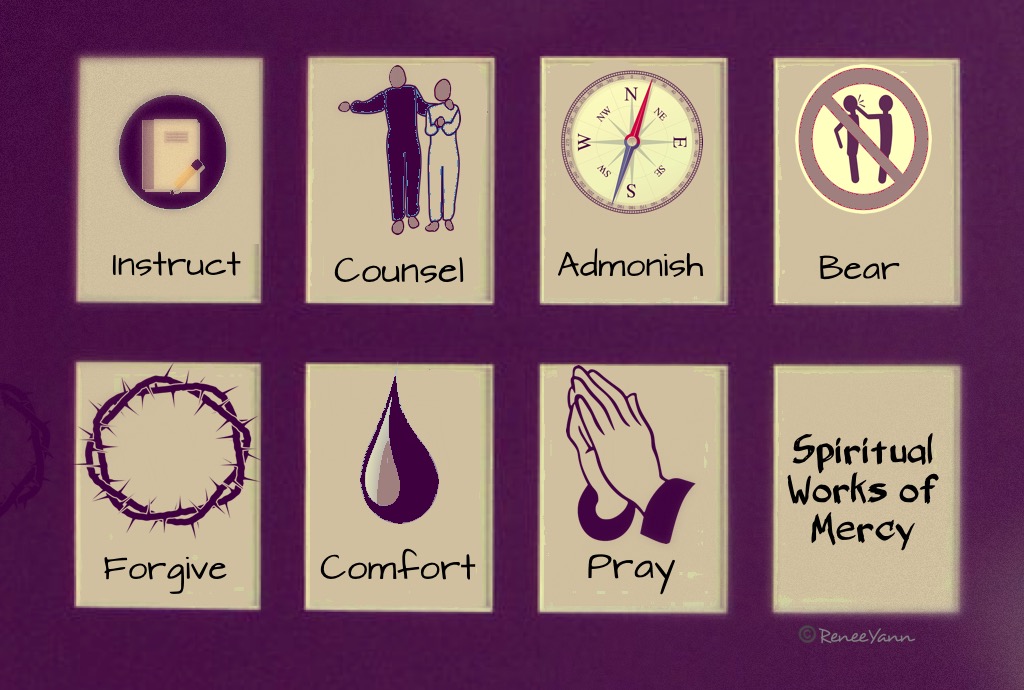
The Spiritual and Corporal Works of Mercy can be our guide as we seek to stretch our love in ever-widening circles.

The Corporal Works of Mercy

To feed the hungry
To give water to the thirsty
To clothe the naked
To shelter the homeless
To visit the sick
To visit the imprisoned, and ransom the captive
To bury the dead


The Spiritual Works of Mercy

To instruct the ignorant.
To counsel the doubtful.
To admonish sinners.
To bear patiently those who wrong us.
To forgive offenses.
To comfort the afflicted.
To pray for the living and the dead.


Poetry: Widening Circles – Rainer Maria Rilke

I live my life in widening circles
that reach out across the world.
I may not complete this last one
but I give myself to it.
I circle around God, around the primordial tower.
I’ve been circling for thousands of years
and I still don’t know: am I a falcon,
a storm, or a great song?

Music: The Mercy Song – Paul Alexander

Psalm 72: Governed with Mercy

Memorial of Saint John Neumann, Bishop

January 5, 2021

Today, in God’s Lavish Mercy, we pray with Psalm 72 which will be familiar to us because it is used six times throughout the Advent and Christmas seasons.

O God, with your judgment endow the king,
and with your justice, the king’s son;
He shall govern your people with justice
and your afflicted ones with judgment.

Psalm 72: 1-2

This short post-Epiphany season is all about “manifestation” – how Jesus begins to show us the face of God-become-flesh.

The core message, conveyed to us in the daily progressive reading of 1 John, is that God is Love.


Our Gospel today, the feeding of the 5000, shows how that Love is expressed – merciful action for those in need.

Our psalm, written a thousand years before Christ, exults in the expectation of such a merciful Messiah:


The mountains shall yield peace for the people,
and the hills justice.
He shall defend the afflicted among the people,
save the children of the poor.
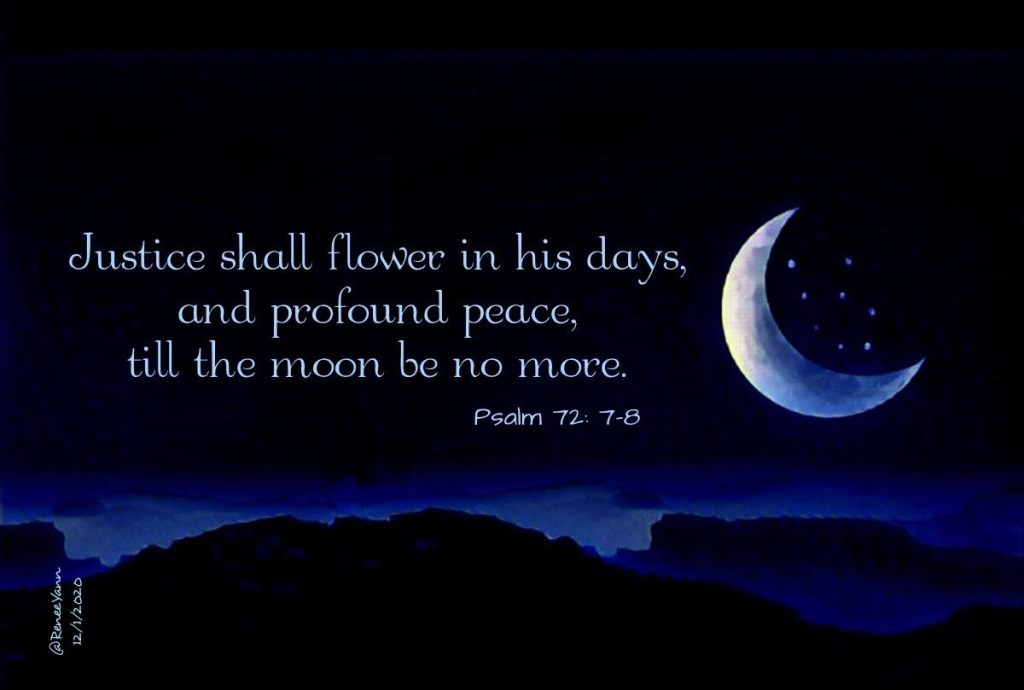
Justice shall flower in his days,
and profound peace, till the moon be no more.
May he rule from sea to sea,
and from the River to the ends of the earth.

Let us begin once again, in this new year,
to soak in the words and images
describing this longed-for and loving Savior.


Poetry: When Little Was Enough – Irene Zimmerman, OSF

(LUKE 9:10–17)

“Send the people away from this deserted place
to find food and lodgings,” the twelve urged Jesus,
“for the day is advanced and it is almost evening.”

Jesus looked at the crowd (there were about five thousand)
and looked at his disciples, still excited and tired
from their first mission journey.

What had they learned from the villagers of Galilee
who shared bread and sheltered them from cold night winds?
What had they learned of human coldness on the way?

He remembered the pain in his mother’s voice
as she told of his birth night when they found no room
in all of Bethlehem, House of Bread.

“You give them something to eat!” he said.

“We have only five loaves and two fish!” they protested.
“How can we feed so many with so little?”
He understood their incredulity.

They had yet to learn that a little was enough
when it was all they had—
that God could turn these very stones to bread.

“Have the crowd sit down in groups of fifty,” he said.
Jesus took the food and looked up to heaven.
He blessed it, broke it, gave it to the disciples
to distribute to the new-formed churches.

Afterwards, when everyone was satisfied,
the twelve filled twelve baskets of bread left over—
as faith stirred like yeast within them.


Music: Justice Shall Flourish – Rory Cooney

Faith from the Beginning

Wednesday, January 2, 2019

Click here for readings

1Jn2_24 beginning

Today, in Mercy, we continue to relish John’s eloquent first letter in which he heartily instructs us in the life of Christian love.

John has written this letter out of concern about false teachings that are cropping up in the early Church. Misguided “teachers” are placing distorted interpretations on the pure, original message of the Gospel.

Human beings have never stopped doing that, have we? Down through the centuries, how many heresies and misinterpretations have woven their way into the Gospel’s central, inviolable thread?

Has it happened to our faith? Have we lost the crisp, clear power of our original belief?

John tells us to hold fast to the core teaching of the Gospel. This is the faith that many of us learned as children from devout parents and teachers. It is a faith that continues to evolve through scriptural prayer and meditation, through openness to theological wisdom, through the holy dialogue of the beloved community.

It is a living faith, stretched and tested by our daily choices for true Christian love for all people, especially the poor, sick and marginalized.

Ultimately, it is a faith rooted in the Cross and transformed by the Resurrection.

Over these next few weeks, let us listen carefully to John as he guides us to the depth of that faith.

Music: some gentle meditation music for your prayer with John:

Herb Ernst – Song of the Inner Child