Holy Thursday

Evening Mass of the Lord’s Supper

April 1, 2021

Today, in God’s Lavish Mercy, we pray with Psalm 116 which Walter Bruggemann calls an example of “the performance of thanks”. 

How shall I make a return to the LORD
    for all the good he has done for me?
The cup of salvation I will take up,
    and I will call upon the name of the LORD.

Psalm 116: 12-13

There is a tone of solemn ritual woven through the psalm, just as there is throughout the Holy Thursday liturgies.

The time of waiting and wondering is over. Jesus chooses the Passover meal to formalize his understanding that the time has come to offer his life in an ultimate sacrifice of praise.

Before the feast of Passover, Jesus knew that his hour had come
to pass from this world to the Father.
He loved his own in the world and he loved them to the end.

John 13:1

The Last Supper by the nun Plautilla Nelli (1524–1588) of Florence
Inscribed: Suor Plautilla · Orate Pro Pictora (Pray for the Paintress)

It is likely that, during his Last Supper, Jesus would have prayed, and possibly sung, Psalm 116 as part of the ancient Hallel,  six thanksgiving prayers included in the Passover rites. 

On our behalf, Jesus is about to enflesh in his own life the redemptive promise awaited through the ages. He is about to enact the Great Deliverance — far greater than that achieved in the Passover. By the power of his Paschal sacrifice, we are redeemed from death itself:

Return, my soul, to your rest;
the LORD has been very good to you.
For my soul has been freed from death,
my eyes from tears, my feet from stumbling.
I shall walk before the LORD
in the land of the living

Psalm 116: 7-9

For me, Holy Thursday is the most solemnly beautiful and meaningful day of the Liturgical Year. There is so much to be found in the readings, especially as we peel back single phrases to hear their living power and love. There is so much to be learned at the side of Jesus as we pray with Him.

May we place ourselves beside Jesus at the holy table of his life. Feel him lay the gathering tensions down as he gathers his beloveds in the truth of this moment. It is time for him to give everything over in love. This is the moment of Holy Acquiescence, this is the moment of Eucharist.

With Jesus, let us pray for the loosening of any bonds which prevent us from giving our lives lovingly into God’s Will for us, from allowing Eucharist to be offered through our lives.

Dear to the eyes of the LORD
    is the death of his faithful ones.
I am your servant, the child of your handmaid;
    you have loosed my bonds.
To you will I offer sacrifice of thanksgiving,
    and I will call upon the name of the LORD.
My vows to the LORD I will pay
    in the presence of all his people.

Psalm 116: 15-18

Prose: from Mass on the World, by Pierre Teilhard de Chardin

Since once again Lord 
I have neither bread nor wine nor altar,
I will raise myself beyond these symbols 
up to the pure majesty of the real itself.
 
I, your priest, will make the whole earth my altar, 
and on it I will offer you 
all the labors and the sufferings of the world.
 
I will place on my paten Lord God 
all the harvest to be won from your renewal. 

Into my chalice, I shall pour all the sap 
which is to be pressed out this day 
from the earth’s fruits and from its sufferings.
 
All the things in the world 
to which this day will bring increase; 
all those that will diminish; 
all those, too, that will die: 
all of them, Lord, I try to gather into my arms 
so as to hold them out to you in offering.
 
This is the material of my sacrifice, 
the only material you desire.
The restless multitude, confused or orderly, 
the immensity of which terrifies us, 
this ocean of humanity, 
the slow, monotonous wave-flows which trouble the hearts 
of even those whose faith is most firm.
 
My paten and my chalice are 
the depths of a soul laid widely open 
to all the forces which in a moment will rise up 
from every corner of the earth 
and converge upon the Spirit. 

Grant me the remembrance and the mystic presence 
of all those whom the light is now awakening to the new day.
Receive, O Lord, this all-embracing Host
which your whole creation, moved by your magnetism, 
offers you at this dawn of a new day.
 
Sanctus, Sanctus, Sanctus
Dominus Deus Sabaoth.
Pleni sunt cæli et terra gloria tua.
Hosanna in excelsis.

Music: Sanctus – Jessie Norman

(Get someplace where you can turn the sound up for this and let it blow you away. There are some exquisite soft notes, beginning and end, that you don’t want to miss. Wait for them.)

A Shocking Gift

Friday of the Third Week of Easter

May 1, 2020

Click here for readings

Dali
Institution of the Eucharist: Salvador Dali

Today, in Mercy, our Gospel is serious business. In it, Jesus reveals the lynchpin of our sacramental faith.

Amen, amen, I say to you,
unless you eat the Flesh of the Son of Man and drink his Blood,
you do not have life within you.
Whoever eats my Flesh and drinks my Blood
has eternal life,
and I will raise him on the last day.

It is a stark and shocking statement. The listening Jews “quarreled among themselves, saying, ‘How can this man give us his Flesh to eat?’.”

Down through the ages, struggling believers have grappled with the same question. Or, perhaps less preferable, complacent believers have never even considered it.

I think Jesus wanted us to consider it, absorb it, be changed by it, live within it, because “unless you eat the Flesh of the Son of Man and drink his Blood, you do not have life within you.”


Among the Christian denominations there is a range of interpretations of this teaching. 

Wikipedia has a very good summary. Click to read it.


As Catholics, we believe that Christ is truly and fully present in Eucharist and that, by Communion, becomes fully present in us, the Church.

When the Church celebrates the Eucharist, the memorial of her Lord’s death and resurrection, this central event of salvation becomes really present and “the work of our redemption is carried out”. This sacrifice is so decisive for the salvation of the human race that Jesus Christ offered it and returned to the Father only after he had left us a means of sharing in it as if we had been present there. Each member of the faithful can thus take part in it and inexhaustibly gain its fruits. This is the faith from which generations of Christians down the ages have lived.
(ECCLESIA DE EUCHARISTIA, Encyclical of John Paul II)


For me, it is a truth only appreciated when approached with more than the mind. It must be apprehended with the heart and soul. God so loves us in the person of Jesus Christ that God chooses to be eternally present with us, and in us, through the gift of Eucharist.

Praying with this truth over the years has led me to read authors like Edward Schillebeeckx (Christ the sacrament of the encounter with God), Diarmuid O’Murchu (Quantum Theology), and Pierre Teilhard De Chardin (Hymn of the Universe).

deChardin


But I will tell you that every time I receive the Eucharist, I let this little hymn play in my heart, one I learned for my First Holy Communion. It still unites my heart to my desired faith.

Music: Jesus, Jesus, Come to Me – sung by the Daughters of Mary
( I know the album art is not classic, but I can still believe I’m one of those little kids climbing into Jesus’s lap🤗. I think most of us are a mix of both unsophisticated and erudite theologies, so I hope you can enjoy this musical selection.)

Live in Love

Sunday, August 12, 2018

Readings: http://www.usccb.org/bible/readings/081218.cfm

Eph 5_1 live in love

Today, in Mercy, our readings capture the essence of life in God through Christ.

The first reading from Kings tells how Elijah, after eating the food God had provided him, was able to endure the long journey to God’s mountain.

In today’s Gospel passage, Jesus makes clear that no one makes that journey into the heart of God unless God calls us. But Jesus says that the invitation is given to all who believe. He says that, just as with Elijah, the Father gives us food – Jesus himself – the bread of life.

The second reading from Ephesians says that we have already “been sealed for the day of redemption through the Holy Spirit.” Paul says that, given this amazing gift, we have only one job:

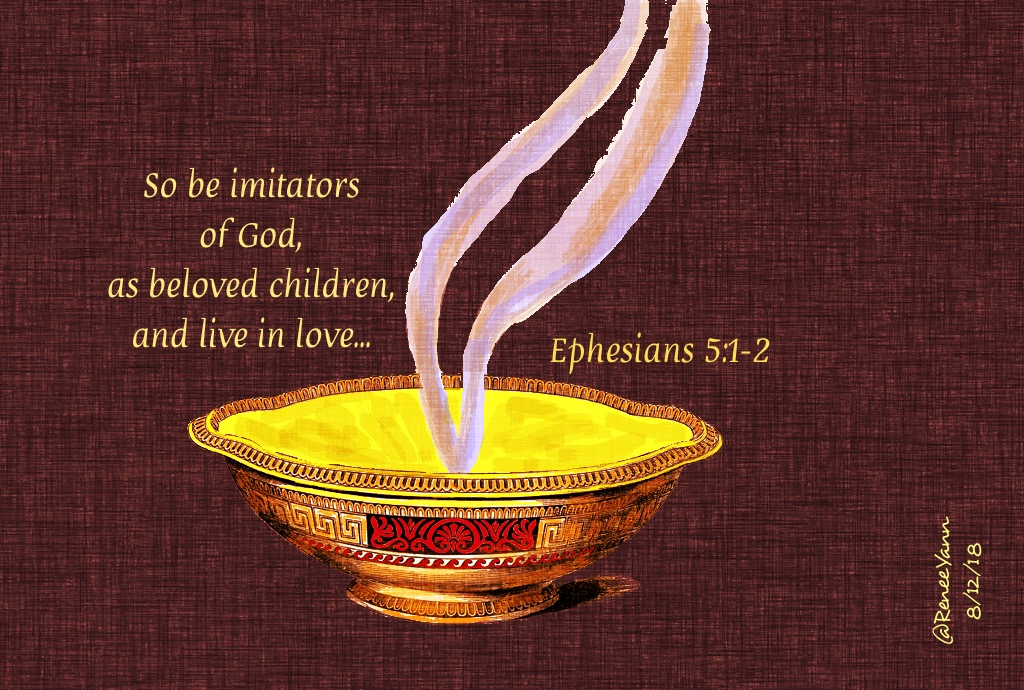
So be imitators of God, as beloved children,
and live in love,
as Christ loved us and handed himself over for us
as a sacrificial offering to God for a fragrant aroma.

We are so accustomed to hearing these astounding passages that we may miss how astounding they really are. But Macrina Wiederkehr says:

When Jesus’ words begin to sound naive to our 21st century minds, let us look through the words, in between the words, underneath for a deeper truth.

Pierre Teilhard de Chardin, the great Jesuit mystical theologian, upon reading these passages,saw the mystery of the Body of Christ. He saw our call to be the heart of Christ in the world. He saw Christ’s promise to become one with us in Eucharist. He saw that, through this Infinite Love played out in our ordinary lives, God continues to redeem Creation.

In each soul,
God loves and partly saves the whole world
which that soul sums up
in an incommunicable and particular way.
~ The Divine Milieu ~

Music: Quintessence – Spencer Brewer

May this lovely instrumental piece help take us to a deeply prayerful place as we contemplate God’s gift in Jesus.

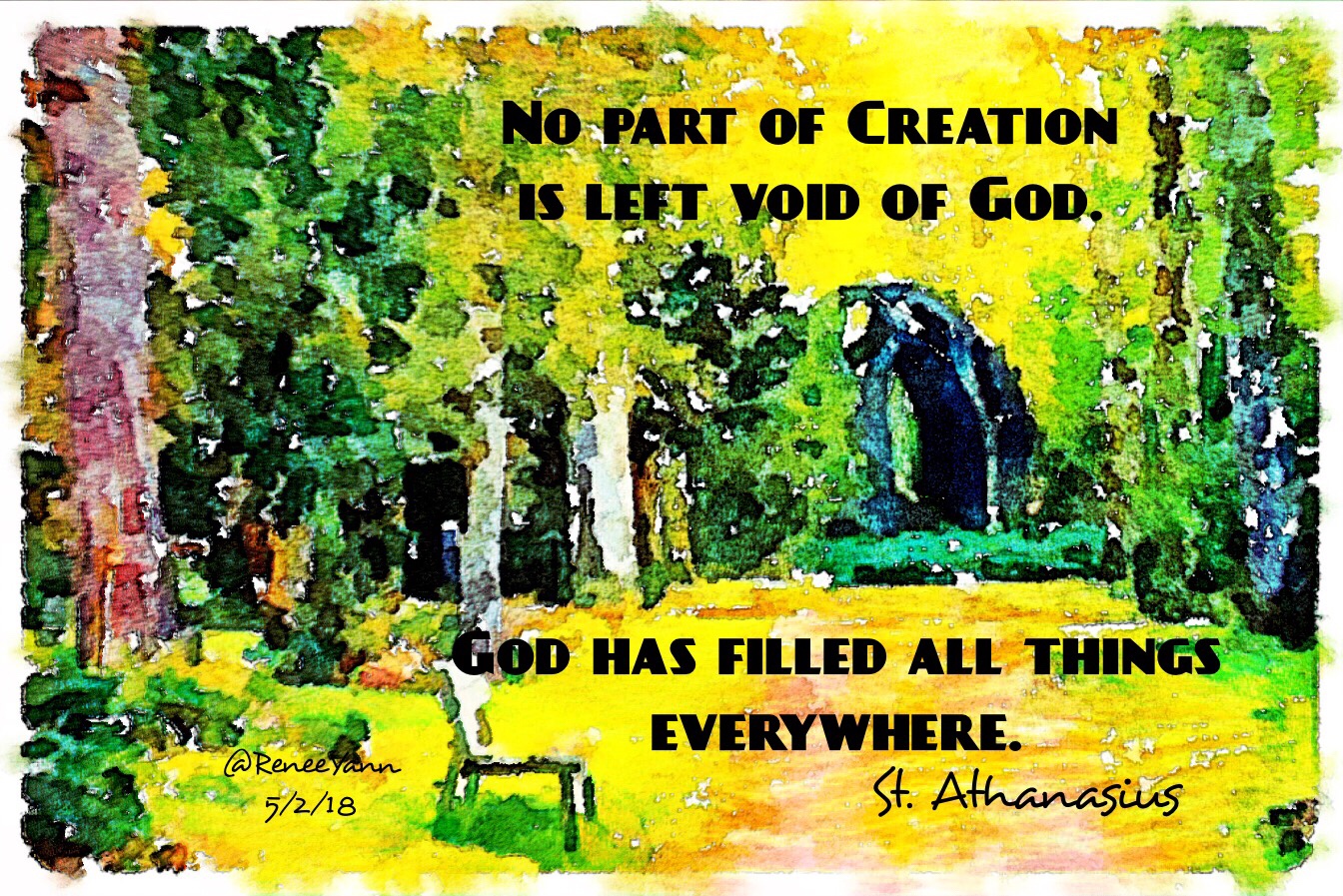
God Has Filled All Things Everywhere

Wednesday, May 2, 2018

Readings: http://www.usccb.org/bible/readings/050218.cfm

Today, in Mercy, we celebrate the feast of St. Athanasius who lived in 4th century Egypt. During his lifetime, the Church struggled with the heresy of Arianism which questioned whether Jesus was really God. Athanasius was named a Doctor of the Church for his steadfast defense of the doctrine of the divinity of Christ. Some of Athanasius’s writings are suggestive of the theology of our great modern theologians, and so necessary for our spirituality today.

The universe unfolds in God, who fills it completely. Hence, there is a mystical meaning to be found in a leaf, in a mountain trail, in a dewdrop, in a poor person’s face. The ideal is not only to pass from the exterior to the interior to discover the action of God in the soul, but also to discover God in all things. (Pope Francis-Laudato Sí, 84)

If we live at a distance from God, the universe remains neutral or hostile to us. But if believe in God, immediately all around us the elements, even the irksome, organize themselves into a friendly whole, ordered to the ultimate success of life. (Pierre deChardin, SJ – Christianity and Evolution)