The Lord God said to me: Son of man, eat what is before you; eat this scroll, then go, speak to the house of Israel. So I opened my mouth and he gave me the scroll to eat. Son of man, he then said to me, feed your belly and fill your stomach with this scroll I am giving you. I ate it, and it was as sweet as honey in my mouth. He said: Son of man, go now to the house of Israel, and speak my words to them. Ezekiel 3:1-3
The scroll represents the Word of God which we are all called to embrace by the faithful living of our lives. We cannot fully do so with only our mind and its analysis. When we do only that, the Word seems difficult and vexing.
Rather, we must consume the Word making it part of ourselves. It must become the sustenance without which we cannot live. When we do that, the Word becomes sweet and longed for.
Today, in God’s Lavish Mercy: We ask for a deep longing for God’s Word and the courage to fully embrace it by our faithful lives.
Poetry: Immersion – Denise Levertov
There is anger abroad in the world, a numb thunder,
because of God’s silence. But how naïve,
to keep wanting words we could speak ourselves,
English, Urdu, Tagalog, the French of Tours, the French of Haiti…
Yes, that was one way omnipotence chose
to address us—Hebrew, Aramaic, or whatever the patriarchs
chose in their turn to call what they heard. Moses
demanded the word, spoken and written. But perfect freedom
assured other ways of speech. God is surely
patiently trying to immerse us in a different language,
events of grace, horrifying scrolls of history
and the unearned retrieval of blessings lost for ever,
the poor grass returning after drought, timid, persistent.
God’s abstention is only from human dialects. The holy voice
utters its woe and glory in myriad musics, in signs and portents.
Our own words are for us to speak, a way to ask and to answer.
Alleluia, alleluia. You have but one Father in heaven; you have but one master, the Christ.
Today, in God’s Lavish Mercy, we come to our final reading from Ezekiel for this liturgical year. I think he is a challenging prophet to read with visions, images, and language that sometimes shock and astound.
But when we consider his circumstances of exile and captivity, we see more clearly how his own angst and suffering – as well as his people’s – spawned his compelling prophecies.
Ezekiel takes the Israelites through a curriculum common to many of the biblical prophets.
You people have been sinful so you’re in trouble.
Your persecutors and conquerors are also rotten sinners.
God is going to fix all of you one way or another.
Repent and your hope for restoration will be realized.
These themes are common to our lives too especially when we’re in spiritual discomfort like Ezekiel was.
We examine ourselves for what’s out of kilter.
We fixate on all the people and circumstances around us that are troubling us.
We finally acknowledge our responsibility for our situation and accept what we can and cannot change.
We reimagine a possible future and reclaim our hope
As with Ezekiel and his community, all this self-renewal happens only when we perceive, acknowledge and engage God’s loving will for us. Without that, we continue to live in spiritual exile from our true home in God.
Our Alleluia Verse and Gospel invite us to be fully at home in the Trinity just as they are at home in One Another.
Alleluia, alleluia. You have but one Father in heaven; you have but one master, the Christ.
Prayer of St. Elizabeth of the Trinity
Make my soul…
Your cherished dwelling place,
Your home of rest.
Let me never leave You there alone,
but keep me there
absorbed in You,
in living faith,
adoring You.
Music: Jesu Dulcis Memoria – written by St. Bernard of Clairvaux whose feast we celebrate today.
Jesu, dulcis memoria, dans vera cordis gaudia, sed super mel et omnia, eius dulcis praesentia.
JESU, the very thought of Thee, with sweetness fills my breast, but sweeter far Thy face to see, and in Thy presence rest.
Nil canitur suavius, nil auditur iucundius, nil cogitatur dulcius, quam Iesus Dei Filius.
Nor voice can sing, nor heart can frame, nor can the memory find a sweeter sound than Thy blest Name, o Savior of mankind!.
Iesu, spes paenitentibus, quam pius es petentibus! quam bonus te quaerentibus! sed quid invenientibus?
O hope of every contrite heart o joy of all the meek, to those who fall, how kind Thou art! how good to those who seek!
Nec lingua valet dicere, nec littera exprimere: expertus potest credere, quid sit Iesum diligere.
But what to those who find? Ah this nor tongue nor pen can show: the love of Jesus, what it is none but His loved ones know.
Sis, Iesu, nostrum gaudium, qui es futurus praemium: sit nostra in te gloria, per cuncta semper saecula. Amen.
Jesu, our only joy be Thou, As Thou our prize wilt be: Jesu, be Thou our glory now, And through eternity. Amen.
Alleluia, alleluia. The word of God is living and effective, able to discern the reflections and thoughts of the heart.
Today, in God’s Lavish Mercy, Ezekiel gets another tough assignment from God:
The word of the Lord came to me: Son of man, prophesy against the shepherds of Israel, in these words prophesy to them to the shepherds: Thus says the Lord GOD: Woe to the shepherds of Israel who have been pasturing themselves! Should not shepherds, rather, pasture sheep?
Ezekiel 34: 1-2
With prophetic insight, Ezekiel understands that Israel’s corrupt leaders will cause its downfall. He takes on the unhappy responsibility of summoning them – and the people – to repentance and conversion of heart.
By comparing Israel’s kings and princes to shepherds, Ezekiel points out how their leadership is a perversion of the ministry to which they have been called. He tells them that God won’t put up with their malfeasance because God has a tenderness for the “sheep” – particularly the struggling ones.
Thus says the Lord GOD: I swear I am coming against these shepherds. I will claim my sheep from them and put a stop to their shepherding my sheep so that they may no longer pasture themselves. I will save my sheep, that they may no longer be food for their mouths.
For thus says the Lord GOD: I myself will look after and tend my sheep.
Ezekiel 34: 10-11
The parallels to our present world are so stark that it’s difficult not to launch into political opining here! But I choose not to because the call within these readings goes much deeper than even current global circumstances.
And it is the call embodied in our Alleluia Verse:
Alleluia, alleluia. The word of God is living and effective, able to discern the reflections and thoughts of the heart.
Each one of us is created to live in the sincere light of God’s Word; to discern our relationships within Creation through the ‘living and effective” lens offered to us through our Baptism.
Whether we are leader or follower, these relationships must be built on reverence, honesty, justice, peace and mercy. Only then can we forestall the corporate corruptions that fester in the absence of grace.
The promissory nature of Ezekiel’s oracles articulates what good leadership looks like…in government, in corporations, all through the private sector. That rule consists in: – Seeking the lost – Bringing back the strayed – Binding up the injured – Strengthening the weak – Feeding the hungry In a word, good leadership consists in the restoration of the common good so that all members of the community, strong and weak, rich and poor, may live together in a common shalom of shared resources.
Walter Brueggemann, On Ezekiel 34
In our Gospel, the landowner refuses to be bound by corporate definitions regarding how he treats his laborers. He chooses to be generous, no doubt realizing the laborers’ underlying need for a decent day’s pay. Doing so, the landowner mirrors God whose generosity has granted the landowner life and livelihood.
As we pray today, let’s consider where we serve a leaders, and who depends on our sincere and generous heart for their subsistence. Some of these relationships might be obvious to us – such as the children in our lives, and others whom we support by our presence, care and love.
But others may not be so obvious. There may be others who need us to recognize that they’re waiting to be noticed and invited just like the late laborers of today’s Gospel. Is our world, and our generosity, big enough to include them?
Poetry: Shepherd – Rumi
Be a lamp, or a lifeboat, or a ladder. Help someone’s soul heal.
Alleluia, alleluia. Jesus Christ became poor although he was rich So that by his poverty you might become rich.
Today, in God’s Lavish Mercy, our readings confront us with a few spiritual cautions.
In our first reading, Ezekiel lets the Prince of Tyre know that he has really messed up his spiritual life:
Thus says the Lord GOD:
Because you are haughty of heart, you say, “A god am I! I occupy a godly throne in the heart of the sea!”— And yet you are a man, and not a god, however you may think yourself like a god.
This Tyrian prince Ithobalus reigned over a wealthy and politically powerful nation – a nation which had become arrogant and domineering in its relationship to other peoples. The word Ezekiel uses describes the condition perfectly: haughty. The prince was so haughty that he considered himself equal to — and in no need of — God.
We, of course, can learn a lesson from vainglorious Ithobalus. No material possession or personal strength makes us equal to God or renders us independent of God’s governance and care. According to Ezekiel, old Itho was about to find that out the hard way!
In our Gospel, Jesus talks about how we can get caught up in ourselves similarly to Ithobaal.
Jesus said to his disciples: “Amen, I say to you, it will be hard for one who is rich to enter the Kingdom of heaven. Again I say to you, it is easier for a camel to pass through the eye of a needle than for one who is rich to enter the Kingdom of God.”
When we read this passage, I think most of us picture material riches. And certainly the saying holds true in that case. But it also holds true for other types of “riches” – strengths or possessions that we use in arrogance and indifference toward others’ needs.
Prose: Pope Francis preached about such things in a homily on this passage from the prophet Amos:
Woe to the complacent in Zion, to those who feel secure … lying upon beds of ivory! . They eat, they drink, they sing, they play and they care nothing about other people’s troubles. (Am 6:1,4)
How does something like this happen? How do some people, perhaps ourselves included, end up becoming self-absorbed and finding security in material things which ultimately rob us of our face, our human face? This is what happens when we become complacent, when we no longer remember God. “Woe to the complacent in Zion”, says the prophet. If we don’t think about God, everything ends up flat, everything ends up being about “me” and my own comfort. Life, the world, other people, all of these become unreal, they no longer matter, everything boils down to one thing: having. When we no longer remember God, we too become unreal, we too become empty; like the rich man in the Gospel, we no longer have a face! Those who run after nothing become nothing – as another great prophet Jeremiah, observed (cf. Jer 2:5). We are made in God’s image and likeness, not the image and likeness of material objects, of idols!
Pope Francis – September 29, 2013
Music: Jesu, Joy of Our Desiring – J.S. Bach, interpreted by Daniel Kobialka
Today, in God’s Lavish Mercy, the core of our readings is about innocence and authenticity. But you have to dig a little to get to that. Maybe, like me, you finished our first reading asking, “So what’s with the green grapes!?”
A common expression in ancient Israel suggested that people’s bad luck was a punishment for their parent’s sins. It was a handy way of avoiding responsibility for one’s own foolish actions, often the actual source of one’s misfortune.
Ezekiel uses the expression to teach a lesson about the nature of God’s love and forgiveness. God loves us completely – without prejudice, without vengeance. There is no record of faults to “set our teeth on edge”. There are no “green grapes” on God’s table. God only wants our wholeness.
Therefore I will judge you, house of Israel, each one according to their own ways, says the Lord GOD. Turn and be converted from all your crimes, that they may be no cause of guilt for you. Cast away from you all the crimes you have committed, and make for yourselves a new heart and a new spirit.
God will not let us hide behind excuses like a bogus “Green Grapes Theory”. As in any loving relationship, we must be honest with God, own our faults, seek forgiveness, and love ardently.
Jesus uses the example of a little child to show us how to do this. Each one of us is born with a core of innocence and authenticity. These are the attributes of God’s life in us. Throughout our lives there are times when we hide these blessings under our sinfulness. Some people bury them so deep that they lose touch with their own sacred integrity.
Jesus calls us back out of our excuses and our excesses, just as the Lord called Ezekiel’s community. We are invited to an eternal covenant rooted in the gift of divine innocence and authenticity given to us at our creation.
Jesus said: Let the children come to me, and do not prevent them; for the Kingdom of heaven belongs to such as these.
Poetry: The Pursuit – Henry Vaughn
LORD ! what a busy, restless thing
Hast Thou made man !
Each day and hour he is on wing,
Rests not a span ;
Then having lost the sun and light,
By clouds surpris’d,
He keeps a commerce in the night
With air disguis’d.
Hadst Thou given to this active dust
A state untir’d,
The lost son had not left the husk,
Nor home desir’d.
That was Thy secret, and it is
Thy mercy too ;
For when all fails to bring to bliss,
Then this must do.
Ah, Lord ! and what a purchase will that be,
To take us sick, that sound would not take Thee !
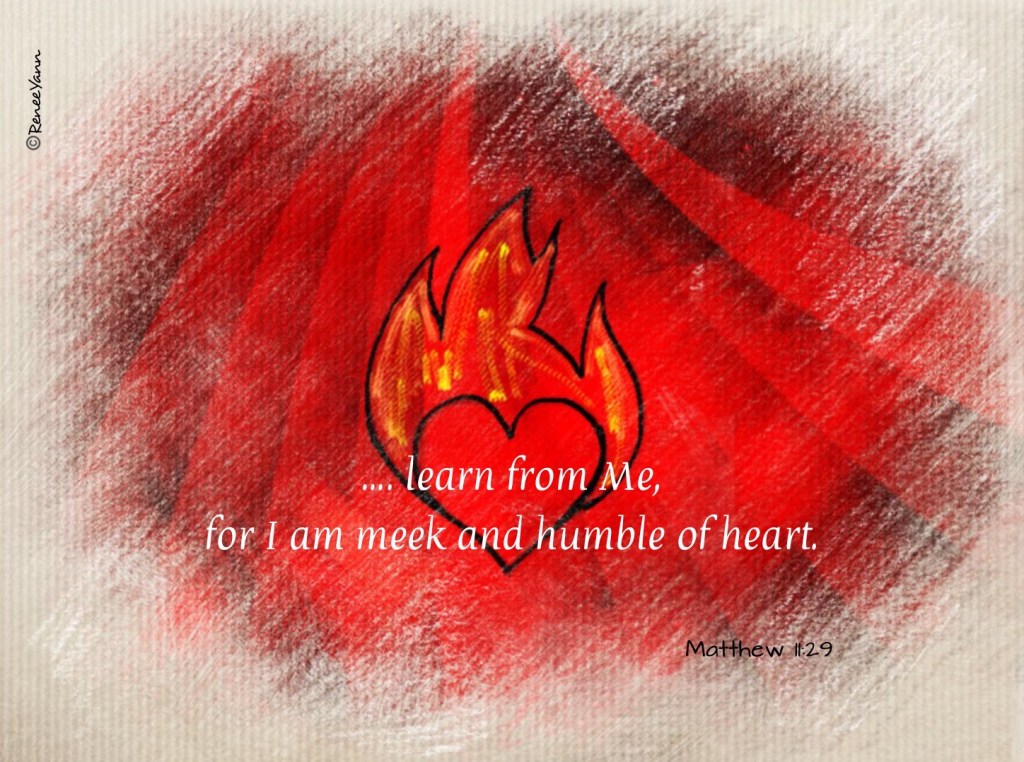
Alleluia, alleluia. Take my yoke upon you and learn from me, for I am meek and humble of heart.
Today, in God’s Lavish Mercy, our readings offer us key lessons about truth, simplicity and sacred obedience.
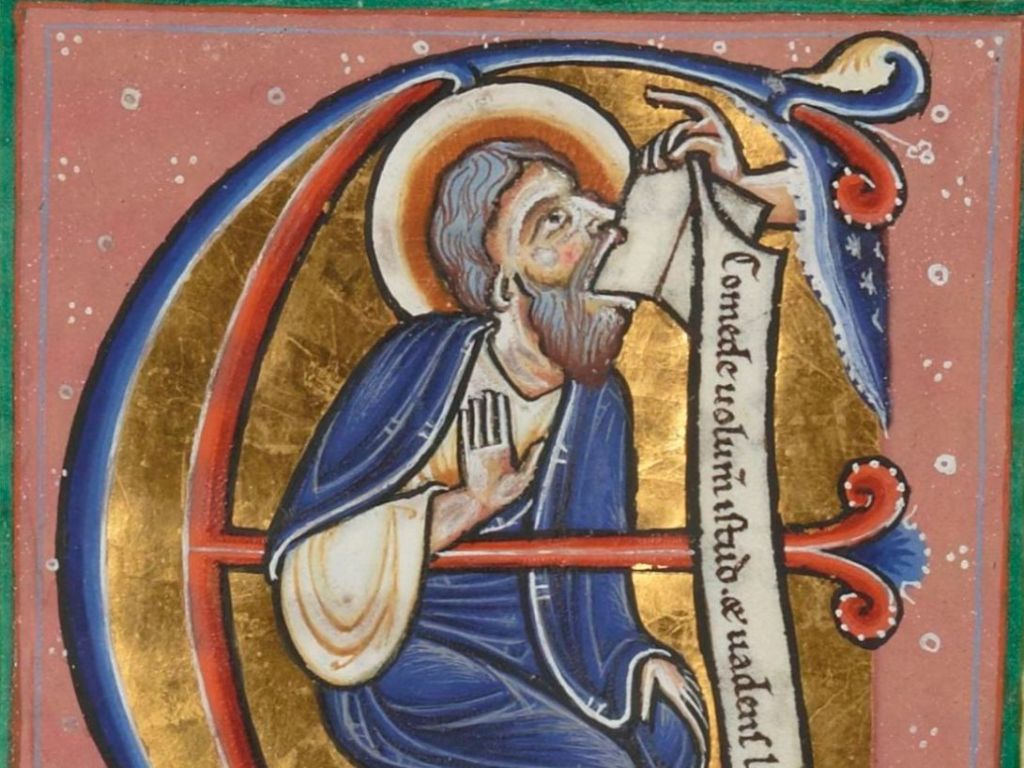
Let’s start with Ezekiel. In one of his technicolor visions, God tells him to eat a scroll inscribed with the scary words, “Lamentation and wailing and woe!” A little nightmarish, isn’t it. One might be tempted to tell God, “Thanks anyway, but I’ve already eaten!”
Source: gallica.bnf.fr Bibliothèque nationale de France, Département des manuscrits, Latin 16744, fol. 81r.
But Ezekiel listens and obeys, only to be surprised by the sweetness of the Word once consumed.
The Lord said to me: Creature of Earth, eat what is before you; eat this scroll, then go, speak to the house of Israel. So I opened my mouth and was given the scroll to eat. Creator of Earth, the Lord then said to me, feed your belly and fill your stomach with this scroll I am giving you. I ate it, and it was as sweet as honey in my mouth. The Lord said: Go now to the house of Israel, and speak my words to them.
Ezekiel 3:1-4
Our Responsorial Psalm expatiates on that sweetness. The psalmist too sees that the Word, once embraced, brings unexpected delight.
In our Gospel, Jesus centers his teaching on the innocence and simplicity of a child. A child’s openness, trust, and readiness to love show us how we should respond to God’s Word.
As we “grow up”, and our lives become complicated with the world’s expectations, the Word can be hard to swallow. It demands honesty in a culture that often manipulates with lies. It asks for selflessness in a world full of “me first”. It asks us to listen, in sacred obedience, for the whisper of grace in a cacophony of violence.
The truth of God’s Word is demanding. It doesn’t bend to worldly expectations. And, certainly, this can bring a certain “lamentation and wailing and woe” to the practitioner of God’s just and merciful message.
Jesus tells us to take up that challenge, to trust the Word, to consume the it and be consumed by it, just as little children are consumed by mystery, hope, and delight.
Amen, I say to you, unless you turn and become like children, you will not enter the Kingdom of heaven. Whoever becomes humble like this child is the greatest in the Kingdom of heaven.
Matthew 18:3-4
Poetry: Where Is God? – Mark Nepo
It’s as if what is unbreakable— the very pulse of life—waits for everything else to be torn away, and then in the bareness that only silence and suffering and great love can expose, it dares to speak through us and to us. It seems to say, if you want to last, hold on to nothing. If you want to know love, let in everything. If you want to feel the presence of everything, stop counting the things that break along the way.
Music: Word of God – Bernadette Farrell
Word of God, renew your people, make us now your living sign. Recreate us for your purpose in this place and in this time.
Word of hope and word of healing… Word of peace and word of justice … With your cross of love upon us … God alone the power we trust in … By our name you call us onward Cross of Jesus freely chosen Cross of Jesus, all-embracing … By your Cross, restored, forgiven… Through the Cross of Christ our Savior … To the waters lead your people … Risen Savior with us always … Holy Spirit, raise your people >>>
Alleluia, alleluia. God has called you through the Gospel to possess the glory of our Lord Jesus Christ.
by Michelangelo on the ceiling of the Sistine Chapel in the Vatican between 1508 to 1512
Today, in God’s Lavish Mercy, we begin nearly two weeks of first readings from the prophet Ezekiel, and this first one is a real WOW!
As I looked, a stormwind came from the North, a huge cloud with flashing fire enveloped in brightness, from the midst of which (the midst of the fire) something gleamed like electrum. Within it were figures resembling four living creatures that looked like this: their form was human.
Ezekiel 1:4-6
Walter Brueggemann calls Ezekiel “the prophet who had fantasies and hallucinations”. Nevertheless, Ezekiel is considered a prophet because like all prophets, Ezekiel “noticed what no one else noticed” — Ezekiel “saw death coming” to Israel.
Ezekiel did not blame the king, the government, the military or the war planners for this terrible death to come. He blamed the religious community, the clergy, the prophets: “My hands will be against the prophets who see delusive visions and give lying messages” (13:9). Ezekiel blamed the religious community because that community is responsible for truth-telling.
Truth-Telling and Peacemaking: A Reflection on Ezekiel by Walter Brueggemann
I think it might be safe to say that most religious communities – and the people who comprise them – do not want to hear such things about themselves. Abraham Heschel, one of the greatest theologians and philosophers of the 20th century said this:
The prophets had disdain for those to whom God was comfort and security; to them God was a challenge, an incessant demand. He is compassion, but not a compromise; justice, but not inclemency. Tranquility is unknown to the soul of a prophet. The miseries of the world give him no rest. While others are callous, and even callous to their callousness and unaware of their insensitivity, the prophets remain examples of supreme impatience with evil, distracted by neither might nor applause, by neither success nor beauty. Their intense sensitivity to right and wrong is due to their intense sensitivity to God’s concern for right and wrong. They feel fiercely because they hear deeply.
In today’s Gospel, Jesus informs his disciples that he too will endure a prophet’s suffering:
As Jesus and his disciples were gathering in Galilee, Jesus said to them, “The Son of Man is to be handed over to men, and they will kill him, and he will be raised on the third day.” And they were overwhelmed with grief.
Matthew 17:22-23
As we reflect on what these readings mean for us in our lives, our Alleluia Verse offers a key phrase:
Alleluia, alleluia. God has called you through the Gospel To possess the glory of our Lord Jesus Christ.
…through the Gospel
Unless we know and cherish the Gospel, we Christians cannot hear our call.
Poetry: The Call of a Christian – John Greenleaf Whittier
Not always as the whirlwind's rush
On Horeb's mount of fear,
Not always as the burning bush
To Midian's shepherd seer,
Nor as the awful voice which came
To Israel's prophet bards,
Nor as the tongues of cloven flame,
Nor gift of fearful words,--
Not always thus, with outward sign
Of fire or voice from Heaven,
The message of a truth divine,
The call of Godis given!
Awaking in the human heart
Love for the true and right,--
Zeal for the Christian's better part,
Strength for the Christian's fight.
Nor unto manhood's heart alone
The holy influence steals
Warm with a rapture not its own,
The heart of woman feels!
As she who by Samaria's wall
The Saviour's errand sought,--
As those who with the fervent Paul
And meek Aquila wrought:
Or those meek ones whose martyrdom
Rome's gathered grandeur saw
Or those who in their Alpine home
Braved the Crusader's war,
When the green Vaudois, trembling, heard,
Through all its vales of death,
The martyr's song of triumph poured
From woman's failing breath.
And gently, by a thousand things
Which o'er our spirits pass,
Like breezes o'er the harp's fine strings,
Or vapors o'er a glass,
Leaving their token strange and new
Of music or of shade,
The summons to the right and true
And merciful is made.
Oh, then, if gleams of truth and light
Flash o'er thy waiting mind,
Unfolding to thy mental sight
The wants of human-kind;
If, brooding over human grief,
The earnest wish is known
To soothe and gladden with relief
An anguish not thine own;
Though heralded with naught of fear,
Or outward sign or show;
Though only to the inward ear
It whispers soft and low;
Though dropping, as the manna fell,
Unseen, yet from above,
Noiseless as dew-fall, heed it well,---
Thy Father's call of love!
Today, in God’s Lavish Mercy, worlds are splitting apart, but the Word of God comes to heal them.
In our first reading, we share in the experience of the prophet Ezekiel.
Ezekiel and his wife lived during the Babylonian Captivity on banks of the Chenab River which is in modern day Iraq. He lived during the siege of Jerusalem in 589 BC. In Ezekiel’s day the northern kingdom had been conquered and destroyed 150 years earlier.
In other words, Ezekiel, like his contemporary Jeremiah, had his heart torn apart along with the homeland they cherished as God’s promise to them.
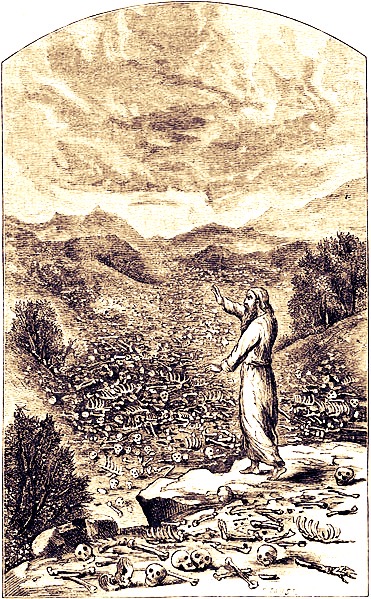
The Valley of the Dry Bones – artist unknown
In today’s reading, which comes immediately after his vision of the Dry Bones, Ezekiel prophesies a message of hope and restoration to a fragmented and devastated nation.
In our Gospel, Jesus is the new Ezekiel. He stands in the midst of the bigger “nation” of all God’s Creation which has been fragmented by the failure to love. Like Ezekiel, Jesus offers a message of hope and restoration to sinners.
In this Gospel, Jesus himself is the “Temple” about to destroyed. The prophecy of its destruction is unwittingly delivered by the high priest Caiaphas:
Caiaphas, who was high priest that year, said to the Pharisees and Sanhedrin, “You know nothing, nor do you consider that it is better for you that one man should die instead of the people, so that the whole nation may not perish.” He did not say this on his own, but since he was high priest for that year, he prophesied that Jesus was going to die for the nation, and not only for the nation, but also to gather into one the dispersed children of God.
John 11: 49-52
Within Christ’s new law of love, these “children of God” go far beyond the Jewish nation. They are you and me, and every other creature with whom we share this time and universe. The fragmentations which separate and alienate us are dissolved in the Passion, Death and Resurrection of Jesus Christ.
Holy Week will begin tomorrow when all believers will intensify their desire to join Christ in his final journey to Resurrection, to understand our own lives anew in the power of Paschal Grace.
Let’s pray for one another, dear friends, for the grace we need to be deepened in the life of Jesus, and for that deepening to bless and heal our suffering world.
Poetry: The New Ezekiel – Emma Lazarus
What, can these dead bones live, whose sap is dried By twenty scorching centuries of wrong? Is this the House of Israel, whose pride Is as a tale that’s told, an ancient song? Are these ignoble relics all that live Of psalmist, priest, and prophet? Can the breath Of very heaven bid these bones revive, Open the graves and clothe the ribs of death?
Yea, Prophesy, the Lord hath said. Again Say to the wind, Come forth and breathe afresh, Even that they may live upon these slain, And bone to bone shall leap, and flesh to flesh. The Spirit is not dead, proclaim the word, Where lay dead bones, a host of armed men stand! I ope your graves, my people, saith the Lord, And I shall place you living in your land.
Music: Make Us One – featuring James Loynes. Written by Sally DeFord (Lyrics below)
Lyrics
How shall we stand amid uncertainty? Where is our comfort in travail? How shall we walk amid infirmity, When feeble limbs are worn and frail? And as we pass through mortal sorrow, How shall our hearts abide the day? Where is the strength the soul may borrow? Teach us thy way.
Chorus: Make us one, that our burdens may be light Make us one as we seek eternal life Unite our hands to serve thy children well Unite us in obedience to thy will. Make us one! teach us, Lord, to be Of one faith, of one heart One in thee. Then shall our souls be filled with charity, Then shall all hate and anger cease And though we strive amid adversity, Yet shall we find thy perfect peace So shall we stand despite our weakness, So shall our strength be strength enough We bring our hearts to thee in meekness; Lord, wilt thou bind them in thy love?
(Repeat chorus)
Take from me this heart of stone, And make it flesh even as thine own Take from me unfeeling pride; Teach me compassion; cast my fear aside. Give us one heart, give us one mind Lord, make us thine Oh, make us thine! (Repeat chorus)
Today, in God’s Mercy, our readings describe a deep and hidden stream revealed by God –
first to Ezechiel …
The Vision of Ezechiel by Rafael
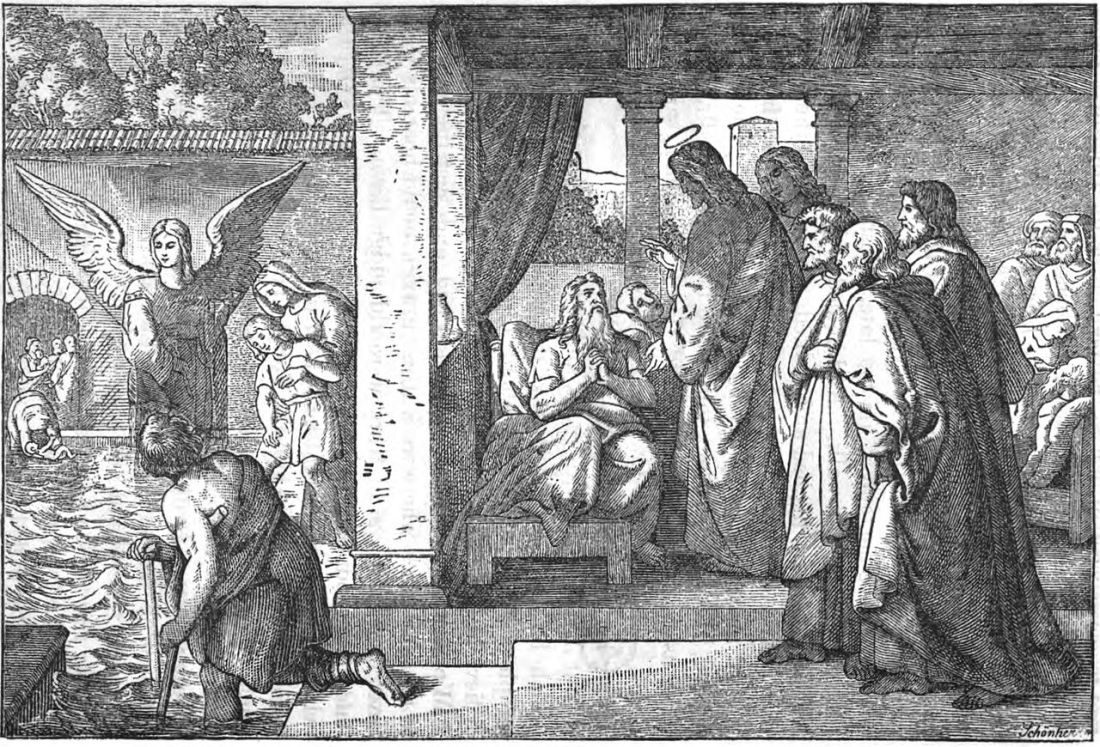
then to a long-paralyzed man …
The pool of Bethesda, by Schönherr.
So many stories in Scripture are laced with the same theme: there is a infinite mystery hidden under the surface of life:
Keep searching. Keep searching.
The precious pearl that awaits discovery.
The lost coin that must be found.
The mustard seed buried in circumstance.
The stream running deep under appearances.
We might be tempted to dismiss our first reading from Ezechiel as over-described allegory. But its rendition of the slow, steady deepening, through which God leads the prophet, offers us an apt image to reflect on our own graced journey.
Hasn’t God led us gently to the faith we have today? Like young children learning to ride the ocean breakers, we have been taught by a patient God Who returns in every tide to take us deeper into our next capacity for grace.
For thirty-eight years, the man in today’s Gospel has been paralyzed by the water’s edge. Maybe we know how he feels.
He believes that his life is beyond transformation. He cannot dive under the surface of his circumstances to find the quickening waters.
Jesus gives him the key to unlock his paralysis. In a short phrase, Jesus offers the man a multilayered question:
What do you really want in your deepest heart?
When you find the answer, break through all that has kept you from that deepest desire.
Step with Me through the next wave, and the next until, finally, we swim together in the great ocean of covenanted trust.
As our Responsorial Psalm-poem promises:
God is our refuge and our strength, an ever-present help in distress. Therefore we fear not, though the earth be shaken and mountains plunge into the depths of the sea.
There is a stream whose runlets gladden the city of God, the holy dwelling of the Most High. God is in its midst; it shall not be disturbed; God will help it at the break of dawn.
Music: I Am – Marty Goetz (Lyrics below)
Come, behold the works of the Lord How He has wrought the desolation How He has brought His early help The Lord of Hosts is with us The God of Jacob is our refuge When the nations rage and all the kingdoms fall He says I Am, I Am, I Am all
And there’s a river whose streams make glad the city of God They flow to His Holy habitation They flow to the home of the Most High The Lord of Hosts is with us The God of Jacob is our refuge He breaks the bow, he shatters the spear And says I Am, I Am, I Am here!
So we will not fear Though the worlds should change Though the waters roar Though the mountains shake and tremble For He’s a present help in trouble, in trouble
Be still and know that I am God I Am exalted in the nations I Am exalted in the earth The Lord of Hosts is with us The God of Jacob is our refuge To the ends of the earth He causes wars to cease and says I Am, I Am, I Am peace He says I Am, I Am, I Am peace
Today, in God’s Lavish Mercy, we pray once again with Deuteronomy 32, the Psalm of Moses. Today’s verses describe an angry God who decides to take vengeance a faithless people.
To pray with these verses is not easy. Taken in isolation, they paint a God who contradicts our larger experience of mercy and tenderness. But the Psalm, like the jarring first reading from Ezekiel, has a lesson for us.
Ezekiel from Biblical Images by James Padgett
In that reading, Ezekiel suffers the sudden death of his beloved wife. The experience opens his prophetic spirit to more fully understand God’s relationship with Israel. He allows his life to be a witness for the people that God expects their repentance and faithfulness.
Like many Old Testament readings, these portray God by way of human analogy because that is the only context we have available to us. Therefore, the temptation when reading these passages might be to think of God solely in human terms playing tit-for-tat with us when we stray from the Law. But God is infinitely greater than any capacity we, or the scripture writers, have to describe Divinity.
The narrative provided by this prophetic book is not one of comfort; its merciless accusations and its violent imagery do not make it an easy scroll to swallow (Ezek 2:8–3:3). While much of Ezekiel’s language, imagery, and reasoning will appear foreign to modern readers, his narrative would have been clearly intelligible to his contemporaries—even though presumably it would have been hard to accept. The exile, according to this narrative, is both inevitable and deserved; it is portrayed as God’s judgement for the constant and complete failure of God’s people.
At the same time, it is not God’s last word. While resisting both optimism and despair, Ezekiel offers a narrative that sheds light on his present and arrives at an original, if peculiar, imagination of hope, founded solely on theological conviction.
Janina M. Hiebel – Hope in Exile: In Conversation with Ezekiel
So then, what might we take from today’s dark readings? For me, it is this:
God is always Light. It is we who get caught in darkness.
God does speak to us in our circumstances, as God did to Ezekiel and Moses. By faithful prayer and sincere desire, we can deepen in our love and understanding of God through every experience of our lives, even the painful ones. When we live with that kind of faith and hope, our lives witness to God’s fidelity and love.
Poetry: two offerings today
Motto – Bertold Brecht
In the dark times
Will there also be singing?
Yes, there will also be singing.
About the dark times.
Light – Alice Jones
The morning when I first notice
the leaves starting to color,
early orange, and back-lit,
I think how rapture doesn't
vanish, merely fades into
the background, waits for those
moment between moments.

I think this and the door pens,
the street takes on its glistening
look, Bay fog lifting, patches of sun
on sycamore -- yellow sea.
I am in again, and swimming.













 Lavish Mercy